Nikon Monarch M5 8x42 Review: Specs, Strengths and Who It Suits
Nikon Monarch M5 8x42 review: ED glass and 19.5 mm eye relief make it a sharp, glasses-friendly birding binocular, but its 335 ft field of view is narrow.
If you buy through links on this page we may earn a commission, at no cost to you. It never decides what we recommend. How we earn
In this article
- Quick answer: is the Monarch M5 8x42 worth it?
- How we evaluated the Monarch M5
- Nikon Monarch M5 8x42 specs
- What the specs mean for birders
- Strengths of the Nikon Monarch M5 8x42
- Drawbacks, based on expert reviews and owner patterns
- What owners commonly report
- How the Monarch M5 handles common backyard situations
- Caring for the Monarch M5
- Who the Monarch M5 8x42 suits
- Monarch M5 8x42 vs the alternatives
- Is 8x42 the right size in the Monarch M5 line?
- How to get the best view from the Monarch M5
- Common mistakes when buying the Monarch M5
- The verdict
- Sources
- Alternatives worth a look
- Frequently asked questions
The short verdict of this Nikon Monarch M5 8x42 review: it is a sharp, bright, glasses-friendly binocular with one clear weakness. On paper it offers ED glass, dielectric prism coatings and a generous 19.5 mm of eye relief at a mid-range price, and the Cornell Lab named it a top pick for image quality. The trade-off is a narrow 335 ft field of view, which makes it harder to follow birds that move fast.
Quick answer: is the Monarch M5 8x42 worth it?
- Buy it if you wear glasses and need more eye relief than most 8x42s offer.
- Buy it if you care most about seeing fine plumage detail on birds that sit still: sparrows in a brush pile, ducks on a pond, a woodpecker on a trunk.
- Skip it if you mostly track warblers and kinglets in busy foliage. A wider view, like the Vortex Diamondback HD 8x42, is easier to use.
- Skip it if you want to focus on birds at a feeder closer than about 8 ft.
How we evaluated the Monarch M5
We have not physically tested this binocular. This is a research-based review. We compared Nikon’s published specifications with rival 8x42 models, read independent reviews from the Cornell Lab of Ornithology and OutdoorGearLab, and looked for consistent patterns across verified owner reviews at large retailers. When independent measurements differed from Nikon’s specs, we note both.
Nikon Monarch M5 8x42 specs
Figures come from Nikon USA and Nikon’s global product pages.
| Spec | Nikon Monarch M5 8x42 |
|---|---|
| Magnification | 8x |
| Objective lens | 42 mm |
| Field of view | 335 ft at 1,000 yd (6.4 degrees real) |
| Apparent field of view | 48.2 degrees |
| Close focus | 8.2 ft |
| Eye relief | 19.5 mm |
| Exit pupil | 5.3 mm |
| Interpupillary distance | 56 to 72 mm |
| Weight | 22.2 oz |
| Dimensions | 5.7 x 5.1 in |
| Glass | ED (extra-low dispersion) |
| Prism | Roof, dielectric high-reflective coating, phase-correction coating |
| Lens coatings | Multilayer coated on all surfaces |
| Waterproofing | 3.3 ft for 10 minutes, nitrogen filled |
| Body | Fiberglass-reinforced polycarbonate, rubber armored |
| Eyecups | Turn-and-slide, multi-click |
Need a refresher on these terms? Our binocular numbers explainer covers each one.
What the specs mean for birders
ED glass: why the Monarch M5 looks sharp
ED stands for extra-low dispersion. Ordinary glass bends different colors of light by slightly different amounts, which shows up as purple or green fringes around a dark bird against bright sky. ED elements reduce that. Combined with dielectric prism coatings (which reflect nearly all light inside the prism) and phase correction (which keeps contrast crisp in roof prisms), the result on paper is a clean, contrasty image.
That matches what reviewers found. The Cornell Lab called the image very sharp and bright and highlighted how well it showed subtle plumage patterns on sparrows. OutdoorGearLab described clarity as good for the price, with slight fringing only at the edges. For more on whether this glass matters to you, read is ED glass worth it in binoculars.

The 335 ft field of view is the main drawback
Field of view tells you how wide a slice of the world you see. At 335 ft at 1,000 yards (6.4 degrees), the Monarch M5 is narrower than most 8x42 rivals. The Vortex Diamondback HD shows 393 ft, the Celestron Nature DX 388 ft and Nikon’s own Monarch M7 435 ft.
The Cornell Lab described the M5’s field as substantially narrower than other top picks, creating a tunnel-vision feel that makes it harder to track birds. OutdoorGearLab’s fence-board count put it below the group average. In a backyard with slow feeder birds this matters little. In a spring migrant trap full of flitting warblers, it matters a lot.
19.5 mm eye relief suits eyeglass wearers
Eye relief is how far behind the eyepiece your eye can be while still seeing the full image. Glasses push your eye back, so wearers need more of it. Many mid-price 8x42s offer around 17 mm. The M5’s 19.5 mm gives more margin, and its turn-and-slide eyecups click into several positions. This is the single strongest reason to choose it over wider rivals. Our list of the best binoculars for glasses wearers compares it with other long-eye-relief models.
Close focus: 8.2 ft on paper, closer in some tests
Nikon lists 8.2 ft. The Cornell Lab used that figure. OutdoorGearLab measured its sample focusing at about 6.2 ft, well inside the spec. Units may vary, so plan around 8.2 ft. That is fine for most yard viewing but longer than the Diamondback HD’s 5 ft, which matters if your feeder is close to where you sit.
Strengths of the Nikon Monarch M5 8x42
Detail and color
The consistent message from expert reviews is sharpness in the center of the view. For the kind of birding where you study a bird for several seconds, sorting a Song Sparrow from a Lincoln’s Sparrow or picking out the red nape of a Red-bellied Woodpecker, that detail is useful. Owners frequently mention natural color rendering.
Bright image for dawn and dusk
With a 5.3 mm exit pupil and dielectric coatings, it is bright for its class. OutdoorGearLab’s light-meter reading was among the higher results in its group, and reviewers note good performance at dawn and on overcast days. That matters because bird activity often peaks in the first hours after sunrise, when light is lowest.
Comfortable, well-built body
The Cornell Lab described it as sturdy, light and ergonomic. OutdoorGearLab praised the soft, pressure-spreading eyecups and grippy rubber. The focus knob was described as solid yet smooth, allowing quick and precise adjustments. The body is fiberglass-reinforced polycarbonate, which keeps weight down.
Weather sealing
Nikon rates it waterproof to 3.3 ft for 10 minutes, nitrogen filled with O-ring seals. Rain, dew and fog on cold mornings are not a concern.
Drawbacks, based on expert reviews and owner patterns
Tunnel vision on active birds
This is covered above but worth repeating, since it is the one issue that shows up across nearly every independent review. If your birding is mostly fast warblers, flycatchers or kinglets, a wider binocular will serve you better.

Balance and weight in small hands
Nikon lists 22.2 oz. OutdoorGearLab weighed its sample, likely with accessories, at 23.7 oz and felt the balance could be better for smaller hands. The Cornell Lab still rated it lighter than average for its class, so this is a matter of feel rather than a heavy binocular.
Diopter and accessories
OutdoorGearLab found the diopter knob small and stiff with no lock, and the neoprene strap scratchy. These are small issues, and a replacement strap or harness is inexpensive. If you plan to carry it for long walks, a chest harness spreads the weight and keeps the binocular from swinging.
Close focus is not a strength
At 8.2 ft on paper, it will not focus on a bird at a window feeder a few feet away. For close viewing through glass, other models are better.
What owners commonly report
Reading across verified owner reviews at large retailers, a few patterns repeat. None of these are measurements, but they line up with what the expert reviews found.
- Image quality for the money is the most frequent point of praise. Many owners who stepped up from budget binoculars describe the difference in sharpness and color as obvious.
- Glasses comfort comes up often among owners who wear eyeglasses, with many saying they can see the full view with the eyecups down.
- Field of view is the most common complaint, usually from owners who compared it side by side with a wider model.
- Build and feel get consistent positive comments, with the rubber armor and focus action described as solid.
- The included strap and case draw mixed comments. Owners who carry it for hours often replace the strap.
How the Monarch M5 handles common backyard situations
Specs only matter in context. Here is how the M5’s numbers translate to typical situations at home and nearby, based on its published specs and reviewer findings.
Birds at a feeder 10 to 30 ft away
This is well inside the M5’s comfort zone. Birds at a feeder tend to sit for several seconds, so the narrow field is not a handicap. The sharp center and good color help with details like the buffy flanks of a Tufted Titmouse or the fine streaking on a female House Finch. If your feeder sits closer than about 8 ft, check that you can focus on it before committing.
Birds moving through leafy trees
This is where the M5 is weakest. Small birds in spring foliage move every second or two, and a narrower field means they leave the view more often. Many birders manage by finding the bird with the naked eye first and raising the binocular to it without looking away, which becomes second nature with practice.
Hawks, ducks and distant birds
For birds at 100 yards or more, detail and brightness matter more than width. The M5’s sharp center and ED glass suit perched raptors, waterfowl on a pond and shorebirds on a mudflat. At these distances, an 8x binocular shows less detail than a 10x, but the image is steadier in the hand.
Low light at dawn and dusk
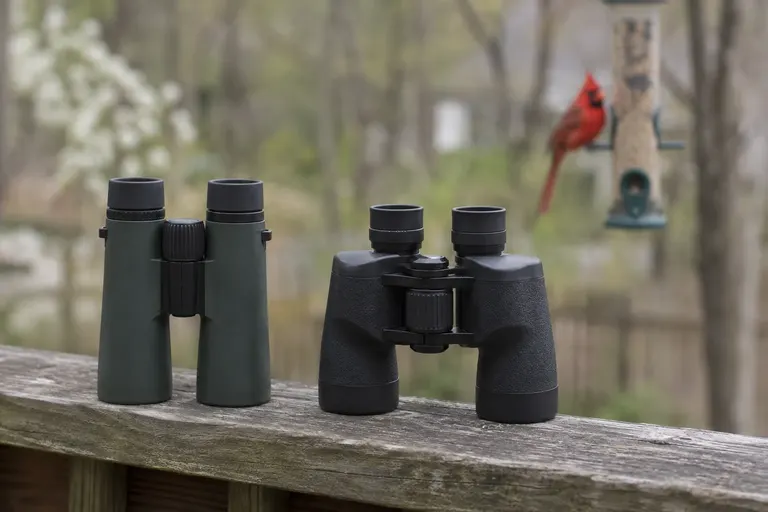
With a 5.3 mm exit pupil and dielectric prism coatings, the M5 should hold up well in the first and last light of the day. Reviewers noted good results in dim and overcast conditions.
Caring for the Monarch M5
A few simple habits keep any binocular performing.
- Blow or brush off grit first. Wiping a dusty lens with a cloth can drag particles across the coatings.
- Clean with lens cleaner and a microfiber cloth, working in a spiral from the center out.
- Let it dry in open air after rain before putting it back in the case. The body is sealed, but moisture trapped in a closed case can encourage mildew on the exterior.
- Keep the rainguard on when carrying it in wet weather.
- Store it away from extreme heat, such as a car dashboard in summer.
Who the Monarch M5 8x42 suits
Eyeglass wearers
If you have tried binoculars and seen a shrunken, vignetted view with your glasses on, eye relief is usually the cause. The M5’s 19.5 mm addresses that directly.
Patient birders and pond watchers
Shorebirds, waterfowl, raptors on poles and birds at feeders sit still long enough that a narrower view does not hurt. The M5’s detail shines here.
Birders who want a quality upgrade from an entry-level pair
If you are coming from a basic porro prism or a budget roof prism, ED glass and dielectric coatings are a real step up. Our guide on how to choose binoculars without overpaying explains where the money goes.
Who should skip it
- Warbler chasers who need a wide view to track movement.
- Window watchers who need close focus under 8 ft.
- Anyone who prioritizes warranty terms, since Vortex’s unconditional coverage is broader. Check Nikon’s current US warranty terms before buying.
Monarch M5 8x42 vs the alternatives
| Model | Field of view (ft at 1,000 yd) | Eye relief | Close focus | Weight | ED glass |
|---|---|---|---|---|---|
| Nikon Monarch M5 8x42 | 335 | 19.5 mm | 8.2 ft | 22.2 oz | Yes |
| Vortex Diamondback HD 8x42 | 393 | 17 mm | 5.0 ft | 21.8 oz | Not listed |
| Nikon Monarch M7 8x42 | 435 | 17.1 mm | 8.2 ft | 23.6 oz | Yes |
| Nikon Prostaff P3 8x42 | 377 | 20.2 mm | 9.8 ft | 20.3 oz | Not listed |
| Celestron Nature DX 8x42 | 388 | 17.5 mm | 6.5 ft | 22.2 oz | No |
All figures from manufacturer product pages.
Monarch M5 vs Vortex Diamondback HD
These two are the most compared mid-price 8x42s. The Nikon wins on eye relief and, according to reviewers, color control. The Vortex wins on field of view (393 versus 335 ft), close focus (5 versus 8.2 ft) and warranty breadth. For a typical backyard birder without thick glasses, the Vortex is easier to live with. For glasses wearers and detail seekers, the Nikon.
Monarch M5 vs Monarch M7
The M7 is Nikon’s step up. Its 435 ft field is one of the widest in any 8x42, which fixes the M5’s main flaw. The cost is shorter eye relief (17.1 mm), slightly more weight (23.6 oz) and a higher price. If you do not wear glasses, the M7 is the better birding tool. If you do, the M5’s eye relief may matter more.
Monarch M5 vs Nikon Prostaff P3
The Prostaff P3 is Nikon’s lower-priced 8x42. It is lighter (20.3 oz), has even longer eye relief (20.2 mm) and a wider 377 ft field. Nikon does not list ED glass for it, and its 9.8 ft close focus is long. It is a good budget pick for glasses wearers; see our list of binoculars under $200.
Is 8x42 the right size in the Monarch M5 line?
The M5 also comes in 10x42 and 12x42. For most birding, 8x42 is the best balance: a steadier image, a brighter exit pupil and more field of view. Since field of view is already the M5’s weak spot, stepping up to 10x narrows it further. Our comparison of 8x42 vs 10x42 explains when higher power pays off.
How to get the best view from the Monarch M5
- Glasses on: turn the eyecups fully down. Glasses off: turn them up to the highest click that shows a full circle without dark crescents.
- Set the hinge so the two circles merge into one.
- Focus with the left eye using the center wheel on a still target.
- Set the diopter under the right eyecup with the right eye only. Because the knob has no lock, check it at the start of each outing.
- Scan wide, then raise. Because the field is narrow, keep your eyes on the bird and bring the binocular up to your line of sight rather than searching through the eyepieces.
Common mistakes when buying the Monarch M5
- Confusing it with the older Monarch 5. The earlier Monarch 5 8x42 is a different model. The current version is the Monarch M5 (Nikon product number 16767).
- Choosing 10x or 12x for birding. It narrows an already narrow field.
- Ignoring close focus. If your feeder is 6 ft from your chair, this is not the right binocular.
- Not checking the diopter each trip. It can drift without a lock.
The verdict
The Nikon Monarch M5 8x42 is a strong optical performer for the money, with ED glass, bright coatings and the kind of eye relief that makes binoculars usable for people who wear glasses. Its narrow 335 ft field of view is a genuine limitation for fast-moving birds, and its close focus is ordinary. If you wear glasses or prefer to study birds at leisure, it is an excellent choice. If you want a wider, easier view, the Vortex Diamondback HD or Nikon’s own Monarch M7 are better fits. See how it compares with the full field in the best binoculars for birding.
Sources
- Nikon USA: Monarch M5 8x42 product page and specifications
- Nikon Imaging: Monarch M5 8x42, 10x42, 12x42 features and specifications
- Cornell Lab of Ornithology, All About Birds: Nikon Monarch M5 8x42 Binoculars review
- OutdoorGearLab: Nikon Monarch M5 8x42 review
- Nikon USA: Monarch M7 8x42 specifications
- Nikon USA: Prostaff P3 8x42 specifications
Alternatives worth a look
Nikon Monarch M5 8x42
ED glass, dielectric and phase-corrected prisms, and 19.5 mm eye relief in a 22.2 oz body.
- Best for
- Glasses wearers and detail-focused birders.
- Skip it if
- A wide field of view matters most to you.
- Field of view
- 335 ft at 1,000 yd
- Eye relief
- 19.5 mm
- Close focus
- 8.2 ft
- Weight
- 22.2 oz
Vortex Diamondback HD 8x42
A much wider 393 ft field and 5 ft close focus, with an unconditional lifetime warranty.
- Best for
- Backyard birders who want an easy, wide view.
- Skip it if
- You wear thick glasses.
- Field of view
- 393 ft at 1,000 yd
- Close focus
- 5.0 ft
- Eye relief
- 17 mm
Nikon Monarch M7 8x42
Nikon's next tier keeps ED glass and widens the view to 435 ft, at the cost of shorter eye relief.
- Best for
- Birders who like Nikon glass but want a far wider view.
- Skip it if
- You need the M5's longer eye relief for glasses.
- Field of view
- 435 ft at 1,000 yd
- Eye relief
- 17.1 mm
- Weight
- 23.6 oz



Frequently asked questions
Is the Nikon Monarch M5 8x42 good for birding?
Yes, with one trade-off. Its ED glass, dielectric prism coatings and phase correction give a sharp, bright image that the Cornell Lab named a top pick. The catch is a narrow 335 ft field of view at 1,000 yards, which makes it harder to follow fast birds. For slower birds, detail and glasses comfort, it is a strong choice.
Does the Nikon Monarch M5 have ED glass?
Yes. Nikon lists extra-low dispersion (ED) glass in the Monarch M5 to reduce chromatic aberration, the color fringing seen around dark birds against bright sky. It also uses dielectric high-reflective prism coatings and phase-correction coatings. Independent reviewers still noticed slight fringing at the very edge of the view, but control of color is one of its strengths at this price.
Is the Monarch M5 good for people who wear glasses?
It is one of the better options in its class. Nikon lists 19.5 mm of eye relief, several millimeters more than many rivals, and turn-and-slide rubber eyecups with multiple click stops. That extra distance lets many eyeglass wearers see the full field with the eyecups turned down. People with very thick lenses should still check the fit on arrival.
What is the difference between the Monarch M5 and Monarch M7?
The Monarch M7 8x42 has a much wider 435 ft field of view versus 335 ft on the M5. The M7 is heavier at 23.6 oz and has shorter eye relief at 17.1 mm versus 19.5 mm. Both use ED glass and list the same 8.2 ft close focus. The M7 costs more.
Is the Monarch M5 waterproof?
Yes. Nikon rates the Monarch M5 waterproof to 1 meter (3.3 ft) for 10 minutes, with nitrogen gas filling and O-ring seals to prevent internal fogging. That covers rain, splashes and a quick drop into shallow water. The body is fiberglass-reinforced polycarbonate with rubber armor for grip and shock protection.