Vortex Diamondback HD 8x42 Review: Specs, Strengths and Who It Suits
Vortex Diamondback HD 8x42 review: a wide 393 ft field, 5 ft close focus and an unconditional warranty make it a strong mid-price birding binocular.
If you buy through links on this page we may earn a commission, at no cost to you. It never decides what we recommend. How we earn
In this article
- Quick answer: should you buy the Diamondback HD 8x42?
- How we evaluated the Diamondback HD
- Vortex Diamondback HD 8x42 specs
- What the specs mean for birding
- Strengths of the Vortex Diamondback HD 8x42
- Drawbacks, based on expert reviews and owner patterns
- Who the Diamondback HD 8x42 suits
- Diamondback HD 8x42 vs the alternatives
- Is 8x42 or 10x42 better in the Diamondback HD line?
- How to set up the Diamondback HD for a sharp view
- Common mistakes when buying the Diamondback HD
- The verdict
- Sources
- Alternatives worth a look
- Frequently asked questions
The Vortex Diamondback HD 8x42 is the mid-price binocular we would point most backyard birders toward first. On paper it pairs one of the widest fields of view in its class (393 ft at 1,000 yards) with a 5 ft close focus and Vortex’s unconditional lifetime warranty. Its weak spots are real but modest: some color fringing on backlit birds, 17 mm of eye relief that is only adequate for thick glasses, and a focus wheel that reviewers describe differently.
Quick answer: should you buy the Diamondback HD 8x42?
- Buy it if you want one pair of binoculars for the yard, local parks and trips, and you value an easy, wide view that helps you find birds quickly.
- Buy it if you want a warranty that covers accidents, not only manufacturing defects.
- Skip it if you wear thick eyeglasses and need 19 mm or more of eye relief. The Nikon Monarch M5 8x42 gives you more room.
- Skip it if you often look into bright sky at birds on high branches and color fringing bothers you. Glass with ED elements handles that better.
How we evaluated the Diamondback HD
We have not physically tested this binocular. This review is research-led. We compared Vortex’s published specifications against its closest rivals, read independent expert reviews from the Cornell Lab of Ornithology, BirdGuides and OutdoorGearLab, and looked for consistent patterns in verified owner feedback from large retailers. Where reviewers disagreed, we say so. Where a number could not be confirmed, we left it out.
Vortex Diamondback HD 8x42 specs
All figures below come from Vortex’s product page for the 8x42 model.
| Spec | Vortex Diamondback HD 8x42 |
|---|---|
| Magnification | 8x |
| Objective lens | 42 mm |
| Field of view | 393 ft at 1,000 yd (7.5 degrees) |
| Close focus | 5.0 ft |
| Eye relief | 17.0 mm |
| Exit pupil | 5.25 mm |
| Interpupillary distance | 55 to 73 mm |
| Weight | 21.8 oz |
| Length | 5.7 in |
| Prism | Roof, phase corrected, dielectric coated |
| Lens coatings | Fully multi-coated, ArmorTek exterior coating |
| Weather sealing | Waterproof, fogproof (argon purged), shockproof |
| Tripod adaptable | Yes |
| Warranty | Vortex VIP, unconditional lifetime |
In the box, Vortex lists a GlassPak binocular harness, a comfort neck strap, tethered objective lens covers, a rainguard eyepiece cover and a lens cloth. If the numbers are unfamiliar, our guide to what the numbers on binoculars actually mean explains each one in plain terms.
What the specs mean for birding
A very wide 393 ft field of view
Field of view is the width of the scene you see at 1,000 yards. Most 8x42 roof prism binoculars in this class land somewhere between about 330 and 420 ft. At 393 ft, the Diamondback HD sits near the top. In practice that means a warbler that hops two branches to the left is more likely to stay in view, and a bird you spot with your naked eye is easier to land on when you raise the glass.
OutdoorGearLab’s side-by-side measurements back this up. Its reviewers counted more fence boards across the Diamondback HD’s view than across most of the group, placing it among the widest they measured. The Cornell Lab review also notes the 7.5 degree angular field, although the linear number printed in that review appears to be a typo, so rely on Vortex’s 393 ft figure.
5 ft close focus for feeder birds
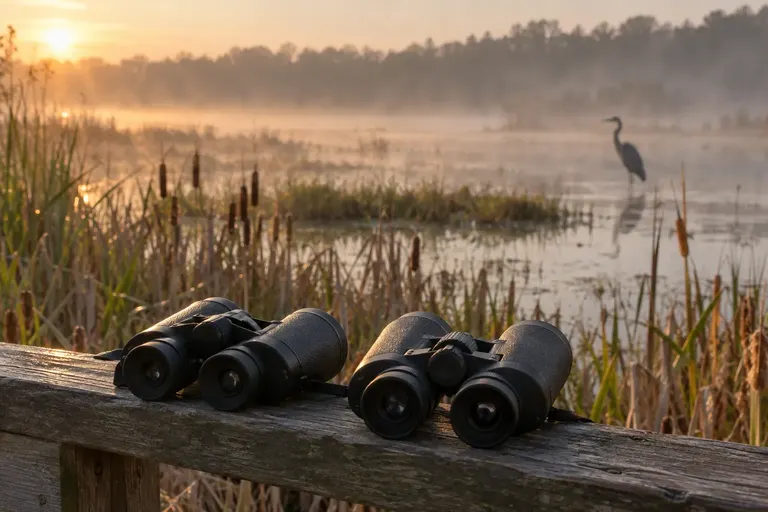
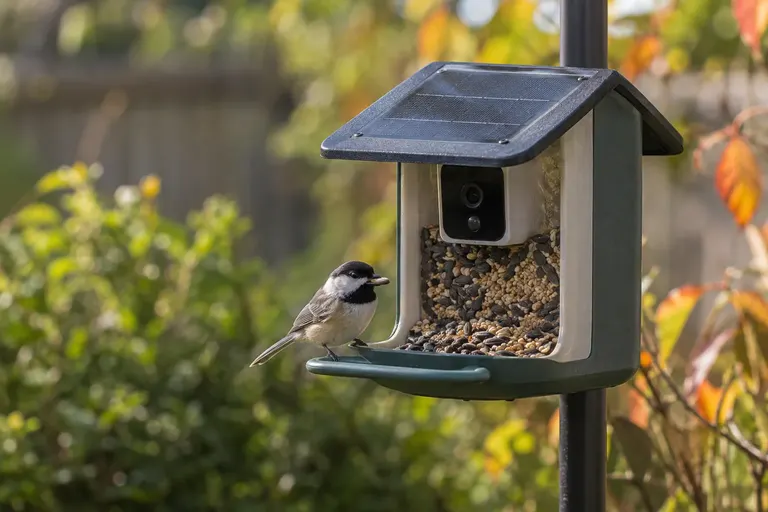
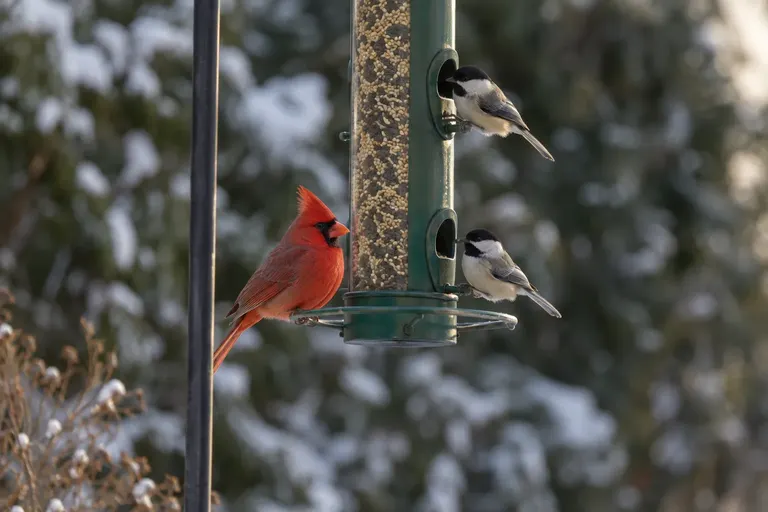
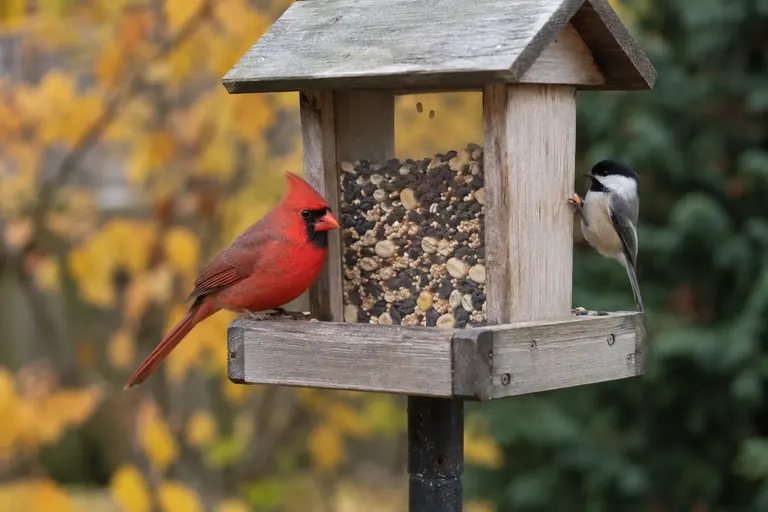
Close focus is the nearest distance at which the image is sharp. Vortex lists 5.0 ft, and both the Cornell Lab and OutdoorGearLab found the real figure in the same range. That is excellent for a full-size 8x42. It matters most in a yard: a chickadee on a feeder 8 ft away, a Carolina Wren poking under the deck, or butterflies on a flower bed are all well inside its range. Many rivals stop at 6.5 to 8 ft.
17 mm eye relief: fine for most, tight for some
Eye relief is the distance your eye can sit behind the eyepiece and still see the full image. Eyeglass wearers need more of it because the lens adds space. Vortex lists 17 mm, with twist-up eyecups that BirdGuides describes as having two raised positions above the fully down setting.
For many people with thin lenses, 17 mm is enough. Owners with thick or strongly curved lenses more often report a slightly clipped edge to the view. If that is you, read our list of the best binoculars for glasses wearers before buying.
5.25 mm exit pupil and low light
Divide 42 by 8 and you get a 5.25 mm exit pupil, the beam of light the binocular delivers to your eye. That is the standard for an 8x42 and is plenty for dawn and dusk. OutdoorGearLab’s light meter reading for the Diamondback HD was among the highest in its test group, and the Cornell Lab calls the image bright. Brightness at this price is not the problem. Contrast in harsh backlight is.
Strengths of the Vortex Diamondback HD 8x42
Bright, wide and easy to use
The recurring theme across expert reviews is that the Diamondback HD is simply easy to look through. The Cornell Lab describes a bright image that is sharp nearly to the edges. BirdGuides calls the image bright and contrasty with natural color. Owner reviews commonly mention that the view comes into focus without fuss and that the wide field makes finding birds easier for beginners. If you are still learning to get on a bird quickly, a wide field is a real help.
Light and comfortable in the hand
At 21.8 oz on Vortex’s spec sheet, it is lighter than several rivals, including the Nikon Monarch M5 (22.2 oz) and Vortex’s own Crossfire HD 8x42 (23.8 oz). Independent reviewers who weighed their samples reported figures in the 23 oz range, possibly with caps or strap attached, but the Cornell Lab still found it lighter than average for its class. Reviewers describe thumb grooves and a grippy armor that suit smaller hands. The Cornell Lab singles out comfort for people with small hands specifically.
A warranty that covers accidents
Vortex’s VIP warranty is described as unlimited, unconditional and lifetime. Vortex says it will repair or replace the binocular regardless of how the damage happened, whose fault it was or where you bought it. It excludes loss, theft, deliberate damage and cosmetic wear that does not affect performance. For a binocular that might get knocked off a porch rail or handed to a grandchild, this matters more than a small difference in sharpness.
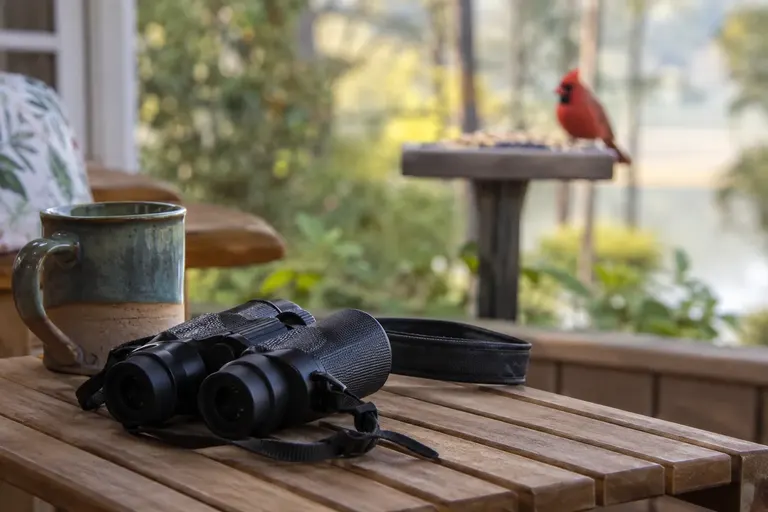
The GlassPak harness is included
Most binoculars at this price ship with a basic case and strap. The Diamondback HD comes with a GlassPak chest harness, which holds the binocular against your chest instead of letting it swing from your neck. Many owners mention it as a reason they chose this model. If you prefer a different carry system, a dedicated harness or padded strap is an easy swap.
Drawbacks, based on expert reviews and owner patterns
Color fringing in backlight
This is the most consistent criticism. BirdGuides reports an appreciable amount of chromatic aberration, especially with backlit subjects. OutdoorGearLab noted color fringing on tree bark and yellowish glare toward bright light. In plain terms, a dark bird against a white sky may show a thin purple or green outline. For most yard birding in good light it is a minor issue. For birders who spend time looking up at canopy warblers against overcast sky, it is the main reason to spend more or pick a model with ED glass. Our explainer on whether ED glass is worth it covers this trade-off in detail.
Reviewers disagree about the focus wheel
The Cornell Lab found the focus wheel stiff, saying it can make it hard to snap to a sharp image quickly. BirdGuides, testing its own sample, described focusing as smooth and fast. OutdoorGearLab called it free-moving with just enough resistance. Owner reviews split in a similar way, with some reporting that the wheel loosens with use. The honest read is that stiffness may vary from unit to unit. Buy from a retailer with an easy return policy and check it in the first week.
Edges soften slightly
OutdoorGearLab noted that the outer edge of the image loses some sharpness, though it judged the effect minimal. This is normal at mid-range prices. Expensive binoculars use field-flattener lenses to keep edges sharp. You will notice it mainly when scanning a flock and looking at birds near the rim of the view.
Not premium glass
OutdoorGearLab summed up clarity as good for beginners but likely to disappoint a professional. That is fair. If you already own a high-end binocular, the Diamondback HD is a good spare, not an upgrade.
Who the Diamondback HD 8x42 suits
Backyard birders who watch from a porch or window
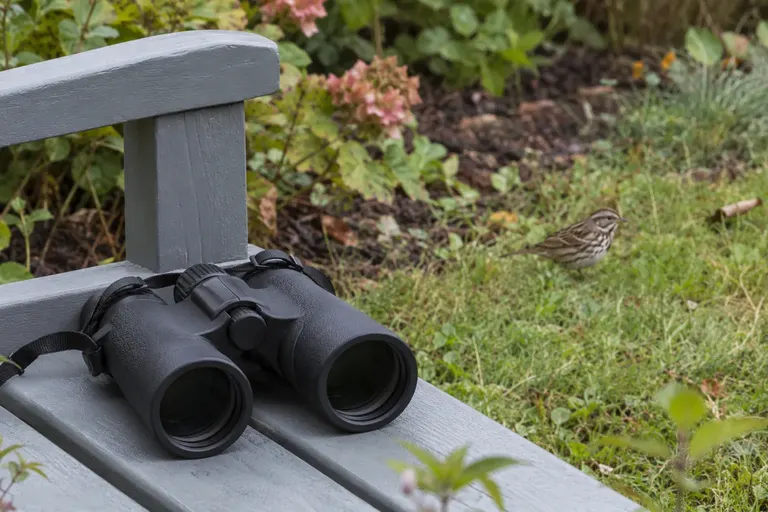
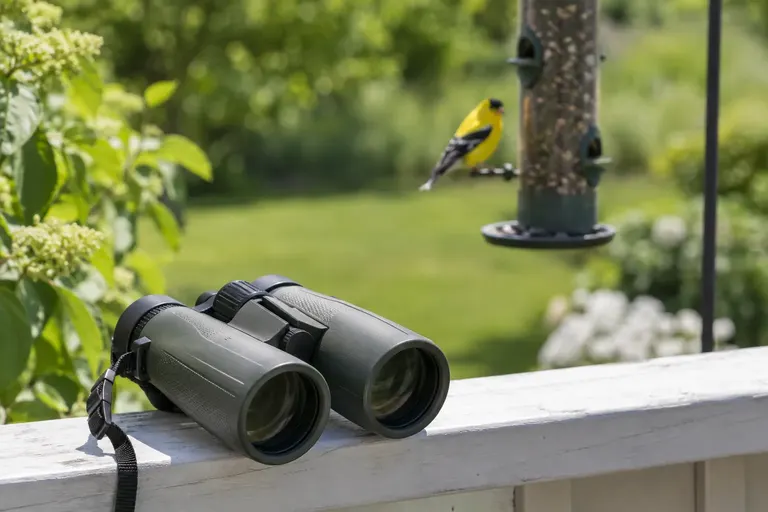
The 5 ft close focus and wide field suit a yard perfectly. You can focus on a titmouse at the feeder, then swing to a hawk on a distant pole without switching gear. If you mostly watch through a window, the close focus is less critical, but the wide field still helps.
Beginners who want to buy once
For a first serious binocular, the combination of easy viewing, included harness and a warranty that forgives accidents is hard to beat. Our guide for beginner birders compares it with cheaper starting points.
Travelers and walkers
At under 22 oz on paper, with a harness included, it is comfortable to carry on long walks. Owners who carry it on trips often mention the harness as the feature that made the weight disappear.

Who should look elsewhere
- Thick eyeglass wearers: consider 19 mm or more of eye relief.
- Canopy warbler specialists: consider ED glass for better control of fringing.
- Long-range open-country birders: consider the 10x42 version or a spotting scope.
Diamondback HD 8x42 vs the alternatives
| Model | Field of view (ft at 1,000 yd) | Close focus | Eye relief | Weight |
|---|---|---|---|---|
| Vortex Diamondback HD 8x42 | 393 | 5.0 ft | 17 mm | 21.8 oz |
| Nikon Monarch M5 8x42 | 335 | 8.2 ft | 19.5 mm | 22.2 oz |
| Vortex Crossfire HD 8x42 | 393 | 6.0 ft | 17 mm | 23.8 oz |
| Vortex Viper HD 8x42 | 409 | 6.0 ft | 18 mm | 24.5 oz |
| Celestron Nature DX 8x42 | 388 | 6.5 ft | 17.5 mm | 22.2 oz |
Specs come from each manufacturer’s product page.
Vortex Diamondback HD vs Nikon Monarch M5
This is the most common head-to-head at this price. The Monarch M5 uses ED glass and gives 19.5 mm of eye relief, which suits glasses wearers. The Cornell Lab praised its very sharp, bright image. But its field of view is much narrower (335 ft versus 393 ft), and the Cornell Lab described that as a noticeable tunnel effect. Its close focus of 8.2 ft is also longer. Choose the Nikon for detail and eye relief. Choose the Vortex for a wide view and close focus. Our full Nikon Monarch M5 8x42 review goes deeper.
Diamondback HD vs Vortex Crossfire HD
The Crossfire HD is Vortex’s lower tier. On paper it matches the Diamondback’s 393 ft field and 17 mm eye relief but is heavier (23.8 oz) and focuses less close (6 ft). If the price difference is small, the Diamondback is the better buy.
Diamondback HD vs Vortex Viper HD
The Viper HD is a meaningful step up in price. It offers a wider 409 ft field, slightly more eye relief (18 mm) and higher-grade glass, with the same warranty. It weighs 24.5 oz. It makes sense if color fringing and edge softness are the things that bother you about the Diamondback.
Diamondback HD vs Celestron Nature DX
The Celestron Nature DX 8x42 typically sells for less and has similar field and weight numbers. Independent reviewers found it weaker in low light and at the edges, and its warranty is a limited lifetime warranty rather than an unconditional one. See our Celestron Nature DX 8x42 review for the details.
Is 8x42 or 10x42 better in the Diamondback HD line?
For most backyard birders, 8x42 is the better fit. It gives a wider field, a brighter 5.25 mm exit pupil and a steadier image, since hand shake is magnified less. The 10x42 version shows more detail on distant birds and suits open marshes, beaches and hawk watches. If you are torn, our comparison of 8x42 vs 10x42 for birding walks through the trade-offs.
How to set up the Diamondback HD for a sharp view
A few minutes of setup makes more difference than most spec gaps.
- Set the eyecups. Twist them fully up if you do not wear glasses. Twist them down if you do. Try the middle position if you see black crescents.
- Set the hinge. Fold the barrels until you see one round image, not two overlapping circles.
- Focus the left side. Close your right eye and turn the center wheel until a fixed target looks sharp.
- Set the diopter. Close your left eye and turn the diopter ring under the right eyecup until the same target is sharp. Leave it there.
- Check the focus wheel. Rack it from close to far several times. If it feels much stiffer than you want, contact the retailer early.
Our full walkthrough on how to adjust binoculars has pictures of each step.
Common mistakes when buying the Diamondback HD
- Buying the original Diamondback instead of the HD. Older non-HD Diamondback models still show up in resale listings. Check that the listing says “HD” and matches the current specs.
- Choosing 10x because more sounds better. For yard birds, 8x is easier to hold steady and faster to aim.
- Ignoring eye relief if you wear glasses. Try the eyecups fully down with your glasses on as soon as it arrives.
- Skipping the harness. The included GlassPak is one of the best reasons to buy this model. Use it.
- Buying from an unknown reseller without checking returns. Focus wheel feel seems to vary between units, so a simple return window is worth having.
The verdict
The Vortex Diamondback HD 8x42 does the things that matter most for everyday birding very well: a wide view, very close focus, good brightness, light weight and a warranty that forgives accidents. It is not a premium optic, and backlit birds can show color fringing. For most backyard and beginner to intermediate birders, it is the safe, sensible pick in the middle of the market. If you want to see where it ranks among other models, our list of the best binoculars for birding puts it in context.
Sources
- Vortex Optics: Diamondback HD 8x42 product page and specifications
- Cornell Lab of Ornithology, All About Birds: Vortex Diamondback HD 8x42 Binoculars review
- BirdGuides: Vortex Diamondback HD 8x32 and 8x42 binoculars review
- OutdoorGearLab: Vortex Diamondback HD 8x42 review
- Nikon USA: Monarch M5 8x42 specifications
- Vortex Optics: Viper HD 8x42 specifications
Alternatives worth a look
Vortex Diamondback HD 8x42
Wide 393 ft field of view, 5 ft close focus and Vortex's unconditional lifetime warranty in a 21.8 oz body.
- Best for
- Most backyard and beginner to intermediate birders.
- Skip it if
- You wear thick glasses and need 19 mm or more of eye relief.
- Field of view
- 393 ft at 1,000 yd
- Close focus
- 5.0 ft
- Eye relief
- 17 mm
- Weight
- 21.8 oz
Nikon Monarch M5 8x42
ED glass and 19.5 mm of eye relief give eyeglass wearers more room, at the cost of a much narrower 335 ft field.
- Best for
- Glasses wearers who value fine detail over a wide view.
- Skip it if
- You track fast warblers in leafy trees and want the widest view.
- Field of view
- 335 ft at 1,000 yd
- Eye relief
- 19.5 mm
- Weight
- 22.2 oz
Vortex Viper HD 8x42
Vortex's next tier up adds a wider 409 ft field and 18 mm eye relief with the same warranty.
- Best for
- Birders ready to spend more for a cleaner, wider image.
- Skip it if
- You want the lightest possible 8x42.
- Field of view
- 409 ft at 1,000 yd
- Eye relief
- 18 mm
- Weight
- 24.5 oz
Frequently asked questions
Is the Vortex Diamondback HD 8x42 good for birding?
Yes. On paper it has what birders need most: a wide 393 ft field of view at 1,000 yards, close focus of 5 ft for birds at the feeder, and a bright 5.25 mm exit pupil. Independent reviews, including the Cornell Lab's, rate it a solid choice. Its main weaknesses are some color fringing in harsh backlight and a focus wheel some reviewers find stiff.
Does the Vortex Diamondback HD have ED glass?
Vortex does not describe the Diamondback HD as having ED glass. The company calls it an HD optical system built with select glass elements, plus fully multi-coated lenses, dielectric prism coatings and phase correction. Independent reviewers report visible color fringing on high-contrast, backlit subjects, which is the main thing true ED glass is meant to reduce.
Is the Diamondback HD good for people who wear glasses?
It is workable for many eyeglass wearers. Vortex lists 17 mm of eye relief with twist-down eyecups. That is enough for many people with thin or moderate lenses, but those with thick lenses or deep-set frames may see a slightly clipped view. If that describes you, a model with 19 mm or more, like the Nikon Monarch M5, is a safer bet.
What does the Vortex VIP warranty cover?
Vortex describes its VIP warranty as unlimited, unconditional and lifetime. Vortex says it will repair or replace the product no matter how the damage happened or where you bought it. It excludes loss, theft, deliberate damage and cosmetic wear that does not affect performance. For a binocular that will live on a porch rail or in a car door pocket, this is one of its strongest selling points.
Should I get the Diamondback HD in 8x42 or 10x42?
For backyard and woodland birding, 8x42 is usually the better pick. It gives a wider field of view, a brighter exit pupil (5.25 mm versus 4.2 mm) and a steadier image in the hand. The 10x42 makes more sense if you mostly watch shorebirds, ducks or hawks at long range across open ground.