Roof Prism vs Porro Prism Binoculars
Roof prism vs porro prism binoculars: porros give more depth and value per dollar, but a phase-coated, waterproof roof prism suits most backyard birders best.
If you buy through links on this page we may earn a commission, at no cost to you. It never decides what we recommend. How we earn
In this article
- Quick answer: roof vs porro at a glance
- What is the difference between roof and porro prisms?
- Why roof prisms need phase coating
- Which gives the better image?
- Size, weight and handling
- Close focus: why it matters at the feeder
- Waterproofing and durability
- Eye relief and glasses
- Price and value
- Which should you choose? Roof or porro for birding
- The two picks, explained
- How to tell which prism type a binocular has
- Does prism type change field of view?
- Common myths about prism types
- How we put this guide together
- Sources
- Gear mentioned in this guide
- Frequently asked questions
For most backyard birders, a waterproof roof prism binocular with phase-coated prisms is the better buy: it is slimmer, easier to carry and usually focuses closer on feeder birds, often to 5 to 8 ft. Porro prism binoculars still win on depth of image and on optical quality per dollar, so they make sense if you bird mainly from a window or a deck and do not mind the bulk.
Neither design is “better” in the abstract. Both flip the image right side up so you do not see birds upside down. They just fold the light path differently, and that shapes the size, cost and feel of the binocular. This guide explains how each works, where each wins, and what to check before you buy.
Quick answer: roof vs porro at a glance
| Factor | Roof prism | Porro prism |
|---|---|---|
| Shape | Straight, H-shaped barrels | Offset, zigzag barrels |
| Size and weight | Slimmer, usually lighter for the aperture | Wider, often heavier at 40 to 50 mm |
| Depth (3D effect) | Normal | Enhanced, because front lenses sit wider apart |
| Coatings needed for top performance | Phase coating, plus mirror coating on Schmidt-Pechan types | No phase coating; reflects by total internal reflection |
| Image quality per dollar | Lower at budget prices | Higher at budget prices |
| Waterproofing | Easy to seal; most birding models are waterproof | Harder to seal; many budget porros are only water resistant |
| Close focus | Often 5 to 8 ft on birding models | Often longer, especially on budget models |
| Durability of alignment | Very good; internal focus | Good, but the extra joints can be knocked out of alignment |
| Typical user | Walkers, travelers, glasses wearers | Window and deck birders, value seekers |
What is the difference between roof and porro prisms?
Every binocular lens system produces an upside-down, reversed image. Prisms flip it back. The two classic ways of doing that give us the two binocular shapes.
How porro prism binoculars work
A porro prism binocular uses two right-angle prisms per barrel, set at 90 degrees to each other. Light enters the first prism, reflects twice off its sloped faces, then passes into the second prism and reflects twice more. Four reflections turn the image the right way up and the right way round.
Each reflection in a porro prism happens by total internal reflection. When light hits a glass surface at a steep enough angle, all of it bounces back, with no mirror coating needed. That is a big reason porros can deliver bright, contrasty images without expensive coatings.
The zigzag light path also shifts the beam sideways. That is why porro binoculars have the familiar offset shape, with the front lenses spaced wider than the eyepieces.
How roof prism binoculars work
A roof prism binocular folds light inside a compact prism assembly that sits in a straight line with the eyepiece. The name comes from one surface ground into a shape like a peaked roof. That roof edge does the left-right flip.
The straight path lets makers build slim, H-shaped binoculars with the focus mechanism sealed inside. It also creates two optical problems that porros do not have, which the next section explains.
Schmidt-Pechan vs Abbe-Koenig roof prisms
There are two main roof prism designs.
- Schmidt-Pechan prisms are compact and inexpensive to make, which is why they dominate modern birding binoculars. One face inside the prism does not reflect by total internal reflection, so it needs a mirror coating. Aluminum and silver coatings reflect well but lose some light; dielectric coatings, made of many thin layers, can reflect over 99% of visible light and bring performance close to the best designs.
- Abbe-Koenig prisms reflect entirely by total internal reflection, so they need no mirror coating. The catch is length: they are significantly longer than Schmidt-Pechan prisms, which makes the binocular longer and heavier. They appear mostly in larger, high-end models.
When a spec sheet mentions “dielectric coating” or “dielectric prism coating”, it almost always refers to a Schmidt-Pechan prism with a high-reflectivity multilayer mirror. That is a good sign in a birding binocular.
Why roof prisms need phase coating
Light traveling through a roof prism splits at the roof edge. The two halves take slightly different paths and come back slightly out of step, or out of phase. When they recombine, fine detail and contrast suffer. The effect is subtle on paper but visible as a softer, flatter image.
Phase-correction coatings fix this. They are applied to the roof surfaces and bring the two halves back into step. Optical references note that phase coatings substantially improve resolution and contrast in roof prism binoculars.
What this means when you shop:
- Any roof prism birding binocular should have phase-coated prisms. Reputable models from Nikon, Vortex, Celestron and others list it.
- A cheap roof prism without phase coating will usually look worse than a similarly priced porro. This is the main reason budget porros often outperform budget roofs.
- Porro prisms never need phase coating, because they have no roof edge.
Which gives the better image?
At the same price, especially at the lower end, porros often deliver a brighter, crisper image. At the high end, the gap closes. A well-made roof prism with phase coating, dielectric mirror coating and good glass can match or beat most porros.
Brightness
Porro prisms reflect all their light by total internal reflection. Schmidt-Pechan roof prisms lose a little at the mirror-coated face unless that face has a dielectric coating. In practice, a dielectric-coated roof prism closes most of that gap.
Depth and the “3D” look
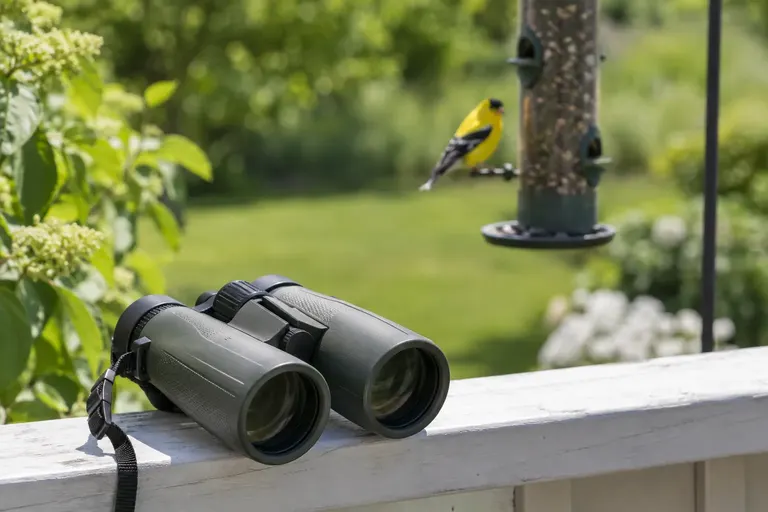
This is where porros shine. Because the front lenses sit wider apart than your eyes, each eye sees the scene from a more separated viewpoint. Your brain reads that as extra depth. Owners of porro binoculars commonly describe the view as more three-dimensional, and it helps when you are trying to work out whether a warbler is in front of or behind a branch.
Roof prisms put the front lenses roughly in line with your eyes, so the view looks more like normal vision. Some people prefer it. Others find porros more immersive.
Sharpness and color
Sharpness depends more on glass quality, coatings and manufacturing than on prism type. Color fringing around bright edges is controlled by the objective lens design, not the prism. If fringing bothers you, look at our guide on whether ED glass is worth it.
Size, weight and handling
Roof prisms are the clear winner for carrying.
Here is a concrete comparison from Nikon’s own specs. Nikon’s Action EX 8x40, a waterproof porro, lists a weight of 30.1 oz. Nikon’s Monarch M5 8x42, a roof prism with a slightly larger front lens, lists 22.2 oz. That is roughly half a pound more for the porro, in a wider body.
Not all porros are heavy. Smaller-aperture porros, like the 8x30 Swarovski Habicht at about 19 oz, are light. But at the common birding size of 40 to 42 mm, a porro is usually bulkier.
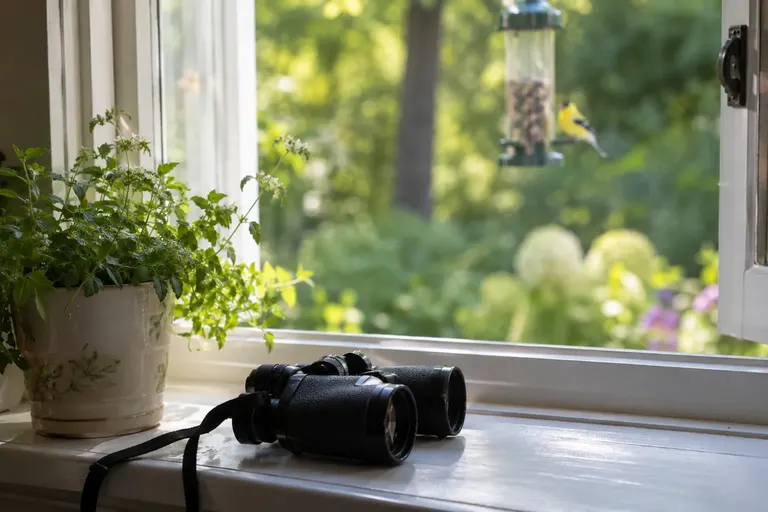
Handling is partly personal. Some people find the wide porro body natural to hold, with plenty to grip. Others find it awkward on a harness or in a jacket pocket. If you walk long distances with binoculars, roof prisms are easier to live with. If you mostly bird from a window, weight matters less. Our roundup of binoculars for watching birds from your window focuses on that use.
Close focus: why it matters at the feeder
Close focus is the shortest distance at which the binocular can produce a sharp image. For feeder birding, it matters.
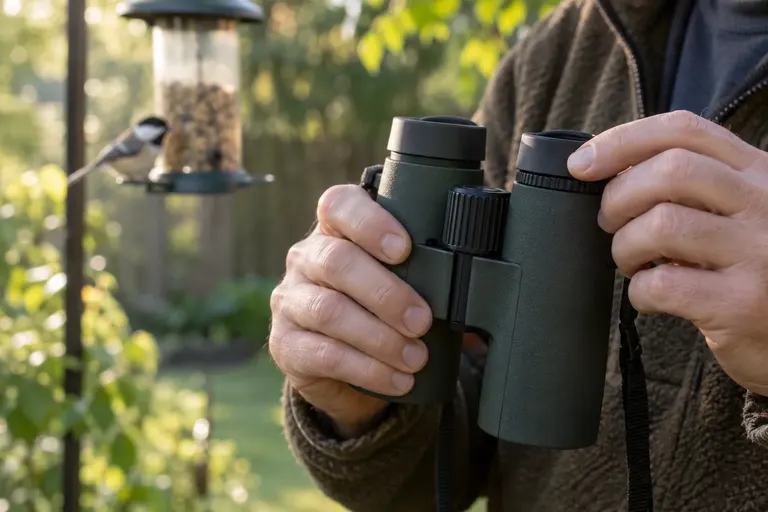
Birding roof prisms commonly focus to around 5 to 8 ft. The Monarch M5 8x42 lists 8.2 ft. Many porros focus much less closely. Nikon’s Action EX 8x40 lists 16.4 ft, which means a chickadee on a deck-rail feeder 10 ft away would be out of focus. The Habicht 8x30, at about 9.8 ft, shows that some porros do better.
If your feeders sit close to the house, check this spec before anything else.
Waterproofing and durability
Roof prism binoculars focus internally, which makes it easier to seal the body and fill it with nitrogen or argon to prevent internal fog. Almost every birding roof prism is waterproof.
Porro binoculars traditionally moved the eyepieces to focus, with more external moving parts and joints. That is harder to seal. Some porros are fully waterproof, including the Habicht line, rated submersible to 3 m, and Nikon’s Action EX series, rated to 1 m for five minutes. Many budget porros are only “weather resistant” or not sealed at all, which invites dust and internal fog.
Collimation
Both designs need their two barrels aligned precisely, called collimation. Porro prisms are held in place with more parts and can shift after a hard knock. Modern roof prisms are generally robust. Either way, a harness and a padded case reduce risk. See our picks for binocular harnesses and straps.
Eye relief and glasses
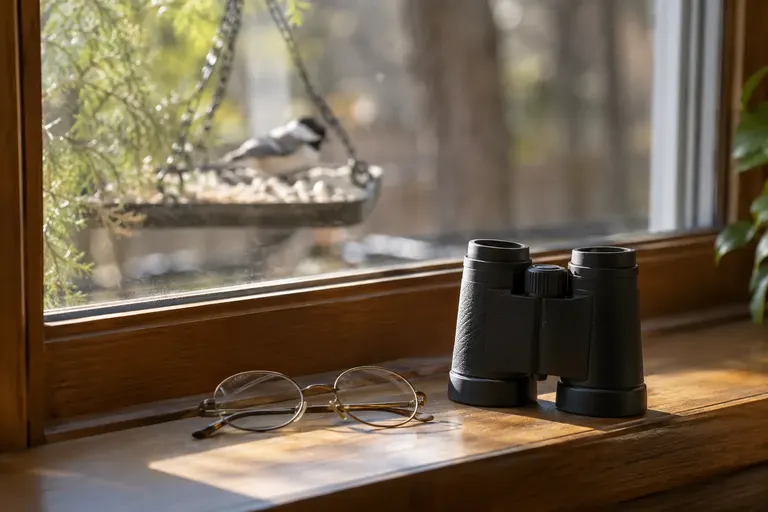
Eye relief depends on eyepiece design more than prism type, but some classic porro models, including the Habicht 8x30 at 12 mm, have short eye relief. Glasses wearers generally need about 15 mm or more. Most modern birding roof prisms offer 15 to 20 mm. If you wear glasses, check this spec closely, and see our binoculars for glasses wearers roundup.
Price and value
The cost argument is simple:
- Porros can deliver excellent optics without phase coatings or mirror coatings. At the budget end, a good porro often beats a roof prism of the same price.
- Roof prisms need phase coatings, and Schmidt-Pechan designs need a mirror coating. Doing all of that well costs more. Budget roof prisms cut corners on coatings, and it shows.
The market has moved toward roof prisms, so the selection of good, waterproof, close-focusing porros is smaller than it once was. That narrows the value advantage in practice. For shoppers with a budget, our list of binoculars under $200 highlights what the current market offers.
Which should you choose? Roof or porro for birding
Choose a roof prism if
- You walk with your binoculars or travel with them.
- You want close focus for feeder birds under 10 ft away.
- You wear glasses and need long eye relief.
- You want a fully waterproof pair without hunting for one.
- You can afford a model with phase coating, ideally with a dielectric mirror coating too.
Choose a porro prism if
- You mostly watch from a deck, porch or window, so weight and bulk matter less.
- You want the most image quality for the money at a lower price point.
- You love the deep, three-dimensional look.
- Your feeders are farther than about 15 ft away, or you choose a porro with a shorter close focus.
What we would avoid
- A cheap roof prism that does not mention phase coating.
- A budget porro that is not waterproof, if you bird in wet or humid weather.
- Any binocular whose close focus is longer than the distance to your nearest feeder.
The two picks, explained
Nikon Monarch M5 8x42 (roof prism)
The Monarch M5 is a good example of a well-specified mainstream roof prism. On paper it has phase-coated prisms, a dielectric mirror coating and ED glass, and Nikon rates it waterproof. The 8.2 ft close focus suits feeder birding, and 19.5 mm of eye relief suits most glasses wearers. The 335 ft field of view is average for an 8x42. For more detail, read our Nikon Monarch M5 8x42 review.
Skip it if you want the widest possible view in this class or the classic porro depth.
Swarovski Habicht 8x30 W (porro prism)
The Habicht is a long-running Austrian porro and one of the few premium porros still made. It weighs about 19 oz, covers 408 ft at 1,000 yd, focuses down to about 9.8 ft and is rated submersible to 3 m. It shows the porro strengths well: a light body for its class, a wide field and a deep image.
Skip it if you bird with glasses on. Its 12 mm eye relief is short, and you likely will not see the full field. It is also a premium-priced binocular, not a budget one.
How to tell which prism type a binocular has
You can usually tell at a glance, but spec sheets are the final word.
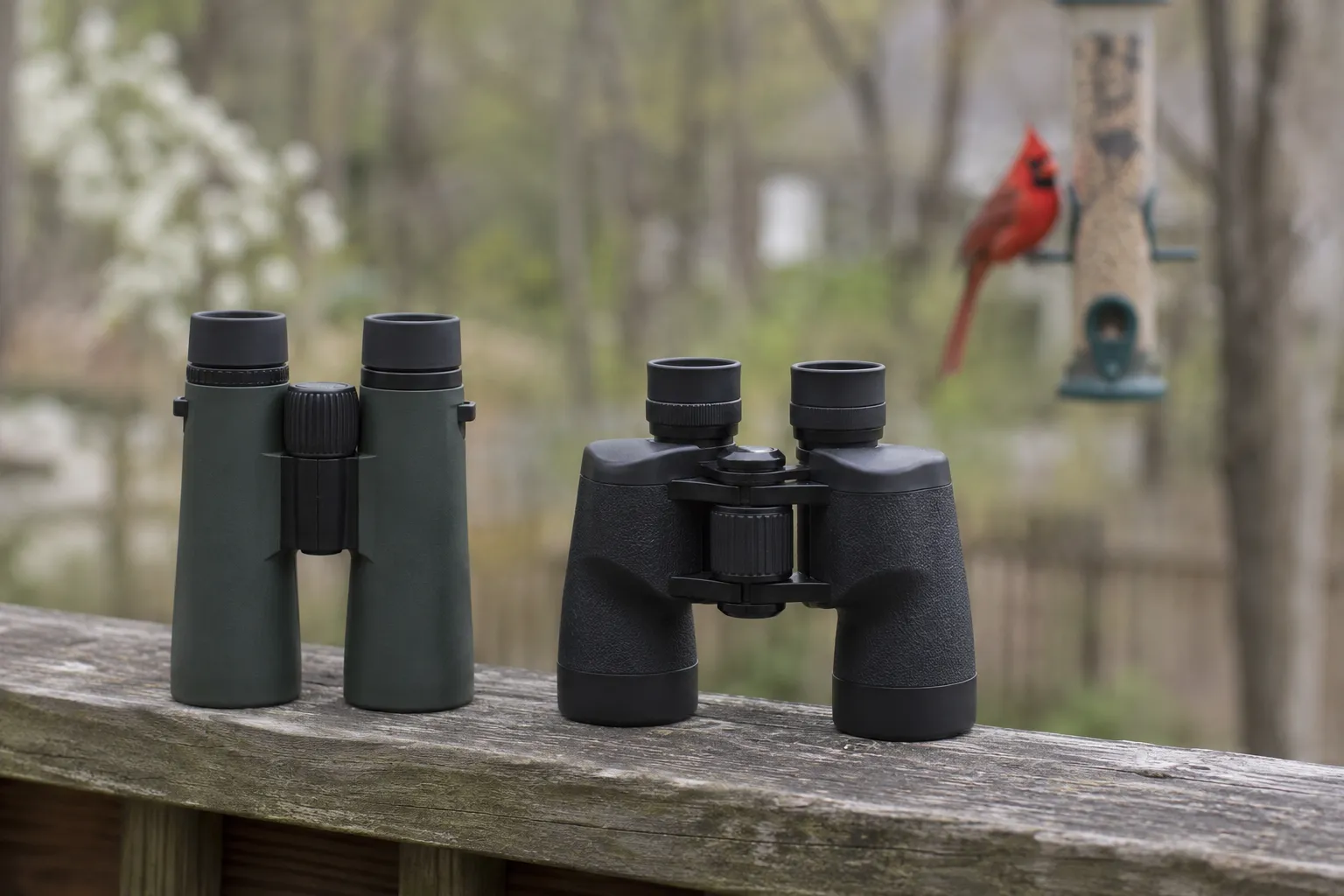
- Look at the barrels. Straight tubes that run in line from front lens to eyepiece mean a roof prism. A zigzag shape, with the front lenses spaced wider than the eyepieces, means a standard porro.
- Check small compacts carefully. Some compact binoculars use a “reverse porro” layout, where the front lenses sit closer together than the eyepieces. They look like a narrow porro. The depth effect is reduced rather than enhanced, because the lenses are closer together than your eyes.
- Read the prism line in the specs. Look for “roof”, “Dach” (German for roof), “Schmidt-Pechan”, “Abbe-Koenig” or “porro”. If the spec sheet lists “phase coating” or “dielectric coating”, it is almost certainly a roof prism.
- Look for BaK-4 or BK-7. This names the prism glass, not the prism shape. BaK-4 is the more common choice in birding binoculars and gives a rounder, evenly lit exit pupil.
A quick exit-pupil check
Hold the binocular at arm’s length, pointed at a bright sky, and look at the small circles of light in the eyepieces. A clean, round circle suggests good prism glass and size. A circle with squared-off, grayish edges suggests lower-grade prism glass or undersized prisms that clip the light. This works on both roof and porro designs and is a useful check in a store.
Does prism type change field of view?
Not directly. Field of view is set mainly by the eyepiece design and the magnification. That said, some classic porro designs, including the Habicht 8x30 at 408 ft at 1,000 yd, offer wide fields for their power, and wide views make it easier to get a bird into the frame quickly. For practical techniques, see our guide on finding a bird in your binoculars fast.
For comparison, the Monarch M5 8x42 roof prism lists 335 ft, while Nikon’s Action EX 8x40 porro lists 8.2 degrees of angular field, or about 430 ft. Wider is not automatically better, since very wide eyepieces can soften at the edges, but for backyard birding a field of 350 ft or more at 8x is comfortable.
Common myths about prism types
- “Porros are old technology, so they are worse.” The design is old, but the optics are sound. Total internal reflection is still the most efficient way to reflect light.
- “All roof prisms are better because they cost more.” Price reflects manufacturing complexity. Without phase coating, a roof prism is often optically weaker.
- “Prism type decides sharpness.” Glass quality, coatings and assembly matter more. A premium roof and a premium porro can both be excellent.
- “BaK-4 means premium.” BaK-4 is a good prism glass and is common in birding binoculars of both types. It is a baseline, not a sign of top quality.
How we put this guide together
This guide is research-led. We have not performed hands-on testing of these models. We compared manufacturer specifications from Nikon, Swarovski and Celestron, reviewed optical references on prism design and coatings, and looked at recurring patterns in owner feedback about handling, depth and close focus. All specs cited come from maker spec pages or authorized dealer listings.
If you are still deciding on the basics, start with how to choose binoculars for birding.
Sources
Gear mentioned in this guide
Nikon Monarch M5 8x42
A mainstream roof prism with the coatings that matter: phase-corrected prisms, dielectric mirror coating and ED glass, in a sealed, waterproof body.
- Best for
- Backyard and field birders who want one pair that focuses close on feeder birds and works for glasses wearers.
- Skip it if
- You want the most depth and image quality per dollar and do not mind extra bulk; a porro can deliver that.
- Field of view
- 335 ft at 1,000 yd
- Eye relief
- 19.5 mm
- Close focus
- 8.2 ft
- Weight
- 22.2 oz
Swarovski Habicht 8x30 W
A long-running premium porro that shows what the design does best: a bright, three-dimensional view in a light, waterproof body.
- Best for
- Birders without glasses who want a light, wide-view pair with classic porro depth and are willing to pay for premium glass.
- Skip it if
- You wear glasses while birding; 12 mm of eye relief is short for most eyeglass wearers.
- Field of view
- 408 ft at 1,000 yd (136 m at 1,000 m)
- Eye relief
- 12 mm
- Close focus
- 9.8 ft (3 m)
- Weight
- 19 oz (540 g)
Frequently asked questions
Are porro prism binoculars better than roof prism binoculars?
Not across the board. Porro prisms reflect light using total internal reflection, need no phase coating, and tend to give more depth and image quality for the money. Roof prisms are slimmer, easier to seal against water and usually focus closer. A well-coated roof prism can match a porro optically, but at a higher cost to make.
Why are roof prism binoculars more expensive?
Roof prisms need tighter manufacturing tolerances, and the common Schmidt-Pechan type needs extra coatings to perform well: a phase-correction coating on the roof surfaces and a mirror coating on one face that does not reflect light by total internal reflection. Those steps add cost. Porro prisms can reach similar image quality with simpler coatings.
Do porro prism binoculars have better depth perception?
Usually, yes. Porro designs place the front lenses farther apart than your eyes, which exaggerates the stereo effect and makes scenes look more three-dimensional. Many birders like this when judging which branch a bird is on. The effect is strongest at mid distances and less noticeable on distant birds.
What is phase coating and do I need it?
Phase coating corrects a light-wave shift that happens on the roof edge of roof prisms. Without it, contrast and fine detail suffer. If you buy a roof prism binocular for birding, look for phase-coated prisms; nearly every reputable birding model has them. Porro prisms do not need phase coating.
Are porro prism binoculars waterproof?
Some are, but fewer than roof prisms. The porro shape, with more joints and a moving eyepiece assembly on many designs, is harder to seal. Waterproof porros exist, including the Swarovski Habicht line and Nikon's Action EX series, but many budget porros are only water resistant. Check the specs before buying.