Best Binoculars for Backyard Bird Watching From a Window
The best binoculars for backyard bird watching from a window: the Vortex Diamondback HD 8x42 focuses to 5 ft. Close-focus, budget and stabilized picks compared.
If you buy through links on this page we may earn a commission, at no cost to you. It never decides what we recommend. How we earn
In this article
- Quick picks
- How we chose
- What makes a binocular good for window bird watching?
- Vortex Diamondback HD 8x42: best binoculars for window bird watching
- Nikon Monarch M7 8x30: best compact binoculars for the windowsill
- Nikon Monarch M5 8x42: best window binoculars for glasses wearers
- Celestron Nature DX 8x42: best budget binoculars for backyard birding
- Pentax Papilio II 8.5x21: best binoculars for window feeders
- Canon 10x20 IS: best image-stabilized binoculars for backyard birding
- Window binoculars compared
- How to get a sharper view through window glass
- Where to put feeders for the best window views
- What details can you see at the feeder with good binoculars?
- Binoculars, spotting scope or feeder camera?
- Common mistakes when choosing window binoculars
- Which binocular should you buy for window watching?
- Sources
- Frequently asked questions
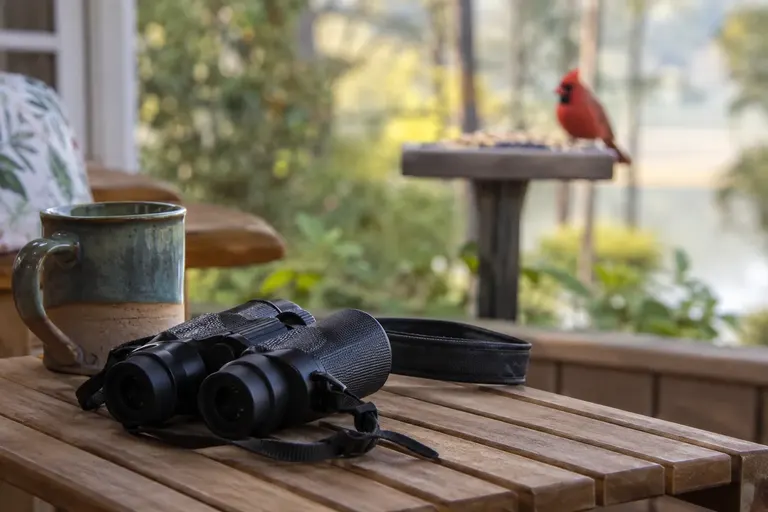
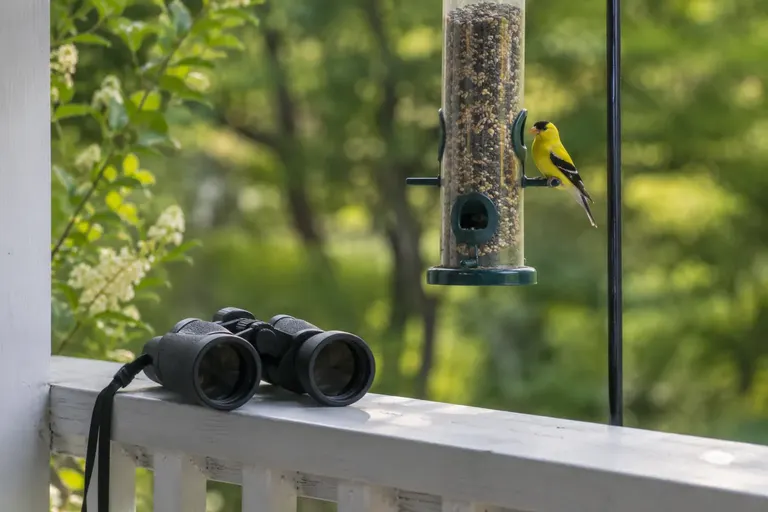
The best binoculars for backyard bird watching from a window, for most people, are the Vortex Diamondback HD 8x42. It focuses down to 5 ft, so a feeder just past the porch rail comes into sharp view, and its 42mm lenses stay bright on gray mornings when feeders are busiest. If you want something lighter to keep on the sill, the Nikon Monarch M7 8x30 is our compact pick, and if your feeder is stuck to the glass itself, only a specialist like the Pentax Papilio II 8.5x21, which focuses to 1.6 ft, will do.
Window watching is its own kind of birding. The birds are close, the viewing distance is fixed, and you see the same yard every day. That puts close focus and field of view ahead of raw magnification, and it makes window glass a factor most binocular guides ignore.
Quick picks
- Best overall: Vortex Diamondback HD 8x42. 5 ft close focus, 393 ft view.
- Best compact: Nikon Monarch M7 8x30. 435 ft view at 16.4 oz.
- Best for glasses wearers: Nikon Monarch M5 8x42. 19.5 mm eye relief.
- Best budget: Celestron Nature DX 8x42. 6.5 ft close focus, 17.5 mm eye relief.
- Best for window feeders: Pentax Papilio II 8.5x21. Focuses to 1.6 ft.
- Best image-stabilized: Canon 10x20 IS. Steady 10x for big yards.
Vortex Diamondback HD 8x42
A 5 ft close focus, a 393 ft field of view and 42mm brightness for dawn feeder activity, with an unconditional lifetime warranty.
- Best for
- Most backyard watchers, especially with feeders 5 to 40 ft from the window.
- Skip it if
- Your eyes are close-set; minimum IPD is 55 mm.
- Close focus
- 5 ft
- Field of view
- 393 ft at 1,000 yd
- Eye relief
- 17 mm
- Weight
- 21.8 oz
Nikon Monarch M7 8x30
A very wide 435 ft view in a 16.4 oz body that is easy to grab and hold at the window.
- Best for
- People who want a light pair that lives on the windowsill.
- Skip it if
- You watch mostly at first light; a 42mm is brighter.
- Close focus
- 6.6 ft
- Field of view
- 435 ft at 1,000 yd
- Eye relief
- 15.1 mm
- Weight
- 16.4 oz
Nikon Monarch M5 8x42
19.5 mm of eye relief and ED glass, so glasses wearers see the whole view.
- Best for
- Eyeglass wearers watching feeders 10 ft or more from the window.
- Skip it if
- Your feeders are within 8 ft of where you stand.
- Close focus
- 8.2 ft
- Field of view
- 335 ft at 1,000 yd
- Eye relief
- 19.5 mm
- Weight
- 22.2 oz
Celestron Nature DX 8x42
A waterproof entry-level 8x42 with 17.5 mm eye relief and a 6.5 ft close focus.
- Best for
- New feeder watchers and gift buyers on a budget.
- Skip it if
- Your window faces into the morning sun; reviewers report glare with backlit birds in this line.
- Close focus
- 6.5 ft
- Field of view
- 388 ft at 1,000 yd
- Eye relief
- 17.5 mm
- Weight
- 22.2 oz
Pentax Papilio II 8.5x21
Focuses to 1.6 ft, close enough to study a bird on a window-mounted feeder in detail.
- Best for
- Anyone with a suction-cup window feeder or a feeder right beside the glass.
- Skip it if
- You also want a binocular for rainy walks; it is not waterproof.
- Close focus
- 1.6 ft
- Field of view
- 315 ft at 1,000 yd
- Weight
- 10.2 oz
Canon 10x20 IS
Stabilized 10x for detail across a bigger yard without the shake, at 15.2 oz without battery.
- Best for
- Large yards, and anyone with unsteady hands who wants more magnification.
- Skip it if
- You wear glasses or want a wide view for small, fast birds.
- Field of view
- About 279 ft at 1,000 yd (93 m at 1,000 m)
- Close focus
- About 6.6 ft (2 m)
- Eye relief
- 13.5 mm
- Weight
- 15.2 oz without battery
How we chose
We have not physically tested these binoculars. This guide is research-based, and here is exactly how we built it.
We compared current manufacturer specifications from established optics makers, confirming each figure on the maker’s product page. For window watching, we weighted close focus most heavily, then field of view, eye relief, brightness and weight. We read independent expert reviews, including the Cornell Lab of Ornithology’s binocular reviews, and looked for patterns in verified owner feedback about focus feel, glare and eyecup comfort. We used Cornell Lab guidance for the bird and window-safety facts in this article.
We left out models we could not confirm are current, and any spec we could not verify.
What makes a binocular good for window bird watching?
Close focus comes first
Close focus is the nearest distance at which a binocular can give a sharp image. At a window, it decides what you can see at all. Measure from where you normally stand or sit to your nearest feeder. Your binocular’s close focus has to be shorter than that number. A binocular that focuses to 5 ft covers almost every hanging feeder near a house. One that focuses to 10 ft cannot see the feeder on your deck rail.
Field of view helps you find the bird
A wider field of view makes it easier to get the bird in the binocular on the first try, especially small, active birds like chickadees and kinglets. Around 390 ft at 1,000 yd or more is comfortable.
8x beats 10x for most yards
Most backyard birds are 10 to 60 ft away. At that distance, 8x shows plenty of detail and keeps the view steady. Our guide to 8x42 vs 10x42 explains the trade-offs. The exception is a large yard, a pond or a field edge, where 10x helps, and image stabilization makes 10x much easier to hold.
Brightness for dawn and gray days
Feeder activity is often busiest in the early morning. A 42mm objective gives a 5.25 mm exit pupil at 8x, which stays brighter in dim light than a 30mm or 21mm binocular.
Weight matters less, but not zero
At a window, you are not carrying the binocular for hours, so a 22 oz 8x42 is fine. But if you hold it up for long stretches, a lighter pair or a windowsill to rest your elbows helps.
Vortex Diamondback HD 8x42: best binoculars for window bird watching
What it is: Vortex’s popular mid-range full-size roof prism binocular.
Who it suits: Most backyard birders, especially those with feeders 5 to 40 ft from the window.
Key specs: 5 ft close focus, 393 ft at 1,000 yd, 17 mm eye relief, 21.8 oz, IPD 55 to 73 mm, argon-purged and waterproof.
Strengths: The 5 ft close focus is the shortest of the full-size picks, so it can focus on feeders just outside a porch or patio door. The field of view is wide for an 8x42. Vortex’s unlimited, unconditional lifetime warranty covers accidents. It is also a strong all-rounder for walks. See our full Vortex Diamondback HD 8x42 review.
Drawbacks: At 21.8 oz, it is heavier than a compact. The 55 mm minimum IPD will not fit everyone with close-set eyes.
Skip it if: your feeder is on the window itself, or you want the lightest pair.
Nikon Monarch M7 8x30: best compact binoculars for the windowsill
What it is: Nikon’s compact ED-glass binocular, and the Cornell Lab’s overall top pick among compact binoculars.
Who it suits: Window watchers who want a light binocular that is easy to grab and hold.
Key specs: 6.6 ft close focus, 435 ft at 1,000 yd, 15.1 mm eye relief, 16.4 oz, waterproof to 3.3 ft for 10 minutes.
Strengths: The field of view is the widest of our window picks, which makes fast birds easier to follow. It weighs almost 6 oz less than the full-size picks. Cornell’s reviewers described an eye-filling, colorful image with low-light brightness that compared well with 8x42s.
Drawbacks: Eye relief is short for some glasses wearers. It will lose a little brightness to a 42mm at first light.
Skip it if: you wear glasses or mostly watch in very dim morning light.
Nikon Monarch M5 8x42: best window binoculars for glasses wearers
What it is: Nikon’s mid-range full-size binocular with ED glass.
Who it suits: Eyeglass wearers whose feeders are 10 ft or more from the window.
Key specs: 8.2 ft close focus, 335 ft at 1,000 yd, 19.5 mm eye relief, 22.2 oz, IPD 2.2 to 2.8 in, waterproof to 3.3 ft for 10 minutes.
Strengths: 19.5 mm is the longest eye relief in this roundup, so glasses wearers should see the full view with the eyecups down. ED glass helps with color fringing on birds against a bright sky. See our Nikon Monarch M5 8x42 review for more.
Drawbacks: The field of view is the narrowest of the 8x picks. The 8.2 ft close focus is too long for very close feeders.
Skip it if: your nearest feeder is within about 8 ft of where you watch.
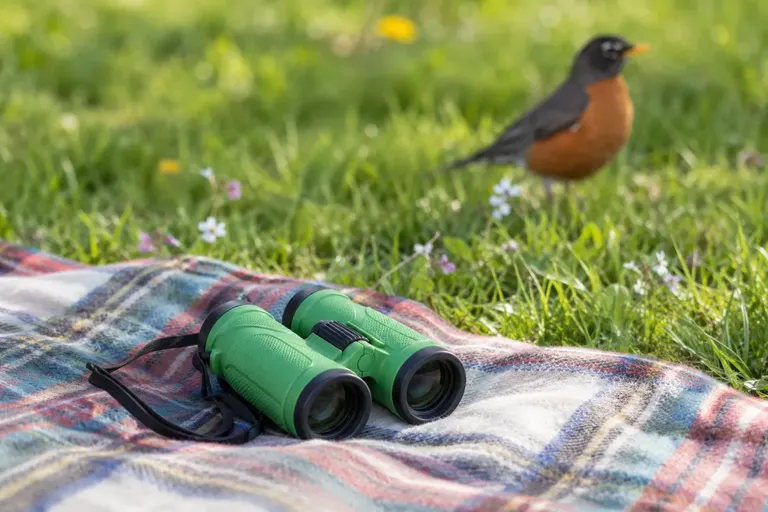
Celestron Nature DX 8x42: best budget binoculars for backyard birding
What it is: Celestron’s entry-level waterproof 8x42 with phase-coated BaK-4 prisms.
Who it suits: New feeder watchers and anyone buying a first pair or a gift.
Key specs: 6.5 ft close focus, 388 ft at 1,000 yd, 17.5 mm eye relief, 22.2 oz, IPD 56 to 74 mm, nitrogen-filled and waterproof.
Strengths: Good close focus and generous eye relief for an entry-level binocular. It is waterproof, so it can move from the window to the yard. It is a sensible first binocular for a household that has never owned one.
Drawbacks: In its review of the 8x32 version of this line, the Cornell Lab noted considerable glare with backlit subjects and some softness at the edges. Expect a less bright and less contrasty image than pricier models.
Skip it if: you watch toward a sunrise or sunset window.
Pentax Papilio II 8.5x21: best binoculars for window feeders
What it is: A small porro prism binocular whose objective lenses converge as it focuses close, so both eyes stay on the same target.
Who it suits: Anyone with a suction-cup window feeder or a hanging feeder within a few feet of the glass. See our window bird feeder roundup for feeder options.
Key specs: 1.6 ft close focus, 315 ft at 1,000 yd (6.0 degrees), 15 mm eye relief, 10.2 oz. It is not waterproof.
Strengths: No standard birding binocular can focus close enough for a window feeder. The Papilio II can, and at 8.5x it shows fine detail such as feather edges and bill shape. It is also excellent for butterflies and bees on garden flowers.
Drawbacks: The 21mm objectives give a small 2.5 mm exit pupil, so the image is dim on overcast days. It is not waterproof or fogproof, and its field of view is narrow.
Skip it if: you want one binocular for everything, including wet walks.
Canon 10x20 IS: best image-stabilized binoculars for backyard birding
What it is: A small porro prism binocular with Canon’s lens-shift image stabilization.
Who it suits: Owners of large yards, and anyone whose hands are unsteady.
Key specs: About 279 ft at 1,000 yd (93 m at 1,000 m, 5.3 degrees), about 6.6 ft close focus, 13.5 mm eye relief, 430 g (15.2 oz) without battery, one CR123A battery rated for about 12 hours at room temperature.
Strengths: Stabilization removes most of the shake that makes 10x hard to hold, so you can study a bird at the back fence in detail. It is light for a 10x.
Drawbacks: The field of view is the narrowest here, and the 2 mm exit pupil is dim in poor light. Canon lists no water resistance rating. The eye relief is short for glasses.
Skip it if: your feeders are close and busy with small, fast birds, or you wear glasses.
Window binoculars compared
| Model | Close focus | FOV (ft at 1,000 yd) | Eye relief | Weight | Waterproof |
|---|---|---|---|---|---|
| Vortex Diamondback HD 8x42 | 5 ft | 393 | 17 mm | 21.8 oz | Yes |
| Nikon Monarch M7 8x30 | 6.6 ft | 435 | 15.1 mm | 16.4 oz | Yes |
| Nikon Monarch M5 8x42 | 8.2 ft | 335 | 19.5 mm | 22.2 oz | Yes |
| Celestron Nature DX 8x42 | 6.5 ft | 388 | 17.5 mm | 22.2 oz | Yes |
| Pentax Papilio II 8.5x21 | 1.6 ft | 315 | 15 mm | 10.2 oz | No |
| Canon 10x20 IS | about 6.6 ft | about 279 | 13.5 mm | 15.2 oz (no battery) | Not rated |
All figures are manufacturer specifications.
How to get a sharper view through window glass
Window glass is an extra optical layer, and it is not made to optical standards. A few habits make a clear difference.
- Open the window and screen when you can. Nothing beats no glass. Insect screens in particular blur the view badly.
- Look straight through the glass. Viewing at a steep angle increases distortion and reflections.
- Keep the glass clean on both sides. Smudges and water spots scatter light and cut contrast.
- Put the binocular close to the glass. This reduces reflections from lamps and bright rooms behind you.
- Expect some ghosting with double panes. Faint double images are common through insulated glass; opening the window is the only full fix.
- Turn off indoor lights behind you. Reflections on the glass reduce contrast, especially on gray days.
Where to put feeders for the best window views
Plan feeders around the binocular, not only around the birds. Place at least one feeder within the close-focus range of your binocular but far enough that birds feel safe, often 10 to 20 ft from the window, with shrubs or small trees nearby for cover. Our guide on where to put a bird feeder covers height, cover and squirrel distance.
Windows near feeders deserve attention. The Cornell Lab now advises making windows near feeders bird friendly rather than worrying about exact distances. Markings spaced about 2 inches apart, external screens or paracord curtains help birds see the glass. Our guide to stopping birds hitting windows explains the options.
What details can you see at the feeder with good binoculars?
The value of a binocular at the window is not just a bigger bird. It is the field marks that separate similar species, which are often too small to see with the naked eye at 20 ft. A few examples of what a sharp 8x binocular helps you pick out:
- Downy vs Hairy Woodpecker. Both are black and white with a red patch on the male’s head. The Downy’s bill is short, noticeably shorter than its head, while the Hairy’s bill is nearly as long as its head is deep. Bill length relative to head is much easier to judge in binoculars.
- House Finch vs Purple Finch. Male House Finches show brown streaks on the flanks and red concentrated on the head and breast; male Purple Finches look more evenly washed with raspberry red. The flank streaking is a subtle detail at feeder range.
- Female cardinal vs other brown birds. A warm brown bird with a crest, reddish wings and tail, and a thick orange-red bill is a female Northern Cardinal. The bill color is what binoculars reveal.
- Chickadee species. Where Black-capped and Carolina Chickadees overlap, the edge of the white on the wing feathers and the look of the bib are among the clues birders check. Binoculars make those edges visible.
For more on how experienced birders sort out lookalikes, see our guide on how to identify birds.
Binoculars, spotting scope or feeder camera?
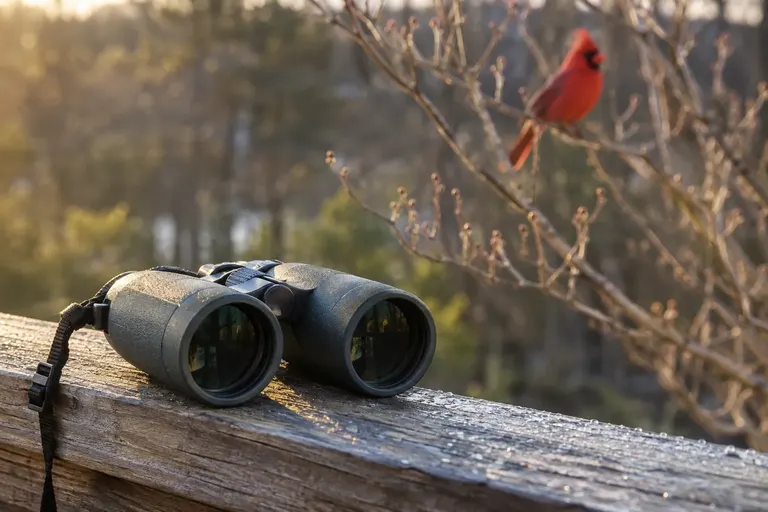
Binoculars are the most flexible tool for window watching, but they are not the only one.
A spotting scope on a short tripod by the window gives far more magnification, useful for a distant pond or field edge. It is slow to aim at small, active birds at close range, and most scopes cannot focus as close as a good binocular.
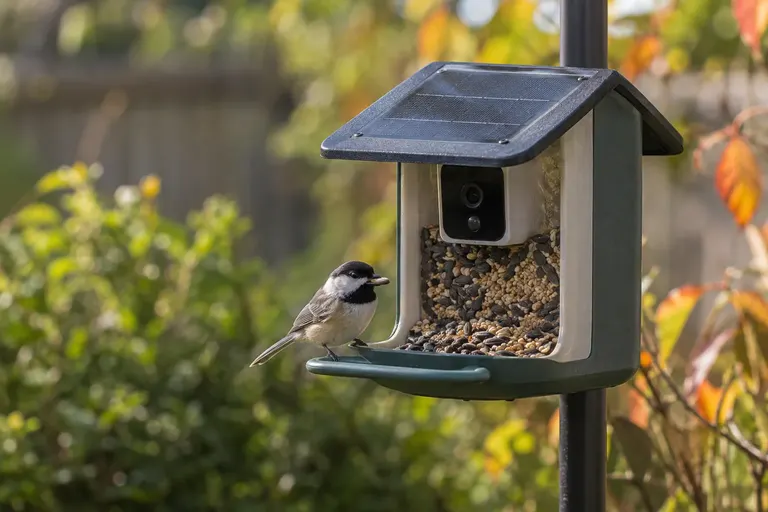
A smart feeder camera shows birds inches from the lens, records visits while you are away and often suggests an ID. It only sees one feeder, and it does not replace the thrill of finding a bird in the yard yourself. Our roundup of bird feeder cameras compares the leading options.
For most households, a good 8x binocular on the windowsill does the most for the least money, and it goes on walks too.
Common mistakes when choosing window binoculars
- Buying high magnification. 12x and 16x are hard to hold and show a narrow view at close range.
- Ignoring close focus. A great binocular that cannot focus on your feeder is the wrong binocular.
- Choosing a 10x50 “for brightness.” It is heavy and slow for close, fast birds.
- Watching through a screen. Open it, or at least slide it aside.
- Leaving the binocular in a case. Keep it on the windowsill, caps off indoors, so it is ready in seconds.
Which binocular should you buy for window watching?
Choose the Vortex Diamondback HD 8x42 if you want one binocular for the window and the trail. Choose the Nikon Monarch M7 8x30 for a light, wide pair. Choose the Nikon Monarch M5 8x42 if you wear glasses. Choose the Celestron Nature DX 8x42 to spend less. Choose the Pentax Papilio II 8.5x21 if your feeder sits on the glass. Choose the Canon 10x20 IS for a big yard or unsteady hands.
Sources
Frequently asked questions
What magnification is best for watching birds from a window?
8x is best for most windows. Backyard birds are usually 10 to 60 ft away, so you do not need high power, and 8x gives a wider, brighter, steadier view. 10x helps if your yard is large or you watch a pond or field. Image-stabilized 10x binoculars remove most of the extra shake that normally comes with higher power.
Can you use binoculars through a window?
Yes, but window glass reduces sharpness and contrast. Double and triple panes can add faint ghost images, and some coated glass adds a tint. For the best view, open the window and screen, or look straight through clean glass rather than at an angle. Keep the binocular's objective lenses close to the glass to reduce reflections from the room.
What close focus do I need for backyard bird watching?
Measure the distance from where you usually stand or sit to your nearest feeder. Your binocular's close focus must be shorter than that. For most yards, 5 to 7 ft is ideal. For feeders mounted on the window glass, only specialist designs such as the Pentax Papilio II, which focuses to 1.6 ft, will work.
Are 10x50 binoculars good for backyard birding?
Usually not. A 10x50 is usually much heavier than an 8x42, with a narrower view and, on many models, a longer close focus. Its extra brightness helps at dusk or for stargazing, but backyard birds are close and quick, so a lighter 8x42 or 8x32 is easier to use. If you want more magnification, consider an image-stabilized 10x instead.
Will watching birds from my window cause window collisions?
Watching does not, but windows near feeders can be a hazard. The Cornell Lab now advises making windows near feeders bird friendly, rather than worrying about exact feeder distances. Markings spaced about 2 inches apart, external screens or paracord curtains on the outside of the glass help birds see it.