Best Monocular for Birding: Worth It or Not? 5 Picks
The best monocular for birding is the Leica Monovid 8x20: 4 oz, waterproof, with a close-up lens. When a monocular beats binoculars, when not, and 5 picks.
If you buy through links on this page we may earn a commission, at no cost to you. It never decides what we recommend. How we earn
In this article
- Quick picks
- How we chose
- Is a monocular good for birding?
- Monocular or binoculars?
- Which monocular is best for birding?
- Leica Monovid 8x20: best overall
- Zeiss Mono 8x20 T*: lightest premium 8x
- Vortex Solo 8x25: best value
- Nikon 7x15 HG Monocular: smallest close-focus pick
- Bushnell Legend Ultra HD 10x42: most magnification and light
- What do the numbers on a monocular mean?
- What magnification is best for birds: 8x or 10x?
- Are cheap high-zoom monoculars (10-30x50, 16x52, “80x”) any good for birds?
- BaK-4 or BK-7: does the prism glass matter?
- Do you need a waterproof monocular?
- Is a monocular good for glasses wearers?
- How do you hold a monocular steady?
- Do you need a tripod for a monocular?
- Can you use a monocular as a magnifier for insects?
- What are the most common monocular mistakes?
- Which monocular should you buy?
- What’s the verdict on monoculars for birding?
- Sources
- Frequently asked questions
The best monocular for birding is the Leica Monovid 8x20: it weighs 112 g (4.0 oz), is sealed waterproof to 5 m, and a screw-on close-up lens lets it focus at about 25-30 cm (10-12 in) on insects. A monocular is a great pocket backup and travel tool, but it does not replace binoculars for birds in flight, long sessions or dusk. If you can carry only one optic for serious birding, buy binoculars; if you want something that is always with you, a monocular earns its place.
Below: a monocular-or-binoculars table, five models worth buying, what the numbers mean, why cheap zoom monoculars disappoint, and a short list to help you decide.
Quick picks
- Best overall: Leica Monovid 8x20. Waterproof to 5 m, 4.0 oz, close-up lens included.
- Lightest premium 8x: Zeiss Mono 8x20 T*. Just 2.4 oz by Zeiss’s figure, splash-proof.
- Best value: Vortex Solo 8x25. Tough, waterproof, widest view of the 8x picks.
- Smallest close-focus pick: Nikon 7x15 HG Monocular. 2.8 in long, focuses to 2.6 ft.
- Most magnification and light: Bushnell Legend Ultra HD 10x42. ED glass, 4.2 mm exit pupil, but 13.2 oz.
Leica Monovid 8x20
A sealed 8x20 monocular with a screw-on close-up lens that brings focus down to about 25-30 cm (10-12 in).
- Best for
- Daily pocket carry for birds by day and insects, flowers and lichens up close.
- Skip it if
- You want the lightest premium 8x; the Zeiss is lighter, though only splash-proof.
- Field of view
- 330 ft at 1,000 yd (110 m at 1,000 m)
- Close focus
- About 5.9 ft (1.8 m); 10-12 in (25-30 cm) with close-up lens
- Weight
- 4.0 oz (112 g)
- Waterproof
- To 16.5 ft (5 m)
Zeiss Mono 8x20 T*
A slim 8x20 from Zeiss's current monocular range, very light, with T* multi-coating.
- Best for
- Travelers and city walkers who want top-brand glass at the lowest weight.
- Skip it if
- You bird in steady rain or want to look at insects; it is splash-proof and focuses no closer than 9.8 ft.
- Field of view
- 330 ft at 1,000 yd (110 m at 1,000 m)
- Close focus
- 9.8 ft (3.0 m)
- Weight
- 2.4 oz (67 g), Zeiss figure
- Weather sealing
- Splash-proof
Vortex Solo 8x25
A rubber-armored, nitrogen-purged 8x25 with the widest field of view of the 8x picks here.
- Best for
- Beginners, hikers and kids' backpacks where toughness matters more than optical polish.
- Skip it if
- You want close focus for butterflies or the sharpest view; it stops at 16.4 ft.
- Field of view
- 378 ft at 1,000 yd (126 m at 1,000 m)
- Close focus
- 16.4 ft (5 m)
- Weight
- 5.6 oz (159 g)
- Waterproof
- Yes, O-ring sealed, nitrogen-purged
Nikon 7x15 HG Monocular
A tiny 7x15 roof-prism monocular from Nikon's HG line, 2.8 in long, that focuses down to 2.6 ft.
- Best for
- Museums, gardens and nature walks where close focus and tiny size matter more than reach.
- Skip it if
- You need weather sealing; Nikon does not list a waterproof rating.
- Field of view
- 345 ft at 1,000 yd (115 m at 1,000 m)
- Close focus
- 2.6 ft (0.8 m)
- Weight
- 2.6 oz (75 g)
- Waterproof
- -
Bushnell Legend Ultra HD 10x42 Monocular
A full-size 10x42 monocular with ED Prime glass and a 4.2 mm exit pupil, closer to half a binocular than a pocket toy.
- Best for
- Shorebird and waterfowl watchers who want a brighter, longer-reaching single-eye scope for a vest or bag.
- Skip it if
- You want true pocket size, or you would rather not see crosshairs; tactical versions have a Mil-Hash reticle.
- Field of view
- 340 ft at 1,000 yd (113 m at 1,000 m)
- Close focus
- 6.2 ft (1.9 m)
- Weight
- 13.2 oz (374 g)
- Waterproof
- IPX7
How we chose
Perch and Glass has not used these monoculars in the field. This guide is research-based. We started from the birding jobs a monocular should do, then compared technical data from Leica, Zeiss and Nikon, and retailer specification pages where the maker’s page was unavailable. We checked that each model is currently sold, used only figures we could find in those sources, and marked anything we could not confirm with a dash. Owner-review patterns and two independent hands-on reviews, credited by name, shaped the strengths and drawbacks.
Is a monocular good for birding?
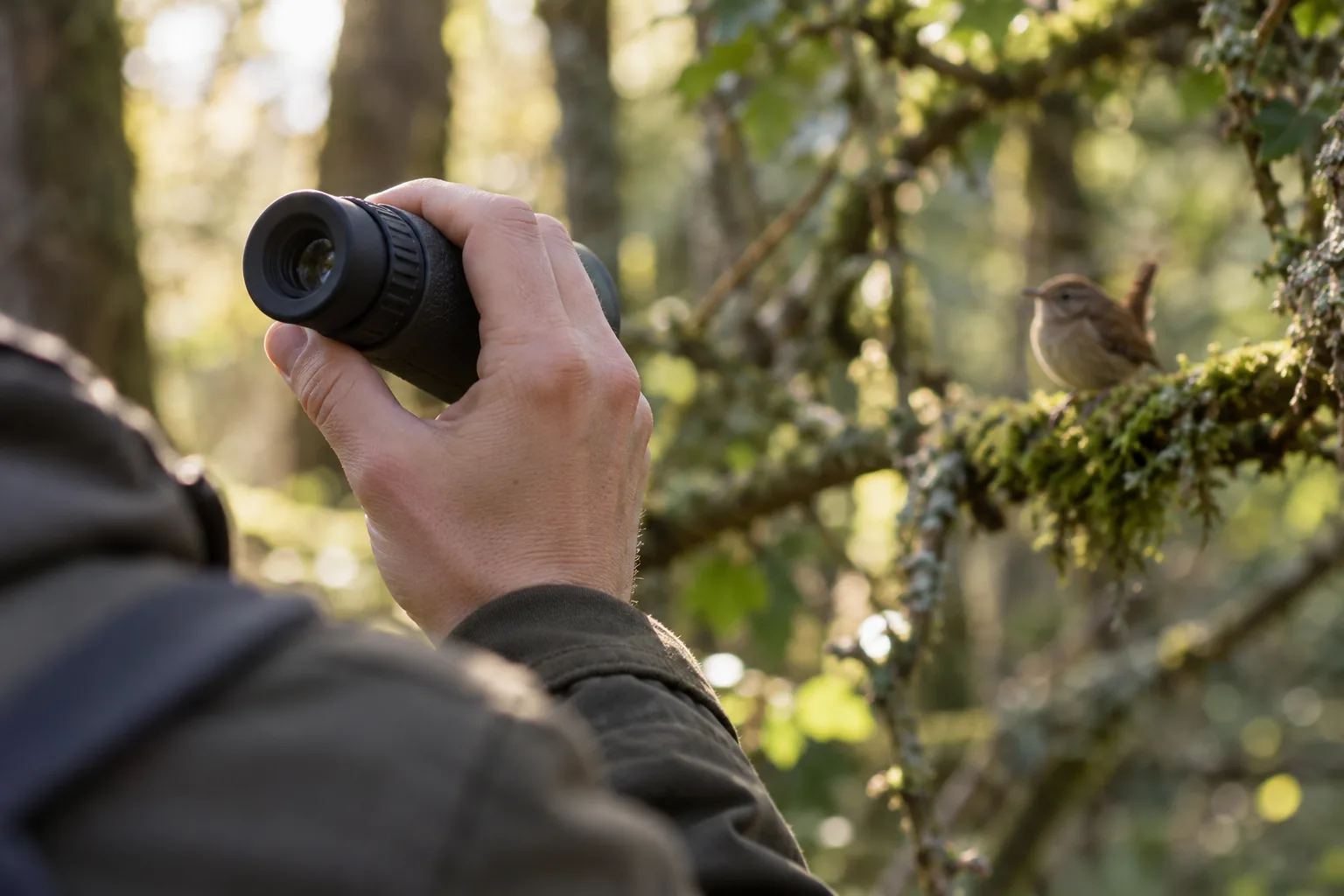
A monocular is good for birding as a pocket companion, not as your main optic. It gives you a magnified view of a perched bird at roughly half the weight and bulk of compact binoculars, but you lose stereo vision and some steadiness, so following birds that move is harder.
Think of it as “optics you actually carry”: a full-size 8x42 often stays at home, while a 2.4 to 5.6 oz monocular rides in a jacket pocket, and a view you have beats a better one on a shelf.
Monocular or binoculars?
Choose binoculars if you can carry only one optic; choose a monocular when size, weight or one-handed use decide. The trade-offs follow from simple optics: one barrel and one eye instead of two.
| Monocular | Binoculars | |
|---|---|---|
| Carry size | Most fit a shirt or jacket pocket; 10x42 models need a bag | Compacts fit a jacket pocket; full-size models need a strap or harness |
| Weight range | 2.4 to 13.2 oz (67 to 374 g) across the picks here | Heavier for the same lenses, because there are two barrels and a hinge |
| Finding birds in flight | Harder: one eye, smaller and shakier image | Easier: both eyes and a steadier two-handed hold |
| Long sessions and eye strain | Tiring, because one eye works while the other squints | Relaxed, because both eyes share the work |
| Depth perception | None; the view is flat | Stereo view shows which branch the bird is on |
| One-handed use | Designed for it | Usually needs two hands |
| Price tier | Usually less than binoculars of similar glass quality, since there is one optical path | Higher for the same glass quality |
Where a monocular wins. Pocket carry on walks and trips. Travel, when a falcon on a cathedral and a painting detail share one tiny optic. One-handed looks while you hold a leash. Quick ID of a perched bird; our guide to finding a bird fast in your optics works with one eye too. Useful vision in only one eye, where binoculars add no stereo benefit. And close-up “loupe” use on butterflies and lichen.
Where binoculars win. Tracking a swallow or a hawk, hour-long sessions at a marsh, judging whether the duck is in front of or behind the reeds, and dusk. Small monoculars have exit pupils of 2.1 to 3.1 mm, against 5.25 mm for an 8x42 binocular, so they dim early.
Which monocular is best for birding?
The Leica Monovid 8x20 is the best monocular for birding for most people, because it combines a sealed, waterproof body with a close-up lens and an 8x view. Figures come from maker or retailer pages; a dash means we could not confirm one.
| Model | Magnification | Objective | Field of view | Close focus | Weight | Waterproof |
|---|---|---|---|---|---|---|
| Leica Monovid 8x20 | 8x | 20 mm | 330 ft at 1,000 yd (110 m at 1,000 m) | 5.9 ft (1.8 m); 10-12 in (25-30 cm) with lens | 4.0 oz (112 g) | Yes, to 5 m |
| Zeiss Mono 8x20 T* | 8x | 20 mm | 330 ft at 1,000 yd (110 m at 1,000 m) | 9.8 ft (3.0 m) | 2.4 oz (67 g) | Splash-proof |
| Vortex Solo 8x25 | 8x | 25 mm | 378 ft at 1,000 yd (126 m at 1,000 m) | 16.4 ft (5 m) | 5.6 oz (159 g) | Yes |
| Nikon 7x15 HG Monocular | 7x | 15 mm | 345 ft at 1,000 yd (115 m at 1,000 m) | 2.6 ft (0.8 m) | 2.6 oz (75 g) | - |
| Bushnell Legend Ultra HD 10x42 | 10x | 42 mm | 340 ft at 1,000 yd (113 m at 1,000 m) | 6.2 ft (1.9 m) | 13.2 oz (374 g) | IPX7 |
Leica Monovid 8x20: best overall
What it is: A short, fully sealed 8x20 with a large focus wheel and a screw-on close-up lens that lives in the lid of its hard case. Leica’s technical data lists close focus of about 1.8 m (5.9 ft), and 25-30 cm (10-12 in) with the close-up lens.
Who it suits: Anyone who wants one small optic for birds and for insects, flowers and lichens up close.
Key facts: 112 g (4.0 oz), 97.9 mm (3.9 in) long, 2.5 mm exit pupil, 15 mm eye relief, waterproof to 5 m (16.5 ft). Scopeviews notes the AquaDura water-repellent coating on the objective and nitrogen filling.
Strengths: The close-up lens turns it into a strong magnifier, something no binocular offers. Build and sealing are top tier.
Drawbacks: It is the priciest pick, in the premium tier. The stiff focus wheel makes fine focusing harder without support. It comes with a wrist lanyard rather than a neck strap.
What reviewers found: In its hands-on review, Scopeviews called the view “sharp, detailed and crisp” but found the focus “very stiff” and the tiny body harder to hold steady than 8x20 binoculars. BirdGuides praised the close-up lens on lichens and woodlice, noted its very shallow depth of field, and concluded the Monovid will never replace binoculars in the field.
Skip it if: You mainly want the lowest weight; the Zeiss weighs less.
See available listings on Amazon
Zeiss Mono 8x20 T*: lightest premium 8x
What it is: A slim 8x20 from Zeiss’s current monocular range, which also includes 3x12, 4x12, 6x18 and 10x25 models. Zeiss lists a 110 m field at 1,000 m, a 3.0 m (9.8 ft) close focus and a weight of 67 g (2.4 oz).
Who it suits: Travelers and city walkers who want top-brand T* coated glass in the lightest package.
Key facts: 2.5 mm exit pupil, 15 mm eye relief, diopter range of plus or minus 4 dpt according to Zeiss. The housing is splash-proof, not rated waterproof.
Strengths: Very light for a premium 8x, with glasses-friendly eye relief.
Drawbacks: Splash-proof only. The 9.8 ft close focus rules out insect viewing; Zeiss’s 3x12 and 4x12 versions focus to 0.2-0.3 m if that is what you want.
Skip it if: You bird in wet weather or want close-up use.
See available listings on Amazon
Vortex Solo 8x25: best value
What it is: A rubber-armored 8x25 with O-ring seals and nitrogen purging. Retailer data lists a 7.2 degree field (378 ft at 1,000 yards), the widest of the 8x picks here.
Who it suits: Beginners, hikers and families. It is tough enough for a kid’s backpack; see our binoculars for kids guide if a young birder is the main user.
Key facts: 3.1 mm exit pupil, the largest among the small picks, 15 mm eye relief, about 4.4 in long.
Strengths: Wide view, a bit brighter than the 20 mm models, waterproof, and in the budget tier.
Drawbacks: Heavier than the premium 8x20s, and 16.4 ft close focus is too far for butterflies. Some European shops now list it as sold out, while US stock is easier to find.
Skip it if: You want close-up use or the most compact pocket size.
See available listings on Amazon
Nikon 7x15 HG Monocular: smallest close-focus pick
What it is: A tiny roof-prism monocular from Nikon’s HG line, sold in 5x15 and 7x15 versions. Nikon lists the 7x15 at 75 g (2.6 oz) and 71 mm (2.8 in) long. The 5x15 focuses to 0.6 m (2.0 ft) with a 157 m field.
Who it suits: Gardens, museums and nature walks.
Key facts: Silver-coated, phase-correction-coated roof prism and multilayer coatings, according to Nikon. Exit pupil 2.1 mm on the 7x and 3.0 mm on the 5x. Eye relief 12 mm on the 7x and 15.8 mm on the 5x.
Strengths: The smallest pick, and a natural loupe for insects without extra lenses.
Drawbacks: Nikon’s page does not list a waterproof rating, so treat it as a fair-weather tool. At 7x and 15 mm it shows less detail on distant birds than an 8x20. The 12 mm eye relief on the 7x can be tight for glasses wearers; the 5x is kinder.
Skip it if: You want weather sealing or detail on birds across a field.
See available listings on Amazon
Bushnell Legend Ultra HD 10x42: most magnification and light
What it is: A full-size 10x42 monocular with ED Prime extra-low-dispersion glass. Retailer data lists 13.2 oz (374 g) and a 5.4 in (137 mm) length. Bushnell’s dealers list an IPX7 waterproof rating.
Who it suits: Watchers of distant shorebirds, ducks and raptors who want half a full-size binocular in a bag.
Key facts: 4.2 mm exit pupil, the brightest view here, and 15.2 mm eye relief. Tactical versions add a Mil-Hash reticle, a crosshair with hash marks, so read the listing to know which one you are buying.
Strengths: Real 10x detail with enough light for overcast days.
Drawbacks: It is not a pocket optic, and 10x magnifies hand shake more than 8x. At 13.2 oz, a compact or lightweight binocular is not much heavier; compare our lightweight binoculars before deciding.
Skip it if: Pocket size is the reason you want a monocular.
See available listings on Amazon
What do the numbers on a monocular mean?
The two numbers are magnification and objective lens diameter in millimeters. An 8x20 monocular makes a bird look 8 times closer and has a 20 mm front lens. Dividing the second number by the first gives the exit pupil, the beam of light that reaches your eye: 20 divided by 8 is 2.5 mm.
Magnification sets detail and shake. More magnification shows more feather detail but also enlarges every tremor of your hand and narrows the view.
Objective size sets light gathering and bulk; a 25 mm lens collects about 56 percent more light than a 20 mm lens.
Exit pupil tells you how bright the view looks. In bright daylight, the human pupil is small, roughly 2 to 3 mm, so a 2.5 mm exit pupil looks fine. At dawn and dusk your pupil opens wider and a small exit pupil looks dim. That is why the 42 mm Bushnell, at 4.2 mm, is the low-light pick here.
Field of view is the width of the scene at 1,000 yards; wider makes finding a bird easier.
Close focus is the nearest distance at which the image is sharp. For birds at a feeder, 10 ft is fine; for insects, you want under 3 ft. For a full walk-through, read what the numbers on binoculars mean; everything applies to monoculars too.

What magnification is best for birds: 8x or 10x?
Choose 8x for most birding. It is easier to hold steady, gives a wider field and a brighter view from the same lens size, and still shows enough detail to identify most songbirds.
Shake that is acceptable at 8x in a small monocular becomes distracting at 10x. If you want 10x, pick a larger body like the Bushnell that gives your hands something to grip. Our 8x42 vs 10x42 guide explains the same trade-off for binoculars.
A 5x to 7x model suits gardens, museums and insects: less shake, wider field, closer focus, but distant birds look small.
Are cheap high-zoom monoculars (10-30x50, 16x52, “80x”) any good for birds?
No. Many of the top-ranking monocular lists recommend 10-30x50 zooms, 16x52 models and “80x100 phone telescopes,” but the physics works against all of them, which is why real birding optics stay between 5x and 10x.
The exit pupil collapses. Exit pupil is objective size divided by magnification. A 10-30x50 at 30x gives 50 / 30 = 1.7 mm, and an “80x100” gives 1.25 mm, both smaller than the 2.5 mm of an 8x20. The view is dim except in full sun, and at dawn and dusk, when your pupil opens to around 5 to 7 mm, it fades fast.
The field narrows. True field is roughly the eyepiece’s apparent field divided by magnification, so tripling the power cuts the field to about a third. With a typical 50 degree eyepiece, 80x leaves under 1 degree, about 11 m at 1,000 m against 110 m for the 8x20 picks. A warbler that hops one branch is gone.
Hand shake is magnified. Magnification enlarges every tremor as much as the bird. A 16x52 has a reasonable 3.25 mm exit pupil, but its handheld image shakes twice as much as at 8x, and at 30x or 80x the view is unusable without a solid tripod.
Zoom is a compromise. Zoom eyepieces typically have a narrower apparent field than fixed-power eyepieces, so even the low end of the range shows less than a good 8x or 10x.
The phone adapter and mini tripod in these kits change none of this.
BaK-4 or BK-7: does the prism glass matter?
Yes, a little. BaK-4 barium crown glass has a higher refractive index than BK-7 borosilicate glass, so prisms made from it reflect the full cone of light and give a round, evenly bright exit pupil; BK-7 prisms clip the edges into a squared-off, grayer disc and lose some brightness. To check, hold the eyepiece toward a bright sky at arm’s length and look at the small disc of light: round and bright means BaK-4 or better. But “BAK4” on a listing says nothing about coatings, lens quality or sealing, so treat it as a minimum, not proof of good optics.
Do you need a waterproof monocular?
Yes, if you bird in rain, near water or in cold weather. A sealed, gas-filled body keeps water and dust out and stops the inside of the lenses fogging when you step from a warm car into cold air. “Splash-proof,” like the Zeiss Mono, handles a shower, not a dunking. IPX7, listed for the Bushnell, means it survives immersion to 1 m (3.3 ft) for 30 minutes, and the Leica is rated to 5 m. Nikon lists no rating for the HG, so keep it dry.
Is a monocular good for glasses wearers?
Usually, yes. Look for eye relief of about 15 mm or more and an eyecup that twists or folds down so your lens can sit close to the eyepiece; the Leica, Zeiss and Vortex list 15 mm and the Bushnell 15.2 mm, while the Nikon 7x15 has a tight 12 mm. Because you use one eye, you can also take your glasses off: the focus wheel corrects nearsightedness or farsightedness, though not astigmatism.
How do you hold a monocular steady?
Use both hands and brace against your face or something solid. One-handed use is fine for a quick look, but a steady view comes from support.
Two-hand cup. Hold the monocular with your dominant hand, cup that hand with the other, and rest the eyecup gently against your eye socket so your face becomes a third contact point.
Brace your elbows. Tuck them against your chest, or rest them on a fence, a car roof or your knees. Lean against a tree when you can.
Breathe out. Exhale halfway and hold for a couple of seconds while you study the bird.
Set focus first. Focus on something at the bird’s distance before it appears, so you only need small corrections.
Do you need a tripod for a monocular?
Not at 7x to 10x. Braced with two hands against your eye socket, those magnifications hold steady enough for a perched bird. A tripod or monopod starts to matter above about 12x, or for long watches of a nest or a distant shorebird flock, and at that point a spotting scope is the better tool. The mini tripods bundled with zoom monoculars are too light to stop the shake that high magnification creates.
Can you use a monocular as a magnifier for insects?
Yes, if it focuses close enough. The Leica Monovid with its close-up lens focuses at about 25-30 cm (10-12 in), and the Nikon HG models at 0.6-0.8 m (2.0-2.6 ft), ideal for bees, butterflies and dragonflies on a flower. For birders who also love insects, this is the strongest argument for a monocular: no binocular gives you a 10-in close focus.
What are the most common monocular mistakes?
The biggest mistake is buying the highest magnification instead of the most usable one.
Buying 30x, 40x or 80x. Covered above: dim, shaky and narrow. Stay at 7x to 10x.
Expecting a binocular replacement. A monocular complements binoculars. If you plan to bird several mornings a week, you need binoculars; read birding for beginners for the core kit.
Ignoring close focus. For insects, check close focus first; the Vortex and Zeiss 8x models stop at 16.4 and 9.8 ft.
Leaving it in the bag. The point is pocket carry; a monocular in a backpack is just a smaller binocular you don’t use.
Which monocular should you buy?
Match the monocular to the job, and be honest about whether you need binoculars instead.
- Pocket and travel: Leica Monovid 8x20 for waterproofing and the close-up lens, or Zeiss Mono 8x20 T* if the lowest weight matters most and you bird in dry weather.
- Budget: Vortex Solo 8x25, a tough, waterproof first monocular with the widest 8x field here.
- Gardens, museums and insects: Nikon 7x15 HG for its 2.6 ft close focus.
- Longer viewing of distant birds: Bushnell Legend Ultra HD 10x42, the brightest view here, if a 13.2 oz bag optic is acceptable.
- You track birds in flight or bird for hours: skip the monocular and look at our best 8x42 binoculars, or our best compact binoculars for pocket size with two eyes.
What’s the verdict on monoculars for birding?
Buy binoculars as your main birding optic, and add a monocular if you want optics with you every day. For most birders, the monocular to add is the Leica Monovid 8x20, because it is sealed, light and doubles as a close-up viewer.
If you have useful vision in only one eye, flip the advice: a quality 8x monocular can be your main birding tool, and the money you save on a second barrel can go into better glass.
Free printable: Download the binocular and monocular decision guide (PDF, 2 pages). No ads and no affiliate links; free to print and share with your bird club or class.
Sources
- Leica Monovid 8x20 technical data (PDF, via EuroOptic)
- Zeiss: Monokulare, technical data
- Nikon: 5x15 HG Monocular and 7x15 HG Monocular
- B&H Photo: Vortex Solo 8x25 Monocular
- B&H Photo: Bushnell Legend Ultra HD 10x42 Monocular
- Scopeviews: Leica 8x20 Monovid review
- BirdGuides: Leica Monovid 8x20 review

Frequently asked questions
Is a monocular good for birding?
Yes, as a second tool. A good 8x monocular weighs 2.4 to 5.6 oz, fits a shirt pocket and is quick for identifying a perched bird. It is worse than binoculars for tracking birds in flight, long sessions and depth perception, because only one eye works and the image is harder to hold steady. Use it for walks, travel and the garden, not as your only optic.
What magnification is best for a birding monocular?
8x is the best all-round choice. It gives enough detail for most songbirds while keeping the field of view wide, around 330 to 378 ft at 1,000 yards on the picks here, and the image steady enough to hold by hand. 10x shows more detail but shakes more. 5x to 7x suits close views in gardens and museums.
Are 80x or 40x60 phone monoculars any good for birds?
No. At 80x every tiny hand tremor is magnified 80 times, the field of view shrinks to a few degrees or less, and the exit pupil of an 80x100 design is only 1.25 mm, so the image is dim and shaky. Real birding optics stay at 7x to 10x. The BAK4 label only names the prism glass type and does not prove good optics.
Can you use a monocular with glasses?
Often, yes. Look for eye relief of about 15 mm or more and a twist-down or fold-down eyecup. The Leica Monovid and Zeiss Mono 8x20 list 15 mm and the Bushnell 15.2 mm. Since you look with one eye, you can also take your glasses off and refocus, which many people find faster.
Is a monocular good if I only see well with one eye?
Yes. If you have useful vision in only one eye, binoculars give you no stereo benefit, so a monocular delivers the same view at about half the weight. It also avoids the problem of very different prescriptions between eyes. Choose 8x with good eye relief, and practise bracing it so the single eye gets a steady image.
Which is better for birding, a monocular or compact binoculars?
For most people, compact 8x25 binoculars. Two eyes give a more relaxed, three-dimensional view that is easier to hold steady and better for birds in motion. A monocular wins only when size and weight decide everything: a pocket you already fill, a travel kit, or a close-up loupe. Many birders own both.