Is ED Glass Worth It in Binoculars?
Are ED glass binoculars worth it? Usually yes at 10x, for birds against bright sky and in mid-priced pairs, but ED labels vary and coatings matter as much.
If you buy through links on this page we may earn a commission, at no cost to you. It never decides what we recommend. How we earn
In this article
- Quick answer: is ED glass worth it?
- What is ED glass in binoculars?
- What does chromatic aberration look like?
- When will you notice ED glass?
- ED glass vs HD glass vs fluorite
- What ED glass does not fix
- A useful comparison: the same binocular with and without ED
- How to check for color fringing before you buy
- Who should pay for ED glass?
- Where ED glass fits at each budget level
- Does ED glass matter for spotting scopes and digiscoping?
- Three ED binoculars worth a look
- Common mistakes when shopping for ED binoculars
- How we put this guide together
- Sources
- Gear mentioned in this guide
- Frequently asked questions
ED glass is worth it in most binoculars if the premium is modest: it reduces the purple and green fringes around birds against bright sky and makes 10x views look crisper. It matters less at 8x on feeder birds in shade. And because there is no official standard for “ED”, the label alone does not guarantee a better image, so check the coatings and the rest of the spec sheet too.
This guide explains what ED glass does, what color fringing looks like, when you will notice it, and how to decide if an ED model is worth the extra cost for your birding.
Quick answer: is ED glass worth it?
- Worth it: 10x or higher binoculars, frequent views of birds against sky or water, raptors and gulls, and any case where the ED version of a model costs little more than the standard one.
- Less important: 8x binoculars used mostly for feeder birds in shaded yards.
- Not enough on its own: ED glass cannot make up for missing phase coating, poor prism coatings or weak lens coatings.
- Watch the wording: “HD” is not the same thing as ED.
What is ED glass in binoculars?
ED stands for extra-low dispersion. Dispersion is the way glass bends each color of light by a slightly different amount. Blue light bends more than red light when it passes through ordinary glass. A single lens therefore brings each color to focus at a slightly different point.
Nikon’s optics guide explains that a single lens cannot compensate for this, so makers combine lenses. A standard two-element objective (an achromat) can bring two colors, typically red and blue, to the same focus. The colors in between, such as green, still land a little off. That leftover error is called the secondary spectrum.
ED glass has an unusual dispersion profile. When it is paired with other glass types in the objective lens, it pulls those leftover colors closer together. Nikon describes ED glass as minimizing the effects of the secondary spectrum far more effectively than standard glass.
Celestron describes ED glass as containing rare-earth compounds. Other makers use fluoride-containing glass or fluorite crystal, which have similarly low dispersion.
What does chromatic aberration look like?
Chromatic aberration shows up as color fringing: thin halos of purple, blue, green or yellow along high-contrast edges. Celestron calls it an unnatural “halo” effect around light-colored objects against dark backgrounds.
In birding, you most often see it in these situations:
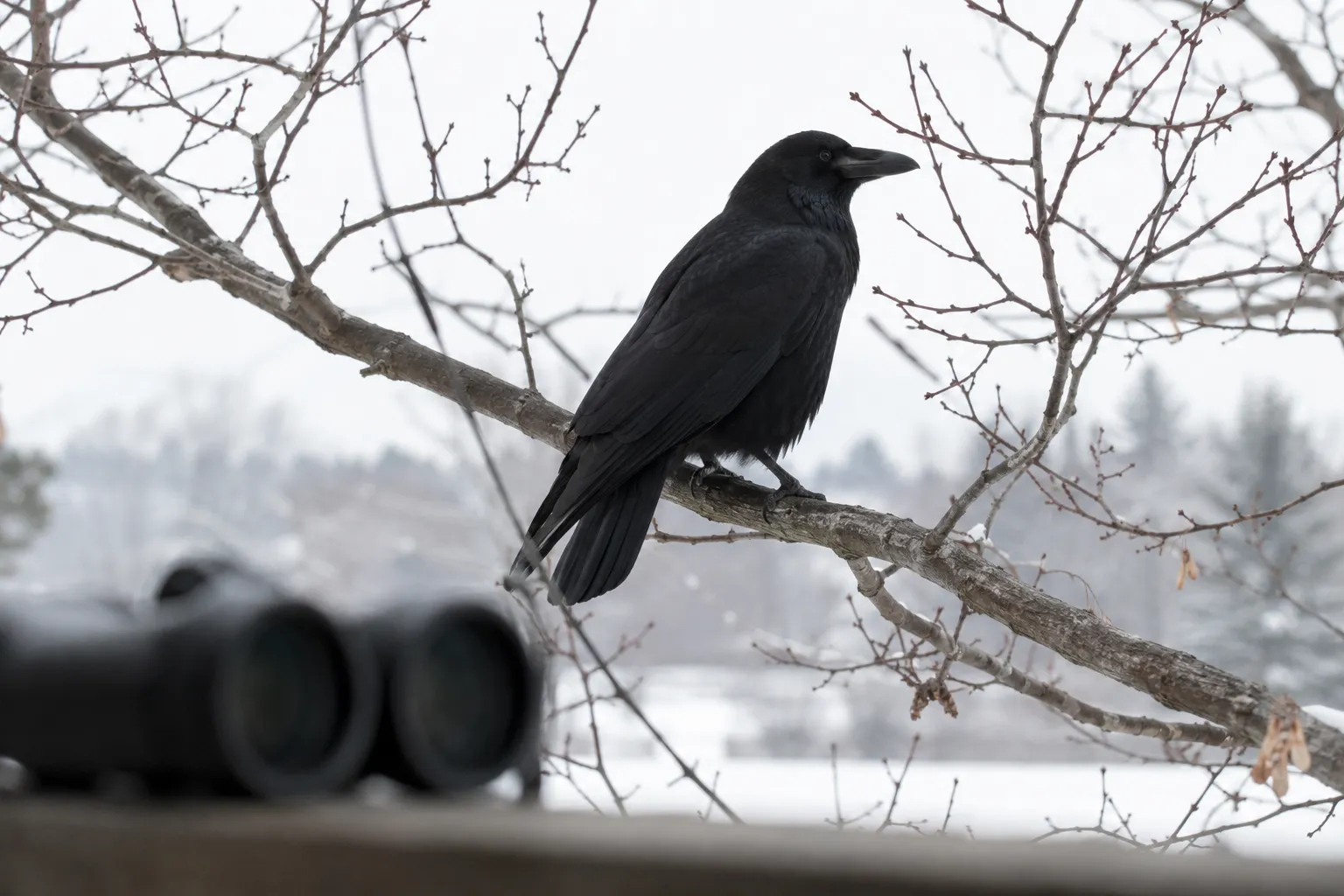
- A dark bird against bright sky. A crow, a vulture or a woodpecker on a bare snag, silhouetted against overcast sky, may show a purple or green outline.
- White birds in sun. Gulls, egrets and the white patches on a nuthatch can pick up colored edges.
- Birds on bare branches in winter. Twigs against sky show fringing clearly.
- Water and snow. Bright reflections create hard edges that reveal fringing.
Fringing does more than add color. It softens the edge itself, so fine detail such as barring, streaks and eye-rings can look slightly less crisp. That is why makers say ED improves sharpness and contrast, not just color.
Two types of fringing
Optics references describe two kinds of chromatic aberration:
- Axial (longitudinal): colors focus at different distances along the lens axis. It shows in the center of the view. This is what ED objective lenses mainly correct.
- Lateral: colors are magnified by slightly different amounts, so fringing grows toward the edge of the field. Nikon notes that magnification as well as focus can vary by wavelength. Eyepiece design plays a large role here.
This is why an ED binocular can still show some fringing near the edge of the view. It is normal and not a defect.
When will you notice ED glass?
Magnification matters
Higher magnification enlarges every flaw, including color fringing. Nikon notes that chromatic aberration becomes prominent at high magnification, particularly with light-colored subjects such as white birds. That is why ED glass has been standard in spotting scopes for years. In binoculars, the difference is more visible at 10x and 12x than at 8x. If you are torn between the two powers, see our comparison of 8x42 vs 10x42 for birding.
Light and background matter
Fringing needs contrast. A chickadee on a feeder in open shade, with a green hedge behind it, shows little fringing in almost any decent binocular. The same chickadee on a bare branch against bright winter sky will reveal the difference between ED and non-ED objectives more clearly.
Your eyes matter
Some people are more sensitive to color fringing than others. Owners commonly report that once they notice fringing, they cannot stop seeing it, while others never notice it at all. If you have used binoculars before and fringing did not bother you, ED is less of a priority.
ED glass vs HD glass vs fluorite
The labels on binocular boxes are not standardized, which makes this confusing.
| Term | What it usually means | Standardized? |
|---|---|---|
| ED (extra-low dispersion) | Objective lenses use a low-dispersion glass type to reduce color fringing | No formal standard; the amount and grade of ED glass varies |
| HD (high definition) | A marketing label for a model line; may or may not include ED glass | No |
| Fluorite / fluoride glass | Very low-dispersion material, used in some premium optics | No single standard, but refers to a specific material family |
| Apochromatic (APO) | Lens designed to bring three colors to a common focus | Term used loosely in marketing |
Celestron’s own ED explainer is candid on this point: there is no official standard or definition for ED, so a maker can use a minimal amount of low-dispersion material and still call a binocular “ED”. Retailer guides make a similar point about HD, which does not refer to a specific type of glass.
Practical takeaway: treat “ED” as a positive sign, not a guarantee. Treat “HD” as a model name unless the specs say what glass it uses. Independent reviews that describe color fringing in real use are more useful than the label.
What ED glass does not fix
ED glass is one part of an optical system. It cannot fix:
- Missing phase coating on roof prisms. Without it, contrast and detail suffer no matter what glass is in the objective. Our explainer on roof prism vs porro prism binoculars covers why.
- Poor prism mirror coatings. Schmidt-Pechan roof prisms need a mirror coating on one face. Silver or dielectric coatings reflect more light than aluminum.
- Weak lens coatings. “Fully multi-coated” means every air-to-glass surface has several anti-reflection layers. Anything less loses light and contrast.
- Poor assembly. Misaligned barrels (collimation) or loose tolerances cause eye strain and softness.
- Setup errors. A mis-set diopter makes any binocular look soft. See how to adjust binoculars.
When you compare two binoculars, check that the ED model also has full multi-coating and, for roof prisms, phase-coated prisms. If a cheaper non-ED model has better coatings than an ED model, it may give the better image.
A useful comparison: the same binocular with and without ED
The cleanest way to judge the value of ED glass is to compare two versions of the same binocular. Celestron sells both a Nature DX 8x42 and a Nature DX ED 8x42.
| Spec | Nature DX 8x42 | Nature DX ED 8x42 |
|---|---|---|
| ED objective lenses | No | Yes |
| Field of view | 388 ft at 1,000 yd | 393 ft at 1,000 yd |
| Eye relief | 17.5 mm | 17.8 mm |
| Close focus | 6.5 ft | 6.5 ft |
| Weight | 22.2 oz | 24.9 oz |
| Prisms | Phase-coated BaK-4 | Phase-coated BaK-4 |
| Waterproof | Yes | Yes |
Specs from Celestron’s product pages. The two share their core layout, so the main optical difference is the ED objective lens. If the price gap between them is small when you shop, the ED version is the logical choice. The Cornell Lab’s review of the ED version rated it a solid choice for its price, praising color and resolution in good light, while noting that it could lose detail and color on backlit subjects. That is a reminder that ED glass reduces one flaw; it does not make a budget binocular behave like a premium one. Our Celestron Nature DX 8x42 review covers the standard version in depth.
How to check for color fringing before you buy
If you can try binoculars in a store or return them easily, this simple check shows how much fringing a pair has.
- Set the binocular up properly first. Eyecups, width and diopter, as described in how to adjust binoculars.
- Find a high-contrast edge. A dark power line, a roof edge or a bare branch against bright overcast sky works well.
- Center it and focus carefully. Look for purple or green edges in the middle of the view. This is mainly axial chromatic aberration, which ED objectives target.
- Move the edge to the side of the view. Some fringing near the edge is normal in almost every binocular.
- Shift your eye slightly. Fringing that changes as you move your eye can come from eye position, not the glass. Recheck the eyecup setting.
- Compare two pairs back to back. Differences that are hard to judge in isolation become obvious side by side.
Do not judge a binocular through a store window or under fluorescent lights. Glass and indoor lighting both distort what you see.
Who should pay for ED glass?
Buy ED if
- You are choosing a 10x42 or 12x binocular.
- You watch hawks, gulls, shorebirds or ducks against sky or water.
- You bird in winter, when bare branches and bright skies are the norm.
- An ED version of the model you want costs only a little more.
- You are sensitive to color fringing and have noticed it in past binoculars.
Skip ED if
- You mostly watch feeder birds in a shaded yard at 8x.
- The ED model would force you to give up phase coating, waterproofing or long eye relief to stay in budget.
- The ED model is from a brand with no clear specs, where you cannot verify what “ED” means.
For budget planning, our roundup of binoculars under $200 shows where ED models sit in the market.
Where ED glass fits at each budget level
Because ED glass is not standardized, its value depends on what else comes with it at each level of the market.
Entry-level binoculars
At the budget end, ED is increasingly common, often as a step-up version of an existing model. The benefit is real but modest. Here, the bigger priorities are phase coating, full multi-coating, waterproofing and a close focus short enough for your feeders. If a budget ED model skips any of those, the non-ED model with better basics is the smarter buy.
Mid-range binoculars
This is where ED glass tends to pay off. Mid-range models usually pair ED objectives with phase coating and a dielectric or silver prism coating, so the ED lenses are working inside a well-built system. Many birders find this tier the best balance of image quality and cost. Our Vortex Diamondback HD 8x42 review shows how a mid-range “HD” model is specified, and why it pays to read past the name.
Premium binoculars
In top-tier binoculars, low-dispersion glass is essentially universal, often using fluoride-containing elements and multi-element objective designs. At this level, ED is a given rather than a selling point, and the differences between models come from field of view, edge sharpness, handling, glare control and warranty.
Does ED glass matter for spotting scopes and digiscoping?
Yes, more than in binoculars. Spotting scopes commonly run at 20x to 60x, and at those powers color fringing is magnified along with everything else. Nikon’s guidance on fieldscopes recommends ED glass where accurate color matters, noting that chromatic aberration is prominent at high magnification with light-colored subjects such as white birds.
The same applies if you photograph through a scope or binocular with a phone, called digiscoping. Camera sensors record color fringing that your eye might overlook, and it shows clearly on a screen. If you plan to digiscope, treat ED glass as close to essential in the scope.
For backyard birding with binoculars at 8x, the case is weaker. That is why the right answer to “is ED worth it” depends so much on how you use your optics.
Three ED binoculars worth a look
These picks are based on manufacturer specifications, independent expert reviews and patterns in owner feedback. We have not tested them hands-on.
Celestron Nature DX ED 8x42
The ED version of Celestron’s popular entry-level binocular. It pairs ED objectives with phase-coated BaK-4 prisms, full multi-coating and a waterproof, nitrogen-filled body. On paper it offers a wide 393 ft field, a close focus of 6.5 ft for feeder birds and 17.8 mm of eye relief for glasses wearers. At 24.9 oz it is about 2.7 oz heavier than the standard Nature DX.
Skip it if you often view birds against bright backgrounds and want the best backlit performance; the Cornell Lab’s reviewers flagged backlighting as a weakness.
Nikon Monarch M5 8x42
The Monarch M5 combines ED glass with phase-coated prisms and a dielectric mirror coating, so all three main image-quality boxes are ticked. Nikon lists 19.5 mm eye relief, one of the more generous figures in its class, plus 8.2 ft close focus and a waterproof build. Read more in our Nikon Monarch M5 8x42 review.
Skip it if you want a wide field; 335 ft is narrower than many 8x42 models.
Nikon Monarch M7 8x42
The M7 uses the same core recipe as the M5, ED glass, phase coating and dielectric prism coating, but with a much wider 435 ft field of view. That wider view makes it easier to find and follow active birds such as warblers and kinglets. It weighs 23.6 oz and lists 17.1 mm of eye relief.
Skip it if you wear thick-framed glasses and need the most eye relief; the M5 offers more.
Common mistakes when shopping for ED binoculars
- Treating HD as ED. Read the glass specification, not the model name.
- Paying for ED and skipping phase coating. A roof prism without phase coating will not look sharp, ED or not.
- Expecting ED to fix backlit views completely. Glare, stray light and coatings also shape backlit performance.
- Judging fringing at the edge of the field. Some edge fringing is normal. Judge the center.
- Upgrading from 8x to 10x without ED. If you move up in power, ED becomes more valuable, not less.
How we put this guide together
This guide is research-led. We compared manufacturer documentation from Nikon and Celestron, optics explainers on chromatic aberration and ED glass, independent reviews from the Cornell Lab of Ornithology, and patterns in verified owner feedback. We have not performed hands-on testing of the binoculars mentioned. All specs come from the manufacturers’ published specifications. For broader buying advice, see how to choose binoculars for birding.
Sources
- Nikon: Aberrations (Structure and Optical Technologies)
- Nikon: Comparison of ED glass and ordinary lens
- Celestron: ED Glass
- Celestron Nature DX ED 8x42 specifications
- Celestron Nature DX 8x42 specifications
- Cornell Lab All About Birds: Celestron Nature DX ED 8x42 review
- Nikon Monarch M7 8x42 specifications
Gear mentioned in this guide
Celestron Nature DX ED 8x42
The ED version of a popular entry-level binocular, with phase-coated BaK-4 prisms and a waterproof body; a clean way to add ED without a big jump in price class.
- Best for
- First-time buyers who want ED glass, close focus for feeders and eyeglass-friendly eye relief.
- Skip it if
- You view a lot of backlit birds; Cornell Lab's reviewers noted it can lose detail and color in backlit scenes.
- Field of view
- 393 ft at 1,000 yd
- Eye relief
- 17.8 mm
- Close focus
- 6.5 ft
- Weight
- 24.9 oz
Nikon Monarch M5 8x42
Combines ED glass with phase-coated, dielectric-coated prisms, so the ED lenses are not carrying the image alone.
- Best for
- Birders who want a complete, well-coated optical package and long eye relief for glasses.
- Skip it if
- You want a wide field of view; 335 ft is on the narrower side for an 8x42.
- Field of view
- 335 ft at 1,000 yd
- Eye relief
- 19.5 mm
- Close focus
- 8.2 ft
- Weight
- 22.2 oz
Nikon Monarch M7 8x42
Adds a much wider field to the same recipe of ED glass, phase coating and dielectric prism coating.
- Best for
- Birders who want ED glass and a wide view for tracking active birds in trees.
- Skip it if
- You need the longest eye relief possible for thick-framed glasses; the M5 offers more.
- Field of view
- 435 ft at 1,000 yd
- Eye relief
- 17.1 mm
- Close focus
- 8.2 ft
- Weight
- 23.6 oz



Frequently asked questions
What does ED mean on binoculars?
ED stands for extra-low dispersion. It is a type of optical glass that bends different colors of light more evenly than standard glass. Used in the objective lenses, it brings red, green and blue light to a closer focus point, which reduces color fringing and can improve apparent sharpness and contrast, especially at higher magnification.
Can you see the difference with ED glass binoculars?
Often, yes, but mainly in specific conditions: dark birds against bright sky, white birds in sun, and high-contrast edges. At 8x on a bird in shade, the difference is small. At 10x or 12x, or when you view birds against bright backgrounds, reduced color fringing is easier to notice.
Is HD the same as ED glass?
No. ED describes a type of low-dispersion glass. HD is a marketing label with no agreed technical definition. Some HD binoculars include ED or similar glass; others do not. Read the full spec sheet for terms like ED, extra-low dispersion or fluoride glass, and do not assume HD means ED.
Is ED glass worth it at 8x?
It helps less at 8x than at 10x, because lower magnification shows less chromatic aberration. If an ED version costs only a little more than the non-ED version of the same model, it is usually worth it. If the extra cost would push you past your budget, a well-coated 8x without ED is still a solid choice.
Does ED glass make binoculars brighter?
Not directly. Brightness depends mostly on objective size, lens coatings and prism coatings. ED glass mainly reduces color fringing. Some makers say ED improves contrast and color accuracy, which can make the image look clearer, but a pair with poor coatings will not become bright just because it has ED lenses.