Best Binoculars for Birding Under $200
The best birding binoculars under $200, compared on verified specs. The Celestron Nature DX 8x42 is our top pick, with Nikon's Prostaff P7 close behind.
If you buy through links on this page we may earn a commission, at no cost to you. It never decides what we recommend. How we earn
In this article
- Quick picks
- How we chose
- Celestron Nature DX 8x42: best birding binoculars under $200
- Nikon Prostaff P7 8x42: best for glasses wearers under $200
- Nikon Prostaff P3 8x42: lowest-cost Nikon
- Celestron Nature DX 8x32: best lightweight binocular under $200
- Vortex Crossfire HD 8x42: best warranty
- Celestron Outland X 8x42: cheapest waterproof option
- Comparison table: birding binoculars under $200
- What to look for in a birding binocular under $200
- Is 8x42 or 10x42 better on a budget?
- When is it worth spending more than $200?
- Which budget binocular fits how you bird?
- How to check a budget binocular when it arrives
- Care tips that make budget binoculars last
- Common mistakes with budget binoculars
- Sources
- Frequently asked questions
The best birding binoculars under $200 for most people is the Celestron Nature DX 8x42. It is waterproof, focuses down to 6.5 ft for feeder birds, shows a 388 ft field of view and weighs 22.2 oz. If you wear glasses, the Nikon Prostaff P7 8x42 is the better pick for its 20.2 mm eye relief and dielectric-coated prisms, and the Celestron Nature DX 8x32 is the choice if weight matters most.
Quick picks
- Best overall under $200: Celestron Nature DX 8x42
- Best for glasses wearers: Nikon Prostaff P7 8x42
- Lowest-cost Nikon: Nikon Prostaff P3 8x42
- Best lightweight: Celestron Nature DX 8x32
- Best warranty: Vortex Crossfire HD 8x42
- Cheapest waterproof option: Celestron Outland X 8x42
Celestron Nature DX 8x42
A waterproof, phase-coated roof prism binocular with a 6.5 ft close focus and a limited lifetime warranty.
- Best for
- Most first-time buyers and feeder watchers.
- Skip it if
- You need extra eye relief for thick glasses.
- Field of view
- 388 ft at 1,000 yd
- Eye relief
- 17.5 mm
- Close focus
- 6.5 ft
- Weight
- 22.2 oz
Nikon Prostaff P7 8x42
Dielectric and phase-coated prisms, 20.2 mm eye relief and a locking diopter at a budget price.
- Best for
- Eyeglass wearers and anyone who wants the brightest prism coatings in this band.
- Skip it if
- You watch birds closer than about 10 ft; close focus is 9.8 ft.
- Field of view
- 377 ft at 1,000 yd
- Eye relief
- 20.2 mm
- Weight
- 20.8 oz
Nikon Prostaff P3 8x42
The same long eye relief and light body as the P7, with simpler prism coatings.
- Best for
- Tight budgets and stationary feeder watching.
- Skip it if
- You want a bright image at dawn; it is dimmer than the P7.
- Field of view
- 377 ft at 1,000 yd
- Eye relief
- 20.2 mm
- Weight
- 20.3 oz
Celestron Nature DX 8x32
The Nature DX optics in a smaller 18 oz body, with the same 388 ft view and 6.5 ft close focus.
- Best for
- Travel, hiking, smaller hands and anyone who finds 8x42s heavy.
- Skip it if
- You bird mostly in dim woods early and late.
- Field of view
- 388 ft at 1,000 yd
- Eye relief
- 17.5 mm
- Weight
- 18 oz
Vortex Crossfire HD 8x42
Vortex's entry 8x42, covered by the same unconditional lifetime VIP warranty as its premium glass.
- Best for
- Buyers who expect drops, kids and car-seat abuse.
- Skip it if
- You cannot find it at or under $200; its list price is now just over.
- Field of view
- 393 ft at 1,000 yd
- Close focus
- 6 ft
- Weight
- 23.8 oz
Celestron Outland X 8x42
A waterproof, nitrogen-purged 8x42 with BaK-4 prisms at roughly half the cost of the Nature DX.
- Best for
- A spare pair for the car, a cabin or a curious grandchild.
- Skip it if
- You watch a window feeder; 13.1 ft close focus is too long.
- Field of view
- 368 ft at 1,000 yd
- Eye relief
- 17.8 mm
- Close focus
- 13.1 ft
How we chose
Perch and Glass has not yet tested these binoculars hands-on, so this guide is built from research. Our method:
- Price band check. We kept models that the manufacturer lists under $200 or that launched with an MSRP under $200. Prices move, so check before buying.
- Spec verification. Every field of view, eye relief, close focus and weight number comes from the manufacturer’s spec page.
- Expert reviews. We leaned on the Cornell Lab of Ornithology’s binocular reviews on All About Birds, which cover several budget models, and specialist optics reviewers.
- Owner feedback patterns. We read verified owner reviews for repeated issues, such as loose eyecups, stiff focus or fogging, and only mention the ones that come up often.
- Birding filters. We required waterproofing and a roof prism design, and preferred close focus under 10 ft and a field of view above 370 ft.
We excluded budget porro prism models that are not waterproof or have eye relief around 12 mm, which is too short for many glasses wearers.
Celestron Nature DX 8x42: best birding binoculars under $200
The Nature DX 8x42 is the default budget birding binocular for good reasons. It has the essentials that make birding easier: BaK-4 prisms with phase coatings for better contrast, fully multi-coated optics, a waterproof and nitrogen-filled body, and a close focus of 6.5 ft. Celestron lists it under $200.
Key specs (Celestron): 388 ft at 1,000 yd (7.4 degrees), 17.5 mm eye relief, 6.5 ft close focus, 22.2 oz, 5.25 mm exit pupil, diopter range of plus or minus 3, limited lifetime warranty.
Who it suits. New birders, feeder watchers and anyone replacing an old non-waterproof pair. The 6.5 ft close focus lets you watch a chickadee at a window feeder without backing away.
Strengths. The field of view is wider than several pricier models, including the Nikon Monarch M5. The weight is manageable for most adults. Owners commonly describe it as a large jump up from department-store binoculars. Our detailed Celestron Nature DX 8x42 review covers it in full.
Drawbacks. Without ED glass or dielectric coatings, it shows more color fringing on backlit birds and less punch at dawn than mid-range models. Accessories are basic.
Skip it if: you can stretch toward the mid-range, where our under $500 picks add ED glass.
Nikon Prostaff P7 8x42: best for glasses wearers under $200
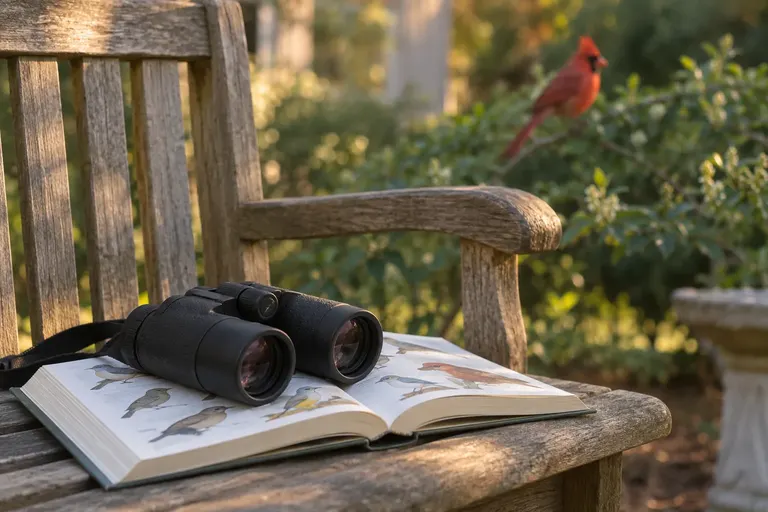
The Prostaff P7 launched in 2022 with an MSRP under $200, and it brings two features rarely seen at this level: dielectric high-reflective prism coatings and a locking diopter. Dielectric coatings reflect more light through the prisms, so the image is brighter and more neutral.
Key specs (Nikon): 377 ft at 1,000 yd, 20.2 mm eye relief, 9.8 ft close focus, 20.8 oz, 5.3 mm exit pupil, phase and dielectric coatings, waterproof to 3.3 ft, nitrogen filled, lead and arsenic free glass.
Who it suits. Eyeglass wearers first. At 20.2 mm, it has the longest eye relief in this roundup. It also suits anyone who wants a light 8x42.
Strengths. The Cornell Lab’s reviewers described a bright, colorful image with crisp detail at distance, a smooth focus wheel and secure eyecups, and called it very lightweight. The locking diopter keeps your setting from drifting in a bag.
Drawbacks. Close focus is listed at 9.8 ft, which is long for window feeders. Reviewers noticed edge distortion that produces a rolling “fishbowl” effect when panning, and accessories are minimal.
Skip it if: your feeders are within 10 ft of where you sit.
Nikon Prostaff P3 8x42: lowest-cost Nikon
The Prostaff P3 shares the P7’s body shape, 20.2 mm eye relief and 377 ft field of view, but drops the dielectric prism coating and locking diopter. It launched with an MSRP well under the P7.
Key specs (Nikon): 377 ft at 1,000 yd, 20.2 mm eye relief, 9.8 ft close focus, 20.3 oz, 5.3 mm exit pupil, waterproof to 3.3 ft, nitrogen filled.
Who it suits. Tight budgets, glasses wearers and people who watch feeders from a fixed chair.
Strengths. Very light and comfortable to hold. The Cornell Lab called the image good considering the low price point and noted the comfortable handling.
Drawbacks. Reviewers found the image dimmer than Nikon’s Monarch models, with edge distortion when panning. Lens covers do not tether, and the strap is unpadded.
Skip it if: the P7 is within reach. The dielectric coating is worth it for early-morning birding.
Celestron Nature DX 8x32: best lightweight binocular under $200
The Nature DX 8x32 puts the same optical recipe into a smaller body. Celestron lists the same 388 ft field of view, 17.5 mm eye relief and 6.5 ft close focus as the 8x42, at 18 oz.
Key specs (Celestron): 388 ft at 1,000 yd, 17.5 mm eye relief, 6.5 ft close focus, 18 oz, waterproof, nitrogen purged.
Who it suits. Hikers, travelers, people with smaller hands, and anyone who finds a 22 oz binocular tiring on a neck strap. It is also a good fit for older birders who want lighter gear; see our guide to lightweight binoculars for seniors.
Strengths. Four ounces lighter than the 8x42 with no loss of field of view or close focus. Easy to carry on every walk, which means you actually have it when a bird appears.
Drawbacks. The 32 mm objectives give a 4 mm exit pupil, so the view is dimmer than the 8x42 in deep shade and at dusk.
Skip it if: you bird mostly in thick forest or at first light.
Vortex Crossfire HD 8x42: best warranty
The Crossfire HD is Vortex’s entry-level 8x42. Its selling point is the VIP warranty, which Vortex describes as unlimited, unconditional and lifetime, covering accidents as well as defects. Vortex’s current list price sits just over $200, so this pick only makes sense when a retailer has it at or under that line.
Key specs (Vortex): 393 ft at 1,000 yd, 17 mm eye relief, 6 ft close focus, 23.8 oz, HD glass elements, nitrogen purged.
Who it suits. Families, first binoculars for teens, and anyone who has broken a pair before.
Strengths. The Cornell Lab’s reviewers liked its smooth focus wheel, comfortable wide neck strap and good ergonomics for smaller hands, and found it bright enough for shaded forest viewing.
Drawbacks. Reviewers noted loose-fitting eyecups, color fringing on backlit subjects and some edge softness. It is the heaviest pick here.
Skip it if: you can find the Diamondback HD on sale. It focuses to 5 ft and is lighter; see our Vortex Diamondback HD 8x42 review.
Celestron Outland X 8x42: cheapest waterproof option
The Outland X is the floor for a binocular we would call usable for birds. Celestron lists it at roughly half the price of the Nature DX, and it is still waterproof and nitrogen purged with BaK-4 prisms and multi-coated lenses.
Key specs (Celestron): 368 ft at 1,000 yd, 17.8 mm eye relief, 13.1 ft close focus, 23.6 oz.
Who it suits. A spare pair for the car, cabin or kitchen window, or a first pair for a child who might drop it.
Strengths. Waterproof at a very low price, with usable eye relief.
Drawbacks. Multi-coated rather than fully multi-coated lenses, no phase coating listed, and a 13.1 ft close focus that makes near birds impossible to focus.
Skip it if: you can afford the Nature DX. The difference in close focus alone is worth it.
Comparison table: birding binoculars under $200
| Binocular | Field of view (ft at 1,000 yd) | Eye relief | Close focus | Weight | Key extra |
|---|---|---|---|---|---|
| Celestron Nature DX 8x42 | 388 | 17.5 mm | 6.5 ft | 22.2 oz | Phase-coated prisms |
| Nikon Prostaff P7 8x42 | 377 | 20.2 mm | 9.8 ft | 20.8 oz | Dielectric coating, locking diopter |
| Nikon Prostaff P3 8x42 | 377 | 20.2 mm | 9.8 ft | 20.3 oz | Lightest 8x42 here |
| Celestron Nature DX 8x32 | 388 | 17.5 mm | 6.5 ft | 18 oz | Compact body |
| Vortex Crossfire HD 8x42 | 393 | 17 mm | 6 ft | 23.8 oz | Unconditional warranty |
| Celestron Outland X 8x42 | 368 | 17.8 mm | 13.1 ft | 23.6 oz | Lowest cost |
What to look for in a birding binocular under $200
Budget binoculars vary more than premium ones. These features separate a good birding pair from a frustrating one.
Roof prism with phase coating
Roof prisms split light in a way that lowers contrast unless the prism is phase coated. Phase coatings are now common under $200, and they are worth insisting on. Dielectric coatings, as on the Prostaff P7, are a further step up.
Fully multi-coated optics
“Coated” or “multi-coated” can mean only some surfaces are treated. “Fully multi-coated” means every air-to-glass surface has multiple layers, which improves brightness and contrast.
Waterproof and fogproof
Look for nitrogen or argon purging and O-ring seals. Dew, rain and moving from a warm house to a cold porch will fog a non-sealed binocular inside, where you cannot wipe it.
Close focus under 10 ft
Budget models often have long close focus. For window feeders and small yards, look for 6 to 7 ft. Our guide to binoculars for watching birds from your window goes further.
Eye relief of 17 mm or more
Eye relief sets whether glasses wearers can see the whole view. Most picks here list 17 mm or more.
Is 8x42 or 10x42 better on a budget?
Stick with 8x. At this price, 10x amplifies the weaknesses of budget optics: edge softness, lower contrast and hand shake. 8x also gives a wider view, so birds are easier to find. Our 8x42 vs 10x42 guide explains the trade-offs.
When is it worth spending more than $200?
If you bird weekly, go out at dawn, or watch birds against bright sky and water, the step to ED glass and dielectric coatings is noticeable. The Nikon Monarch M5 8x42 and Vortex Diamondback HD 8x42 are the usual next steps. Our overall best binoculars for birding list covers every price band.
Which budget binocular fits how you bird?
Specs only matter in the context of where you watch birds. Here is how the picks line up with common situations.
Watching a feeder from indoors
Close focus and field of view matter most. A feeder 8 to 15 ft from a window is inside or near the close focus limit of several budget models. The Celestron Nature DX 8x42 (6.5 ft) and Vortex Crossfire HD (6 ft) handle this well. The Prostaff pair (9.8 ft) work if your feeders sit farther out. Glass windows also reduce contrast, so clean both sides of the pane.
Walking local parks and trails
Weight and carry comfort decide whether the binocular comes with you. The Nature DX 8x32 at 18 oz and the Prostaff P3 at 20.3 oz are the easiest to carry for an hour or more. A padded strap or harness helps more than most people expect.
Ponds, lakes and open marsh
Here birds are farther away and often backlit by water or sky. An 8x42 is still the better all-round choice, but pick one with the best coatings you can afford. The Prostaff P7’s dielectric prism coating helps with brightness and color. Expect some color fringing on white birds against dark water with any binocular in this band.
Birding with glasses
The Prostaff P3 and P7 both list 20.2 mm of eye relief, the most in this price band. The Nature DX at 17.5 mm works for many glasses wearers with thin frames. Our guide to the best binoculars for glasses wearers explains how to check fit.
How to check a budget binocular when it arrives
Budget binoculars have wider unit-to-unit variation than premium ones, so check yours within the return window. You do not need special tools.
- Inspect the lenses. Look for scratches, chips, dust inside the barrels or loose rattles. A little dust inside is normal; smears or debris in the center of the view are not.
- Set the hinge and diopter. Close the hinge until you see one round image. Cover the right objective, focus with the center wheel on a sign or branch about 30 yards away, then cover the left objective and focus the right eye with the diopter ring only.
- Check alignment. Look at a distant horizontal line, such as a roof edge, for a minute. If you feel eye strain, or the line doubles when you relax, the barrels may be out of collimation. Return it.
- Test close focus. Focus on something at the listed distance. Units that fall short by more than a foot or two are worth exchanging.
- Look at a bright edge. Aim at a dark branch against sky. Some purple or green fringing is expected without ED glass, but it should not be severe in the center.
- Move the eyecups. They should click into each position and hold. Owners of several budget models report eyecups that slip; if yours creep down while you use them, contact the maker.
Care tips that make budget binoculars last
- Keep the rain guard and objective caps on in the car and in the closet.
- Blow or brush grit off the lenses before wiping. Wiping sand across coatings causes fine scratches.
- Use a microfiber cloth and lens cleaning fluid, not a shirt tail.
- Store the binocular somewhere dry, not in a damp garage or a hot car trunk.
- If it gets soaked, let it dry at room temperature with the caps off.
Common mistakes with budget binoculars
- Buying by magnification. A 12x or 16x “high power” binocular is harder to use for birds, not easier.
- Accepting a long close focus. Anything past 10 ft limits backyard use.
- Skipping the diopter setup. Focus with your left eye, then set the diopter for your right. Many “blurry” complaints disappear.
- Trusting unverified listings. Marketplace binoculars with inflated specs, such as impossible magnification claims, rarely match their descriptions. Stick to established brands with published spec sheets.
- Leaving eyecups up while wearing glasses. Twist them down to see the full field.
Sources
Frequently asked questions
Can you get good birding binoculars for under $200?
Yes. Several waterproof roof prism models with phase-coated prisms and useful close focus sit under $200, including the Celestron Nature DX and Nikon Prostaff series. They will not match mid-range ED glass in low light or against bright sky, but they show plumage detail well and are a big step above toy or department-store binoculars.
Is 8x42 or 10x42 better for a budget birding binocular?
8x42 is the safer choice. Budget binoculars show more edge softness and less contrast, and higher magnification exaggerates both, along with hand shake. An 8x42 also gives a wider field of view, which makes birds easier to find. Choose 10x only if you mostly look at distant waterbirds or hawks in open country.
What should I give up to stay under $200?
Usually ED glass, dielectric prism coatings on most models, and the last bit of edge sharpness and low-light brightness. Do not give up waterproofing, fully multi-coated optics, phase-corrected roof prisms or a close focus under about 10 ft. Those basics decide whether a binocular is pleasant for birds.
Are Nikon Prostaff binoculars good for birding?
The Prostaff P3 and P7 8x42 are solid budget choices, especially for eyeglass wearers, because both list 20.2 mm of eye relief. They are light at about 20 oz. The main limits are a 9.8 ft close focus and some edge distortion that independent reviewers noticed when panning, so they suit feeder watching more than chasing warblers.
How long do budget binoculars last?
A waterproof, nitrogen-purged roof prism binocular can last many years with basic care: keep lens caps on, store it dry and clean lenses with a brush and microfiber cloth. Warranty terms differ a lot. Vortex covers accidental damage unconditionally, while most other brands in this band offer limited lifetime coverage against defects.