The Best Binoculars for Birding in 2026
The best binoculars for birding in 2026, from budget to premium. Our research pick is the Nikon Monarch M7 8x42 for its wide view, ED glass and easy handling.
If you buy through links on this page we may earn a commission, at no cost to you. It never decides what we recommend. How we earn
In this article
- Quick picks
- How we chose
- Nikon Monarch M7 8x42: best birding binoculars overall
- Nikon Monarch M5 8x42: best value
- Celestron Nature DX 8x42: best budget binoculars for birding
- Vortex Diamondback HD 8x42: best warranty
- Athlon Midas G2 UHD 8x42: widest view for the money
- Zeiss Conquest HDX 8x42: best mid-premium
- Swarovski NL Pure 8x42: best premium binoculars for birding
- Zeiss SFL 8x40: lightest premium
- Comparison table
- What makes a binocular good for birding?
- Is 8x42 or 10x42 better for birding?
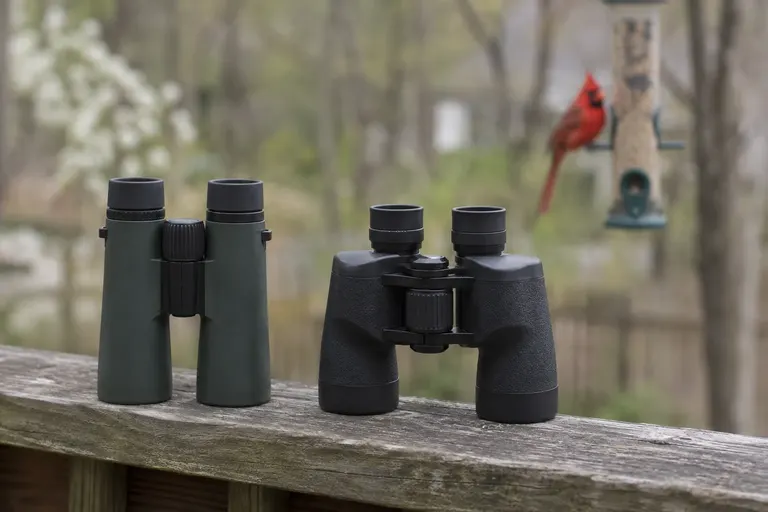
- Roof prism or porro prism?
- How much should you spend on birding binoculars?
- Common mistakes when buying birding binoculars
- Who should buy which?
- Sources
- Frequently asked questions
The best binoculars for birding in 2026 for most people is the Nikon Monarch M7 8x42: it combines a 435 ft field of view, ED glass and a locking diopter at a mid-range price. If you want to spend less, the Nikon Monarch M5 8x42 is the value pick, and the Celestron Nature DX 8x42 is the best option we found under $200. Premium buyers should look at the Swarovski NL Pure 8x42 or the lighter Zeiss SFL 8x40.
Quick picks
- Best overall: Nikon Monarch M7 8x42. Very wide view, ED glass, easy to hold.
- Best value: Nikon Monarch M5 8x42. Sharp ED optics and 19.5 mm eye relief.
- Best budget: Celestron Nature DX 8x42. Waterproof, close focusing, listed under $200.
- Best warranty: Vortex Diamondback HD 8x42. Unconditional lifetime coverage, 5 ft close focus.
- Widest view for the money: Athlon Midas G2 UHD 8x42. 426 ft field of view.
- Best mid-premium: Zeiss Conquest HDX 8x42. Class-leading sharpness per independent reviewers.
- Best premium: Swarovski NL Pure 8x42. 477 ft field of view, the widest in the class.
- Lightest premium: Zeiss SFL 8x40. 22.6 oz with 18 mm eye relief.
Nikon Monarch M7 8x42
One of the widest fields of view in its class, ED glass and a locking diopter at a mid-range price.
- Best for
- Birders who want the easiest possible bird-finding in a full-size 8x42.
- Skip it if
- You wear thick glasses and need 19 mm or more of eye relief.
- Field of view
- 435 ft at 1,000 yd
- Eye relief
- 17.1 mm
- Close focus
- 8.2 ft
- Weight
- 23.6 oz
Nikon Monarch M5 8x42
Sharp, bright ED optics and long 19.5 mm eye relief for well under the cost of premium glass.
- Best for
- Eyeglass wearers and anyone who wants a big optical step up without a big bill.
- Skip it if
- You struggle to find birds quickly; the field of view is narrow for an 8x42.
- Field of view
- 335 ft at 1,000 yd
- Eye relief
- 19.5 mm
- Weight
- 22.2 oz
Celestron Nature DX 8x42
A waterproof, phase-coated roof prism binocular with a 6.5 ft close focus that Celestron lists under $200.
- Best for
- New and budget-minded birders.
- Skip it if
- You bird mostly at dawn and dusk, where pricier glass pulls ahead.
- Field of view
- 388 ft at 1,000 yd
- Eye relief
- 17.5 mm
- Close focus
- 6.5 ft
Vortex Diamondback HD 8x42
Light, close-focusing and backed by Vortex's unconditional lifetime VIP warranty.
- Best for
- Hard-use birders, families and anyone who worries about drops.
- Skip it if
- You want a fast, light focus wheel; owners often call it stiff.
- Field of view
- 393 ft at 1,000 yd
- Close focus
- 5 ft
- Weight
- 21.8 oz
Athlon Midas G2 UHD 8x42
A 426 ft field of view, dielectric prism coatings and a smooth focuser in the mid-price band.
- Best for
- Birders who want a wide, bright view without paying Nikon M7 money.
- Skip it if
- You dislike heavily textured armor.
- Field of view
- 426 ft at 1,000 yd
- Eye relief
- 17.2 mm
- Weight
- 23.3 oz
Zeiss Conquest HDX 8x42
German-designed optics with class-leading sharpness, a fast focuser and LotuTec lens coating.
- Best for
- Serious birders who want near-premium sharpness below alpha prices.
- Skip it if
- You need long eye relief; Zeiss lists 16.5 mm.
- Field of view
- 384 ft at 1,000 yd
- Close focus
- 6.6 ft
- Weight
- 25.2 oz
Swarovski NL Pure 8x42
The widest field of view of any current 8x42, with top-tier sharpness and focus precision.
- Best for
- Committed birders who want the best view available and will carry the weight.
- Skip it if
- Weight or cost matters more than the last few percent of performance.
- Field of view
- 477 ft at 1,000 yd
- Eye relief
- 18 mm
- Weight
- 29.5 oz
Zeiss SFL 8x40
Near 8x42 performance in a body closer to an 8x32, with 18 mm eye relief.
- Best for
- Premium buyers who carry binoculars all day or have sore necks and wrists.
- Skip it if
- You bird mostly in deep dusk, where a 42 mm objective helps a little.
- Field of view
- 420 ft at 1,000 yd
- Eye relief
- 18 mm
- Weight
- 22.6 oz
How we chose
Perch and Glass has not yet put these binoculars through hands-on testing, so this list is research-led. We started with every current 8x42 and 8x40 roof prism binocular from the major optics brands sold in the US, then:
- Verified specs on manufacturer pages. Every field of view, eye relief, close focus and weight figure below comes from the maker’s own spec sheet. Where independent reviewers measured something different, we say so.
- Read independent expert reviews, with the most weight on the Cornell Lab of Ornithology’s long-running binocular reviews on All About Birds, plus specialist optics reviewers.
- Looked for patterns in verified owner feedback, such as focus wheel stiffness, eyecup slippage or fogging, and only mention an issue when it shows up repeatedly.
- Weighted what matters for birds: field of view, close focus, eye relief, brightness, weight and warranty, in roughly that order for a backyard and local-park birder.
We covered one pick per price band so every reader has a sensible option. We excluded models without waterproofing, with close focus beyond 13 ft, or with no verifiable current listing.
Nikon Monarch M7 8x42: best birding binoculars overall
The Monarch M7 is Nikon’s upper mid-range 8x42 and the model we would point most birders toward first. Its headline number is a 435 ft field of view at 1,000 yards, which puts it near the top of its price class and ahead of many binoculars that cost far more. A wide view means that when a kinglet flicks through a spruce, it is more likely to still be in the frame when you raise the glass.
Key specs (Nikon): 435 ft at 1,000 yd, 17.1 mm eye relief, 8.2 ft close focus, 23.6 oz, ED glass, waterproof to 3.3 ft, nitrogen filled, oil and water repellent lens coating, locking diopter.
Strengths. The Cornell Lab’s reviewers described the image as bright and crisp from edge to edge with excellent color, and flagged the field of view as among the widest they had tried. The body is compact for an 8x42 and owners commonly report good balance in the hand. The locking diopter keeps your eye setting from drifting when the binocular bumps against a coat.
Drawbacks. Nikon rates close focus at 8.2 ft, which is longer than the Vortex Diamondback HD. Cornell’s reviewers measured closer in practice, but plan on it being a little long for butterflies. The focus wheel takes a bit of effort to start moving, and it is priced at the top of the mid-range.
Skip it if: you wear glasses with thick frames and need the most eye relief you can get. The Monarch M5 has 19.5 mm.
Nikon Monarch M5 8x42: best value
The Monarch M5 is the binocular we would suggest to someone who wants a clear jump over entry-level glass without paying for the M7. It uses ED glass, multilayer coatings and phase-corrected prisms, and has one of the longest eye relief figures in its price band at 19.5 mm.
Key specs (Nikon): 335 ft at 1,000 yd, 19.5 mm eye relief, 8.2 ft close focus, 22.2 oz, ED glass, waterproof to 3.3 ft.
Strengths. Independent reviewers consistently praise the M5 for a very sharp, bright image and solid build in a comfortable package. It is lighter than average for an 8x42, and the long eye relief makes it one of the easiest mid-range models for eyeglass wearers. See our full Nikon Monarch M5 8x42 review for more.
Drawbacks. The field of view is the weak spot. At 335 ft it is noticeably narrower than the M7 or the Athlon Midas, and the Cornell Lab called out a tunnel-like feel that makes fast-moving birds harder to track.
Skip it if: you mostly chase warblers through treetops, where a wider view pays off.
Celestron Nature DX 8x42: best budget binoculars for birding
The Nature DX 8x42 shows up on almost every budget birding list for good reasons. It is a proper waterproof roof prism binocular with BaK-4 prisms, phase coatings and a 6.5 ft close focus, and Celestron lists it under $200.
Key specs (Celestron): 388 ft at 1,000 yd (7.4 degrees), 17.5 mm eye relief, 6.5 ft close focus, 22.2 oz, fully multi-coated, phase-coated BaK-4 prisms, waterproof and nitrogen filled, limited lifetime warranty.
Strengths. A wider field of view than the Monarch M5, a genuinely useful close focus for feeder watching, and a weight most adults can carry for hours. Owners commonly report it is a big step up from department-store binoculars. Read our Celestron Nature DX 8x42 review for the details.
Drawbacks. The accessories are basic, and in low light or against bright sky the image loses contrast compared with ED and dielectric-coated models. Color fringing is more visible on backlit birds.
Skip it if: you can stretch to the Monarch M5, which is a clear optical step up.
Vortex Diamondback HD 8x42: best warranty
The Diamondback HD is a light, close-focusing 8x42 whose biggest selling point may be the paperwork. Vortex’s VIP warranty is unlimited, unconditional and lifetime, and it covers accidental damage, not only manufacturing defects.
Key specs (Vortex): 393 ft at 1,000 yd, 17 mm eye relief, 5 ft close focus, 21.8 oz, argon purged, O-ring sealed.
Strengths. At 5 ft it has the closest focus in this list, which makes it good for birds at a window feeder and for insects. The Cornell Lab praised a bright image that stays sharp nearly to the edges and noted it suits smaller hands. For households where binoculars get dropped, lent out and left in the car, the warranty matters. More in our Vortex Diamondback HD 8x42 review.
Drawbacks. The focus wheel is the common complaint. Cornell’s reviewers called it notably stiff, and owners echo that. Edges soften slightly.
Skip it if: you follow fast birds and want a light, quick focuser.
Athlon Midas G2 UHD 8x42: widest view for the money
Athlon’s Midas G2 UHD brings a 426 ft field of view and ESP dielectric prism coatings into the mid-price band. Dielectric coatings reflect more light through the prism than older silver or aluminum coatings, which shows up as a brighter, more neutral image.
Key specs (Athlon): 426 ft at 1,000 yd, 17.2 mm eye relief, 6.5 ft close focus, 23.3 oz, UHD glass, ESP dielectric prism coating, waterproof, lifetime warranty.
Strengths. The Cornell Lab described a very bright, crisp image with good contrast and edge-to-edge sharpness, a focus wheel with smooth, consistent resistance, and comfortable eyecups. That wide view helps with flocking birds and flight views.
Drawbacks. The heavily textured armor divides opinion. Reviewers also noted the eyecups do not extend as far as some rivals and the objective cover rings can loosen.
Skip it if: you want a slim, classic-looking binocular.
Zeiss Conquest HDX 8x42: best mid-premium
The Conquest HDX is Zeiss’s 2024 update of the Conquest HD, adding a lockable diopter, new armor, improved eyecups and revised coatings while keeping the optical design. It sits between mid-range and alpha glass in price.
Key specs (Zeiss): 384 ft at 1,000 yd (128 m at 1,000 m), 16.5 mm eye relief, 6.6 ft close focus, 25.2 oz, about 90 percent light transmission, LotuTec water-repellent coating, magnesium body, nitrogen filled.
Strengths. Specialist reviewers describe class-leading sharpness, fast focus and easy handling. The LotuTec coating helps rain bead off, which matters on wet mornings.
Drawbacks. The 8x42’s field of view is narrower than many competitors, and 16.5 mm of eye relief is on the short side for glasses. At 25.2 oz it is heavier than the Nikons.
Skip it if: you wear glasses or want the widest possible view.
Swarovski NL Pure 8x42: best premium binoculars for birding
If money is not the main constraint, the NL Pure is the benchmark. Its 477 ft field of view is the widest of any current 8x42, and independent reviewers rate its focuser as one of the most precise available.
Key specs (Swarovski): 477 ft at 1,000 yd, 18 mm eye relief, 6.6 ft close focus, 29.5 oz, waterproof to 13 ft.
Strengths. Specialist reviewers report virtually no chromatic aberration, excellent stray light control and a sharp field. The slim, hourglass body is shaped to be held for long periods, and Swarovski sells a forehead rest to steady the view.
Drawbacks. It is the heaviest pick here, and some reviewers found the large eyecups do not suit narrow or deep-set eyes. The price is steep even by premium standards.
Skip it if: you rarely bird for more than an hour or want to save weight.
Zeiss SFL 8x40: lightest premium
The SFL, short for SmartFocus Lightweight, is Zeiss’s answer to birders who want top optics without a heavy 8x42. Zeiss says it is 19 percent lighter and 17 percent shorter than its Victory SF 42.
Key specs (Zeiss): 420 ft at 1,000 yd, 18 mm eye relief, 5 mm exit pupil, 22.6 oz, about 90 percent light transmission, water resistant to 400 mbar.
Strengths. Reviewers describe it as an 8x40 that looks and feels like an 8x32 but performs close to an 8x42. BirdWatching magazine’s review lists close focus at 1.5 m (about 4.9 ft). The 18 mm eye relief suits most glasses wearers.
Drawbacks. Very slight color fringing under extreme light, and it is still a premium purchase.
Skip it if: you bird mostly in heavy forest at dusk, where the extra 2 mm of objective helps slightly.
Comparison table
| Binocular | Field of view (ft at 1,000 yd) | Eye relief | Close focus | Weight |
|---|---|---|---|---|
| Nikon Monarch M7 8x42 | 435 | 17.1 mm | 8.2 ft | 23.6 oz |
| Nikon Monarch M5 8x42 | 335 | 19.5 mm | 8.2 ft | 22.2 oz |
| Celestron Nature DX 8x42 | 388 | 17.5 mm | 6.5 ft | 22.2 oz |
| Vortex Diamondback HD 8x42 | 393 | 17 mm | 5 ft | 21.8 oz |
| Athlon Midas G2 UHD 8x42 | 426 | 17.2 mm | 6.5 ft | 23.3 oz |
| Zeiss Conquest HDX 8x42 | 384 | 16.5 mm | 6.6 ft | 25.2 oz |
| Swarovski NL Pure 8x42 | 477 | 18 mm | 6.6 ft | 29.5 oz |
| Zeiss SFL 8x40 | 420 | 18 mm | about 4.9 ft* | 22.6 oz |
*Close focus from BirdWatching magazine’s review; Zeiss’s US spec page did not list it at the time of writing.
What makes a binocular good for birding?
Birding asks more of a binocular than sports or travel. Birds are small, quick and often in shade. These are the specs that decide how a binocular performs with birds, in order of importance for most backyard and local-park birders.
Field of view
Field of view is the width of the scene you see at 1,000 yards. Wider views make it easier to find a bird and keep it in frame. In 8x42 models, anything above about 400 ft is wide, 370 to 400 ft is average, and below 350 ft feels narrow. Higher magnification almost always means a narrower field of view, which is one reason 8x is easier than 10x.
Close focus
Close focus is the nearest distance at which the binocular can focus. For feeder watching near a window, anything around 6 ft or less is ideal. Many budget models stop at 9 to 13 ft.
Eye relief
Eye relief is how far behind the eyepiece your eye can be and still see the full view. Glasses push your eye back, so eyeglass wearers usually need longer eye relief. Our guide to binoculars for glasses wearers covers this in depth.
Brightness and coatings
Brightness depends on objective size, glass quality and coatings. Look for “fully multi-coated” lenses, phase-corrected roof prisms and, ideally, dielectric prism coatings. ED glass reduces color fringing on backlit birds, which matters most when a bird sits against bright sky.
Weight and handling
You will leave a heavy binocular at home. Most 8x42s weigh 20 to 30 oz. A harness spreads the load and takes the weight off your neck.
Is 8x42 or 10x42 better for birding?
For most birders, 8x42. The 8x gives a wider field of view, a steadier image and more depth of field, so more of a bird in a bush stays sharp without refocusing. 10x shows more detail on distant birds, which helps with shorebirds, hawks and ducks on open water, but it magnifies hand shake. Our full comparison of 8x42 vs 10x42 goes deeper.
Roof prism or porro prism?
Every pick here is a roof prism binocular. Roof prisms are slimmer, easier to waterproof and easier to hold in one hand. Porro prisms can deliver good depth and brightness for the money, but very few modern porros are waterproof, and budget porros often have short eye relief and long close focus. For birding, a roof prism is the simpler choice.
How much should you spend on birding binoculars?
Based on specs and expert reviews, the value curve looks like this:
- Under $200: Good enough to learn with and to enjoy feeder birds. Expect a phase-coated roof prism, waterproofing and reasonable sharpness. Our under $200 picks cover this band.
- Around $250 to $500: The biggest jump. ED glass, dielectric coatings and wider fields of view appear. See our under $500 picks.
- Mid-premium: Better edge sharpness, contrast and build. The Zeiss Conquest HDX sits here.
- Premium: The last increments of sharpness, width and handling. Excellent, but less improvement per dollar.
Common mistakes when buying birding binoculars
- Buying 10x or 12x for “more power.” High magnification makes birds harder to find and the image shakier.
- Ignoring close focus. A 13 ft close focus is frustrating at a window feeder.
- Skipping the diopter setup. Many “blurry binocular” complaints are an unadjusted diopter. Set it once for your right eye and note the setting.
- Buying compact 8x25s as your only pair. Small exit pupils make them dim in shade.
- Choosing on brand alone. Compare field of view, close focus and eye relief on spec sheets.
Who should buy which?
- New birders on a budget: Celestron Nature DX 8x42. See our beginner binocular guide.
- Glasses wearers: Nikon Monarch M5 8x42 or Zeiss SFL 8x40.
- Active warbler and woodland birders: Nikon Monarch M7 or Athlon Midas G2 UHD for their wide views.
- Families and hard use: Vortex Diamondback HD for the warranty.
- Buy-once birders: Swarovski NL Pure or Zeiss SFL.
Sources
- Nikon Monarch M7 8x42 specifications, Nikon USA
- Nikon Monarch M5 8x42 specifications, Nikon USA
- Celestron Nature DX 8x42 specifications
- Vortex Diamondback HD 8x42 specifications
- Zeiss Conquest HDX 8x42 specifications
- Swarovski NL Pure 8x42 technical data
- Nikon Monarch M7 8x42 review, Cornell Lab All About Birds
- Athlon Midas G2 UHD 8x42 review, Cornell Lab All About Birds
Frequently asked questions
What magnification is best for birding binoculars?
For most birders 8x is the best starting point. It gives a wider field of view, a steadier image and more depth of field than 10x, which makes finding and following moving birds easier. Choose 10x only if you mostly watch distant birds in open country, such as shorebirds, hawks or waterfowl, and have steady hands.
Are 8x42 binoculars good for bird watching?
Yes. 8x42 is the most popular birding format because it balances brightness, field of view and weight. The 42 mm objectives give a 5.25 mm exit pupil, which stays bright in shade and at dawn. Most 8x42s weigh between about 20 and 30 oz, which most adults can carry all morning on a harness or padded strap.
How much should I spend on birding binoculars?
Good birding binoculars start below $200, and the biggest jump in image quality usually comes in the mid-range, where ED glass and dielectric prism coatings appear. Premium European models add sharper edges, better contrast and wider views, but the gains are smaller per dollar. Buy the best you can afford without resenting the price.
Do I need ED glass for birding?
ED glass reduces color fringing, the purple or green edges you see around a dark bird against bright sky. It helps most with backlit birds and high-contrast scenes. It is not essential for backyard feeder watching, but in the mid-range it is a real upgrade, and most mid-range binoculars now include it.
What close focus distance do I need for birding?
Around 6 feet or closer is ideal if you watch feeders near a window, look at butterflies or follow birds in thick cover. Many budget models focus only to 9 to 13 feet, which can frustrate you when a wren pops up nearby. For distant birds, close focus matters much less.