8x42 vs 10x42: Which Is Better for Birding?
8x42 vs 10x42 for birding: 8x42 is better for most birders, with a wider, brighter, steadier view. Here is when 10x42 is worth it, with real spec comparisons.
If you buy through links on this page we may earn a commission, at no cost to you. It never decides what we recommend. How we earn
In this article
- Quick answer: 8x42 or 10x42?
- What the numbers 8x42 and 10x42 mean
- 8x42 vs 10x42: side-by-side specs
- Field of view: why 8x makes birds easier to find
- Brightness: exit pupil and low light
- Hand shake: the hidden cost of 10x
- Depth of field: more in focus at 8x
- Eye relief: which is better for glasses wearers?
- Close focus: does magnification matter?
- When 10x42 is the better choice
- When 8x42 is the better choice
- 8x42 vs 10x42 by habitat and bird group
- What about 8x32 or 10x32?
- Does magnification or glass quality matter more?
- Our picks for each format
- How to test 8x vs 10x before you buy
- Common mistakes when choosing between 8x and 10x
- The bottom line
- Sources
- Gear mentioned in this guide
- Frequently asked questions
On 8x42 vs 10x42 for birding, 8x42 is the better choice for most people. It shows a wider field of view, a brighter image in shade and a steadier picture, and those three things matter more than extra magnification when you are trying to find a warbler in a tree or follow a sparrow through brush. Choose 10x42 if you mostly watch birds across open fields, marshes, shorelines or hawk ridges, and your hands are steady.
Quick answer: 8x42 or 10x42?
- Choose 8x42 if you bird in backyards, woodlands or parks, you are new to binoculars, you watch fast-moving songbirds, your hands shake a little, or you often bird at dawn and dusk.
- Choose 10x42 if you bird mainly in open country, you watch shorebirds, waterfowl or raptors at distance, and you can hold a steady image.
- Either works if you bird a mix of habitats. Many birders start with 8x42 and add a spotting scope later rather than moving to 10x.
What the numbers 8x42 and 10x42 mean
The first number is magnification. An 8x binocular makes a bird look eight times closer than it does to your naked eye, and 10x makes it look ten times closer. A bird at 100 yards looks as if it were 12.5 yards away through 8x and 10 yards away through 10x.
The second number is the diameter of each objective lens in millimeters. Both of these formats use 42 mm lenses, so they gather the same total amount of light. The Cornell Lab calls 42 mm the standard full-size birding binocular. Because the lenses are the same size, the two formats usually share the same body, size and weight within a model line. For a full walk through every number printed on a binocular, see our guide to what the numbers on binoculars mean.
8x42 vs 10x42: side-by-side specs
The cleanest comparison is the same model in both powers. Here are two popular lines, using the manufacturers’ published specs.
| Spec | Vortex Diamondback HD 8x42 | Vortex Diamondback HD 10x42 | Nikon Monarch M5 8x42 | Nikon Monarch M5 10x42 |
|---|---|---|---|---|
| Field of view (ft at 1,000 yd) | 393 | 314 | 335 | 293 |
| Angular field of view | 7.5° | 6.0° | 6.4° | 5.6° |
| Exit pupil | 5.25 mm | 4.2 mm | 5.3 mm | 4.2 mm |
| Eye relief | 17 mm | 15.5 mm | 19.5 mm | 18.4 mm |
| Close focus | 5.5 ft | 5.5 ft | 8.2 ft | 8.2 ft |
| Weight | 21.3 oz | 21.5 oz | 22.2 oz | 22.6 oz |
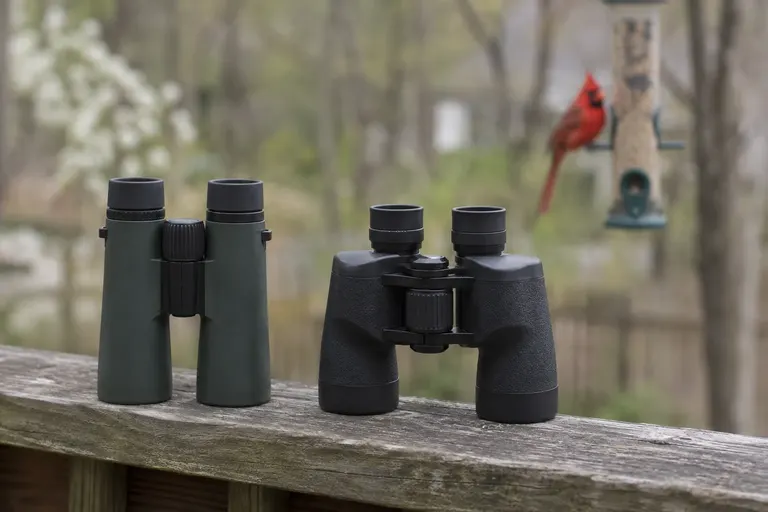
Three patterns show up in both lines. The 8x has a much wider view. The 8x has a larger exit pupil. And the 8x has more eye relief. Weight is almost identical.
Field of view: why 8x makes birds easier to find
Field of view is the width of the scene you see, usually listed in feet at 1,000 yards. In the Vortex line, the 8x42 shows 393 feet and the 10x42 shows 314 feet. That is about 25% wider for the 8x, and because the view is a circle, the area you see is roughly 57% larger.
That extra area matters most in the moment you raise the binoculars. A bird that flits between branches is more likely to land inside a wide field than a narrow one. It also helps when following birds in flight, scanning a flock, or tracking a wren as it moves through a thicket. If you struggle to get birds in view at all, our guide on how to find a bird in your binoculars fast covers technique, and a wider field makes every technique easier.
Brightness: exit pupil and low light
Exit pupil is the objective diameter divided by magnification. For 8x42 it is 5.25 mm, and for 10x42 it is 4.2 mm. It is the width of the beam of light that leaves each eyepiece and enters your eye.
Your own pupil sets the limit. In bright daylight, pupils close to roughly 2 to 3 mm, so both formats deliver more light than your eye can use and look equally bright. In deep shade, at dawn and at dusk, pupils open wider, and the 8x’s larger beam can fill more of them. That is why 8x42 tends to look brighter under a forest canopy or at the edges of the day.
Age matters here. Pupils open less as we get older, and pupils of people over 50 rarely dilate beyond about 5 mm. For older birders, the brightness gap between 8x and 10x narrows in dim light, though the 8x still has the edge in field of view and steadiness.
The 10x has one point in its favor. Twilight factor, the square root of magnification times objective size, is about 18.3 for 8x42 and 20.5 for 10x42. It suggests that 10x can show slightly more detail in dim light, provided you hold it steady.
Hand shake: the hidden cost of 10x
Every binocular magnifies your own movement along with the bird. At 10x, a small tremor looks 25% larger than at 8x. Breathing, heartbeat and muscle fatigue all show up as a jittery image.
For many people, that shake cancels much of the extra detail 10x should deliver. A steady 8x image often reveals more than a wobbling 10x image, especially when looking at fine field marks such as wing bars or eye rings. This is a common reason experienced birders recommend 8x as a first pair.
You can reduce shake with 10x by bracing your elbows against your chest, leaning on a tree or post, or resting on a car window. If you have a tremor, arthritis or reduced grip strength, 8x is the safer choice, and a lighter pair helps too.
There is one exception to the shake problem: image-stabilized binoculars. Models from brands such as Canon use battery-powered stabilization to cancel small hand movements, which makes 10x and even higher powers much easier to hold steady. They are heavier, need batteries and cost more than conventional binoculars of similar optical quality, so they suit birders who specifically struggle with shake rather than most buyers.
Depth of field: more in focus at 8x
Depth of field is how much of the scene is sharp at once, front to back. It shrinks as magnification rises. As a rough optical rule, depth of field falls with the square of magnification, so 8x shows about one and a half times as much depth as 10x at the same distance.
In practice, this means fewer focus adjustments with 8x. When a bird hops from a near branch to one a few feet behind, it is more likely to stay sharp. For fast songbirds in thick cover, that saves time you would otherwise spend turning the focus wheel.
Eye relief: which is better for glasses wearers?
Eye relief is the distance behind the eyepiece where your eye sees the full image. Eyeglass wearers generally need about 16 mm or more. In both of the model lines above, the 8x version has more eye relief than the 10x: 17 mm vs 15.5 mm for Vortex, and 19.5 mm vs 18.4 mm for Nikon.
That pattern is common across many lines, though not universal. If you wear glasses, compare the eye relief of the exact model and power you are considering. Our roundup of binoculars for glasses wearers focuses on this spec.
Close focus: does magnification matter?
Close focus is the nearest distance a binocular can focus on. It depends on the optical design rather than the magnification, so the 8x and 10x versions in a line usually match. The Diamondback HD focuses to 5.5 feet in both powers, and the Monarch M5 to 8.2 feet in both.
For backyard birding and butterflies, a close focus under about 7 feet is helpful. It lets you watch birds at a window feeder or a nearby bird bath without stepping back.
When 10x42 is the better choice
10x earns its place when birds are consistently far away and the habitat is open.
- Shorebirds and waterfowl. Sandpipers on a mudflat or ducks across a lake are often too far for 8x to show key marks.
- Raptors. Hawks soaring over a ridge or perched on a distant pole reward extra reach.
- Open grassland and desert. Wide views and long distances suit 10x.
- Steady hands and a brace. If you bird from a car window, a blind or a railing, shake is less of a problem.
Even here, a spotting scope often solves the distance problem better. At 20x to 60x on a tripod, it goes far beyond what either binocular can do. Many birders carry 8x42 binoculars and bring a scope to the shore.
When 8x42 is the better choice
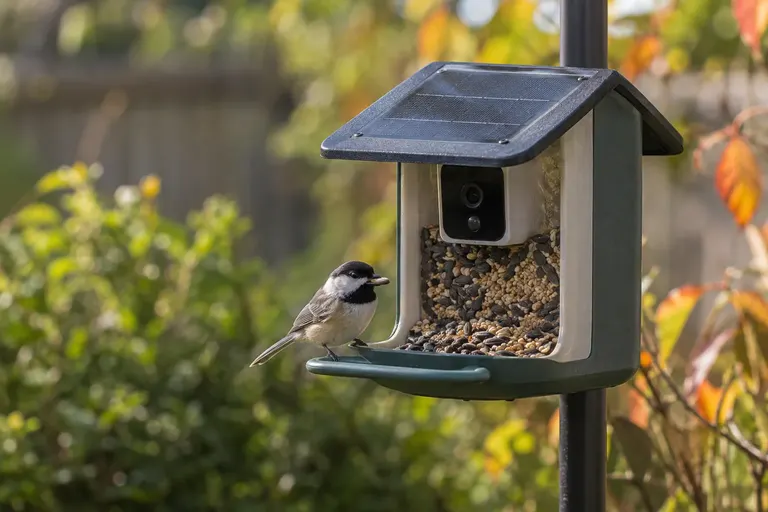
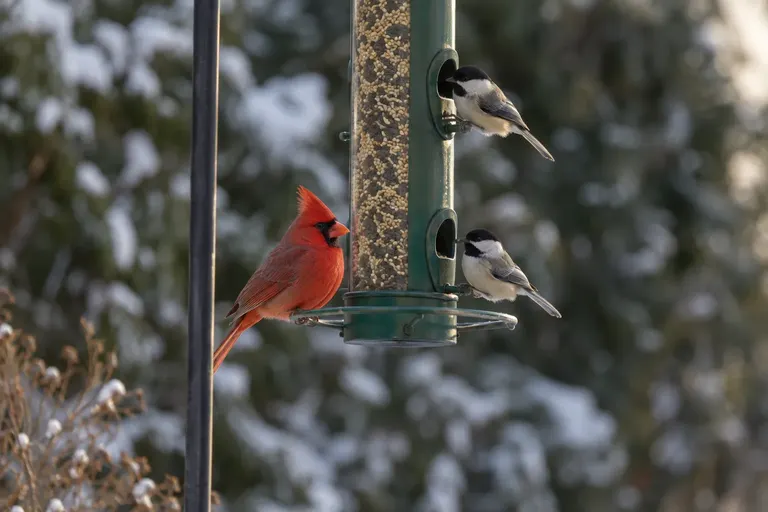
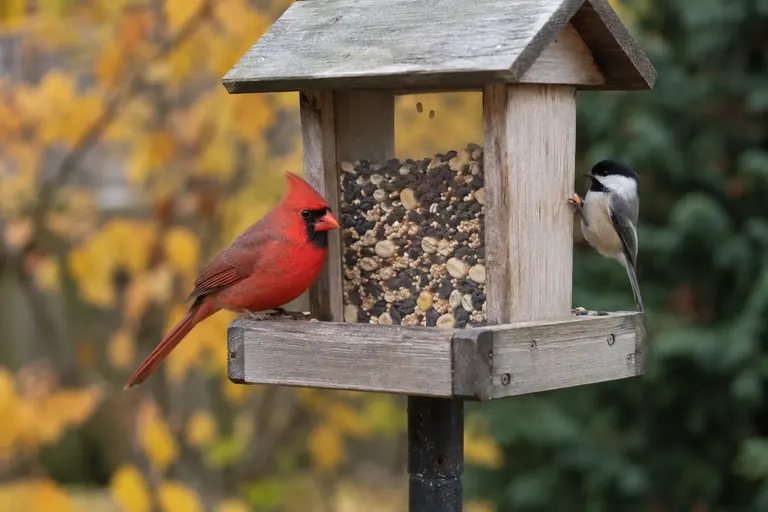
- Backyards. Feeder birds are close, and the wide view makes it easy to switch between them. Our list of binoculars for watching birds from your window leans heavily on 8x.
- Woodlands and parks. Warblers, vireos and kinglets move constantly in dense leaves.
- Beginners. A wider view shortens the learning curve for getting birds in view.
- Low light. Dawn, dusk and heavy shade favor the larger exit pupil.
- Older birders and anyone with a tremor. Steadier, brighter views outweigh extra reach.
8x42 vs 10x42 by habitat and bird group
| Where and what you watch | Better choice | Why |
|---|---|---|
| Feeder birds from a window or patio | 8x42 | Birds are close, wide view helps |
| Warblers and vireos in woodland | 8x42 | Wide view, more depth of field, brighter in shade |
| Sparrows in brush and hedgerows | 8x42 | Quick target acquisition in cover |
| Owls and birds at dusk | 8x42 | Larger exit pupil |
| Shorebirds on mudflats | 10x42 | Birds are distant and often still |
| Ducks on lakes and reservoirs | 10x42 | Long distances across open water |
| Hawks on poles or soaring | 10x42 | Extra reach in open sky |
| Mixed habitats, one pair only | 8x42 | Fewer weaknesses overall |
What about 8x32 or 10x32?
If weight matters more than low-light performance, 32 mm models are worth a look. The Cornell Lab groups binoculars into full-size, around 42 mm, and compact, around 32 mm. A 32 mm pair is usually several ounces lighter and noticeably smaller, which makes it easier to carry all day or hang by the back door.
The trade-off is exit pupil. An 8x32 has a 4 mm exit pupil and a 10x32 has 3.2 mm. In daylight, both are fine. In shade and at dusk, they dim sooner than 42 mm models. The magnification logic stays the same, though: 8x32 is easier to hold steady and usually shows a wider view than 10x32.
Cornell’s own reviews found a wider range of image quality among compact models than among full-size ones, so it pays to be more selective. Our roundup of compact binoculars covers the better options.
Does magnification or glass quality matter more?
Glass quality usually matters more. A well-made 8x42 with good coatings will often show more real detail than a poorly made 10x42. Several features drive image quality independent of power:
- Phase-correction coatings on roof prisms keep the image sharp and contrasty. They were developed at Zeiss in 1988 and are now standard on most decent roof prism binoculars.
- Dielectric mirror coatings on the prisms can reflect more than 99% of visible light, which improves brightness and color.
- Extra-low dispersion (ED) glass reduces color fringing around high-contrast edges, such as a dark bird against a bright sky.
- Fully multi-coated lenses cut reflections and glare.
When you compare an 8x and a 10x, make sure the rest of the specs match. The fairest test is the same model in both powers, as in the table above.
Our picks for each format
These picks are based on published specs, manufacturer documentation, independent expert reviews and patterns in verified owner feedback. We have not tested them hands-on.
Vortex Diamondback HD 8x42
The Diamondback HD 8x42 offers one of the widest fields of view in its class at 393 feet at 1,000 yards, with 17 mm of eye relief, a 5.5 foot close focus and a listed weight of 21.3 oz. Vortex backs it with its VIP warranty, which it describes as unconditional, lifetime and transferable. Owner feedback commonly praises the wide view and easy focus. Our Vortex Diamondback HD 8x42 review covers it in detail.
Skip it if: you need maximum eye relief for thick glasses.
Nikon Monarch M5 10x42
The Monarch M5 10x42 uses ED glass and lists a 293 foot field of view, 18.4 mm of eye relief, an 8.2 foot close focus and a weight of 22.6 oz. Nikon states it is waterproof to 3.3 feet and nitrogen filled. The generous eye relief is its standout spec for a 10x, which makes it a good match for glasses wearers who want more reach.
Skip it if: you mainly watch birds at close range in a small yard.
How to test 8x vs 10x before you buy
- Try both in the same model. Differences between brands can mask the effect of magnification.
- Look at a sign or bird at 50 to 100 yards. Note how much you can read or see with each.
- Hold each for a full minute. Watch how much the image jitters as your arms tire.
- Swing onto a moving target. A passing car or a bird in flight shows how easy each is to follow.
- Check with your glasses on and off. Make sure you see the full field with the eyecups adjusted. Our guide on how to adjust binoculars explains setting the diopter and eyecups.
Common mistakes when choosing between 8x and 10x
- Assuming more power means more detail. Hand shake can erase the gain.
- Buying 10x for backyard birding. Birds are close, and the narrower view slows you down.
- Ignoring eye relief. Glasses wearers can lose part of the view on some 10x models.
- Comparing across brands and prices. A premium 10x may outperform a budget 8x for optical reasons unrelated to magnification.
- Buying 12x for general birding. Nikon’s own Monarch M5 12x42 drops to 267 feet of field and a 3.5 mm exit pupil, which is hard to hold steady without support.
The bottom line
If you are buying one pair of binoculars for general birding, choose 8x42. If your birding happens across open water, grassland or hawk-watch sites and your hands are steady, 10x42 is a fine choice. For a broader look at models and budgets, start with our guide to the best binoculars for birding.
Sources
Gear mentioned in this guide
Vortex Diamondback HD 8x42
A very wide 393 ft field of view, 5.5 ft close focus and an unconditional lifetime warranty make it an easy 8x42 to recommend.
- Best for
- Backyard and woodland birders who want the widest view in this class.
- Skip it if
- You wear thick glasses and need more than 17 mm of eye relief.
- Field of view
- 393 ft at 1,000 yd
- Eye relief
- 17 mm
- Close focus
- 5.5 ft
- Weight
- 21.3 oz
Nikon Monarch M5 10x42
ED glass and 18.4 mm of eye relief, which is generous for a 10x, make it a sound choice when you need more reach.
- Best for
- Open-country birders and eyeglass wearers who want 10x.
- Skip it if
- You watch warblers at close range; 8.2 ft close focus is long for a backyard.
- Field of view
- 293 ft at 1,000 yd
- Eye relief
- 18.4 mm
- Close focus
- 8.2 ft
- Weight
- 22.6 oz
Frequently asked questions
Is 8x42 or 10x42 better for backyard birding?
8x42 is better for most backyards. Birds at feeders and in nearby trees are close, so extra magnification adds little, while the 8x's wider field of view and larger exit pupil make birds easier to find and follow in shade. The steadier image also shows more detail than you might expect. Choose 10x only if your yard looks over open fields or water.
Do 10x42 binoculars show more detail than 8x42?
On paper, yes: a bird looks 25% larger. In practice, hand shake is also magnified 25%, which eats into the gain for many people. Birders with steady hands see more detail with 10x at long range. Birders with a slight tremor often see as much or more with 8x because the image holds still.
Are 10x42 binoculars too heavy?
No. The weight difference is tiny because both use 42 mm objective lenses. Vortex lists the Diamondback HD at 21.3 oz in 8x42 and 21.5 oz in 10x42, and Nikon lists the Monarch M5 at 22.2 oz and 22.6 oz. The difference you feel is hand shake at higher magnification, not added weight.
Which is better in low light, 8x42 or 10x42?
8x42 has the larger exit pupil, 5.25 mm vs 4.2 mm, so it delivers a brighter view at dawn and dusk for eyes that can open wide. 10x42 has a higher twilight factor, which suggests slightly better detail in dim light if you can hold it steady. For most birders at the edges of the day, 8x feels brighter and easier.
What magnification do most birders use?
8x is the most common choice for general birding, with 10x close behind. The Cornell Lab notes that 8x and 10x are the most common magnifications on birding binoculars. Many experienced birders own an 8x for woods and yards and use a spotting scope, rather than higher-power binoculars, for distant birds.