Best Lightweight Binoculars for Seniors
The best lightweight binoculars for seniors: the 15.9 oz Nikon Monarch HG 8x30 leads, with stabilized, glasses-friendly and budget picks under 19 oz compared.
If you buy through links on this page we may earn a commission, at no cost to you. It never decides what we recommend. How we earn
In this article
- Quick picks
- How we chose
- What to look for in binoculars for seniors
- Nikon Monarch HG 8x30: best lightweight binoculars overall
- Vortex Diamondback HD 8x32: best value lightweight binoculars
- Canon 8x20 IS: best binoculars for shaky hands
- Swarovski CL Companion 8x30: best lightweight binoculars for glasses wearers
- Celestron Nature DX 8x32: best budget lightweight binoculars
- Nikon Prostaff P3 8x30: best lightweight binoculars for a wide view
- Lightweight binoculars compared
- How to make any binocular feel lighter
- Tips for birding from a chair, porch or window
- Common mistakes seniors make when buying binoculars
- Which lightweight binocular should you buy?
- Sources
- Frequently asked questions
The Nikon Monarch HG 8x30 is the best lightweight binocular for most seniors. It weighs 15.9 oz, shows a 435 ft field of view, focuses to 6.6 ft and is waterproof to 16.4 ft, so it is light enough to wear all morning and good enough to keep for decades. If your hands shake, the Canon 8x20 IS will help more than any lens upgrade, and if you wear glasses, the Swarovski CL Companion 8x30 gives the most eye relief.
Binoculars get heavier the longer you wear them. A full-size 8x42 at 22 to 25 oz feels fine for ten minutes and wears on you by hour two. For older birders, the right binocular is the one that stays comfortable, steady and easy to focus, so it actually gets used.
Quick picks
- Best overall: Nikon Monarch HG 8x30. 15.9 oz, magnesium body, 435 ft view.
- Best value: Vortex Diamondback HD 8x32. 15.9 oz, 5 ft close focus, lifetime warranty.
- Best for shaky hands: Canon 8x20 IS. Image stabilization in a 14.8 oz body.
- Best for glasses wearers: Swarovski CL Companion 8x30. 19 mm eye relief.
- Best budget: Celestron Nature DX 8x32. 17.5 mm eye relief, 6.5 ft close focus.
- Widest view: Nikon Prostaff P3 8x30. 456 ft at 1,000 yd.
Nikon Monarch HG 8x30
Nikon's premium compact on a magnesium chassis: 15.9 oz, a very wide 435 ft view and a 6.6 ft close focus.
- Best for
- Seniors who want the best view per ounce and plan to keep their binocular for years.
- Skip it if
- You wear thick-framed glasses and need 18 mm or more of eye relief.
- Weight
- 15.9 oz
- Field of view
- 435 ft at 1,000 yd
- Eye relief
- 16.2 mm
- Close focus
- 6.6 ft
Vortex Diamondback HD 8x32
Just as light as the Nikon HG on paper, with a 5 ft close focus and an unconditional lifetime warranty.
- Best for
- Budget-conscious buyers and anyone worried about drops.
- Skip it if
- Your eyes are set close together; minimum IPD is 55 mm.
- Weight
- 15.9 oz
- Field of view
- 426 ft at 1,000 yd
- Eye relief
- 16 mm
- Close focus
- 5 ft
Canon 8x20 IS
Button-activated image stabilization steadies the view, and it weighs 14.8 oz without the battery.
- Best for
- Birders with tremor or arthritis who find a normal binocular image jumpy.
- Skip it if
- You wear glasses or bird in the rain.
- Weight
- 14.8 oz without battery
- Field of view
- About 345 ft at 1,000 yd
- Eye relief
- 13.5 mm
- Battery
- 1 x CR123A
Swarovski CL Companion 8x30
The longest eye relief here at 19 mm, premium glass and a 13 ft waterproof rating.
- Best for
- Eyeglass wearers who want a light binocular that shows the whole field.
- Skip it if
- Your feeders are closer than 10 ft to where you watch.
- Weight
- 19 oz
- Field of view
- 420 ft at 1,000 yd
- Eye relief
- 19 mm
- Close focus
- 9.8 ft
Celestron Nature DX 8x32
Glasses-friendly 17.5 mm eye relief and a 6.5 ft close focus at an entry-level cost.
- Best for
- Casual feeder watchers and gift buyers on a tight budget.
- Skip it if
- You often look toward the light; reviewers report some glare with backlit birds.
- Weight
- 18 oz
- Field of view
- 388 ft at 1,000 yd
- Eye relief
- 17.5 mm
- Close focus
- 6.5 ft
Nikon Prostaff P3 8x30
A 456 ft field of view makes birds easy to find, in a waterproof 16.8 oz body.
- Best for
- Anyone who struggles to find the bird once the binocular is up.
- Skip it if
- You want ED glass or you wear glasses.
- Weight
- 16.8 oz
- Field of view
- 456 ft at 1,000 yd
- Eye relief
- 15.4 mm
- Close focus
- 8.2 ft
How we chose
We have not physically tested these binoculars. This is a research-based guide, and here is how we built it.
We set a firm ceiling of about 19 oz, then compared manufacturer specifications for current models from established optics makers, confirming each number on the maker’s product page. We weighted the specs that matter most to older eyes and hands: weight, eye relief for glasses, field of view for finding birds, close focus for feeders, and features such as stabilization. We then read independent expert reviews, including the Cornell Lab of Ornithology’s binocular reviews, and looked for patterns in verified owner feedback about stiff focus wheels, awkward eyecups and grip.
We left out discontinued models and any product whose specifications we could not confirm.
What to look for in binoculars for seniors
How light should binoculars be for seniors?
Aim for 14 to 19 oz. That puts you in the 8x30 and 8x32 class, where modern binoculars keep most of the brightness of a full-size pair while cutting 4 to 8 oz. Every ounce counts more than it seems, because the binocular hangs from your neck for hours and is lifted to your eyes hundreds of times.
Why 8x is easier than 10x
Higher magnification also magnifies every tremor. At 8x, the image is steadier, the field of view is wider, and the exit pupil is larger, so small shifts in how you hold the binocular do not black out the view. Our guide to 8x42 vs 10x42 covers the trade-off in detail, and it applies equally to compact sizes.
Exit pupil and aging eyes
Exit pupil is objective size divided by magnification. An 8x30 gives 3.75 mm and an 8x32 gives 4 mm. Eye care sources generally note that the pupil tends to open less widely with age, which means an older birder often cannot use all the extra light from a big 42mm or 50mm objective anyway. That is one reason a compact loses less for older eyes than the spec sheet suggests.
Eye relief for glasses
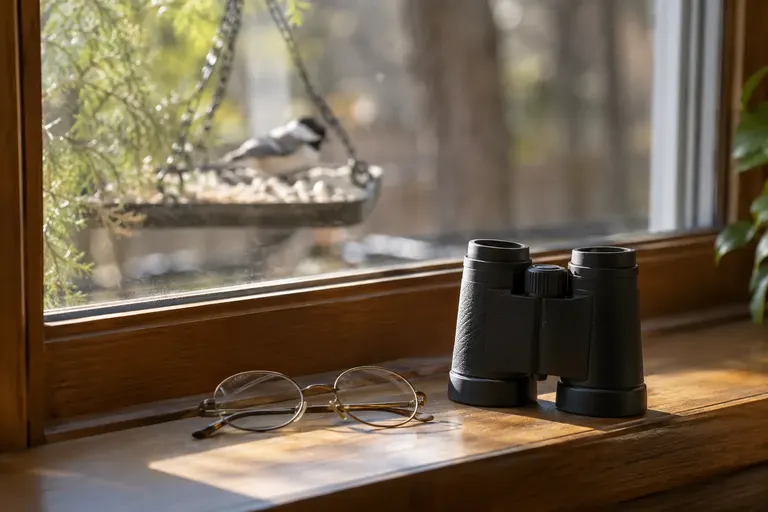
If you wear glasses to see distance, you need enough eye relief to see the full circle with the eyecups twisted down. Look for 17 mm or more. Our binoculars for glasses wearers roundup goes deeper.
Easy focus and a wide view
A wide field of view helps you find the bird quickly, which reduces frustration. A smooth, large focus wheel matters if you have arthritis. Owner feedback on focus stiffness is worth reading closely for any model you consider.
Roof prism or porro prism?
Most lightweight binoculars today are roof prism designs, with straight barrels that are slim and easy to grip with one hand. Porro prism binoculars, with their offset zig-zag barrels, can give a good image for the cost, but at full size they tend to be bulkier. Small porro designs such as the Canon 8x20 IS are the exception. For more on the difference, see our guide to roof prism vs porro prism binoculars.
Weatherproofing still matters
Lighter does not have to mean fragile. A waterproof, gas-purged binocular will not fog inside when you carry it from a warm kitchen to a cold porch in January. Of our picks, only the Canon lacks a water resistance rating, so keep it indoors or under a porch roof on wet days.
Nikon Monarch HG 8x30: best lightweight binoculars overall
What it is: Nikon’s premium compact, built on a lightweight magnesium alloy body.
Who it suits: Seniors who want a light binocular that performs like a much larger one.
Key specs: 15.9 oz, 435 ft at 1,000 yd, 16.2 mm eye relief, 6.6 ft close focus, IPD 56 to 74 mm, waterproof to 16.4 ft for 10 minutes.
Strengths: It combines one of the lowest weights here with one of the widest views. The magnesium body keeps weight down without feeling fragile. The waterproof rating is deeper than most compacts. Expert reviewers commonly describe a sharp image well toward the edges, which helps when scanning a hedge for movement.
Drawbacks: At 16.2 mm, eye relief is adequate but not generous for glasses wearers. It costs noticeably more than the Vortex, which weighs the same on paper.
Skip it if: you need 18 mm or more of eye relief, or cost matters more than optics.
Vortex Diamondback HD 8x32: best value lightweight binoculars
What it is: A mid-range compact roof prism binocular with a very broad warranty.
Who it suits: Seniors on a budget, and anyone who worries about dropping expensive gear.
Key specs: 15.9 oz (manufacturer figure), 426 ft at 1,000 yd, 16 mm eye relief, 5 ft close focus, IPD 55 to 72 mm.
Strengths: The 5 ft close focus is excellent for feeders on a small porch. The Cornell Lab’s review praised a bright, crisp image and called it a solid choice. Vortex’s VIP warranty covers repair or replacement even after an accident.
Drawbacks: Cornell’s reviewers noted a slightly stiff focus wheel and thin eyecup covering that was hard to adjust, and a poor fit for people with close-set eyes. Cornell’s measured weight was a little higher than Vortex’s published figure.
Skip it if: your hands struggle with a stiff focus wheel, or your eyes are close set.
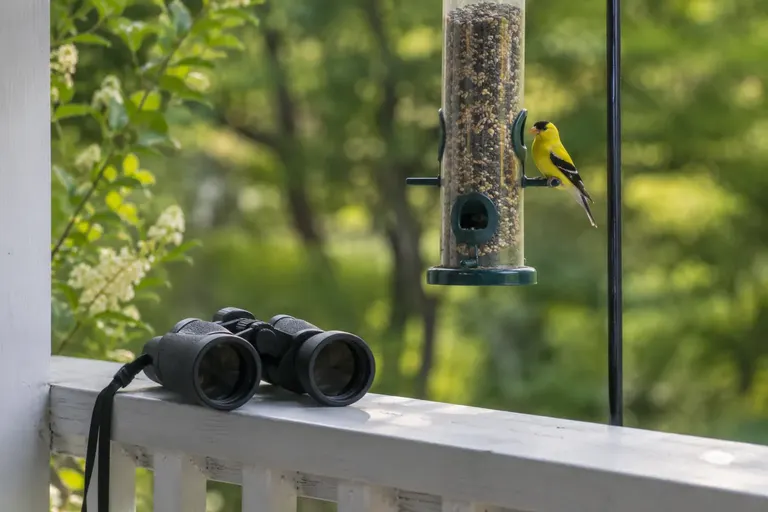
Canon 8x20 IS: best binoculars for shaky hands
What it is: A small porro prism binocular with Canon’s lens-shift image stabilization.
Who it suits: Birders with essential tremor, Parkinson’s-related tremor, arthritis or general unsteadiness.
Key specs: 420 g (14.8 oz) without battery, about 345 ft at 1,000 yd, 13.5 mm eye relief, about 6.6 ft close focus, one CR123A battery rated for about 12 hours at room temperature.
Strengths: Stabilization is the single biggest help for unsteady hands. The system can run while you hold the button or for five minutes per press, so you do not have to keep pressure on it. Reviewers commonly report less eye strain over long sessions.
Drawbacks: Canon lists no water resistance. Eye relief is short for glasses. The 20mm objectives make it dimmer in poor light, and reviewers mention the smooth body can feel slippery and the eyepiece caps are easy to lose.
Skip it if: you wear glasses, or you bird in wet weather.
Swarovski CL Companion 8x30: best lightweight binoculars for glasses wearers
What it is: Swarovski’s current compact, offered in mountain green, desert orange and safari brown.
Who it suits: Glasses wearers, and seniors who want the best optics they can carry easily.
Key specs: 19 oz, 420 ft at 1,000 yd, 19 mm eye relief, 9.8 ft close focus, IPD 2.2 to 2.9 in, waterproof to 13 ft, 90 percent light transmission (Swarovski’s figure).
Strengths: The 19 mm eye relief is the longest in this roundup. Swarovski’s optical quality is widely regarded among expert reviewers as among the best available. The deep waterproof rating adds peace of mind.
Drawbacks: At 19 oz, it sits at our weight ceiling. The 9.8 ft close focus is long for anyone watching a feeder a few steps away. It is by far the most expensive pick.
Skip it if: your feeders are close to where you sit, or you want the lightest possible pair.
Celestron Nature DX 8x32: best budget lightweight binoculars
What it is: Celestron’s entry-level waterproof roof prism binocular with phase-coated BaK-4 prisms.
Who it suits: Casual feeder watchers, gift buyers and glasses wearers on a budget.
Key specs: 18 oz, 388 ft at 1,000 yd, 17.5 mm eye relief, 6.5 ft close focus, IPD 56 to 74 mm, nitrogen-filled and waterproof.
Strengths: The 17.5 mm eye relief is generous for this class, and the Cornell Lab noted comfortable eyecups and a relatively bright, sharp image for the cost. The close focus suits small yards.
Drawbacks: Cornell’s reviewers reported some softness at the edge of the image, considerable glare with backlit subjects, an unpadded neck strap and occasional slip-and-stick focusing.
Skip it if: you often watch birds against the morning or evening sun.
Nikon Prostaff P3 8x30: best lightweight binoculars for a wide view
What it is: Nikon’s entry-level waterproof compact.
Who it suits: Anyone who loses the bird as soon as the binocular goes up.
Key specs: 16.8 oz, 456 ft at 1,000 yd, 15.4 mm eye relief, 8.2 ft close focus, IPD 56 to 72 mm, waterproof to 3.3 ft for 10 minutes.
Strengths: The widest field of view in this roundup, which makes finding and following birds easier. It is waterproof, light and simple.
Drawbacks: No ED glass, so expect more color fringing on bright edges. The eye relief is modest for glasses.
Skip it if: you wear glasses, or you want the sharpest image for the money.
Lightweight binoculars compared
| Model | Weight | FOV (ft at 1,000 yd) | Eye relief | Close focus | Waterproof |
|---|---|---|---|---|---|
| Nikon Monarch HG 8x30 | 15.9 oz | 435 | 16.2 mm | 6.6 ft | Yes, 16.4 ft |
| Vortex Diamondback HD 8x32 | 15.9 oz | 426 | 16 mm | 5 ft | Yes |
| Canon 8x20 IS | 14.8 oz (no battery) | about 345 | 13.5 mm | about 6.6 ft | Not rated |
| Swarovski CL Companion 8x30 | 19 oz | 420 | 19 mm | 9.8 ft | Yes, 13 ft |
| Celestron Nature DX 8x32 | 18 oz | 388 | 17.5 mm | 6.5 ft | Yes |
| Nikon Prostaff P3 8x30 | 16.8 oz | 456 | 15.4 mm | 8.2 ft | Yes, 3.3 ft |
All figures are manufacturer specifications.
How to make any binocular feel lighter
Switch to a harness
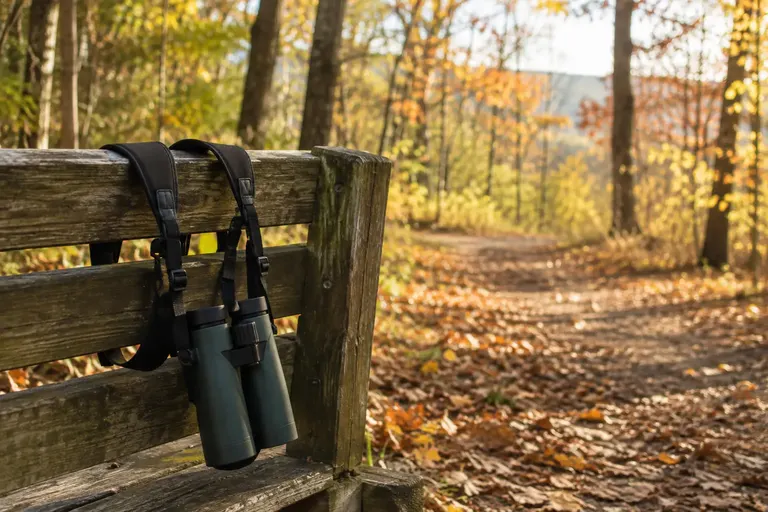
A harness moves the load from the back of your neck to your shoulders and keeps the binocular from swinging. For many older birders, this change matters as much as the binocular itself. See our roundup of binocular harnesses and straps.
Brace your arms
When you raise the binocular, tuck your elbows against your chest, or rest them on a railing, table or car door. Holding the binocular with your thumbs under the barrels and fingertips on top also steadies it.
Set it up once
A binocular that is not adjusted to your eyes looks blurry, and people often blame the optics. Setting the diopter and eyecups takes a few minutes. Our step-by-step guide to adjusting binoculars explains how.
Practice finding birds
Keep your eyes on the bird and bring the binocular up to them, rather than searching through the eyepieces. Our guide on how to find a bird in your binoculars fast has simple drills that work well at a window.
Tips for birding from a chair, porch or window
Many older birders do most of their watching seated. That changes what matters in a binocular, and a few habits make a big difference.
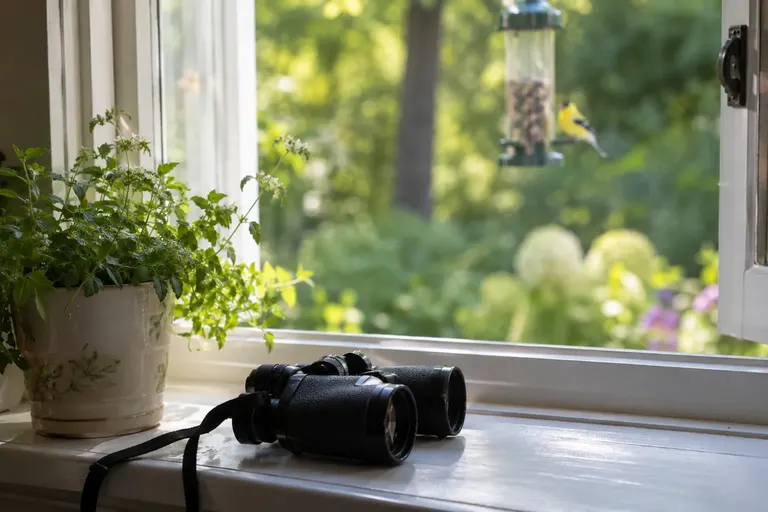
Keep the binocular where you sit. A light binocular hung on a hook by the window, lens caps off, is used far more often than one in a case in the closet. Rainguards and lens caps are worth using outdoors, but indoors they mostly slow you down.
Match close focus to your feeder distance. Measure from your chair to the nearest feeder. If it is 6 ft, a binocular with a 5 or 6.5 ft close focus, such as the Vortex or Celestron, will work. The Swarovski will not focus that close. For feeders stuck to the glass, even the best standard binoculars cannot focus, and your eyes alone will do better.
Rest your elbows. A chair arm, a windowsill or a small table is the easiest stabilizer there is. Resting both elbows cuts shake more than most people expect.
Open the window when you can. Window glass, especially double or triple panes, reduces sharpness and can add faint double images. Looking straight through clean glass helps, but an open window or screen door is better. Our roundup of binoculars for watching birds from your window covers this in more detail.
Watch at the right time. Feeder activity is usually busiest in the early morning. Activity often picks up again in the late afternoon, especially in cold weather.
Common mistakes seniors make when buying binoculars
- Buying more magnification to “see better.” 10x and 12x look impressive but are harder to hold steady and harder to aim.
- Buying the heaviest, brightest pair. A 25 oz binocular that stays in the drawer shows you nothing.
- Forgetting glasses. Check eye relief before you buy if you wear glasses outdoors.
- Ignoring close focus. If you watch a feeder from a porch 8 ft away, a 10 ft close focus will not work.
- Using the thin strap in the box. Most included straps are narrow. A padded strap or harness makes a real difference.
Which lightweight binocular should you buy?
Choose the Nikon Monarch HG 8x30 if you want the best balance of low weight and optical quality. Choose the Vortex Diamondback HD 8x32 for the same weight at a lower cost with a warranty that covers drops. Choose the Canon 8x20 IS if tremor is your main problem. Choose the Swarovski CL Companion 8x30 if you wear glasses and want premium glass. Choose the Celestron Nature DX 8x32 or Nikon Prostaff P3 8x30 if budget comes first.
For more models in this size class, see our compact binoculars roundup.
Sources

Frequently asked questions
What is a good weight for binoculars for seniors?
For most older birders, 14 to 19 oz is the comfortable range. That is where quality 8x30 and 8x32 binoculars sit. Full-size 8x42 models usually weigh 21 to 25 oz, which can tire the neck, shoulders and wrists on a long walk. A harness strap spreads the weight and makes any binocular feel lighter.
Are 8x or 10x binoculars better for older people?
8x is usually better. It shows a wider view, so birds are easier to find, and it magnifies hand shake less than 10x. It also gives a larger exit pupil, which is more forgiving of eye position. 10x can work well for open water or fields, but most backyard and woodland birding suits 8x.
Do image-stabilized binoculars help with hand tremor?
Yes. Image-stabilized binoculars use a battery-powered system to cancel small movements, so the image stays still while you hold a button or for a timed period. Models like the Canon 8x20 IS are light and simple to use. The trade-offs are battery dependence, shorter eye relief and, on this model, no water resistance rating.
What binoculars are best for seniors who wear glasses?
Look for at least 17 mm of eye relief and eyecups that twist fully down. The Swarovski CL Companion 8x30 offers 19 mm and the Celestron Nature DX 8x32 offers 17.5 mm. Many compact models have about 15 mm, which can cut off the edge of the view for some glasses wearers.
Is a harness better than a neck strap for older birders?
For many people, yes. A harness moves the weight from the back of the neck to the shoulders and holds the binocular against the chest so it does not swing. Owners with neck or shoulder problems commonly report more comfort. It adds a small step when putting it on, which some people find fiddly.