Best Compact Binoculars for Birding
The best compact binoculars for birding in 2026: the Nikon Monarch M7 8x30 leads on view and weight, with Vortex, Zeiss, Swarovski and budget picks compared.
If you buy through links on this page we may earn a commission, at no cost to you. It never decides what we recommend. How we earn
In this article
- Quick picks
- How we chose
- What makes a binocular “compact” for birding?
- Nikon Monarch M7 8x30: best compact binoculars overall
- Vortex Diamondback HD 8x32: best value compact binoculars
- Swarovski CL Companion 8x30: best premium compact binoculars
- Zeiss Terra ED 8x32: best compact binoculars for travel
- Nikon Prostaff P3 8x30: best budget compact binoculars
- Pentax Papilio II 6.5x21: best pocket binoculars for close focus
- Canon 8x20 IS: best image-stabilized compact binoculars
- Compact binoculars compared
- How to choose compact binoculars for birding
- Are compact binoculars good for backyard birding?
- Common mistakes when buying compact binoculars
- Compact or full-size: which should you buy?
- Sources
- Frequently asked questions
The Nikon Monarch M7 8x30 is the best compact binocular for birding for most people. It pairs a 435 ft field of view with ED glass and a 16.4 oz body, and the Cornell Lab of Ornithology named it the overall top pick in its compact binocular review. If you want to spend less, the Vortex Diamondback HD 8x32 is the value pick, and the Swarovski CL Companion 8x30 is the one to buy if you want premium glass that lasts decades.
Compact binoculars have improved to the point where many birders no longer need a full-size 8x42 for daylight birding. The best 8x30 and 8x32 models now show a wider view than many 42mm binoculars, focus closer, and weigh several ounces less. That matters on a three-hour walk, and it matters even more if the binocular lives by the kitchen window.
Quick picks
- Best overall: Nikon Monarch M7 8x30. Widest view among the ED models, light, and a Cornell Lab top pick.
- Best value: Vortex Diamondback HD 8x32. 5 ft close focus, 15.9 oz and an unconditional lifetime warranty.
- Best premium: Swarovski CL Companion 8x30. Top-tier optics, 19 mm eye relief, waterproof to 13 ft.
- Best for travel: Zeiss Terra ED 8x32. ED glass and a 5.3 ft close focus from Zeiss.
- Best budget: Nikon Prostaff P3 8x30. A 456 ft view, the widest in this roundup.
- Best pocket and close focus: Pentax Papilio II 6.5x21. Focuses to 1.6 ft and weighs 10.2 oz.
- Best image-stabilized: Canon 8x20 IS. Button-activated stabilization for shaky hands.
Nikon Monarch M7 8x30
A very wide 435 ft field of view, ED glass and a light 16.4 oz body. The Cornell Lab named it the overall top pick in its compact binocular review.
- Best for
- Most birders who want one compact binocular that does everything well.
- Skip it if
- You wear glasses and need more than about 15 mm of eye relief.
- Field of view
- 435 ft at 1,000 yd
- Eye relief
- 15.1 mm
- Close focus
- 6.6 ft
- Weight
- 16.4 oz
Vortex Diamondback HD 8x32
Wide view, a 5 ft close focus and one of the lightest bodies here, backed by Vortex's unconditional lifetime warranty.
- Best for
- Budget-minded birders who want a warranty that covers accidents.
- Skip it if
- Your eyes are set close together; the minimum IPD is 55 mm.
- Field of view
- 426 ft at 1,000 yd
- Eye relief
- 16 mm
- Close focus
- 5 ft
- Weight
- 15.9 oz
Swarovski CL Companion 8x30
Top-tier glass in a small body, with the longest eye relief in this group and a 13 ft waterproof rating.
- Best for
- Birders who want one compact binocular to last decades, including glasses wearers.
- Skip it if
- You watch feeders close to the house; 9.8 ft close focus is long for a compact.
- Field of view
- 420 ft at 1,000 yd
- Eye relief
- 19 mm
- Close focus
- 9.8 ft
- Weight
- 19 oz
Zeiss Terra ED 8x32
ED glass, a fast focus wheel and a 5.3 ft close focus from a premium optics brand, in a body built for packing.
- Best for
- Travelers and hikers who want Zeiss optics without top-tier cost.
- Skip it if
- Weight is your main concern; it is about 2 oz heavier than the Nikon and Vortex.
- Field of view
- 405 ft at 1,000 yd
- Eye relief
- 16.5 mm
- Close focus
- 5.3 ft
- Weight
- 18.0 oz
Nikon Prostaff P3 8x30
The widest field of view in this roundup at 456 ft, waterproof, and a low-risk way to try a compact.
- Best for
- First-time buyers and spare pairs for the car or kitchen window.
- Skip it if
- You want ED glass and the sharpest edges.
- Field of view
- 456 ft at 1,000 yd
- Eye relief
- 15.4 mm
- Close focus
- 8.2 ft
- Weight
- 16.8 oz
Pentax Papilio II 6.5x21
A true pocket binocular that focuses down to 1.6 ft, ideal for feeders near windows, butterflies and dragonflies.
- Best for
- Garden watchers and anyone who wants a binocular in a jacket pocket.
- Skip it if
- You bird in rain; it is not waterproof.
- Field of view
- 394 ft at 1,000 yd
- Close focus
- 1.6 ft
- Weight
- 10.2 oz
Canon 8x20 IS
Push a button and the shake disappears. Useful for anyone whose hands are not as steady as they were.
- Best for
- Birders with hand tremor or anyone who finds 8x images jumpy.
- Skip it if
- You need weatherproofing; Canon lists no water resistance rating.
- Field of view
- About 345 ft at 1,000 yd (115 m at 1,000 m)
- Eye relief
- 13.5 mm
- Close focus
- About 6.6 ft (2 m)
- Weight
- 14.8 oz without battery
How we chose
We have not physically tested these binoculars. This guide is built from research, and we are open about how it was put together.
We started with published manufacturer specifications for every current 8x30, 8x32 and pocket model from established optics makers, and confirmed each number on the maker’s own product page. We compared the specs that matter most for birding: field of view, close focus, eye relief, weight and weather sealing. We then read independent expert reviews, especially the Cornell Lab of Ornithology’s binocular reviews, and looked for patterns in verified owner feedback: focus wheels that stiffen, eyecups that slip, fit problems for close-set eyes.
We excluded models that are discontinued, that lack published specs, or that sell mainly as unbranded imports. Where we could not verify a number, we left it out.
What makes a binocular “compact” for birding?
Binocular names are two numbers. The first is magnification. The second is the diameter of each objective lens in millimeters. Birders use “compact” loosely, but it usually means one of two groups:
- Mid-size compacts (8x30 to 8x32). These are the sweet spot. They weigh about 15 to 19 oz and still deliver a 3.75 to 4 mm exit pupil, bright enough for most birding.
- Pocket binoculars (8x20 to 10x25). These fold small and weigh 10 to 15 oz, but the exit pupil drops to 2.5 to 3 mm. The view is dimmer and less forgiving of eye position.
If you are new to the numbers, our guide to what the numbers on binoculars mean covers exit pupil, field of view and twilight factor in plain terms.
Is 8x32 as good as 8x42 for birding?
In good light, a quality 8x32 is close enough that most people will not see a difference. Your eye’s pupil in daylight is usually 2 to 4 mm wide, so the 4 mm exit pupil of an 8x32 already fills it. The 42mm binocular pulls ahead in the dim light of early morning, heavy overcast and forest shade, when your pupil opens wider. If most of your birding happens at feeders between mid-morning and late afternoon, a compact loses very little.
Nikon Monarch M7 8x30: best compact binoculars overall
What it is: Nikon’s mid-price compact, with ED (extra-low dispersion) glass, dielectric-coated prisms and a waterproof, fogproof body.
Who it suits: Almost everyone. It is light enough for daily walks and wide enough to follow warblers through branches.
Key specs: 435 ft field of view at 1,000 yd, 15.1 mm eye relief, 6.6 ft close focus, 16.4 oz, waterproof to 3.3 ft for 10 minutes. Interpupillary distance range is 2.2 to 2.8 in.
Strengths: The field of view is the headline. At 435 ft, it is wider than many full-size 8x42s, including Nikon’s own Monarch M5 8x42. The Cornell Lab’s review described an eye-filling, colorful image with brightness that held up well in low light, and chose it as the overall top pick among compact binoculars. The ED glass keeps color fringing down on high-contrast subjects like a dark crow against a pale sky.
Drawbacks: Eye relief of 15.1 mm is fine for most people without glasses, but some eyeglass wearers will lose the edge of the view. Cornell’s reviewers noted one tester found the focus knob a little stiff to turn.
Skip it if: you wear thick-framed glasses, or you need the absolute lowest cost.
Vortex Diamondback HD 8x32: best value compact binoculars
What it is: The compact version of Vortex’s popular mid-range roof prism line.
Who it suits: Birders who want good optics without stretching the budget, and anyone who values an accident-proof warranty.
Key specs: 426 ft at 1,000 yd, 16 mm eye relief, 5 ft close focus, 15.9 oz (manufacturer figure), IPD 55 to 72 mm, argon-purged and O-ring sealed.
Strengths: It is among the lightest binoculars here and nearly as wide as the Nikon. A 5 ft close focus is excellent for feeders on a small patio and for butterflies. The Cornell Lab rated it a solid choice, praising a bright, crisp image. Vortex’s VIP warranty is unlimited and unconditional, which means repair or replacement even after a drop.
Drawbacks: Cornell’s reviewers reported a slightly stiff focus wheel and thin eyecup covering that was hard to adjust, and noted poor fit for people with close-set eyes. The 55 mm minimum IPD is the reason.
Skip it if: your eyes are set close together, or you share binoculars with a child.
For the full-size version, see our Vortex Diamondback HD 8x42 review.
Swarovski CL Companion 8x30: best premium compact binoculars
What it is: Swarovski’s compact line, refreshed in current colors (mountain green, desert orange and safari brown).
Who it suits: Birders who want a single compact binocular for life, and eyeglass wearers who struggle with most compacts.
Key specs: 420 ft at 1,000 yd, 19 mm eye relief, 9.8 ft close focus, 19 oz, IPD 2.2 to 2.9 in, waterproof to 13 ft. Swarovski lists 90 percent light transmission.
Strengths: The 19 mm eye relief is the longest in this group, so glasses wearers should see the full field. Swarovski optics are widely regarded by expert reviewers for sharpness, color and flare control, and the waterproof rating is the deepest here.
Drawbacks: Close focus of 9.8 ft is long for a compact. If your feeders hang 6 or 8 ft from where you stand, you will not be able to focus on them. It is also the heaviest mid-size pick and the most expensive by a wide margin.
Skip it if: you watch feeders close to the house, or you want the lightest binocular.
Zeiss Terra ED 8x32: best compact binoculars for travel
What it is: Zeiss’s entry-level ED line, in a compact size made to go in a daypack.
Who it suits: Travelers, hikers and anyone who likes the idea of Zeiss glass at a mid-range level.
Key specs: 405 ft at 1,000 yd, 16.5 mm eye relief, 5.3 ft close focus, 18.0 oz, IPD 56 to 74 mm, nitrogen-filled.
Strengths: ED glass, a close focus nearly as short as the Vortex, and a slightly longer eye relief than the Nikon. Expert reviews commonly praise its fast focus and neutral color. The wide IPD range suits people with broad faces.
Drawbacks: At 18 oz, it is about 2 oz heavier than the Nikon M7 and the Vortex. The field of view is narrower than both.
Skip it if: every ounce counts, or your eyes are close set.
Nikon Prostaff P3 8x30: best budget compact binoculars
What it is: Nikon’s entry-level waterproof compact.
Who it suits: First-time buyers, grandparents buying a gift, and anyone who wants a spare pair by the window.
Key specs: 456 ft at 1,000 yd, 15.4 mm eye relief, 8.2 ft close focus, 16.8 oz, IPD 56 to 72 mm, waterproof to 3.3 ft for 10 minutes.
Strengths: The widest field of view in this roundup, which makes it easy to find a bird. It is waterproof and nitrogen filled, which many cheap compacts are not.
Drawbacks: No ED glass, so expect more color fringing on bright edges than in the Monarch M7. An 8.2 ft close focus is average.
Skip it if: you already know you will bird seriously; the M7 is a better long-term buy.
Pentax Papilio II 6.5x21: best pocket binoculars for close focus
What it is: A small porro prism binocular with a unique trick: the objective lenses move toward each other as you focus close, so both eyes stay aimed at the same spot.
Who it suits: Gardeners, butterfly watchers and anyone with a feeder right outside the window.
Key specs: 394 ft at 1,000 yd (7.5 degrees), 1.6 ft close focus, 15 mm eye relief, 10.2 oz. It is not waterproof.
Strengths: No other binocular here focuses nearly as close. At 6.5x, the image is steady and forgiving. It is the lightest pick, and it fits a coat pocket.
Drawbacks: The 21mm objectives give a 3.2 mm exit pupil, so it is dim in poor light. It is not waterproof or fogproof. At 6.5x, distant birds look small.
Skip it if: you need one binocular for everything, or you bird in wet weather.
Canon 8x20 IS: best image-stabilized compact binoculars
What it is: A small porro prism binocular with Canon’s lens-shift image stabilization, run by one CR123A battery.
Who it suits: Anyone with hand tremor, and birders who find even 8x jumpy.
Key specs: About 345 ft at 1,000 yd (115 m at 1,000 m), 13.5 mm eye relief, about 6.6 ft close focus, 420 g (14.8 oz) without battery. Canon quotes about 12 hours of stabilization per battery at room temperature.
Strengths: Stabilization makes fine detail, such as eye rings and wing bars, easier to see. The button has two modes, press-and-hold or a powered mode that runs for five minutes per press. Independent reviewers commonly report less eye strain in long sessions.
Drawbacks: Canon lists no water resistance. The 20mm objectives limit low-light performance, and 13.5 mm eye relief is short for glasses. Reviewers note the smooth body can be slippery.
Skip it if: you bird in rain, or you wear glasses.
Compact binoculars compared
| Model | FOV (ft at 1,000 yd) | Eye relief | Close focus | Weight | Waterproof |
|---|---|---|---|---|---|
| Nikon Monarch M7 8x30 | 435 | 15.1 mm | 6.6 ft | 16.4 oz | Yes, 3.3 ft |
| Vortex Diamondback HD 8x32 | 426 | 16 mm | 5 ft | 15.9 oz | Yes |
| Swarovski CL Companion 8x30 | 420 | 19 mm | 9.8 ft | 19 oz | Yes, 13 ft |
| Zeiss Terra ED 8x32 | 405 | 16.5 mm | 5.3 ft | 18.0 oz | Yes |
| Nikon Prostaff P3 8x30 | 456 | 15.4 mm | 8.2 ft | 16.8 oz | Yes, 3.3 ft |
| Pentax Papilio II 6.5x21 | 394 | 15 mm | 1.6 ft | 10.2 oz | No |
| Canon 8x20 IS | about 345 | 13.5 mm | about 6.6 ft | 14.8 oz (no battery) | Not rated |
All figures are manufacturer specifications.
How to choose compact binoculars for birding
Start with magnification: 8x almost always wins
At compact sizes, 8x is the right default. It gives a wider view, a brighter image and less visible shake than 10x. Our comparison of 8x42 vs 10x42 explains the trade-offs, and they apply even more strongly at 30mm and 32mm.
Field of view: aim for 390 ft or more
Field of view is how wide a scene you see at 1,000 yards. A wider view makes it easier to find a bird and follow it as it moves. Every mid-size 8x30 and 8x32 pick here clears 400 ft, which is why we like this class so much.
Close focus: under 7 ft for backyard birders
If you watch feeders on a small deck or patio, close focus matters more than you might expect. A binocular that focuses to 5 ft lets you study a chickadee on a feeder a few steps away. One with a 10 ft close focus cannot.
Eye relief: 17 mm or more if you wear glasses
Eye relief is the distance your eye can sit from the eyepiece and still see the whole view. Compacts often run short. If you wear glasses, see our binoculars for glasses wearers roundup, and fold your eyecups down fully.
Interpupillary distance: check the minimum
Compact roof prism binoculars often cannot fold narrow enough for people with close-set eyes or for children. If you have ever seen two circles instead of one, look for a minimum IPD of 55 mm or less, and try before you commit.
ED glass: helpful, not essential
ED glass reduces the purple and green fringes around high-contrast edges. It is a nice upgrade, but coatings and build quality matter too. Our guide to whether ED glass is worth it goes deeper.
Are compact binoculars good for backyard birding?
Yes, and for many backyards they are the better choice. Most feeder birds are seen at 10 to 60 ft, in daylight, and often for a few seconds at a time. That rewards a wide view, a short close focus and a binocular light enough to grab quickly, which is exactly where the 8x30 and 8x32 class is strongest.
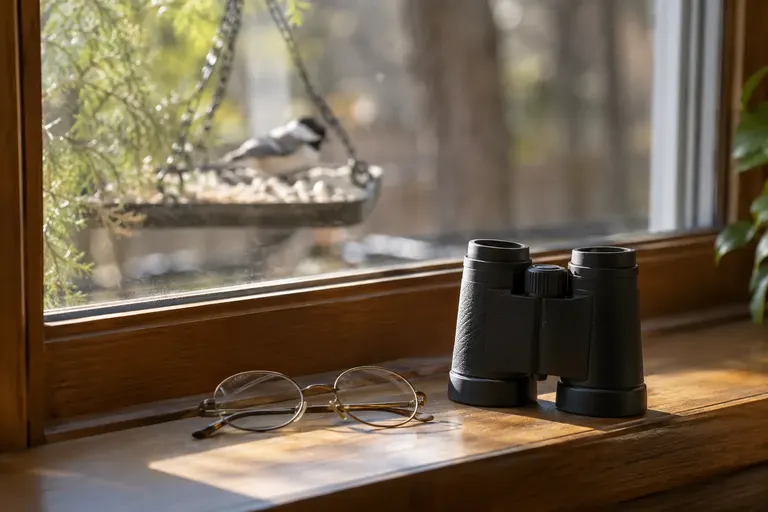
A few practical points help. Keep the binocular by the window you watch from, strap on, so it is always ready. Set the diopter once and leave it. If a feeder hangs within 6 ft of where you stand, favor the Vortex, Zeiss or Pentax, which focus closer than the rest. If you watch mostly from indoors, remember that window glass softens any image, so open the window or look straight through clean glass rather than at an angle.
Common mistakes when buying compact binoculars
- Buying a 10x25 pocket binocular as your only pair. The small exit pupil makes it dim and fussy to hold in the right position.
- Ignoring close focus. Many buyers only notice it when the bird on the feeder will not come sharp.
- Choosing by magnification alone. Higher power looks good on the box and worse in the hand.
- Skipping the diopter setup. An unadjusted diopter makes any binocular look soft. Our guide on how to adjust binoculars takes five minutes.
- Assuming “waterproof” is universal. Two picks here are not rated for water. Know which you are buying.
Compact or full-size: which should you buy?
Buy a compact if you walk more than you sit, travel with carry-on luggage, or watch birds mainly in daylight. Buy a full-size 8x42 if you bird at dawn, in deep forest, or you want one binocular for every situation. Our main best binoculars for birding roundup covers the full-size options, and our guide on how to choose binoculars walks through the decision step by step.
Sources
Frequently asked questions
What size binoculars count as compact for birding?
Birders usually mean binoculars with 25mm to 32mm objective lenses, such as 8x30 and 8x32. They weigh roughly 15 to 19 oz, versus 21 to 25 oz for typical 8x42s. True pocket binoculars, like 8x20 or 6.5x21 models, are smaller again, but their tiny exit pupils make them dimmer in poor light.
Are 8x32 binoculars good enough for serious birding?
Yes. A good 8x32 or 8x30 gives a 4 mm exit pupil, which is plenty in daylight and open shade. Many compact models also have wider fields of view than full-size binoculars. The trade-off shows up in the last minutes of light at dawn and dusk, where a 42mm binocular stays brighter.
Should I get 8x or 10x in a compact binocular?
Choose 8x for birding. At 30mm or 32mm, a 10x binocular has a 3 to 3.2 mm exit pupil, a narrower view and more visible hand shake. 10x compacts make sense for open country such as shorebird flats, but for backyards, woods and warblers, 8x is easier to use.
Are pocket binoculars like 8x21 or 10x25 good for birding?
They work as a spare, not a main pair. The small objectives make a dim, narrow view with a tiny exit pupil, so the image blacks out if your eyes are not perfectly centered. Exceptions are specialist designs such as the Pentax Papilio II, which trades brightness for a close focus of 1.6 ft.
Do compact binoculars work for people who wear glasses?
Some do. Look for 17 mm of eye relief or more and eyecups that twist fully down. In this roundup the Swarovski CL Companion 8x30 has the most, at 19 mm. Compact models with about 15 mm can cut off the edges of the view for some eyeglass wearers.