Best Binoculars for Kids Who Love Birds, by Age
The best binoculars for kids birding: the Vortex Bantam HD 6.5x32 fits small faces with a 51 mm minimum IPD. Picks for preschoolers, tweens and teens compared.
If you buy through links on this page we may earn a commission, at no cost to you. It never decides what we recommend. How we earn
In this article
- Quick picks
- How we chose
- What to look for in binoculars for kids
- Vortex Bantam HD 6.5x32: best binoculars for kids overall
- GeoSafari Jr. Kidnoculars: best binoculars for preschoolers
- Pentax Papilio II 6.5x21: best for kids who love bugs and birds
- Nikon Aculon A30 8x25: best pocket binoculars for tweens
- Nikon Prostaff P3 8x30: best binoculars for teens
- Celestron Nature DX 8x32: best budget binoculars for teens
- Kids binoculars compared
- Which binocular for which age?
- How to check whether binoculars fit your child
- How to keep kids interested in birding
- Easy first birds for kids to find with binoculars
- Caring for a child’s binoculars
- Common mistakes when buying binoculars for kids
- Sources
- Frequently asked questions
The best binoculars for kids who love birds, for most families, are the Vortex Bantam HD 6.5x32. It is a real, waterproof birding binocular that folds down to a 51 mm eye spacing, so it fits small faces, and at 6.5x the image stays steady in small hands. For preschoolers, a focus-free toy like GeoSafari Jr. Kidnoculars is a smarter first step, and teenagers can move up to an adult compact such as the Nikon Prostaff P3 8x30.
The most common reason kids give up on binoculars is not the optics. It is fit. Many adult binoculars simply cannot fold narrow enough for a child’s eyes, so the child sees two circles, or nothing, and hands them back. Choosing the right size matters more than choosing the brand.
Quick picks
- Best overall: Vortex Bantam HD 6.5x32. Made for smaller faces, waterproof, lifetime warranty.
- Best for preschoolers: GeoSafari Jr. Kidnoculars. Focus-free 2x with a breakaway strap.
- Best for curious naturalists: Pentax Papilio II 6.5x21. Focuses to 1.6 ft for birds and bugs.
- Best pocket pick: Nikon Aculon A30 8x25. 9.7 oz and folds small.
- Best for teens: Nikon Prostaff P3 8x30. A 456 ft view in a waterproof body.
- Best budget for teens: Celestron Nature DX 8x32. A 6.5 ft close focus for backyard feeders.
Vortex Bantam HD 6.5x32
A real waterproof birding binocular sized for kids, with a 51 mm minimum IPD, 6.5x steadiness and an unconditional lifetime warranty.
- Best for
- Kids roughly 6 to 12 who want to see real detail on birds.
- Skip it if
- Your child mostly watches feeders a few feet from the window; the 12 ft close focus is long.
- IPD range
- 51 to 69 mm
- Field of view
- 400 ft at 1,000 yd
- Close focus
- 12 ft
- Weight
- 14.4 oz
GeoSafari Jr. Kidnoculars
A focus-free 2x toy binocular with big eyepieces and a breakaway strap, made for ages 3 and up.
- Best for
- Preschoolers learning to look through binoculars at all.
- Skip it if
- Your child is 6 or older and genuinely interested in birds; 2x will feel like a toy.
- Magnification
- 2x
- Focus
- Focus-free
- Ages
- 3 and up
Pentax Papilio II 6.5x21
Focuses to 1.6 ft, so kids can study a bird at the window feeder, a caterpillar or a dragonfly in the same session.
- Best for
- Kids who love bugs and flowers as much as birds.
- Skip it if
- It will get wet; it is not waterproof.
- Close focus
- 1.6 ft
- Field of view
- 394 ft at 1,000 yd
- Weight
- 10.2 oz
Nikon Aculon A30 8x25
A light, folding 8x25 from Nikon that fits a small backpack, at 9.7 oz.
- Best for
- Tweens who want something small for hikes and car trips.
- Skip it if
- Your child is younger than about 10; the 56 mm minimum eye spacing may be too wide.
- IPD range
- 56 to 72 mm
- Field of view
- 315 ft at 1,000 yd
- Close focus
- 9.8 ft
- Weight
- 9.7 oz
Nikon Prostaff P3 8x30
An adult-grade waterproof compact with a 456 ft view that makes birds easy to find.
- Best for
- Teens who are ready to bird with adults.
- Skip it if
- Your child's eyes are set closer than about 56 mm.
- IPD range
- 56 to 72 mm
- Field of view
- 456 ft at 1,000 yd
- Close focus
- 8.2 ft
- Weight
- 16.8 oz
Celestron Nature DX 8x32
A waterproof entry-level binocular with a 6.5 ft close focus that suits backyard feeders.
- Best for
- Teens and older tweens who watch feeders at home and on field trips.
- Skip it if
- You want the lightest pair for a young child; at 18 oz it is heavy for small arms.
- IPD range
- 56 to 74 mm
- Field of view
- 388 ft at 1,000 yd
- Close focus
- 6.5 ft
- Weight
- 18 oz
How we chose
We have not physically tested these binoculars with children. This guide is based on research, and we want to be clear about how we did it.
We compared manufacturer specifications for current binoculars that are marketed to young people or that suit smaller faces, and we checked each figure on the maker’s own product page. For kids, we put the most weight on minimum interpupillary distance, magnification, weight, close focus and durability. We read the Cornell Lab of Ornithology’s K-12 guidance on binoculars for young birders and independent expert reviews, and we looked for patterns in verified owner feedback about fit, sturdiness and whether children kept using them.
Where a maker does not publish a key spec, such as eye spacing, we say so plainly rather than guess.
What to look for in binoculars for kids
Fit first: interpupillary distance
Interpupillary distance, or IPD, is the space between the centers of your eyes. The two halves of a binocular hinge together so the eyepieces can match it. If the binocular cannot fold narrow enough, the child sees two overlapping circles or a black edge, and it feels broken to them.
Adult binoculars often bottom out at 55 or 56 mm. Children’s eyes are usually closer together than adults’, especially under about age 10. That is why a minimum IPD of around 51 mm, like the Vortex Bantam HD’s, is so useful. For teens, a standard 56 mm minimum usually works, but it is still worth a quick check at home.
Magnification: 6x to 8x
Lower magnification gives a wider, brighter and steadier view. The Cornell Lab’s K-12 program recommends 7x or 8x for beginners and notes that lower magnification is best for young people. For younger kids, 6x or 6.5x is even easier. Avoid 10x and 12x binoculars for children, whatever the box promises.
Weight: under about 16 oz for younger kids
A pound is a lot for small arms and a thin neck strap. For children under 10, look for binoculars around 10 to 15 oz. Teens can manage a full compact at 16 to 18 oz.
Durability and a strap
Kids drop things. Waterproof, rubber-armored binoculars survive better, and a warranty that covers accidents is worth a great deal. A strap that is always around the neck prevents most drops in the first place.
Close focus
Kids often want to look at whatever is close, whether that is a chickadee on the feeder or a beetle on the fence. A shorter close focus means more fun and fewer “it’s blurry” moments.
Vortex Bantam HD 6.5x32: best binoculars for kids overall
What it is: A youth binocular from Vortex, designed for smaller hands and faces.
Who it suits: Kids from roughly 6 to 12 who are interested in birds and ready for a real binocular.
Key specs: IPD 51 to 69 mm, 400 ft at 1,000 yd, 18.7 mm eye relief, 12 ft close focus, 14.4 oz, waterproof. It comes with a soft case, comfort neck strap, tethered objective covers, rainguard and lens cloth.
Strengths: The narrow 51 mm minimum IPD is the key feature, and few real birding binoculars fold this small. At 6.5x with a 32mm objective, it gives a large 4.9 mm exit pupil, which is forgiving when a child does not hold it perfectly centered. The long eye relief helps kids who wear glasses. Vortex’s unlimited, unconditional lifetime warranty covers accidental damage, which matters with children.
Drawbacks: The 12 ft close focus is long. A child watching a feeder 8 ft from the window will not get it sharp. At 6.5x, small birds far away look small.
Skip it if: most of your child’s birding happens at a feeder within 10 ft of where they stand.
GeoSafari Jr. Kidnoculars: best binoculars for preschoolers
What it is: A toy binocular from Educational Insights built for young children, with oversized eyepieces and no focus knob.
Who it suits: Ages 3 to about 5, and families who want to build the habit before buying real optics.
Key specs: 2x magnification, focus-free, extra-large cockpit-style eyepieces, breakaway neck strap, durable plastic, no batteries.
Strengths: There is nothing to adjust, so young children can simply lift it and look. The large eyepieces mean there is no IPD problem. The breakaway strap is a sensible safety feature for small children.
Drawbacks: At 2x, it is a toy. It will not show a feather pattern on a sparrow across the yard.
Skip it if: your child is 6 or older and already asking what kind of bird that is.
Pentax Papilio II 6.5x21: best for kids who love bugs and birds
What it is: A compact porro prism binocular whose objective lenses move inward as you focus close, so both eyes stay on the same spot.
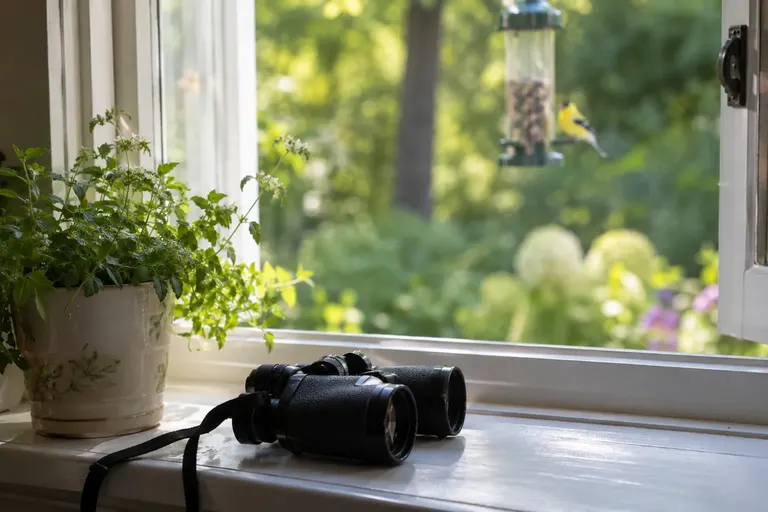
Who it suits: Kids who flip over rocks, chase butterflies and watch birds at the window feeder.
Key specs: 1.6 ft close focus, 394 ft at 1,000 yd (7.5 degrees), 15 mm eye relief, 10.2 oz. It is not waterproof.
Strengths: The close focus is extraordinary. A child can look at a bird on a window feeder, then at a ladybug on a leaf, without changing binoculars. It is light, and 6.5x is steady.
Drawbacks: It is not waterproof or fogproof. The 21mm objectives are dim in poor light. We could not find a published minimum IPD, so check the fit on your child before the return window closes.
Skip it if: your child is rough on gear or often out in the rain.
Nikon Aculon A30 8x25: best pocket binoculars for tweens
What it is: A small folding roof prism binocular from Nikon’s entry-level line.
Who it suits: Tweens and older kids who want something that fits a backpack pocket.
Key specs: IPD 56 to 72 mm, 315 ft at 1,000 yd (105 m at 1,000 m), 15 mm eye relief, 9.8 ft close focus, 275 g (9.7 oz).
Strengths: It is the lightest real binocular here and small enough to take everywhere. A binocular that goes on every walk teaches more than a better one that stays home.
Drawbacks: The 3.1 mm exit pupil makes it dim in shade. The 56 mm minimum IPD may be too wide for younger children. Nikon’s published specs we reviewed do not list a waterproof rating.
Skip it if: your child is under about 10, or the binocular will be used in wet weather.
Nikon Prostaff P3 8x30: best binoculars for teens
What it is: Nikon’s entry-level waterproof compact, a real adult binocular in a manageable size.
Who it suits: Teens who are serious about birding and go on walks with local clubs or school groups.
Key specs: IPD 56 to 72 mm, 456 ft at 1,000 yd, 15.4 mm eye relief, 8.2 ft close focus, 16.8 oz, waterproof to 3.3 ft for 10 minutes.
Strengths: The 456 ft field of view is the widest in this roundup, which makes finding birds easier. It is waterproof and nitrogen filled. At 8x, it shows enough detail to keep up with adult birders.
Drawbacks: No ED glass. The 56 mm minimum IPD will not suit every younger child.
Skip it if: your child is small for their age or has close-set eyes.
Celestron Nature DX 8x32: best budget binoculars for teens
What it is: Celestron’s waterproof entry-level roof prism binocular.
Who it suits: Teens who mostly watch backyard feeders and want a real binocular without a big spend.
Key specs: IPD 56 to 74 mm, 388 ft at 1,000 yd, 17.5 mm eye relief, 6.5 ft close focus, 18 oz, waterproof.
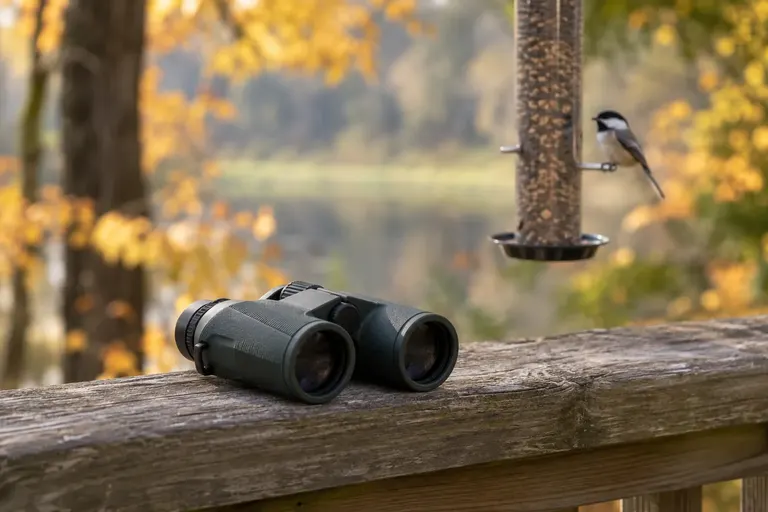
Strengths: The 6.5 ft close focus suits feeders close to the house. The Cornell Lab’s review noted a relatively bright, sharp image for the cost and comfortable eyecups.
Drawbacks: At 18 oz, it is the heaviest pick. Cornell’s reviewers noted glare with backlit birds, softness at the edges and an unpadded strap.
Skip it if: your child is under about 12 or small-framed.
Kids binoculars compared
| Model | Magnification | Min IPD | Close focus | Weight | Waterproof |
|---|---|---|---|---|---|
| Vortex Bantam HD 6.5x32 | 6.5x | 51 mm | 12 ft | 14.4 oz | Yes |
| GeoSafari Jr. Kidnoculars | 2x | Not applicable | Focus-free | Not listed | No |
| Pentax Papilio II 6.5x21 | 6.5x | Not published | 1.6 ft | 10.2 oz | No |
| Nikon Aculon A30 8x25 | 8x | 56 mm | 9.8 ft | 9.7 oz | Not listed |
| Nikon Prostaff P3 8x30 | 8x | 56 mm | 8.2 ft | 16.8 oz | Yes |
| Celestron Nature DX 8x32 | 8x | 56 mm | 6.5 ft | 18 oz | Yes |
All figures are manufacturer specifications.
Which binocular for which age?
- Ages 3 to 5: A focus-free toy binocular. The goal is the habit of looking, not detail.
- Ages 6 to 9: A real 6x or 6.5x binocular with a minimum IPD near 51 mm, such as the Vortex Bantam HD.
- Ages 10 to 12: The Vortex Bantam HD still fits best. A small 8x like the Aculon A30 can work if the child’s eyes are wide enough apart.
- Teens: Most can use adult 8x30 or 8x32 binoculars. See our best binoculars for beginners for more options.
Ages are rough guides. Always check the fit on your own child.
How to check whether binoculars fit your child
- Fold the hinge all the way in. Ask your child to look at a large object, such as a car or a doorway.
- Ask what they see. They should see one round image. Two overlapping circles or a black edge on one side means the binocular is still too wide.
- Set the eyecups. Twist them fully up unless your child wears glasses.
- Set focus and diopter for them. Young children rarely manage this alone at first. Our guide on how to adjust binoculars shows the steps.
- Check the weight. Hang the binocular on their neck for a few minutes. If they keep pulling at the strap, it is too heavy.
How to keep kids interested in birding
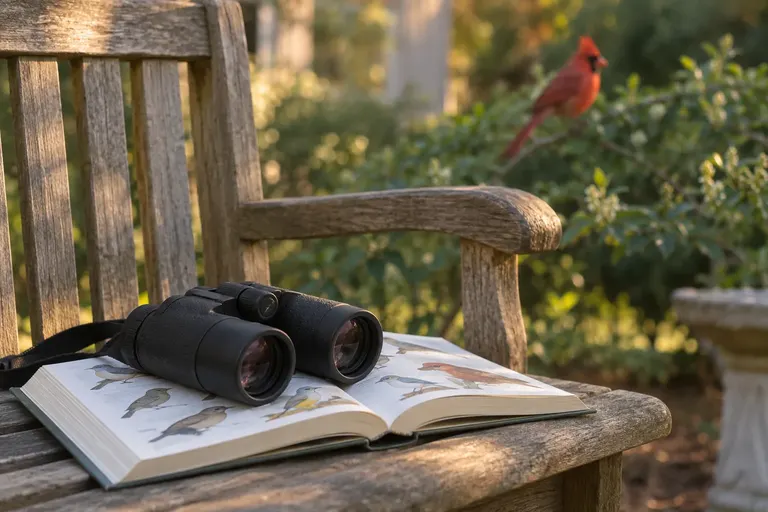
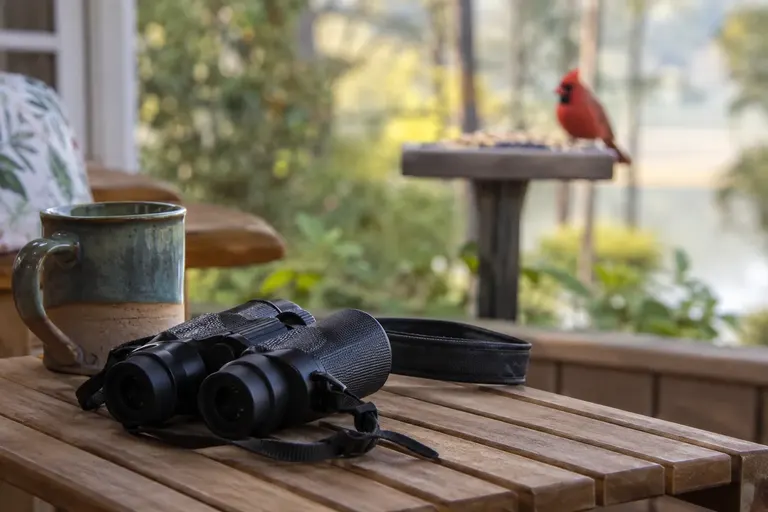
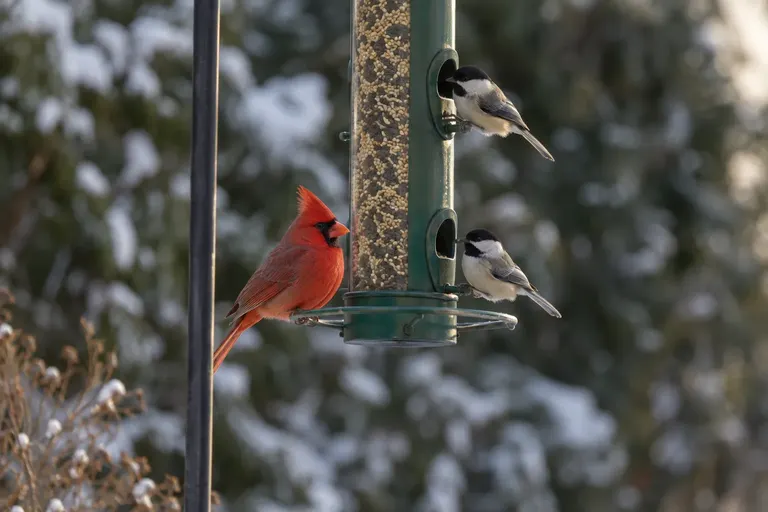
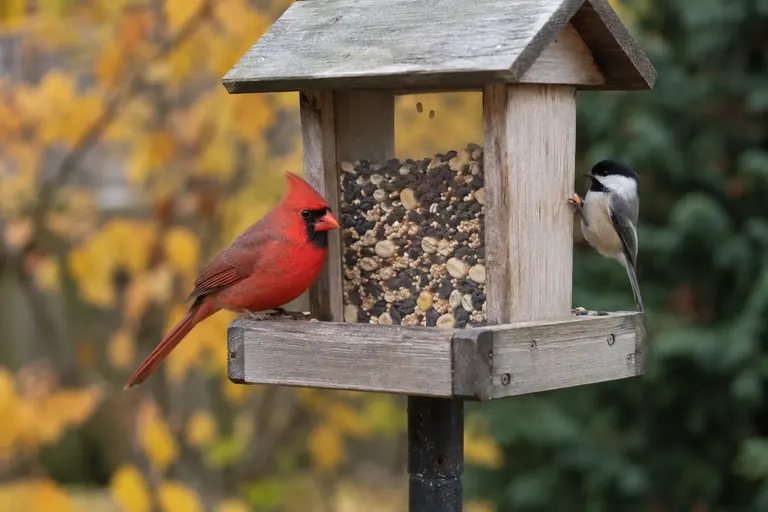
Kids stay interested when they succeed early. Start at a feeder, where birds come to you. Cardinals, chickadees and blue jays are big, bright and easy to find. Our guide to attracting Northern Cardinals is a good project for families.
Teach kids to find the bird with their eyes, then lift the binocular without looking away. Our guide on how to find a bird in your binoculars fast has simple drills. A kid-friendly field guide or a free app such as Merlin adds the thrill of naming what they see; see our best bird ID apps. For more ideas, read birding with kids.
Easy first birds for kids to find with binoculars
Success early keeps kids looking. These common backyard birds across much of the US are big enough, bright enough or bold enough to be good first targets.
| Bird | What to look for | Where kids will find it |
|---|---|---|
| Northern Cardinal | Male bright red with a crest and black face; female warm brown with red in wings and tail | Feeders, shrubs, often at dawn and dusk |
| Blue Jay | Blue, white and black with a crest; loud calls | Treetops, feeders with peanuts or sunflower |
| American Robin | Gray-brown back, orange breast | Lawns, running and stopping to pull up earthworms |
| Black-capped or Carolina Chickadee | Black cap and bib, white cheeks | Feeders, flitting in and out with single seeds |
| Mourning Dove | Soft tan-gray, long pointed tail | On the ground under feeders, and on wires |
A good exercise for a new young birder is to pick one feature to check, such as “Does it have a crest?” or “What color is its belly?” Looking for a specific clue turns binocular practice into a game. Our guide to how to identify birds explains the clues experienced birders use, in terms kids can follow.
Caring for a child’s binoculars
A little care goes a long way with young owners.
- Strap on, always. Make it the first rule. Most drops happen when a binocular is set down or carried by hand.
- Caps on in the bag. Tethered lens covers, like those on the Vortex Bantam HD, are much harder to lose than loose caps.
- Blow, brush, then wipe. Teach kids to blow off grit before wiping a lens, and only to use a lens cloth. A T-shirt with sand on it can scratch coatings.
- Keep non-waterproof models dry. The Papilio II is not waterproof, and the Aculon A30 specs we reviewed list no waterproof rating, so both should stay home on rainy days.
- Store it where they can reach it. A binocular on a hook by the back door gets used. One on a high shelf does not.
Common mistakes when buying binoculars for kids
- Buying high magnification. 10x and 12x are shaky, dim and hard to aim.
- Ignoring IPD. A binocular that does not fold narrow enough is unusable, however good the glass.
- Buying cheap unbranded “kids binoculars.” Owners commonly report blurry images, and poorly aligned barrels can cause eye strain.
- Buying too heavy. A binocular that is uncomfortable stays in the car.
- Skipping the strap. Strap on, every time, prevents most drops.
Sources
Frequently asked questions
What age can a child start using real binoculars?
Many children can handle a real, low-power binocular from about age 6, once they can close focus with a small wheel and hold something steady for a few seconds. Younger children usually do better with a focus-free toy binocular. The biggest limit is fit: a child's eyes are closer together, so the binocular must fold narrow enough to show one clear circle.
What magnification is best for kids binoculars?
6x to 8x. Lower magnification gives a wider, steadier and brighter view, which makes it easier for a child to find the bird. The Cornell Lab's K-12 guidance recommends 7x or 8x for beginners and notes lower magnification is best for young people. Avoid 10x or higher for children, since hand shake becomes a real problem.
What is interpupillary distance and why does it matter for kids?
Interpupillary distance, or IPD, is the space between the centers of your pupils. A binocular's hinge must fold until the eyepieces match it. Many adult binoculars cannot fold narrower than 55 or 56 mm, which is too wide for many younger children. When it does not fit, a child sees two circles or blacks out, and quickly gives up.
Are toy binoculars worth buying for birding?
For preschoolers, yes. A focus-free toy binocular teaches the habit of lifting binoculars to the eyes and looking for a bird. For school-age children who are interested in birds, most toy binoculars are frustrating because the images are small and blurry. That is when a real low-power binocular is worth it.
How do I teach a child to use binoculars?
Set the binocular to fit first: fold the hinge until the child sees one circle and adjust the focus for them. Then practice on large, still targets such as a mailbox or a feeder. Teach them to keep their eyes on the bird and bring the binocular up to their eyes, without looking down. Short, successful sessions build confidence.