Best Binoculars for Beginners: Easy First Birding Picks
The best binoculars for beginners birding, chosen on verified specs. The Celestron Nature DX 8x42 is our top pick: waterproof, close focusing and easy to use.
If you buy through links on this page we may earn a commission, at no cost to you. It never decides what we recommend. How we earn
In this article
- Quick picks
- How we chose
- Celestron Nature DX 8x42: best binoculars for beginner birders
- Nikon Prostaff P7 8x42: best for beginners who wear glasses
- Vortex Diamondback HD 8x42: best warranty for beginners
- Nikon Monarch M5 8x42: best buy-once pick
- Celestron Nature DX 8x32: best lightweight binoculars for beginners
- Nikon Prostaff P3 8x42: lowest-cost starter
- Comparison table: beginner birding binoculars
- What do the numbers on binoculars mean?
- Why 8x42 is the best first binocular
- How to set up new binoculars in five minutes
- How beginners find birds in binoculars faster
- Good first birds to practice on
- Should a beginner buy compact, full-size or porro binoculars?
- Tips for older beginners
- How to care for your first binoculars
- Common beginner mistakes when buying binoculars
- What else does a beginner birder need?
- Sources
- Frequently asked questions
The best binoculars for beginners in birding is the Celestron Nature DX 8x42. It is waterproof, focuses as close as 6.5 ft for feeder birds, shows a 388 ft wide view that makes birds easier to find, and Celestron lists it under $200. Beginners who wear glasses should look at the Nikon Prostaff P7 8x42 for its 20.2 mm eye relief, and anyone sure they will stick with birding can buy once with the Nikon Monarch M5 8x42.
Quick picks
- Best overall for beginners: Celestron Nature DX 8x42
- Best for beginners who wear glasses: Nikon Prostaff P7 8x42
- Best warranty: Vortex Diamondback HD 8x42
- Best buy-once pick: Nikon Monarch M5 8x42
- Best lightweight: Celestron Nature DX 8x32
- Lowest-cost starter: Nikon Prostaff P3 8x42
Celestron Nature DX 8x42
Forgiving 8x magnification, a wide 388 ft view, 6.5 ft close focus and a waterproof body.
- Best for
- Most new birders.
- Skip it if
- You wear thick glasses and need more than 17.5 mm eye relief.
- Field of view
- 388 ft at 1,000 yd
- Close focus
- 6.5 ft
- Weight
- 22.2 oz
Nikon Prostaff P7 8x42
20.2 mm eye relief, a locking diopter and dielectric prism coatings in a light 20.8 oz body.
- Best for
- Eyeglass wearers and anyone who wants a light first binocular.
- Skip it if
- Your feeders are closer than 10 ft; close focus is 9.8 ft.
- Eye relief
- 20.2 mm
- Field of view
- 377 ft at 1,000 yd
- Weight
- 20.8 oz
Vortex Diamondback HD 8x42
Close focus to 5 ft and an unconditional lifetime warranty that covers drops.
- Best for
- Families, shared binoculars and nervous first-time buyers.
- Skip it if
- You find stiff focus wheels frustrating.
- Close focus
- 5 ft
- Field of view
- 393 ft at 1,000 yd
- Weight
- 21.8 oz
Nikon Monarch M5 8x42
ED glass and 19.5 mm eye relief, good enough that many birders never need to upgrade.
- Best for
- Beginners who are sure birding will stick.
- Skip it if
- You struggle to find birds in the view; its field is narrow.
- Eye relief
- 19.5 mm
- Field of view
- 335 ft at 1,000 yd
- Weight
- 22.2 oz
Celestron Nature DX 8x32
The Nature DX in a smaller 18 oz body with the same wide view and close focus.
- Best for
- Smaller hands, walkers and travelers.
- Skip it if
- You often bird in dim woods at dawn.
- Weight
- 18 oz
- Field of view
- 388 ft at 1,000 yd
- Close focus
- 6.5 ft
Nikon Prostaff P3 8x42
A light, waterproof Nikon 8x42 with 20.2 mm eye relief at an entry-level price.
- Best for
- Trying birding without much financial risk.
- Skip it if
- You can reach the P7, which adds brighter prism coatings.
- Eye relief
- 20.2 mm
- Weight
- 20.3 oz
How we chose
Perch and Glass has not yet physically tested these binoculars, so this guide is research-led. We focused on what makes a binocular easy for someone new to birds:
- Forgiving specs. We looked for 8x magnification, a field of view of at least 335 ft at 1,000 yards, and eye relief of 17 mm or more so glasses wearers can use them.
- Verified numbers. All specs come from manufacturer spec pages.
- Expert reviews. We used the Cornell Lab of Ornithology’s All About Birds binocular reviews, which cover several beginner-priced models, plus specialist optics reviewers.
- Owner feedback patterns. We read verified owner reviews for common problems that frustrate beginners, such as stiff focus wheels, loose eyecups or accessories that fall off.
- Durability and warranty. Beginners drop things. Waterproofing was required, and warranties were weighed.
Celestron Nature DX 8x42: best binoculars for beginner birders
The Nature DX 8x42 checks every box a new birder needs, and nothing it includes is hard to use.
Key specs (Celestron): 388 ft at 1,000 yd (7.4 degrees), 17.5 mm eye relief, 6.5 ft close focus, 22.2 oz, 5.25 mm exit pupil, phase-coated BaK-4 prisms, fully multi-coated, waterproof and nitrogen filled, limited lifetime warranty.
Why it suits beginners. The wide field of view gives you a better chance of finding a bird on the first try. The 6.5 ft close focus means a titmouse at the feeder just outside the window is in reach. The 5.25 mm exit pupil keeps the image bright in shade and makes it easier to line your eyes up.
Strengths. Owners commonly describe it as a big step up from older or cheap binoculars, and it appears on many independent budget birding lists. It includes a case, strap, lens caps and rain guard. See our Celestron Nature DX 8x42 review.
Drawbacks. Low-light performance and control of color fringing are a step behind ED-glass models. The strap and case are basic.
Skip it if: you know you will be out every weekend; the Monarch M5 is worth the extra.
Nikon Prostaff P7 8x42: best for beginners who wear glasses
The Prostaff P7 has 20.2 mm of eye relief, the most of any pick here, so most glasses wearers can see the full view with the eyecups twisted down.
Key specs (Nikon): 377 ft at 1,000 yd, 20.2 mm eye relief, 9.8 ft close focus, 20.8 oz, dielectric and phase-coated prisms, locking diopter, waterproof to 3.3 ft, nitrogen filled.
Why it suits beginners. It is light, and the locking diopter keeps your eye setting from getting bumped. Beginners often do not notice when a diopter drifts; they only notice the view is suddenly soft.
Strengths. The Cornell Lab’s reviewers found a bright, colorful image with crisp distant detail, a smooth focus wheel and secure eyecups.
Drawbacks. Close focus is listed at 9.8 ft. Reviewers also noted edge distortion when panning and minimal accessories.
Skip it if: you watch a window feeder from close range.
Vortex Diamondback HD 8x42: best warranty for beginners
For many beginners, the biggest worry is breaking something expensive. Vortex’s VIP warranty is unlimited, unconditional and lifetime, and it covers accidental damage.
Key specs (Vortex): 393 ft at 1,000 yd, 17 mm eye relief, 5 ft close focus, 21.8 oz, argon purged, O-ring sealed.
Why it suits beginners. The 5 ft close focus is the best here, and the body is light and comfortable for smaller hands. It is a good family binocular that can be shared and lent without worry.
Strengths. The Cornell Lab praised a bright image sharp nearly to the edges, the light weight and the close focus. More in our Vortex Diamondback HD 8x42 review.
Drawbacks. Both Cornell’s reviewers and many owners describe the focus wheel as stiff, which can make following a moving bird harder while you learn.
Skip it if: a smooth, light focus wheel matters more than the warranty.
Nikon Monarch M5 8x42: best buy-once pick
Some beginners know from day one that birding will stick. For them, the Monarch M5 avoids buying twice. It adds ED glass, which reduces color fringing, and long eye relief.
Key specs (Nikon): 335 ft at 1,000 yd, 19.5 mm eye relief, 8.2 ft close focus, 22.2 oz, ED glass, waterproof to 3.3 ft.
Why it suits beginners. Sharp, bright optics and easy eye placement make long sessions comfortable, and the image quality is good enough that many birders never upgrade. Our Nikon Monarch M5 8x42 review has more.
Strengths. Independent reviewers praise the sharpness, brightness, color and build.
Drawbacks. The 335 ft field of view is narrow. Beginners already find locating birds in binoculars the hardest skill, and a narrow view makes it slightly harder.
Skip it if: you mostly watch quick songbirds in trees.
Celestron Nature DX 8x32: best lightweight binoculars for beginners
The 8x32 version of the Nature DX keeps the wide 388 ft view and 6.5 ft close focus in an 18 oz body.
Key specs (Celestron): 388 ft at 1,000 yd, 17.5 mm eye relief, 6.5 ft close focus, 18 oz, waterproof, nitrogen purged.
Why it suits beginners. A binocular that is light enough to carry every walk gets used. It is also a good size for smaller hands and for older teens.
Strengths. Four ounces lighter than the 8x42 with identical field of view and close focus.
Drawbacks. The smaller objectives give a dimmer view at dawn, dusk and in dense shade.
Skip it if: you bird mostly in low light.
Nikon Prostaff P3 8x42: lowest-cost starter
The Prostaff P3 is the least expensive pick here and a reasonable way to try birding. It shares the P7’s 20.2 mm eye relief and light body.
Key specs (Nikon): 377 ft at 1,000 yd, 20.2 mm eye relief, 9.8 ft close focus, 20.3 oz, waterproof to 3.3 ft.
Why it suits beginners. Low cost, low weight and long eye relief.
Strengths. The Cornell Lab called it comfortable, light and good for the price, and suggested it for stationary use such as feeder watching.
Drawbacks. A dimmer image than Nikon’s Monarch line, edge distortion when panning, and basic accessories.
Skip it if: you can afford the P7 or the Nature DX.
Comparison table: beginner birding binoculars
| Binocular | Field of view (ft at 1,000 yd) | Eye relief | Close focus | Weight |
|---|---|---|---|---|
| Celestron Nature DX 8x42 | 388 | 17.5 mm | 6.5 ft | 22.2 oz |
| Nikon Prostaff P7 8x42 | 377 | 20.2 mm | 9.8 ft | 20.8 oz |
| Vortex Diamondback HD 8x42 | 393 | 17 mm | 5 ft | 21.8 oz |
| Nikon Monarch M5 8x42 | 335 | 19.5 mm | 8.2 ft | 22.2 oz |
| Celestron Nature DX 8x32 | 388 | 17.5 mm | 6.5 ft | 18 oz |
| Nikon Prostaff P3 8x42 | 377 | 20.2 mm | 9.8 ft | 20.3 oz |
What do the numbers on binoculars mean?
Every binocular has two numbers, such as 8x42. The first is magnification: an 8x binocular makes a bird look eight times closer. The second is the diameter of each front lens in millimeters. Bigger front lenses gather more light but add weight. Divide the second number by the first to get the exit pupil, the beam of light that reaches your eye: 42 divided by 8 is 5.25 mm. Larger exit pupils are brighter and easier to line up with your eyes. Our guide to what the numbers on binoculars mean covers field of view and eye relief too.
Why 8x42 is the best first binocular
- Easy to find birds. 8x has a wider view than 10x.
- Steadier image. Lower magnification shows less hand shake.
- More depth of field. More of the branch stays in focus as a bird moves.
- Bright. A 5.25 mm exit pupil works well in shade.
- Versatile. Good for feeders, parks, ponds and trails.
How to set up new binoculars in five minutes
Most beginner frustration comes from skipping setup. Do this once and write down the diopter setting.
- Set the eyecups. Twist them fully up if you do not wear glasses, fully down if you do.
- Adjust the hinge. Look at something distant and fold the barrels until you see one clean circle, not two overlapping ones.
- Focus the left eye. Cover the right front lens with your hand or lens cap. Turn the center focus wheel until a sign or branch 30 to 50 yards away is sharp.
- Set the diopter. Cover the left front lens. Turn only the diopter ring, usually near the right eyepiece, until the same object is sharp.
- Check with both eyes. It should be sharp and comfortable. From now on, use only the center wheel.
Our full binocular adjustment guide has more detail.
How beginners find birds in binoculars faster
The hardest skill for new birders is getting the binocular onto a bird. Try this:
- Keep your eyes on the bird. Do not look down at the binocular.
- Raise the binocular to your eyes without moving your head or gaze.
- Use landmarks. Note a branch fork or a distinctive leaf near the bird, find that, then move to the bird.
- Practice on still targets. Mailboxes, fence posts and feeders are good practice.
Our guide on how to find a bird in your binoculars fast includes more drills.
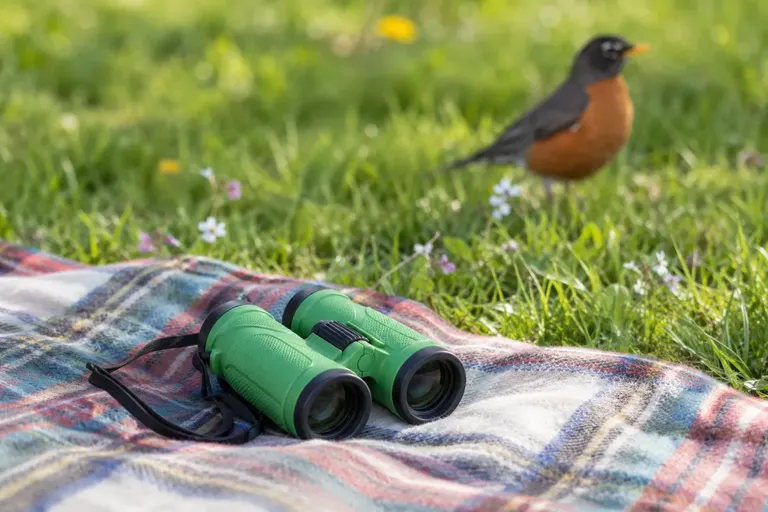
Good first birds to practice on
New binoculars are easiest to learn with on birds that sit still, return often and show clear field marks. Across much of the US, these common backyard species are good practice:
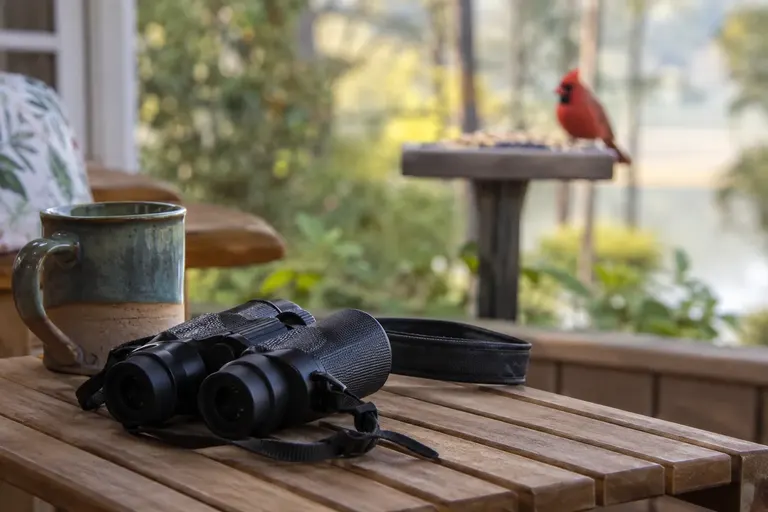
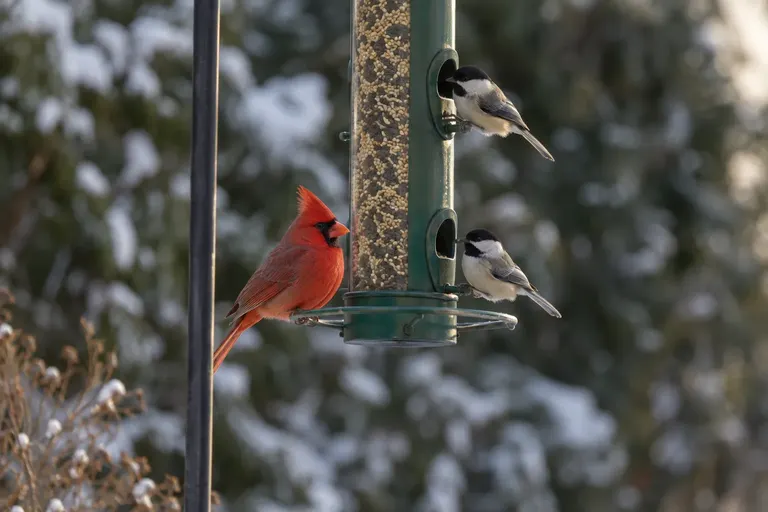
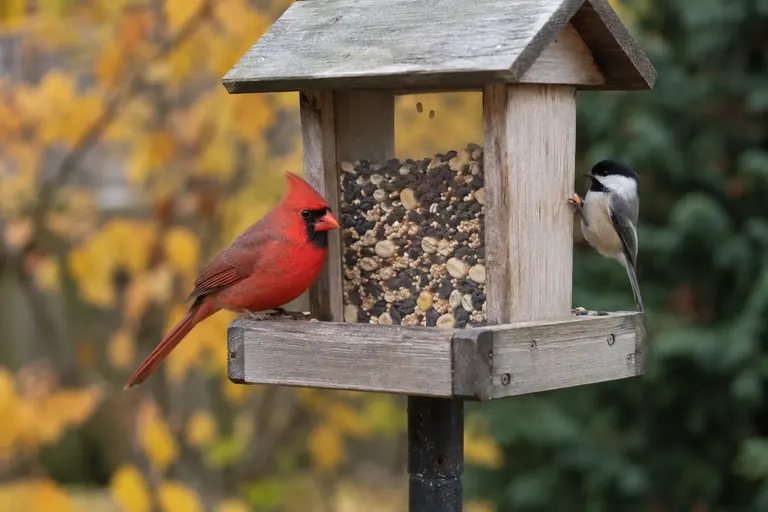
- Northern Cardinal. Common across the eastern and central US. The male is bright red with a black face; the female is warm brown with red tinges on the crest, wings and tail. Both have a thick orange-red bill. Cardinals often perch in the open on shrubs.
- Mourning Dove. Found across most of the US. Doves sit calmly on wires and ground for long periods, so they are ideal for practicing focus and noticing details such as the black spots on the wings.
- American Robin. Widespread and often on open lawns, where you can practice following a bird that runs, stops and looks.
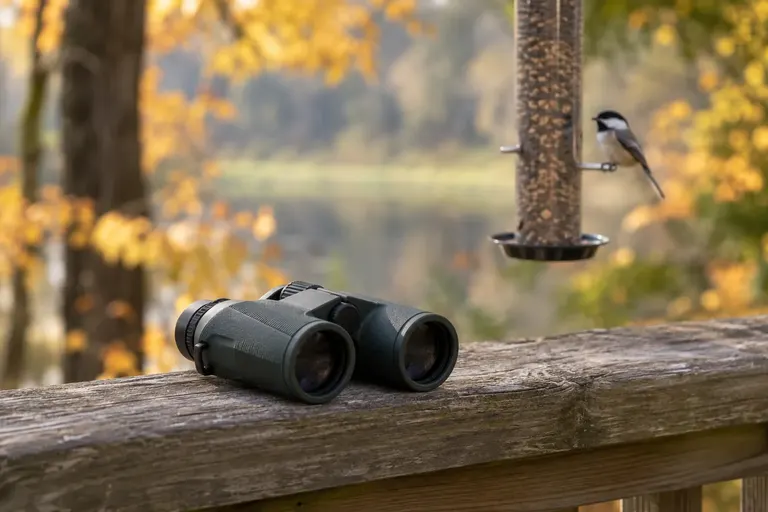
- Chickadees. Black-capped Chickadees in the north and Carolina Chickadees in the southeast visit feeders often. They move fast, which makes them good practice once you are comfortable with slower birds.
- Birds at your feeder. Any regular visitor is useful because you know where it will appear.
Practice raising the binocular smoothly to each bird, then work through details: bill shape, wing bars, eye rings, tail length. This is the core of learning bird identification.
Should a beginner buy compact, full-size or porro binoculars?
Full-size 8x42 is the best first choice for most people. It is bright, easy to line up with your eyes and comfortable in adult hands.
Compact 8x32 is a strong second choice if you walk a lot, travel or have smaller hands. You give up a little brightness in dim light.
Pocket 8x25 or 10x25 binoculars are handy to keep in a car or bag, but they are harder to use as a main pair. The small exit pupil means your eyes have to be in exactly the right place.
Porro prism binoculars, with the zigzag body shape, can offer good optics for the money, but budget porros are often not waterproof and some have short eye relief and long close focus. For a first birding binocular, a waterproof roof prism is simpler.
Tips for older beginners
Many people take up birding later in life, and a few details matter more:
- Weight. If 22 oz feels heavy after an hour, choose an 8x32 or use a harness that moves the weight to your shoulders.
- Eye relief. Bifocals and progressive lenses push eyes farther from the eyepiece. Models with 19 mm or more, such as the Prostaff P3, P7 and Monarch M5, are easiest.
- Grip. Rubber armor and a slim body help if your hands tire or ache.
- Brightness. Pupils tend to open less with age, so very large exit pupils bring less benefit than they do for younger eyes, but good coatings still help contrast.
How to care for your first binoculars
- Keep lens caps and the rain guard on when the binocular is not in use.
- Brush or blow grit off lenses before wiping, then use a microfiber cloth.
- Never use paper towels or clothing on lenses; they can scratch coatings.
- Store it dry and at room temperature, not in a hot car.
- Register the warranty if the maker asks, and keep the receipt even when the warranty says it is not needed.
Common beginner mistakes when buying binoculars
- Buying high magnification. 12x, 16x and “zoom” binoculars are harder to hold steady and harder to aim.
- Buying tiny pocket binoculars as a first pair. Small exit pupils make them fiddly and dim.
- Ignoring waterproofing. Morning dew and rain happen. Fogged internals cannot be wiped.
- Trusting unverified marketplace listings. Stick to brands that publish full spec sheets.
- Skipping a strap or harness. A comfortable strap means you carry the binocular more often.
What else does a beginner birder need?
Not much. The binocular is the only piece of gear that is hard to do without. After that, a comfortable strap or harness, a hat with a brim to cut glare, and a feeder you can see from a favorite chair will do more for your birding than any upgrade. A field guide or a free app such as Merlin helps you put names to birds, and a notebook or eBird checklist helps you learn faster. Our guide to birding for beginners covers the rest of the kit, and our overall best binoculars for birding list shows where to go when you are ready to upgrade.
Sources
Frequently asked questions
What binoculars should a beginner birder buy?
Start with a waterproof 8x42 roof prism binocular from an established brand, with phase-coated prisms, a field of view of at least 370 ft at 1,000 yards and close focus under 10 ft. The Celestron Nature DX 8x42 and Nikon Prostaff P7 8x42 both fit that description and cost less than most mid-range models.
Is 8x or 10x better for beginners?
8x is better for beginners. A lower magnification gives a wider view, so birds are easier to find, and the image shakes less, so field marks are easier to see. 8x also has more depth of field, so less refocusing is needed as a bird hops through branches. Many experienced birders still prefer 8x.
How much should a beginner spend on binoculars?
A capable beginner binocular is available under $200. That is enough to see plumage detail clearly and learn common birds. If you already know you enjoy birding, spending more for ED glass, such as on the Nikon Monarch M5, can mean you never need to upgrade.
Why do my new binoculars look blurry?
Usually the diopter is not set, the hinge is not adjusted to your eye spacing, or the eyecups are in the wrong position. Close the hinge until you see one circle, focus with your left eye using the center wheel, then set the right eye with the diopter ring. Glasses wearers should twist the eyecups down.
Are compact binoculars good for beginners?
Compact 8x32 models are a good choice for beginners who value low weight. Very small 8x25 or 10x25 pocket binoculars are harder to use because their small exit pupils make it harder to line up your eyes and dimmer in shade. For a first pair, 8x42 or 8x32 is easier to learn with.