Leave the Leaves: Why Fall Cleanup Hurts Birds
Leave the leaves: fallen leaves shelter the insects, spiders and seeds birds need through winter and spring. Here is the science and a practical way to do it.
In this article
- Quick answer: why leaves matter to birds
- What actually lives in a pile of fallen leaves?
- Which birds forage in leaf litter?
- Why does leaf litter matter most in spring?
- Isn’t a leaf layer bad for the garden?
- How to leave the leaves: a step-by-step plan
- How many leaves should I keep?
- Leave the leaves: myths vs facts
- Common mistakes when leaving the leaves
- Does leaving the leaves help in small gardens and cities?
- What about leaves in ponds and bird baths?
- How leaves fit into a year-round bird garden
- How can I explain leaving the leaves to neighbors or an HOA?
- Quick facts
- Sources
- Frequently asked questions
Leave the leaves because fallen leaves are not garden waste, they are winter habitat. A layer of leaves under shrubs and in planting beds shelters the caterpillars, moth pupae, beetles, spiders, snails and seeds that ground-foraging birds eat all winter, and it protects the insect generation that parent birds harvest to feed nestlings next spring: research by Doug Tallamy’s group estimates one pair of Carolina Chickadees needs roughly 6,000 to 9,000 caterpillars to raise one brood. Bagging, blowing or burning every leaf removes that food supply.
This does not mean letting your whole yard go wild. It means moving leaves to the right places, keeping them whole where it matters, and timing your spring tidy-up so the insects inside have a chance to emerge. Below is the science behind the idea, the birds that benefit most, and a practical routine that works in a small suburban lot as well as on an acre.
Quick answer: why leaves matter to birds
- Leaf litter is insect habitat. Many moths, butterflies, beetles, fireflies, spiders and other invertebrates spend winter in or under fallen leaves as eggs, larvae, pupae or adults.
- Those insects are bird food. Winter birds pick them out of the litter, and in spring the survivors become the caterpillars that most songbirds feed their young.
- Ground birds forage in leaves directly. Towhees, thrushes, sparrows, wrens and, in Europe, blackbirds and robins flip and scratch through leaves looking for prey.
- Leaves also improve soil, which supports healthier native plants, which support more insects. It is a cycle, and raking breaks it every year.
What actually lives in a pile of fallen leaves?
A layer of leaf litter is one of the most crowded habitats in a temperate garden. It stays a few degrees warmer than the open air on a cold night, it holds moisture, and it hides small animals from predators. For that reason, a surprising share of garden wildlife spends the cold months there.
Moths and butterflies
Many moth species, which vastly outnumber butterflies, pupate in the soil or in the litter layer. Some spin cocoons that are wrapped in a dead leaf. The luna moth and several other silk moths in North America are classic examples: their cocoons fall to the ground with the leaves in autumn. The woolly bear caterpillar, the larva of the Isabella tiger moth, overwinters as a caterpillar curled up under leaves. Some butterflies, such as certain fritillaries and swallowtails, spend winter as caterpillars or chrysalises at or near ground level too.
Every one of those that survives is a potential meal, either for a winter bird that finds it in the litter or, more importantly, as a parent of next year’s caterpillar crop.
Beetles, spiders and everything else
Ground beetles, rove beetles, millipedes, woodlice, spiders, snails, slugs and earthworms all use leaf litter. Firefly larvae, which are predators of snails and slugs, live in moist litter and soil for a year or more before becoming adults. Queen bumblebees usually overwinter just below the soil surface, and a leaf blanket helps insulate them.
Seeds and fallen fruit
Leaves also trap seeds from native plants and grasses, and they hide fallen berries. Sparrows, juncos and doves pick these out of the litter throughout winter.
Which birds forage in leaf litter?
Some birds are so tied to leaf litter that they are hard to attract to a tidy yard at all.
North America
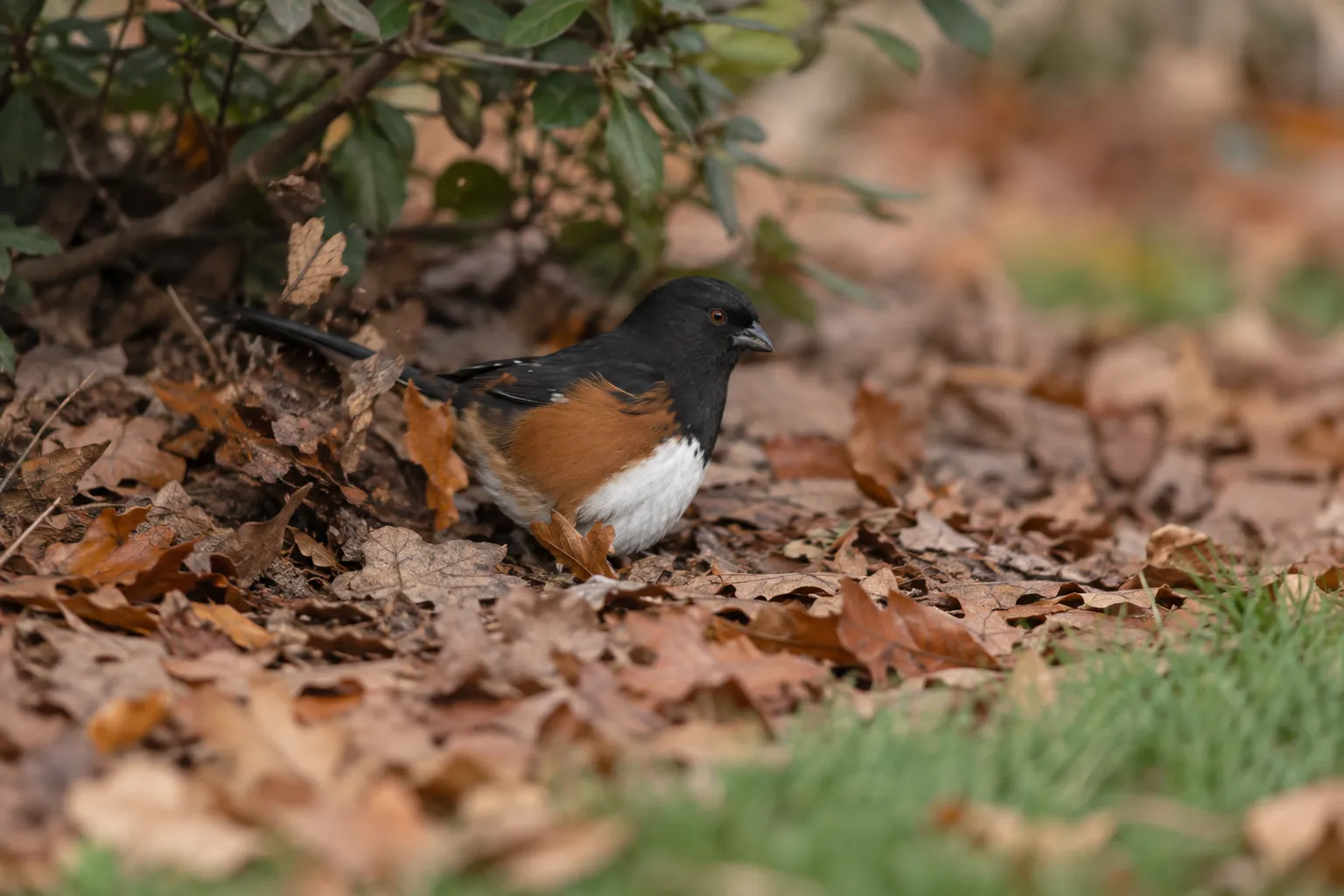
- Eastern and Spotted Towhees use a two-footed backward hop to flip leaves and expose food underneath. A yard with no litter offers them almost nothing.
- White-throated, Fox and Song Sparrows and Dark-eyed Juncos scratch through leaves under shrubs for seeds and insects all winter.
- Hermit Thrushes, which winter across much of the southern and coastal United States, turn leaves with their bills to find insects, spiders and snails.
- Carolina Wrens probe into leaf piles and brush for spiders and insects, which matters because they are vulnerable to hard winters.
- Brown Thrashers sweep their long bills sideways through the litter.
- American Robins that stay north in winter mix fruit with invertebrates found under leaves.
Europe, Brazil and Turkey
The pattern is the same elsewhere. In European and Turkish gardens, Common Blackbirds noisily toss leaves aside, and European Robins, Dunnocks, Song Thrushes and Eurasian Wrens search the litter under hedges. In Brazil, the Rufous-bellied Thrush (the sabiá-laranjeira) forages on the ground among leaves in gardens and parks, and many ground-feeding tanagers and sparrows, such as the Rufous-collared Sparrow, do the same. Wherever there are deciduous or semi-deciduous trees, some birds have evolved to make a living from what falls beneath them.
Why does leaf litter matter most in spring?
Winter foraging is the visible part of the story. The bigger effect is invisible, and it happens months later.
Most songbirds, including many that eat seeds as adults, feed their nestlings insects, above all caterpillars. Caterpillars are soft, high in protein and water, and easy for small chicks to digest. Research led by entomologist Doug Tallamy at the University of Delaware estimated that a single pair of Carolina Chickadees needs somewhere in the range of 6,000 to 9,000 caterpillars to raise one brood. Similar figures apply to European tits: Blue Tits and Great Tits time their breeding to peak caterpillar abundance on oaks.
Where do those caterpillars come from? From moths that survived winter, many of them in the litter layer or the soil beneath it. If leaves are removed every autumn, the insects sheltering in them go too, along with the protection that would have let pupae in the soil survive hard frost. The effect on a single yard is small. Across a whole neighborhood, where nearly every lot is raked to bare soil or lawn, it adds up to a much thinner spring food supply. For more on nestling diets, see our explainer on what baby birds eat.
Loss of insects is one of the drivers researchers point to when they discuss why many insect-eating bird species have declined. Our article on why bird populations are declining covers the broader picture. Leaving leaves is one of the few actions every gardener can take this weekend that addresses it directly.
Isn’t a leaf layer bad for the garden?
It depends on where the leaves end up. A thick, matted layer is hard on some things and very good for others.
Lawns: move them or mow them
Turf grass needs light through winter and early spring. A dense, wet blanket of whole leaves, especially large ones like maple, can smother patches and encourage snow mold. The usual solution is to take leaves off the lawn and put them somewhere better, or to run a mower over a light layer so the chopped pieces fall between the grass blades and feed the soil. Mulching the lawn is a compromise, not a wildlife win, because shredding destroys cocoons, but it keeps leaves on site.
Beds and borders: whole leaves are free mulch
Under shrubs, in perennial beds and around trees, a layer of whole leaves works like bark mulch. It suppresses weeds, holds soil moisture, moderates soil temperature, and breaks down into organic matter by the following summer. Perennials grow up through it in spring. Many native woodland plants are adapted to exactly this situation, since leaf fall is what happens in a forest every year.
Plant diseases
Some gardeners worry about disease. For a few specific problems, such as apple scab on fruit trees, rose black spot, or tar spot on maples, removing the infected leaves from directly beneath those plants helps break the disease cycle. That is a targeted exception. It is not a reason to clear leaves from the entire property.
Thick piles against the house
Keep leaves away from foundations, gutters, drains, window wells and paths. Wet leaves on steps are a slip hazard, and piles against siding hold moisture. None of that conflicts with leaving leaves in beds a few feet away.
How to leave the leaves: a step-by-step plan
This routine fits most yards. Adjust quantities to the size of your trees and beds.
- Pick your leaf zones. Choose beds, shrub borders, the area under trees and any wilder corner. The best spots are near cover, because ground birds prefer to forage within a short dash of shrubs.
- Clear the high-traffic areas. Rake or blow leaves off the lawn, patio, paths, steps, driveways and drains. Move them into the leaf zones rather than to the curb.
- Keep leaves whole in the beds. Skip the shredder there. Aim for a loose layer a few inches deep. Deeper is fine under shrubs and in corners, but avoid burying low evergreen perennials or crowns of plants that rot easily.
- Leave the small stuff too. Fallen twigs, seed heads and dead stems add structure and food. Our guide to seed heads to leave standing for winter finches explains which ones matter most.
- Make a leaf corral if you have extra. A simple ring of wire fencing in a back corner holds surplus leaves neatly and turns them into leaf mold, a crumbly soil conditioner, in a year or two.
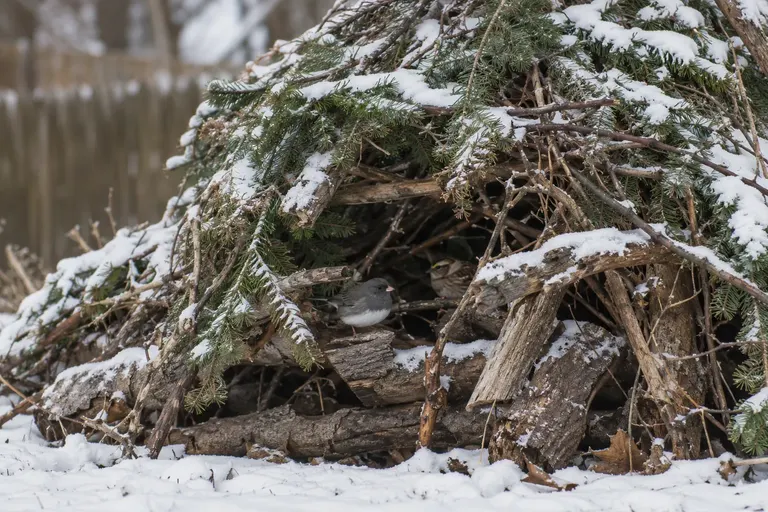
- Combine with a brush pile. Leaves collect naturally around the base of a brush pile and give sparrows and wrens both food and escape cover. See how to build a brush pile for birds.
- Wait in spring. Do not rake beds bare on the first warm weekend. Many pollinator groups suggest waiting until daytime temperatures stay above roughly 50°F (10°C) for a week or so. Even then you can simply let plants grow through the layer.
How many leaves should I keep?
There is no fixed number, but more is better than less. A useful guideline is to keep as many as your beds and corners can hold without smothering plants you care about, and to keep the rest on site in a corral or compost rather than sending it away. Municipal yard waste programs collect enormous volumes of leaves every autumn in the United States, and in many places those leaves end up composted at a central site or, in some areas, landfilled. Either way, the insects inside are lost to your yard.
If your yard has little leaf fall of its own, you can often collect bagged leaves from neighbors. Choose leaves from trees that were not sprayed with pesticides, and avoid bags that include lawn clippings treated with herbicide.
Leave the leaves: myths vs facts
Myth: Leaves left in beds will kill my plants. Fact: Perennials and shrubs evolved with leaf fall. A loose layer protects roots from freeze-thaw heaving. Problems come mainly from very thick, wet mats over low evergreen plants or small seedlings.
Myth: Birds only need seed in winter. Fact: Many winter birds eat both. Chickadees, titmice, wrens, nuthatches, thrushes and kinglets rely heavily on dormant insects, eggs and pupae. Even sparrows and juncos take invertebrates when they find them.
Myth: Shredded leaves are just as good. Fact: Shredded leaves are good for soil, but shredding kills many of the insects and cocoons inside. Whole leaves are better for wildlife.
Myth: Leaves attract rodents and pests. Fact: Rodents are drawn mainly to spilled seed, food scraps and dense shelter next to buildings. A leaf layer in a bed away from the house is not a significant draw. Keeping feeders clean and seed off the ground matters far more.
Myth: Leaving leaves looks messy. Fact: Neatness is a matter of framing. Crisp lawn edges, clear paths, and a small sign stating the area is wildlife habitat make leaf beds look intentional. Many neighbors copy the idea once they see birds using it.
Common mistakes when leaving the leaves
- Leaving them on the lawn only. Turf is the worst place for a thick layer and the least useful habitat. Beds and shrub borders are where the value is.
- Using a leaf blower on the highest setting everywhere. Powerful blowers and vacuum-mulchers can suck up or batter small animals. Use a rake in beds, or a blower gently on paths only.
- Burning leaves. It destroys habitat, releases smoke and fine particles, and is banned or restricted in many towns. Check local rules, but in any case it is the worst option for wildlife.
- Clearing too early in spring. Removing leaves in March or on the first warm day can throw away the very insects you sheltered all winter.
- Piling leaves against the house or in window wells. This causes moisture and pest problems and gives leaf-leaving a bad name.
- Spreading invasive pests. In parts of the United States, invasive jumping worms spread in leaf and mulch piles. If they are known in your area, avoid moving leaves or compost from yard to yard.
Does leaving the leaves help in small gardens and cities?
Yes, and proportionally it may matter more. In a dense neighborhood, a single bed with leaves under a shrub might be the only patch of litter for several houses in each direction. Wintering sparrows, juncos, thrushes and, in European cities, blackbirds and robins will find it.
In a very small space:
- Put leaves under the one or two shrubs you have.
- Tuck some around containers, where they also insulate pots in cold snaps.
- Use a narrow leaf corral in a side yard or behind a shed.
- Pair the leaves with a shallow water source and a few native plants.
Our guide to designing a small bird-friendly garden shows how to fit these elements into a compact yard.
What about leaves in ponds and bird baths?
Leaves that fall into ponds are partly a natural process, but too many can rot and lower oxygen levels in small garden ponds. A net over a small pond in autumn, then adding the collected leaves to your beds, is a reasonable compromise.
Bird baths are simpler: keep them clear. Decaying leaves foul water quickly and can spread disease among birds using the same bath. Our guide on how to clean a bird bath covers a safe routine.
How leaves fit into a year-round bird garden
Leaves are one layer of a bigger system. Birds need food, water and cover every month, and a garden that offers all three through natural features needs less supplemental feeding.
- Autumn: leaves fall and become litter; berries on native shrubs ripen; seed heads dry on stems.
- Winter: ground birds forage in the litter; fruit-eaters strip shrubs; finches work seed heads. Feeders supplement, as described in our winter bird feeding guide.
- Spring: insects emerge from the litter and soil; caterpillars appear on native trees; parents collect them for nestlings.
- Summer: the leaf layer has broken down into rich soil that supports healthier plants, and the cycle starts again.
Planting native trees and shrubs multiplies the effect, because they host more caterpillar species than most non-native ornamentals. Oaks, willows, cherries, birches and native maples are especially productive in North America. In Europe, native oaks, willows, hawthorns and birches play the same role. For fruit through the cold months, see berry shrubs that feed birds all winter.
How can I explain leaving the leaves to neighbors or an HOA?
Some homeowners’ associations and towns have rules about tidy yards. A few practical ways to handle it:
- Keep the frontage crisp. Mow and edge the lawn, clear sidewalks and put the leaf layer in defined beds.
- Use a sign. Small “wildlife habitat” or “leaves left for pollinators and birds” signs signal intent rather than neglect.
- Cite the source. Groups such as the Xerces Society promote “leave the leaves” as a conservation practice, and many extension services now recommend keeping leaves on site as mulch.
- Point to savings. Fewer bags, less hauling, less purchased mulch and fewer hours of raking.
Quick facts
- Leaf litter shelters overwintering moths, butterflies, beetles, spiders, snails and firefly larvae.
- Ground-foraging birds such as towhees, sparrows, juncos, thrushes, wrens and blackbirds rely on it for winter food.
- A pair of Carolina Chickadees may need roughly 6,000 to 9,000 caterpillars to raise one brood, according to research by Doug Tallamy’s group.
- Whole leaves are better than shredded ones for wildlife; shredded leaves are fine for lawns.
- Move leaves off lawns, paths and drains into beds and under shrubs.
- Wait until spring temperatures are consistently mild before tidying beds, or skip it entirely.
Sources
Frequently asked questions
What does leave the leaves mean?
Leave the leaves is a conservation message asking gardeners to keep fallen leaves on their property instead of bagging, burning or blowing them away. The leaves become shelter for overwintering insects, spiders, snails and other small animals, and those creatures feed birds in winter and especially in spring, when nestlings need huge numbers of soft-bodied caterpillars.
Do I have to leave leaves on my lawn?
No. A thick, matted layer can smother turf grass over winter. The usual compromise is to rake or blow leaves off the lawn and into planting beds, under shrubs and around the base of trees, where they do the most good. Alternatively, mow over a light layer so the chopped leaves feed the soil while the grass still gets light.
Should I shred leaves before leaving them in beds?
Whole leaves are better for wildlife. Many moth cocoons, butterfly chrysalises and overwintering insects are attached to or wrapped in individual leaves, and shredding or mowing destroys them. Shredded leaves still improve soil, so they are a good choice for the lawn, but in beds and under shrubs whole leaves offer more shelter and more food for birds.
Do leaves left in the garden attract ticks?
Leaf litter holds moisture, and blacklegged ticks in North America and sheep ticks in Europe do use it. That is a reason to keep leaves out of lawns, paths and play areas, not to remove them from the whole yard. Put the leaf layer in beds and wilder corners that people rarely walk through, and check for ticks after working in them.
When should I clear leaves in spring?
Wait until insects have emerged. A common rule of thumb from pollinator groups is to hold off until daytime temperatures are consistently above about 50 degrees Fahrenheit (10 degrees Celsius) for a week or more. Even then, you do not need to remove leaves from beds at all: plants grow up through them, and the layer breaks down into mulch by summer.