How to Build a Brush Pile for Birds, Step by Step
How to build a brush pile for birds: lay a loose base of thick logs, stack branches in layers, top with twigs or evergreen boughs, and site it near cover.
In this article
- Quick answer: brush pile at a glance
- Why do birds need brush piles?
- Which birds use brush piles?
- How do you build a brush pile step by step?
- Where is the best place for a brush pile?
- What should you use, and what should you avoid?
- Are brush piles safe? Addressing common concerns
- Can you build a brush pile in a small yard?
- How quickly will birds use a new brush pile?
- How do you maintain a brush pile over time?
- What are other ways to use brush in a garden?
- Common mistakes when building a brush pile
- Quick facts
- Sources
- Frequently asked questions
Here is how to build a brush pile for birds: lay a base of thick logs or large branches in a loose crisscross so there are open tunnels at ground level, stack progressively smaller branches on top, and finish with twigs or evergreen boughs to shed snow and rain. Aim for a dome roughly 5 to 10 feet across and 3 to 5 feet tall, placed at the edge of your yard near other cover. The result is a safe refuge where sparrows, juncos, wrens and towhees can hide, rest and find food.
A brush pile is one of the cheapest and most effective bird habitat features you can add, and it uses material you would otherwise haul away. This guide covers why birds use brush piles, a step-by-step building method, siting, what to use and avoid, safety concerns and how to keep the pile working for years.
Quick answer: brush pile at a glance
| Feature | Recommendation |
|---|---|
| Size | About 5 to 10 ft wide and 3 to 5 ft tall for a backyard |
| Base | Logs or thick branches, 4 to 8 inches across, laid with gaps |
| Middle | Medium branches, crisscrossed |
| Top | Small twigs, evergreen boughs or old Christmas trees |
| Location | Yard edge, near trees or shrubs, 10 to 15 ft from feeders |
| Keep away from | House walls, sheds, fences in fire-prone areas |
| Avoid | Treated wood, diseased wood, seeding invasive plants |
| Maintenance | Add fresh branches each year as the pile settles |
Why do birds need brush piles?
In natural landscapes, fallen trees, storm debris and thickets create a tangle of hiding places near the ground. Tidy yards rarely have any. A brush pile puts that missing layer back.
Escape cover from predators
Small ground-feeding birds are vulnerable to hawks, especially Cooper’s and Sharp-shinned Hawks in North America and Eurasian Sparrowhawks in Europe, and to cats. When a hawk appears, juncos and sparrows plunge into the nearest dense cover. A brush pile gives them a refuge that a hawk cannot fly into. Our guide on hawks at feeders explains why nearby cover matters so much.
Shelter from wind, snow and cold
The inside of a well-built brush pile is calmer than the open yard. Gaps near the base stay relatively free of snow under a layer of evergreen boughs, and birds can rest out of the wind. For small birds that burn energy fast in cold weather, cutting wind exposure matters. Our article on how birds stay warm in winter explains the physiology.
Food
As the wood decays, it attracts beetles, spiders, sowbugs, ants and other invertebrates. Wrens probe the gaps, towhees and sparrows scratch in the litter beneath, and woodpeckers may work rotting logs. Seeds blown in from nearby plants collect at the base too.
Nesting sites
Some species nest in or beside brush piles. Carolina Wrens and House Wrens tuck nests into cavities in tangles, Song Sparrows sometimes nest low in dense cover, and in Europe, Eurasian Wrens and Robins use similar sites. Many birds also nest in the vines or shrubs that grow up around an older pile.
Which birds use brush piles?
The species that benefit most are small birds that feed on or near the ground.
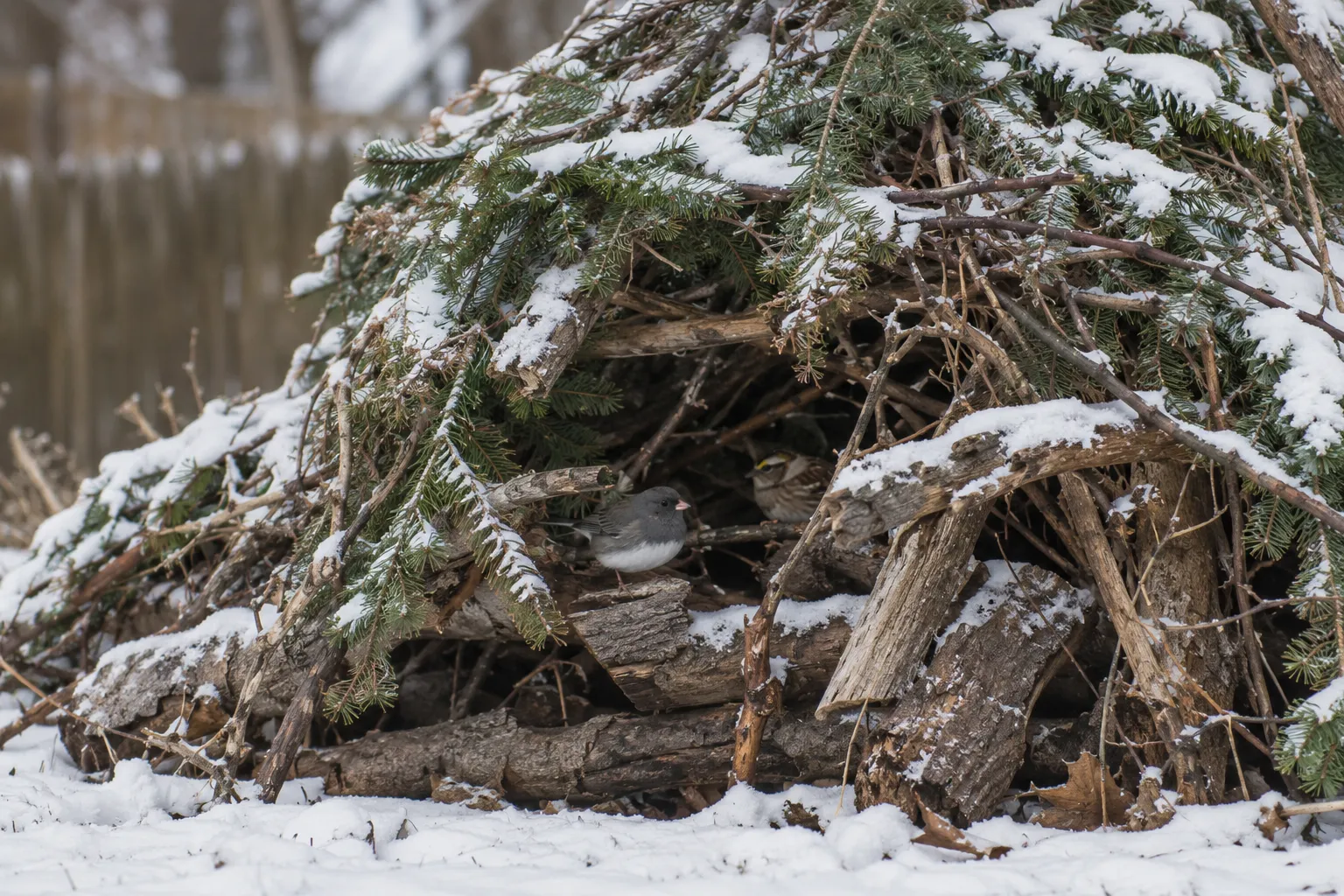
- Sparrows and juncos. Dark-eyed Juncos, White-throated Sparrows, Song Sparrows, Fox Sparrows and American Tree Sparrows stay close to brush in winter. See our guide to Dark-eyed Juncos for more on this classic brush-pile bird.
- Wrens. Carolina Wrens and Winter Wrens explore every crevice. Our Carolina Wren guide covers their love of tangles.
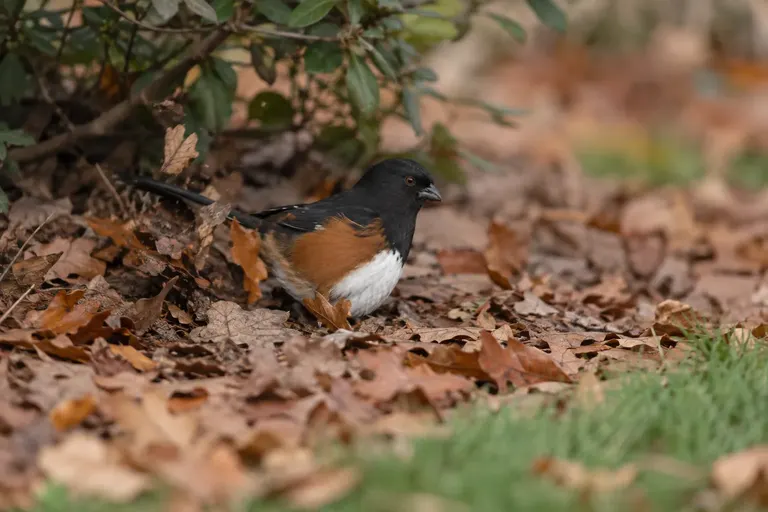
- Towhees, thrashers and cardinals. Eastern and Spotted Towhees, Brown Thrashers and Northern Cardinals use the pile for cover while foraging nearby.
- Thrushes. Hermit Thrushes shelter in brush in winter in the southern US.
Beyond North America, the picture is similar. In Britain and across Europe, Eurasian Wrens, Dunnocks, European Robins, Blackbirds and Song Thrushes use log piles and “dead hedges”, and hedgehogs, toads and slow-worms shelter underneath. In Turkey, wintering Robins, Blackbirds and wrens use similar cover. In southern Brazil, ground-foraging birds such as thrushes and seedeaters use brushy edges in much the same way.
Brush piles also help other wildlife: rabbits, chipmunks, toads, salamanders, lizards and pollinators such as bumblebees, which may overwinter nearby. That wider food web feeds birds too, in the end.
How do you build a brush pile step by step?
What you need
- Logs or thick branches 4 to 8 inches in diameter for the base
- Medium branches 1 to 4 inches across
- Small twigs, prunings and evergreen boughs
- Gloves, eye protection and a pruning saw or loppers
- Optional: flat stones, untreated wooden pallets or clay drainage pipe to create ground-level tunnels
The steps
- Choose and clear the spot. Pick a flat or gently sloping area at the yard edge. You do not need to remove leaves; leaf litter underneath adds foraging value.
- Build the base layer. Lay four to six thick logs parallel to each other, about 1 foot apart. Add a second layer at right angles on top, creating a grid of open tunnels. Alternatively, arrange logs in a rough tepee or lean-to shape, or use stones or pipe to hold spaces open.
- Keep the bottom open. The base must leave gaps of several inches at ground level so birds can enter and move through. A solid heap at ground level is far less useful.
- Add the middle layer. Lay medium branches in alternating directions, crisscrossing so they hold each other up. Work toward a dome shape.
- Add the top layer. Finish with small twigs and brush, and ideally evergreen boughs, which shed rain and snow and give winter shade and shelter.
- Check the density. From outside, you should see into the pile in places but not straight through it. Too open and it offers little protection; too dense and birds cannot get in.
- Plant around it. If you like, plant native vines or low shrubs at the edges, or let native plants grow up through the pile. This creates a “living brush pile” that keeps working as the wood decays.
Should you use old Christmas trees?
Yes. A real Christmas tree, stripped of tinsel, hooks, lights and ornaments, makes an excellent top layer or a small pile on its own. Many people prop one or two in a corner of the yard after the holidays, sometimes with the base wedged in the ground, and see juncos and sparrows move in within days. Do not use trees sprayed with flocking or artificial colorants.
Where is the best place for a brush pile?
Location is as important as construction.
Near other cover
A pile at the edge of a wooded area, along a fence line with shrubs or near a hedge gives birds a network of hiding places. An isolated pile in the middle of a lawn is used less.
A short dash from feeders
A pile about 10 to 15 feet from a feeder gives ground-feeding birds a close escape route while leaving enough open space that a cat cannot ambush from the pile directly beside the feeding area. Watch how birds use it and adjust. If you notice a cat using the pile as a blind, move the feeder or the pile. Our guide to cats and birds covers other ways to reduce cat risk.
Visible from a window
If you want to watch the activity, put the pile where you can see it from the house. Winter mornings at a brush pile near a feeder can be surprisingly lively.
Away from buildings
Keep piles well away from the house, garage, sheds and wooden fences. That reduces fire risk and keeps rodents that shelter in the pile from moving into buildings.
What should you use, and what should you avoid?
Good materials
- Pruned branches from native trees and shrubs
- Storm-fallen limbs
- Logs from yard tree removal
- Evergreen boughs and Christmas trees
- Dead plant stalks and grasses mixed into the top
Materials to avoid
- Treated or painted lumber. Chemicals can leach into soil.
- Wood with nails, wire or plastic. Hazardous for wildlife.
- Diseased wood. Oak wilt, Dutch elm disease and similar problems can spread from infected material. If a tree died of disease, ask your local extension service how to dispose of it.
- Wood from quarantine zones. Many areas restrict moving firewood and logs to slow pests such as emerald ash borer and spotted lanternfly. Use wood from your own property or local sources.
- Invasive plant cuttings with seeds or rooting stems. Branches of bush honeysuckle, buckthorn, Japanese knotweed or similar invasives can sprout or scatter seed. Let them dry out fully, or dispose of them separately.
- Poison ivy. Its oils stay active on dead stems.
Are brush piles safe? Addressing common concerns
Fire risk
Dry brush burns readily. In wildfire-prone regions, including much of the western US, Australia, the Mediterranean and parts of Turkey, fire agencies advise keeping flammable material well away from homes, often at least 30 feet, and sometimes much more. Check local defensible space rules before building a pile, and choose a smaller, greener pile, or a low log pile, if you live in a high-risk area.
Rodents
Brush piles shelter mice, voles and chipmunks, which are natural prey for owls, hawks and foxes. Rats are drawn mainly by food and water, especially spilled seed. Keep piles away from buildings and clean up under feeders. Our guide on keeping rats away from bird feeders covers the details.
Snakes and ticks
In some regions, snakes may shelter in brush piles; most are harmless and eat rodents. Wear gloves when adding material. Ticks are more associated with tall grass and leaf litter than with brush itself, but it is sensible to check for ticks after working outdoors in tick country.
Neighbors and rules
Some homeowner associations and towns have rules about yard debris. A tidy, dome-shaped pile at the back of a lot, perhaps screened by shrubs, usually looks intentional. A small sign saying “wildlife habitat” can help neighbors understand its purpose.
Can you build a brush pile in a small yard?
Yes, on a smaller scale. A pile 3 to 4 feet across and 2 to 3 feet high, tucked into a corner behind shrubs, still gives wrens, sparrows and juncos a place to duck out of sight. In a very small or formal garden, a few options keep things neat:
- A corner “habitat stack.” Stack short logs and branch sections neatly inside a corner formed by two fences or walls, leaving gaps at the base. Keep it a little away from the fence boards themselves if fire is a concern.
- A brush basket. Drive several stakes in a circle and fill the space inside with prunings. It looks tidy and is easy to top up.
- A short dead hedge. Two rows of stakes a foot or two apart, filled with woven branches, can edge a bed or hide a compost area.
- Under-shrub brush. Simply sliding prunings under large, dense shrubs adds ground-level cover without creating a separate feature.
Even these small versions work best when they connect to other cover, such as a shrub border or a neighbor’s hedge, so birds can move between them without crossing open ground.
How quickly will birds use a new brush pile?
Often within days in winter, when ground-feeding birds are actively looking for cover near food. Juncos and sparrows that already visit your feeders are usually the first to use a new pile. Wrens may find it quickly too, because they spend much of their time investigating nooks and crannies. In summer, use is less obvious, because birds are spread out, foliage provides plenty of cover and many species are busy nesting.
Watching a pile for a few minutes on a cold morning is a good way to judge whether it works. You should see birds slipping in and out of the gaps at the base, especially when a hawk flies over or a door opens. If birds perch only on top and never go inside, the base is probably too dense or too open. Loosen or add material until the interior offers shaded, protected spaces.
How do you maintain a brush pile over time?
Brush piles are not permanent. As the wood decays, the pile settles and loses its internal spaces over three to five years or so, depending on climate and wood type.
- Add fresh material every year. Toss prunings, storm debris or a Christmas tree on top each winter.
- Rebuild the base when needed. If the pile has collapsed into a flat heap, start a new base nearby and use the decayed material as mulch or let it become a rotting log feature.
- Never burn an established brush pile. Hedgehogs, toads, reptiles and overwintering insects may be hiding inside. In the UK, wildlife charities regularly warn about hedgehogs in bonfire piles; the same risk applies anywhere animals shelter in brush.
- Leave it alone in nesting season. Avoid moving or reshaping the pile in spring and early summer, when birds may be nesting in or near it.
What are other ways to use brush in a garden?
- Dead hedges. A popular technique in Europe, a dead hedge is a linear brush pile held between two rows of stakes. It works as a fence, a windbreak and wildlife habitat all at once, and is ideal for narrow gardens.
- Log piles. A stack of logs partly sunk into the soil in a shady spot hosts beetles, fungi and amphibians, and gives wrens and robins places to forage.
- Leaving leaves. A layer of fallen leaves under shrubs provides much of the same foraging value. Our article on leaving the leaves explains why.
- Snags. A dead tree left standing, where it is safe, provides food and nest cavities for woodpeckers, nuthatches and chickadees.
A brush pile works best as part of a layered yard with native shrubs, trees and flowers. Our guide on designing a small bird-friendly garden shows how it fits into a full plan.
Common mistakes when building a brush pile
- Packing it too tight. A solid heap has no room for birds. Keep the base open.
- Building it too small. A few loose twigs will not stop a hawk or cat.
- Putting it in the open. Isolated piles see less use.
- Placing it right beside a feeder. Cats can use it as an ambush point.
- Building against the house. It adds fire risk and invites rodents indoors.
- Using invasive or diseased material. It can spread problems.
- Burning it later. Wildlife may be sheltering inside.
- Forgetting to replenish it. It slowly flattens and loses value.
Quick facts
- A brush pile gives small birds escape cover, shelter and insect food.
- Build a loose base of logs, then medium branches, then twigs or boughs.
- Aim for 5 to 10 ft wide and 3 to 5 ft tall in a backyard.
- Place it at the yard edge near other cover, about 10 to 15 ft from feeders.
- Christmas trees make excellent tops.
- Keep piles well away from buildings, especially in wildfire areas.
- Add material each year and never burn an established pile.
Sources
Frequently asked questions
What is a brush pile for birds?
A brush pile is a loose, layered heap of logs, branches and twigs built to create sheltered pockets of space. Small birds such as sparrows, juncos, wrens and towhees use it to escape hawks and cats, shelter from wind and snow and forage for insects. It mimics the fallen trees and tangles found at natural woodland edges.
How big should a brush pile be?
A useful backyard brush pile is roughly 5 to 10 feet across and 3 to 5 feet tall, though even a small pile of 3 to 4 feet helps. Larger piles in rural areas can reach 15 feet or more. The key is a loose base with open gaps at ground level, rather than sheer size.
Where should I put a brush pile?
Put it at the edge of the yard, near existing trees or shrubs, where it links to other cover. Keeping it roughly 10 to 15 feet from a feeder gives birds a quick escape route. Keep it away from the house, sheds and fences in wildfire-prone areas, and away from foundations to avoid attracting rodents indoors.
Do brush piles attract rats and snakes?
They can shelter mice, voles, chipmunks, rabbits and in some regions snakes, all of which are part of a healthy yard ecosystem. Rats are drawn mainly by spilled food, not brush. Keep piles away from buildings and clean up seed spills under feeders to reduce the chance of rats settling nearby.
What birds use brush piles?
In North America, Dark-eyed Juncos, White-throated, Song and other sparrows, Carolina and Winter Wrens, Spotted and Eastern Towhees, Northern Cardinals, Brown Thrashers and Hermit Thrushes all use brush piles. In Europe, Eurasian Wrens, Dunnocks, European Robins and Blackbirds do the same, and hedgehogs often shelter underneath.