Bat House Guide: Size, Placement and Best Houses
A bat house works when it is tall, multi-chambered, in 6+ hours of sun and 12 to 20 feet up on a pole or wall. Sizing chart, placement rules and 4 picks.
If you buy through links on this page we may earn a commission, at no cost to you. It never decides what we recommend. How we earn
In this article
- Quick answer: what makes a bat house work
- How we chose
- Is a bat house good for a bird garden?
- What size bat house do I need?
- What color should a bat house be, and how much sun does it need?
- Where should I put a bat house?
- How far should a bat house be from bird feeders and nest boxes?
- How much does a bat house cost, and is a bigger one worth it?
- What occupancy should I expect?
- How do I keep a bat house clean?
- Are bats protected by law?
- The best bat houses to buy
- Common bat house mistakes
- What are the alternatives to a bat house?
- Sources
- Gear mentioned in this guide
- Frequently asked questions
A bat house is a flat box with narrow, open-bottom chambers where bats roost by day. The ones that get used are multi-chambered, at least 20 inches (51 cm) tall, mounted 12 to 20 feet (3.7 to 6 m) up on a pole or building, not a tree, with six or more hours of direct sun.
Bats are not birds, but they hunt insects over the same yard your birds work by day, need the same unsprayed, native-planted habitat, and many species are in steep decline.
Quick answer: what makes a bat house work
- Height and size: chambers at least 20 inches tall and ideally 14 inches (36 cm) wide, with a rough landing pad extending 3 to 6 inches (8 to 15 cm) below the entrance.
- Chamber gap: about 3/4 inch (19 mm) between boards. Bats want a snug crevice, not a box.
- Sun: at least six hours of direct sun a day, more in cool climates.
- Height off the ground: 12 feet minimum, 15 to 20 feet better.
- Mounting: a building wall or a stout pole. Trees are the weakest choice.
- Color: dark in cool climates, medium in moderate ones, light in very hot ones.
- Location: ideally within about a quarter mile of a pond, stream or wetland.
- Patience: one to two seasons is common, and some houses take longer.
How we chose
We have not installed or monitored these bat houses ourselves. This guide is research-led. The design numbers (chamber width, height, sun hours and color zones) come from long-running guidance published by Bat Conservation International and repeated by state wildlife agencies and extension services. For the four products named here, we used only dimensions and features stated on the makers’ own product pages, plus repeated patterns in verified owner feedback. Where we could not confirm a spec, we left it out.
Is a bat house good for a bird garden?
Yes. Bats and songbirds do not compete for food or space, because bats feed after dark and roost in narrow crevices no songbird uses. What they share is habitat: insects, water and unsprayed plants.
Backyard bats such as the big brown bat and little brown bat eat night-flying insects, with moths and beetles a large share for many species. The promise that one bat house will “get rid of mosquitoes” is not supported by diet studies, since mosquitoes are a small part of most bat diets. For who really eats them, see whether birds eat mosquitoes.
The bigger reason is conservation. White-nose syndrome, a fungal disease of hibernating bats, has killed millions of North American bats since 2006, and the northern long-eared bat is now listed as endangered. Summer roosts matter for the survivors, especially maternity colonies raising pups.
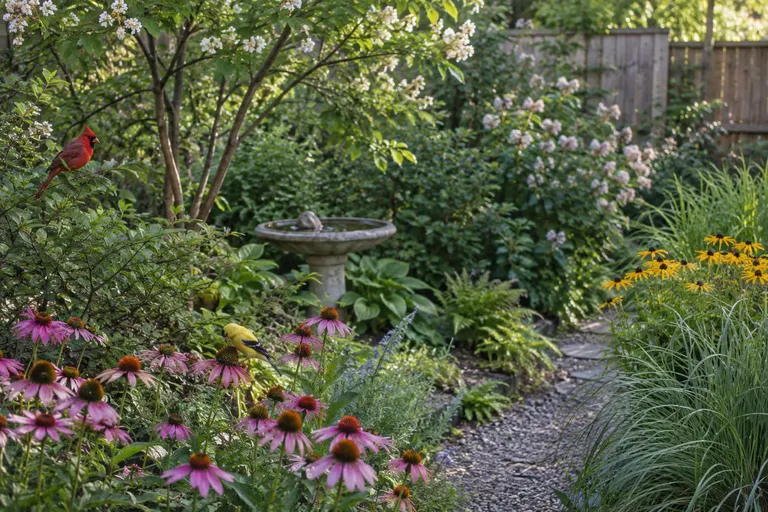
A bat house fits the same plan that works for birds: native shrubs, water, no broad insecticides and some wild corners. Start with designing a small bird-friendly garden, then add the bat house as the night-shift piece alongside an insect hotel.
What size bat house do I need?
Buy or build the largest house your wall or pole can hold, with at least two chambers. Small single-chamber houses, often sold as garden decor, stay too cool and too variable in temperature for most colonies.
Bats choose roosts mainly by temperature. Nursing females want a roost that holds roughly 80 to 100°F (27 to 38°C), and taller, deeper houses give bats room to move up toward warmth or down toward cooler air as the day changes. That is why size and chamber count matter more than looks.
Bat house sizing chart
| House type | Chamber height | Chambers | Best use | Honest verdict |
|---|---|---|---|---|
| Mini or decor house | Under 20 in | 1 | Gift or decoration | Rarely used by colonies. Skip it. |
| Standard single chamber | 20 to 24 in | 1 | Building walls in hot climates | Works where summer heat is reliable. |
| Dual chamber | 24 to 36 in | 2 | Most US gardens | Good default for a first house. |
| Three or four chamber | 24 in or more | 3 to 4 | Cool climates, poles, larger colonies | Best odds, and holds heat longest. |
| Rocket box | 3 ft or taller, four sides | 1 to 2, wrapped | Open ground on a single pole | Excellent, but usually a DIY project. |
Inside, keep the gap near 3/4 inch, roughen every surface with grooves or flat plastic mesh so bats can grip, add a front vent slot about 6 inches above the bottom in warm regions, caulk the seams under a sloped roof, and leave the bottom open so droppings fall out.
What color should a bat house be, and how much sun does it need?
Give a bat house at least six hours of direct sun a day, and choose its color by your average July high temperature. In cool northern gardens, sun and a dark finish are the whole game. In desert heat, a light color and some afternoon relief prevent overheating.
| Average July high | Suggested exterior color | Sun target | Notes |
|---|---|---|---|
| Below about 85°F (29°C) | Black or dark brown | 8 to 10 or more hours | Multi-chamber strongly preferred. East or south facing. |
| About 85 to 95°F (29 to 35°C) | Medium brown or dark gray | 6 to 8 hours | Most of the Mid-Atlantic, Midwest and Southeast fall near here. |
| Above about 95°F (35°C) | Light tan, light gray or white | 6 hours, morning sun favored | Add venting. Afternoon shade from a building can help. |
Use exterior-grade, water-based paint or stain on the outside only. Leave the interior raw and grooved, with no paint, stain or preservative inside the chambers.
Facing a house south, southeast or east usually catches the most useful sun. West-facing houses can overheat in hot regions.
Where should I put a bat house?
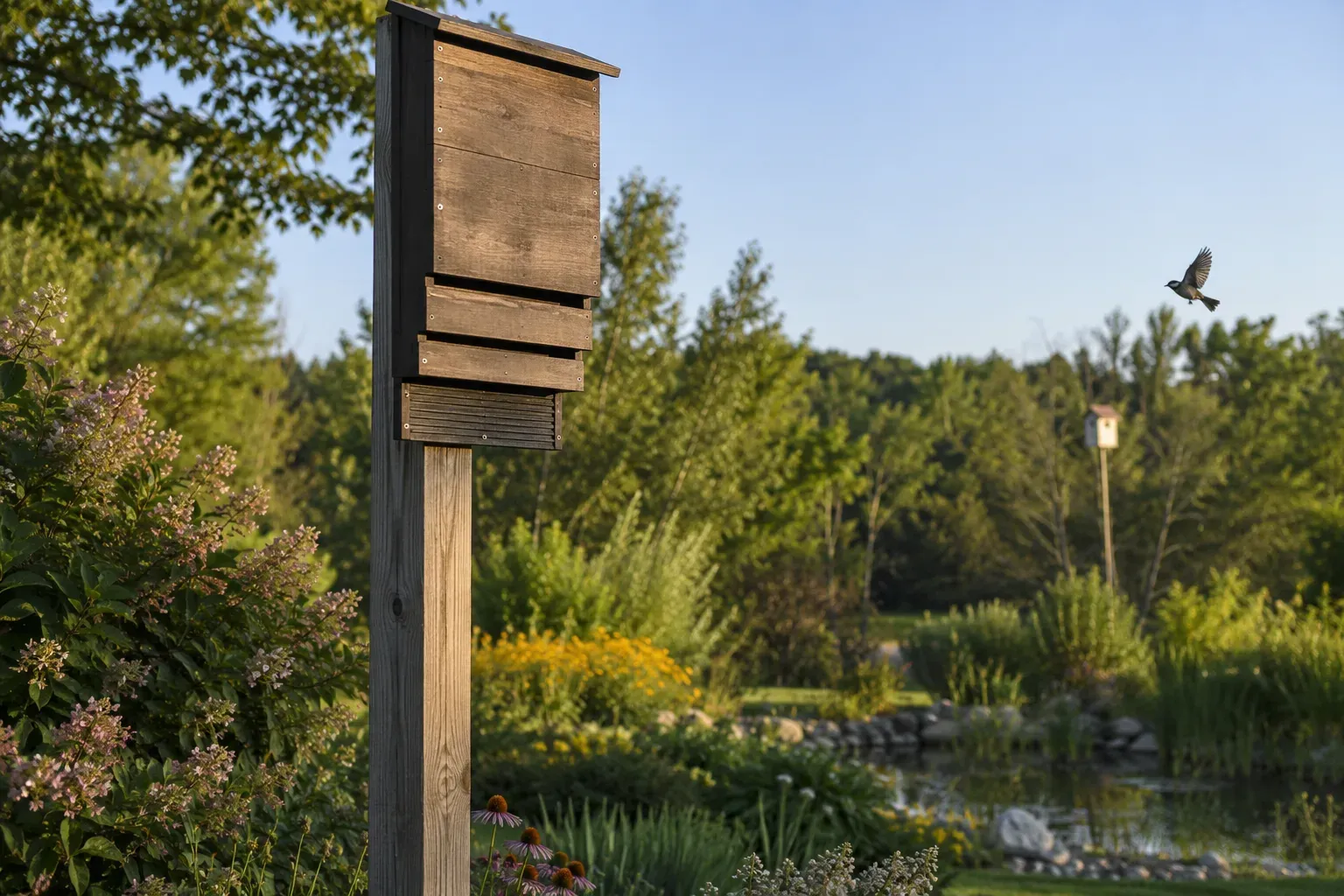
Put a bat house on a building wall or a strong pole, 12 to 20 feet off the ground, with open flying room in front of it and full sun on its face. Water within about a quarter mile raises the odds considerably.
Use this placement checklist before you drill a single hole:
- At least 12 feet up, and 15 to 20 feet is better. Higher houses are safer from cats, raccoons and people.
- Clear flight path. Leave about 20 feet of open air in front and below the house, with no branches, wires or shrubs crowding the entrance.
- About 20 to 25 feet from the nearest tree, so owls and hawks cannot wait on a branch beside the exit.
- Away from bright night lighting. Security floodlights aimed at the entrance deter emerging bats.
- Not above a door, patio, window or grill, because droppings fall straight down.
- Near water if possible: a pond, creek, marsh, lake shore or river corridor.
- Mixed habitat nearby: hedgerows, woodland edges, native meadows or orchards, which produce the insects bats eat.
Pole, building or tree: which mounting is best?
Buildings and poles win. Houses on a wall or pole tend to get more sun, stay warmer and are much harder for predators to reach. Tree trunks are the classic mistake: canopy shade keeps them cool, and branches give snakes, raccoons and owls easy access.
A sunny wall under the eaves is often the easiest good spot, and the wall itself adds heat. Mount the house on spacer strips so it does not trap moisture against siding.
For a pole, use galvanized steel pipe or a 4x4 or 4x6 timber long enough to put the bottom of the house 12 or more feet up with about 3 feet set in concrete. Many gardeners bolt two houses back to back on one pole, which creates a cooler and a warmer side and a shared gap on top. Our guide on how to mount a birdhouse on a pole, tree or wall covers the concrete, bracket and hardware steps. The same methods apply here, scaled up for the extra height and wind load.
How far should a bat house be from bird feeders and nest boxes?
Keep a bat house at least 20 feet (6 m) from bird feeders and nest boxes, and farther if you can. Bats and birds do not fight over space, but feeders and bat houses have different needs, and mixing them causes small, avoidable problems.
Here is why the spacing helps:
- Seed attracts rodents and raccoons. Spilled seed under a feeder brings mice, rats and raccoons at night, and those are the same animals you want kept far from a bat house. Our guide to keeping rats away from bird feeders explains the cleanup routine.
- Guano and seed do not mix. Droppings falling onto platform feeders or baths are a hygiene problem you do not need.
- Birds may try to use the bat house. House Sparrows and wrens occasionally stuff nesting material into the bottom openings, especially if a house is low and near feeders.
A simple layout that works in most yards: feeders near the house windows and cover, following our advice on where to put a bird feeder, nest boxes on poles along the garden edges, and the bat house on the sunniest wall or on a tall pole at the far, open end of the yard, ideally facing a pond or open lawn.
How much does a bat house cost, and is a bigger one worth it?
A small single-chamber house is the cheapest option, while large multi-chamber houses in cedar or poly lumber cost noticeably more. The larger house is worth it in most climates, because an empty cheap house saves nothing.
Budget single chambers suit warm walls in the South and Southwest. Mid-range dual or triple chambers are the best value for most gardens. Premium tall cedar or poly houses make sense on a prominent wall where you want the house to last for many years. DIY is realistic too: Bat Conservation International and several state wildlife agencies publish free plans with cut lists.
What occupancy should I expect?
Expect uncertainty. A well-placed house can be found within weeks, but one to two summers is more typical, and many houses never get used, almost always because of too little sun, too low a mount or shade from trees.
Signs of use are small dark droppings below that crumble to dust when rolled, faint chattering on warm afternoons, and bats dropping out just after sunset.
If a house stays empty for two full seasons, move it. Raising it, moving it into more sun, taking it off a tree, or shifting it closer to water are the fixes that most often work. Painting it darker in a cool climate is another common fix.
Common tenants include big brown and little brown bats in the North and East, and Mexican free-tailed bats in parts of the South. Colonies arrive in spring, raise pups in early summer and leave by fall, so a bat house is a summer roost.
How do I keep a bat house clean?
Most bat houses need almost no cleaning, because the open bottom lets droppings fall out. Your job is a once-a-year inspection in winter, when the house is empty, and nothing at all while bats are present.
Yearly bat house care, step by step
| When | Task | How |
|---|---|---|
| Late winter (bats absent) | Check for wasps and old nests | Shine a light up each chamber. Scrape out mud dauber cells or paper wasp nests with a long, thin stick. |
| Late winter | Check seams and roof | Re-caulk gaps, tighten screws, replace rotted boards. |
| Every 3 to 5 years | Refresh exterior finish | Repaint or restain the outside only, on a dry day, well before spring arrival. |
| Spring to fall | Leave it alone | No opening, spraying, poking or hosing. Watch the emergence from a distance. |
| Any time | Manage guano | Rake it up with gloves and a dust mask, or let it fall on a bed. Aged guano is a strong plant fertilizer. |
Never spray insecticide in or around the house. For the general hygiene habits that carry over, see when and how to clean out a birdhouse.
Are bats protected by law?
Yes, in many places. Several US bat species are federally listed under the Endangered Species Act, including the Indiana bat, gray bat and northern long-eared bat, and many states protect all native bats. In practice this changes three things for a gardener.
- Do not disturb an occupied house. Harming or harassing listed bats can be illegal, and it is always harmful to a maternity colony.
- Do not evict bats from a building during pup season. Many states restrict exclusions in summer, often roughly May or June through August, because flightless pups left inside die. Check your state wildlife agency for exact dates, and use a licensed wildlife control operator who follows them.
- Never handle a bat with bare hands. A small share of bats carry rabies. If a bat is found in a room where someone was asleep, or a person or pet has direct contact, contact your local health department right away.
If bats are in your attic, put a house up nearby before a legal, off-season exclusion.
The best bat houses to buy
These four are currently listed houses with specs confirmed on the makers’ pages. Capacity figures are manufacturer claims.
JCs Wildlife Recycled Poly Lumber 3 Chamber Bat House
The best overall pick on paper. At 19 inches wide and 24 inches tall with three chambers, it sits close to the size bat groups recommend, and the poly lumber will not rot, split or need restaining. The maker describes a brown body with a green roof and a black back, grooved roosting crevices with ventilation grooves, and stainless steel screws.
Skip it if: you prefer natural wood or garden in extreme summer heat.
Nature’s Way CWH6 Cedar Three Chamber Bat House
A widely available cedar house at 20.5 inches tall, 12 inches wide and 5 inches deep. Nature’s Way lists removable interior chambers for inspection, side and front air vents, landing kerfs at the base with nylon hanging mesh, and a weight of 6 lb 12 oz, light enough for most walls.
Skip it if: you have a pole and room for a bigger house.
BatBnB Carlsbad Dual Chamber Bat House
The tall option. At 36 inches high, 19 inches wide and 4.75 inches deep, this Western Red Cedar house gives bats a long vertical range to move through as temperatures change. It is built in the USA, ships assembled, and includes hardware for wood surfaces. The maker states it fits 100 to 120 bats.
Skip it if: budget matters more than looks.
JCs Wildlife Single Chamber Bat House
The single-chamber pick, made in the USA from recycled poly lumber with grooved roosting crevices, ventilation grooves and pre-drilled stainless mounting screws. The maker states it weighs 12 lb and describes a brown body, green roof and black back. Stock can come and go, so check availability.
Skip it if: you live in a cool northern climate.
Bat house buyer’s checklist
| Check | Pass | Fail |
|---|---|---|
| Chamber height | 20 in or taller | Under 20 in |
| Chamber gap | About 3/4 in | Over 1 in or unstated |
| Interior grip | Grooves or mesh on every surface | Smooth boards |
| Landing pad | 3 to 6 in below entrance | None |
| Bottom | Open | Closed floor |
| Seams | Tight or caulked, sloped roof | Gaps, flat roof |
| Interior finish | Raw wood or textured poly | Painted or treated inside |
| Color | Matches your July highs | Wrong for your climate |
A house that fails more than one line is decor, not habitat.
Common bat house mistakes
- Mounting on a tree or lower than 10 feet.
- Buying a mini house that is too small to hold heat.
- Too little sun, the most common reason houses stay empty.
- Wrong color for the climate.
- Spraying for wasps instead of scraping nests out in winter.
What are the alternatives to a bat house?
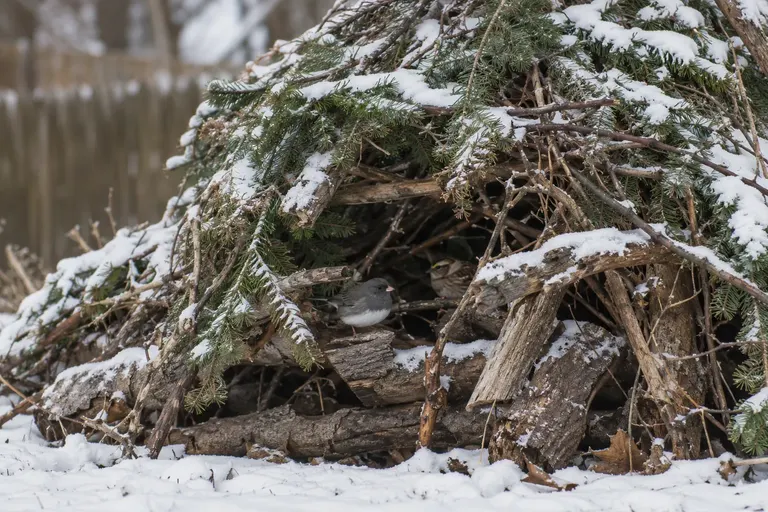
If you cannot mount a house high in the sun, help bats with habitat instead. Leave safe dead trees with loose bark standing as natural roosts, add a small pond, shield outdoor lights downward, skip broad insecticides and keep cats indoors. Downed wood can go into a brush pile that feeds insects for both birds and bats.
Sources
- Bat Conservation International
- White-nose Syndrome Response Team (USFWS)
- U.S. Fish and Wildlife Service: Northern long-eared bat
- CDC: Rabies and bats
- JCS Wildlife Recycled Poly Lumber 3 Chamber Bat House (maker page)
- JCS Wildlife Single Chamber Bat House (maker page)
- Nature’s Way Cedar Three Chamber Bat House (maker page)
- BatBnB Carlsbad Bat House (retailer page)
Gear mentioned in this guide
JCs Wildlife Recycled Poly Lumber 3 Chamber Bat House
A large three-chamber house in recycled poly lumber with grooved roosting crevices, ventilation grooves and stainless steel screws, sized close to the tall, wide design bat groups recommend.
- Best for
- Anyone who wants a big, rot-proof house that will not need restaining.
- Skip it if
- You want natural wood, or you live where summers are very hot and need a light-colored house.
- Size
- 19 in W x 5.75 in D x 24 in H
- Chambers
- 3
- Maker's capacity claim
- Up to 300 bats
- Material
- Recycled poly lumber, stainless screws
Nature's Way CWH6 Cedar Three Chamber Bat House
A widely stocked cedar house with three removable chambers, side and front vents and landing kerfs, a practical wood option for smaller walls.
- Best for
- Gardeners who prefer wood and want a multi-chamber house that is easy to lift and inspect.
- Skip it if
- You want a house that fully meets the common 20-inch-tall, 14-inch-wide chamber guidance, since this one is narrower.
- Size
- 20.5 in H x 12 in W x 5 in D
- Chambers
- 3, removable
- Weight
- 6 lb 12 oz
- Material
- Cedar, rust-resistant hardware
BatBnB Carlsbad Dual Chamber Bat House
A tall, US-built Western Red Cedar house with two chambers, machine-cut grip grooves and venting, sold fully assembled.
- Best for
- A sunny house wall where a tall, clean-looking design matters.
- Skip it if
- You are on a tight budget, since it sits in the premium bracket.
- Size
- 19 in W x 36 in H x 4.75 in D
- Chambers
- 2
- Maker's capacity claim
- 100 to 120 bats
- Material
- Western Red Cedar
JCs Wildlife Single Chamber Bat House
A US-made poly lumber single-chamber house with a dark back, grooved roosting surfaces and pre-drilled stainless mounting screws, for smaller walls and mild or hot climates.
- Best for
- A first house on a building wall in a warm region.
- Skip it if
- You garden in a cool northern climate, where multi-chamber houses hold heat better.
- Chambers
- 1
- Maker's capacity claim
- Up to 100 bats
- Material
- Recycled poly lumber, stainless screws
- Weight
- 12 lb
Frequently asked questions
Where is the best place to put a bat house?
Mount it on a building wall or a sturdy pole 12 to 20 feet (3.7 to 6 m) above the ground, facing south, southeast or east so it gets at least six hours of direct sun. Keep 20 feet or more of open air in front of it, place it within about a quarter mile of water if you can, and avoid tree trunks, which are shady and give predators easy access.
What color should a bat house be?
Match color to your summer heat. Where average July highs are below about 85°F (29°C), use black or dark brown so the house warms up. In moderate climates, use a medium brown or gray. Where July highs regularly exceed about 95°F (35°C), use a light color such as tan or white so pups do not overheat inside the chambers.
How long does it take bats to move into a bat house?
There is no fixed timeline. Houses in good spots are often found within the first year or two, and some sit empty for several seasons before a colony arrives. Houses that stay empty for two full summers usually have a placement problem: too little sun, too low, or too close to trees. Try moving the house before giving up.
Do bat houses attract bats to my house or cause problems?
A bat house does not draw bats into your attic. It gives bats already in the area a better roost. The main side effect is guano, dry pellets that fall below the house, so do not mount it over a door, patio or window. Never handle a bat with bare hands, and teach children never to touch one, because bats can carry rabies.
Do I need to clean a bat house?
Usually not. A good bat house has an open bottom, so droppings fall straight out. Inspect it once a year in winter, when bats are gone, and scrape out any wasp or bird nests with a thin stick. Never spray insecticide, never open or disturb it while bats are present, and wear gloves and a dust mask when working below it.