Seed Heads to Leave Standing for Winter Finches
The best seed heads to leave standing for winter finches: coneflowers, sunflowers, asters, goldenrod, grasses and more, plus when to cut them back in spring.
In this article
- Quick answer: top seed heads for winter finches
- Why do finches depend on seed heads in winter?
- Which finches visit winter seed heads?
- Which plants hold their seeds longest?
- How to plan a finch-friendly seed garden
- Seed heads by region: a starting list
- How do finches get seeds out of different seed heads?
- Do trees and shrubs count as seed heads?
- What about sunflowers and ornamental annuals?
- When should I cut back seed heads in spring?
- Myths vs facts about seed heads and finches
- Common mistakes
- How do seed heads work with feeders?
- Quick facts
- Sources
- Frequently asked questions
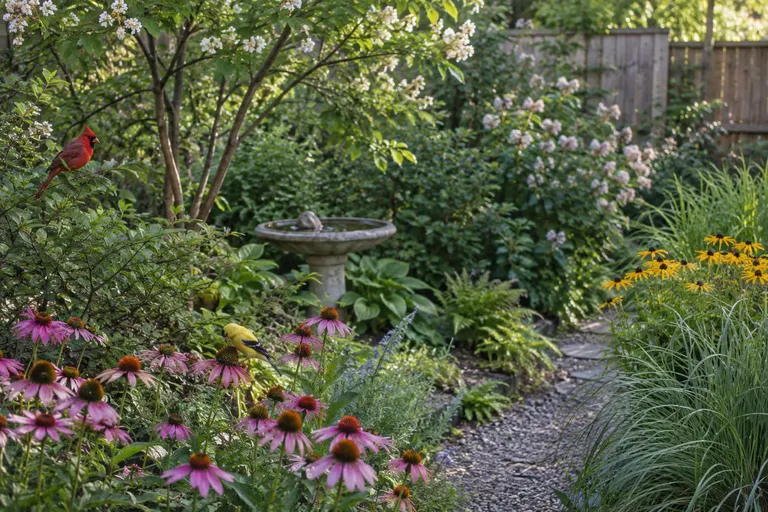
The best seed heads to leave standing for winter finches are composite flowers and grasses that hold small seeds on stiff stems above the snow: purple coneflower, black-eyed Susan, sunflowers, cup plant, asters, goldenrod, blazing star, native thistles, evening primrose and bunch grasses such as little bluestem and switchgrass. In Europe and Turkey, teasel, knapweed, thistles and lavender do the same job for European Goldfinches and other finches. Stop deadheading in late summer, leave the stems through winter, and cut back in spring to about 8 to 24 inches.
That is the short version. The rest of this guide explains why finches prefer certain seed heads, which plants last longest into winter, how to arrange them so birds actually use them, and when to cut them back without harming the next generation of pollinators.
Quick answer: top seed heads for winter finches
| Plant | Seed type | Finches that use it | Holds into winter? |
|---|---|---|---|
| Purple coneflower (Echinacea purpurea) | Small seeds in a spiny cone | American Goldfinch, House Finch | Well, often into January |
| Black-eyed Susan (Rudbeckia) | Tiny seeds in a dark cone | Goldfinches, juncos, sparrows | Well |
| Sunflowers (Helianthus, annual and perennial) | Large to medium seeds | Goldfinches, House and Purple Finches, chickadees | Annual heads empty fast, perennials last longer |
| Cup plant (Silphium perfoliatum) | Large flat seeds | Goldfinches | Moderate |
| Asters (Symphyotrichum) | Fluffy small seeds | Goldfinches, Pine Siskins, sparrows | Moderate |
| Goldenrod (Solidago) | Tiny seeds | Goldfinches, siskins, juncos | Good |
| Blazing star (Liatris) | Small seeds on spikes | Goldfinches | Moderate |
| Native thistles (Cirsium discolor, C. altissimum) | Seeds with down | American Goldfinch | Seeds taken late summer and fall |
| Evening primrose (Oenothera biennis) | Tiny seeds in capsules | Goldfinches, redpolls | Very good |
| Little bluestem, switchgrass | Grass seeds | Sparrows, juncos, finches | Good |
| Teasel (Dipsacus, native only in Europe and western Asia) | Seeds in spiny heads | European Goldfinch | Very good |
Why do finches depend on seed heads in winter?
Finches are seed specialists. Their conical bills are built for cracking and husking seeds, and most species eat seeds for nearly the whole year. The American Goldfinch is one of the most strictly vegetarian songbirds in North America: adults eat almost entirely seeds, and they even feed their nestlings regurgitated seed rather than insects. They also nest late, in mid to late summer, when thistles and other composites are setting seed.
Winter makes finches’ problem harder. Days are short, nights are long and cold, and a small bird has to eat enough in daylight to fuel shivering through the night. Our explainer on how birds stay warm in winter covers the physiology. Seeds are energy-dense, and a garden full of standing seed heads is a buffet that does not require the bird to compete at a crowded feeder.
Why seed heads rather than seed on the ground?
Seeds held above the ground stay accessible after snow. They are also less exposed to mold, and finches can feed while perched with a view of approaching hawks. Many finches, especially goldfinches and siskins, are acrobatic feeders that cling to swaying stems and even hang upside down. Stiff, upright seed heads suit them perfectly.
Which finches visit winter seed heads?
North America
- American Goldfinch. The most reliable visitor. In winter the males lose their bright yellow and look olive-buff, which surprises many people. Our American Goldfinch guide covers identification and feeding.
- House Finch. Common in towns across most of the continent. Eats a broad range of seeds. See how to attract House Finches.
- Purple Finch. Less common in suburbs, more likely near conifers and woodland edges.
- Pine Siskin. An irruptive finch that appears in large numbers some winters and is almost absent in others. Siskins work asters, goldenrod and birch or alder seeds.
- Redpolls. Northern finches that move south in irruption years. They feed on birch and alder catkins, and on weedy seed heads that stick up through snow.
Juncos and native sparrows such as American Tree Sparrows, White-throated Sparrows and Song Sparrows also take seeds, usually from heads bent low or seeds that have dropped to the snow surface.
Europe and Turkey
- European Goldfinch. Famous for its fondness for teasel, thistles and knapweed. Its thin, pointed bill can reach seeds deep in a teasel head. In Turkey it is widely known as the saka.
- Eurasian Siskin. Feeds heavily on birch and alder seeds in winter, often in mixed flocks with redpolls.
- European Greenfinch. Bulkier bill, takes larger seeds such as sunflower seeds and the seeds inside rose hips, as well as smaller ones.
- Linnet. A farmland finch that uses weedy seed heads in field edges and large gardens.
Brazil and the tropics
Tropical and subtropical regions do not have the same deep winter, but the pattern of seed-eating birds using grass and composite seed heads holds. In Brazil, Saffron Finches and several species of seedeaters (Sporophila) feed heavily on grass seed heads, and the non-native House Sparrow does the same in towns. Leaving some grasses to set seed in a garden or along a lawn edge supports them in the dry season.
Which plants hold their seeds longest?
Not all seed heads last equally long. Some empty within weeks because birds strip them or seeds drop. Others hold on into late winter.
Early season (late summer to early autumn)
Annual sunflowers, native thistles, cup plant and zinnias are often cleaned out before autumn ends. That is fine: they feed goldfinches during their late nesting season and early migration. Plant them for that window, not for January.
Mid season (autumn into early winter)
Coneflowers, black-eyed Susans, asters and blazing star usually still hold seed when the first snows arrive. Coneflowers are especially good because the stiff cones stay upright and dry.
Late season (deep winter)
Goldenrod, evening primrose, many grasses, teasel in Europe, and trees such as birch and alder hold seed well into late winter. These carry birds through the leanest weeks, when many other heads are empty.
Planting a mix across all three windows gives finches a food supply from August through March. It also means that if one plant has a poor seed year, others fill the gap.
How to plan a finch-friendly seed garden
- Choose natives first. Native plants support far more insects, which other birds need in spring, and they are adapted to your climate and soil. Check the Audubon Native Plants Database or your local extension service for species native to your area.
- Plant in drifts. Groups of three to seven plants of one species are easier for finches to find and work than single scattered plants. Drifts also look more deliberate in winter.
- Mix heights. Tall plants such as cup plant and sunflowers stand above snow. Mid-height coneflowers and black-eyed Susans fill the middle. Low sedges and grasses give cover.
- Add woody cover nearby. Finches feed more confidently when shrubs or small trees are within a short flight. Evergreens are ideal for winter shelter.
- Stop deadheading in late summer. Deadheading in June extends bloom. From August on, leave spent flowers so they can set seed.
- Leave stems standing. Do not cut perennials back in autumn. Standing stems also catch snow and insulate plant crowns.
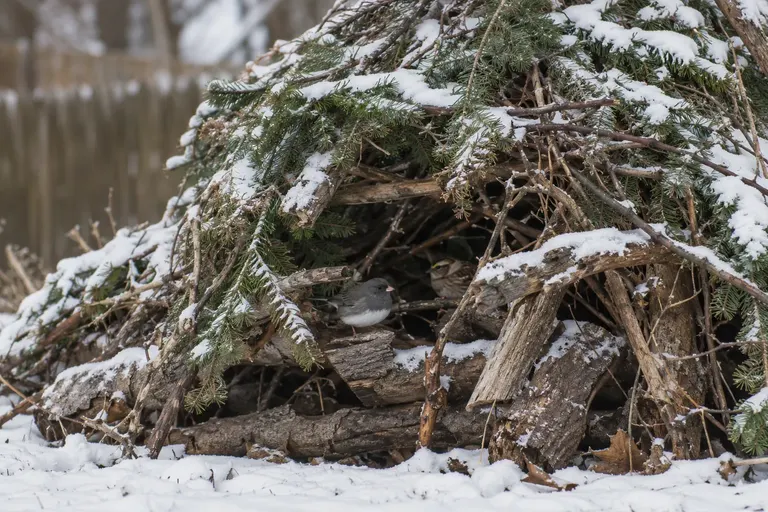
- Pair with leaves and brush. Seeds that fall to the ground feed juncos and sparrows, which prefer the protection of leaf litter and brush. See leave the leaves and how to build a brush pile.
Seed heads by region: a starting list
These are well-known, widely grown examples. Always confirm what is native in your specific state or country.
Eastern and central North America
Purple coneflower, black-eyed Susan, sweet coneflower, cup plant, New England aster, smooth aster, stiff goldenrod, showy goldenrod, rough blazing star, meadow blazing star, evening primrose, field thistle, little bluestem, switchgrass, Indian grass.
Western North America
Blanketflower (Gaillardia), native sunflowers, western asters, California poppy, desert marigold in arid regions, Rocky Mountain bee plant, native bunchgrasses such as blue grama and Idaho fescue.
Britain and continental Europe
Wild teasel, common knapweed, greater knapweed, field scabious, native thistles, lavender (seeds taken by goldfinches in some gardens), evening primrose (naturalized), sunflowers, and birch and alder trees for siskins and redpolls.
Turkey and the eastern Mediterranean
Native thistles and knapweeds, teasel, wild chicory, sunflowers, and grasses left long at field and garden edges. Plane, alder and birch in cooler, wetter regions support siskins.
How do finches get seeds out of different seed heads?
Watching finches on seed heads is a lesson in bill design. Each plant packages its seeds differently, and each finch species is better at some packages than others.
Cones and discs
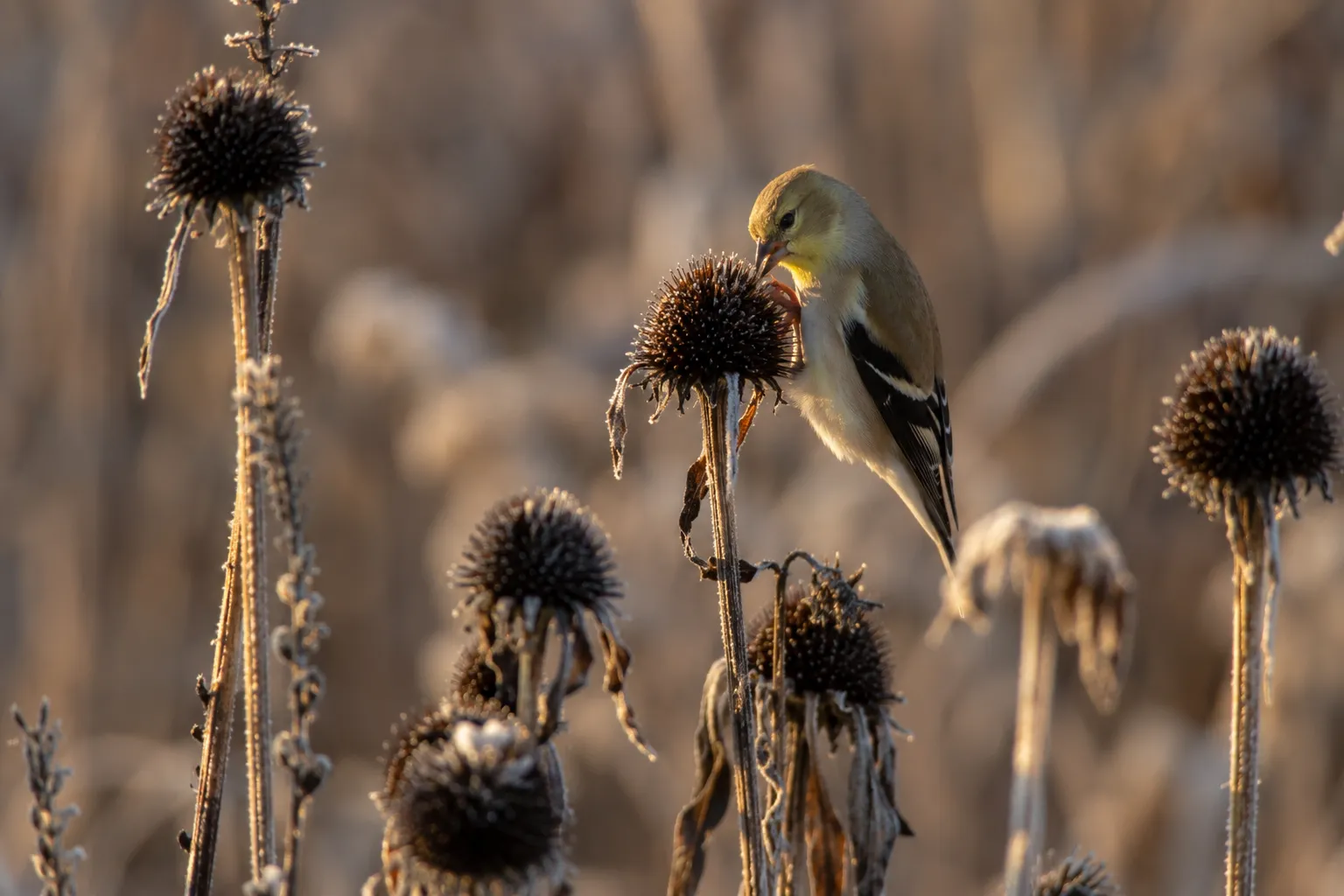
Coneflowers and black-eyed Susans hold seeds tightly in a spiny or domed central disc. Goldfinches perch on the stem or the cone itself and pull seeds out one at a time, twisting their heads to work around the spines. House Finches, with slightly heavier bills, do the same but more slowly.
Fluffy seed heads
Asters, goldenrod and thistles attach seeds to a parachute of fine hairs, called a pappus. Goldfinches and siskins strip the seed and let the fluff drift away, which is why the ground under a thistle patch often looks snowy in September. American Goldfinches also collect thistle down to line their nests, one reason their breeding season is timed so late.
Capsules and spikes
Evening primrose holds tiny seeds in woody capsules that split open gradually over winter, releasing a little food at a time. Blazing star carries seeds along a spike, and finches work it from top to bottom.
Deep spiny heads
European teasel packs seeds at the bottom of narrow, spine-lined cells. Research on European Goldfinches has found that males, which tend to have slightly longer bills, are generally better at reaching teasel seeds than females. It is a small, clear example of how bill shape matches food.
Do trees and shrubs count as seed heads?
For some winter finches, trees matter more than any flower bed. Birches and alders produce catkins and small cones packed with tiny seeds that hang on into late winter. Siskins and redpolls in North America, Europe and Turkey feed on them heavily, often hanging upside down at branch tips. Sweetgum balls in the southeastern United States feed goldfinches and siskins, and conifer cones from spruce, hemlock, pine and larch feed crossbills and Pine Siskins in good cone years.
If you have space for one tree, a native birch or alder near your seed-head border extends the season for finches that flower beds alone cannot support.
What about sunflowers and ornamental annuals?
Annual sunflowers are a finch magnet, but they behave differently from perennials. Large-headed types can be stripped in days by goldfinches, House Finches, chickadees and squirrels. In wet autumns, big heads can mold before birds finish them.
Some options:
- Grow multi-headed, smaller-flowered varieties. They dry faster and spread food over a longer period.
- Cut a few heads and hang them. Dry them under cover and put them out in winter when perennial seed heads are running low.
- Leave some annuals like zinnias and cosmos to go to seed. Goldfinches pick at them in autumn.
Avoid treated or ornamental varieties bred to be pollenless or seedless if feeding birds is your goal. Seedless sunflower varieties sold for cut flowers produce little or nothing for birds.
When should I cut back seed heads in spring?
Timing matters for two reasons: birds may still be eating the last seeds in late winter, and many insects overwinter in or on dead stems.
- Wait until new growth appears at the base of the plants.
- Use temperature as a guide. Many pollinator groups suggest waiting until daytime temperatures are consistently above about 50°F (10°C). In many northern regions that is April or May.
- Leave stubble. Cut stems back to about 8 to 24 inches instead of to the ground. Hollow and pithy stems of plants such as bee balm, cup plant, elderberry and raspberry become nesting sites for small native bees during the summer, and new growth soon hides the stubble.
- Keep cuttings on site. Lay cut stems loosely at the back of a bed or on a brush pile for a few weeks so insects inside can still emerge.
Myths vs facts about seed heads and finches
Myth: Seed heads look untidy, so birds must not really need them. Fact: Winter seed heads are one of the most important natural food sources for finches and sparrows in gardens. The look is a matter of framing: clean edges and paths make a seed-head border look intentional.
Myth: Leaving seed heads spreads weeds. Fact: Native perennials self-sow to some degree, which many gardeners welcome. Aggressive spreaders, such as some goldenrods and asters, can be managed by siting them where spreading is fine. The real problem is invasive non-natives, which should be cut before they set seed.
Myth: Finches only eat nyjer. Fact: Nyjer (niger seed) is a convenient feeder food, but wild finches eat hundreds of kinds of seeds. Nyjer is imported and grown as a crop, not a natural part of any American or European finch’s diet. See our guide to finch feeders if you want to use it as a supplement.
Myth: Seed heads are only for goldfinches. Fact: Chickadees, titmice, juncos, sparrows, cardinals and even woodpeckers take seeds from standing plants. In Europe, tits and sparrows join goldfinches on seed heads.
Common mistakes
- Cutting everything back in autumn. This removes food and shelter at the start of the hardest season.
- Deadheading all summer long. Deadhead early to extend bloom, then stop by late summer.
- Planting only one species. One plant gives one short window of food. A mix covers the whole winter.
- Growing invasives for their seeds. In North America, common teasel, Canada thistle, bull thistle and some ornamental grasses spread aggressively. Choose natives that feed the same birds.
- Using pesticides on seed plants. Systemic insecticides on plants can end up in pollen and nectar. Many seed plants also host caterpillars that birds need in spring.
- Placing seed plants far from cover. Finches exposed in the middle of a lawn feel vulnerable to hawks. Keep seed beds near shrubs. Our guide to hawks at feeders explains how predators use open space.
How do seed heads work with feeders?
Natural seed heads and feeders complement each other. Seed heads spread birds out across the garden, which reduces crowding and the spread of disease that can happen at busy feeders. They also give finches something to eat on days you cannot refill.
Feeders fill in when natural seed runs low, typically in mid to late winter, and during snowstorms that bury low heads. A reasonable plan is to lean on seed heads in autumn and early winter, then increase feeder supply as the season goes on. For details on what to offer, see what to feed birds in winter.
Quick facts
- American Goldfinches eat almost entirely seeds and feed seeds to their young.
- Coneflowers, black-eyed Susans, asters, goldenrod and grasses are among the most useful seed heads in North America.
- European Goldfinches are strongly associated with teasel, thistles and knapweed.
- Birch and alder seeds feed siskins and redpolls in winter across the Northern Hemisphere.
- Stop deadheading in late summer and leave stems standing until spring.
- Cut back in spring to 8 to 24 inches, leaving hollow stems for native bees.
- Avoid letting invasive plants go to seed.
Sources
Frequently asked questions
Which seed heads do goldfinches like best in winter?
In North America, American Goldfinches work coneflowers, sunflowers, black-eyed Susans, cup plant, asters, goldenrod, native thistles, blazing star and many grasses. In Europe and Turkey, European Goldfinches favor teasel, thistles, knapweed, burdock and dandelion-type composites. Both species have fine bills suited to prying small seeds out of composite flower heads.
When should I cut back seed heads?
Leave them through winter and cut back in spring once new growth starts and daytime temperatures are consistently mild, roughly above 50 degrees Fahrenheit (10 degrees Celsius). Many pollinator groups also suggest leaving hollow stems 8 to 24 inches tall, because some native bees nest in them the following summer.
Will birds actually eat seeds from garden flowers?
Yes, if the plants are allowed to set seed and the heads are left in place. Finches, sparrows, juncos, chickadees and titmice all eat seeds from garden perennials and grasses. Deadheading removes this food, so stop deadheading in late summer on the plants you want birds to use.
Should I leave seed heads on invasive plants?
No. Leaving seed heads on invasive species spreads them into nearby natural areas. In North America, common garden or roadside invasives such as Canada thistle, common teasel and some ornamental grasses should be cut before they set seed. Grow native plants that feed the same birds instead.
Do seed heads replace a finch feeder?
Not entirely, but they reduce how much a feeder has to do and spread birds across the garden. Seed heads run out by mid to late winter in many areas, so a nyjer or sunflower feeder is a useful backup. Natural seed heads also carry less disease risk than crowded feeders, because birds are not concentrated at one spot.