How to Mount a Birdhouse on a Pole, Tree or Wall
How to mount a birdhouse: a smooth metal pole with a predator baffle is safest, while trees and walls suit some species. Heights, direction and setup steps.
In this article
- Quick answer: pole, tree or wall?
- Why is a pole the safest mount?
- How do you mount a birdhouse on a pole step by step?
- How do you mount a birdhouse on a tree?
- Can you mount a birdhouse on a wall or building?
- How high should you mount a birdhouse?
- Which direction should a birdhouse face?
- Can you mount a birdhouse on a fence or deck railing?
- How do you protect a birdhouse from snakes?
- How far apart should you mount birdhouses?
- How far should a birdhouse be from a feeder?
- Common mistakes
- When should you mount a birdhouse?
- Quick facts
- Sources
- Frequently asked questions
If you are deciding how to mount a birdhouse, the safest choice for most backyard cavity nesters is a smooth metal pole, about 5 feet (1.5 m) high, with a predator baffle below the box, in open or edge habitat facing away from prevailing wind. Trees are fine for woodpeckers, owls, chickadees and European tits if you add an entrance guard, and walls under the eaves suit House Sparrows, starlings, swifts and martins. Fences and wooden posts are the riskiest choice, because cats and raccoons use them as walkways.
Mounting decides whether a box is safe. A well-built box with the right hole size can still fail every year if a raccoon can reach in or a snake can climb up. This guide covers the three main mounting options, heights and directions for common species, how to install a pole and baffle step by step, and the mistakes that cost the most nests.
Quick answer: pole, tree or wall?
| Mounting | Predator safety | Best species | Main drawback |
|---|---|---|---|
| Metal pole with baffle | Highest | Bluebirds, swallows, wrens, chickadees, martins | Needs a baffle and digging or driving |
| Wooden post | Low without a baffle | Same as poles | Climbable; rots in the ground |
| Tree trunk | Moderate | Woodpeckers, nuthatches, chickadees, tits, owls, Wood Ducks | Squirrels, cats and snakes can climb |
| Building wall or under eaves | Moderate to high | House Sparrows, starlings, swifts, House Martins, kestrels, barn owls | Harder to reach for cleaning |
| Hanging from a branch | Low | House Wrens | Swings; easy access for squirrels |
| Fence | Lowest | Rarely recommended | Cats and raccoons patrol fence lines |
Why is a pole the safest mount?
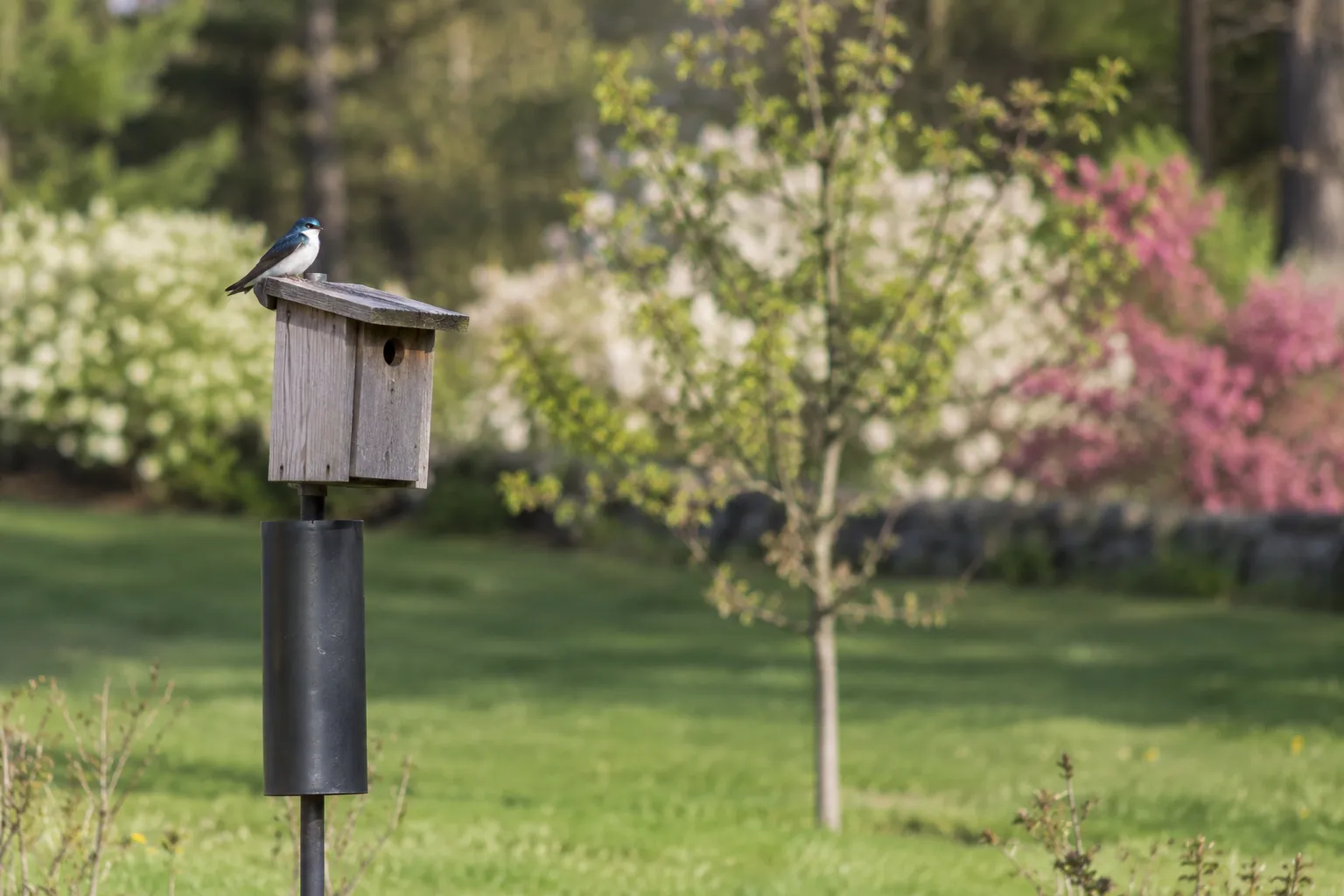
A smooth metal pole is hard to climb, and it isolates the box from branches, fences and roofs that predators use to approach. Add a baffle, a cylinder or cone around the pole below the box, and you block the main climbing predators in North America: raccoons, domestic cats, opossums, squirrels and rat snakes.
Organized bluebird trails in North America almost always use pole mounts with baffles for this reason. Monitors on these trails consistently report fewer lost nests after switching from wooden posts or fences to baffled poles.
Which poles work best?
- Metal electrical conduit (EMT) slipped over a length of steel rebar driven into the ground is a popular do-it-yourself system among bluebird enthusiasts. The rebar anchors it and the smooth conduit is hard to climb.
- Galvanized steel pipe set in the ground or on a ground socket is sturdier and suits larger boxes.
- Commercial nest-box poles come with mounting plates, and many are designed to take standard baffles.
- Wooden posts are the easiest option but the least safe. Cats and raccoons climb wood readily. If you use one, a baffle is essential.
Our guide to bird feeder poles and baffles covers the hardware in more depth. The same principles apply to nest boxes.
What kind of baffle should you use?
Two designs dominate.
Stovepipe (cylinder) baffles are tubes roughly 8 inches (20 cm) in diameter and about 24 inches (60 cm) long, mounted on the pole just below the box. They are widely regarded as the most effective design against raccoons and snakes, because there is nothing to grab and the loose top wobbles.
Cone baffles flare out below the box. They stop squirrels and cats well but are less reliable against snakes, which can sometimes wrap past a cone’s edge.
Mount the top of the baffle at least 4 feet (1.2 m) above the ground so predators cannot jump over it, and keep the whole setup at least 8 to 10 feet (2.5 to 3 m) from anything a squirrel could leap from. For more on sizing and placement, see squirrel baffles explained.
How do you mount a birdhouse on a pole step by step?
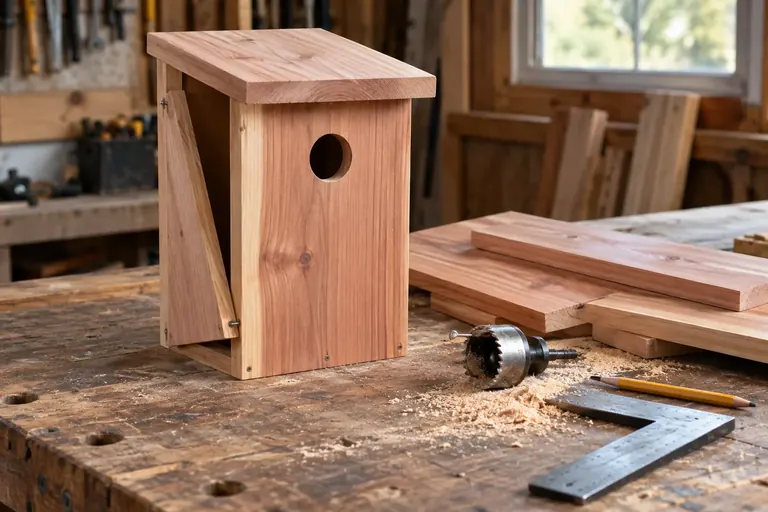
- Choose the site. Pick open or edge habitat that suits your target species, away from feeders, doors and busy paths.
- Check underground utilities. Before digging or driving anything, call your local utility-locating service (811 in the US).
- Set the anchor. Drive rebar about 2 feet (60 cm) into the ground, or dig a hole for a pipe or ground socket. In soft or sandy soil, use concrete or a longer anchor.
- Slide the pole on and check it is plumb using a level on two sides.
- Fit the baffle so its top sits just below the box, and at least 4 feet above the ground.
- Attach the box with a mounting bracket, pipe flange or U-bolts. The box should not rotate or wobble.
- Tilt the box very slightly forward if possible, so rain runs off the front rather than into the entrance.
- Add an entrance guard if raccoons are common. A wooden block that thickens the entrance, or a wire-mesh cage around the hole (often called a Noel guard), makes it harder for a raccoon or cat to reach in.
- Test the door to make sure you can open it for monitoring and cleaning while standing on the ground.
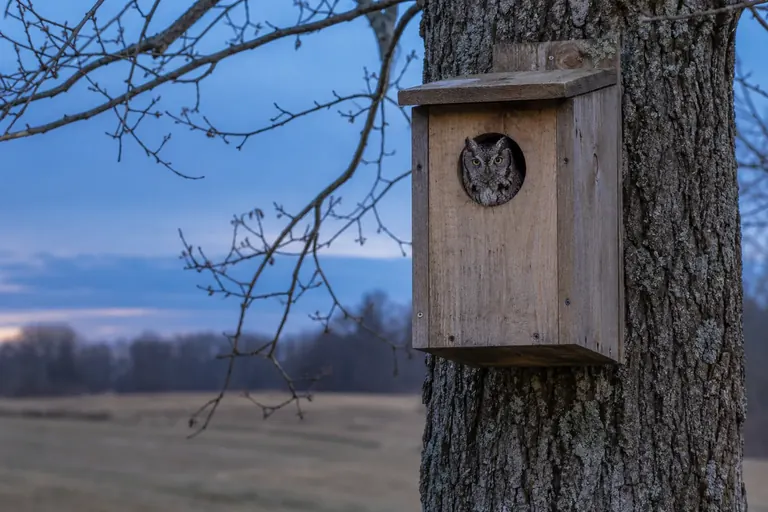
How do you mount a birdhouse on a tree?
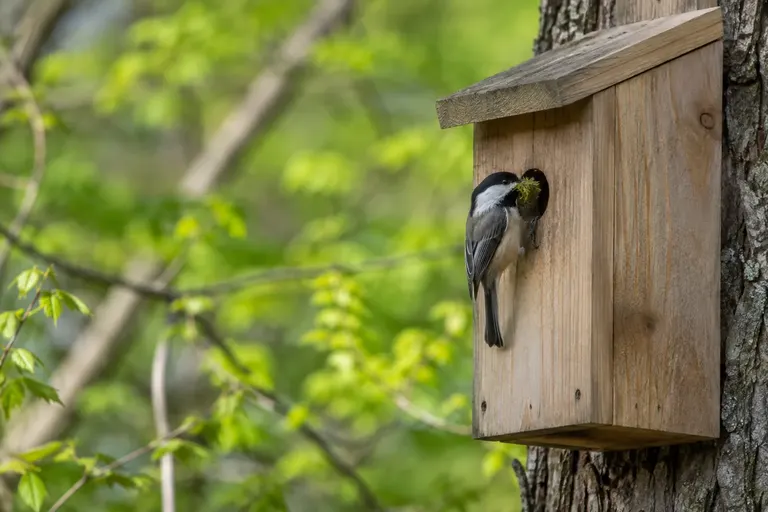
Trees suit species that naturally nest in trunks: woodpeckers, nuthatches, chickadees, titmice, screech-owls and, in Europe, Blue and Great Tits, Pied Flycatchers and nuthatches. Trees are also where most European garden boxes are placed.
Tree mounting steps
- Pick a healthy trunk that you will not prune or remove, with a clear flight path to the entrance.
- Attach a backing board to the box that extends above and below it. Mount through the board rather than the box itself.
- Use stainless steel or galvanized screws, which will not rust or stain. Aluminum nails are also used by some because they are softer if a saw later hits them.
- Leave the fixing slightly loose or plan to back it out a little each year or two, so the growing tree does not engulf it.
- Or use a strap. A padded strap or wire running through a section of garden hose around the trunk avoids fixings in the wood. Loosen it every year so it does not girdle the tree.
- Add a trunk baffle or a guard if cats, squirrels or raccoons are common. A band of smooth metal flashing around the trunk below the box, at least 2 feet tall, can help but does not stop animals jumping from nearby branches.
What are the drawbacks of trees?
Squirrels and climbing snakes reach tree boxes easily. Gray squirrels and red squirrels may chew entrance holes larger or take over boxes, and in Europe Great Spotted Woodpeckers sometimes hammer into boxes to take chicks. A metal plate around the hole and a deep box help. Some European makers use wood-concrete boxes, which resist woodpeckers and squirrels better than plain wood.
Can you mount a birdhouse on a wall or building?
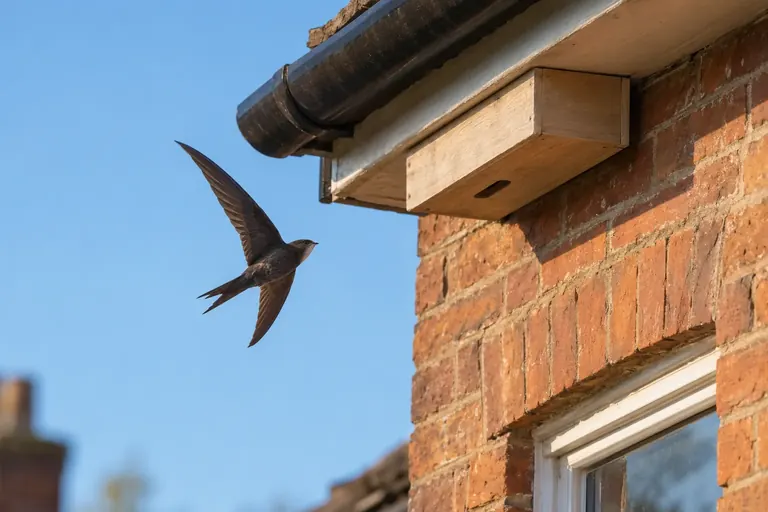
Yes, and for some species a building is the natural choice. House Sparrows, House Martins, Common Swifts, Barn Swallows, Eurasian Tree Sparrows, starlings, American Kestrels and Barn Owls all nest on or in buildings in parts of their range.
Wall mounting tips
- Use masonry anchors or screws into a secure part of the wall, never just the siding.
- Keep boxes under the eaves where they are shaded and sheltered from rain.
- Avoid mounting over doors, windows or patios, where droppings will be a nuisance and traffic disturbs the birds.
- Consider cleaning access. A wall box 20 feet up needs a safe ladder, so choose designs that are self-cleaning or rarely need it, such as swift boxes.
- Swift boxes go high, at least about 5 m (16 ft) in UK guidance, with a clear drop below the entrance, because swifts need space to drop into flight.
- House Martin cups go directly under the eaves, often in groups, because martins nest colonially.
In Turkey and much of southern Europe, Common Swifts, Pallid Swifts and House Sparrows are among the most likely wall-box users, and older stone buildings often already hold natural nest sites in their gaps.
How high should you mount a birdhouse?
Height depends on the species, and ease of monitoring matters too. These are typical ranges from nest-box guidance.
| Species | Typical mounting height |
|---|---|
| Eastern, Western, Mountain Bluebirds | 4 to 6 ft (1.2 to 1.8 m) |
| Tree and Violet-green Swallows | 5 to 10 ft (1.5 to 3 m) |
| House Wren | 5 to 10 ft (1.5 to 3 m) |
| Chickadees and titmice | 5 to 15 ft (1.5 to 4.5 m) |
| Nuthatches | 5 to 20 ft (1.5 to 6 m) |
| Downy Woodpecker | 5 to 20 ft (1.5 to 6 m) |
| Northern Flicker | 6 to 20 ft (2 to 6 m) |
| Purple Martin | 10 to 20 ft (3 to 6 m), on a raisable pole |
| Eastern Screech-Owl | 10 to 30 ft (3 to 9 m) |
| American Kestrel | 10 to 30 ft (3 to 9 m) |
| Blue and Great Tits (Europe) | 2 to 4 m (6.5 to 13 ft) |
| Open-fronted boxes for Robins and Wrens (Europe) | Below 2 m, hidden in climbers or shrubs |
| Common Swift (Europe) | 5 m (16 ft) or higher |
For the right entrance size for each species, see our birdhouse hole sizes by species chart.
Which direction should a birdhouse face?
The goal is shelter from the worst weather and from overheating.
- Away from prevailing wind and rain. In much of North America, prevailing winds come from the west, so an east- or southeast-facing entrance is common advice.
- Out of strong afternoon sun. Boxes in full afternoon sun can overheat and kill chicks in hot weather. Shade from a nearby tree, a wide roof overhang and good ventilation help.
- In the UK, the RSPB recommends facing boxes between north and east to avoid strong sunlight and the wettest winds, unless there is shade.
- Toward open ground for bluebirds and swallows, ideally with a tree, shrub or fence within about 100 feet (30 m) where fledglings can land on their first flight.
Direction matters less than shelter. A box on the shady side of a tree, protected from wind, can face almost any way.
Can you mount a birdhouse on a fence or deck railing?
You can, but it is the weakest option for predator safety. Fence tops are travel routes for cats, raccoons and squirrels, and a box screwed to a fence post sits right on that route. Deck railings add another problem: constant human traffic, which keeps shy species away and leads to abandoned nests.
If a fence is the only option, for example in a small city yard, reduce the risk:
- Mount the box on the side of a post facing away from the fence line, not on top where animals walk past the hole.
- Add an entrance guard that lengthens the tunnel to 3 inches (7.5 cm) or more, so a paw cannot reach the nest.
- Choose a species that tolerates it, such as House Wrens in North America or House Sparrows and tits in European gardens.
- Watch for problems and move the box if a nest is raided.
How do you protect a birdhouse from snakes?
In the eastern and southern US, rat snakes are skilled climbers and take many eggs and nestlings from boxes. Similar climbing snakes raid nests in southern Europe, Turkey and Brazil. Snakes climb wooden posts, rough bark and even some metal poles.
The most effective defenses are:
- A stovepipe baffle at least 8 inches wide and 24 inches long, fitted snugly at the top so a snake cannot squeeze between baffle and pole.
- A smooth metal pole rather than wood, with nothing a snake could use to bridge the baffle, such as tall grass, vines or nearby shrubs.
- Clear vegetation from around the base so the pole stands alone.
- Avoid netting or sticky barriers. Loose bird netting and sticky pastes can trap and kill snakes, birds and other animals, and are not recommended.
No method is perfect, but a well-installed stovepipe baffle on a bare metal pole stops most climbing predators.
How far apart should you mount birdhouses?
Spacing depends on how territorial the species is.
- Bluebirds: at least 100 yards (about 90 m) between boxes, and often more.
- Tree Swallows and bluebirds together: pair boxes about 15 to 25 feet (5 to 8 m) apart; each species takes one and they tolerate each other.
- House Wrens: highly territorial and known to destroy other birds’ eggs nearby. Keep bluebird boxes away from wooded edges, where wrens are most likely to nest.
- Colonial species: Purple Martins, House Sparrows, Tree Sparrows and House Martins nest close together, so groups of compartments or cups are normal.
- Tits in European gardens: a small garden usually holds one pair of each species; two or three boxes of different hole sizes, spread out, work better than several identical boxes together.
How far should a birdhouse be from a feeder?
Keep nest boxes well away from feeders, ideally 15 to 20 feet or more, and out of direct sight lines if possible. Feeders draw crowds, including squirrels, jays, starlings and predators such as hawks and cats. A nesting pair wants quiet. For feeder placement itself, see where to put a bird feeder.
Common mistakes
- Mounting on a fence or wooden post without a baffle. These are the most common routes for cats and raccoons.
- Putting boxes too close to branches or roofs. Squirrels and cats jump. Keep 8 to 10 feet of clearance.
- Nailing tightly into a living tree. The tree grows around the nail, and the box eventually splits or tilts.
- Facing the entrance into prevailing wind and rain. Wet nests chill chicks.
- Full afternoon sun on a dark box. Overheating is a real risk in hot summers.
- Mounting too high to monitor. If you cannot open the box easily, you will not clean it. See when and how to clean out a birdhouse.
- Adding a perch. It helps predators and competitors, not the nesting birds.
- Placing boxes where cats roam. Our guide to cats and birds covers ways to reduce the risk.
When should you mount a birdhouse?
Ideally in late winter or fall, so the box is in place when birds start prospecting. Our guide to when to put up birdhouses gives timing by region and species. Installing in fall also means the ground is not frozen, which makes driving rebar or setting a pole much easier.
Quick facts
- A smooth metal pole with a stovepipe baffle is the safest mount for most small cavity nesters.
- Keep the top of the baffle at least 4 feet above the ground.
- Keep boxes 8 to 10 feet from branches, fences and roofs.
- Mount bluebird boxes about 5 feet high; tit boxes in Europe about 2 to 4 m.
- Face entrances away from prevailing wind and out of strong afternoon sun.
- Use stainless or galvanized screws and allow for tree growth.
- Keep nest boxes 15 to 20 feet or more from feeders.
- Never add a perch.
Sources
Frequently asked questions
What is the best way to mount a birdhouse?
For most cavity nesters, the safest option is a smooth metal pole with a predator baffle below the box, set in open or edge habitat. Poles are harder for cats, raccoons and snakes to climb than trees, fences or wooden posts. Trees and walls work well for woodpeckers, owls, House Sparrows and several European species.
How high should a birdhouse be mounted?
Most small songbird boxes go 5 to 10 feet (1.5 to 3 m) above the ground. Bluebird and swallow boxes are commonly about 5 feet high so you can monitor them. Woodpeckers, screech-owls and kestrels use boxes 10 to 20 feet or more up. In Europe, tit boxes are usually placed 2 to 4 m high.
Which direction should a birdhouse face?
Face the entrance away from prevailing wind and rain and out of strong afternoon sun. In much of North America that means roughly east or southeast. In the UK the RSPB suggests facing boxes between north and east. For bluebirds, facing toward open ground or a nearby tree helps fledglings on their first flight.
Can you hang a birdhouse from a branch?
Only for a few species. House Wrens tolerate swinging boxes, but most cavity nesters prefer a firmly fixed box, and a hanging box is easy for squirrels and cats to reach from the branch. If you hang one, use a short, stiff wire or chain and keep it away from the trunk.
Should I nail a birdhouse to a tree?
Nailing into a living tree can damage it and loosen as the tree grows. A better option is a stainless or galvanized screw into a wooden backing board, left slightly proud and loosened every year or two, or a padded strap that you adjust as the trunk grows. Avoid trees you plan to fell or prune heavily.