Where to Put a Bird Feeder (Distance, Height, Cover)
Where to put a bird feeder: about 10 feet from shrubs, within 3 feet of windows or well away, 10 feet from squirrel launch points, and easy to see and refill.
In this article
- Quick answer: the placement checklist
- How far should a bird feeder be from trees and shrubs?
- How far should a bird feeder be from a window?
- How high should a bird feeder be?
- How do you place a bird feeder so squirrels cannot reach it?
- Sun, shade and wind: what conditions do birds prefer?
- Does the best feeder spot change with the seasons?
- Does placement change for specific birds?
- Where should you put a bird feeder for the best view?
- Where not to put a bird feeder
- How far apart should multiple bird feeders be?
- What if your yard cannot meet every rule?
- Step by step: setting up your feeder in the right spot
- Common mistakes with feeder placement
- Sources
- Frequently asked questions
Where to put a bird feeder comes down to four rules: about 10 feet from dense cover, either within 3 feet of a window or well back from glass, at least 10 feet from anything a squirrel can leap from, and somewhere you can see from inside and reach in any weather. Get those four things right and most feeders start drawing birds. Get one wrong and you get empty perches, window strikes or a fat squirrel.
Quick answer: the placement checklist
| Factor | Recommended placement | Why |
|---|---|---|
| Distance from shrubs and trees | About 10 feet (12 to 15 feet if squirrels are bold) | Birds can reach cover, but predators and squirrels cannot launch from it |
| Distance from windows | Within 3 feet, or on the glass | Birds cannot hit glass at full speed |
| Distance from squirrel launch points | At least 10 feet from roofs, fences, branches | Squirrels jump about 10 feet across |
| Pole baffle height | Bottom at least 4.5 to 5 feet off the ground | Squirrels can jump about 5 to 6 feet straight up |
| Feeder height | About 4 to 6 feet for hanging and pole feeders | Easy refilling and good viewing |
| Hummingbird feeders | Shade, out of strong wind | Nectar spoils faster in sun |
| Ground and platform feeders | Near brush piles or low shrubs | Juncos, sparrows and doves feed low and want escape cover |
The rest of this guide explains the reasons behind each number, and what to do when your yard cannot meet all of them at once.
How far should a bird feeder be from trees and shrubs?
Put your feeder about 10 feet from the nearest tree or shrub. Project FeederWatch, run by the Cornell Lab of Ornithology, describes this as a good compromise between two competing needs.
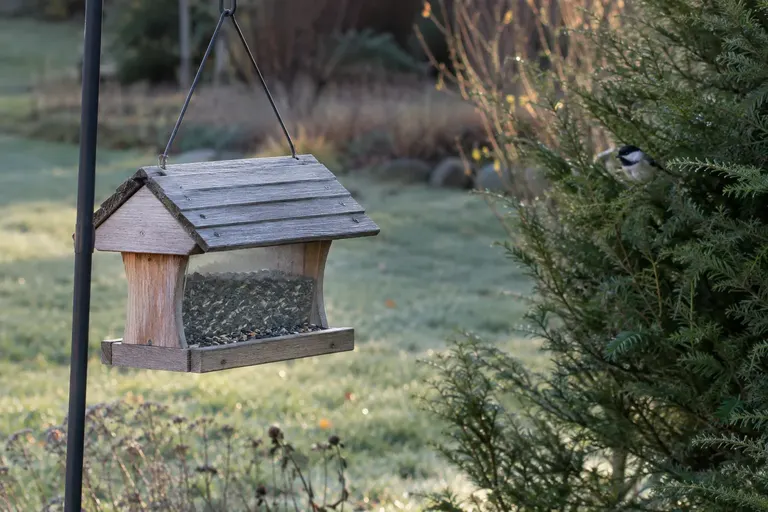
Birds need cover close by. Small birds do not sit in the open for long. Chickadees, titmice and nuthatches grab a seed and fly back to a branch to eat it. When a Cooper’s Hawk or Sharp-shinned Hawk swoops in, every bird at the feeder needs a place to hide within a second or two. A feeder in the middle of a bare lawn often gets fewer visitors because it feels exposed.
Cover too close helps predators. If the feeder hangs right next to a shrub, a cat can crouch inside the foliage and ambush birds as they land. Branches within jumping range also give squirrels an easy route in.
Ten feet solves both. Mass Audubon suggests a slightly wider 12 to 15 feet, which is a good target if squirrels keep beating your setup.
Which kind of cover works best?
Evergreens are the top choice. The Cornell Lab points out that conifers and other evergreens give dense, year-round concealment and block winter wind. A spruce, juniper, holly or arborvitae within 10 to 15 feet of the feeder gives birds a safe staging area where they can wait and watch before flying in.
If your yard lacks shrubs, you can build cover:
- Brush piles. Cornell recommends a loosely stacked brush pile near the feeder for ground birds like Song Sparrows and White-throated Sparrows. Prunings, old Christmas trees and fallen branches all work.
- Container evergreens. On a patio, a few large pots of dwarf conifers can serve as a staging point.
- Native shrubs. Over time, native plantings give both cover and natural food. Our guide to backyard birding covers planting for birds.
How far should a bird feeder be from a window?
Place feeders within 3 feet of a window, or attach them directly to the glass. The Cornell Lab and Audubon both give this advice. A bird that leaves a feeder only a few feet from glass cannot build up enough speed to be badly hurt if it flies into the window.
Older advice also suggested placing feeders more than 30 feet from windows. The Cornell Lab has since noted that the more useful goal is making nearby windows safer, rather than obsessing over exact distance. Window strikes are a large problem. Cornell cites research estimating that up to about 1 billion birds die from window collisions in the United States each year.
How to make windows near your feeder safer
- Mark the outside of the glass. Cornell recommends decals, dots or tape spaced about 2 inches apart across the entire outer surface. That spacing protects even very small birds like hummingbirds and kinglets.
- Use enough markings. One or two hawk silhouettes on a big picture window will not stop collisions. The pattern has to cover most of the glass.
- Consider hanging cords. Products made of parachute cord hung vertically about 4 inches apart are highly visible to birds.
- Watch reflections. Windows that reflect trees and sky are the most dangerous, because birds see habitat, not glass.
Our full guide on how to stop birds hitting windows goes further. If you want the closest possible view, a feeder mounted right on the glass solves both viewing and collision risk. See our best window bird feeders.
How high should a bird feeder be?
For most hanging tube, hopper and pole feeders, aim for the feeding ports to sit about 4 to 6 feet off the ground. That range puts the feeder at a comfortable height for refilling, keeps it at eye level for viewing from a standing position or a chair indoors, and works well with squirrel baffles.
Different birds feed at different heights
Height also decides who comes. Birds forage where they naturally feed:
- Ground feeders: Dark-eyed Juncos, Mourning Doves, many sparrows and towhees feed on or near the ground. A low platform tray a few inches up, or seed scattered near cover, suits them.
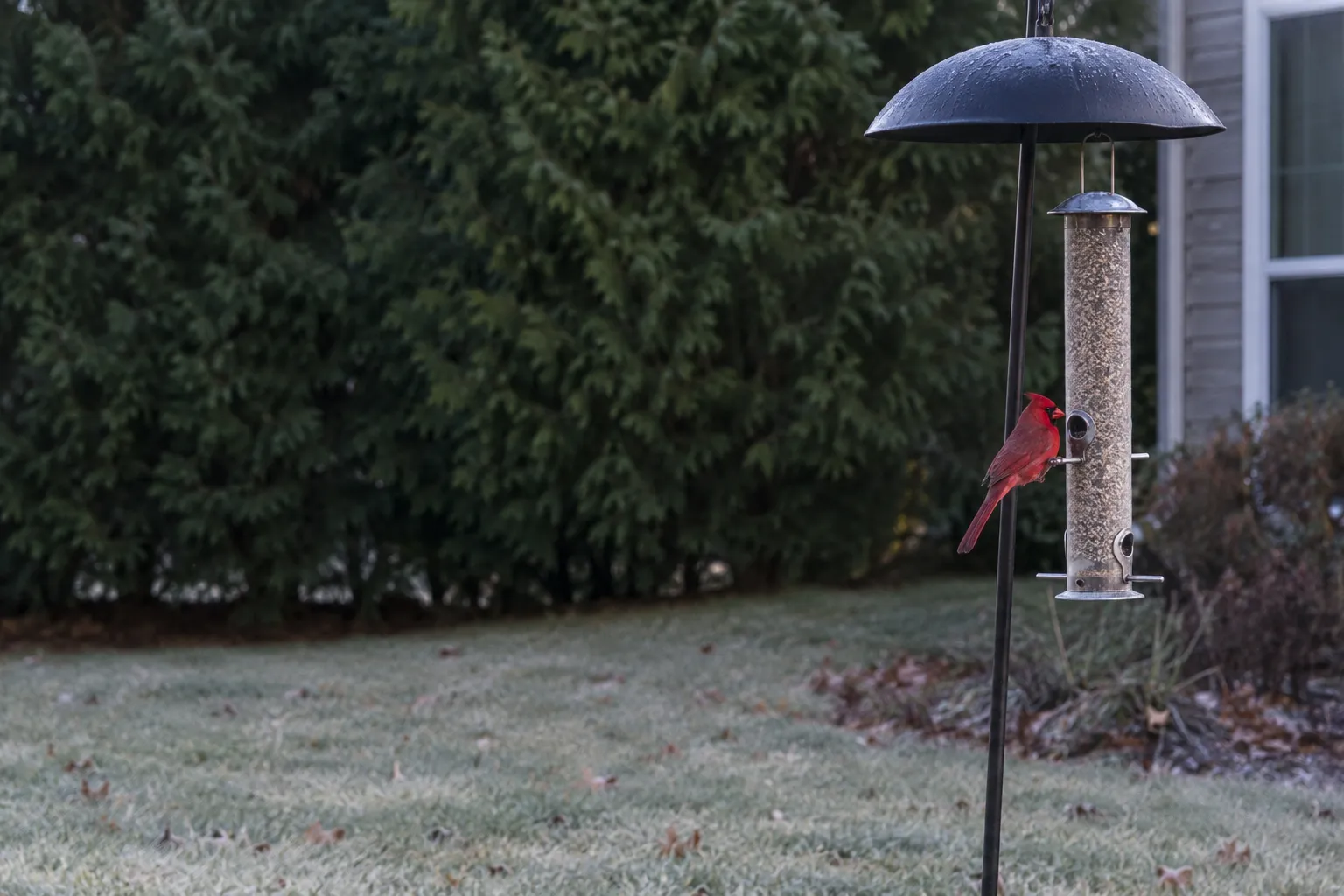
- Mid-level feeders: Northern Cardinals prefer to perch and feed from a stable ledge. Hoppers and trays at about 4 to 5 feet work well.
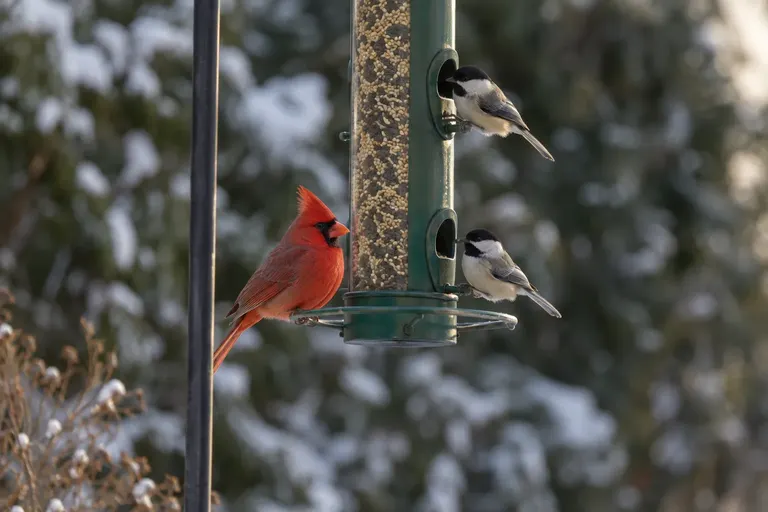
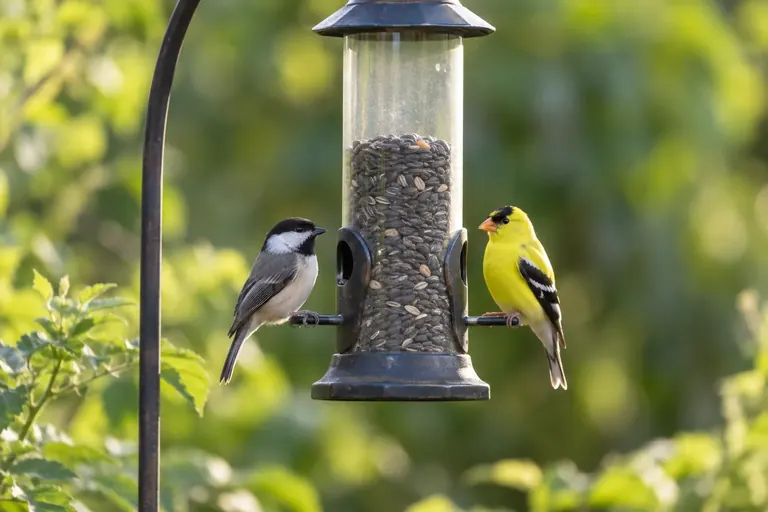
- Clinging feeders: Chickadees, titmice, finches and nuthatches happily use tube feeders at any height.
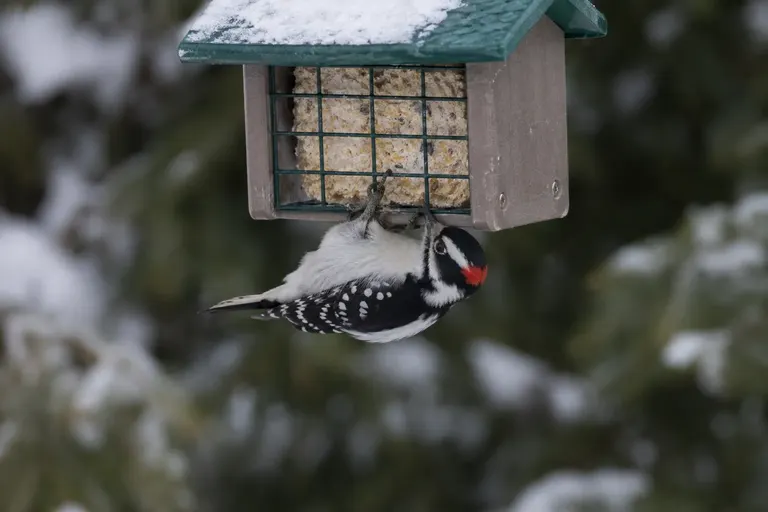
- Tree-trunk foragers: Woodpeckers and nuthatches visit suet feeders, and many take suet hung against or near a trunk.
If you want variety, offer two or three feeder types at different heights. A low tray near a brush pile is the simplest way to serve ground birds.
How do you place a bird feeder so squirrels cannot reach it?
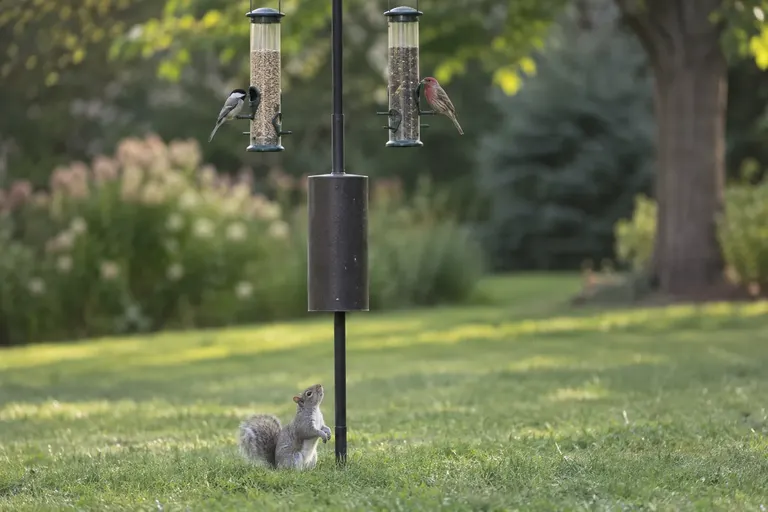
Location is the foundation of squirrel control. No baffle works if the feeder sits within jumping range of a fence, roof or branch.
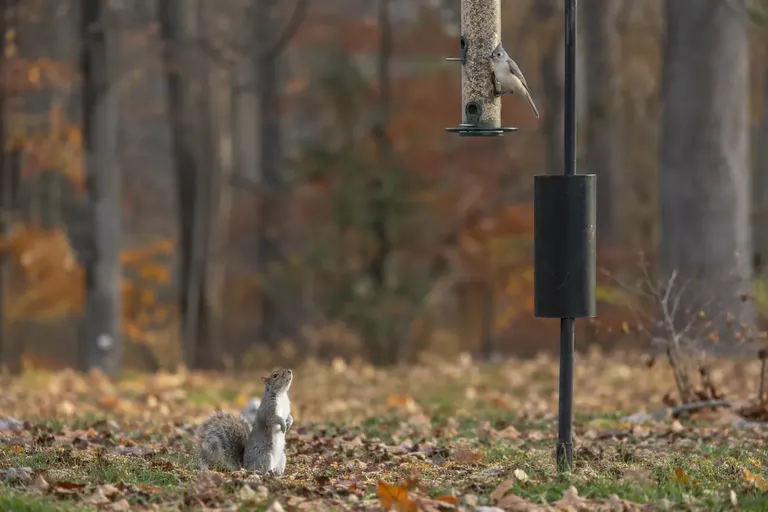
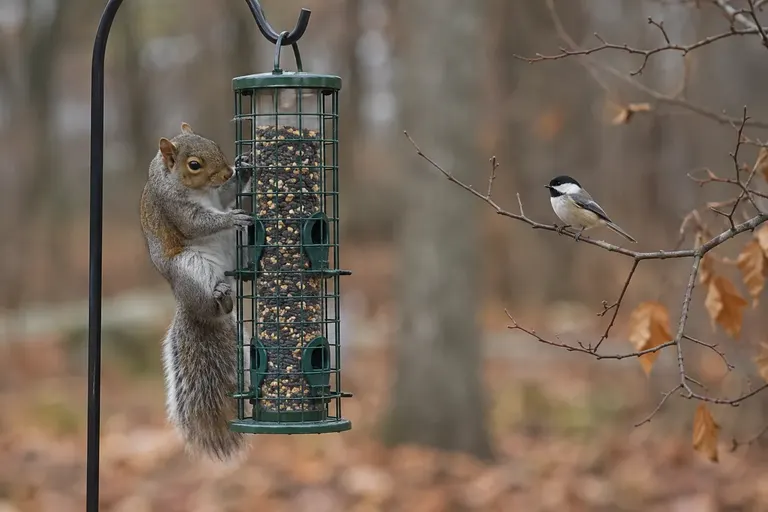
Squirrels are strong jumpers. Mass Audubon notes they can jump about 6 feet straight up and launch themselves to a feeder about 10 feet away from a tree or building. The University of Nebraska-Lincoln Extension advises placing feeders at least 10 feet from anywhere a squirrel can jump, in any direction.
To squirrel-proof by placement:
- Measure 10 feet or more from every launch point: tree trunks, overhanging limbs, fences, deck railings, roofs and patio furniture. Remember to check above the feeder, since squirrels also drop from branches.
- Use a smooth pole, not a hook on a tree.
- Add a baffle below the feeder, with its bottom edge at least 4.5 to 5 feet off the ground, based on guidance from wild bird retailers.
- Check for new launch points after storms and as trees leaf out or grow.
For baffle sizes and mounting details, see squirrel baffles explained. For the full playbook, including feeder designs and foods squirrels dislike, read how to keep squirrels off bird feeders.
Sun, shade and wind: what conditions do birds prefer?
Seed feeders
Pick a spot sheltered from the prevailing winter wind, often on the south or east side of a building or evergreen screen. Birds use a lot of energy staying warm, and a calm spot with some winter sun is where they will linger. Avoid spots where the feeder swings hard in gusts, which scatters seed and can make birds reluctant to land.
Hummingbird feeders
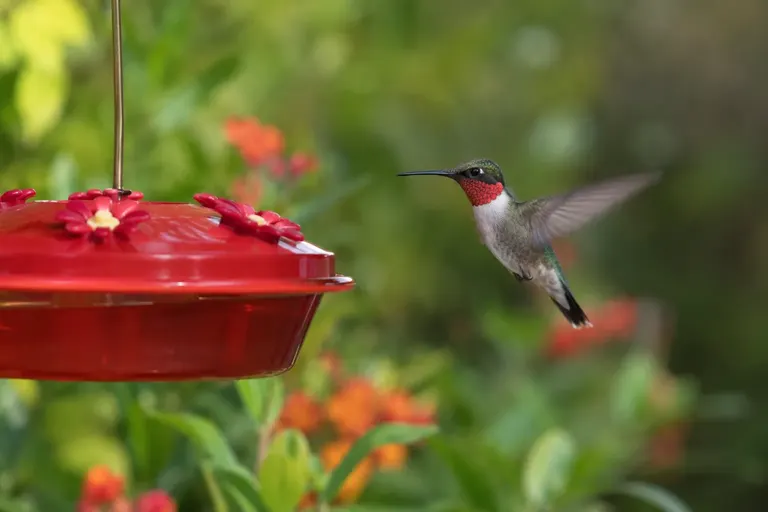
Hang hummingbird feeders in shade. The Cornell Lab notes that sugar water spoils quickly in sunlight, which means more fermentation, more mold and more cleaning. Shade also slows evaporation. Keep the feeder out of strong wind, which tips nectar out of the ports. Place it where hummingbirds can see it from their flight paths, often near flowering plants.
Rain and snow
Wet seed spoils. If your spot gets hit by driving rain, choose a feeder with a wide roof, or add a weather guard above a tube feeder. A spot under the eave of a house can work if it still meets the squirrel and window rules.
Does the best feeder spot change with the seasons?
Yes, a little. The rules on windows, cover and squirrels stay the same all year, but the conditions around them shift.
Fall and winter
This is when feeders matter most. Penn State Extension notes that feeder use is heaviest when temperatures are cold and when natural food is covered by ice or snow. In winter:
- Favor shelter from wind. A feeder on the lee side of an evergreen screen or building sees more use on bitter days.
- Keep the path clear. You will be refilling in snow. A spot close to a door means the feeder stays full.
- Watch for new launch points. Snowbanks can raise the ground under a baffle by a foot or more, giving squirrels a shorter jump. Clear snow below the baffle or raise it.
- Consider a second feeder near cover for juncos and sparrows, which spend winter feeding on the ground.
Spring and summer
Natural food returns and feeder traffic often drops, which is normal. In warm months:
- Move hummingbird feeders into shade and check them often.
- Keep seed dry. Summer rain and humidity spoil seed faster, so a roofed feeder or a spot under an eave helps.
- Give nesting birds space. Keep feeders away from active nest boxes. Constant traffic next to a box can stress the pair nesting there.
- Check for bears. In bear country, many wildlife agencies advise taking feeders down during the months bears are active.
Does placement change for specific birds?
Most feeder birds follow the same basic rules, but a few favorites have preferences worth knowing:
- Northern Cardinals like a stable perch and tend to stay close to dense shrubs. A hopper or tray feeder a short flight from thick cover suits them well.
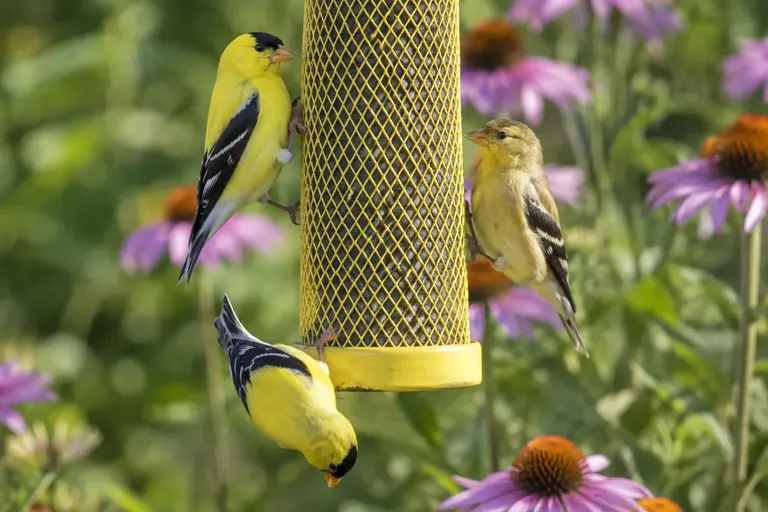
- American Goldfinches use tube and nyjer feeders at any height and tolerate more open spots than many birds.
- Chickadees and titmice take a seed and fly to cover to eat it, so a shrub or tree within about 10 to 15 feet keeps them coming.
- Dark-eyed Juncos and sparrows feed on the ground under or near feeders, so leave a little open ground beside brush.
- Woodpeckers like suet feeders near tree trunks or hung from a pole close to trees.
Where should you put a bird feeder for the best view?
You will enjoy the feeder more if you can see it easily. Stand at the window you use most, such as the kitchen, the breakfast table or a favorite chair, and pick the spot from there.
A few tips:
- Think about light. A feeder lit by morning sun as seen from your window looks better than one that is backlit against a bright sky.
- Simple backgrounds help. A hedge or lawn behind the feeder makes birds stand out, which also helps with photos or a feeder camera.
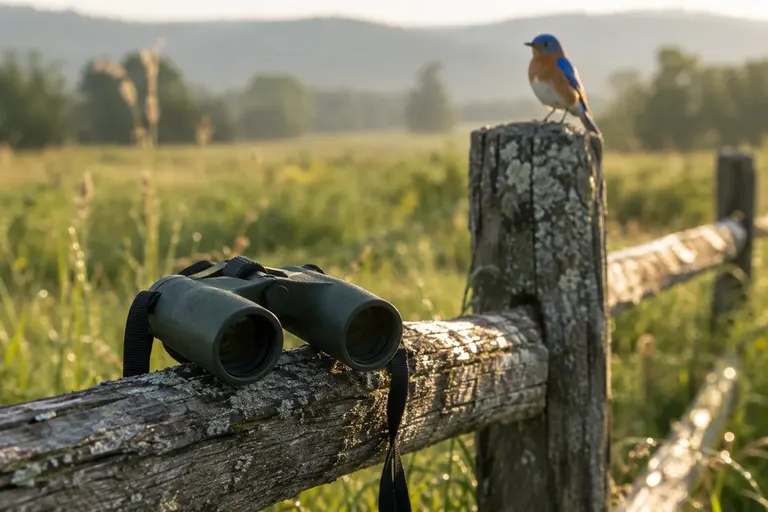
- Keep it close enough to identify. A feeder 15 to 25 feet from your window is easy to watch with binoculars. A window-mounted feeder needs none.
Where not to put a bird feeder
Avoid these common trouble spots:
- Over a deck, patio or walkway. Droppings and seed hulls pile up below every feeder. Hulls can also smother grass underneath.
- Next to a car. Birds perched above will leave droppings on it.
- Beside dense shrubs. As noted above, cats use shrubs as ambush cover.
- Midway from an untreated window. A feeder several yards from glass gives a startled bird room to build speed toward a reflective window. Either move it within 3 feet or mark the glass.
- Under overhanging tree limbs. Branches above the feeder give squirrels a drop-down route.
- In bear country when bears are active. Mass Audubon advises removing feeders from about March to November where black bears are active. Check your state wildlife agency’s current guidance.
How far apart should multiple bird feeders be?
Spreading feeders out reduces crowding, which helps with both aggression and disease. Audubon recommends offering multiple feeders so birds are not crowded together, since close contact at a single feeder helps spread illnesses like Salmonella and House Finch eye disease.
A practical approach:
- Separate food types. Put a nyjer feeder for goldfinches in one spot, a sunflower tube or hopper in another, and a suet cage elsewhere.
- Give bullies their own station. A tray of peanuts or corn away from the main feeders can draw jays and squirrels off your main station. Project FeederWatch mentions this distraction approach for squirrels.
- Keep hummingbird feeders apart. Male hummingbirds defend feeders. Several feeders placed out of sight of each other let more birds feed.
- Clean the ground below. Rotating a feeder’s spot slightly now and then prevents a build-up of hulls and droppings.
What if your yard cannot meet every rule?
Real yards are small, shady and full of fences. Prioritize in this order:
- Window safety first. Either within 3 feet of glass or treat the glass.
- Cover within reach. Some shrub, tree or brush pile within 10 to 15 feet.
- Squirrel distance. If you cannot get 10 feet from launch points, choose a weight-activated squirrel-resistant feeder or feed safflower. See our best squirrel-proof bird feeders.
- Convenience. A feeder you can refill in snow or rain is one you will actually keep full.
Placement for balconies and apartments
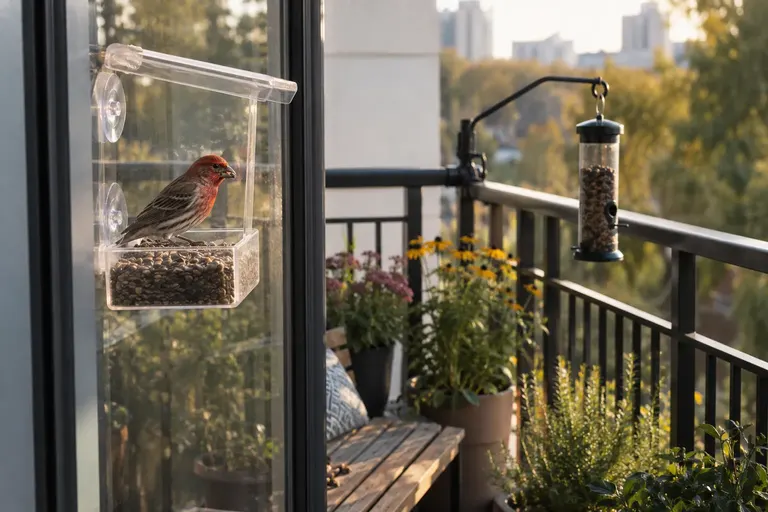
On a balcony, cover and squirrel distance are harder to control. Window-mounted feeders and small hanging feeders on railing brackets are good options. Plant a pot or two of dense shrubs to give birds a place to wait. Check building rules first, since some prohibit feeders. Our best bird feeders for balconies and small spaces covers compact designs.
Step by step: setting up your feeder in the right spot
- Walk the yard and note every tree, shrub, fence, roofline and window.
- Mark candidate spots about 10 feet from cover and at least 10 feet from launch points.
- Check sightlines from your favorite window.
- Decide the window rule: close to glass, or treat the glass.
- Install a pole and baffle if squirrels are around, with the baffle bottom at least 4.5 feet up.
- Hang the feeder with ports at about 4 to 6 feet.
- Fill it with black oil sunflower seed, the food that draws the widest range of feeder birds.
- Scatter a little seed on the ground nearby. The Cornell Lab suggests this to make a new station easier for birds to notice.
- Wait and watch. Birds may take days to weeks to find a new feeder.
Common mistakes with feeder placement
- Hanging the feeder in open lawn with no cover within 20 or 30 feet. Birds feel exposed and visit less.
- Hanging it inside a shrub. It feels safe to us, but it gives cats a hunting blind.
- Using a tree branch as a hanger. It is a squirrel highway.
- Putting the baffle too low. A baffle 3 feet up is a step stool for a squirrel.
- Forgetting about the mess. Choose a spot where hulls and droppings will not bother you.
- Giving up in a week. A new feeder can take time to be discovered. If it has been several weeks, read why birds aren’t coming to your new feeder.
Sources
- Where to Put Your Bird Feeder (Cornell Lab, All About Birds)
- Feeder Placement (Project FeederWatch)
- Why Birds Hit Windows and How You Can Help Prevent It (Cornell Lab, All About Birds)
- Help Birds Avoid a Deadly Collision (Audubon)
- Bird Feeding Best Practices (Mass Audubon)
- Preventing Conflicts With Tree Squirrels (University of Nebraska-Lincoln)
- Three Easy but Important Ways to Keep Your Bird Feeders Disease-Free (Audubon)
Frequently asked questions
How far should a bird feeder be from a window?
The Cornell Lab and Audubon recommend placing feeders within 3 feet of a window, or attaching them to the glass, so birds cannot build up enough speed to be badly hurt if they fly into it. Cornell also stresses that marking nearby windows with patterns spaced about 2 inches apart matters more than exact distance.
How far should a bird feeder be from trees and bushes?
About 10 feet is the standard compromise recommended by Project FeederWatch. Birds can reach cover quickly if a hawk appears, but branches are far enough away that squirrels cannot leap onto the feeder and cats cannot ambush from inside the shrubs. Mass Audubon suggests 12 to 15 feet where squirrels are persistent.
How high should a bird feeder be off the ground?
For most hanging and pole feeders, about 4 to 6 feet puts the ports at a comfortable height for refilling and viewing. If squirrels are an issue, the pole baffle should sit at least 4.5 to 5 feet up. Ground-feeding birds such as juncos, doves and sparrows prefer low platform feeders near the ground.
Should a bird feeder be in the sun or shade?
Seed feeders do well in a spot sheltered from the prevailing winter wind, ideally with some morning sun. Hummingbird feeders belong in shade, because the Cornell Lab notes that sugar water spoils quickly in sunlight. Avoid spots where the feeder swings in strong wind, which spills seed and nectar.
Can I put a bird feeder close to my house?
Yes. A feeder near the house is easier to watch and refill, and within 3 feet of a window it is actually safer for birds. Expect droppings and seed hulls below it, so avoid placing it over a deck, patio or entryway you want to keep clean.