When and How to Clean Out a Birdhouse, Step by Step
When and how to clean out a birdhouse: remove old nests after young fledge and again in late fall or winter, scrub with hot water or dilute bleach, then dry it.
In this article
- Quick answer: birdhouse cleaning at a glance
- Why should you clean out a birdhouse at all?
- When is the right time to clean a birdhouse?
- Is it legal to clean out a bird’s nest?
- How do you clean out a birdhouse step by step?
- What do you do if you find eggs, dead chicks or other animals?
- What maintenance should you do while the box is open?
- Can you check a birdhouse during the nesting season?
- Should you leave a birdhouse up over winter?
- Common mistakes when cleaning birdhouses
- What does regular cleaning mean for your birds?
- Quick facts
- Sources
- Frequently asked questions
Here is when and how to clean out a birdhouse. Do it twice in its yearly cycle: once after each nesting attempt ends and the young have left, and once more in fall or winter when the breeding season is over. The job itself takes about 10 to 15 minutes per box: open the box, remove the old nest, scrub the inside with hot water or a dilute bleach solution, let it dry fully and fix anything broken before birds return in spring.
Clean boxes cut down on parasites and mold, make it easier to see what is happening during the next season and give you a reason to check that the box is still safe. This guide covers the timing, the legal side, the step-by-step method and what to do about eggs, wasps, mice and other surprises.
Quick answer: birdhouse cleaning at a glance
| Question | Short answer |
|---|---|
| When is the best time? | After fledging, and a full clean in fall or winter |
| When is the latest? | Before birds prospect in late winter or early spring |
| Can I remove an active nest? | No, not for native protected species |
| What should I use? | Gloves, mask, scraper, stiff brush, hot water, optional 1:9 bleach |
| What should I avoid? | Insecticides, flea powders, strong-smelling products |
| How long does it take? | About 10 to 15 minutes per box |
Why should you clean out a birdhouse at all?
In the wild, cavity-nesting birds often use a new hole each year or a cavity that has been emptied by weather, decay or other animals. A nest box is different. It is a sealed wooden container, and last year’s nest sits exactly where it was left. Cleaning replaces that natural turnover.
Parasites build up in old nests
Old nest material can harbor bird fleas, mites, lice and the larvae or pupae of blowflies (genus Protocalliphora in North America), which feed on the blood of nestlings. Heavy infestations weaken chicks. In Europe, the hen flea Ceratophyllus gallinae is a well-studied parasite of tit nests, and it overwinters as larvae and cocoons in old nest material, ready to emerge when birds return.
Mold and moisture
Damp nest material rots, grows mold and keeps the box wet. A box that stays damp all winter can warp, split and lose its seal around the roof.
Some birds prefer a clean box
Behavior varies by species. Several studies in Europe have found that some cavity nesters, including certain tits and flycatchers, tend to choose boxes without old nests when given a choice, possibly to avoid parasites. The evidence is not uniform across species, but for most backyard boxes, a clean start does no harm and often helps. Our article on whether birds reuse nests covers which species tend to build fresh each time.
A stacked nest can become a hazard
If a box is never cleaned, new nests may be built on top of old ones. That lifts the nest closer to the entrance hole, where raccoons, cats and snakes can reach in more easily. House Wrens, which pack boxes full of twigs, are a classic example.
When is the right time to clean a birdhouse?
Timing matters more than technique. The rule is simple: only work on a box when no active nest is present.
After each brood fledges
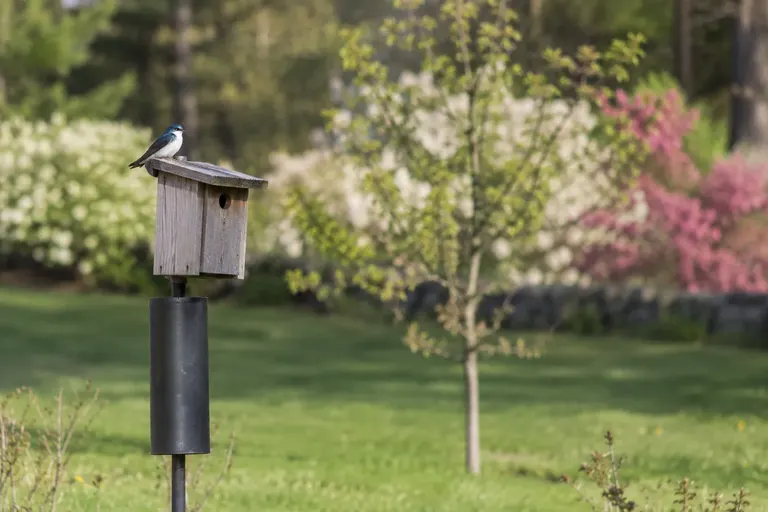
Species that raise more than one brood a season often start a second nest soon after the first set of young leaves. Eastern Bluebirds commonly raise two broods, sometimes three, and bluebird monitors routinely remove the used nest once the young are gone. Tree Swallows, House Wrens and Carolina Wrens may also nest more than once.
How do you know the young have fledged? Nestlings leave at a predictable age: roughly 16 to 22 days after hatching for Eastern Bluebirds, depending on conditions. Watch for adults no longer carrying food and a quiet box. Our guide on how long baby birds stay in the nest gives typical ranges by species. When you open the box, a flattened nest cup with droppings along the rim is the usual sign of a successful fledging.
After the breeding season
Give every box a thorough clean once nesting is over. In most of the US and Canada that means any time from late summer through winter. In the Deep South and the Southwest, nesting starts earlier, so finish by midwinter.
Before the next season starts
Birds begin looking at boxes before they build. Chickadees and bluebirds may prospect on mild days in late winter, and Tree Swallows arrive in early spring in many northern areas. Our guide on when to put up birdhouses lists typical prospecting times. Aim to have every box clean and closed by then.
What about outside North America?
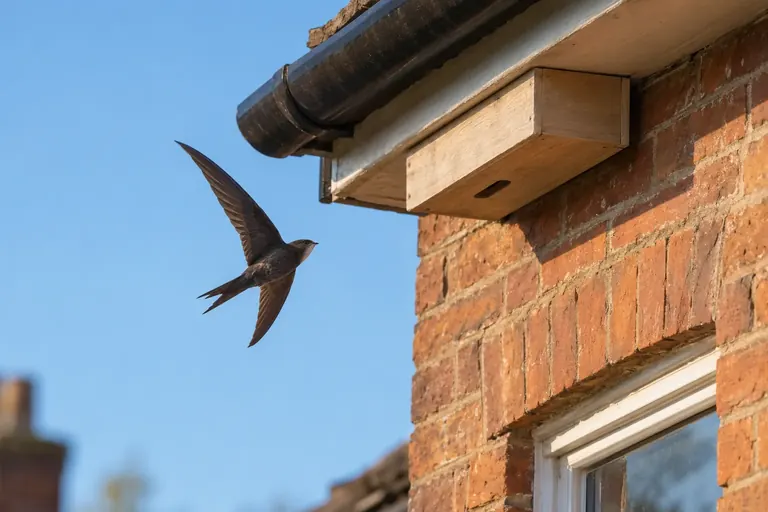
- UK and Ireland. The RSPB recommends cleaning boxes after the breeding season, typically from September onward. Under the Wildlife and Countryside Act 1981, unhatched eggs may only be removed between August 1 and January 31, and must then be destroyed.
- Continental Europe and Turkey. Great Tits, Blue Tits, House Sparrows and Eurasian Tree Sparrows use boxes widely. Late autumn or winter cleaning suits most areas.
- Southern Hemisphere. In Brazil, the calendar is reversed. Southern House Wrens and Saffron Finches readily use boxes, and many species nest from about September to January or later. Clean in the late austral autumn or winter once boxes are empty, and check local wildlife rules.
Is it legal to clean out a bird’s nest?
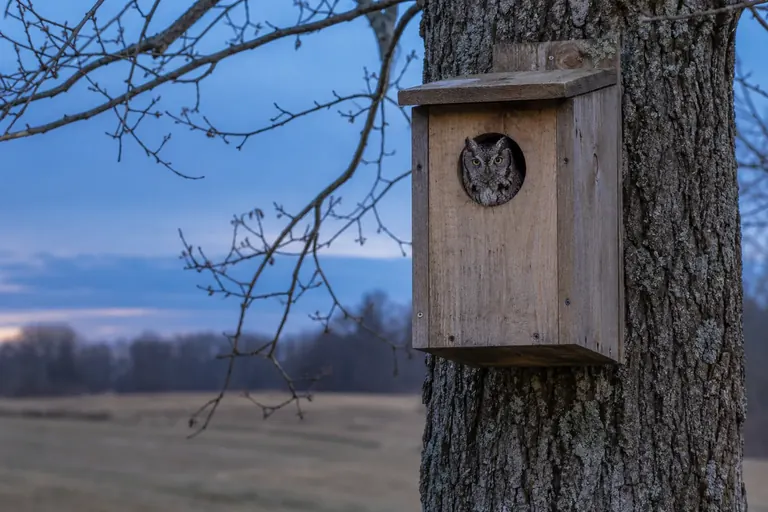
In the United States, the Migratory Bird Treaty Act protects most native bird species, their eggs and their nests. You may not destroy, move or disturb an active nest, meaning one with eggs or young. Removing an empty nest from your own nest box after the season is routine maintenance and is what programs such as Cornell Lab’s NestWatch recommend. You should not keep nests or eggs as collections.
House Sparrows and European Starlings are introduced species in North America and are not protected by the Act. Many bluebird and swallow landlords remove their nests to protect native birds. Be sure of your identification before doing so, because female House Sparrows can be confused with native sparrows.
Elsewhere, laws differ. Most European countries protect wild bird nests during the breeding season under national law and the EU Birds Directive. If in doubt, clean only once a box is clearly empty and the season has ended.
How do you clean out a birdhouse step by step?
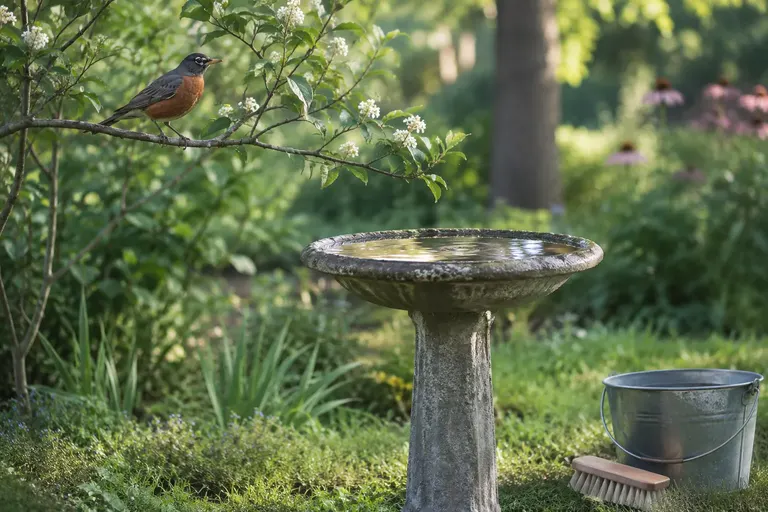
What you need
- Disposable or rubber gloves
- A dust mask (dry nest material and droppings produce dust)
- A putty knife or paint scraper
- A stiff brush
- A bucket of very hot water
- Optional: household bleach for a 1:9 solution
- A trash bag
- A screwdriver and spare screws for repairs
The steps
- Check that the box is empty. Tap the box gently and wait. Look inside before putting your hand in. Wasps, mice and even flying squirrels use boxes.
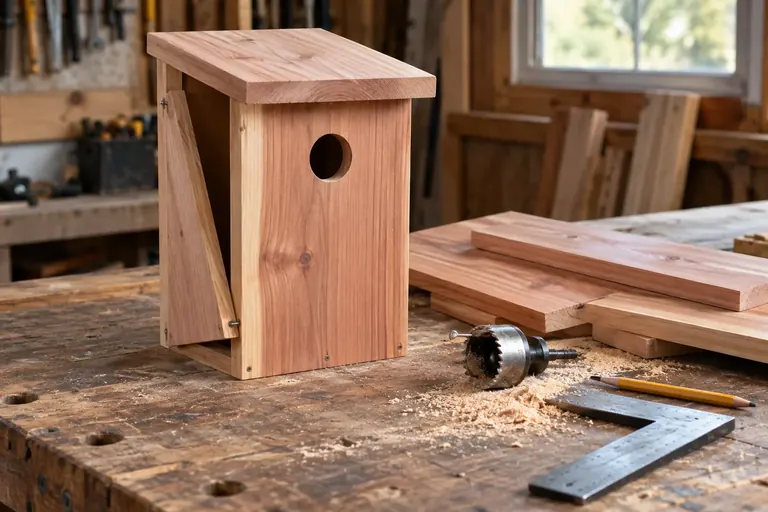
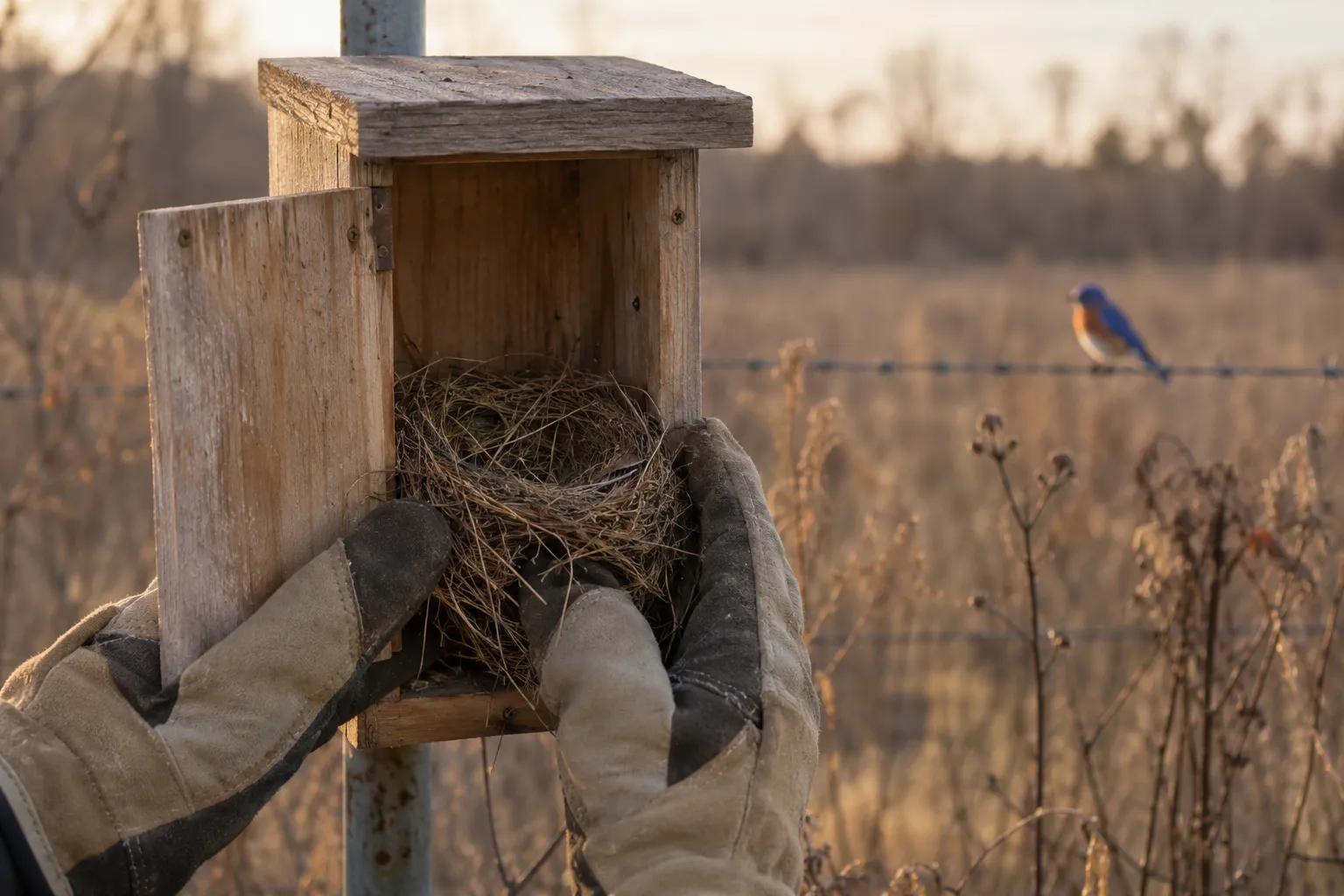
- Open the box. Well-designed boxes have a side or front panel that swings open, or a removable roof. If yours does not open, it is worth modifying or replacing it, because a box you cannot clean is a box you cannot monitor. Our guide to birdhouse hole sizes by species also covers useful design features.
- Remove the old nest. Lift it out whole if possible and drop it straight into a bag. Seal the bag and put it in the trash, not the compost near the box, so parasites do not simply move back.
- Scrape the floor and corners. Loosen stuck droppings and debris with the scraper.
- Scrub with hot water. Brush all interior surfaces, especially seams and corners where mites hide.
- Disinfect if needed. If the nest was heavily infested, moldy or held dead young, scrub with a 1:9 bleach and water solution, leave it 10 minutes, then rinse thoroughly with clean water.
- Dry completely. Leave the door open in the sun for several hours or a full day. Wood must be dry before closing the box.
- Inspect and repair. Check drainage holes, ventilation gaps, hinges, the roof seal and the mounting. See the maintenance checklist below.
- Close the box, or leave it open until spring. Some monitors leave boxes open through fall to keep mice and wasps from moving in, then close them in late winter.
- Wash your hands. Bird droppings and nest material can carry bacteria.
What should you never put in a birdhouse?
Do not spray insecticides, use flea powders or hang pest strips in a nest box. Chemicals soak into wood and can harm nestlings. Avoid scented cleaners. Do not add nesting material yourself for most songbirds; they prefer to build their own.
What do you do if you find eggs, dead chicks or other animals?
Opening a box after the season sometimes brings surprises.
Unhatched eggs
A few eggs in a clutch fail to hatch in many species. If the rest of the brood has fledged, you can remove the eggs during cleaning. If the whole clutch sits unhatched, be patient. Parents may leave eggs for periods during laying, and incubation only starts with the last or second-to-last egg in many songbirds. NestWatch advice is to wait well beyond the normal incubation period before assuming abandonment. In the UK, the August 1 to January 31 window applies.
Dead nestlings
Nest failures happen through cold snaps, food shortages, predators and parasites. Wear gloves, remove the nest and young together, bag them and disinfect the box with the bleach solution. If you find several dead birds or suspect disease, see our guide on what to do with an injured bird for contacts, and check local reporting rules for bird flu.
Wasps and bees
Paper wasps often hang small combs from the ceiling of a nest box. Remove small, abandoned combs in cold weather when wasps are inactive. A widely shared monitor tip is to rub plain bar soap on the inside of the roof, which may make it harder for wasps to attach combs. Never use wasp spray inside a box.
Mice and other mammals
Mice sometimes stuff boxes with soft material in fall. Wear gloves and a mask, as rodent droppings can carry disease. Remove the material and clean thoroughly. Leaving boxes open through autumn can discourage mice from settling.
What maintenance should you do while the box is open?
Cleaning is the ideal moment for a quick safety check.
| Check | Why it matters | Fix |
|---|---|---|
| Drainage holes in the floor | Standing water chills eggs and chicks | Drill 1/4 inch holes or clear blocked ones |
| Ventilation gaps under the roof | Prevents overheating in summer | Keep gaps open; do not seal them |
| Roof and seams | Leaks soak the nest | Tighten screws, replace warped panels |
| Door latch | Raccoons can open loose doors | Use a secure latch or screw |
| Entrance hole | Squirrels and woodpeckers may enlarge it | Add a metal hole guard of the right size |
| Mounting and baffle | Predators climb poles and trees | Tighten fixings and check the baffle; see how to mount a birdhouse |
| Interior grooves below the hole | Help fledglings climb out | Re-score smooth boards if needed |
| Paint and finish | Dark exteriors overheat | Use light, exterior-grade finish on the outside only |
Can you check a birdhouse during the nesting season?
Yes, carefully, and doing so makes end-of-season cleaning easier because you already know what happened in the box. Nest monitoring programs such as NestWatch publish a simple code of conduct that most landlords follow:
- Check once or twice a week at most. Brief visits are enough to follow building, laying, hatching and growth.
- Approach openly and tap first. A gentle knock gives the adult a chance to leave before you open the door.
- Keep visits under a minute. Count eggs or young, note the date, close the box.
- Avoid bad weather and early mornings. Cold or wet eggs and chicks suffer when parents are kept away, and many birds lay eggs in the early morning.
- Stop opening the box late in the nestling period. For most small songbirds, stay away once young are about 12 days old, because a disturbance can make them leave too early. For Eastern Bluebirds that means roughly the last week before fledging.
- Do not leave a scent trail to the box. Walk past rather than straight to it and back, so predators are less likely to follow.
Monitoring also tells you when a nest has failed. If a nest was abandoned early, you can clean the box right away and give the pair, or another pair, a chance to try again the same season. A dated note of hatching lets you predict fledging, so you know exactly when a cleaning visit will not disturb anyone.
Should you leave a birdhouse up over winter?
Yes, in most places. Many cavity nesters use boxes as winter roosts. Eastern Bluebirds sometimes pack several birds into a single box on frigid nights, and chickadees, titmice, nuthatches and Downy Woodpeckers also roost in cavities. In Europe, Blue Tits and Great Tits commonly roost in boxes through winter.
For winter use, clean the box in fall, make sure it is dry, and consider temporarily plugging some ventilation gaps with weatherstripping or foam to reduce drafts, removing them before spring. Some people add a small layer of dry wood shavings for woodpeckers, which do not bring nesting material. Do not add hay or straw, which holds moisture.
Common mistakes when cleaning birdhouses
- Cleaning too early. Opening a box that still holds eggs or young can cause abandonment or premature fledging. Confirm it is empty.
- Leaving the nest next to the box. Parasites crawl back. Bag it and bin it.
- Using pest sprays. The residue lingers in wood.
- Closing a damp box. Moisture breeds mold. Dry it first.
- Forgetting the dust mask. Dry droppings and nest dust are unpleasant to breathe.
- Skipping repairs. A clean box with a leaking roof still fails.
- Owning boxes that do not open. You cannot clean or monitor them properly.
- Removing native nests by mistake. Confirm House Sparrow identification before removing any nest.
What does regular cleaning mean for your birds?
Regular cleaning will not guarantee success, but it improves the odds. Boxes with fewer parasites, dry floors and secure doors give nestlings a better start. Cleaning also lets you learn about your birds. Many people keep simple notes on species, egg counts and fledging dates, and share them with citizen science projects such as NestWatch in North America or the BTO Nest Record Scheme in Britain. If you are hoping to host a particular species, our guides to Eastern Bluebirds and House Wrens cover their specific nesting needs.
Quick facts
- Clean after each brood fledges and again after the breeding season.
- Never disturb an active nest of a protected species.
- Bag and bin old nests away from the box.
- Scrub with hot water; use 1:9 bleach for heavy infestations, then rinse.
- Let the box dry fully before closing it.
- No insecticides, flea powders or pest strips.
- Check drainage, ventilation, latch and predator guards every year.
- Leave boxes up in winter for roosting birds.
Sources
Frequently asked questions
When should you clean out a birdhouse?
Clean a birdhouse after the young have fledged and the nest is empty, and give every box a thorough clean once the breeding season is over, usually in fall or winter. For species that raise several broods, such as bluebirds, removing the old nest between broods is common practice. Always finish before birds start prospecting in late winter or early spring.
Is it illegal to remove a bird nest from a birdhouse?
In the US, the Migratory Bird Treaty Act protects most native birds, their eggs and active nests, so you must not disturb a nest in use. Removing an empty nest from your own box after the season for maintenance is standard practice recommended by nest monitoring programs. House Sparrows and European Starlings are not protected. Rules differ in other countries.
Should I leave old nests in a birdhouse over winter?
Most experts recommend removing them. Old nests can hold mites, fleas, blowfly pupae and mold, and some species prefer clean boxes. A few people leave clean, dry material for winter roosting, but a fresh box is safer for next season. Clean in fall, then you can add a little dry wood shaving if woodpeckers use the box.
What should I use to clean a birdhouse?
Scrape out the nest, then scrub the inside with a stiff brush and very hot water. For a deeper clean, use about 1 part household bleach to 9 parts water, rinse thoroughly and let the box dry completely with the door open. Do not use insecticides, flea powders or aerosol sprays inside a nest box.
What do I do with unhatched eggs in a birdhouse?
Wait. Many eggs hatch days after others, and parents may return. Only remove eggs once the nest is clearly abandoned for well beyond the normal incubation period, or after all young have fledged. In the UK, the law allows unhatched eggs to be removed only between August 1 and January 31.