How to Keep Squirrels Off Bird Feeders: What Actually Works
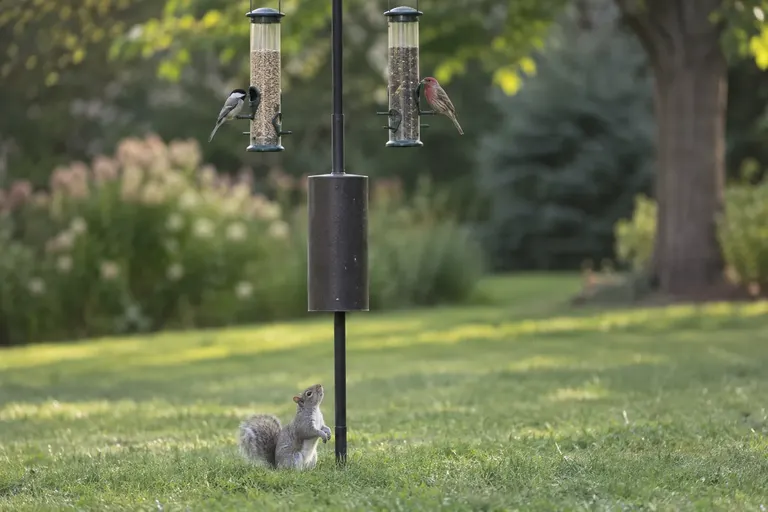
How to keep squirrels off bird feeders: a smooth pole 10 feet from launch points with a baffle 4.5 to 5 feet up works best. Weight-activated feeders come next.
If you buy through links on this page we may earn a commission, at no cost to you. It never decides what we recommend. How we earn
In this article
- Quick answer: squirrel deterrents ranked
- How we researched this guide
- Why are squirrels so hard to keep off bird feeders?
- Step 1: Put the feeder where squirrels cannot jump to it
- Step 2: Mount it on a smooth pole with a baffle
- Step 3: If your feeder hangs from a tree, use a hanging baffle
- Step 4: Use a weight-activated squirrel-resistant feeder
- Step 5: Change the food
- Step 6: Give squirrels their own food, far away
- Which squirrels visit bird feeders?
- What does not work, or causes harm?
- What about chipmunks, raccoons and rats?
- Common mistakes when squirrel-proofing feeders
- How to figure out how a squirrel is getting on
- Sources
- Gear mentioned in this guide
- Frequently asked questions
The only reliable way to keep squirrels off bird feeders is placement plus a baffle: a smooth pole set at least 10 feet from anything a squirrel can jump from, with a baffle whose bottom sits at least 4.5 to 5 feet off the ground. Weight-activated feeders are the best backup when your yard will not allow that spacing. Hot pepper seed and safflower help at the margins. Grease, sprays and gadgets mostly do not.
Quick answer: squirrel deterrents ranked
| Method | How well it works | Best for | Main catch |
|---|---|---|---|
| Pole 10 ft from launch points plus baffle | Most reliable | Any yard with open space | Needs the right distances |
| Weight-activated feeder | Very good | Feeders near trees or fences | Squirrels still sit on it and try |
| Hanging baffle over a feeder | Good if it is wide enough | Feeders hung from a limb | Squirrels can still jump from the side |
| Hot pepper seed | Mixed | Window and railing feeders | Some squirrels tolerate it |
| Safflower or nyjer seed | Moderate | Cardinals and finches | Hungry squirrels may still eat it |
| Decoy feeding station | Helps reduce pressure | Large yards | Keeps squirrels around |
| Caged feeders | Good for small birds | Chickadees, finches | Keeps out cardinals and jays too |
| Grease or petroleum jelly on poles | Harmful, do not use | None | Mats fur and feathers |
How we researched this guide
We have not physically tested these products or methods. This guide draws on guidance from the Cornell Lab of Ornithology’s Project FeederWatch, Mass Audubon, the University of Nebraska-Lincoln Extension and Clemson University’s Home and Garden Information Center, plus manufacturer specifications and patterns in verified owner feedback on squirrel-resistant feeders and baffles.
Why are squirrels so hard to keep off bird feeders?
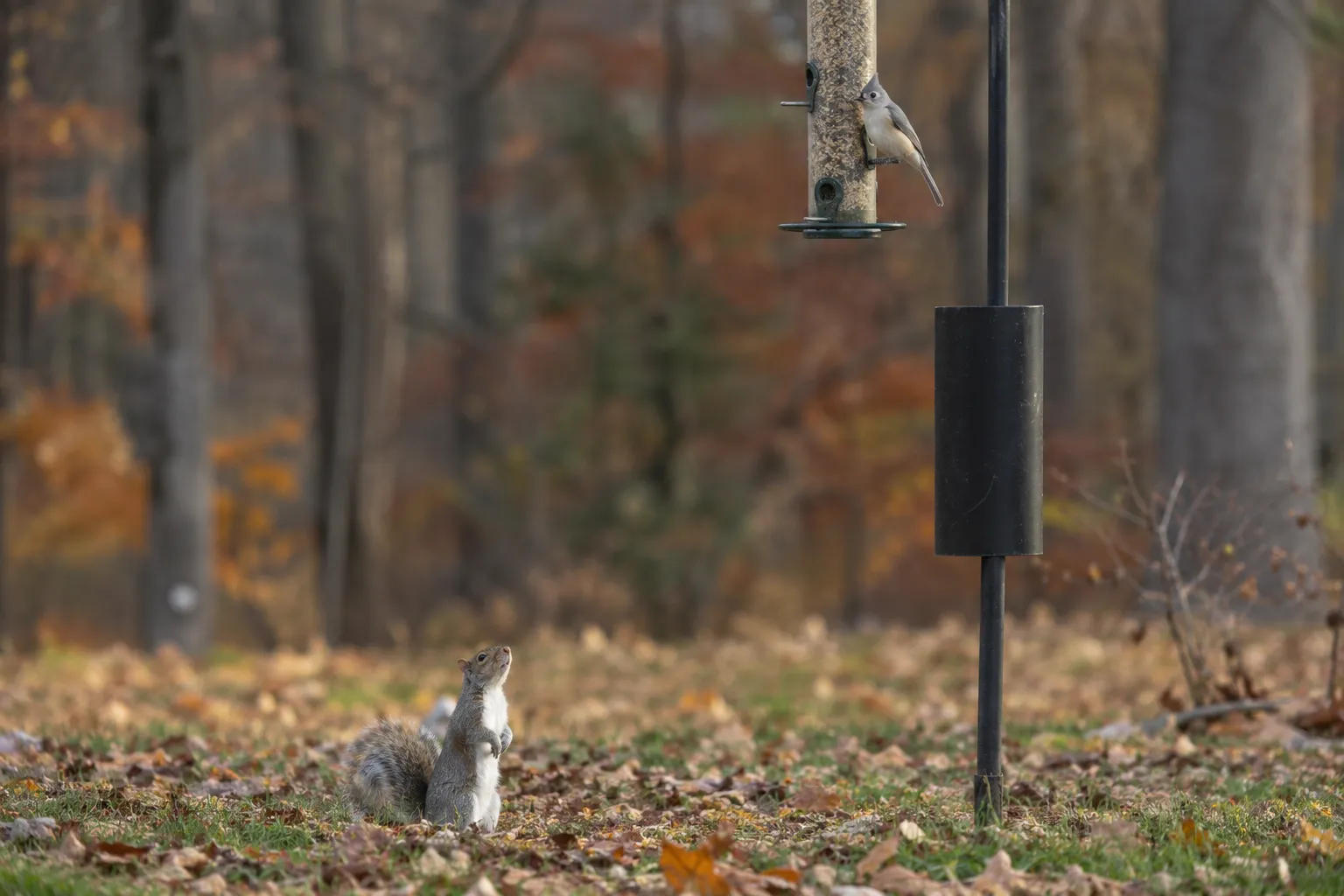
Squirrels are strong, agile and patient. They climb almost any surface with texture, including wood, brick, wooden posts and rough bark. They leap far, both up and across, and they drop onto feeders from branches above.
The numbers matter because every effective method is built around them. Mass Audubon notes that squirrels can jump about 6 feet straight up and launch themselves to a feeder about 10 feet away from a tree or building. The University of Nebraska-Lincoln Extension gives a vertical leap of up to 5 feet and advises keeping feeders at least 10 feet from any spot a squirrel can jump from, in any direction.
Squirrels are also persistent learners. A defense that holds for a week may fail once one squirrel figures it out. That is why the approaches that work rely on physics, distance and slick surfaces, not on scaring squirrels.
Step 1: Put the feeder where squirrels cannot jump to it
Location does most of the work. Before you buy anything, walk your yard and find a spot at least 10 feet from:
- Tree trunks and overhanging branches, including branches above the feeder
- Fences, deck railings and walls
- Roofs, sheds and gutters
- Patio furniture, grills and planters a squirrel can climb
A wild bird retailer’s guidance suggests 10 to 12 feet to be safe. Remember that trees grow, snow piles up under poles in winter, and new outdoor furniture appears. Recheck the spot each season.
Placement also matters to birds. Project FeederWatch recommends about 10 feet from cover as a good compromise between giving birds shelter and denying squirrels and cats a launch point, so the same spot tends to work for both goals. Our guide on where to put a bird feeder covers distance from windows and cover in more detail.
Step 2: Mount it on a smooth pole with a baffle
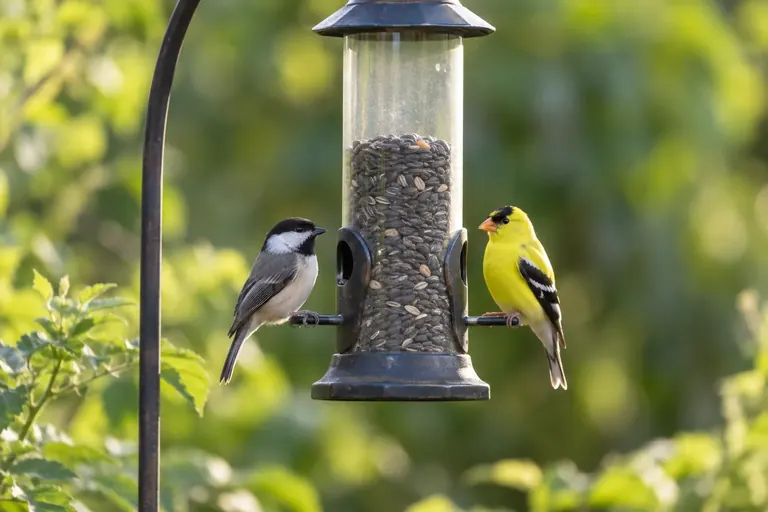
A smooth metal pole is harder to climb than wood, but squirrels can still shinny up many poles. The baffle is what stops them.
Project FeederWatch calls squirrel baffles “usually the best way to keep squirrels away” from seed. Two types exist.
Stovepipe or cylinder baffles
A cylinder, or stovepipe, baffle wraps around the pole below the feeder. A squirrel climbs up, reaches the open bottom of the tube, and has nothing to grip. Longer cylinders also stop raccoons, which can reach around shorter ones.
Placement: set the bottom of the baffle at least 4.5 to 5 feet above the ground, based on guidance from wild bird retailers. Lower than that and a squirrel can jump past it.
Cone or disk baffles
A cone or disk baffle mounts on the pole and flares out. It works if it is wide enough and high enough. Cones are also sometimes used under a feeder on a 4x4 post.
How to set up a pole and baffle correctly
- Pick the spot at least 10 feet from every launch point.
- Sink the pole deep enough to stay upright and not wobble. A leaning pole brings the feeder closer to launch points.
- Mount the baffle so its bottom edge sits at least 4.5 to 5 feet off the ground.
- Hang feeders above the baffle, not beside it. Feeders hanging from long arms that stick out past the baffle can be reached by a jumping squirrel.
- Check the ground under it. Planters, rocks or snowdrifts under the baffle raise the launch point.
Our squirrel baffles explained guide covers sizes and mounting, and our best bird feeder poles and baffles roundup compares complete systems.
Our baffle pick: Erva Cylindrical Baffle (Round Pole)
Erva makes this cylindrical baffle in the United States from galvanized steel with a black powder-coated finish. The squirrel version is 14.5 inches long, and a 28-inch raccoon version is also offered. It fits round poles from 0.5 to 1.75 inches in diameter, which covers most standard feeder poles. On paper, it is a simple, durable design, and cylinder baffles in general get strong marks in owner feedback when they are installed at the right height.
Skip it if: your feeder hangs from a tree. A pole baffle only works on a pole.
Step 3: If your feeder hangs from a tree, use a hanging baffle
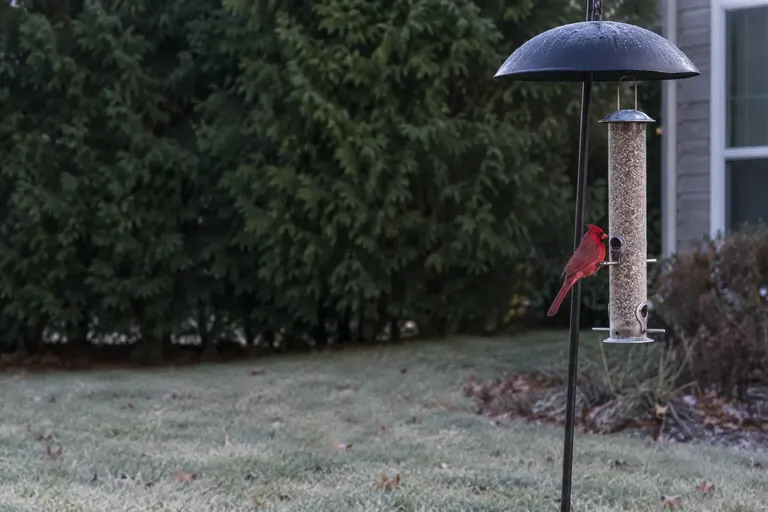
Sometimes a tree limb is the only option. In that case, put a wide dome baffle above the feeder to stop squirrels climbing down the hanger.
Guidance from a wild bird retailer suggests a hanging baffle at least 18 inches in diameter, with a 2 to 3 foot gap between the tree limb and the top of the baffle. That spacing makes it harder for a squirrel to drop past the dome.
The weak point is sideways jumping. If the feeder hangs within about 10 feet of the trunk or other branches, a squirrel can leap straight to it and skip the baffle. Hang it as far out on the limb as you can, and pair it with a weight-activated feeder.
The University of Nebraska-Lincoln Extension also describes stringing a horizontal wire between two supports and threading it through lengths of plastic tubing that spin when a squirrel steps on them. Keep the wire ends out of jumping range.
Step 4: Use a weight-activated squirrel-resistant feeder
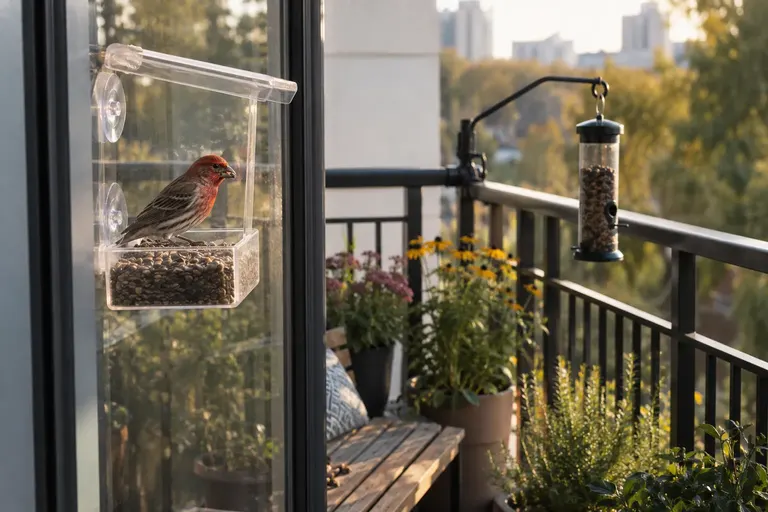
When distances will not cooperate, a weight-activated feeder is the next best tool. These feeders use a spring-loaded shroud or perch. A small bird’s weight does nothing. A squirrel’s weight pulls the shroud down over the feeding ports.
Our feeder pick: Brome Squirrel Buster Plus
The Squirrel Buster Plus is one of the best-known designs of this type. Brome lists a 5.1 lb seed capacity and a height of 28 inches from base to hanger. When a squirrel climbs on, its weight forces the outer shroud down to close access to the ports. A patented weight-adjustable spring lets you set how much weight triggers the closure, and a cardinal ring gives larger birds like cardinals a place to perch. The feeder comes apart by hand without tools for cleaning, and Brome offers lifetime care coverage.
Strengths: works close to trees and fences, adjustable for your birds, big capacity, easy to clean.
Drawbacks: squirrels still climb on and try, and heavier birds can close the ports at some settings.
Skip it if: you want jays, doves and other large birds to feed from the same feeder.
For more options, including hopper and tube designs, see our best squirrel-proof bird feeders.
What about caged feeders?
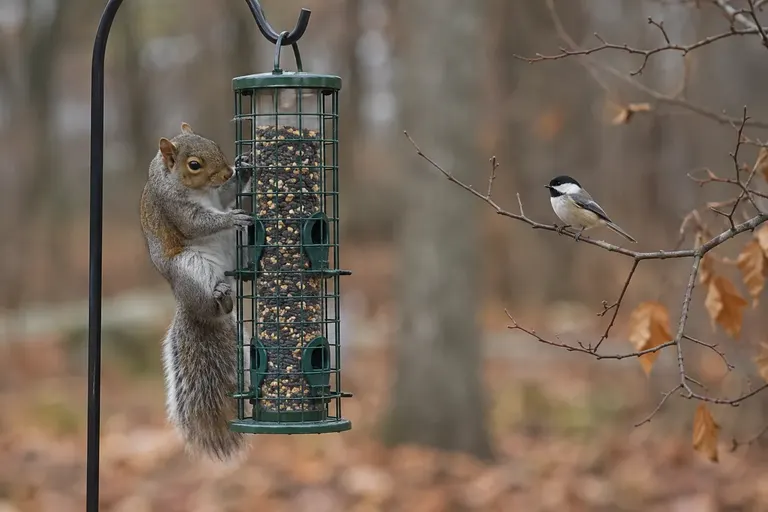
Caged feeders surround a tube feeder with a wire cage. Small birds like chickadees, titmice and finches slip through the openings, while squirrels cannot reach in. The catch is that the cage also keeps out cardinals, jays, woodpeckers and other larger birds. They work best as one feeder among several.
Step 5: Change the food
Food choice will not stop a determined squirrel on its own, but it can make your feeder much less appealing.
Safflower and nyjer
The University of Nebraska-Lincoln Extension recommends safflower and nyjer seed because they attract birds like cardinals, sparrows, doves and finches while discouraging squirrels. Safflower is a white seed with a bitter taste that squirrels and many blackbirds tend to avoid. Nyjer is tiny and served in small-port finch feeders. Read our guide to safflower seed and bird food squirrels won’t eat.
Hot pepper seed
Seed treated with capsaicin, the compound that makes chili peppers hot, is one of the more interesting options. Birds do not feel the burning sensation that mammals do, so they eat it normally. Squirrels feel the heat.
Clemson University’s Home and Garden Information Center reviewed this approach and found mixed results: some squirrels were deterred at first, then returned, and some seemed to develop a taste for it. The same review found squirrel baffles on feeder poles solved the problem more completely.
Handle hot pepper seed with care. Wear rubber gloves, avoid touching your face, watch for windblown pepper dust, and keep dogs away from residue below the feeder.
Our food pick: Cole’s Hot Meats
Cole’s Hot Meats is sunflower hearts infused with habanero chili and safflower oil. Because it is hulled, it leaves little mess under the feeder. Cole’s sells it in 5, 10, 20 and 40 lb bags and says it is popular with cardinals and bluebirds, along with finches, woodpeckers and chickadees. Owner reviews are mixed on squirrel results, which matches Clemson’s findings.
Skip it if: you have pets that forage under feeders, or you have a squirrel that already ignores the heat.
Step 6: Give squirrels their own food, far away
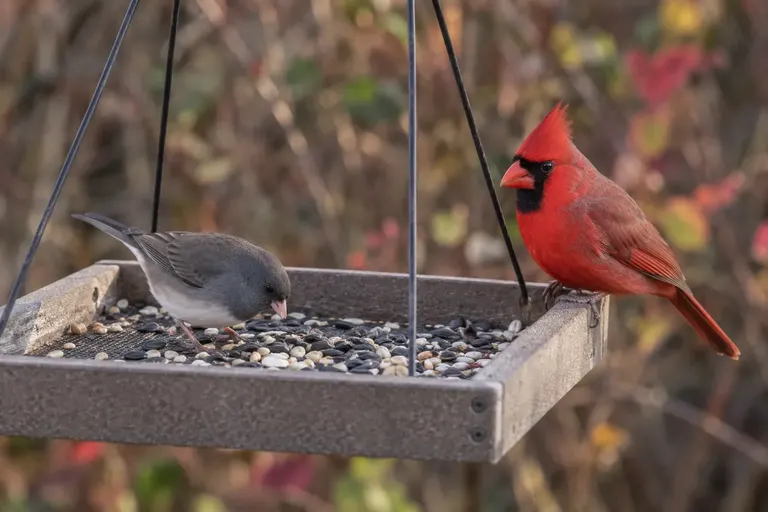
Project FeederWatch suggests distracting squirrels by feeding peanuts or dried ears of corn in a spot some distance from your bird feeders. Squirrels take the easier meal and spend less time working on your feeders.
This works best in bigger yards, and it has a downside: you are still feeding squirrels, which can keep more of them around. The University of Nebraska-Lincoln Extension discourages intentionally feeding squirrels, noting that it can promote disease and aggressive behavior. Decide based on your yard and your tolerance.
Which squirrels visit bird feeders?
Knowing your squirrel helps you choose the right defense, because size and habits differ.
- Eastern Gray Squirrels are the most common feeder raiders across much of the eastern United States and in many western cities where they have been introduced. They are agile jumpers and the main reason for the 10-foot rule.
- Fox Squirrels are larger and heavier than gray squirrels, and are common in the Midwest and parts of the South. Their weight makes weight-activated feeders close reliably, but they are strong enough to wreck flimsy plastic feeders.
- American Red Squirrels are small, fast and noisy, and live mostly in northern and mountain conifer forests. Because they are light, check that a weight-activated feeder’s spring is set sensitively enough to close for them.
- Flying squirrels are nocturnal and glide rather than jump. Many people never know they visit. If seed disappears overnight, a flying squirrel may be the reason, and taking feeders in at night solves it.
Whatever the species, the same physics applies: keep feeders out of jumping or gliding range and put a slick barrier in the path of climbers.
What does not work, or causes harm?
Grease, petroleum jelly and sticky coatings
Do not coat poles with grease, petroleum jelly, oil or sticky products. The University of Nebraska-Lincoln Extension warns that these mat the fur of squirrels and other wildlife and expose them to dangerous cold. Birds that touch them can foul their feathers.
Hot pepper sprays and powders you mix yourself
Home-mixed pepper powder blows around in the wind and can get into your eyes, your pets’ eyes and nearby birds’ eyes. If you want to use capsaicin, buy commercially treated seed.
Predator decoys and scare devices
Plastic owls and similar decoys are widely sold. Squirrels tend to get used to anything that never moves or changes. We found no strong evidence that decoys or ultrasonic devices keep squirrels off feeders over the long run.
Trapping and relocating
Rules on trapping and moving squirrels vary by state, and relocation often just opens space for new squirrels to move in. Check with your state wildlife agency before considering it.
What about chipmunks, raccoons and rats?
Other mammals come for the same seed:
- Raccoons raid feeders at night and can reach around short baffles. Use a longer cylinder baffle, like the 28-inch raccoon version described above, and consider taking feeders in overnight.
- Chipmunks and rats feed on spilled seed below feeders. Rake up waste regularly, use a seed catcher tray, or switch to hulled seed to reduce mess. See our best no-mess bird seed.
- Bears are a serious concern in some regions. Many wildlife agencies advise removing feeders entirely while bears are active.
Common mistakes when squirrel-proofing feeders
- Baffle too low. A baffle 3 to 4 feet up is a step for a squirrel, not a barrier.
- Pole too close to a launch point. An 8-foot gap is not enough. Measure 10 feet or more.
- Feeder arms that stick out past the baffle. Squirrels jump to the arm and skip the baffle.
- Ignoring the canopy. A branch 6 feet above the feeder is a drop-down route.
- Cheap, thin hanging baffles. Small domes let squirrels reach around them.
- Overfilling platform trays. Spilled seed draws squirrels to the base of the pole, where they keep testing your defenses.
- Giving up after one failure. Find exactly how the squirrel gets on, then fix that route.
How to figure out how a squirrel is getting on
If squirrels still reach the feeder, watch for a morning and look for:
- A jump from the side. Measure the distance to the closest fence, branch or roofline.
- A drop from above. Look up for branches.
- A climb past the baffle. Check whether the baffle wobbles, tilts or sits too low.
- A leap from the ground. Measure the height of the bottom of the baffle.
- A ladder you did not notice. Planters, grills, snow or bird baths near the pole all help.
Fix the route you find and watch again. Most setups need one or two adjustments before they hold.
Sources
- Feeding Birds: Squirrels (Project FeederWatch)
- Feeder Placement (Project FeederWatch)
- Bird Feeding Best Practices (Mass Audubon)
- Preventing Conflicts With Tree Squirrels (University of Nebraska-Lincoln)
- Too Hot to Handle: My Review of Spicy Bird Seed (Clemson HGIC)
- Squirrel Buster Plus (Brome)
- Cylindrical Baffle, Round Pole (Erva)
- Hot Meats (Cole’s Wild Bird Products)
Gear mentioned in this guide
Brome Squirrel Buster Plus
A weight-activated tube feeder whose shroud drops to close the ports when a squirrel climbs on, with an adjustable spring and tool-free disassembly for cleaning.
- Best for
- Yards where you cannot get a feeder 10 feet from every launch point.
- Skip it if
- You want to feed large birds like jays and doves, which can be heavy enough to close some settings.
- Seed capacity
- 5.1 lb
- Height
- 28 in, base to hanger
- Mechanism
- Weight-adjustable spring
Erva Cylindrical Baffle (Round Pole)
A US-made galvanized steel stovepipe-style baffle with a powder-coated finish, sold in a squirrel length and a longer raccoon length.
- Best for
- Pole-mounted feeders that already sit at least 10 feet from trees, fences and roofs.
- Skip it if
- Your feeder hangs from a tree; a pole baffle cannot help there.
- Length
- 14.5 in (squirrel) or 28 in (raccoon)
- Fits poles
- 0.5 to 1.75 in round
- Material
- Galvanized steel, powder coat
Cole's Hot Meats
Sunflower hearts coated with habanero chili; birds do not feel the heat, while many squirrels are put off after a taste.
- Best for
- Feeders you cannot baffle, such as window or railing feeders.
- Skip it if
- You have dogs that nose around under the feeder, or your squirrels have already learned to tolerate the heat.
- Ingredients
- Sunflower meats, habanero chili, safflower oil
- Bag sizes
- 5, 10, 20 and 40 lb
Frequently asked questions
What is the best way to keep squirrels off a bird feeder?
Put the feeder on a smooth metal pole at least 10 feet from trees, fences, roofs and anything else a squirrel can jump from, then add a baffle with its bottom edge at least 4.5 to 5 feet off the ground. Project FeederWatch calls baffles usually the best way to keep squirrels away, but they only work when the jump distances are right.
How far can a squirrel jump to a bird feeder?
Mass Audubon notes squirrels can jump about 6 feet straight up and launch themselves to a feeder about 10 feet away. The University of Nebraska-Lincoln Extension cites a vertical leap of up to 5 feet. Plan on at least 10 feet of clearance sideways and a baffle at least 4.5 to 5 feet up the pole.
Does hot pepper bird seed hurt birds?
No. Birds do not experience capsaicin as a burning sensation the way mammals do, so they eat pepper-treated seed normally. Clemson University's Home and Garden Information Center notes that squirrel results vary, and some squirrels return or tolerate it over time. Wear gloves when handling it and keep it away from your eyes.
Is it safe to put Vaseline or grease on a bird feeder pole?
No. The University of Nebraska-Lincoln Extension warns against sticky substances, petroleum jelly, grease or oil on poles, because they mat the fur of squirrels and other wildlife and expose them to cold. The same products can foul birds' feathers. Use a baffle instead.
What bird seed do squirrels not like?
Safflower and nyjer are the two seeds squirrels are least interested in, according to the University of Nebraska-Lincoln Extension. Safflower still attracts cardinals, chickadees, titmice and doves, and nyjer draws goldfinches. Seed treated with hot pepper is another option. Squirrels may still sample these foods when they are hungry.