Best Suet Feeders
The best suet feeder for most yards is an upside-down design like the Birds Choice Upside Down: woodpeckers and nuthatches feed easily, starlings struggle.
If you buy through links on this page we may earn a commission, at no cost to you. It never decides what we recommend. How we earn
In this article
- Quick picks
- How we chose
- Birds Choice Upside Down Suet Feeder: best overall
- Birds Choice Pileated Suet Feeder with Tail Prop: best for big woodpeckers
- Brome Squirrel Buster Suet: best squirrel-proof
- More Birds Two Cake Suet Buffet: best double cage
- Stokes Select Squirrel Proof Double Suet Feeder: best for small birds only
- Heath S-1-8 Single Suet Feeder: best budget
- Suet feeder comparison table
- What type of suet feeder is best?
- Suet cakes, plugs, balls or logs: which format should you use?
- Which birds come to suet feeders?
- Is suet safe for birds in summer?
- Where should you hang a suet feeder?
- How to clean a suet feeder
- Common mistakes with suet feeders
- The bottom line
- Sources
- Frequently asked questions
The best suet feeder for most backyards is an upside-down design, and the Birds Choice Upside Down Suet Feeder is the one we would start with. Woodpeckers, nuthatches and chickadees cling underneath and feed easily, while starlings struggle. If squirrels are your problem instead, the Brome Squirrel Buster Suet closes up under their weight. For big woodpeckers, the Birds Choice Pileated Suet Feeder with Tail Prop gives them room to brace against its 9.5-inch tail prop.
Suet is the single best food for bringing woodpeckers to a yard, especially in winter. The feeder you choose mostly decides who else gets to eat it.
Quick picks
- Best overall: Birds Choice Upside Down Suet Feeder. Starling-resistant, recycled plastic, made in USA.
- Best for big woodpeckers: Birds Choice Pileated Suet Feeder with Tail Prop. Two cakes and a 9.5-inch tail prop.
- Best squirrel-proof: Brome Squirrel Buster Suet. Weight-activated shroud, two cakes.
- Best double cage: More Birds Two Cake Suet Buffet. Simple steel cage with a roof.
- Best for small birds only: Stokes Select Squirrel Proof Double Suet Feeder. Outer cage keeps big birds out.
- Best budget: Heath S-1-8 Single Suet Feeder. The classic basket.
Birds Choice Upside Down Suet Feeder (Single Cake)
A recycled-plastic box that offers suet only from below, which clinging birds handle easily and starlings do not.
- Best for
- Yards where starlings or grackles hog the suet.
- Skip it if
- You want the fastest possible suet turnover for many woodpeckers.
- Capacity
- 1 suet cake
- Outside size
- 7.75 x 8.75 x 4.25 in
- Weight
- 2 lb
- Made in
- USA
Birds Choice Pileated Suet Feeder with Tail Prop
A tall two-cake feeder with a long tail prop that lets large woodpeckers brace the way they do on a tree trunk.
- Best for
- Wooded yards with Pileated, Red-bellied or Hairy Woodpeckers and Northern Flickers.
- Skip it if
- Starlings are a problem, since the open cage faces are easy for them to use.
- Capacity
- 2 suet cakes
- Size
- 8 x 3 x 22.5 in
- Tail prop
- 9.5 in
- Weight
- 2.5 lb
Brome Squirrel Buster Suet
A weight-activated shroud closes the feeding ports when a squirrel climbs on, and the spring tension is adjustable.
- Best for
- Yards where squirrels steal whole suet cakes.
- Skip it if
- You mainly want to deter starlings, which are light enough to feed normally.
- Capacity
- 2 suet cakes
- Mechanism
- Weight-activated shroud
- Warranty
- Brome Lifetime Care
More Birds Two Cake Suet Buffet with Weather Guard
A simple powder-coated steel cage for two cakes, with a shingle-style roof that sheds rain and snow.
- Best for
- Yards with several woodpeckers and wrens that empty a single cake too fast.
- Skip it if
- Starlings visit, since the open cage suits them as well as woodpeckers.
- Capacity
- 2 suet cakes
- Size
- 7 x 5 x 6.75 in
- Material
- Powder-coated steel
Stokes Select Squirrel Proof Double Suet Feeder
Two suet cakes sit inside an outer wire cage with 1.5-inch openings that let small birds through but keep squirrels and large birds out.
- Best for
- Downy Woodpeckers, chickadees, nuthatches and wrens in yards overrun by starlings or squirrels.
- Skip it if
- You want to feed larger woodpeckers such as Red-bellied or Pileated.
- Capacity
- 2 suet cakes
- Size
- 9.5 in wide, 11 in tall
- Cage openings
- 1.5 in
- Weight
- 1.95 lb
Heath S-1-8 Single Suet Feeder
The classic vinyl-coated wire suet basket for one standard cake.
- Best for
- Trying suet for the first time, or adding extra feeders cheaply.
- Skip it if
- Starlings, grackles or squirrels are regulars.
- Capacity
- 1 suet cake
- Weight
- 0.25 lb
- Material
- Vinyl-coated metal
How we chose
We have not hung these feeders ourselves, so this roundup is research-led. We compared manufacturer specifications for capacity, size, materials and weight, and confirmed each model is currently listed by its maker or major specialty retailers. We looked for patterns in verified owner feedback about starlings, squirrels, rust and durability. We also used Cornell Lab of Ornithology guidance on which birds eat suet, how starlings feed, and when suet becomes unsafe.
We ranked designs by how well they solve the problems that frustrate most suet feeders: starlings emptying the feeder, squirrels stealing whole cakes, and cakes getting soaked.
Birds Choice Upside Down Suet Feeder: best overall
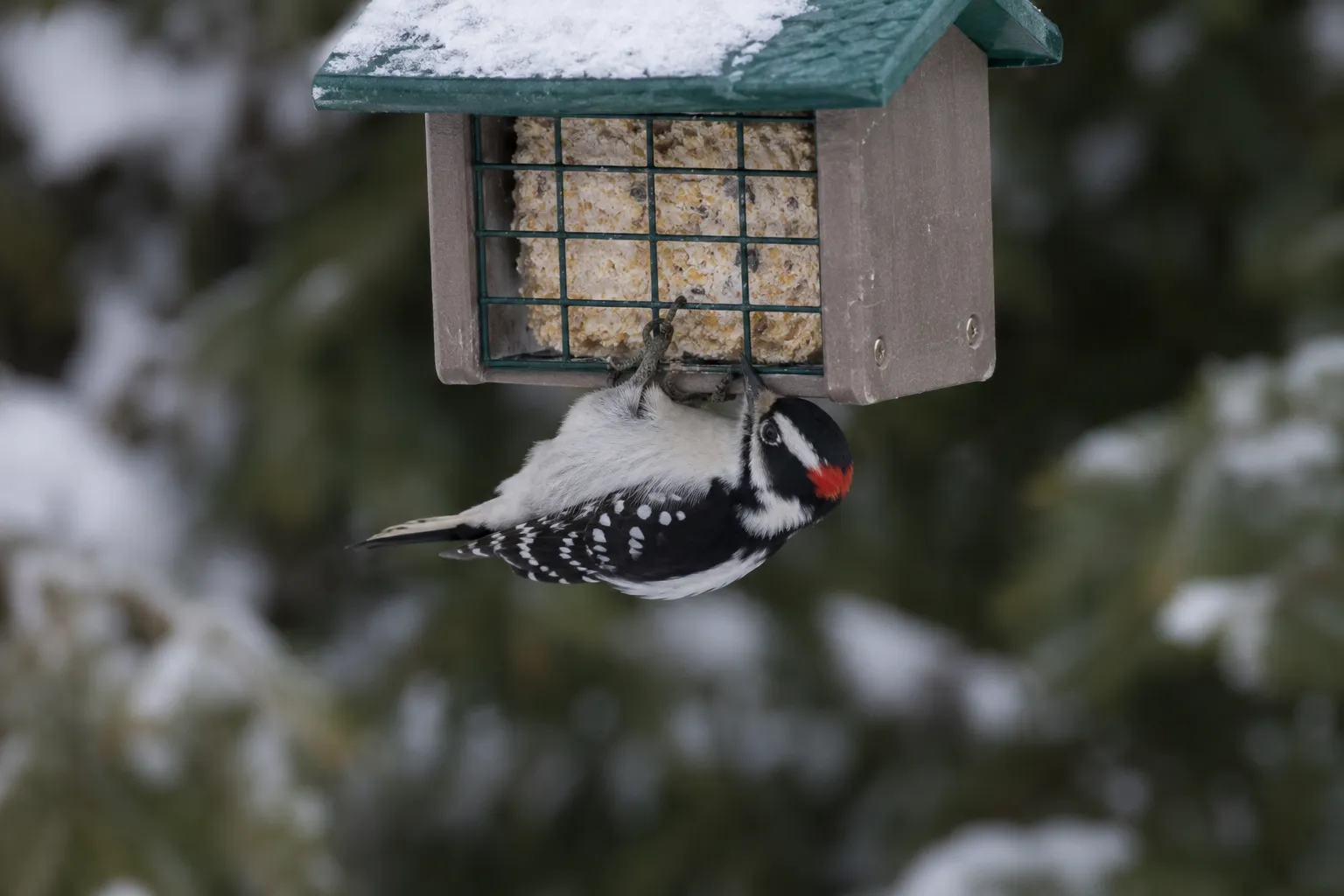
This feeder is a recycled-plastic box with a roof on top and a vinyl-coated grid on the bottom. The suet cake sits inside facing down. Birds have to cling to the grid and feed upside down.
Who it suits: Almost every yard east of the Rockies, and anywhere European Starlings show up in flocks.
Key specs: Holds one suet cake. Outside dimensions 7.75 by 8.75 by 4.25 inches, inside 4.625 by 5 by 2 inches. Recycled poly lumber with a vinyl-coated grid and stainless steel screws. Weighs 2 lb and comes with a 12-inch hanging cable. Made in the USA.
Strengths:
- Cornell Lab’s All About Birds notes that woodpeckers, chickadees and nuthatches can feed hanging upside down easily, but starlings cannot.
- The solid top acts as a roof, keeping rain and sun off the cake.
- Birds Choice guarantees its recycled poly lumber never to crack, split or fade.
Drawbacks: Owners commonly report that determined starlings sometimes learn to snatch a bite from below, so it resists them rather than blocking them completely. Birds feed more slowly than at an open cage, and first-time visitors may take a while to figure it out.
Skip it if: You have no starling problem and want several woodpeckers feeding at once.
Birds Choice Pileated Suet Feeder with Tail Prop: best for big woodpeckers
Woodpeckers brace on their stiff tail feathers when they climb trees. Small suet cages give a large woodpecker nowhere to put its tail, so it feeds awkwardly or not at all. This feeder solves that with a long vertical body and a 9.5-inch tail prop below the suet.
Who it suits: Wooded yards that host Pileated Woodpeckers, Red-bellied and Hairy Woodpeckers or Northern Flickers.
Key specs: Holds two suet cakes stacked vertically. 8 by 3 by 22.5 inches (29 inches with cable), interior 4.5 by 1.75 by 9.25 inches. Recycled poly lumber, vinyl-coated grid, stainless steel screws. Weighs 2.5 lb. Made in the USA.
Strengths:
- The tail prop lets big birds feed in a natural, stable posture.
- Two cakes last longer with large birds that eat a lot.
- The vertical layout suits the way woodpeckers naturally work a trunk.
Drawbacks: At 22.5 inches tall it needs a sturdy hook with clearance below. Both faces of the cage are open, so starlings can feed. It is one of the pricier suet feeders.
Skip it if: You mainly see small Downy Woodpeckers and chickadees; a compact cage will do.
Brome Squirrel Buster Suet: best squirrel-proof
Brome’s Squirrel Buster line uses a spring-loaded outer shroud. Openings in the shroud line up with the feeding ports. When a squirrel climbs on, its weight pulls the shroud down and closes the ports. Birds are too light to trigger it.
Who it suits: Yards where squirrels carry off entire suet cakes, which is common with standard cages.
Key specs: Holds two suet cakes. Weight-adjustable spring mechanism, chew-proof materials, UV-resistant parts, crumb ports that let birds reach fallen bits. It comes apart by hand for cleaning. Brome recommends 18 inches of clearance around the feeder and covers it with its Lifetime Care program.
Strengths:
- The adjustable spring lets you set how much weight closes the ports.
- Brome describes loading as mess-free, which helps with greasy cakes.
- Tool-free disassembly for cleaning.
Drawbacks: It is the most expensive feeder here by a wide margin. Starlings are light enough to feed normally, so it does nothing about them. It needs open space around it so squirrels cannot reach from a branch or rail.
Skip it if: Starlings, not squirrels, are your main problem. For squirrel strategy in general, see how to keep squirrels off bird feeders.
More Birds Two Cake Suet Buffet: best double cage
A no-frills powder-coated steel cage that holds two cakes side by side, with a shingle-patterned roof to shed rain and snow. Double cages are useful when woodpeckers, wrens and nuthatches drain a single cake too fast.
Who it suits: Yards with lots of suet eaters and few starlings.
Key specs: Holds two cakes, 7 by 5 by 6.75 inches, steel with a weather-resistant brown powder-coated finish, model 38070. The maker lists woodpeckers, nuthatches, chickadees, Carolina Wrens and Tufted Titmice as typical visitors.
Strengths:
- The roof keeps cakes drier than a bare basket.
- Two cakes mean fewer refills in cold weather.
- The grid is designed for clinging birds.
Drawbacks: Open cage faces are easy for starlings and squirrels to use. Powder coating can chip over years, and bare steel can then rust.
Skip it if: Starlings arrive in groups. An upside-down or caged design will serve you better; see our guide to keeping starlings and grackles off feeders.
Stokes Select Squirrel Proof Double Suet Feeder: best for small birds only
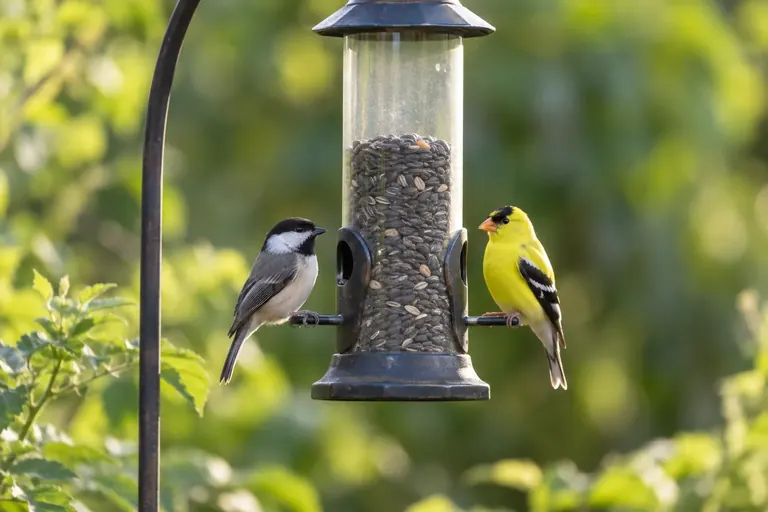
This feeder puts the suet inside an outer wire cage. Small birds fly through 1.5-inch openings to reach the cakes. Squirrels and large birds, including starlings and grackles, cannot reach far enough in.
Who it suits: Yards where you want to reserve suet for Downy Woodpeckers, chickadees, nuthatches, titmice and wrens.
Key specs: Holds two cakes. 9.5 inches across, 11 inches tall, 1.95 lb. All-metal with a weather-resistant finish and a lockable roof.
Strengths:
- One of the few designs that deters squirrels and large birds at the same time.
- The roof locks closed, so the cakes stay put inside the cage.
- Two cakes inside mean fewer refills.
Drawbacks: It also excludes larger woodpeckers you might want, such as Red-bellied and Hairy Woodpeckers and flickers. Refilling takes more steps than a simple cage.
Skip it if: Your goal is big woodpeckers.
Heath S-1-8 Single Suet Feeder: best budget
The vinyl-coated wire basket that most people picture when they hear “suet feeder.” It holds one standard cake, and birds can feed from all sides.
Who it suits: First-time suet feeders and anyone adding extra suet stations cheaply.
Key specs: One standard suet or seed cake, vinyl-coated metal cage, about 0.25 lb.
Strengths:
- Very inexpensive.
- Light enough to hang from a small branch or shepherd’s hook arm.
- Easy to hang against a tree trunk with a nail or wire, where woodpeckers already forage.
Drawbacks: No protection from starlings, squirrels or weather. Owners often mention that the vinyl coating wears through where birds grip and squirrels chew, leading to rust over time.
Skip it if: You already have starlings, grackles or squirrels visiting.
Suet feeder comparison table
| Feeder | Cakes | Size (in) | Material | Starling resistant | Squirrel resistant | Made in USA |
|---|---|---|---|---|---|---|
| Birds Choice Upside Down | 1 | 7.75 x 8.75 x 4.25 | Recycled plastic | Yes | No | Yes |
| Birds Choice Pileated Tail Prop | 2 | 8 x 3 x 22.5 | Recycled plastic | No | No | Yes |
| Brome Squirrel Buster Suet | 2 | Not listed | Plastic, metal | No | Yes | Not stated |
| More Birds Two Cake Buffet | 2 | 7 x 5 x 6.75 | Powder-coated steel | No | No | Not stated |
| Stokes Select Double Caged | 2 | 9.5 wide x 11 tall | Metal | Yes | Yes | Not stated |
| Heath S-1-8 | 1 | Not listed | Vinyl-coated metal | No | No | Not stated |
What type of suet feeder is best?
There are four main designs, and each answers a different problem.
Simple cage
A wire basket for one or two cakes. Cheap and easy for every bird to use, which is the drawback: starlings, grackles and squirrels use it too.
Upside-down feeder
Suet faces the ground, and birds must cling below. Cornell Lab recommends this style specifically to discourage starlings. Woodpeckers, nuthatches and chickadees adapt quickly.
Tail-prop feeder
A taller cage with a board below that supports a woodpecker’s tail. It matters most for large species such as Pileated and Red-bellied Woodpeckers and Northern Flickers, which feed awkwardly on small cages.
Caged or weight-activated feeder
Either an outer cage that only small birds can pass through, or a spring shroud that closes under a squirrel’s weight. These are the answers when squirrels or large birds dominate.
Suet cakes, plugs, balls or logs: which format should you use?
Almost every feeder in this guide takes the standard square suet cake, which is the easiest format to find and to load. It is not the only option, and the format affects which feeder you need.
- Square cakes fit standard cages, upside-down feeders and most squirrel-resistant designs. They are the default choice.
- Suet plugs are cylinders that fit into drilled holes in a log-style feeder. A hanging log imitates a tree trunk, so woodpeckers and nuthatches take to it naturally, and the small holes limit how much any one bird can grab.
- Suet balls go in round mesh or wire holders. They are popular in Europe and increasingly common in the US. Avoid any sold in plastic mesh bags, which can trap birds’ feet and tongues.
- Suet pellets and nuggets are small bits served from a tube or tray. They are handy for bluebirds and wrens but disappear fast when starlings find them.
Whatever the format, check the ingredients. Rendered beef fat should be first, and plain or insect-based blends attract woodpeckers without drawing as many starlings as cheap seed-heavy cakes.
How many suet feeders do you need?
One is enough to start. Add a second once you see birds waiting their turn, or if a dominant woodpecker chases others away. Hanging a small cage and an upside-down feeder in different parts of the yard lets you compare which design your local birds prefer.
Which birds come to suet feeders?
Cornell Lab lists woodpeckers, nuthatches, chickadees and jays as the core suet eaters. Wrens, creepers, kinglets, cardinals and some warblers also visit. In most eastern yards, expect Downy Woodpeckers first, followed by Red-bellied Woodpeckers, White-breasted Nuthatches, chickadees, Tufted Titmice and Carolina Wrens. Hairy Woodpeckers and Northern Flickers are common but more wary. Pileated Woodpeckers visit mainly in yards with mature woods nearby.
European Starlings are also enthusiastic suet eaters. They are not native to North America and often arrive in groups large enough to empty a cake in an afternoon.
Is suet safe for birds in summer?
It depends on the suet. Cornell Lab warns that raw suet from the butcher goes rancid quickly once temperatures rise above freezing, so it should be offered only in winter. Rendered suet, which has been melted to remove impurities, keeps better but can still soften in heat. Soft suet can coat birds’ belly feathers, and Cornell Lab notes it may even affect eggs during incubation.
For warm months:
- Use commercial rendered suet cakes or “no-melt” suet dough.
- Hang the feeder in shade.
- Buy small amounts and replace any cake that softens, smells off or shows mold.
- Choose a feeder with a roof to keep sun off the cake.
Cornell Lab also suggests refrigerating suet cakes that contain corn, cornmeal or peanuts until use. For picks, see our guide to the best suet cakes and suet blends.
Where should you hang a suet feeder?
Woodpeckers and nuthatches forage on trunks and large limbs, so meet them there:
- On or near a tree trunk. A feeder hung against a trunk, or from a limb a few feet from it, is found much faster than one in the open lawn.
- At a comfortable height for you to refill, typically eye level.
- In shade in warm months, and in some sun in winter.
- Away from jumping points if squirrels are a problem: well away from branches, fences and roofs, ideally on a baffled pole.
In winter, suet becomes one of the most valuable foods you can offer. Our guide to winter bird feeding explains why fat matters so much in cold weather.
How to clean a suet feeder
Suet feeders need less frequent cleaning than seed or nectar feeders, but grease and old crumbs build up.
- Remove any leftover cake, especially if it is soft, moldy or smells rancid.
- Scrape grease off the grid with a stiff brush.
- Scrub with hot, soapy water. Hot water matters, because cold water will not cut the fat.
- Every week or two during heavy use, soak in a 1 to 9 bleach-to-water solution, as Project FeederWatch recommends for feeders generally.
- Rinse thoroughly and let dry before adding a fresh cake.
Common mistakes with suet feeders
- Hanging it in the open lawn. Woodpeckers want trunks. Move it closer to trees.
- Leaving soft suet out in summer heat. Replace it quickly or switch to no-melt dough.
- Using an open cage when starlings are around. You will go through cakes in hours.
- Buying suet loaded with cheap seed and corn. It attracts starlings and grackles more than woodpeckers.
- Ignoring a tail prop for big birds. Large woodpeckers feed more comfortably, and longer, with support.
The bottom line
Start with the Birds Choice Upside Down Suet Feeder if you have starlings, or expect them. Choose the Brome Squirrel Buster Suet if squirrels steal your cakes, and the Birds Choice Pileated Tail Prop feeder if big woodpeckers live nearby. For a quick, cheap start, the Heath basket still works in yards with no pests.
Sources
Frequently asked questions
What is the best way to keep starlings off a suet feeder?
Use an upside-down suet feeder, which only exposes suet on the bottom face. Cornell Lab notes that woodpeckers, chickadees and nuthatches feed this way easily while starlings cannot manage it well. A cage-within-a-cage design with openings of about 1.5 inches also blocks starlings. Pure suet without seed or corn is less attractive to them too.
Can you put out suet in the summer?
You can offer rendered suet or no-melt suet dough in warm weather, but not raw suet. Cornell Lab warns that raw suet goes rancid quickly above freezing, and soft suet can coat belly feathers. Hang summer suet in shade, buy small quantities and replace any cake that softens, smells off or grows mold.
Which birds eat from suet feeders?
Woodpeckers, nuthatches, chickadees and jays are the main suet eaters, according to Cornell Lab. Titmice, Carolina Wrens, Brown Creepers, kinglets, some warblers and even Northern Cardinals visit occasionally. European Starlings also love suet, which is why feeder design matters so much for who gets fed.
Why is no bird eating from my new suet feeder?
Birds can take days or weeks to find a new suet feeder. Hang it on or near a tree trunk, where woodpeckers and nuthatches already forage, rather than in open lawn. Make sure the suet is fresh, not rancid. Winter is the busiest season, so a feeder put up in spring may be quiet until the weather turns cold.
Do suet feeders need a roof?
A roof helps. It keeps rain and melting snow off the cake, which slows spoilage, and it shades suet in warmer months. It is not essential for winter suet in cold, dry climates, but in wet areas a covered feeder keeps cakes usable noticeably longer.