Best Bird Feeder Pole System to Stop Squirrels and Raccoons
The best bird feeder pole system pairs a rigid steel pole with a proper baffle and smart placement. See our research-based picks for squirrels and raccoons.
If you buy through links on this page we may earn a commission, at no cost to you. It never decides what we recommend. How we earn
In this article
- Quick picks
- How we chose
- What makes a good bird feeder pole system?
- Squirrel Stopper Deluxe: best overall pole system
- Kettle Moraine Pole Set with Raccoon Baffle: best for raccoons
- Erva Multi-Arm Pole System: best heavy-duty pole
- Woodlink 18-Inch Wrap Around Squirrel Baffle: best cone baffle for round poles
- Woodlink Torpedo Raccoon Baffle: best raccoon baffle add-on
- Woodlink 22-Inch Wrap Around 4x4 Post Baffle: best for 4x4 posts
- Droll Yankees Dome Squirrel and Weather Guard: best hanging dome baffle
- Comparison table
- Cone vs cylinder vs dome: which baffle do you need?
- How tall should a bird feeder pole be?
- How to set up a feeder pole so squirrels cannot win
- Common mistakes with poles and baffles
- Do bird feeder poles help with hawks and other problems?
- Sources
- Frequently asked questions
The best bird feeder pole system is a rigid steel pole, a baffle long or wide enough for the animals you actually have, and a spot 8 to 10 feet from anything a squirrel can jump from. Based on specs and owner feedback, the Squirrel Stopper Deluxe is the most complete all-in-one option, while the Kettle Moraine pole package with its 28-inch raccoon baffle is the one to get if raccoons raid your feeders at night.
Poles and baffles are unglamorous, but they are the single biggest fix for squirrel problems. A decent feeder on a well-placed, baffled pole will usually outperform a pricey “squirrel-proof” feeder hanging from a tree.
Quick picks
- Best overall pole system: Squirrel Stopper Deluxe. Spring-mounted baffle, auger anchor, up to eight feeders.
- Best for raccoons: Kettle Moraine Pole Set with Raccoon Baffle. A 28-inch cylinder baffle and a 20-inch ground socket.
- Best heavy-duty pole: Erva Multi-Arm Pole System. US-made 16-gauge steel in two to four arm versions.
- Best cone baffle for round poles: Woodlink 18-Inch Wrap Around Baffle. Adds protection without removing feeders.
- Best raccoon baffle add-on: Woodlink Torpedo Raccoon Baffle. 28 inches tall.
- Best for 4x4 posts: Woodlink 22-Inch Wrap Around 4x4 Post Baffle.
- Best hanging dome baffle: Droll Yankees Dome Squirrel and Weather Guard, 15 inches.
Squirrel Stopper Deluxe Pole System
A heavy-duty steel pole with a spring-mounted baffle that wobbles when a squirrel grabs it, plus a screw-in auger and room for up to eight feeders.
- Best for
- Busy feeding stations with several feeders and persistent squirrels.
- Skip it if
- You want a simple one-feeder pole or have very rocky soil.
- Total height
- 8 ft
- Feeders
- Up to 8
- Anchor
- Screw-in ground auger
Kettle Moraine Pole Set with Raccoon Baffle
A 1-inch steel pole with a 28-inch galvanized raccoon baffle and a 20-inch twist-in ground socket, available with two to four arms.
- Best for
- Yards where raccoons climb poles at night.
- Skip it if
- You plan to hang heavy feeders at the ends of the arms in windy, soft ground.
- Height to hooks
- 84 in
- Raccoon baffle
- 28 in long, 6.25 in wide
- Ground socket
- Twists 20 in into soil
Erva Multi-Arm Pole System
A US-made 16-gauge steel pole in two to four arm versions, with a 20-inch twist-in socket and an optional extended-reach arm set.
- Best for
- People who have bent cheap poles and want something that stays straight.
- Skip it if
- You want a single-package squirrel solution with the baffle already specified.
- Height
- 90 in above ground
- Ground socket
- 20 in twist-in
- Arm reach
- About 12 in, or 22 in extended
Woodlink 18-Inch Wrap Around Squirrel Baffle
A wide steel cone that wraps around an existing pole, so you can add a baffle without taking your feeders down.
- Best for
- Adding squirrel protection to a pole you already own.
- Skip it if
- Raccoons are the problem, since they can reach around a cone.
- Size
- 18 in diameter, 7 in tall
- Fit
- Wraps around existing poles
Woodlink Torpedo Raccoon Baffle
A long cylinder baffle that is too tall for a raccoon to reach over and too smooth to climb.
- Best for
- Upgrading a pole that squirrels and raccoons both climb.
- Skip it if
- Your pole is shorter than about 7 feet above ground.
- Size
- 7.75 in diameter, 28 in tall
Woodlink 22-Inch Wrap Around 4x4 Post Baffle
An extra-wide cone sized for square wooden posts, which standard round-pole baffles do not fit.
- Best for
- Wooden post feeding stations and bird house posts.
- Skip it if
- You use a round metal pole.
- Size
- 22 in diameter, 7.6 in tall
- Fit
- 4x4 wooden posts
Droll Yankees Dome Squirrel and Weather Guard
A 15-inch dome that hangs above a feeder to block squirrels dropping from branches and keep rain off seed.
- Best for
- Feeders hung from a tree branch or wire.
- Skip it if
- Squirrels can jump onto the feeder from the side.
- Diameter
- 15 in
- Mounting
- Hangs above feeder
How we chose
We have not installed or tested these poles and baffles ourselves. This guide is based on research. We compared manufacturer specifications, including pole height, wall thickness, anchoring method and baffle dimensions, using each maker’s own product pages or a specialist retailer where the maker did not publish full specs. We checked that each product is currently listed for sale.
We weighted the features that matter most in practice: baffle length and diameter, how the pole is anchored, whether a baffle can be added to an existing pole, and whether the system suits squirrels, raccoons or both. We also looked for repeated themes in verified owner reviews, such as leaning poles, rust, and baffles that squirrels learned to beat. Placement guidance comes from baffle manufacturers and specialist bird-feeding retailers.
What makes a good bird feeder pole system?
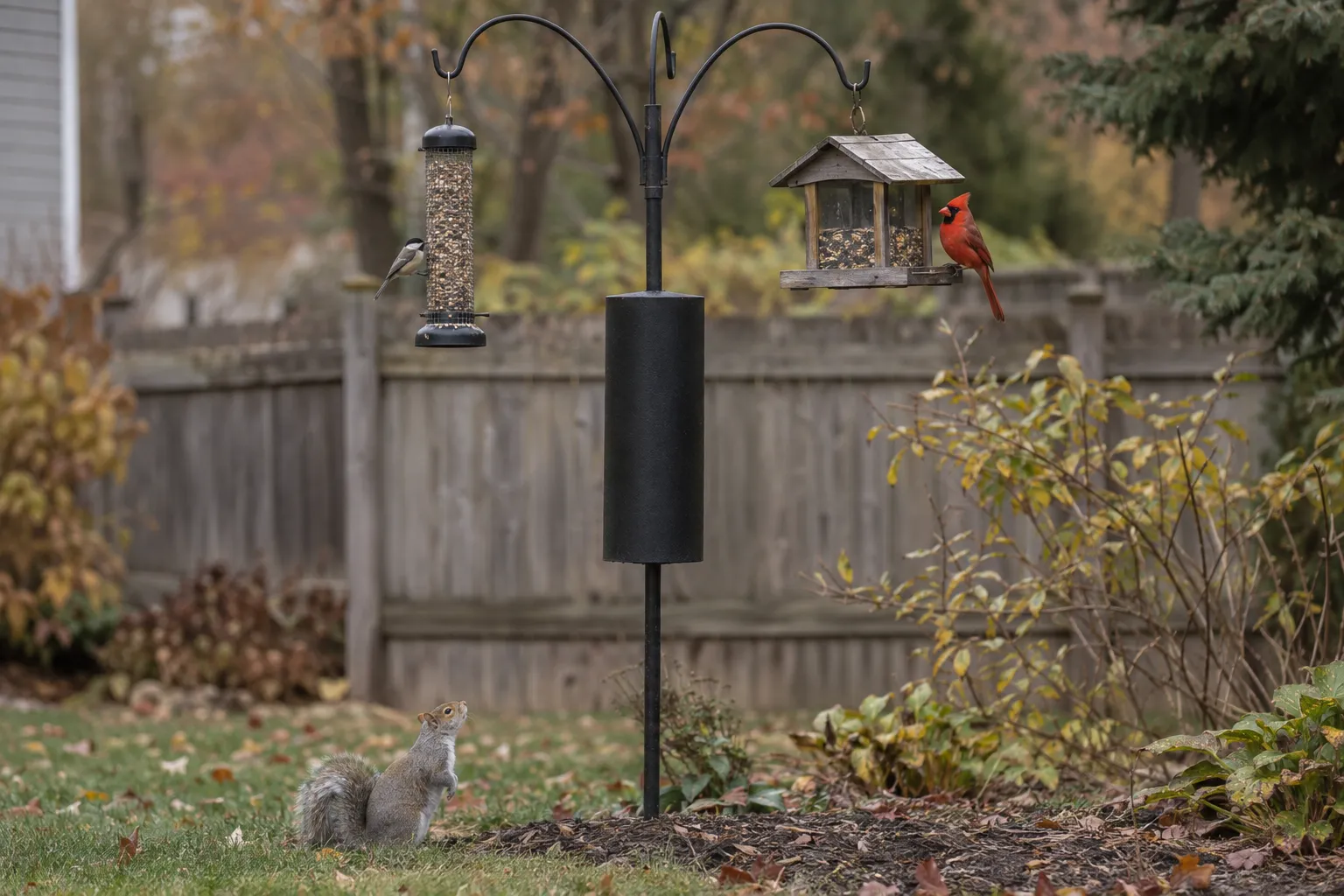
A pole system has four jobs: stand straight, hold weight, keep animals from climbing, and keep animals from jumping on. The first three are about hardware. The fourth is about where you put it.
Pole diameter and wall thickness
Thin poles bend, lean and wobble, and a leaning pole moves your feeders closer to the ground or to a jump point. Erva advertises 16-gauge steel with walls nearly twice as thick as the industry standard. Kettle Moraine uses 1-inch steel sections. Heavier systems like the Squirrel Stopper use a larger pole. If you plan to hang several full feeders, favor thicker steel.
Anchoring
Most sectional poles use a twist-in ground socket or auger rather than a spike. Erva and Kettle Moraine sockets twist about 20 inches into the ground. The Squirrel Stopper uses a screw-in auger. A socket also lets you lift the pole out for cleaning or winter without digging.
Baffle type
The baffle is what stops climbers. There are three main styles, covered below. Match the style to your pest: cones for squirrels, long cylinders for squirrels and raccoons.
Arms and reach
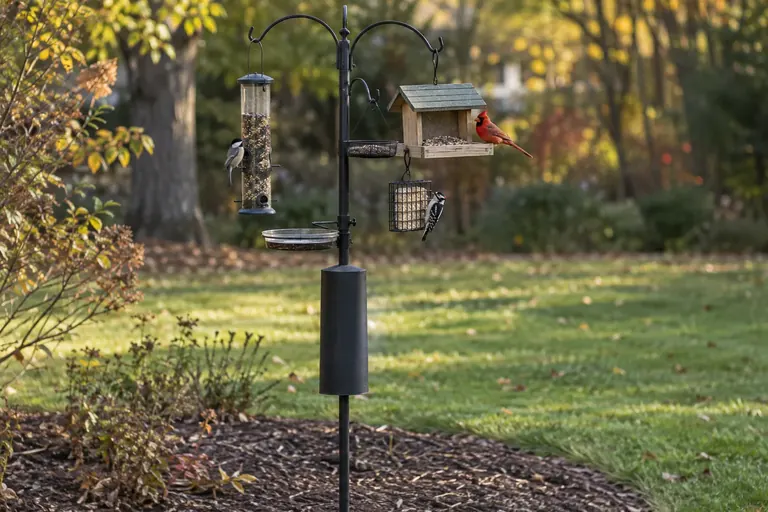
Multi-arm toppers let you hang a tube, a hopper and a suet cage from one pole. Longer arms spread feeders apart but add leverage, so they need a stronger pole and deeper anchor. Keep feeders from hanging so low that a squirrel on the ground can jump straight to them.
Squirrel Stopper Deluxe: best overall pole system
What it is: A complete steel pole kit with a multi-arm topper, a spring-mounted “floating” baffle that rocks when climbed, and a screw-in ground auger.
Who it suits: People running a full feeding station who want one kit that addresses both squirrels and raccoons.
Key specs: Duncraft lists it at 8 feet tall overall, with a 36-inch arm spread, capacity for up to eight feeders, and a weight rating of 30 lb per arm. It assembles without tools and carries a one-year guarantee through that retailer.
Strengths: The spring mount is the standout. A normal baffle is fixed, so a determined squirrel can sometimes brace against it. The Squirrel Stopper baffle tips and sways, which makes it hard to grip. The auger holds better than a straight spike, and the multi-arm top means you can build a whole station on one pole.
Drawbacks: It is a large, heavy kit. The auger is harder to install in rocky or root-filled soil. Owners commonly note that it only works as designed if the pole is well away from trees, fences and roofs, which applies to every pole but matters more with a big station that tempts squirrels.
Skip it if: You only need one feeder, or your only open space is small.
Kettle Moraine Pole Set with Raccoon Baffle: best for raccoons
What it is: A powder-coated steel pole in three sections with a two-, three- or four-arm topper, a twist-in ground socket and a long galvanized raccoon baffle. Kettle Moraine also sells a shorter squirrel baffle option.
Who it suits: Yards where raccoons, not just squirrels, are climbing the pole. Raccoons are bigger and can reach around a short cone.
Key specs: The two-arm package measures 84 inches from the ground to the bottom of the hooks. Poles are 1-inch steel, arms reach 12 inches, and the twister socket goes 20 inches into the soil. The raccoon baffle is 28 inches long and 6.25 inches in diameter, while the squirrel baffle option is 16.75 inches long.
Strengths: The raccoon baffle length is the key number. At 28 inches, it presents a long, smooth, closed-top tube that a raccoon cannot reach over. Kettle Moraine’s own guidance, to keep the pole 8 to 10 feet from rails, roofs or trees and the baffle at least 4 feet off the ground, is clear and consistent with other specialist advice.
Drawbacks: A 1-inch pole is slimmer than heavy-duty options. With several heavy feeders on the arms and soft ground, some leaning is possible. The baffle fits only straight poles, not shepherd’s hooks.
Skip it if: You need to hang heavy hoppers at full arm reach in windy, sandy ground.
Erva Multi-Arm Pole System: best heavy-duty pole
What it is: A sectional steel pole system from Erva, sold with two, three or four arms in several arm styles, including an extended-reach option. Erva also sells matching baffles.
Who it suits: People who have had cheaper poles bend or rust and want a stronger base.
Key specs: Erva lists 90 inches above ground, a 20-inch twist-in ground socket, three pole sections, 16-gauge steel with a corrosion-resistant powder coat, and arm reach of about 12 inches (standard) or 22 inches (extended). Erva says the poles are made in the USA.
Strengths: Wall thickness is the selling point. Thicker steel resists the slow lean that affects many kits once they are loaded. The range of arm styles means you can spread feeders farther apart, which can reduce squabbling.
Drawbacks: Baffle choice matters and sizes vary by bundle, so check which baffle is included in the listing you buy. Extended arms add leverage and make the ground anchor work harder.
Skip it if: You want the simplest possible one-box solution with the baffle decided for you.
Woodlink 18-Inch Wrap Around Squirrel Baffle: best cone baffle for round poles
What it is: A wide steel cone that opens along a seam so it can wrap around an existing pole, then clamps closed.
Who it suits: Anyone who already has a pole and wants to add squirrel protection without taking feeders down.
Key specs: Woodlink lists it at 18 inches in diameter and 7 inches tall. A 14-inch version also exists, but wider is better against squirrels.
Strengths: Wraparound design means a quick install. At 18 inches across, it is wide enough that squirrels climbing from below cannot reach around the edge.
Drawbacks: Cones do less against raccoons. Some wraparound baffles also slide down the pole over time if the clamp or support collar is not tight.
Skip it if: Raccoons are part of the problem.
Woodlink Torpedo Raccoon Baffle: best raccoon baffle add-on
What it is: A long cylindrical baffle with a closed top, designed to sit on a pole below the feeders.
Who it suits: Anyone upgrading an existing pole against both squirrels and raccoons.
Key specs: 7.75 inches in diameter and 28 inches tall, per Woodlink. A shorter Torpedo Squirrel Baffle (6 by 15.75 inches) is sold for squirrels only.
Strengths: The long, narrow shape takes up less space than a wide cone and gives a raccoon nothing to reach over.
Drawbacks: It needs a tall pole. With 28 inches of baffle starting at least 4 feet up, the feeders sit high, so a short pole will not work.
Skip it if: Your pole is under about 7 feet above ground.
Woodlink 22-Inch Wrap Around 4x4 Post Baffle: best for 4x4 posts
What it is: An extra-wide cone baffle sized to fit square 4x4 wooden posts.
Who it suits: People using wooden posts for feeders or bird houses.
Key specs: 22 inches in diameter and about 7.6 inches tall, in green or bronze.
Strengths: Round-pole baffles do not fit square posts, and gaps give squirrels a foothold. This is sized for the job. Its width also helps with nest boxes, where predators climbing posts is a concern.
Drawbacks: Only for 4x4 posts. Wooden posts are easier for squirrels to climb than steel, so the baffle is doing all the work.
Skip it if: You use a round metal pole.
Droll Yankees Dome Squirrel and Weather Guard: best hanging dome baffle
What it is: A 15-inch dome that hangs above a feeder.
Who it suits: People who hang feeders from a tree limb or a wire between two points.
Key specs: 15 inches in diameter, hangs above the feeder on its hanger.
Strengths: It blocks squirrels coming down the hanger and doubles as a rain and snow shield. Specialist retailers suggest hanging the feeder on a chain or hook at least 18 to 24 inches long below the branch.
Drawbacks: A dome does nothing if a squirrel can leap onto the feeder from the side or from below. Light domes can tilt in wind.
Skip it if: Your feeder hangs within jumping distance of the trunk or other branches.
Comparison table
| Product | Type | Key dimension | Stops squirrels | Stops raccoons |
|---|---|---|---|---|
| Squirrel Stopper Deluxe | Pole system | 8 ft tall | Yes | Yes, per retailer |
| Kettle Moraine with Raccoon Baffle | Pole system | 28 in baffle | Yes | Yes |
| Erva Multi-Arm | Pole system | 90 in above ground | Depends on baffle | Depends on baffle |
| Woodlink 18 in Wrap Around | Cone baffle | 18 in wide | Yes | Less reliable |
| Woodlink Torpedo Raccoon | Cylinder baffle | 28 in tall | Yes | Yes |
| Woodlink 22 in 4x4 | Cone baffle | 22 in wide | Yes | Less reliable |
| Droll Yankees Dome | Hanging dome | 15 in wide | From above only | No |
Cone vs cylinder vs dome: which baffle do you need?
Cone baffles (also called wraparound baffles) mount on a pole under the feeder. They work by being too wide to reach around. Wider is better; 18 inches or more is a sensible minimum for squirrels.
Cylinder baffles (torpedo or stovepipe baffles) are long tubes with a closed top. They work by being too tall to reach over and too smooth and wobbly to grip. Around 28 inches long is the standard size for raccoons.
Dome baffles hang above a feeder. They stop squirrels coming from above, and they shed rain. They do nothing against jumps from the side.
Our explainer on squirrel baffles goes deeper into sizing.
How tall should a bird feeder pole be?
Work backward from the baffle. The bottom of the baffle needs to sit at least 4 feet above the ground. Add the baffle’s own height, then leave a few inches of clear pole before the lowest feeder hangs. With a 16 to 18 inch squirrel baffle, that puts the lowest feeder around 6 feet up. With a 28-inch raccoon baffle, it pushes the lowest feeder closer to 7 feet.
That is why most complete systems stand about 7 to 8 feet above ground. Kettle Moraine’s package reaches 84 inches to the bottom of the hooks, Erva’s stands 90 inches, and the Squirrel Stopper is 8 feet overall.
Two practical checks before you buy:
- Can you reach the feeders? Taller poles mean lifting full feeders overhead. If that is hard, choose feeders with top-fill lids, or a pole with sections you can lift out.
- Can you see them? A feeder at 7 feet is still easy to watch from a window, but it may sit above your sightline from a low chair on the patio.
If you need the feeders lower, you can shorten the gap under a squirrel baffle, but do not drop the baffle below 4 feet. For more ways to combine hardware and placement, see our guide on keeping squirrels off bird feeders.
How to set up a feeder pole so squirrels cannot win
- Pick the spot first. Choose a place 8 to 10 feet from trees, fences, deck rails, sheds and roofs. Kettle Moraine recommends 8 to 10 feet; other specialist retailers suggest at least 7 to 8. Our guide on where to put a bird feeder covers cover and window placement too.
- Install the socket straight. Use a level. A pole that starts crooked will lean more once loaded.
- Set the baffle at least 4 feet up. Measure from the ground to the bottom of the baffle. Place it right under the lowest feeder if you can.
- Keep feeders above the baffle. Nothing should hang low enough to reach from the ground or from the top of the baffle.
- Check for launch points. Look for lawn furniture, grills, planters or low shrubs that could give a squirrel a boost.
- Clean up spilled seed. Seed under the pole keeps squirrels interested and attracts rodents. A no-mess blend helps; see our no-mess bird seed picks.
Common mistakes with poles and baffles
- Putting the pole too close to a tree or fence. This is the most common reason baffles “fail.” Squirrels simply jump past them.
- Mounting the baffle too low. A baffle at 3 feet is an easy jump.
- Using a cone for raccoons. Raccoons reach around short cones. Use a long cylinder.
- Using a shepherd’s hook. Most baffles need a straight pole, and hooks bend under weight.
- Letting the pole lean. A few degrees of lean puts feeders closer to jump points and to the ground.
- Relying on the baffle alone. Combine it with a squirrel-resistant feeder for belt-and-braces protection. Our squirrel-proof feeder picks pair well with any pole here.
Do bird feeder poles help with hawks and other problems?
Not directly. A pole does not stop hawks. Placement near cover, within reach of shrubs, gives small birds a place to escape. If hawks are a regular issue, see our guide on hawks at feeders. Poles do make cleaning easier, since you can lower a feeder by lifting a section, and they keep feeders away from house walls where mice can climb.
Sources
Frequently asked questions
How high should a squirrel baffle be on a pole?
Mount the bottom of a pole baffle at least 4 feet above the ground, and ideally just under the feeder. Specialist bird stores and baffle makers such as Kettle Moraine consistently use 4 feet as the minimum. If your yard slopes, measure from the highest nearby ground, not from the base of the pole.
How far should a bird feeder pole be from trees?
Keep the pole about 8 to 10 feet from trees, fences, deck rails, roofs and anything else a squirrel can climb. Kettle Moraine recommends 8 to 10 feet, and other specialist retailers suggest at least 7 to 8. Squirrels are strong jumpers, and a baffle only stops climbing, not leaping in from the side.
Do squirrel baffles stop raccoons?
Short cone baffles often do not, because raccoons are bigger and can reach around them. Long cylinder baffles, often called torpedo or stovepipe baffles, work much better. Look for one around 24 to 28 inches long, such as the 28-inch Woodlink Torpedo Raccoon Baffle or Kettle Moraine Raccoon Baffle, and mount it with its top at least 4 feet up.
What is the difference between a cone baffle and a cylinder baffle?
A cone baffle is a wide, flat or shallow dish that squirrels cannot get around. A cylinder baffle is a long tube with a closed top that wobbles and gives nothing to grip. Cylinder baffles tend to handle raccoons better and take up less horizontal space, while wide cones are simpler to add to an existing pole.
How deep should a bird feeder pole go in the ground?
Most sectional systems use a twist-in ground socket or auger. Erva and Kettle Moraine both use sockets that twist about 20 inches into the soil. Deeper is better for multi-arm poles loaded with heavy feeders. In sandy or very soft soil, owners commonly add gravel or concrete around the socket to stop leaning.