Best Peanut Feeders: Mesh, Squirrel-Proof and Heavy-Duty
The best peanut feeder for most gardens is a rigid metal mesh tube. Compare 5 picks: mesh, squirrel-proof, heavy-duty, whole-peanut wreath and jar feeders.
If you buy through links on this page we may earn a commission, at no cost to you. It never decides what we recommend. How we earn
In this article
- Quick picks
- How we chose
- What makes a good peanut feeder?
- Nature’s Way Metal Mesh Seed and Peanut Feeder: best peanut feeder overall
- Brome Squirrel Buster Nut: best squirrel proof peanut feeder
- Cottage Garden 12 in Heavy Duty Mesh Nut Feeder: best heavy-duty peanut feeder
- Songbird Essentials Whole Peanut Wreath: best whole peanut bird feeder
- Esschert Design FB460 Peanut Butter Feeder: best peanut butter bird feeder
- Comparison table
- Which bird nut feeder type should you choose?
- Is the Squirrel Buster Nut feeder worth it?
- Where should you hang a peanut feeder?
- What birds use peanut feeders?
- Are whole peanuts safe for baby birds?
- When should you put out peanuts? A month-by-month guide
- How do you fill and clean a peanut feeder?
- Common mistakes with peanut feeders
- Sources
- Frequently asked questions
The best peanut feeder for most gardens is a rigid metal mesh tube, and our top pick is the Nature’s Way Metal Mesh Seed and Peanut Feeder. It holds about 2 quarts, makes birds peck off small pieces instead of carrying off whole nuts, and comes apart without tools for cleaning. If squirrels raid your garden, step up to the weight-activated Brome Squirrel Buster Nut.
A peanut feeder is a simple thing, but the details matter for bird safety. The mesh must be metal and rigid, never a plastic net. The peanuts must be plain and good quality. And in spring, whole nuts should never be loose. This guide covers the feeders; our guide to peanuts for birds covers the food itself.
Quick picks
- Best overall: Nature’s Way Metal Mesh Seed and Peanut Feeder. All metal, about 2 qt, draining tray.
- Best squirrel-proof: Brome Squirrel Buster Nut. Weight-activated shroud, two meshes, about 1.3 lb.
- Best heavy-duty: Cottage Garden 12 in Heavy Duty Mesh Nut Feeder. About 3 lb, secure cap.
- Best for whole peanuts: Songbird Essentials Whole Peanut Wreath. About 5 cups of in-shell peanuts.
- Best peanut butter feeder: Esschert Design FB460. One jar, zinc roof, quick swaps.
Nature's Way Metal Mesh Seed and Peanut Feeder
An all-metal, powder-coated mesh tube with a twist-off lid, a draining seed tray and parts that come off without tools.
- Best for
- A first peanut feeder for clinging birds in a mixed garden.
- Skip it if
- Grey squirrels already raid your feeders; metal mesh resists chewing but won't keep them off.
- Capacity
- About 2 qt (KMESH-2)
- Material
- Powder-coated metal mesh
- Extras
- Seed tray with rain drainage
- Mounting
- Hanging
Brome Squirrel Buster Nut
A nut feeder whose outer shroud slides down under a squirrel's weight and closes the ports, with two interchangeable meshes.
- Best for
- Gardens where squirrels take more peanuts than the birds do.
- Skip it if
- You want jays and woodpeckers heavy enough to trip the shroud to keep feeding.
- Capacity
- About 1.3 lb (3/4 qt)
- Size
- 5.13 x 5.13 x 19.38 in
- Squirrel guard
- Weight-activated shroud, adjustable spring
- Foods
- Shelled peanuts, other nuts, suet nuggets, dried fruit
Cottage Garden 12 in Heavy Duty Mesh Nut Feeder
A sturdy 12 in metal mesh nut feeder holding about 3 lb, with a secure cap cover that keeps the lid in place.
- Best for
- Busy winter gardens and anyone who wants fewer refills.
- Skip it if
- Your peanuts would sit for more than a few days, since a big load turns stale in damp weather.
- Capacity
- About 3 lb
- Material
- Heavy-duty metal mesh
- Size
- 12 in tube
- Lid
- Secure cap cover
Songbird Essentials Whole Peanut Wreath
A spiral wire wreath that holds peanuts in the shell, so jays and other strong-billed birds work each nut free.
- Best for
- Jays, woodpeckers and nuthatches in autumn and winter.
- Skip it if
- You feed in spring or summer, or you don't want squirrels at your feeding station.
- Capacity
- About 5 cups of in-shell peanuts
- Size
- 13 in outside, 7 in inside diameter
- Material
- Spiral wire
- Mounting
- Hook for a pole or branch
Esschert Design FB460 Peanut Butter Feeder
A small pine house with a galvanized roof that holds one jar of bird peanut butter on its side.
- Best for
- Small gardens and balconies where you want a no-mess, quick-swap feeder.
- Skip it if
- You can only find salted peanut butter for people; buy bird peanut butter first.
- Size
- 17.9 x 13.6 x 16.6 cm (about 7 x 5.4 x 6.5 in)
- Material
- Pine, zinc roof
- Jar
- Lock fits standard peanut butter jars
How we chose
We haven’t hung these feeders in our own garden yet. This guide is research-based. We compared manufacturer and retailer specifications for capacity, materials, mesh, lid security and squirrel protection, and we confirmed each model is currently listed on Amazon. We read feeding guidance from the RSPB, the BTO, the Cornell Lab of Ornithology and Project FeederWatch, NABU and Vogelbescherming Nederland. We then looked for consistent patterns in verified owner reviews, especially reports of chewed lids, rust, wet peanuts and squirrel damage. Safety came first: any design that lets birds take whole nuts, or uses soft netting, was ruled out of the main mesh picks.
What makes a good peanut feeder?
A good peanut feeder has rigid metal mesh with small holes, a lid that squirrels can’t lift, and a base that lets rain drain away. Those three points cover almost every problem owners report.
- Rigid metal mesh. The BTO says peanuts are best supplied behind wire mesh so a bird cannot take a whole peanut away. Rigid steel keeps its shape when a woodpecker hammers at it, so the holes never stretch.
- Small holes. The mesh should be fine enough that birds pull out fragments, not whole kernels. Our peanuts for birds guide explains why fragments are the safe size.
- No plastic nets. The RSPB says never to put out any food in mesh bags, because birds can trap their feet and break legs, and woodpeckers can trap their beaks.
- A secure lid. A screw cap, locking cap or twist-off top stops squirrels and jays from lifting it.
- Easy to take apart. Crumbs and damp fragments collect at the base. A feeder you can strip in seconds is a feeder you’ll actually clean.
Nature’s Way Metal Mesh Seed and Peanut Feeder: best peanut feeder overall
What it is: An all-metal mesh tube sold as model KMESH-2. Retailer listings give a capacity of about 2 quarts of seed or peanuts, with powder-coated metal parts, a twist-off lid and a wide mesh tube for easy filling.
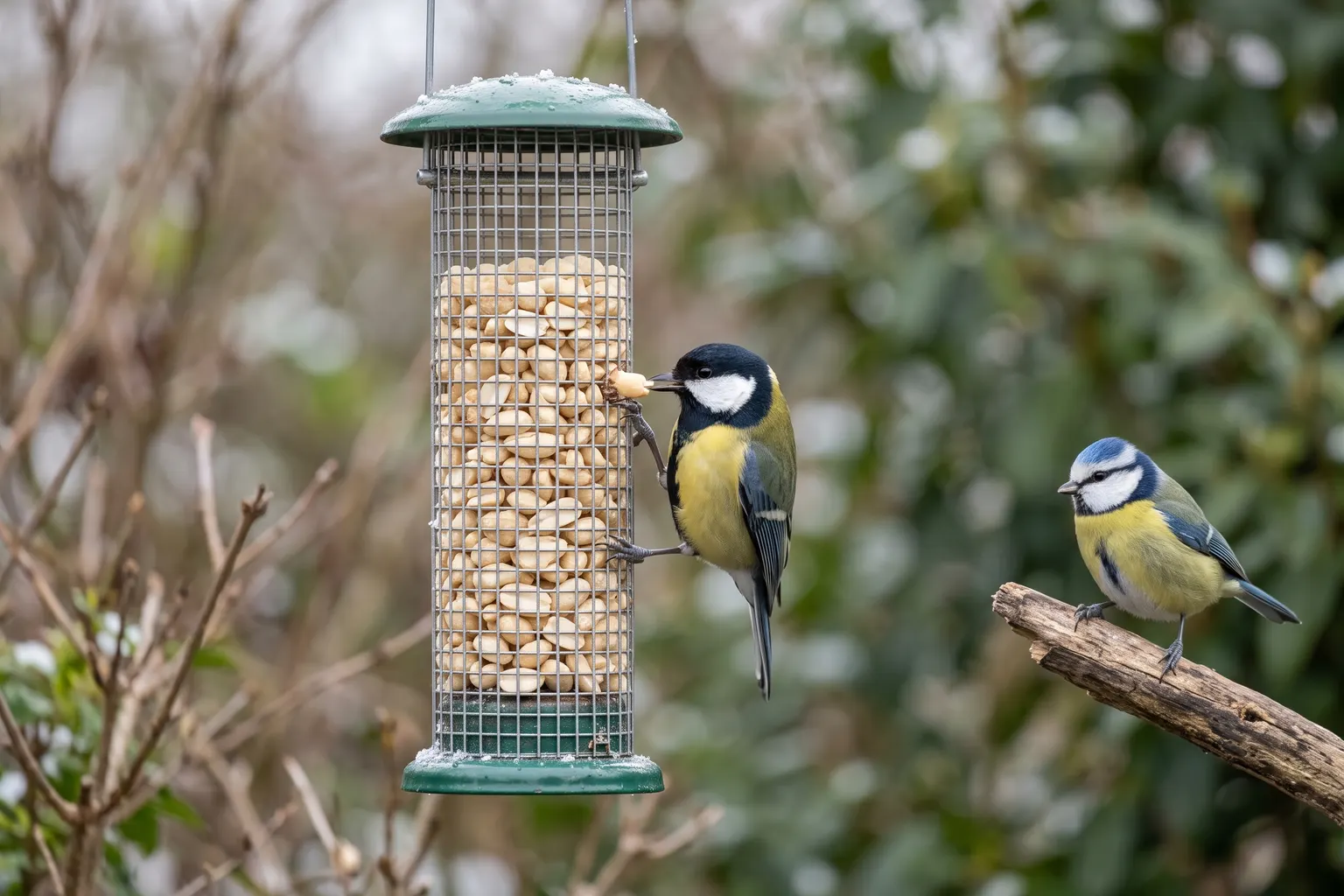
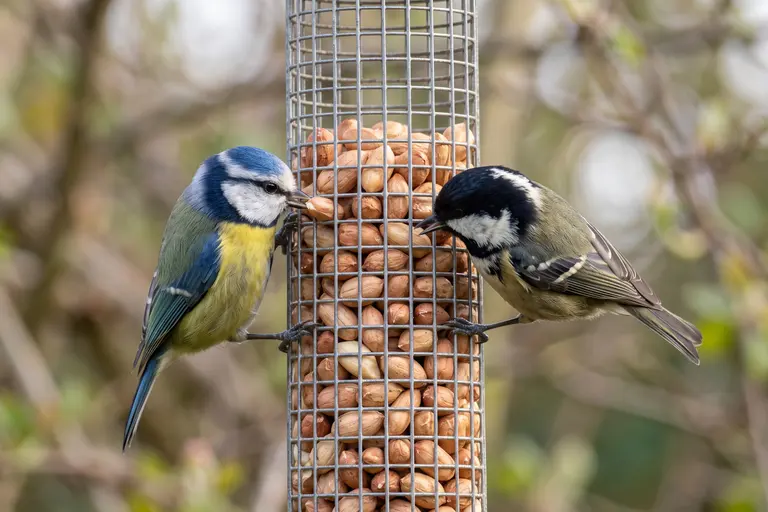
Why it stands out: It ticks the core safety boxes. The mesh is metal, not netting, so birds cling and peck rather than pulling nuts out whole. The seed tray at the base has rain drainage, which matters because wet peanuts spoil quickly. Nature’s Way says the parts come off without tools for cleaning, and the mesh gives a 360 degree feeding surface so several tits can feed at once.
Owner patterns: Owners of all-metal mesh feeders tend to praise how well they stand up to woodpeckers and weather compared with plastic tubes. The most common caution is the tray: in a wet spell, fragments that fall into it turn soggy, so empty it when you refill.
Key specs: About 2 qt, powder-coated metal mesh, draining tray, hanging.
- Best for: A first peanut feeder for blue tits, great tits, chickadees, nuthatches and woodpeckers. If you already own tube feeders for seed, this is the natural partner.
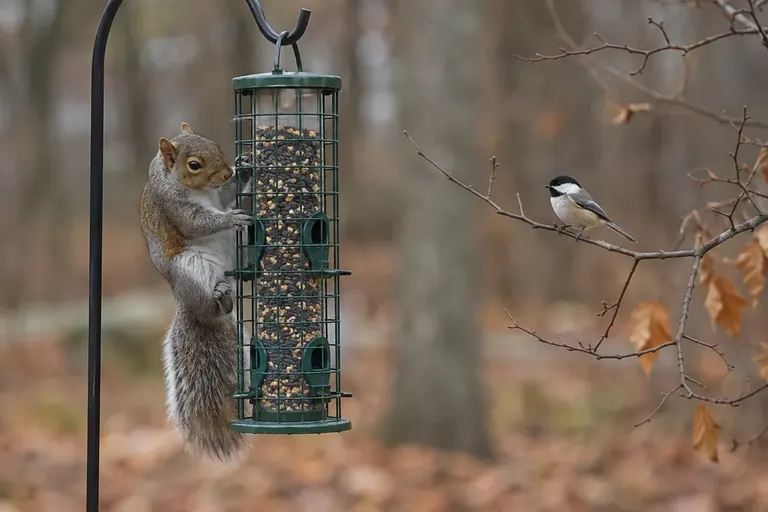
- Skip it if: Grey squirrels already raid your garden. Metal resists chewing, but squirrels can still hang on and eat.
See available listings on Amazon
Brome Squirrel Buster Nut: best squirrel proof peanut feeder
What it is: The nut version of the Squirrel Buster range. Brome lists a capacity of 3/4 quart (about 1.3 lb), a size of 5.13 x 5.13 x 19.38 in and a weight of 2.6 lb. It’s made of metal, plastic and resin, and comes with two interchangeable meshes of different sizes.
Why it stands out: The outer shroud is weight activated. When a squirrel grabs it, the shroud slides down and closes the feeding ports, and Brome says squirrels are deterred without being harmed. A patented spring lets you adjust how much weight the shroud supports. Brome lists shelled peanuts, almonds, pecans, cashews, suet nuggets and dried fruit as suitable foods. The parts come apart without tools.
Owner patterns: In verified reviews, owners mainly praise how reliably the shroud closes on squirrels when the feeder hangs clear of jump-off points. Note Brome’s own limits: it says the feeder will not deter grackles, starlings, juvenile tree squirrels, chipmunks or raccoons, and recommends bringing it in at night where raccoons or bears roam.
Key specs: About 1.3 lb, 19.38 in tall, weight-activated shroud, two meshes.
- Best for: Gardens where squirrels win every round. Pair it with the placement tips in our squirrel-proof feeder guide.
- Skip it if: You enjoy jays at the peanuts. Heavier birds can trip the shroud, depending on the spring setting.
See available listings on Amazon
Cottage Garden 12 in Heavy Duty Mesh Nut Feeder: best heavy-duty peanut feeder
What it is: A 12 in metal mesh nut feeder sold under the Cottage Garden name, listed with about 3 lb capacity and a secure cap cover. It comes in several finishes, including copper and matte black.
Why it stands out: Capacity and toughness. A 3 lb tube suits a garden where a family of tits and a woodpecker work through peanuts every day in winter. The secure cap is designed to keep the lid on when squirrels or jays tug at it. Heavy mesh also holds its shape under hammering beaks.
Owner patterns: Owners of large mesh nut feeders like refilling less often. The repeated caution is freshness: if birds don’t clear a big load within a few days, peanuts at the bottom can go damp and stale. The fix is simple: fill it halfway until you know how fast your birds eat.
Key specs: About 3 lb, 12 in heavy-duty metal mesh, secure cap cover.
- Best for: Busy winter feeding stations and people who refill once or twice a week.
- Skip it if: You only get a few visitors. A small feeder keeps peanuts fresher.
See available listings on Amazon
Songbird Essentials Whole Peanut Wreath: best whole peanut bird feeder
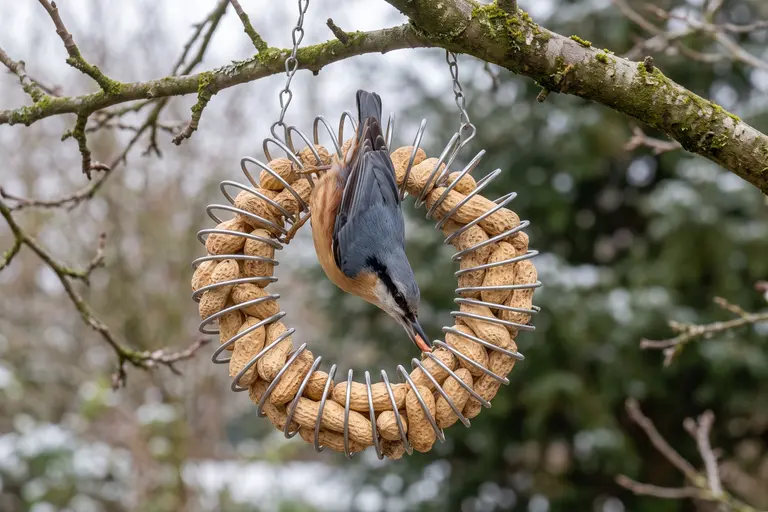
What it is: A peanut wreath feeder made from a spiral wire coil. Retailer listings give an outside diameter of 13 in, an inside diameter of 7 in and a spring diameter of 2.75 in, holding about 5 cups of whole peanuts in the shell. A hook is included.
Why it stands out: In-shell peanuts are hard work, and that’s the point. Jays and woodpeckers have to wiggle each nut through the coil, which keeps them busy and limits waste. Project FeederWatch notes that larger birds such as jays can carry off several whole peanuts to cache, so a wreath slows them down.
Owner patterns: Owners love watching jays work at a wreath. The recurring note is that squirrels love it too. Many owners hang it deliberately away from the main feeders as a decoy.
Key specs: About 5 cups in-shell peanuts, 13 in outside diameter, spiral wire, hook included.
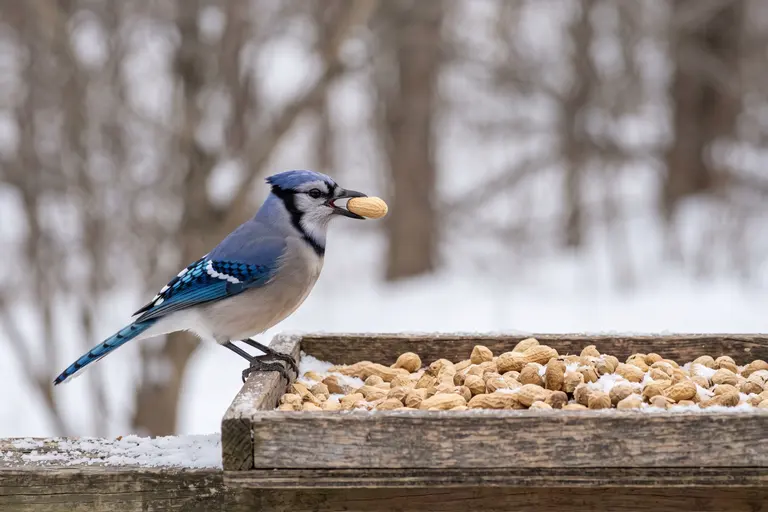
- Best for: Blue Jays, Eurasian Jays, woodpeckers and nuthatches in autumn and winter. See how to attract Blue Jays.
- Skip it if: It’s spring or summer. Whole nuts can be carried to nests, which is exactly what the RSPB warns against.
See available listings on Amazon
Esschert Design FB460 Peanut Butter Feeder: best peanut butter bird feeder
What it is: A small house-shaped jar holder from Dutch maker Esschert Design. Listings give a size of 17.9 x 13.6 x 16.6 cm (about 7 x 5.4 x 6.5 in), a pine body and a zinc (galvanized) roof. Its lock fits standard peanut butter jars, which lie on their side so birds feed from the open mouth.
Why it stands out: A jar feeder is the cleanest way to offer peanut butter. Nothing smears on branches, the roof keeps rain off, and an empty jar swaps out in seconds. It suits small gardens and balconies where loose peanut fragments would be a nuisance.
Owner patterns: Owners report robins, tits and sparrows learning the jar quickly. The common caution is heat: in warm weather peanut butter softens and spoils faster, so Vogelbescherming Nederland advises hanging it in the shade.
Key specs: 17.9 x 13.6 x 16.6 cm, pine, zinc roof, fits standard jars.
- Best for: Small spaces and anyone who wants peanut energy without mess. Read can you feed birds peanut butter before you buy a jar.
- Skip it if: You only have peanut butter for people. Vogelbescherming warns that human peanut butter often contains salt, which is bad for birds.
See available listings on Amazon
Comparison table
| Feeder | Type | Capacity | Squirrel guard | Best food |
|---|---|---|---|---|
| Nature’s Way Metal Mesh | Metal mesh tube | About 2 qt | No | Shelled peanuts |
| Brome Squirrel Buster Nut | Caged mesh, weight-activated | About 1.3 lb | Yes, adjustable | Shelled peanuts, suet nuggets |
| Cottage Garden Heavy Duty | Large metal mesh tube | About 3 lb | Secure cap only | Shelled peanuts |
| Songbird Essentials Wreath | Spiral wire wreath | About 5 cups | No | Peanuts in the shell |
| Esschert Design FB460 | Jar holder | One jar | No | Bird peanut butter |
Which bird nut feeder type should you choose?
Choose a metal mesh tube unless you have a specific problem to solve. Each other bird nut feeder type fixes one problem and adds a trade-off.
- Plain mesh tube: the safe default for shelled peanuts. Cheap, easy to clean, and birds get small pieces.
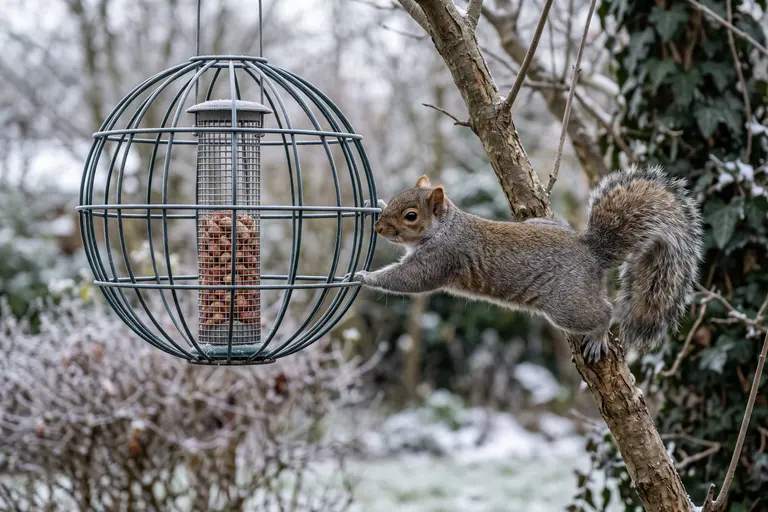
- Caged or weight-activated feeder: for squirrels and big birds. A squirrel proof peanut feeder costs more and is heavier, and a cage can also keep out the woodpeckers you want.
- Heavy-duty feeder: cast or thick-gauge metal for gardens where squirrels chew through ordinary tubes.
- Whole-peanut wreath: for jays and woodpeckers in winter only.
- Peanut butter jar feeder: for small spaces and no-mess feeding, using bird peanut butter.
If you also feed fat, our guide to suet feeders covers cages that take suet cakes alongside your peanuts.
Is the Squirrel Buster Nut feeder worth it?
The Squirrel Buster Nut feeder is worth it if squirrels empty your peanuts every day; otherwise a plain mesh tube does the job for far less. Its weight-activated shroud closes the ports under a squirrel, and the two meshes let you switch between peanuts and suet nuggets.
Placement still decides whether any squirrel proof peanut feeder works. Hang it where squirrels can’t reach the feeder from a fence, branch or roof without touching the shroud. Our guides to keeping squirrels off feeders and bird feeder poles and baffles explain the distances and hardware.
Where should you hang a peanut feeder?
Hang a peanut feeder near cover but not inside it, high enough to stop cats, and clear of anything a squirrel can jump from.
- Mind the distance to cover. The RSPB suggests a couple of metres from thick cover such as bushes, so small birds can dash to safety when a Sparrowhawk appears. Project FeederWatch says birds like feeders close to natural cover and calls about 10 feet (3 m) a good compromise. Somewhere between 6 and 10 feet (2 to 3 m) from a shrub suits both.
- Beat the squirrel jump. Project FeederWatch notes that squirrels can jump to feeders placed less than ten feet from a tree or building. For squirrels dropping from above, it suggests a tilting baffle at least 18 inches (46 cm) across.
- Keep cats out of reach. The RSPB says to hang feeders high enough to be out of reach of ground predators like cats, and FeederWatch recommends keeping pet cats indoors.
- Avoid perches above it. The RSPB advises against hanging feeders under trees or other perches, because droppings from above can contaminate the food.
- Move it now and then. The RSPB suggests moving feeders regularly, ideally weekly, so debris and droppings don’t build up underneath. Our guide to bird feeding stations shows easy setups.
- Choose shade in warm weather. The Cornell Lab of Ornithology says birds may avoid feeders in extreme heat and suggests a shady spot.
If nothing visits, the RSPB’s advice is simple: try a different location.
What birds use peanut feeders?
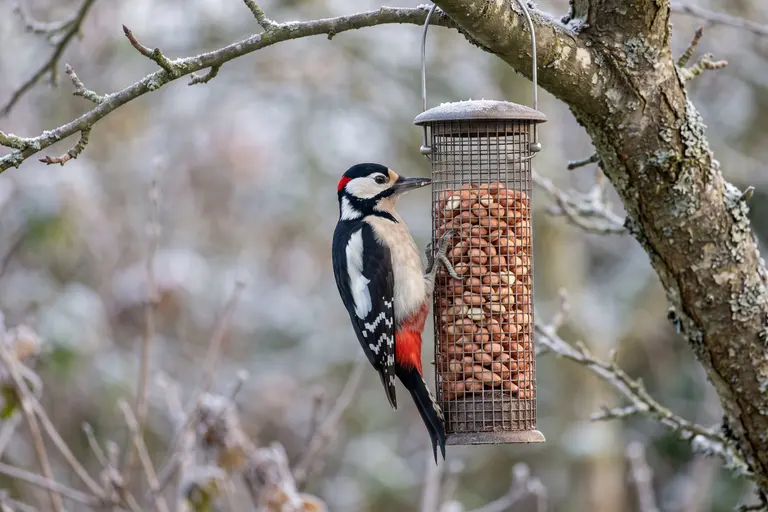
Clinging birds that can hang upside down use peanut feeders most. In Britain and Europe, the RSPB names tits and nuthatches as the classic visitors to a hanging mesh peanut feeder. Great spotted woodpeckers, siskins, robins and even house sparrows learn to use them.
In North America, Project FeederWatch says smaller birds such as chickadees, nuthatches and titmice do best with shelled peanuts, while jays can carry off several whole peanuts to store. The White-breasted Nuthatch is one of the most reliable peanut feeder regulars. Woodpeckers, from Downy to Red-bellied, also visit mesh feeders.
Are whole peanuts safe for baby birds?
Loose whole peanuts are not safe for nestlings, so keep them off the menu in spring. The RSPB warns that dry, hard foods can be carried to the nest by parent birds, where young birds can choke on them. NABU in Germany warns that young birds can choke on large peanut pieces, and advises no peanuts while young are being raised from April to July.
A rigid mesh feeder reduces the risk because birds can only take small fragments. In the UK, the RSPB and BTO now go further and advise pausing seed and peanut feeders from May to October to reduce finch trichomonosis. Follow that advice and the spring question answers itself.
When should you put out peanuts? A month-by-month guide
UK charities set firm dates; US guidance turns on heat and bears.
In the UK, the BTO advises feeding seeds and peanuts from November to April and pausing from May to October, as a proportionate step to reduce finch trichomonosis. The BTO links disease spread at feeding stations to lower adult survival in Greenfinches and Chaffinches. Mealworms and fat or suet can continue year-round. In the US, the Cornell Lab says leaving feeders up year-round is not a problem if you keep a few things in mind, but if bears live near you, feeders should not stay up in the warmer months. It cites New York’s advice to take feeders down by April 1.
| Months | UK (RSPB and BTO) | US (Cornell Lab and FeederWatch) |
|---|---|---|
| November to February | Peak peanut season. Fill mesh feeders and refill often. | Peak season. Shelled peanuts for chickadees, nuthatches and titmice; in-shell nuts in a wreath for jays. |
| March and April | Keep feeding, mesh only, no loose whole nuts. | Keep feeding. In bear country, take feeders in by early spring. |
| May to October | Pause seed and peanut feeders. Fat and mealworms can continue. | Feeding can continue where there are no bears. Fill less so nuts don’t spoil in heat, and hang in shade. |
During a pause, wash the feeder, dry it fully and store it indoors so it’s ready for November. For the cold months, our guide to what to feed birds in winter shows where peanuts fit alongside seed and fat.
How do you fill and clean a peanut feeder?
Fill a peanut feeder with plain shelled peanuts, only as many as birds will clear in a few days, and clean it every week or two.
- Buy good peanuts. The RSPB warns that poor quality peanuts can carry aflatoxin, a fungal toxin that kills birds, and advises peanuts guaranteed aflatoxin-free from a reputable supplier. The BTO adds: buy in small quantities and store them cool and dry.
- Never salted or roasted with coatings. The RSPB lists all salted foods among the things not to feed birds. Project FeederWatch says to avoid salted peanuts or any roasted with coatings or flavorings. European charities such as Vogelbescherming Nederland and the LPO recommend unroasted peanuts.
- Fill to match demand. Start half full and adjust.
- Clean regularly. Empty old nuts, scrub the mesh with hot soapy water and a bottle brush, then soak in one part bleach to nine parts water, as Project FeederWatch recommends. Rinse and dry fully before refilling.
- Bin anything doubtful. Moldy, discolored or musty peanuts go in the bin, not the feeder.
Our step-by-step guide on how to clean bird feeders covers every feeder type.
Common mistakes with peanut feeders
- Using the plastic net the peanuts came in. The RSPB says never to put food out in mesh bags.
- Choosing soft or wide mesh. Birds can pull whole kernels through stretched wire.
- Offering loose whole peanuts in spring. Parents can carry them to nestlings.
- Buying cheap, unknown peanuts. Aflatoxin can’t be seen, so supplier testing is your protection.
- Overfilling in wet weather. Damp peanuts at the bottom of a tube turn moldy.
- Hanging within jumping distance of a fence. Even a squirrel proof peanut feeder fails if squirrels can bypass the guard.
Sources
- RSPB: Open a bird cafe
- RSPB: What to feed garden birds in nesting season
- BTO: Feeding garden birds
- Project FeederWatch: Peanuts
- Project FeederWatch: Feeding birds
- Cornell Lab of Ornithology: Should I take my feeder down when the weather starts to warm up?
- NABU: Vogelfütterung
- Vogelbescherming Nederland: Wat is goed voer
- Vogelbescherming Nederland: Mogen jonge vogels pindakaas eten
- Brome Bird Care: Squirrel Buster Nut

Frequently asked questions
What is the best peanut feeder?
The best peanut feeder is a rigid metal mesh tube, because birds can only peck off small pieces and the nuts stay off the ground. The RSPB recommends a hanging mesh feeder for peanuts, and the BTO says peanuts are best supplied behind wire mesh so a bird cannot take a whole nut away. Our top pick is the Nature's Way Metal Mesh feeder.
Can I put peanuts in a plastic net bag?
No. The RSPB says never to put out any food in mesh bags, because birds can trap their feet and break legs, and woodpeckers can trap their beaks. Vogelbescherming Nederland gives the same warning about plastic nets. Cut the bag off and pour the peanuts into a rigid metal feeder before you hang them.
What birds use peanut feeders?
Clinging birds use peanut feeders most. The RSPB names tits and nuthatches as regulars at mesh peanut feeders, and great spotted woodpeckers, siskins and robins learn to use them too. In North America, Project FeederWatch says chickadees, nuthatches and titmice do best with shelled peanuts, while jays carry off whole nuts to store.
Should I take my peanut feeder down in summer?
In the UK, yes. The RSPB and BTO now advise pausing seed and peanut feeders from May to October to reduce the spread of finch trichomonosis. Outside that advice, never offer loose whole peanuts in spring, because the RSPB warns that parent birds can carry dry, hard foods to the nest, where nestlings can choke.
How often should you clean a peanut feeder?
Clean a peanut feeder every week or two, and straight away if the nuts get wet or moldy. Project FeederWatch recommends scrubbing feeders and soaking them in one part bleach to nine parts water, then rinsing and drying fully. Mesh tubes trap crumbs, so use a bottle brush inside and check the base where damp fragments collect.