Squirrel Baffles Explained: Sizes and Placement
Squirrel baffle placement decides everything: top edge at 4 feet or higher, pole 10 feet from launch points, and a baffle wide enough to stop the climb.
If you buy through links on this page we may earn a commission, at no cost to you. It never decides what we recommend. How we earn
In this article
- Quick answer: squirrel baffle placement in four rules
- What is a squirrel baffle and how does it work?
- How far can a squirrel jump?
- Types of squirrel baffles
- What size squirrel baffle do you need?
- Where to place a squirrel baffle on a pole
- Where to place a hanging dome baffle
- Squirrel baffles vs raccoons, chipmunks and bears
- Do squirrel-proof feeders replace baffles?
- Common squirrel baffle mistakes
- Seasonal squirrel baffle checklist
- How we chose the baffles in this guide
- Sources
- Gear mentioned in this guide
- Frequently asked questions
A squirrel baffle works only when the numbers work. Put the top of a pole baffle at least 4 feet off the ground, keep the pole at least 10 feet from every tree, fence, deck and roof, and choose a baffle wide or long enough that a squirrel cannot reach around it. Get those three things right and a simple steel cone or cylinder will beat almost any gadget. Get one wrong and the best baffle made is decoration.
This guide covers the types of baffles, the sizes that matter, exact placement for pole and hanging setups, and the mistakes that let squirrels win.
Quick answer: squirrel baffle placement in four rules
- Height: the top edge of a pole baffle sits at least 4 feet above the ground. Aim for 4.5 to 5 feet if your squirrels are especially athletic.
- Distance: the pole stands at least 10 feet from anything a squirrel can launch from, including trees, fences, deck rails, sheds, house walls and overhanging branches.
- Size: hanging and cone baffles should be at least 18 inches across. Cylinder baffles should be about 8 inches wide and 24 inches long.
- Feeders above, not beside: every feeder on the pole hangs above the baffle and inside the “safe zone” where a squirrel on the ground cannot jump to it.
What is a squirrel baffle and how does it work?
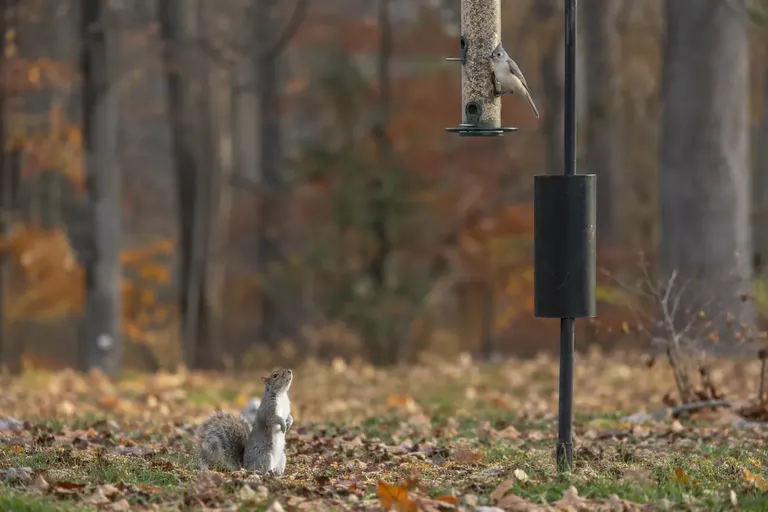
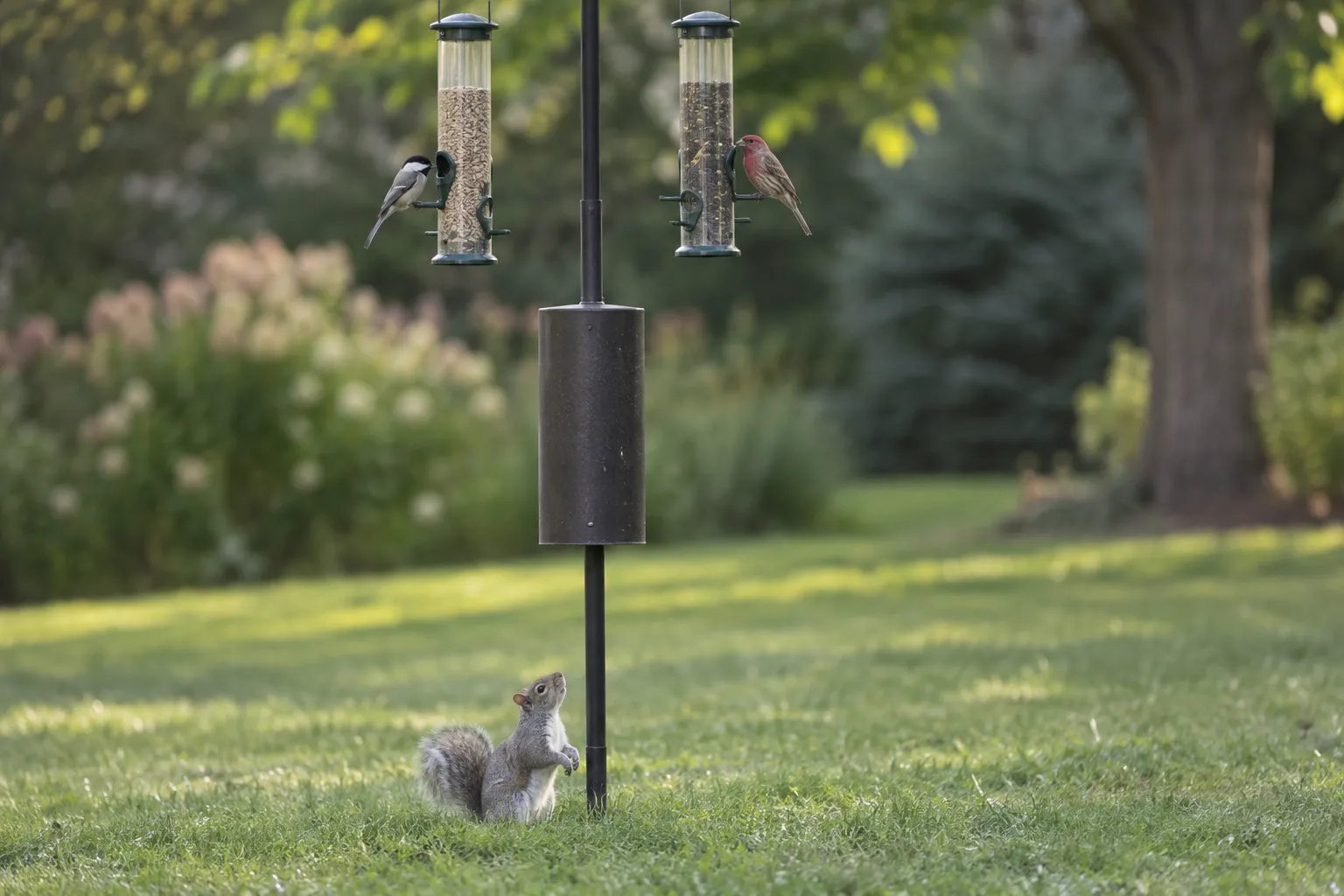
A squirrel baffle is a physical barrier placed between a squirrel and your bird feeder. It does not repel squirrels with taste, smell or spikes. It simply removes the route. A squirrel climbing a pole reaches the baffle and finds a smooth, often wobbling surface it cannot grip or get around. A squirrel dropping from above lands on a slippery dome and slides off.
Baffles are the method that bird feeding organizations recommend first. Project FeederWatch, run by the Cornell Lab of Ornithology and Birds Canada, describes baffles as usually the best way to keep squirrels away from feeders. They are cheap, silent, harmless to the animal and they do not change what birds eat.
The catch is that squirrels are very good at finding the one gap you left. So a baffle is less a product than a system: the pole, the baffle, the feeder position and the distance to surrounding objects all have to line up. For the bigger picture of what works, see our guide on how to keep squirrels off bird feeders.
How far can a squirrel jump?
Everything about baffle placement flows from two numbers: how high a squirrel can jump from the ground and how far it can leap across a gap.
- Straight up: Wild Birds Unlimited puts the vertical jump of a squirrel at about 3.5 feet. Other feeder specialists cite about 4 feet. Building your setup around 4 feet, plus a margin, covers both.
- Across: squirrels routinely leap 8 to 10 feet between surfaces, and Project FeederWatch warns that squirrels can reach feeders placed less than 10 feet from a tree or building.
- Down: squirrels will drop onto a feeder or baffle from a branch or roof above. A fall from height lets them cover more horizontal distance, so an overhanging limb 10 feet up is still a launch point even if the trunk is far away.
Most guidance is built around eastern gray squirrels. When in doubt, add distance and height.
Types of squirrel baffles
There are four common designs. Each one suits a different mounting and a different pest.
Cone baffles (pole-mounted)
A cone baffle is a wide, shallow metal cone that clamps around a pole with its point up and its skirt down. A climbing squirrel reaches the underside and cannot get past the rim. Many are made in a “wrap-around” style that opens along a seam, so you can fit it to a pole that is already set in the ground without taking the feeders off.
- Good for: squirrels climbing a pole.
- Size to look for: 18 inches across or more.
- Weak spot: raccoons. With their longer reach and hand-like paws, raccoons can sometimes grab past a cone rim.
Cylinder or stovepipe baffles (pole-mounted)
A cylinder baffle is a closed metal tube, usually about 8 inches in diameter and around 24 inches long, mounted around the pole on a bracket with the open end facing down. A squirrel or raccoon climbing up ends up inside the tube with nothing to grip and no way past the closed top. Bluebird groups have used this “stovepipe” design on nest box poles for decades because it also stops snakes. Sialis.org, a leading bluebird resource, recommends an 8-inch-wide, 24-inch-long baffle mounted with its bottom at least four feet off the ground.
- Good for: squirrels and raccoons. This is the design to choose if raccoons visit at night.
- Size to look for: 8 inches wide or wider and roughly 24 inches long.
- Weak spot: fits specific pole diameters, so check the bracket before you buy.
Dome baffles (hanging)
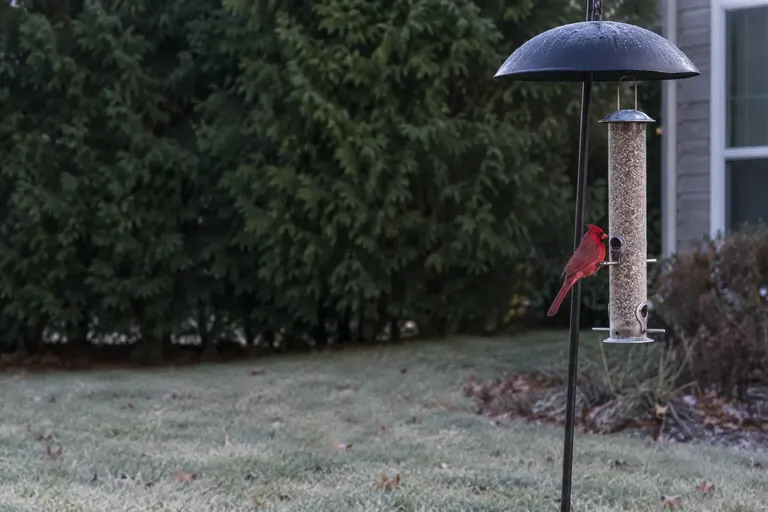
A dome baffle hangs above a feeder, like an umbrella. Squirrels coming down a hanger, from a branch or from a shepherd’s hook land on a slippery curved surface and slide off. Many hanging domes also tilt when touched, which throws the squirrel off. Project FeederWatch recommends a tilting baffle at least 18 inches in diameter placed above the feeder. Domes also keep rain and snow off seed, which helps feeders stay cleaner.
- Good for: feeders hung from a line, a tree limb or a hook where squirrels come from above.
- Size to look for: at least 18 inches across, and wider for large feeders.
- Weak spot: does nothing if a squirrel can jump to the feeder from the side or from the ground.
Post-mounted baffles for 4x4s
Square wooden posts need their own baffle design. Post baffles either wrap around the 4x4 as a wide flat disc or cone, or form a cylinder that fits over the post. They serve people who mount platform feeders or hopper feeders on a fence-style post.
Line baffles and spinning tubes
For feeders hung from a horizontal wire between two supports, Project FeederWatch suggests threading lengths of plastic tubing onto the line. The tubing spins when a squirrel steps on it, and the squirrel falls. Rows of discs or old plastic bottles work on the same principle.
What size squirrel baffle do you need?
Size depends on the design, but the logic is the same: the baffle has to be wider or longer than a squirrel can reach around.
| Baffle type | Mounting | Size to look for | Stops squirrels | Stops raccoons | Best use |
|---|---|---|---|---|---|
| Cone | Round pole | 18 in diameter or wider | Yes, if placed right | Sometimes | Squirrel-only yards, retrofit on existing pole |
| Cylinder (stovepipe) | Round pole | About 8 in wide, 24 in long | Yes | Yes, usually | Yards with raccoons, nest box poles |
| Hanging dome | Above feeder | 18 in diameter or wider | From above only | From above only | Feeders on lines, limbs or hooks |
| 4x4 post wrap | Square wood post | Wide disc or 8 in cylinder | Yes, if placed right | Varies | Platform or hopper on a post |
| Spinning tubes | Horizontal wire | Covers full line length | From the line only | Limited | Feeders hung between two supports |
Two extra points on sizing:
- Match the pole diameter. Most pole baffles are built around standard feeder pole sizes. If the bracket is loose, the baffle can slide down. If it is too tight, it will not seat.
- Match the feeder width to a hanging dome. A dome should extend past the feeder on every side. If a squirrel can hang off the dome rim and reach the feeder below, the dome is too small or the feeder is hanging too close under it.
Where to place a squirrel baffle on a pole
This is where most setups fail. Here is the step-by-step order that works.
Step 1: Choose the spot before you dig
Walk the yard with a tape measure. Mark a point at least 10 feet from every tree trunk, fence, deck rail, shed, wall, railing, clothesline pole and parked trailer. Look up as well. If a branch or roofline hangs over the spot, move farther away or plan to trim.
Balance that with bird safety. Birds like cover within flying distance, and the Cornell Lab’s FeederWatch team suggests feeders near natural cover but around 10 feet from dense brush where predators can hide. Also think about windows. Feeders are safest either very close to glass, within about 3 feet, or well away from it. Our guide to where to put a bird feeder walks through those trade-offs, and how to stop birds hitting windows covers the glass side.
Step 2: Set the pole straight and solid
A leaning pole makes the baffle sit crooked. Sink the pole deep enough that it does not rock in wet soil, and check it with a level. Smooth metal is harder to climb than wood, but the baffle does the real work.
Step 3: Mount the baffle with its top at 4 feet or higher
Measure from the ground to the top edge of the baffle. It should be at least 48 inches. If your squirrels are unusually determined, go to 54 to 60 inches. On uneven ground, measure from the highest point a squirrel could jump from, such as a landscape rock, edging, or a raised bed next to the pole.
Step 4: Hang feeders above the baffle and keep them close
Every feeder must sit higher than the baffle. There are two failure modes here:
- Feeder too low: if a feeder hangs beside or just below the baffle rim, a squirrel on the ground can jump straight to the feeder and skip the pole entirely.
- Feeder arm too long: a long side arm can carry the feeder out past the edge of the baffle. That puts the feeder over open ground where a squirrel can leap to it.
One feeder specialist documented a squirrel beating a well-placed baffle after the collar was moved just two inches higher, because it created a perch spot below the baffle from which the squirrel could spring to a platform feeder. Small changes matter. After you set up, stand back and look for any point from which a squirrel could jump 4 feet up or 8 to 10 feet across to a feeder.
Step 5: Clean up the ground below
Seed that falls to the ground feeds squirrels anyway and teaches them to hang around the pole. A seed tray under the feeders, no-waste blends, or foods squirrels dislike can cut that down. See our picks for bird food squirrels won’t eat and our notes on safflower seed.
Where to place a hanging dome baffle
Hanging domes solve a different problem: squirrels coming from above.
- Hang the dome directly above the feeder, centered on the same hanger.
- Leave a short gap between the dome and the feeder top, just enough to lift the feeder lid for refills. A large gap lets a squirrel slip under the dome edge and drop onto the feeder.
- Keep the whole assembly out of side reach. The feeder still needs to hang at least 10 feet from any trunk, wall or perch, and high enough that a squirrel on the ground cannot jump to its bottom. Aim for the feeder bottom to be at least 5 feet up.
- For feeders on a wire, combine the dome with spinning tubes on the line so squirrels cannot walk to the dome in the first place.
Hanging a feeder from a tree limb with a dome above it rarely works on its own, because the squirrel can often jump from the trunk or a nearby branch. It works best on a long horizontal line strung between two supports that are far apart.
Squirrel baffles vs raccoons, chipmunks and bears
Squirrels are not the only animals that climb.
- Raccoons: they are heavier, taller when standing and use their front paws like hands. A long cylinder baffle on a smooth pole is the most reliable defense. Sialis.org notes that raccoons have gotten around metal cone guards on poles, even those 36 inches in diameter. If you see raccoons, switch to a stovepipe baffle or bring feeders inside at dusk, which Project FeederWatch suggests for animals that visit only at night.
- Chipmunks: small and good climbers, but the same baffle that stops a gray squirrel will stop a chipmunk climbing the pole. They usually go for fallen seed instead.
- Bears: no baffle stops a bear. Project FeederWatch recommends against any feeding when bears are active, only while they are hibernating. Feeding bears near homes puts the bears at risk.
Do squirrel-proof feeders replace baffles?
They solve a different part of the problem. Weight-activated feeders close their ports when a squirrel’s weight lands on the perch, and caged feeders keep large animals from the seed. But a squirrel that can reach the feeder will still sit on it, chew it and scare birds away.
The strongest setup combines both: a baffled pole in a good location, plus a squirrel-resistant feeder as a backup. Our roundup of the best squirrel-proof bird feeders covers the designs, and the best bird feeder poles and baffles covers complete pole systems.
Common squirrel baffle mistakes
- Mounting the baffle too low. A baffle at 3 feet looks tall but a squirrel can simply jump over it. Measure to the top edge, not the bottom.
- Putting the pole near a launch point. Fences, deck rails and patio furniture count. So do bird baths, garden sculptures and the grill you moved beside the pole for summer.
- Forgetting what is overhead. A branch 12 feet up and 6 feet to the side can still be a launch point, because gravity helps the squirrel cover distance.
- Using a baffle that is too small. Cones under 18 inches and short cylinders give squirrels a reachable rim.
- Letting feeders dangle beside the baffle. Feeders must be above the baffle and inside its footprint.
- A baffle that slides. If the bracket slips, the baffle creeps down the pole over time. Recheck height after storms or heavy snow.
- Snow drifts. In northern winters, deep snow effectively raises the ground. Squirrels standing on a 2-foot drift gain 2 feet of height. Clear snow around the pole or raise the baffle.
- Expecting a baffle to fix a bad spot. If there is no place in your yard that is 10 feet from everything, consider a squirrel-proof feeder, a different food, or feeding only what birds clear in a day.
Seasonal squirrel baffle checklist
- Spring: check the pole is still straight after freeze and thaw. Trim new growth nearby.
- Summer: watch for plants or furniture creeping within jumping range.
- Fall: recheck height as leaves and mulch build up at the base.
- Winter: clear drifts, and knock heavy snow off domes so they can tilt.
How we chose the baffles in this guide
We have not installed or tested these baffles ourselves. The picks come from comparing manufacturer specifications, published dimensions, independent guidance from bird organizations such as Project FeederWatch and bluebird societies on which baffle designs and sizes work, and patterns in verified owner feedback. We prioritized designs that meet the size thresholds described above: at least 18 inches across for cone and dome baffles, and about 8 inches by 24 inches for cylinders.
Songbird Essentials Predator Defeater Raccoon and Squirrel Baffle
A 24-inch-long, 8-inch-diameter cylinder for round feeder poles. On paper it matches the stovepipe dimensions that bluebird groups use against climbing predators, which makes it the safer choice when raccoons are in the picture as well as squirrels. Owners commonly report that installation is straightforward on standard poles; check the bracket fits your pole diameter before you order.
Skip it if you mount feeders on a square wooden post or a hanging line.
Woodlink Audubon Wrap Around Squirrel Baffle, 18-Inch
An 18-inch steel cone with a wrap-around design, so it can go on a pole that is already in the ground without removing feeders. Woodlink lists it at 18 by 18 by 7 inches and 2.8 pounds. It is a simple fix for squirrel-only yards. Cones are less reliable against raccoons than long cylinders.
Skip it if raccoons are your main problem.
Erva Post Mounted Squirrel Baffle for 4x4 Posts
Erva makes baffles specifically for square wooden posts, including a galvanized wrap-around version listed at 23.25 inches in diameter. That width gives a generous margin over the 18-inch minimum. It solves the specific problem of platform and hopper feeders mounted on a 4x4.
Skip it if you use a standard round metal pole.
Sources
- Project FeederWatch: Other Feeder Visitors (squirrels, baffles, bears, raccoons)
- Project FeederWatch: Feeding Birds (placement and cleaning)
- Sialis.org: Baffles for nest boxes and predator guards
- Wild Birds Unlimited: Feeder placement and squirrel jumping height
- Birdseed and Binoculars: The right way to baffle feeders on a pole
- Woodlink: 18-inch Wrap Around Squirrel Baffle specifications
Gear mentioned in this guide
Songbird Essentials Predator Defeater Raccoon and Squirrel Baffle
A stovepipe-style cylinder that stops both squirrels and raccoons on a round feeder pole, the design most bluebird and feeder experts favor for climbing predators.
- Best for
- Pole systems where raccoons also raid feeders at night.
- Skip it if
- You feed from a 4x4 wooden post or a hanging line; it is designed for round poles.
- Type
- Pole-mounted cylinder (stovepipe)
- Diameter
- 8 in
- Height
- 24 in
Woodlink Audubon Wrap Around Squirrel Baffle, 18-Inch
A wrap-around steel cone that installs on an existing pole without removing the feeders, at the 18-inch width that squirrel guidance treats as the practical minimum.
- Best for
- Squirrel-only yards where you want to add a baffle to a pole that is already set in the ground.
- Skip it if
- Raccoons are your main problem; they can reach around cone baffles more easily than cylinders.
- Type
- Pole-mounted wrap-around cone
- Diameter
- 18 in
- Weight
- 2.8 lb
Erva Post Mounted Squirrel Baffle for 4x4 Posts
A wide steel wrap-around baffle made for square wooden posts, a mounting problem most round-pole baffles cannot solve.
- Best for
- Feeders or platform trays mounted on a 4x4 post.
- Skip it if
- You use a standard round metal feeder pole.
- Type
- Post-mounted wrap-around
- Fits
- 4x4 wooden posts
- Diameter
- 23.25 in (galvanized version)
Frequently asked questions
How high should a squirrel baffle be off the ground?
Mount a pole baffle so its top edge is at least 4 feet off the ground, and 4.5 to 5 feet is safer in yards with athletic squirrels. Wild Birds Unlimited notes squirrels can jump about 3.5 feet straight up, and other sources put it near 4 feet, so a lower baffle simply gets jumped over. The feeders then hang above the baffle, not beside it.
How far from a tree should a baffled feeder pole be?
At least 10 feet from any tree trunk, branch, fence, deck rail, roof edge or wall. Project FeederWatch warns that squirrels can jump to feeders placed less than ten feet from a tree or building. Check overhead too, because a squirrel can drop onto a feeder from a limb several feet above it.
What size squirrel baffle do I need?
For a hanging or cone baffle, 18 inches in diameter is the practical minimum that Project FeederWatch cites for tilting baffles above feeders. For pole-mounted cylinder baffles, 8 inches wide and about 24 inches long is the widely used standard, because it gives a climbing squirrel or raccoon nothing to grip and too much length to reach around.
Do squirrel baffles stop raccoons?
Long cylinder baffles on a smooth pole stop most raccoons. Cone baffles are less reliable: Sialis.org, a bluebird resource, notes raccoons have been known to get around metal cone guards on poles, even ones 36 inches across. If raccoons empty your feeders at night, use a stovepipe baffle or bring feeders in at dusk.
Should a squirrel baffle wobble?
A little wobble helps. A baffle that tilts or rocks when a squirrel grabs it gives no stable foothold, which is why many commercial baffles are designed to swing slightly. It should still sit securely on its bracket so it cannot slide down the pole or be pushed up.