Solar Bird Bath Fountain: 6 Best Picks for Moving Water
The best solar bird bath fountain for most yards is a floating 3.5W pump with battery backup. 6 picks, a sun-hours sizing chart and a clog-free cleaning plan.
If you buy through links on this page we may earn a commission, at no cost to you. It never decides what we recommend. How we earn
In this article
- Quick picks
- How we chose
- AISITIN 3.5W Solar Fountain Pump with 1500mAh Battery: best overall
- Smart Solar SunJet 150 Solar Pump and Panel (21410R01): best for shady baths
- Mademax 1.4W Solar Fountain Pump with 8 Nozzles: best budget
- Alpine Corporation TZL202SLR Solar Birdbath Fountain with LED Lights: best all-in-one
- AISITIN 6.5W Solar Fountain Pump with Battery Backup: best for more spray
- AISITIN 2.5W DIY Solar Fountain Pump with 4 ft Hose: best DIY kit
- Solar bird bath fountain comparison table
- How many hours of sun does a solar bird bath fountain need?
- What size solar fountain do you need for your bird bath?
- Where should you put a solar bird bath fountain?
- How do you keep a solar fountain from clogging?
- How do you keep algae out of a solar bird bath?
- Are solar bird bath fountains noisy?
- Which birds are attracted to moving water?
- How much does a solar bird bath fountain cost to run?
- Solar fountain vs plug-in fountain vs water agitator
- Do solar fountains work in winter?
- Buyer’s checklist
- Sources
- Frequently asked questions
A solar bird bath fountain is a small solar-powered pump that makes the water in a bird bath spray, bubble or ripple, and the best one for most yards is the AISITIN 3.5W Solar Fountain Pump with its 1,500 mAh battery. Its panel is big enough for steady spray, and the battery bridges short clouds. If your bath is shaded, buy a separate-panel pump instead.
Quick picks
- Best overall: AISITIN 3.5W Solar Fountain Pump with 1500mAh Battery
- Best for shady baths: Smart Solar SunJet 150 Solar Pump and Panel (21410R01)
- Best budget: Mademax 1.4W Solar Fountain Pump with 8 Nozzles
- Best all-in-one: Alpine Corporation TZL202SLR Solar Birdbath Fountain with LED Lights
- Best for more spray: AISITIN 6.5W Solar Fountain Pump with Battery Backup
- Best DIY kit: AISITIN 2.5W DIY Solar Fountain Pump with 4 ft Hose
AISITIN 3.5W Solar Fountain Pump with 1500mAh Battery
A floating solar fountain with a larger panel than most and a battery that keeps it running through short cloudy spells.
- Best for
- Most existing bird baths that get partial to full sun.
- Skip it if
- Your bath is under 12 inches across or under 1.5 inches deep.
- Panel
- 3.5 W
- Battery
- 1,500 mAh built-in
- Nozzles
- 10, plus 4 fixers
Smart Solar SunJet 150 Solar Pump and Panel (21410R01)
A submersible pump wired to a separate stake-mounted panel, so the bath can sit in shade while the panel sits in sun.
- Best for
- Baths under trees or near cover where a floating panel would sit in shade.
- Skip it if
- You want night or cloudy-day running; no battery is listed.
- Flow
- About 40 gal (150 L) per hour
- Cable
- 10 ft (3 m) to panel
- Fountain heads
- 4 included
Mademax 1.4W Solar Fountain Pump with 8 Nozzles
A small, simple floating fountain for trying moving water in a bath you already own.
- Best for
- First-time buyers with a bath in strong, all-day sun.
- Skip it if
- Your bath gets less than full sun or you want spray on cloudy days.
- Panel
- 1.4 W
- Nozzles
- 8
- Brackets
- 4 included
Alpine Corporation TZL202SLR Solar Birdbath Fountain with LED Lights
A complete resin pedestal bath with a solar pump and LED lights built in, for buyers who want one box and no fitting.
- Best for
- Buyers starting from scratch who want a matched bath and fountain.
- Skip it if
- You care most about bath depth and cleaning access over looks.
- Height
- 29 in
- Material
- Resin
- Extras
- Solar pump and LED lights included
AISITIN 6.5W Solar Fountain Pump with Battery Backup
The larger AISITIN floating unit, for wide baths and shallow garden basins that need more push.
- Best for
- Wide basins 18 inches and up, and yards with frequent cloud.
- Skip it if
- Your bath is small; the spray will throw water over the rim.
- Panel
- 6.5 W
- Battery
- Built-in backup
- Nozzles
- 6
AISITIN 2.5W DIY Solar Fountain Pump with 4 ft Hose
A small submersible pump on a hose with a separate panel, for building a bubbler rock or a custom basin.
- Best for
- DIY builders who want to hide the pump under a stone or in a pot.
- Skip it if
- You want drop-in, no-fiddle setup.
- Panel
- 2.5 W
- Nozzles
- 6
- Hose
- 4 ft
How we chose
We have not physically tested these fountains. Picks are based on manufacturer specifications and product documentation, the retailer listings that confirm each model is currently sold, patterns in verified owner feedback (what breaks, what clogs, what disappoints), and guidance on water and birds from the Cornell Lab of Ornithology and the National Audubon Society.
We favored enough panel or battery to run in real light, easy cleaning and a low spray option. Unconfirmed specs were left out.
AISITIN 3.5W Solar Fountain Pump with 1500mAh Battery: best overall
This is a round floating fountain: the solar panel, pump and battery sit in one disc that drifts on the water and pushes a spray up through a nozzle in the center.
Who it suits: Owners of an existing pedestal or ground bath that gets at least a few hours of direct sun.
Key specs: 3.5 W panel, 1,500 mAh built-in battery, 10 interchangeable nozzles, and 4 fixers that hold the disc in the center of the bath.
Strengths: The 3.5 W panel is larger than the 1 to 1.5 W panels on entry-level floaters, which means more lift when light is weak. The battery stores surplus charge on bright days, so owners commonly report that it keeps going through brief cloud cover instead of stopping every time a shadow passes. The fixers stop the disc drifting to the edge and spraying onto the lawn.
Drawbacks: A floating unit needs enough water to float, so shallow decorative basins can be a problem. Its small intake clogs with seed hulls and algae if not rinsed.
Skip it if: Your bath is under about 12 inches (30 cm) across or holds less than 1.5 inches (4 cm) of water. A strong spray will empty a small bath fast.
Smart Solar SunJet 150 Solar Pump and Panel (21410R01): best for shady baths
The SunJet 150 separates the two parts that floating fountains combine. A small submersible pump sits in the bath, and a solar panel on a ground stake connects to it by cable.
Who it suits: Anyone whose bath sits near trees, shrubs or a fence line, which is often the right place for birds but the wrong place for a floating panel.
Key specs: Rated at about 40 gallons (150 liters) per hour, a 10 ft (3 m) cable to the panel, four fountain heads, a filter and a foam float disc.
Strengths: This is the design to buy if shade is your problem. You can keep the bath 10 to 15 feet from cover, as birds prefer, and move the panel into full sun within cable reach. Several fountain heads let you choose a gentle bubble instead of a tall jet.
Drawbacks: No battery is listed, so it runs only while the panel gets sun. Submersible pumps sit on the bottom, where debris settles, so the filter needs regular rinsing.
Skip it if: You want spray on cloudy days or into the evening.
Mademax 1.4W Solar Fountain Pump with 8 Nozzles: best budget
A small floating disc with a 1.4 W panel, eight nozzle shapes and four brackets to keep it centered.
Who it suits: Anyone who wants to test whether moving water changes the birds at their bath before buying something bigger.
Key specs: 1.4 W panel, 8 nozzles, 4 brackets.
Strengths: Simple, light and drops into almost any bath. In strong sun a small panel makes a low spray, and a gentle pattern often suits birds better than a tall jet.
Drawbacks: Owner feedback on small, battery-free floaters is consistent: they run only in direct sun and slow or stop under cloud or light shade.
Skip it if: Your bath gets less than full sun, or you want water moving from early morning, when many birds bathe.
Alpine Corporation TZL202SLR Solar Birdbath Fountain with LED Lights: best all-in-one
A 29-inch resin pedestal bird bath with a solar pump and LED lights built in, sold as one unit.
Who it suits: Buyers starting from scratch who want a matched bath and fountain without fitting a pump themselves.
Key specs: 29 in tall, resin construction, solar pump and LED lights included.
Strengths: Everything arrives together, so there is no guessing about basin size or pump strength. The pedestal height keeps bathing birds above a cat waiting in the grass.
Drawbacks: Decorative fountain baths are designed to look good first. Check the basin depth and texture on arrival: if it is deeper than 2 inches or glassy smooth, add a flat stone or clean gravel so small birds can stand. Built-in pumps are harder to reach for cleaning than a floating disc, and owners of decorative solar fountains commonly mention that the pump needs regular attention to keep flowing.
Skip it if: You already own a good bath. A separate pump is the better value.
AISITIN 6.5W Solar Fountain Pump with Battery Backup: best for more spray
The larger AISITIN floating model, with a 6.5 W panel, battery backup and six nozzles.
Who it suits: Owners of wide baths and shallow garden basins, and anyone in a region with frequent cloud.
Key specs: 6.5 W panel, built-in battery backup, 6 nozzles.
Strengths: More panel means more power in poor light and more battery charging on bright days.
Drawbacks: More power is not better in a small bath. A strong spray throws water over the rim, drains the bath in hours on a hot day, and can make small birds wary.
Skip it if: Your bath is under about 18 inches (45 cm) across.
AISITIN 2.5W DIY Solar Fountain Pump with 4 ft Hose: best DIY kit
A small submersible pump connected by a 4 ft hose, with a 2.5 W panel and six nozzles.
Who it suits: Gardeners who want to build a bubbling rock, a drilled urn or a pot fountain, or who want to hide the pump entirely.
Key specs: 2.5 W panel, 6 nozzles, 4 ft hose.
Strengths: Because the pump sits under the water and the hose carries the flow, you can set up a thin sheet of water over a flat stone, which is one of the most bird-friendly water features you can make.
Drawbacks: It needs building. You will need a reservoir, a way to hide the pump and a way to return water. No battery is listed, so it runs in sun only.
Skip it if: You want a drop-in fountain for an existing bath.
Solar bird bath fountain comparison table
| Pick | Type | Panel | Battery | Best bath size | Main limitation |
|---|---|---|---|---|---|
| AISITIN 3.5W with 1500mAh | Floating | 3.5 W | Yes, 1,500 mAh | 12 to 20 in | Needs 1.5 in or more of water |
| Smart Solar SunJet 150 | Submersible, separate panel | Not listed | Not listed | 12 in and up | Sun-only running |
| Mademax 1.4W | Floating | 1.4 W | Not listed | 12 to 16 in | Stops in cloud or shade |
| Alpine TZL202SLR | All-in-one pedestal | Not listed | Not listed | Built in | Harder pump access |
| AISITIN 6.5W | Floating | 6.5 W | Yes | 18 in and up | Too strong for small baths |
| AISITIN 2.5W DIY | Submersible, hose | 2.5 W | Not listed | Custom build | Requires a DIY setup |
How many hours of sun does a solar bird bath fountain need?
For a battery-free floating fountain, plan on direct midday sun on the panel; light shade or cloud slows or stops most small units. Battery backup and separate panels widen the options. Use the sizing chart below, our own rule of thumb built from manufacturer guidance and owner-review patterns, to match the fountain to your spot.
Sun-hours sizing chart
| Direct sun on the bath | What to buy | Why |
|---|---|---|
| 6 or more hours | Any floating fountain, 1.4 W and up | Enough light for steady spray through the middle of the day |
| 3 to 6 hours | Floating fountain with battery, 3.5 W or more | Battery covers the gaps when shade or cloud passes |
| Under 3 hours, but sun nearby | Separate-panel pump like the SunJet 150 | Put the panel in sun and keep the bath near cover |
| Under 3 hours, no sun nearby | Skip solar; use a plug-in dripper or a battery agitator | Solar will run too little to matter |
Check the spot at 9 a.m., noon and 3 p.m. on a clear day. Seasons shift shade: full sun in June can be tree shade by September.
What size solar fountain do you need for your bird bath?
Match the fountain to the basin: small floaters for baths around 12 to 16 inches (30 to 40 cm), 3.5 W units for most 14 to 20 inch baths, and 6.5 W units only for wide basins. The goal is a spray that lands back inside the bath.
Three measurements matter:
- Diameter. The floating disc should cover no more than about a third of the surface, so birds still have room to stand.
- Depth at the center. Floaters need water to float and an intake that stays submerged. If your bath is very shallow at the middle, choose a submersible pump.
- Edge slope. Birds wade in from the rim. A basin that slopes from a thin edge to a deeper middle suits both birds and pumps.
If you are still choosing the bath itself, our roundup of the best bird baths by type covers depth, material and height in detail.
Where should you put a solar bird bath fountain?
Put it in open ground about 10 to 15 feet (3 to 5 m) from shrubs or trees, in the sunniest spot that still meets that rule. Birds want a quick escape route, but dense cover right beside a bath lets cats hide.
Solar adds one more constraint: the panel needs light. If the best bird spot and the sunniest spot are not the same, choose a separate-panel pump rather than moving the bath into a worse location. Keep it away from feeders so hulls do not clog the pump. Our guide to where to put a bird bath covers windows, balconies and hot climates, and if cats visit your yard, read how to keep cats away from birds before you place anything at ground level.

How do you keep a solar fountain from clogging?
Rinse the pump every time you clean the bath, which should be every few days in warm weather. Clogging is the number one complaint in owner reviews of every type of solar fountain, and it is almost always a maintenance issue, not a defect.
A simple routine:
- Lift it out. There is no mains power, so no unplugging.
- Open the pump. Most floating units have a twist-off cover over the impeller and a foam or mesh filter at the intake.
- Rinse the filter under a hose or tap until the water runs clear.
- Check the impeller for hair, grass or string wound around it, and pull it free.
- Wipe the panel with a soft damp cloth. Dust, pollen and bird droppings cut output.
- Soak stubborn scale in a cup of white vinegar and water, then rinse well.
How do you keep algae out of a solar bird bath?
Change the water every two to three days and scrub the basin weekly. Solar fountains sit in sun by design, and sun plus still or warm water grows algae quickly, so a solar setup needs more cleaning than a shaded bath, not less.
Moving water slows algae a little but does not stop it. Scrub the basin with a stiff brush. For a deeper clean, the Cornell Lab’s Project FeederWatch recommends a solution of 1 part household bleach to 9 parts water, followed by a thorough rinse. Never add algaecides, dyes or “bird bath enzymes” that are not clearly labeled as safe for wildlife. Frequent water changes also stop mosquitoes, whose larvae need several days of standing water. Our step-by-step guide to cleaning a bird bath without harming birds covers scrubbing, rinsing and what to avoid.
Are solar bird bath fountains noisy?
No. The pumps are close to silent, and the sound you hear is water splashing, which is the point. A low bubbler makes a soft trickle; a tall jet makes more splash and more sound.
For sound without water loss, use a dome or bubbler nozzle and keep spray below a few inches, which also stops wind blowing water over the rim.
Which birds are attracted to moving water?
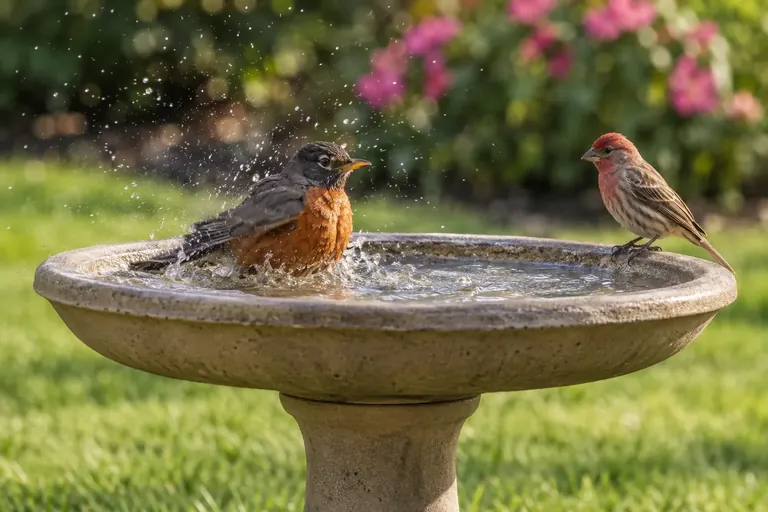
Most backyard birds that drink and bathe will use a fountain bath, and moving water can draw species that seldom visit still water. The Cornell Lab and Audubon both note that the sound and glint of moving or dripping water helps birds find a bath.
Common visitors to baths with moving water include:
- Thrushes and relatives. American Robins and bluebirds bathe often and seem to notice splash from a distance.
- Warblers and vireos. These insect-eaters rarely visit feeders, but migrating warblers are among the birds most often seen at dripping or bubbling water.
- Hummingbirds. They rarely stand in a bath, but some, including Anna’s Hummingbirds, are known to fly through fine spray or mist to bathe.
- Finches, sparrows, cardinals and chickadees. Regular bath users that will come to a fountain bath as readily as a still one.
Birds also drink in different ways, and some sip from droplets on a bubbler dome. We explain the mechanics in how do birds drink water.
How much does a solar bird bath fountain cost to run?
Nothing to run: it uses sunlight, not electricity. Upfront, a floating pump for an existing bath is the cheapest route, a separate-panel pump sits in the middle, and a complete fountain bath costs the most because you are also buying the basin.
Hidden costs are replacement pumps after a few seasons and aging battery cells that shorten run time.
Solar fountain vs plug-in fountain vs water agitator
Choose solar when your bath gets good sun and you have no outdoor outlet nearby. Choose a plug-in pump when you need reliable all-day flow, and a battery water agitator when you want ripples in a shady spot with no wiring.
- Plug-in pump. Runs regardless of weather, but needs an outdoor GFCI outlet and a cord route across the yard.
- Battery agitator. Devices like the Allied Precision Water Wiggler sit in the bath and ripple the surface using batteries, not sun. There is no spray, but the moving surface catches light and helps birds notice the water.
- Dripper. A slow drip is a classic warbler attractant but needs a water supply.
Do solar fountains work in winter?
Not reliably. Short days and low sun limit output, and freezing water can crack pump housings. Most manufacturers advise bringing floating pumps indoors before frost.
For winter water, switch to a heated bath or a de-icer. Our guide to keeping a bird bath ice-free in winter explains the safe options.
Buyer’s checklist
Use this before you order:
- Sun check: How many hours of direct sun does the bath get? Use the sizing chart above.
- Basin width: Measure across. Under 12 inches, pick the smallest floater or a submersible bubbler.
- Center depth: Is there at least 1.5 inches of water in the middle? If not, avoid floaters.
- Battery: Do you want water moving in the early morning, when many birds bathe? Choose battery backup.
- Spray control: Does it include a low dome or bubbler nozzle?
- Centering: Are fixers or brackets included to stop drifting?
- Cleaning access: Can you open the pump by hand to rinse the filter and impeller?
- Storage: Do you have a frost-free place to keep it over winter?
Sources
- Project FeederWatch, Cornell Lab of Ornithology: Feeding birds
- Cornell Lab of Ornithology, All About Birds
- National Audubon Society
- AISITIN: 3.5W Solar Fountain Pump with 1500mAh Battery
- Smart Solar SunJet 150 product listing, DoMyOwn
- Alpine Corporation TZL202SLR Solar Birdbath Fountain, Lowe’s
- Mademax solar fountains
- US Centers for Disease Control and Prevention: Mosquitoes
Frequently asked questions
Do solar bird bath fountains work in the shade?
Not well. A floating solar fountain runs directly off its panel, so shade from a branch or a passing cloud slows or stops the spray. Models with a built-in battery can run for a while after the sun drops. If your bath sits in shade, choose a pump with a separate panel and cable, such as the Smart Solar SunJet 150, and stake the panel in the sunniest spot within cable reach.
How deep should the water be for a solar fountain?
Most floating solar fountains need enough water to float freely and keep the pump intake submerged, so plan on at least 1.5 to 2 inches (4 to 5 cm) in the center of the bath. That is still within the range songbirds use. Top up daily in hot weather, because spray and evaporation drop the level quickly, and a pump that runs dry can wear out.
Why does my solar fountain keep stopping?
The usual causes are weak sun, a dirty panel, low water or a clogged intake. Wipe the panel with a soft damp cloth, raise the water level, and pull the pump apart to rinse the filter sponge and impeller. If it stops and starts with every cloud, the panel is simply too small for your light, and a battery-backup or separate-panel model is the fix.
Do moving water fountains attract more birds?
Generally, yes. Cornell Lab and Audubon both note that the sound and sparkle of moving or dripping water helps birds find a bath, and it can draw species that rarely visit still water, including warblers during migration. A fountain does not replace good placement, though. Birds still need a shallow, safe bath with cover nearby and clean water.
Can I leave a solar fountain out in winter?
Most manufacturers advise bringing floating solar pumps indoors before freezing weather, because ice can crack the housing and damage the pump. Drain, clean and dry the unit, and store it somewhere frost-free. For winter water, switch to a heated bird bath or a de-icer rated for outdoor use, and remove the fountain once nights drop below freezing.