Best Birdhouses: 6 Nest Boxes Birds Actually Use
The best birdhouses have the right hole size, vents, drainage, a clean-out door and no perch. See 6 researched picks for bluebirds, wrens, chickadees and owls.
If you buy through links on this page we may earn a commission, at no cost to you. It never decides what we recommend. How we earn
In this article
- Quick picks
- How we chose
- What makes a birdhouse birds actually use?
- JCs Wildlife Ultimate Eastern and Western Bluebird House: best overall
- Coveside Classic Eastern Bluebird House with Large Roof: best wooden bluebird house
- Coveside Sparrow-Resistant Eastern Bluebird House: best where House Sparrows are common
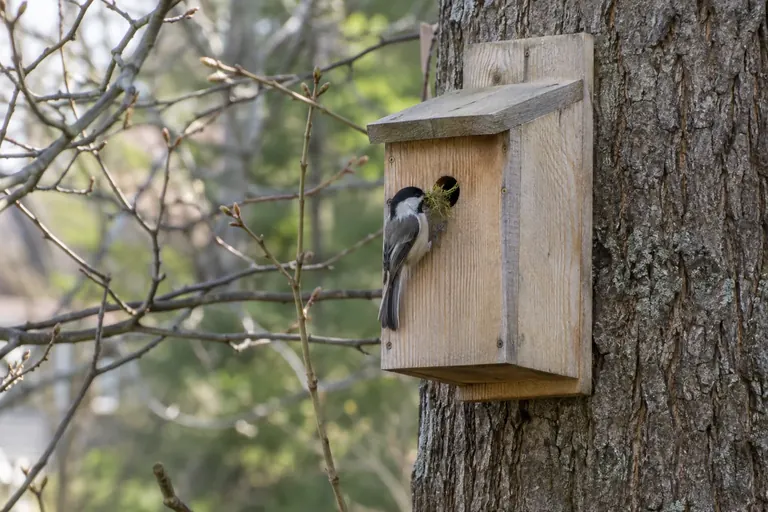
- Nature’s Way CWH1 Cedar Wren House: best for wrens and chickadees
- Schwegler 1B Nest Box: best woodcrete box
- Coveside Saw-Whet and Screech Owl House: best for owls
- Best birdhouses compared
- Which size birdhouse do I need?
- Cedar vs recycled plastic vs woodcrete: which birdhouse material is best?
- Buyer’s checklist: score a birdhouse before you buy
- Where should you put a birdhouse?
- How do you keep a birdhouse clean?
- How much should you spend on a birdhouse?
- Which birds use birdhouses?
- What are the alternatives to buying a birdhouse?
- Sources
- Frequently asked questions
The best birdhouses are simple boxes built for one kind of bird: the right entrance hole (1.5 inches for bluebirds), thick walls, vents, drainage, a door you can open to clean it, and no perch. Based on specs and manufacturer data, the JCs Wildlife Ultimate Bluebird House is the most complete low-maintenance pick, and the Coveside Classic Eastern Bluebird House is the best traditional wooden box.
Many garden birdhouses are decorations with oversized holes, perches, no vents and no way to open them. Birds skip them, or House Sparrows take over. This guide matches real products to the features NestWatch and the North American Bluebird Society recommend.
Quick picks
- Best overall: JCs Wildlife Ultimate Eastern and Western Bluebird House. Recycled poly lumber, entrance guard, separate view and clean doors.
- Best wooden bluebird house: Coveside Classic Eastern Bluebird House with Large Roof. 3/4-inch pine, vents, drainage, entrance block.
- Best where House Sparrows are common: Coveside Sparrow-Resistant Eastern Bluebird House. Slot entrance and adjustable depth.
- Best for wrens and chickadees: Nature’s Way CWH1 Cedar Wren House. 1 1/8-inch hole that excludes House Sparrows.
- Best woodcrete box: Schwegler 1B Nest Box. Wood-concrete, heavy and chew-resistant.
- Best for owls: Coveside Saw-Whet and Screech Owl House. 3-inch hole with wood chips included.
JCs Wildlife Ultimate Eastern and Western Bluebird House
A recycled poly lumber bluebird box with a built-in entrance guard, separate viewing and cleaning doors, and a stainless mesh nest riser that lifts the nest off the floor.
- Best for
- Bluebird landlords who want a box that will not rot, crack or need repainting.
- Skip it if
- You prefer natural wood or want the lightest box to carry along a trail.
- Entrance hole
- 1.5 in (38 mm)
- Size
- 9.5 in W x 12 in H x 8 in D
- Material
- Recycled poly lumber, stainless hardware
Coveside Classic Eastern Bluebird House with Large Roof
A traditional 3/4-inch pine box made in the USA with a deep roof overhang, vent slots, drainage gaps, a wooden entrance block and a lift-up side panel.
- Best for
- People who want a classic wooden box with every functional feature bluebird groups recommend.
- Skip it if
- You want a box you never need to re-stain or check for weathering.
- Entrance hole
- 1.5 in (38 mm)
- Size
- 9.25 in L x 9 in W x 12.5 in H
- Wall thickness
- 0.75 in pine
Coveside Sparrow-Resistant Eastern Bluebird House
A shallow box with a slot entrance and an adjustable depth block, a design built around research showing House Sparrows prefer deeper cavities than bluebirds.
- Best for
- Suburban yards and farm edges where House Sparrows take over standard bluebird boxes.
- Skip it if
- You have no sparrow problem, since a standard round-hole box is simpler and widely accepted.
- Entrance
- Slot, 4 in x 1.25 in
- Size
- About 8.5 in L x 5.75 in W x 10 in H
- Wall thickness
- 0.75 in pine
Nature's Way CWH1 Cedar Wren House
A small cedar house with a 1 1/8-inch hole that admits wrens and chickadees but keeps out House Sparrows, plus a clean-out door and wall and floor vents.
- Best for
- Small yards and gardens with House Wrens, Carolina Wrens or chickadees nearby.
- Skip it if
- You want bluebirds or titmice, which need a larger hole.
- Entrance hole
- 1 1/8 in (29 mm)
- Size
- 8 in H x 8 7/8 in W x 8 1/8 in D
- Weight
- 2 lb
Schwegler 1B Nest Box
A German wood-concrete box that is heavy, stable and resistant to woodpeckers and squirrels, sold with 26 mm, 32 mm or oval entrances.
- Best for
- Wooded yards where squirrels or woodpeckers chew wooden boxes, and European gardens with tits.
- Skip it if
- You need a light box, or you shop mainly in the US, where it is harder to find.
- Entrance options
- 26 mm, 32 mm or 29 x 55 mm oval
- Outside size
- 17 x 26 x 18 cm (6.7 x 10.2 x 7.1 in)
- Weight
- About 3.6 kg (7.9 lb)
Coveside Saw-Whet and Screech Owl House
A US-made pine owl box with a 3-inch entrance, vent slots, drainage holes, a lift-up side panel and an included bag of wood chips for the floor.
- Best for
- Wooded suburbs and rural yards with Eastern or Western Screech-Owls.
- Skip it if
- You cannot safely mount a box 10 feet or more up.
- Entrance hole
- 3 in (76 mm)
- Size
- 11 in L x 9 in W x 17.75 in H
- Material
- Eastern white pine
How we chose
We have not installed or monitored these birdhouses ourselves. This guide is research-based. We compared manufacturer specifications for entrance size, wall thickness, ventilation, drainage, cleaning access and predator protection, using each maker’s own product pages. We checked those features against design guidance from NestWatch and the North American Bluebird Society, and looked for repeated patterns in verified owner feedback, such as boxes that warp, doors that stick or houses that sparrows take over. We excluded houses with perches or no cleaning access, and list only specs confirmed by the manufacturer.
What makes a birdhouse birds actually use?
A birdhouse gets used when it copies a safe natural cavity for one species. The entrance hole decides who can get in: a 1 1/8-inch (29 mm) hole admits chickadees and House Wrens but not House Sparrows, and a 1.5-inch (38 mm) hole admits bluebirds and Tree Swallows but keeps out European Starlings.
After the hole, look for walls about 3/4 inch (19 mm) thick, vents under the roof, drainage in the floor, a panel that opens for cleaning, a rough inside wall below the hole so nestlings can climb out, and no perch. Native cavity nesters do not need a perch, and it gives sparrows and predators a foothold.
JCs Wildlife Ultimate Eastern and Western Bluebird House: best overall
What it is: A bluebird box built from high-density recycled poly lumber with stainless steel hardware, handcrafted in the USA, with separate doors for viewing and cleaning and a stainless steel mesh nest riser.
Who it suits: People who want a bluebird box that lasts for years without repainting and is easy to wash out between broods.
Key specs: JCs lists a 1.5-inch entrance for Eastern and Western Bluebirds (a 1 9/16-inch version exists for Mountain Bluebirds). The house measures 9.5 inches wide, 12 inches high and 8 inches deep. The maker says the poly lumber will not crack, split, warp or fade.
Strengths: A built-in entrance guard deepens the hole, making it harder for a raccoon or cat to reach in. The mesh riser lifts the nest off the floor, which the maker says improves airflow and keeps it dry.
Drawbacks: Poly lumber is heavier than pine, and the internal viewing window adds another part to keep closed.
Skip it if: You want a light, traditional wooden box.
Coveside Classic Eastern Bluebird House with Large Roof: best wooden bluebird house
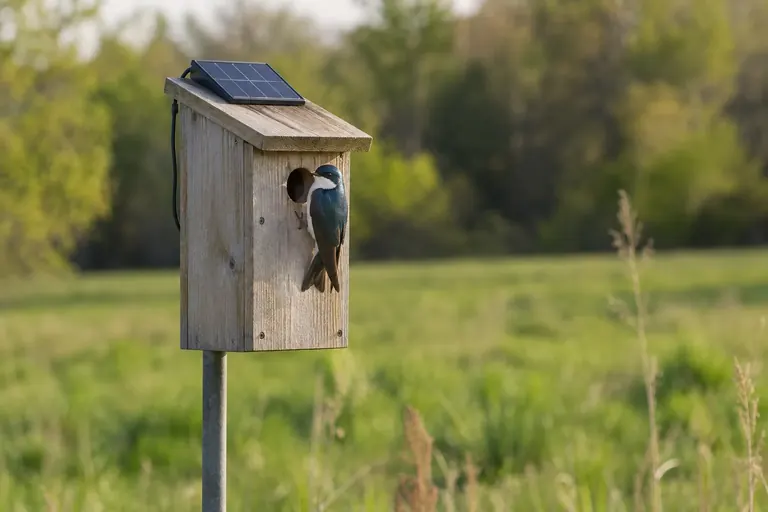
What it is: A traditional pine bluebird box made in the USA by Coveside Conservation Products, with a deep overhanging roof and a wooden block around the entrance.
Who it suits: Anyone who wants a wooden box with every functional feature: thick walls, vents, drainage, a latched door and a predator block.
Key specs: Coveside lists a 1.5-inch entrance, 3/4-inch pine boards and outside dimensions of 9.25 by 9 by 12.5 inches. Vent slots sit under the roof, corner gaps in the floor drain water, and one side panel lifts for nest checks. A small ladder inside the front helps nestlings climb out.
Strengths: Three-quarter-inch wood is the thickness bluebird groups recommend for insulation. The entrance block adds depth to the hole, and the large roof shades the front.
Drawbacks: Pine weathers, so expect to check it each winter and replace it eventually.
Skip it if: You want a box with zero maintenance over a decade.
Coveside Sparrow-Resistant Eastern Bluebird House: best where House Sparrows are common
What it is: A compact pine bluebird box with a horizontal slot entrance and a removable block that makes the cavity shallower.
Who it suits: Yards near buildings, barns or busy feeders, where House Sparrows often claim standard bluebird boxes.
Key specs: The slot is 4 inches long and 1.25 inches high. The box measures about 8.5 by 5.75 by 10 inches in 3/4-inch pine, the front panel pulls up for nest checks, and a 1.5-inch-thick block reduces depth. Coveside says the design is based on University of Kentucky research on sparrow and bluebird preferences.
Strengths: It targets the biggest threat to bluebird boxes in many yards. House Sparrows are non-native and aggressive, and they are known to kill bluebird nestlings and adults in boxes. A shallow cavity with a slot is reported to be less attractive to them.
Drawbacks: It is sparrow-resistant, not sparrow-proof, so you still need to monitor it. The shallow nest also sits closer to the entrance, which makes a baffled pole more important.
Skip it if: You live in open country with few sparrows, where a standard box works fine.
Nature’s Way CWH1 Cedar Wren House: best for wrens and chickadees
What it is: A small hanging cedar house with a 1 1/8-inch entrance, a clean-out door, vents in the walls and floor, and a vinyl-coated steel hanging cable.
Who it suits: Small yards and gardens with wrens or chickadees,.
Key specs: Nature’s Way lists it at 8 inches high, 8 7/8 inches wide and 8 1/8 inches deep, weighing 2 lb, with stainless steel screws and a three-year warranty.
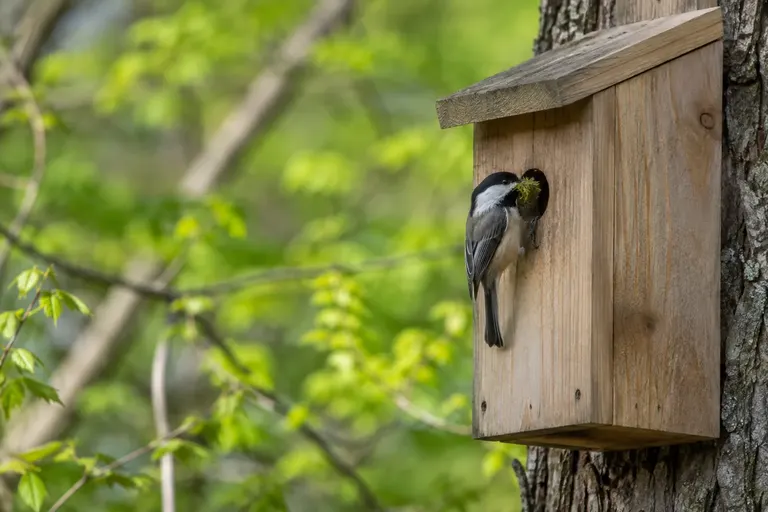
Strengths: The 1 1/8-inch hole keeps House Sparrows out but fits House Wrens, Carolina Wrens and chickadees. There is no perch, and cedar resists rot naturally.
Drawbacks: It is designed to hang. House Wrens accept a hanging box, but chickadees generally prefer a fixed mount, so screw it to a post or tree if chickadees are the goal. House Wrens also fill nearby boxes with sticks.
Skip it if: You want bluebirds, titmice or nuthatches, which need a bigger hole.
Schwegler 1B Nest Box: best woodcrete box
What it is: A round-bodied nest box made of Schwegler’s wood-concrete, a mix of sawdust and concrete, with a galvanized steel hanger.
Who it suits: Wooded yards where squirrels and woodpeckers chew holes in wooden boxes, and European gardens with Blue and Great Tits.
Key specs: Entrances come in 26 mm (about 1 inch), 32 mm (about 1 1/4 inches) or a 29 x 55 mm oval. It measures 17 x 26 x 18 cm and weighs about 3.6 kg (7.9 lb). A marten-guard front is also offered.
Strengths: Woodcrete breathes like wood, holds a steady temperature and resists chewing, so the hole cannot be enlarged. European retailers commonly describe these boxes lasting decades.
Drawbacks: It is heavy, hangs from a tree rather than a baffled pole, and is harder to find from US sellers. For North American birds, the 32 mm hole suits titmice and nuthatches, and the 26 mm hole suits chickadees and House Wrens.
Skip it if: You want bluebirds, since neither round entrance is 1.5 inches.
Coveside Saw-Whet and Screech Owl House: best for owls
What it is: A tall Eastern white pine owl box made in the USA with a 3-inch entrance and a bag of wood chips for the floor.
Who it suits: Wooded suburbs, farms and rural lots within the range of Eastern or Western Screech-Owls.
Key specs: Coveside lists a 3-inch entrance and outside dimensions of 11 by 9 by 17.75 inches, with ventilation slots, drainage holes and a latched side panel that lifts for access.
Strengths: Owls do not carry nesting material, so the included chips matter: they give eggs a base and stop them rolling. Three inches is the standard screech-owl hole size.
Drawbacks: It must go 10 to 30 feet up, which means a ladder for mounting and cleaning. Squirrels and starlings may claim it first.
Skip it if: You have no mature trees nearby or cannot mount a box safely at height.
Best birdhouses compared
| Birdhouse | Entrance | Material | Opens for cleaning | Predator feature | Main target birds |
|---|---|---|---|---|---|
| JCs Wildlife Ultimate Bluebird | 1.5 in round | Recycled poly lumber | Two side doors | Extended entry guard | Eastern and Western Bluebirds, Tree Swallows |
| Coveside Classic Eastern Bluebird | 1.5 in round | 3/4 in pine | Lift-up side panel | Wooden entrance block | Eastern Bluebirds, Tree Swallows |
| Coveside Sparrow-Resistant Bluebird | 4 x 1.25 in slot | 3/4 in pine | Lift-up front panel | Shallow, adjustable depth | Eastern Bluebirds |
| Nature’s Way CWH1 Cedar Wren | 1 1/8 in round | Cedar | Clean-out door | Small hole excludes sparrows | House and Carolina Wrens, chickadees |
| Schwegler 1B | 26 mm, 32 mm or oval | Woodcrete | Not specified by maker | Chew-proof body, marten front option | Tits, chickadees, titmice, nuthatches |
| Coveside Saw-Whet and Screech Owl | 3 in round | Eastern white pine | Lift-up side panel | Mount high with a guard | Screech-owls, Northern Saw-whet Owls |
Which size birdhouse do I need?
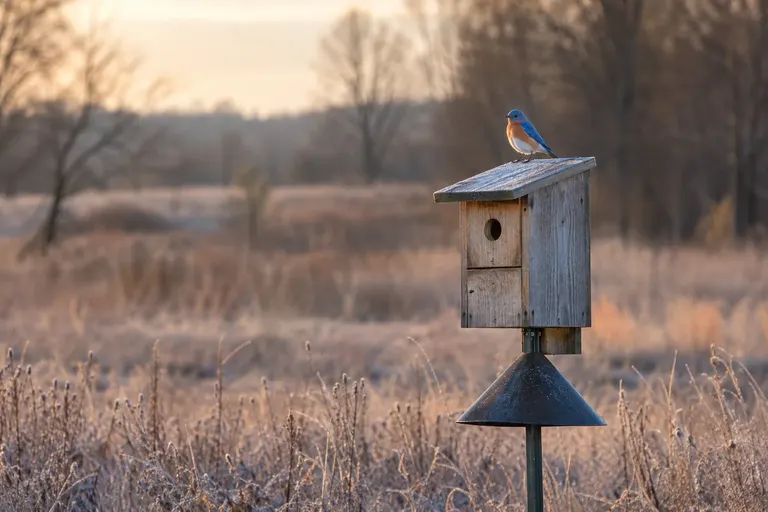
Buy for the bird, not the yard. The entrance hole matters most, followed by habitat and mounting height. Use this decision table, and see our full birdhouse hole size chart by species for more birds.
| If you have… | Target birds | Hole size | Mount height | Pick from this guide |
|---|---|---|---|---|
| Open lawn, meadow or pasture edge | Eastern and Western Bluebirds, Tree Swallows | 1.5 in (38 mm) | 4 to 6 ft (1.2 to 1.8 m) | JCs Ultimate or Coveside Classic |
| Open lawn near buildings or feeders | Bluebirds, with House Sparrows competing | Slot, or 1.5 in with monitoring | 4 to 6 ft | Coveside Sparrow-Resistant |
| Shrubby garden or small yard | House Wren, Carolina Wren | 1 to 1 1/8 in (25 to 29 mm) | 5 to 10 ft (1.5 to 3 m) | Nature’s Way CWH1 |
| Trees and woodland edge | Chickadees | 1 1/8 in (29 mm) | 5 to 15 ft (1.5 to 4.5 m) | Nature’s Way CWH1, fixed mount |
| Mature deciduous trees | Tufted Titmouse, nuthatches | 1 1/4 in (32 mm) | 5 to 15 ft or higher | Schwegler 1B 32 mm |
| Wooded lot, older trees | Eastern or Western Screech-Owl | 3 in (76 mm) | 10 to 30 ft (3 to 9 m) | Coveside Saw-Whet and Screech Owl |
Match the habitat first: bluebirds rarely nest in a shaded wooded yard, however good the box. When unsure, go smaller, since an oversized hole admits competitors.
Cedar vs recycled plastic vs woodcrete: which birdhouse material is best?
All three make excellent birdhouses if the walls are thick. Wood is the classic choice, recycled poly lumber lasts longest with the least care, and woodcrete wins where animals chew boxes.
Cedar and pine
Cedar resists rot and insects naturally, and 3/4-inch boards insulate well. Thick pine works almost as well. Both breathe, which limits condensation, but both weather. Never use pressure-treated wood or preservatives inside.
Recycled poly lumber and PVC
Thick poly lumber does not rot, crack or need paint, and it is simple to scrub. Some bluebird trails use the Gilbertson box, made from PVC pipe with a wooden roof, which monitors report sparrows use less. The real risk is thin, cheap plastic, which can overheat in full sun, so judge a plastic box by wall thickness, color and ventilation.
Woodcrete
Woodcrete is a molded mix of sawdust and concrete. It breathes, holds temperature steadily, resists chewing and weather, and lasts a very long time. The trade-offs are weight and tree-hanging rather than pole mounting.
Skip thin metal, glass, sealed ceramic, painted or varnished interiors and dark exterior colors, which absorb heat.
Buyer’s checklist: score a birdhouse before you buy
Use this 10-point checklist on any product page. A good box scores 8 or more. Most decorative houses score 4 or less.
- The hole size matches a species that nests near you.
- Walls are about 3/4 inch (19 mm) thick, or the plastic is thick and light-colored.
- There are vents near the top of the side walls.
- The floor has drainage holes or cut corners.
- A side, front or roof panel opens for cleaning.
- There is no perch below the hole.
- The inside is unpainted and unstained.
- The inside front is rough or grooved below the hole.
- The roof overhangs the front by about 2 inches or more.
- It can be mounted on a pole or post with a predator guard or baffle.
Where should you put a birdhouse?
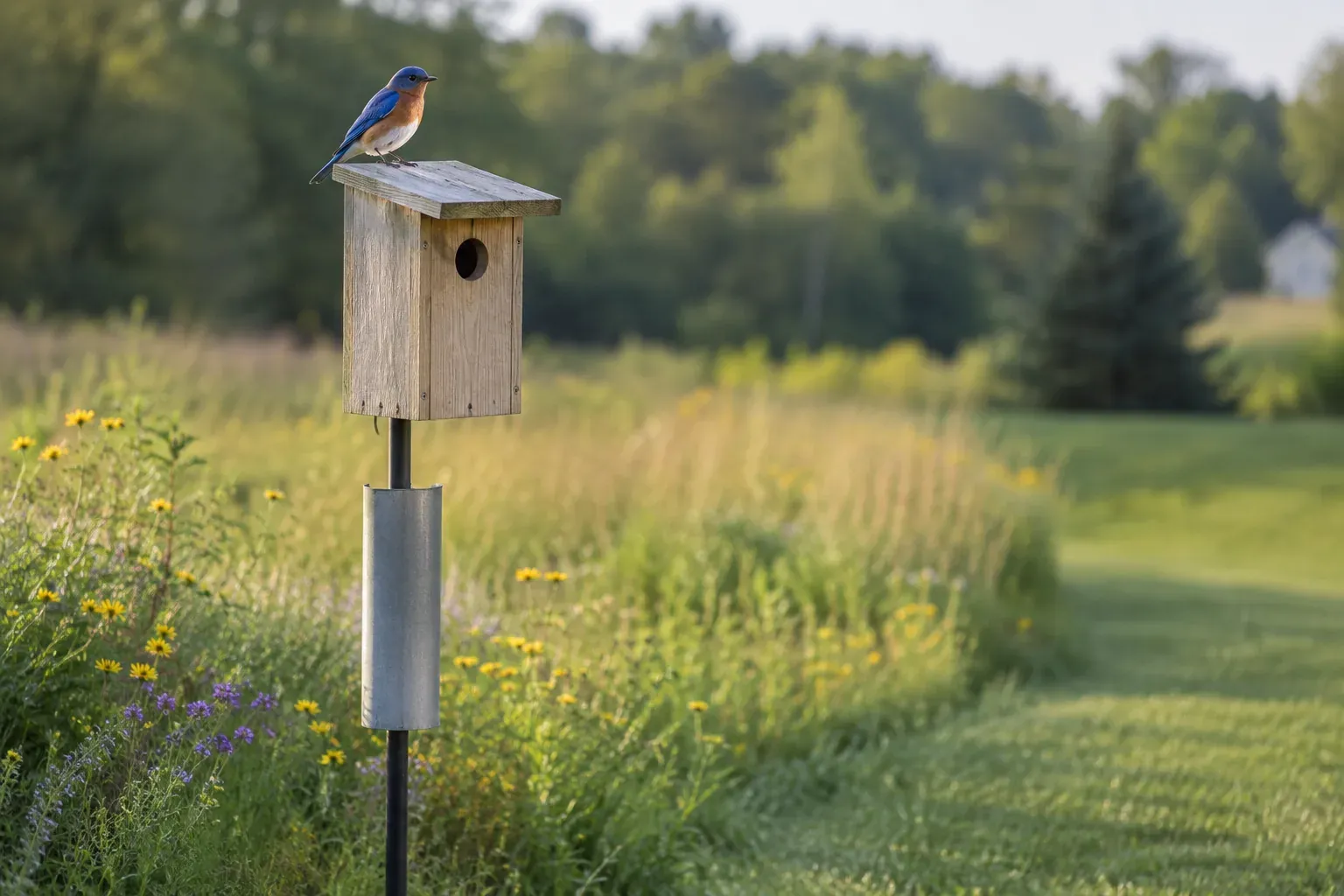
Put it in the right habitat for its species, on a smooth metal pole with a baffle where possible, facing away from prevailing wind and strong afternoon sun. For bluebirds, that means open grass with a tree or fence line in sight.
- Height: Follow the chart above. Bluebird and swallow boxes around 5 feet are easy to monitor.
- Direction: In much of North America, facing roughly east or southeast avoids cold wind and hot afternoon sun.
- Spacing: Bluebirds defend territories, so space boxes well apart. Many bluebirders pair two boxes close together, since Tree Swallows will take one and tend to leave bluebirds alone in the other.
- Distance from feeders: Keep boxes away from busy feeders, which draw House Sparrows and predators.
- Timing: Late winter or early spring is best. See when to put up birdhouses for timing by region.
Pole mounting is the biggest safety upgrade. Our guide on how to mount a birdhouse on a pole, tree or wall walks through the steps, and the stovepipe baffles in our bird feeder pole and baffle picks stop climbing snakes, cats and raccoons. If outdoor cats roam your area, read cats and birds: keeping your yard safe.
How do you keep a birdhouse clean?
Remove the old nest after each brood fledges or at the end of the season, then scrape out debris and let the box dry. A door that opens is what makes this possible.
- Wait until the young have fledged and the box is empty. In the US, active nests of native birds are protected by the Migratory Bird Treaty Act.
- Open the door and lift out the old nest with gloves.
- Scrape the floor. If there are mites or mold, scrub with about one part bleach to nine parts water, rinse well and dry fully.
- Check vents, drainage holes, hinges and the latch.
Bluebirds often raise two broods a year, so a quick clean between nests helps. Full steps are in when and how to clean out a birdhouse.
How much should you spend on a birdhouse?
Spend enough to get the functional features, not decoration. A plain, well-built box often costs less than an ornamental house with a porch and perch, and it works far better.
Pay for durable materials, thick walls and a predator guard, not paint or carving. Budget for a pole and baffle too, because a basic box on a baffled pole usually beats a fancy box on a fence post.
Which birds use birdhouses?
Only cavity-nesting birds use enclosed boxes: in North America, bluebirds, Tree Swallows, wrens, chickadees, titmice, nuthatches, some woodpeckers, Great Crested Flycatchers, Purple Martins, screech-owls, American Kestrels and Wood Ducks.
Cardinals, goldfinches and most sparrows build open cup nests in shrubs and will not use a box. American Robins and Eastern Phoebes may use an open nesting shelf under an eave. For the most popular box species, start with our guide to Eastern Bluebirds.
What are the alternatives to buying a birdhouse?
The best alternative is habitat. Leave safe dead trees standing, keep old woodpecker holes, and plant dense native shrubs.
- Snags: A dead tree that poses no risk to people or buildings hosts woodpeckers, whose old holes later house chickadees, nuthatches and owls.
- Nesting shelves: An open ledge suits robins and phoebes.
- Dense cover: Native shrubs and a brush pile for birds give cup-nesters places to build.
Sources
- NestWatch, Cornell Lab of Ornithology: All About Birdhouses
- Cornell Lab of Ornithology, All About Birds
- North American Bluebird Society
- Sialis.org: The story of the Gilbertson nestbox
- JCs Wildlife: Ultimate Bluebird House product page
- Coveside Conservation Products: Sparrow-Resistant Eastern Bluebird House
- Nature’s Way Bird Products: Traditional Cedar Wren House
- Schwegler: Nest Box 1B
Frequently asked questions
What is the best birdhouse for attracting birds?
The best birdhouse is one sized for a species already in your area. A bluebird box with a 1.5-inch hole on a baffled pole in open grass is the most reliable choice for many US yards. For small gardens, a 1 1/8-inch wren or chickadee box works well. Features matter more than looks: vents, drainage, a clean-out door, thick walls and no perch.
Should a birdhouse have a perch?
No. Native cavity nesters such as bluebirds, wrens, chickadees and swallows do not need a perch to enter a box. A perch mainly helps House Sparrows, starlings and predators such as raccoons, cats and jays, which can use it as a foothold to harass or reach into the nest. Cornell Lab's NestWatch recommends boxes without perches.
Is cedar or plastic better for a birdhouse?
Both can work well. Cedar and thick pine insulate well and breathe, but weather over time. Thick recycled poly lumber does not rot, crack or need finishing, and it is easy to wash. The material to avoid is thin plastic or thin metal, which can overheat in direct sun. Whatever you buy, check that the walls are thick, ideally about 3/4 inch.
What color should a birdhouse be?
Leave the inside unpainted and untreated. Outside, natural wood or light, muted colors such as tan, gray or pale green are the safest choices. Dark colors absorb heat and can overheat nestlings in summer sun. Never use wood preservatives or paint inside the box, and avoid painting around the entrance hole, where birds grip and peck.
How long does it take birds to use a new birdhouse?
It can happen within days in spring or take a full season or more. Boxes put up before nesting starts, often late winter in the South and early spring farther north, have the best chance. If a box sits empty for two seasons, check the hole size, habitat and height against the species you want, then try moving it.