Purple Martin House: 6 Best Houses, Gourds and Poles
The best purple martin house is one you can lower straight down for weekly checks. See 6 researched picks: aluminum houses, gourd racks, gourds and a pole.
If you buy through links on this page we may earn a commission, at no cost to you. It never decides what we recommend. How we earn
In this article
- Quick picks
- How we chose
- Heath AH-12D Deluxe Aluminum Purple Martin House, 12 Room
- Heath AH-12SR Starling Resistant Convertible Aluminum Purple Martin House
- Troyer’s Birds’ Paradise Horizontal Gourd Rack with 8 SuperGourds
- Heath PH-12 Plastic 12 Room Purple Martin House
- Heath Deluxe Purple Martin Gourd (PMG-2)
- Heath MP-19P 15 ft Telescoping Purple Martin Pole
- Purple martin house comparison table
- Should you choose an aluminum house or a gourd rack?
- Which size purple martin house should you buy?
- Where should you put a purple martin house?
- Do purple martin houses need a telescoping pole?
- When should you put up a purple martin house?
- How do you keep starlings and House Sparrows out?
- What are a landlord’s duties each season?
- Which birds use a purple martin house?
- What are the alternatives if your yard does not suit martins?
- Buyer’s checklist: will this setup work?
- Common mistakes
- Sources
- Frequently asked questions
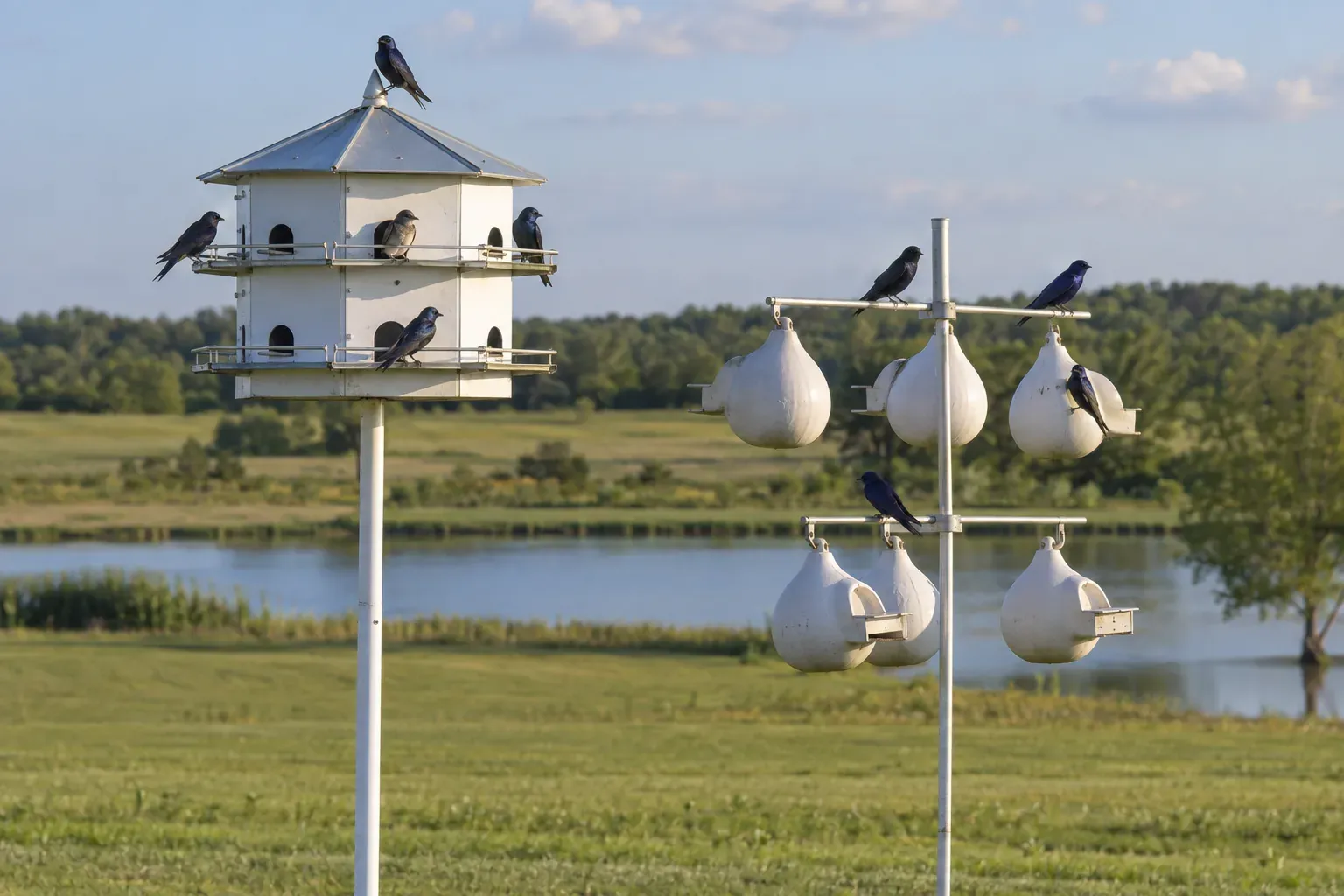
A purple martin house works only if it sits in wide open space and lowers straight down for weekly nest checks. Our top pick is the Heath AH-12D Deluxe Aluminum 12-Room house on the Heath MP-19P telescoping pole. If you want larger cavities, choose the Troyer Horizontal Gourd Rack with 8 SuperGourds instead.
Purple Martins are the largest swallow in North America, and east of the Rocky Mountains they nest almost entirely in housing that people put up and manage. That makes the landlord, not the box, the deciding factor. The guide after the picks covers sizing, placement, starling control and the season’s duties.
Quick picks
- Best overall aluminum house: Heath AH-12D Deluxe Aluminum Purple Martin House, 12 Room
- Best starling-resistant house: Heath AH-12SR Starling Resistant Convertible Aluminum Purple Martin House
- Best gourd system: Troyer’s Birds’ Paradise Horizontal Gourd Rack with 8 SuperGourds
- Best budget house: Heath PH-12 Plastic 12 Room Purple Martin House
- Best add-on gourd: Heath Deluxe Purple Martin Gourd (PMG-2)
- Best telescoping pole: Heath MP-19P 15 ft Telescoping Purple Martin Pole
Heath AH-12D Deluxe Aluminum Purple Martin House, 12 Room
A rust-free, hexagonal 12-room aluminum house with porch rails, snap-out floors for cleaning, and a pole that runs through the center, so there is no mounting plate to fuss with.
- Best for
- First-time landlords who want a proven, light house that fits a standard telescoping pole.
- Skip it if
- Starlings are already a problem in your area, since the stock holes are round.
- Rooms
- 12, expandable with the Heath A-6D add-a-floor
- Compartment
- 9 in front x 3 in back, 6 in deep, 6 in tall
- Entrance holes
- 2.25 in (57 mm) round
- Pole fit
- 1.25 in outer diameter
Heath AH-12SR Starling Resistant Convertible Aluminum Purple Martin House
A hexagonal aluminum house with removable starling-resistant entryways and a layout that converts from 12 rooms to 6 larger ones.
- Best for
- Landlords where European Starlings breed nearby, and anyone who wants the option of bigger rooms.
- Skip it if
- You want to see exact compartment dimensions before buying, because the retail listings do not publish them.
- Rooms
- 12, convertible to 6 larger rooms
- Entrances
- Removable starling-resistant entryways
- Material
- White aluminum
Troyer's Birds' Paradise Horizontal Gourd Rack with 8 SuperGourds
A US-made rack on a 2-inch square aluminum pole with a rope-and-pulley system that lowers all eight gourds straight down, each gourd with a large cavity and a side access port.
- Best for
- Landlords who want the roomy nest cavities and easy nest checks that many experienced colonies are built on.
- Skip it if
- You want a smaller, cheaper start, since this is a full system rather than an add-on.
- Gourds
- 8 SuperGourds, 2 in (51 mm) round entries
- Gourd size
- 10.5 in diameter x 13.75 in tall
- Pole
- 2 in square aluminum, 48 in ground stake
- Lowering
- Rope and pulley with winder clip
Heath PH-12 Plastic 12 Room Purple Martin House
A snap-together 12-room house in UV fade-resistant plastic with lift-open front panels for nest inspections and drainage holes in each room.
- Best for
- Trying martin housing on a tighter budget, or adding capacity to an existing site.
- Skip it if
- You dislike fiddly assembly, which is a common theme in owner feedback.
- Rooms
- 12
- Size
- 21.75 in W x 21.5 in H x 7.25 in D
- Material
- UV fade-resistant plastic
Heath Deluxe Purple Martin Gourd (PMG-2)
A molded plastic gourd with a crescent starling-resistant entrance, a 9-inch-deep chamber and an extended front landing platform.
- Best for
- Hanging from gourd arms on a pole you already own, or expanding a colony a few cavities at a time.
- Skip it if
- You want a full kit in one box.
- Entrance
- Crescent, starling-resistant
- Chamber depth
- 9 in (23 cm)
- Material
- Ivory molded plastic
Heath MP-19P 15 ft Telescoping Purple Martin Pole
A four-section, powder-coated steel pole with keylocks that raises a house or gourds to 15 feet and lowers them straight down, with a ground socket and gourd rods included.
- Best for
- Pairing with the Heath AH-12D or hanging a handful of gourds without a winch.
- Skip it if
- You plan a large gourd rack with 12 or more gourds, which calls for a heavier winch pole.
- Height
- 15 ft (4.6 m), 4 sections
- Top diameter
- 1.25 in
- Capacity
- Up to 25 lb
- Included
- Ground socket, 2 gourd rods (20 in)
How we chose
We have not installed these products ourselves, so this guide is research-led. We compared manufacturer and retailer specifications, checked each product against housing guidance from the Purple Martin Conservation Association (PMCA) and Cornell Lab, and looked for consistent patterns in verified owner feedback, such as assembly trouble or poles that sway. We favored housing that is light, weather-resistant, easy to lower vertically and easy to clean. We left out anything we could not confirm is currently sold, and we list only specs we could verify. If a number is missing, it is because the maker does not publish it.
Heath AH-12D Deluxe Aluminum Purple Martin House, 12 Room
Best overall aluminum house. This is the classic white-and-green hexagonal martin house, built from rust-free aluminum with plastic porch rails around each entrance. The hexagon spreads the doorways around six faces, which cuts down on squabbles between neighboring pairs on shared porches. Ventilation is hidden in the cupola, porches have drainage holes, and the floors snap out for cleaning.
The practical win is the mount. The pole passes through the center of the house and fits a 1.25-inch outer diameter pole, which matches the top of the Heath MP-19P below. You can add a second story later with the Heath A-6D add-a-floor unit.
- Compartment: 9 in wide at the front, 3 in at the back, 6 in deep, 6 in tall
- Entrances: 2.25 in (57 mm) round
- Pole fit: 1.25 in outer diameter
Strengths: light enough to raise and lower on a telescoping pole, reflects heat, easy seasonal cleaning. Drawbacks: the wedge-shaped rooms are on the small side compared with gourds, and 2.25-inch round holes admit starlings. You can fit crescent entrance plates later.
Skip it if: European Starlings already nest in your neighborhood and you do not want to buy retrofit entrances.
Heath AH-12SR Starling Resistant Convertible Aluminum Purple Martin House
Best starling-resistant house. This is Heath’s aluminum hexagon with removable starling-resistant entryways in place of plain round holes. It also converts from 12 rooms to 6, so you can open up larger rooms if your colony prefers them. Porch railings help keep young martins from tumbling off before they can fly.
Retail listings for this model publish the room count and height but not exact compartment or entrance dimensions, so check the manual if those numbers matter to you. You can start with the entryways in place or add them once starlings show up.
Strengths: starling defense built in, room layout you can change, same light aluminum build. Drawbacks: fewer published specs than the AH-12D. Starling-resistant entrances deter starlings but not House Sparrows, which fit through any martin-sized opening.
Skip it if: you want every dimension confirmed on paper before you buy.
Troyer’s Birds’ Paradise Horizontal Gourd Rack with 8 SuperGourds
Best gourd system. Plastic gourds are what many long-running colonies are built on, and this kit from Troyer’s Birds’ Paradise in Pennsylvania is a complete system. Eight SuperGourds hang on horizontal arms, all entrances facing outward. The rack rides a high-tensile 2-inch square aluminum pole with a 48-inch ground stake, and a rope-and-pulley system with a winder clip lowers the whole rack straight down. Nylon glides in the top hub keep it moving smoothly.
Each SuperGourd is 10.5 inches across and 13.75 inches tall, blow-molded from white, UV-inhibited high-density polyethylene, with a 2-inch round entry, a rain canopy over the entrance, seven drain holes and a threaded side access port for nest checks. That cavity is far larger than a standard house compartment, which gives nests more distance from the entrance. A version with crescent starling-resistant entrances is also sold.
Strengths: roomy cavities, fast inspections through the access ports, vertical lowering built in. Drawbacks: a larger footprint than a house and a bigger one-time outlay. The rope system needs occasional checks for wear.
Skip it if: you only want to test the waters with a few cavities.
Heath PH-12 Plastic 12 Room Purple Martin House
Best budget house. The PH-12 is a snap-together plastic house made from UV fade-resistant poly, with 12 rooms, lift-open front panels for nest inspections and drainage holes. It measures 21.75 inches wide by 21.5 inches tall by 7.25 inches deep, a flatter, two-sided shape rather than a hexagon. Heath sells starling-resistant entrance adapters separately.
Owners commonly report that assembly takes patience despite the snap-together design.
Strengths: low entry cost, no rust or rot, inspection panels on the front. Drawbacks: fiddly assembly and round entrances as standard.
Skip it if: you want the easiest possible build or starling-resistant entrances out of the box.
Heath Deluxe Purple Martin Gourd (PMG-2)
Best add-on gourd. This single molded plastic gourd has a crescent entrance that deters starlings, a 9-inch-deep chamber and an extended front platform that gives martins a place to land and perch. The ivory color helps keep the interior cool in summer.
It is the simple way to add cavities: hang a few from the gourd rods included with the Heath MP-19P pole, or add them to an existing gourd rack.
Strengths: starling-resistant entrance, deep chamber, lets you grow a site gradually. Drawbacks: you still need a pole and arms or rods to hang it.
Skip it if: you want everything in one box, in which case the Troyer rack is simpler.

Heath MP-19P 15 ft Telescoping Purple Martin Pole
Best telescoping pole. The pole is the part most first-time landlords underbuy. The MP-19P is a white powder-coated steel pole in four sections with keylocks, reaching 15 feet. It comes with a ground socket, two 20-inch gourd rods and two pole clamps, and it carries up to 25 pounds. The top outer diameter is 1.25 inches, which matches the center mount on Heath aluminum houses.
Heath recommends setting the socket deep in the ground or in concrete, and that matters: a tall pole with a house on top catches a lot of wind.
Strengths: telescopes straight down for checks, fits both houses and gourds, includes the socket. Drawbacks: telescoping sections take two hands and some practice. The 25-pound limit rules out large gourd racks.
Skip it if: you plan 12 or more gourds, which need a heavier pole with a winch.
Purple martin house comparison table
| Pick | Type | Cavities | Entrance | Lowers by | Best for |
|---|---|---|---|---|---|
| Heath AH-12D | Aluminum house | 12 | 2.25 in round | Telescoping pole (sold separately) | First colony |
| Heath AH-12SR | Aluminum house | 12 or 6 | Removable starling-resistant | Telescoping pole (sold separately) | Starling areas |
| Troyer Horizontal Rack | Gourd rack | 8 | 2 in round (crescent version sold) | Rope and pulley, included | Larger cavities |
| Heath PH-12 | Plastic house | 12 | Round, adapters sold separately | Telescoping pole (sold separately) | Tight budget |
| Heath PMG-2 | Single gourd | 1 | Crescent | Depends on your pole | Adding cavities |
| Heath MP-19P | Pole | Holds a house or gourds | Not applicable | Telescoping, 4 sections | Heath houses |
Should you choose an aluminum house or a gourd rack?
Choose a gourd rack if you want larger cavities and fast nest checks; choose an aluminum house if you want a lighter, simpler first setup. Both work when the site is right and the landlord manages it.
Aluminum houses are light, reflect heat and last for decades. Their weakness is compartment size: standard rooms are about 6 by 6 inches, and PMCA guidance favors larger, deeper compartments because nests set back from the entrance are safer from owls and crows reaching in. Gourds solve that with a much larger interior and access ports that make inspections quick. Plastic gourds do not crack and are easier to clean than natural dried gourds.
Wooden martin houses exist, but a heavy house is hard to lower safely, so it tends to go unchecked.
Which size purple martin house should you buy?
Start with 8 to 12 cavities for a new site. That is enough to look like an established colony to scouting martins without leaving many empty rooms for sparrows. Add cavities once most are occupied.
Use this sizing chart when comparing housing:
| Feature | Minimum that works | Better | Why it matters |
|---|---|---|---|
| Compartment floor | 6 x 6 in (15 x 15 cm) | 7 x 12 in or a gourd | Deeper cavities keep nests away from reaching predators |
| Entrance, round | About 1.75 in (44 mm) | About 2.125 in (54 mm) | Too large admits starlings and larger birds |
| Entrance, starling-resistant | Crescent or SREH shape | Crescent with a flat bottom | Lets martins in, keeps most starlings out |
| Height above ground | 10 ft (3 m) | 12 to 20 ft (3.7 to 6 m) | Martins prefer a high, open approach |
| Cavities at a new site | 6 to 8 | 12 | Enough to attract a colony, few enough to manage |
| Ventilation and drainage | Vents and floor drain holes | Shaded vents, several drain holes | Heat and standing water kill nestlings |
For the exact hole sizes used by other cavity nesters, see our birdhouse hole size chart.
Where should you put a purple martin house?
Put it in the most open spot you have: about 40 to 60 feet from trees, 30 to 120 feet from your home, and 10 to 20 feet high. Martins approach at speed and want a clear flight path in every direction.
Proximity to people helps. Eastern Purple Martins have nested near humans for centuries, and PMCA guidance notes that housing near a home tends to attract more martins, partly because human activity discourages some predators.
Placement checklist:
- Walk out 40 feet from the nearest tree in every direction. If you cannot, expect lower odds.
- Keep wires, fences and buildings from crowding the pole.
- Set the ground socket deep or in concrete so the pole stays plumb in wind.
- Check that there is room to telescope or winch the housing straight down, with space for you to stand beside it.
- Keep shrubs and vines away from the pole base, where snakes and raccoons can climb.
For more on sockets and ground sleeves, read how to mount a birdhouse on a pole.
Do purple martin houses need a telescoping pole?
Yes, or a winch pole. The housing must lower straight down, so eggs and nestlings stay put while you check them. A house on a fixed pole or a pole that tilts over on a hinge makes weekly checks impractical.
Telescoping poles suit houses up to their weight limit, such as the 25-pound rating on the Heath MP-19P. Larger gourd racks use square aluminum poles with rope and pulley or a crank winch. Add a predator guard around the pole below the housing: a wide cylinder baffle stops raccoons and most snakes. Our guide to squirrel baffles and their sizes explains the same cylinder design.
When should you put up a purple martin house?
Install the housing before the season but keep the entrances plugged, then open them when martins arrive in your area. Scouts reach the Gulf Coast as early as January, while northern states usually see them in April or May.
The PMCA publishes a live scout arrival map each spring. Open when birds are reported within your region. New sites can attract young first-time breeders later in the season, so keep housing open until about mid-summer. Our guide on when to put up birdhouses covers timing for other species.
How do you keep starlings and House Sparrows out?
Use starling-resistant crescent entrances, keep entrances closed until martins arrive, and remove sparrow and starling nests every week. Both species are non-native and are not protected under the federal Migratory Bird Treaty Act, while Purple Martins are.
Starling-resistant entrances stop most European Starlings, but House Sparrows fit through any hole a martin can use, so management is the only real control. Sparrows kill martin eggs and nestlings and will take over a colony that goes unwatched. If you cannot remove their nests every week, do not put up martin housing: an unmanaged house becomes a sparrow factory. For feeder-side tactics, see how to keep starlings and grackles off feeders.

What are a landlord’s duties each season?
Plan on a weekly nest check from arrival to fledging, sparrow and starling removal, predator guarding, and a full cleanout when the season ends. That routine is what separates a thriving colony from an empty house.
Landlord calendar:
| When | Task |
|---|---|
| Late winter | Clean and repair housing, check the pole, install guards, keep entrances plugged |
| Scout arrival in your area | Open entrances, start weekly checks |
| Nest building to egg laying | Check every 5 to 7 days, remove sparrow and starling nests |
| Nestling period | Keep checking; replace wet or mite-infested nests with dry material if needed |
| After fledging | Leave housing up while young return to roost, then take it down or plug it |
| Fall | Remove old nests, scrub and dry compartments, store or close for winter |
During checks, lower the housing smoothly, open each cavity, note contents and close it again within a few minutes. The adults return quickly. For general technique, see when and how to clean out a birdhouse.
Which birds use a purple martin house?
Purple Martins are the target, but House Sparrows and European Starlings use the same housing if they get the chance. Occasionally Tree Swallows move into gourds on the edge of a colony.
Eastern martins nest almost only in human-provided housing. Western populations still use natural cavities, including woodpecker holes and saguaro cactus cavities in the Southwest, and rarely use martin houses. If you live west of the Rockies outside a few coastal areas, a martin house is a long shot.
Martins eat flying insects caught high in the air, such as dragonflies, beetles, flies and moths. They are often sold as mosquito control, but research does not support that, as we explain in do birds eat mosquitoes.
What are the alternatives if your yard does not suit martins?
If you do not have 40 feet of open space, put up a bluebird or Tree Swallow box instead. Both nest in open yards with less space, and both take far less management than a martin colony.
A wren box suits a smaller, shrubby garden. Our roundup of the best birdhouses covers proven boxes for each.
Buyer’s checklist: will this setup work?
Answer these before you buy. If any answer is no, fix that first.
- Open space with the nearest trees about 40 feet or more away
- Housing that lowers straight down, never tilts
- Compartments at least 6 x 6 inches, or gourds
- Starling-resistant entrances available now or as a retrofit
- Vents and drainage holes in every cavity
- A predator guard on the pole
- Time for a nest check every week from spring to mid-summer
- Willingness to remove House Sparrow and European Starling nests
Common mistakes
- Buying a decorative house. Many ornamental martin houses have small rooms, no access and no way to lower them.
- Placing housing near trees. Martins avoid sites where hawks and owls can ambush from cover.
- Opening too early. Open entrances months before martins arrive and sparrows move in first.
- Skipping checks. Without weekly checks, you never see a sparrow problem until it has cost the colony.
Sources

Frequently asked questions
What is the best purple martin house for beginners?
A 12-room aluminum house such as the Heath AH-12D on a telescoping pole is the easiest start. Aluminum is light, stays cool and does not rot, and a telescoping pole lets you lower the house straight down for weekly nest checks. Place it in an open area 40 to 60 feet from trees and keep the entrances closed until the first martins arrive in your area.
How high should a purple martin house be?
Mount the housing roughly 10 to 20 feet high. Height matters less than openness: martins want a clear flight path in every direction, with the nearest trees about 40 to 60 feet away. The pole must lower vertically, by telescoping sections or a rope or winch, so you can inspect every compartment without tilting nests and spilling eggs.
When should I put up a purple martin house?
Have the housing installed before martins return, then open the entrances when the first birds are reported near you. Scouts reach the Gulf Coast as early as January, while northern states see them in April or May. The Purple Martin Conservation Association publishes a live scout arrival map each spring that shows when to open.
Are gourds better than a martin house?
Gourds offer larger cavities than many standard house compartments, and deeper nests are harder for owls and crows to reach. Many established colonies use gourds or a mix of both. A well-placed aluminum house works well too. The best choice is whichever you will actually lower and check every week, because management matters more than the housing type.
Do purple martins eat mosquitoes?
Very rarely. Purple martins feed high in the air on larger flying insects such as dragonflies, beetles, flies, moths and bees. Mosquitoes fly mostly near the ground at dusk and dawn and make up a tiny share of the diet in diet studies. Put up martin housing to host a native swallow, not for mosquito control.