How to Keep a Bird Bath From Freezing in Winter
How to keep a bird bath from freezing: a thermostatic heater or heated bath on a GFCI outlet works best. Plus no-power methods, safety rules and what to avoid.
In this article
- Quick answer: which method should you use?
- Why do birds need open water in winter?
- How do heated bird baths and de-icers work?
- How can you keep a bird bath from freezing without electricity?
- What should you never add to a bird bath?
- Is it safe for birds to bathe in freezing weather?
- How do you keep a winter bird bath clean?
- How deep should a winter bird bath be?
- Common mistakes
- How does winter water fit with winter feeding?
- A seasonal plan for winter water
- Regional notes
- Quick facts
- Sources
- Frequently asked questions
The most reliable way to keep a bird bath from freezing in winter is heat: either a bird bath with a built-in thermostatic heater, or a bird-bath de-icer placed in the basin you already own, plugged into an outdoor GFCI-protected outlet. If your winters regularly drop below about 25°F (roughly -4°C), heat is the only method that works through the night. Without electricity, a dark shallow basin in full sun, refilled with warm water every morning, keeps water open for part of most winter days.
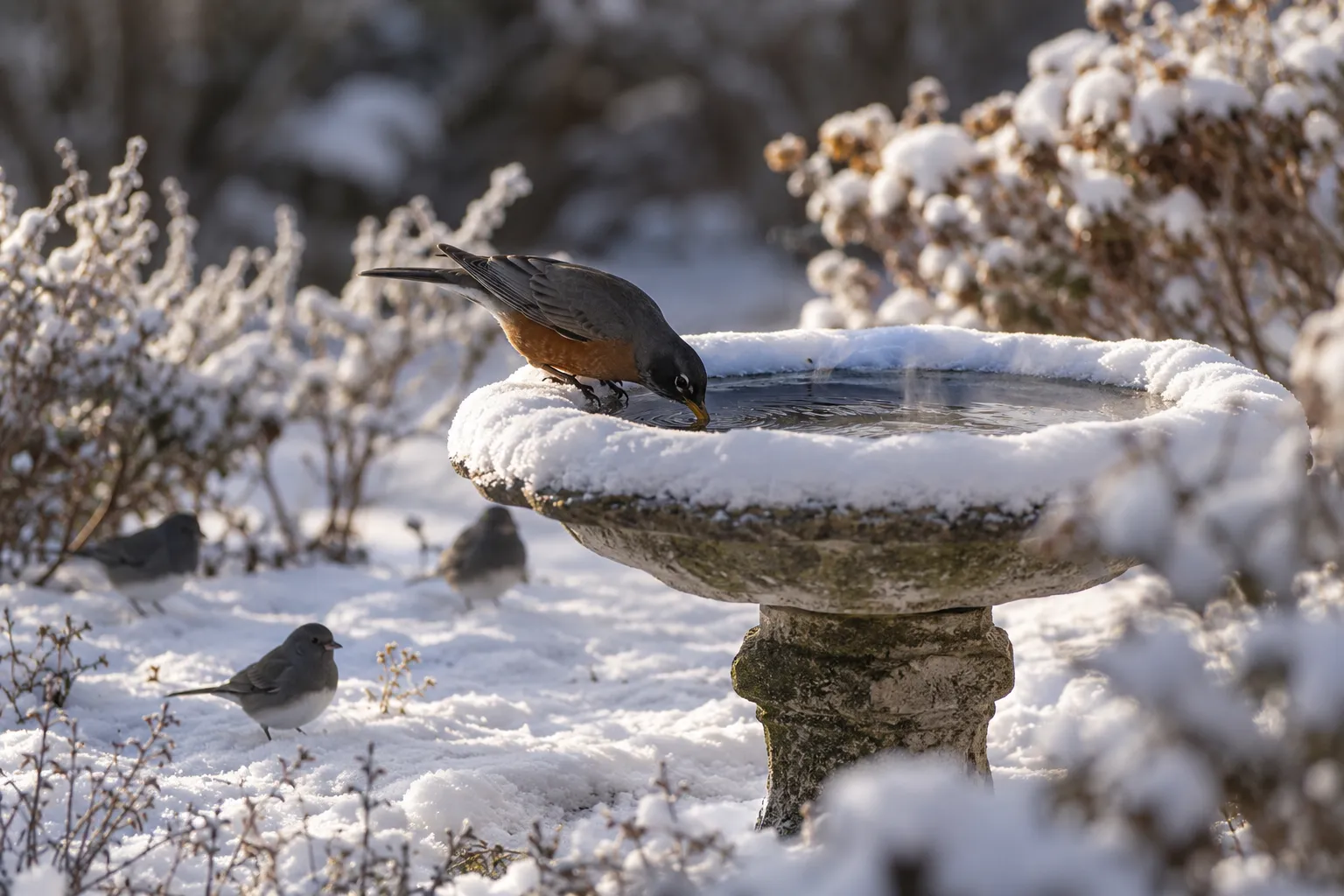
Open water can be scarcer than food in a cold snap. When puddles, streams and ponds lock up, a single unfrozen basin can pull in birds that never visit your feeders. This guide covers which methods actually work, how to set them up safely, what never to add to the water, and how to keep winter water clean.
Quick answer: which method should you use?
| Method | Keeps water open in a hard freeze? | Needs power? | Best for |
|---|---|---|---|
| Heated bird bath (built-in heater) | Yes | Yes, outdoor outlet | Anyone starting fresh in a cold climate |
| De-icer placed in an existing bath | Yes, if the basin is suitable | Yes | Keeping a bath you already like |
| Solar-powered or solar-circulating bath | Partly, on sunny days | No | Mild winters, frequent sun |
| Dark basin in sun plus warm refills | Only for some hours | No | Occasional frost, renters, no outlet |
| Floating ball or wind-driven movement | Only in marginal cold | No | Nights just around freezing |
If your winters regularly drop below about 25°F (roughly -4°C) for days at a time, a thermostatic heater is the only method that works through the night. In places where frost is occasional, such as the US Gulf Coast, much of coastal western Europe or southern Brazil, the no-power methods are usually enough.
Why do birds need open water in winter?
Birds need water year-round for drinking and for keeping feathers in working order. In winter, three things make open water harder to find and more valuable.
First, natural sources freeze. Small streams, ditches and garden ponds are the first to go, and even large lakes can ice over at the edges where small birds would drink.
Second, eating snow costs energy. Birds do eat snow and lick frost, but melting snow inside the body uses heat that a small bird has to replace with food. For a chickadee or a Goldcrest that already spends most of a winter day feeding, that is a real cost. We explain how small birds manage the cold in how do birds stay warm in winter.
Third, feathers still need care. Insulation depends on clean, well-aligned feathers that can be fluffed to trap air. Bathing and preening keep them that way, which is why birds still bathe on cold, bright days.
Which birds use winter bird baths?
In North America, winter water attracts species that eat little or no seed and so may ignore your feeders: American Robins, Eastern and Western Bluebirds, Cedar Waxwings, Northern Mockingbirds and Yellow-rumped Warblers are frequent visitors, along with the regular feeder crowd of chickadees, titmice, juncos, cardinals and finches. In Europe, a heated basin can bring in Blackbirds, Song Thrushes, Redwings and Fieldfares during freezes, plus Robins, tits and finches. In the cold interior of Turkey and the Balkans, sparrows, finches and buntings will flock to it.
How do heated bird baths and de-icers work?
Both use a small electric heating element controlled by a thermostat. The thermostat switches the heater on when the water approaches freezing and off again once it has warmed slightly. The goal is not warm water, only water that stays liquid. A good unit keeps the basin just above freezing and uses little power on milder days.
Heated bird bath vs de-icer: which is better?
A heated bird bath has the element built into the bowl, usually a plastic or resin basin that sits on a deck rail, on the ground, or on a pedestal. Everything is designed to work together, the depth is usually right for birds, and there is nothing loose in the water.
A de-icer (sometimes called a bird bath heater) is a separate element that sits in the bottom of your existing basin, with its cord running over the edge. It lets you keep a bath you already own, but check two things first:
- Basin material. Many manufacturers advise against using a de-icer in glass, and some caution about thin ceramic. Concrete and cast stone can still crack if the rim freezes while the center stays open. Follow the product’s instructions for approved materials.
- Water depth. The element must stay fully covered. A bath only 1 inch deep may leave it exposed as water evaporates, which is why many de-icers carry an automatic shut-off if they run dry.
Whichever you choose, look for a thermostat, a safety listing from a recognized testing laboratory, and a cord rated for outdoor use.
How to set up a heated bath safely
- Use a GFCI-protected outdoor outlet. Ground-fault protection cuts power if current leaks to water or ground. If your outdoor outlet is not GFCI-protected, have an electrician add one.
- Use an outdoor-rated extension cord only if you must, as short as possible, with the connection kept off the ground and out of puddles. Do not chain several cords together.
- Route the cord so birds cannot perch on the plug and so it will not be chewed, stepped on or caught by a snow shovel.
- Fill before you plug in and unplug before you empty, scrub or move the unit.
- Keep the water topped up. Winter air is dry and a heated basin evaporates faster than you expect. Check daily.
- Place it where you can reach it easily on a snowy morning. A bath 60 feet from the door will be neglected in January.
How can you keep a bird bath from freezing without electricity?
You can slow freezing and buy hours of open water, but in steady sub-freezing weather ice will win. These methods stack, so combine several.
Pick a dark, shallow basin
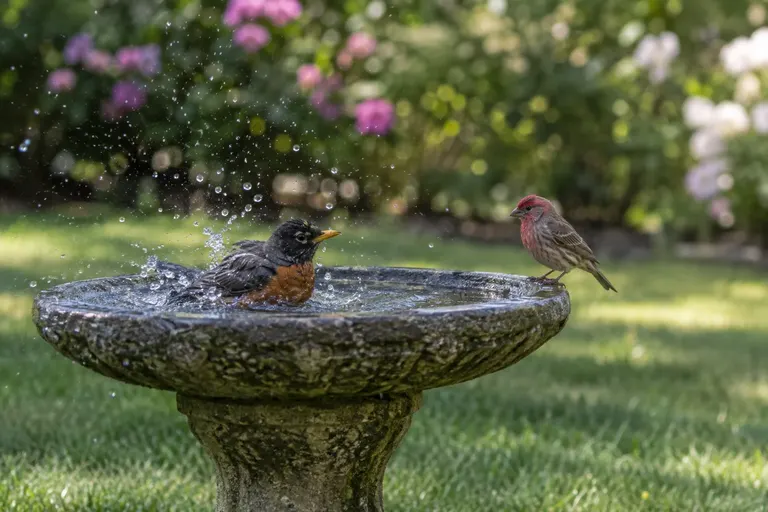
Dark surfaces absorb more sunlight than pale ones. A black or dark gray basin warms faster on a sunny winter day and may thaw earlier in the morning. Shallow water also warms faster than deep water, and 1 to 2 inches is the right depth for birds anyway.
Put it in winter sun, out of the wind
The low winter sun reaches different parts of your yard than the summer sun. Find a spot with direct sun from mid-morning onward, sheltered from the prevailing cold wind by a wall, fence or evergreen hedge. Wind strips heat from water surfaces quickly. Keep the usual safety rules: open ground around the bath so birds can see predators, with cover 10 to 15 feet away. Our guide to where to put a bird bath covers placement in detail.
Refill with warm water each morning
Pour out the ice (or pop it out as a disc once the edges loosen) and refill with warm tap water, not boiling water, which can crack basins and injure a bird that lands right away. Morning is the most valuable time, because birds are thirsty after a long night. Many people keep a second basin indoors and simply swap them.
Try a solar-powered option
Solar-powered heated baths and small solar fountains can keep water moving or slightly warmed while the sun is out. On short, gray winter days at high latitudes they deliver little. They are most useful where winter days are bright and freezes are light, such as the American Southwest or the Mediterranean.
Movement helps, but only a little
Moving water freezes more slowly than still water. A floating ball nudged by the wind, or a small solar pump, can prevent a thin skin of ice on a night that barely dips below freezing. It will not keep water open at 15°F.
What should you never add to a bird bath?
This matters more than any gadget. Never put any of these in water birds may drink or bathe in:
- Antifreeze (ethylene glycol or propylene glycol products). Ethylene glycol is highly toxic, and neither belongs in wildlife water.
- Salt or de-icing salts. Salty water is unsafe to drink and can dry out skin and damage feathers.
- Glycerin. An old tip claimed it lowers the freezing point safely. It can mat feathers and reduce their insulation, and there is no good reason to risk it.
- Sugar, alcohol or any additive. None are safe at levels that would stop freezing.
- Oil or soap films. Anything that coats feathers reduces waterproofing and insulation.
Plain water is the only thing that belongs in a bird bath. Also keep de-icing salt used on paths and driveways from splashing or draining into the basin.
Is it safe for birds to bathe in freezing weather?
On balance, yes, for healthy wild birds. Birds decide for themselves when to bathe, they bathe quickly, and they shake, fluff and preen afterward. Observers across North America and Europe routinely watch robins, starlings and sparrows bathe on frosty mornings and carry on normally.
There is one caution you will see in some expert advice: during extreme cold, often given as below about 0°F (-18°C), a thoroughly soaked small bird could lose heat faster than it can recover, especially if it is already thin or unwell. The evidence for harm is thin, but the precaution is easy. On those days, lay a piece of hardware cloth, a grid of sticks or a few flat stones across most of the basin so birds can reach water to drink but cannot climb in and soak. Remove it when temperatures moderate.
Can birds’ feet freeze to a metal bath?
Bird feet have very little soft tissue and are kept only slightly above freezing by a countercurrent heat exchange in the legs, so they rarely freeze to perches. Wet feet on very cold metal is still a theoretical risk, and metal basins cool quickly and can crack glazes. A plastic, resin or wooden rim is kinder. For more on how bird feet cope with cold, see do birds get frostbite.
How do you keep a winter bird bath clean?
A heated bath attracts more birds, and more birds means more droppings. Winter does not make dirty water safe. Diseases such as salmonellosis can spread where many birds gather, and cold water does not kill the bacteria.
A simple winter routine:
- Rinse and refill every day or two, even if the water looks clear.
- Scrub the basin weekly with a stiff brush. Unplug heated units first.
- Disinfect periodically with a dilute bleach solution (commonly given as 1 part bleach to 9 parts water), then rinse very thoroughly and let it dry before refilling. Full instructions are in our guide on how to clean a bird bath.
- Watch for sick birds. If you see lethargic, fluffed-up birds that stay put when approached, empty and disinfect the bath and feeders and consider pausing both for a week or two. Our page on sick birds at the feeder explains the signs.
- Follow local guidance on avian influenza. Where bird flu is circulating, especially near waterfowl, some wildlife agencies advise extra care with shared water. See our bird flu and backyard feeders guidance.
How deep should a winter bird bath be?
Keep it shallow: about 1 inch at the edges sloping to no more than 2 to 3 inches in the center. Songbirds wade rather than swim, and a shallow basin is safer in any season. If you use a de-icer in a deeper bowl, add a flat stone so small birds have a place to stand.
A wide rim or a sloping edge gives birds footing when the edges are icy. Some people add a small stick or rough stone that stays above water level as a perch.
Common mistakes
- Using boiling water. It can shatter ceramic and concrete and scald a bird that lands too soon. Use warm tap water.
- Leaving an unheated concrete or ceramic bath full. Freezing water expands and cracks bowls. Empty it or bring it in.
- Running a de-icer in too little water. An exposed element can overheat or shut off. Top up daily.
- Using an indoor extension cord. Indoor cords are not built for cold, moisture or UV. Use outdoor-rated cords and a GFCI outlet.
- Placing the bath next to dense shrubs. Cats and other ambushers use cover. Keep 10 to 15 feet of open ground. See cats and birds: keeping your yard safe.
- Letting it run dry after a snowfall. People check less in bad weather, just when birds need water most.
- Adding “safe” antifreeze or salt. Nothing added to the water is safe for birds.
How does winter water fit with winter feeding?
Water and food work together. A heated bath near your feeders (a few yards away, so seed hulls and droppings do not fall in) turns your yard into a complete winter stop. High-energy foods such as black oil sunflower, suet and peanuts help birds maintain body heat through long nights, and water helps them process dry seed. Our guides to winter bird feeding and what to feed birds in winter cover the food side.
If you are wondering how birds actually take in water with a beak, and why some species sip while others suck, how do birds drink water explains the mechanics.
A seasonal plan for winter water
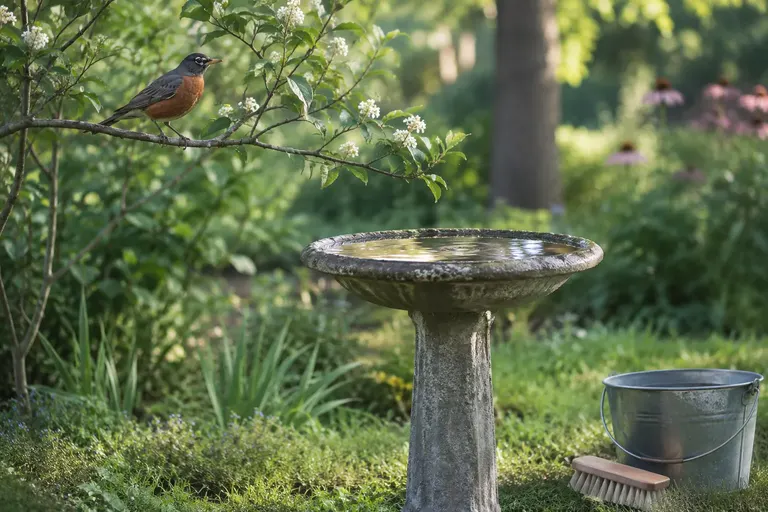
Late fall. Before the first hard frost, decide on your method. Test that your outdoor outlet has GFCI protection and works. Empty and store any unheated concrete or glazed basin.
First freezes. Start with morning warm-water refills and knock out overnight ice. Place a dark basin in the sunniest sheltered spot.
Deep winter. Run the heated bath or de-icer. Check water level daily and clean weekly. In extreme cold, cover most of the surface so birds drink but do not soak.
Late winter thaw. Migrant robins, bluebirds and, in Europe, returning thrushes often arrive while ice still lingers. Keep water open until nights stay reliably above freezing.
Spring. Unplug and store the heater dry, clean the basin thoroughly and switch to a regular summer routine.
Regional notes
Winter conditions vary enormously, and the right method follows your climate.
- Northern US, Canada, Scandinavia, eastern Europe and eastern Turkey: long, deep cold. A thermostatic heated bath is the only practical way to offer water through the whole day.
- Mid-Atlantic US, the UK, the Low Countries and western Turkey: freezes come and go. A de-icer for cold spells plus warm refills on milder frosty mornings works well.
- Southern US, the Mediterranean and southern Brazil: frost is occasional and brief. A dark basin in morning sun and a warm refill on frosty days is usually enough.
In the Southern Hemisphere, winter runs from June to August, so reverse the calendar above if you are in Brazil, Argentina, South Africa or Australia.
Quick facts
- Heat is the only method that reliably keeps water open through a hard freeze.
- Thermostatic heaters keep water just above freezing, not warm.
- Always use a GFCI-protected outdoor outlet and outdoor-rated cords.
- Never add antifreeze, salt, glycerin or any other additive.
- Keep the water 1 to 2 inches deep at the edges.
- Refill with warm, never boiling, water.
- Clean at least weekly, because crowds of winter visitors spread disease.
- Empty unheated concrete and ceramic baths before freezing weather.
Sources
Frequently asked questions
How do you keep a bird bath from freezing without electricity?
Without power you cannot stop ice in a hard freeze, but you can delay it. Use a dark, shallow basin placed in full winter sun and out of the wind, refill it each morning with warm tap water, and knock out ice before it thickens. Solar-powered baths help on bright days but rarely keep water open overnight in sustained cold.
Is it safe for birds to bathe in winter?
Healthy wild birds generally bathe in winter without harm, because they choose when to bathe and fluff and preen afterward. Some experts suggest covering most of the water with a grid or sticks during extreme cold, below about 0°F, so birds can still drink but cannot soak themselves. That is a precaution rather than a proven need.
Can I put salt or antifreeze in a bird bath?
No. Salt makes water unsafe to drink and damages feathers, and antifreeze products such as ethylene glycol are poisonous even in small amounts. Glycerin, sugar and alcohol are also not safe substitutes. The only safe way to keep water open is heat, from a heated bath, a thermostatic de-icer or regular warm refills.
Does a ping-pong ball stop a bird bath from freezing?
Not in real cold. A floating ball moved by the wind can slow a thin skin of ice from forming on a mild, breezy night, which is why the tip circulates. Once temperatures stay well below freezing the water freezes around the ball. Treat it as a small help in marginal weather, not a solution.
Do heated bird baths use a lot of electricity?
Most heated baths and de-icers are thermostatically controlled, so they only draw power when the water is near freezing. Running cost depends on wattage, the number of hours below freezing and your electricity rate. Check the wattage on the label; a lower-wattage unit in a smaller basin is usually enough for a backyard bath.
Should I bring my concrete bird bath inside for winter?
If you will not heat it, yes, or at least empty it and turn the basin upside down. Water that soaks into concrete, cast stone and glazed ceramic expands as it freezes and can crack or flake the bowl. Heated baths are usually plastic or resin, which handle freezing better.