Where to Put a Bird Bath
Where to put a bird bath: in open, partly shaded ground 10 to 15 feet from shrubs, away from feeders and near a perch. Height, sun, safety and placement tips.
In this article
- Quick answer: bird bath placement checklist
- How do birds decide if a bird bath is safe?
- How far should a bird bath be from trees and shrubs?
- Should a bird bath be in the sun or shade?
- Should a bird bath be near a bird feeder?
- How far should a bird bath be from windows?
- What height should a bird bath be?
- Where should a bird bath go in a small yard or balcony?
- Does moving water help a bird bath get noticed?
- How should the ground around a bird bath be set up?
- How do you get birds to start using a new bird bath?
- Will a bird bath attract mosquitoes?
- Myths vs facts about bird bath placement
- Common mistakes
- How does placement change with the seasons?
- Quick facts
- Sources
- Frequently asked questions
The best place for a bird bath is open, level ground in partial shade, about 10 to 15 feet (3 to 5 m) from shrubs or trees that birds can fly to for safety, and far enough from dense cover that cats cannot ambush. Keep it several yards from your feeders so seed and droppings stay out of the water, and put it where you can see it from a window and reach it easily with a hose.
Placement decides whether birds use a bath and whether they survive using it. Wet birds fly less well, so a bath is a moment of vulnerability. This guide explains how birds judge a safe water source, the right distances from cover, feeders and windows, sun versus shade, ground versus pedestal height, and how to adapt placement for small yards, balconies and hot or cold climates.
Quick answer: bird bath placement checklist
| Factor | Best choice | Why |
|---|---|---|
| Distance from shrubs | 10 to 15 ft (3 to 5 m) | Escape cover nearby, but no ambush point for cats |
| Light | Partial shade, morning sun | Cooler water, less algae, less evaporation |
| Distance from feeders | 10 ft (3 m) or more | Keeps seed hulls and droppings out |
| Distance from windows | Well away from glass, or very close | Reduces collision risk |
| Nearby perch | A branch or shrub within about 10 to 20 ft | Birds pause before bathing and preen after |
| Overhead | No branches directly above | Fewer droppings and leaves in the water |
| Ground | Level, firm | Water sits evenly at the right depth |
| Access | Easy reach of a hose or tap | You will clean and refill more often |
| Visibility | Visible from a window | You get to enjoy it |
How do birds decide if a bird bath is safe?
Birds approach water cautiously. Before they drink or bathe, most perch nearby and scan for danger. Only when they feel secure do they drop down. A bath placed where birds feel exposed, or where they cannot see approaching predators, may be ignored.
Three things matter most to a bird considering your bath:
- Can it see danger coming? Open ground around the bath lets birds spot cats and other ground predators early.
- Can it escape quickly? Cover within a short flight means a bird can reach safety if a hawk appears. Wet feathers make flight heavier and slower, so the escape route needs to be short.
- Is there somewhere to preen after? After bathing, birds fly to a sheltered perch to shake off, fluff and rearrange feathers. A bath with a good perch nearby is more attractive.
These are the same principles that govern feeder placement, which we explain in where to put a bird feeder.
How far should a bird bath be from trees and shrubs?
About 10 to 15 feet is the standard recommendation for backyard baths. It balances two risks.
Too close to dense cover (under about 5 feet), and cats can crouch in the shrubs and pounce on birds as they bathe. Domestic cats kill very large numbers of birds each year in North America and Europe, and a bath next to a hedge is an easy hunting spot. Our guide to cats and birds covers ways to reduce that risk.
Too far from any cover (more than about 30 to 40 feet, in the middle of a large open lawn), and birds feel exposed to hawks. A Cooper’s Hawk in North America or a Eurasian Sparrowhawk in Europe hunts by surprise, and small birds want safety within a few wingbeats. For more on this, see how to stop hawks from hunting at your feeder.
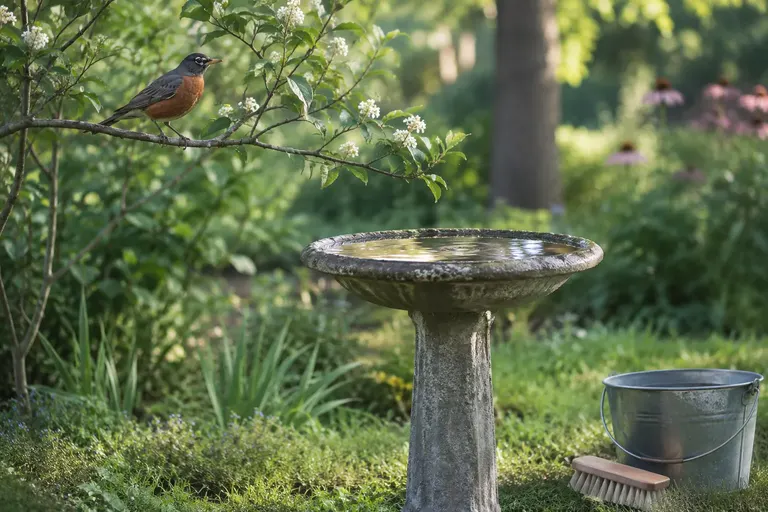
The ideal is a bath standing in open ground, with a shrub, small tree or brush pile within about 10 to 15 feet on one side.
Should a bird bath be in the sun or shade?
For most of the year, partial shade is best. A spot with morning sun and afternoon shade, or dappled shade under a tree canopy that is not directly overhead, works well.
Why shade helps:
- Cooler water. In hot weather, a bath in full sun can get uncomfortably warm. Birds prefer cooler water in summer.
- Less algae. Sunlight feeds algae growth, which makes cleaning harder and water less appealing.
- Less evaporation. A shallow bath in full summer sun can dry out in a day. Shade buys time between refills.
When sun helps: In winter, an unheated bath in the sun thaws sooner and stays open longer. If you keep water available in cold weather, a sunnier spot, sheltered from wind, is better. See keeping a bird bath ice-free in winter.
In hot climates such as the American Southwest, Florida, much of Brazil, the Mediterranean coast and southern Turkey, shade is especially important. A shaded bath refilled daily can be the most visited spot in the garden in July and August, or in January in the Southern Hemisphere.
Should a bird bath be under a tree?
Near a tree, yes. Directly under the canopy, usually no. Birds perched in the branches above will drop feces into the water, and falling leaves, flowers, sap and seeds foul it quickly. The ideal is a tree within a short flight, not directly overhead. Dappled shade from the side of a canopy gives the benefits without the mess.
Should a bird bath be near a bird feeder?
Close enough to be seen, not so close it gets fouled. Birds find a new bath faster if it is in view of an existing feeding area, but seed husks, spilled seed and droppings from feeding birds make bath water dirty within hours. Aim for about 10 feet or more between feeder and bath.
Keeping them apart also spreads birds out. Crowding at feeders and baths helps diseases such as salmonellosis, trichomonosis and house finch eye disease spread. Our guide to sick birds at the feeder explains the signs.
How far should a bird bath be from windows?
Windows kill large numbers of birds every year, and a bird bath near glass can add to the risk, especially when startled birds flush toward reflections. The same rule that applies to feeders helps: place baths either very close to windows, within about 3 feet, or well away, beyond about 30 feet. At very close range, birds leaving the bath cannot build up enough speed to be badly hurt if they hit the glass. At mid-range, they can.
In practice, most bird baths are too big to sit within 3 feet of a window, so place them well out in the yard and treat nearby windows with markers or screens. Our guide to how to stop birds hitting windows covers options that work.
What height should a bird bath be?
Both ground-level and raised baths work. They attract slightly different birds and carry different risks.
Ground-level baths
In nature, most birds drink and bathe at puddles, stream edges and pond shallows. Ground baths imitate that and are especially attractive to:
- Thrushes: American Robins, Eurasian Blackbirds, Song Thrushes and, in Brazil, Rufous-bellied Thrushes.
- Doves and pigeons: Mourning Doves, Eurasian Collared Doves, Eared Doves and Laughing Doves.
- Sparrows, juncos and towhees.
The trade-off is exposure to cats. A ground bath needs even more open space around it, 15 feet or more from any cover a cat could use.
Pedestal and raised baths
Pedestal baths, typically about 2 to 3 feet high, lift birds above most cat ambushes and are easier for you to clean. Most songbirds use them readily. They may be less appealing to shy ground feeders.
Hanging and railing baths
Hanging baths from a branch or bracket, and railing-mounted baths on decks, suit small yards and balconies. Chickadees, titmice, tits, finches and warblers use them. Make sure they hang level and do not swing wildly, and keep them clear of glass.
A good plan in larger gardens is to offer one ground bath and one raised bath, in different spots.
Where should a bird bath go in a small yard or balcony?
Small spaces can still offer water successfully.
- Pick the quietest corner, away from doors and seating areas where people move constantly.
- Use a shallow dish on a sturdy table or a railing bracket, no more than 1 to 2 inches deep.
- Add potted shrubs or climbers nearby to give birds a landing and preening spot.
- Keep it away from glass doors, or mark the glass.
- Clean more often, because small baths foul and warm up quickly.
On city balconies in Europe, Turkey and Brazil, House Sparrows, Eurasian Blackbirds, pigeons, Blue Tits, Rufous-bellied Thrushes, Bananaquits and Sayaca Tanagers are among the birds that may find a well-placed dish. For more ideas, see designing a small bird-friendly garden.
Does moving water help a bird bath get noticed?
Yes. Birds are strongly attracted to the sound and sparkle of moving water, which is why dripping and trickling water often draws birds that ignore still baths. A dripper, a small solar fountain or a bubbler also discourages mosquitoes, which lay eggs in still water.
Place a moving-water bath where the sound carries toward cover and perches, and where you can easily reach any pump or tubing for cleaning. Warblers and other migrants that rarely visit feeders are especially drawn to dripping water.
How should the ground around a bird bath be set up?
- Level the site so water sits evenly. On a slope, one side dries while the other is too deep.
- Use firm footing. A paver or flat stone base keeps pedestals stable and stops them sinking in soft soil.
- Keep mulch and low ground cover short right around the bath, so birds have a clear view.
- Avoid pesticides and fertilizers nearby. Runoff can end up in the water.
- Consider a small dust-bathing patch a few yards away in a sunny, dry spot, for sparrows and other birds that also bathe in dust. See why do birds take dust baths.
How do you get birds to start using a new bird bath?
Placement does most of the work, but a few extras help:
- Keep the water shallow. About 1 inch at the edges and no more than 2 to 3 inches in the center. Add flat stones if the bath is deeper.
- Give it a rough surface. Slippery glazed or glass bowls give poor footing. A few stones help.
- Add movement. A dripper makes a big difference.
- Keep it clean and full. Fresh water every two to three days; see how to clean a bird bath.
- Be patient. Birds may take a few days to a few weeks to discover a new water source, especially in wet weather when puddles are everywhere.
For the mechanics of how birds sip and swallow, how do birds drink water explains why some species tilt their heads back while pigeons and doves suck water like a straw.
Will a bird bath attract mosquitoes?
Only if the water sits still for too long. Mosquitoes lay eggs on standing water, and in warm weather the larvae of common species can develop into adults in roughly a week, sometimes less. Emptying and refilling the bath every two to three days breaks that cycle, because the larvae are poured out before they mature.
Placement helps too. A bath in partial shade and within easy reach of a hose is far more likely to get those regular refills than one at the far end of the garden. Moving water from a dripper or bubbler also discourages egg laying. Never add oil, soap or larvicide products that are not specifically approved as safe for birds and wildlife, and check the label carefully even then. Clean, frequently changed water is the safest answer.
Myths vs facts about bird bath placement
Myth: Birds prefer a bath hidden among shrubs. Fact: Birds like cover nearby, not surrounding the bath. Dense cover right next to the water helps predators more than birds.
Myth: A bath must be in full sun to stay clean. Fact: Sun speeds algae growth. Partial shade and regular scrubbing keep water cleaner.
Myth: Taller is always safer. Fact: A pedestal helps against cats, but a bath on a very tall stand or high shelf can be hard to clean and may put off ground-loving birds. About 2 to 3 feet suits most yards.
Myth: Birds will find a bath anywhere. Fact: Placement matters a lot. Birds often ignore a bath in the wrong spot, then start using it within days once it is moved nearer to a perch and into partial shade.
Myth: Once placed, a bath should never move. Fact: Moving it with the seasons is normal, and birds adjust quickly.
Common mistakes
- Tucking the bath against a hedge. It looks natural but gives cats an ambush point.
- Placing it in the middle of a large open lawn. Birds feel exposed to hawks.
- Putting it under a feeder or directly under a tree. Seed, droppings and leaves foul the water quickly.
- Full afternoon sun in summer. Hot water, algae and constant refills.
- Mid-range from a big window. The distance where collisions are most dangerous.
- Uneven ground. One side dry, the other too deep.
- Too far from the house. A bath that is hard to reach gets cleaned less often and goes unseen.
- Deep water. Songbirds wade, not swim. Deep bowls go unused or become hazards.
How does placement change with the seasons?
A bath does not have to stay in one place. In summer, move it into partial shade to keep water cool and slow algae. In winter, move it into sun and out of the wind, or closer to an outdoor outlet if you use a heater. Migrant seasons in spring and fall, when warblers, thrushes and flycatchers pass through, are a good time to add a dripper and place the bath near native shrubs and trees where migrants forage.
Quick facts
- Place the bath 10 to 15 feet from shrubs or trees that birds can escape into.
- Keep open ground around the bath so birds can watch for cats.
- Choose partial shade in summer, more sun in winter.
- Keep it 10 feet or more from feeders.
- Avoid putting it directly under branches.
- Put it very near windows or well away, not in between.
- Ground baths attract thrushes and doves; pedestals are safer where cats roam.
- Moving water helps birds find a bath faster.
- Keep water 1 to 2 inches deep at the edges.
Sources
Frequently asked questions
Should a bird bath be in the sun or shade?
Partial shade is best for most of the year. Shade keeps water cooler, slows algae growth and reduces evaporation, which matters in hot summers. Morning sun with afternoon shade is a good balance. In winter, a sunnier spot helps an unheated bath thaw sooner.
How far should a bird bath be from bushes?
About 10 to 15 feet (3 to 5 m) is the usual guidance. That is close enough for birds to escape into cover if a hawk appears, but far enough that a cat cannot hide in the shrubs and ambush a wet bird. Keep the ground immediately around the bath open.
Should a bird bath be near a bird feeder?
Near, but not right beside. Placing the bath within sight of your feeders helps birds find it, but keep it several yards away so seed hulls and droppings do not fall into the water. Ten feet or more from the feeder is a sensible starting point.
Is a ground bird bath or a pedestal bird bath better?
Both work, and they attract slightly different birds. Ground-level baths suit thrushes, doves, sparrows and juncos that naturally drink from puddles, but they are more exposed to cats. Pedestal baths about 2 to 3 feet high are safer where cats roam. Offering one of each widens the variety.
Can I put a bird bath on a balcony or deck?
Yes. A shallow basin on a railing mount or a sturdy table works well, especially if it is near potted plants or a nearby tree that gives birds a place to land and preen. Keep it away from glass doors, clean it often and make sure water cannot spill onto neighbors below.