Chickadee House: 6 Best Nest Boxes and How to Size Them
The best chickadee house has a 1 1/8-inch hole, a floor near 4 to 5 1/2 inches, vents, drainage and no perch. Compare 6 boxes for chickadees, titmice and wrens.
If you buy through links on this page we may earn a commission, at no cost to you. It never decides what we recommend. How we earn
In this article
- Quick picks
- How we chose
- What size chickadee house do chickadees need?
- Coveside Chickadee House: best overall
- Kettle Moraine Recycled Nuthatch and Titmouse Nest Box: best low-maintenance box
- Coveside Nuthatch House: best wooden box for titmice and nuthatches
- JCs Wildlife Wren, Chickadee, and Warbler Chateau Birdhouse: best compact poly house
- Nature’s Way CWH1 Cedar Wren House: best cedar budget pick
- Schwegler 1B Nest Box: best woodcrete box
- Chickadee house comparison table
- Which chickadee house should you buy? A decision table
- What features should a good chickadee house have?
- Which wood is best for a chickadee house?
- Where should you put a chickadee house, and how high?
- When should you put up a chickadee house?
- How do you keep a chickadee house clean?
- Which birds use a chickadee house besides chickadees?
- How much does a good chickadee house cost?
- What are the alternatives to a chickadee house?
- Common chickadee house mistakes
- Sources
- Frequently asked questions
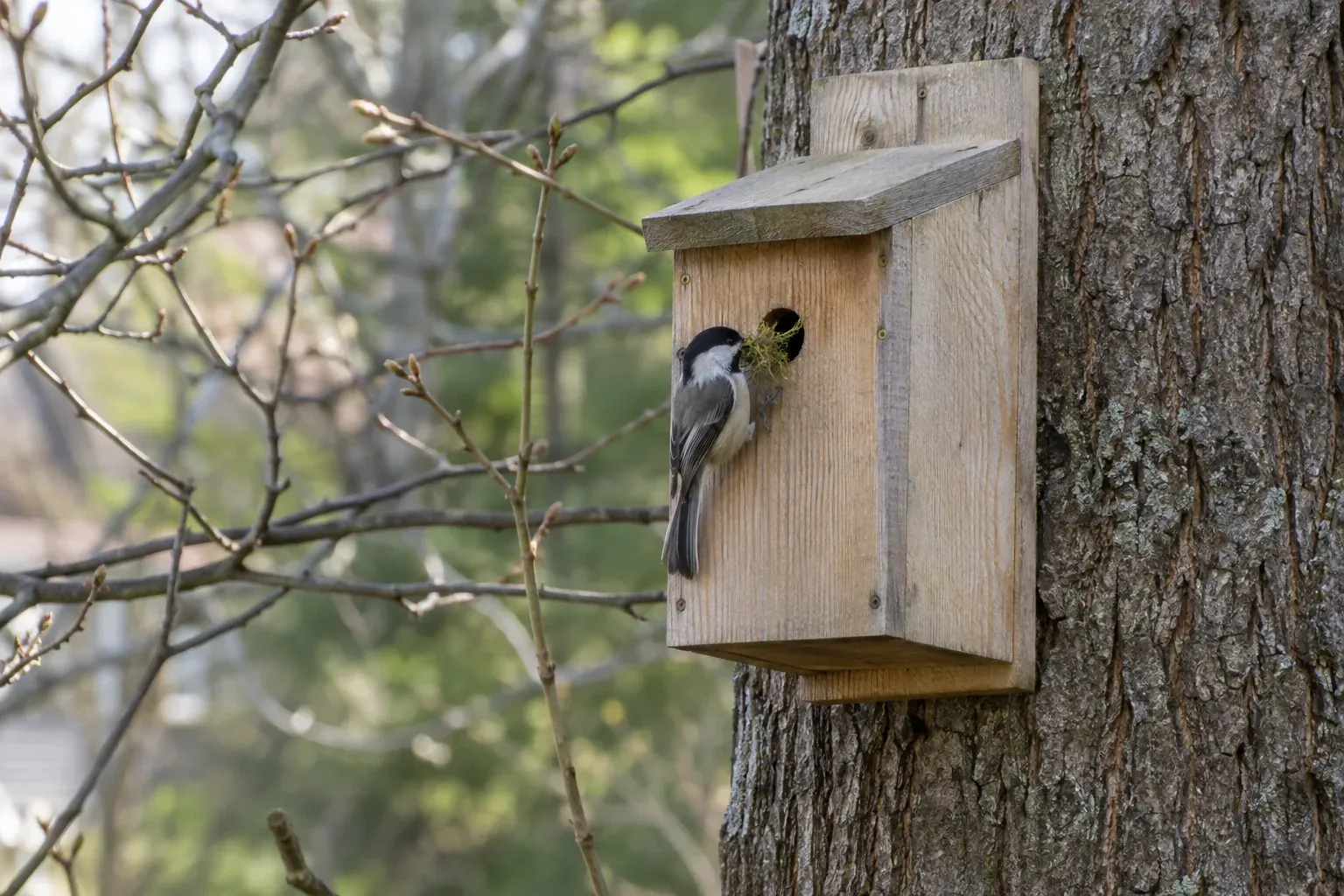
The best chickadee house is a plain box with a 1 1/8-inch (29 mm) entrance hole, a floor of about 4 to 5 1/2 inches square, vents under the roof, drainage in the floor, a door you can open, and no perch. Based on manufacturer specs, the Coveside Chickadee House is the most complete wooden pick, and the Kettle Moraine Recycled Nuthatch and Titmouse Nest Box is the best low-maintenance box if you also want titmice and nuthatches.
Quick picks
- Best overall: Coveside Chickadee House. Pine, 1 1/8-inch hole, vents, drainage and a lift-up side panel.
- Best low-maintenance box: Kettle Moraine Recycled Nuthatch and Titmouse Nest Box. Recycled HDPE, 1 1/4-inch copper-guarded hole, swing-open front.
- Best wooden box for titmice and nuthatches: Coveside Nuthatch House. 3/4-inch pine, 1 1/4-inch hole.
- Best compact poly house: JCs Wildlife Wren, Chickadee, and Warbler Chateau Birdhouse. 1 1/8-inch hole, removable floor.
- Best cedar budget pick: Nature’s Way CWH1 Cedar Wren House. 1 1/8-inch hole, clean-out door, vents.
- Best woodcrete box: Schwegler 1B Nest Box. Chew-resistant wood-concrete, 32 mm hole option.
Coveside Chickadee House
A US-made pine box with a 1 1/8-inch hole, vent slots under the roof, drainage gaps at the floor corners, a rough interior for fledglings and a side panel that lifts for cleaning.
- Best for
- Anyone who wants a classic wooden box sized for chickadees that also keeps out House Sparrows.
- Skip it if
- You want titmice or nuthatches, which need a 1 1/4-inch hole.
- Entrance hole
- 1 1/8 in (29 mm)
- Size
- 8 1/8 in L x 5 3/4 in W x 12 1/2 in H
- Material
- Eastern pine, made in the USA
Kettle Moraine Recycled Nuthatch and Titmouse Nest Box
A recycled HDPE box with a 1 1/4-inch copper-guarded entrance, a 4 x 4-inch floor, vented eaves, a swing-open front and an inside fledgling ladder.
- Best for
- Yards with titmice, nuthatches and chickadees, and owners who never want to re-stain a box.
- Skip it if
- House Sparrows nest near your house, since a 1 1/4-inch hole does not exclude them.
- Entrance hole
- 1 1/4 in (32 mm), copper portal
- Floor
- 4 x 4 in
- Size
- 11 in H x 7 in W x 8 in D
- Material
- HDPE from recycled milk jugs
Coveside Nuthatch House
The 1 1/4-inch sibling of the Coveside Chickadee House, with 3/4-inch pine walls, vent slots, corner drainage and a latched side panel.
- Best for
- Wooded yards with Tufted Titmice or White-breasted Nuthatches that already come to the feeder.
- Skip it if
- Your main target is chickadees in a sparrow-heavy neighborhood.
- Entrance hole
- 1 1/4 in (32 mm)
- Size
- 8 in L x 5 3/4 in W x 12 1/2 in H
- Wall thickness
- 3/4 in pine
JCs Wildlife Wren, Chickadee, and Warbler Chateau Birdhouse
A small recycled poly lumber house with a 1 1/8-inch hole set 4 inches above the floor, stainless screws, front climbing grooves and a removable bottom panel.
- Best for
- Small gardens and patios where a hanging wren or chickadee house fits better than a tall box.
- Skip it if
- You want easy nest checks, because cleaning means unscrewing the floor.
- Entrance hole
- 1 1/8 in (29 mm)
- Inside size
- 5 1/2 in W x 7 in H x 4 in D
- Outside size
- 6 1/2 in W x 9 in H x 6 1/4 in D
Nature's Way CWH1 Cedar Wren House
A small cedar house with a 1 1/8-inch hole, a clean-out door and wall and floor vents, widely sold and easy to find.
- Best for
- First-time landlords who want a simple, sparrow-excluding box for wrens or chickadees.
- Skip it if
- You want the deepest cavity for chickadees, since this is a shorter wren-style house.
- Entrance hole
- 1 1/8 in (29 mm)
- Size
- 8 in H x 8 7/8 in W x 8 1/8 in D
- Weight
- 2 lb
Schwegler 1B Nest Box
A heavy German wood-concrete box that resists woodpeckers and squirrels, sold with 26 mm, 32 mm or oval entrances.
- Best for
- Wooded yards where squirrels or woodpeckers chew the holes of wooden boxes.
- Skip it if
- You need a light box or shop mainly in the US, where it can be hard to find.
- Entrance options
- 26 mm, 32 mm or 29 x 55 mm oval
- Outside size
- 17 x 26 x 18 cm (6.7 x 10.2 x 7.1 in)
- Weight
- About 3.6 kg (7.9 lb)
How we chose
We have not installed or monitored these boxes ourselves. This guide is research-based. We compared manufacturer specifications for entrance size, floor size, wall material, ventilation, drainage, cleaning access and predator protection, taken from each maker’s product page. We checked those features against the species nest box plans published by Cornell Lab’s NestWatch, and looked for repeated patterns in verified owner feedback, such as panels that stick, boxes that warp or houses that wrens fill with sticks. We excluded houses with perches or no cleaning access.
What size chickadee house do chickadees need?
Chickadees need a 1 1/8-inch (29 mm) entrance hole and a box about 8 inches deep inside. NestWatch plans for Black-capped and Carolina Chickadees use a 5 1/2 x 5 1/2-inch floor, while many well-reviewed commercial boxes use a 4 x 4-inch floor, which is also widely accepted.
The hole matters most. At 1 1/8 inches, the opening admits chickadees and House Wrens but is too small for House Sparrows, a non-native species that kills adult chickadees and takes over boxes. Go up to 1 1/4 inches and you add Tufted Titmice and White-breasted Nuthatches, but sparrows can squeeze in too. For the full species list, see our birdhouse hole size chart.
Chickadee house sizing chart
| Species | Hole | Floor (inside) | Depth (inside) | Mounting height | Wood shavings? |
|---|---|---|---|---|---|
| Black-capped Chickadee | 1 1/8 in (29 mm) | 5 1/2 x 5 1/2 in | 8 in | 5 to 15 ft | Yes, about 1 in |
| Carolina Chickadee | 1 1/8 in (29 mm) | 5 1/2 x 5 1/2 in | 8 in | 4 to 15 ft | Not necessary |
| Tufted Titmouse | 1 1/4 in (32 mm) | 5 1/2 x 5 1/2 in | 8 in | 5 to 15 ft | Optional |
| White-breasted Nuthatch | 1 1/4 in (32 mm) | 5 1/2 x 5 1/2 in | 8 in | 5 to 20 ft | Yes, about 1 in |
| House Wren | 1 in (25 mm) | 5 1/2 x 5 1/2 in | 8 in | 5 to 10 ft | No |
Floor and depth within an inch are fine. Match the hole exactly.
Coveside Chickadee House: best overall
What it is: A made-in-the-USA pine box built specifically for chickadees, with a 1 1/8-inch entrance, a downward-sloping roof, ventilation slots at the sides of the top panel, drainage gaps at the base corners and a single side panel that lifts open.
Who it suits: Anyone with chickadees at the feeder and a mature tree, post or wall to mount a box on.
Key specs: 1 1/8-inch hole; 8 1/8 in L x 5 3/4 in W x 12 1/2 in H; pine; metal hanger and predrilled hole for mounting.
Strengths: The box follows the functional checklist point by point: correct hole, no perch, vents, drainage and a rough-hewn interior that Coveside says helps fledglings climb out. The tall shape keeps the nest well below a probing paw.
Drawbacks: Pine is softer than cedar and will eventually weather, and a squirrel or woodpecker can enlarge the hole.
Skip it if: You want titmice or nuthatches. Choose its 1 1/4-inch sibling below instead.
Kettle Moraine Recycled Nuthatch and Titmouse Nest Box: best low-maintenance box
What it is: A nest box made from HDPE plastic lumber from recycled milk jugs, made in the Midwest, with a 1 1/4-inch entrance protected by a copper portal, a 4 x 4-inch floor, a wide overhanging roof with vents in the eaves and a front panel that swings open.
Who it suits: Yards that host a mix of titmice, nuthatches, chickadees and Downy Woodpeckers, and owners who want a box that will not rot or need re-staining.
Key specs: 1 1/4-inch hole with copper guard; 4 x 4-inch interior floor; 11 in tall x 7 in wide x 8 in deep; fledgling ladder inside the front panel.
Strengths: The copper portal stops squirrels and woodpeckers from chewing the hole larger, which is the most common way a small box fails over time. HDPE will not warp or split, and it scrubs clean.
Drawbacks: A 1 1/4-inch hole admits House Sparrows. Pick a muted roof color over a bright one.
Skip it if: House Sparrows nest on your house or in the neighborhood. Use a 1 1/8-inch box instead.
Coveside Nuthatch House: best wooden box for titmice and nuthatches
What it is: The 1 1/4-inch version of the Coveside design, in 3/4-inch pine, with ventilation slots at the top, corner drainage holes in the floor, a latched side panel and a coarse interior finish.
Who it suits: Wooded suburbs and rural yards with Tufted Titmice or White-breasted Nuthatches. Chickadees can use it too.
Key specs: 1 1/4-inch hole; 8 in L x 5 3/4 in W x 12 1/2 in H; 3/4-inch pine walls; made in the USA.
Strengths: Thick 3/4-inch walls insulate against spring cold and summer heat. The latch keeps raccoons from opening the side panel, and NestWatch notes White-breasted Nuthatches may use boxes as winter roosts.
Drawbacks: Nuthatches use nest boxes only occasionally, mostly where natural cavities are scarce, so this box may host titmice or chickadees instead.
Skip it if: Your yard has few mature trees. Titmice and nuthatches rarely nest far from them.
JCs Wildlife Wren, Chickadee, and Warbler Chateau Birdhouse: best compact poly house
What it is: A small hanging house made from recycled poly lumber, handcrafted in the USA, with stainless steel screws, a sheathed cable hanger, climbing grooves on the front and a 1 1/8-inch hole set 4 inches above the floor.
Who it suits: Small gardens, patios and wooded yards where a compact, colorful house fits better than a tall wooden box.
Key specs: 1 1/8-inch hole; inside 5 1/2 in W x 7 in H x 4 in D; outside 6 1/2 in W x 9 in H x 6 1/4 in D.
Strengths: Poly lumber will not rot or crack, and the 1 1/8-inch hole keeps House Sparrows out.
Drawbacks: The interior is shallow at 4 inches front to back, smaller than NestWatch plans, and wrens are likely to claim it before chickadees. Cleaning means removing the bottom panel with a Phillips screwdriver, which is slower than a hinged door.
Skip it if: You want the best chance at chickadees specifically. A deeper, fixed box is the better bet.
Nature’s Way CWH1 Cedar Wren House: best cedar budget pick
What it is: A small cedar house with a 1 1/8-inch hole, a clean-out door and vents in the walls and floor.
Who it suits: First-time nest box hosts who want an easy-to-find, sparrow-excluding box for wrens or chickadees.
Key specs: 1 1/8-inch hole; 8 in H x 8 7/8 in W x 8 1/8 in D; about 2 lb.
Strengths: Cedar resists rot naturally, and the entrance size is correct for chickadees and wrens.
Drawbacks: The wren-style shape is shorter than a chickadee box, so the nest sits closer to the hole.
Skip it if: You want a deep box for Black-capped Chickadees or plan to mount it in full afternoon sun.
Schwegler 1B Nest Box: best woodcrete box
What it is: A German wood-concrete nest box that is heavy, stable and resistant to woodpeckers and squirrels, sold with a 26 mm, 32 mm or oval entrance.
Who it suits: Wooded yards where squirrels or woodpeckers chew wooden boxes, and European readers with tits in the garden.
Key specs: Entrance 26 mm, 32 mm or 29 x 55 mm oval; outside 17 x 26 x 18 cm (6.7 x 10.2 x 7.1 in); about 3.6 kg (7.9 lb).
Strengths: Woodcrete holds heat and humidity steadier than thin wood and is hard for predators to chew. For North American chickadees, titmice and nuthatches, the 32 mm (1 1/4 in) version is the one to order. The 26 mm hole is sized for small European tits and is smaller than NestWatch’s 1 1/8-inch chickadee spec.
Drawbacks: At nearly 8 lb it needs a solid tree or wall and strong fixings. The 32 mm hole admits House Sparrows.
Skip it if: You want something light and easy to find at US stores.
Chickadee house comparison table
| Box | Hole | Material | Clean-out | Main birds | Excludes House Sparrows? |
|---|---|---|---|---|---|
| Coveside Chickadee House | 1 1/8 in | Pine | Lift-up side panel | Chickadees, wrens | Yes |
| Kettle Moraine Recycled Nuthatch and Titmouse Nest Box | 1 1/4 in | Recycled HDPE | Swing-open front | Titmice, nuthatches, chickadees | No |
| Coveside Nuthatch House | 1 1/4 in | 3/4-in pine | Latched side panel | Nuthatches, titmice, chickadees | No |
| JCs Wildlife Chateau Birdhouse | 1 1/8 in | Recycled poly lumber | Screw-off floor | Wrens, chickadees | Yes |
| Nature’s Way CWH1 | 1 1/8 in | Cedar | Clean-out door | Wrens, chickadees | Yes |
| Schwegler 1B (32 mm) | 32 mm (1 1/4 in) | Woodcrete | Removable front | Chickadees, titmice, nuthatches | No |
Which chickadee house should you buy? A decision table
| Your situation | Choose | Why |
|---|---|---|
| Chickadees at the feeder, House Sparrows around | 1 1/8-inch box (Coveside Chickadee, Nature’s Way CWH1) | The only hole that admits chickadees and excludes sparrows |
| Titmice or nuthatches at the feeder, no sparrows nearby | 1 1/4-inch box (Coveside Nuthatch, Kettle Moraine) | Adds larger species while chickadees can still use it |
| Squirrels or woodpeckers chew boxes | Kettle Moraine (copper portal) or Schwegler 1B | Hole cannot be enlarged |
| Hot afternoon sun, no shade | Thick pine or woodcrete, light color | Thin or dark boxes overheat |
| Small patio or balcony near trees | JCs Wildlife Chateau | Compact, but expect wrens first |
| House Wrens are abundant | Put the chickadee box deeper in the woods, well away from shrubs | Wrens fill nearby boxes with sticks |
What features should a good chickadee house have?
Use this buyer’s checklist before you buy:
- Hole: exactly 1 1/8 inches for chickadees only, or 1 1/4 inches to add titmice and nuthatches.
- Depth: the hole sits roughly 6 inches or more above the floor, so a predator’s paw cannot reach the nest.
- Walls: about 3/4 inch thick wood, thick poly lumber or woodcrete.
- Vents: gaps or slots just under the roof to let hot air out.
- Drainage: holes or recessed corners in the floor.
- Access: a side, front or floor panel that opens without tools, or with one screw.
- Interior: grooves or rough wood below the hole so fledglings can climb out.
- No perch: chickadees do not need one, but sparrows and predators use it.
Which wood is best for a chickadee house?
Cedar and thick pine are the best woods for a chickadee house. Both insulate well and are safe untreated; cedar resists rot longer. Recycled poly lumber and woodcrete are good non-wood alternatives because they will not rot or split.
Never use pressure-treated lumber, stain or paint inside. Outside, keep any finish light and away from the hole. If you want to make one yourself, our guide to building a birdhouse walks through cutting and assembly.
Where should you put a chickadee house, and how high?
Mount a chickadee house 5 to 15 feet high near mature trees or woodland edge, with the hole facing away from prevailing wind. NestWatch lists 4 to 15 feet for Carolina Chickadees and up to 20 feet for White-breasted Nuthatches.
Placement is where most chickadee boxes fail. Chickadees nest in woods, open woodland and towns with trees, so a box on a fence in the middle of a lawn often sits empty or goes to wrens or bluebirds. Use a trunk, a post under the canopy or a pole at the woodland edge, give partial shade in hot climates, and fix the box so it does not swing.
On a pole, add a baffle below the box to stop raccoons, cats and snakes. On a tree, a hole guard or portal helps against squirrels. For step-by-step mounting options, see how to mount a birdhouse on a pole, tree or wall.
Should you fill a chickadee house with wood shavings?
For Black-capped Chickadees and White-breasted Nuthatches, yes: NestWatch recommends about 1 inch of wood shavings on the floor. Black-capped Chickadees like to excavate, and shavings give them something to clear out. Use plain pine or aspen shavings, not aromatic cedar or treated sawdust.
Carolina Chickadees do little excavating, so NestWatch says shavings are not necessary for them.
When should you put up a chickadee house?
Put a chickadee house up by late winter, ideally in fall or January and February. Chickadees pair up and begin checking cavities in late winter, and nest building often starts in March and April across much of the US. A box up in fall may also serve as a winter roost. Our guide on when to put up birdhouses has regional timing.
How do you keep a chickadee house clean?
Clean a chickadee house once a year, after the young fledge or in late fall. Remove the old nest, scrape out droppings, rinse with water, and let it dry with the door open before closing it up.
Chickadees usually raise a single brood a year and build a new moss-and-fur nest each spring. Old nests can harbor mites, so clear them and add fresh shavings. Wear gloves. Our full routine is in when and how to clean out a birdhouse.
Which birds use a chickadee house besides chickadees?
A 1 1/8-inch box is used by Black-capped, Carolina, Mountain and Boreal Chickadees and by House Wrens. A 1 1/4-inch box adds Tufted and other titmice, White-breasted and Red-breasted Nuthatches and, occasionally, Downy Woodpeckers and Prothonotary Warblers.
House Wrens deserve special mention. Males are fiercely territorial, stuff every nearby box with twigs, and may destroy eggs or nestlings of other cavity nesters, per NestWatch. You cannot legally remove an active House Wren nest, since they are a native, protected species. The practical fix is placement: put chickadee boxes deeper in the woods and keep them well away from shrubby edges that wrens favor. NestWatch suggests keeping other species’ boxes at least 100 feet from wren boxes.
For more on attracting the birds themselves, see our species guides to the Black-capped Chickadee and the Carolina Chickadee.
How much does a good chickadee house cost?
A well-built chickadee house usually costs more than a decorative gift-shop birdhouse, and the difference buys the features that matter.
Building your own from one cedar or pine board is cheapest. Poly lumber and woodcrete cost more upfront but last many seasons without refinishing.
What are the alternatives to a chickadee house?
The best alternatives are a titmouse or nuthatch box with a 1 1/4-inch hole, a roost box for winter, or leaving dead trees and snags standing. Chickadees naturally nest in rotting wood and old woodpecker holes. A winter roost box helps on cold nights but is not for nesting, and open lawns suit a bluebird box better. See our roundup of the best birdhouses for boxes sized for other species.
Common chickadee house mistakes
- Hole too big. A 1 1/2-inch hole invites House Sparrows and bluebirds, not chickadees.
- A perch under the hole. It helps predators and sparrows, not chickadees.
- Mounting in open lawn. Chickadees want trees within easy reach.
- Dark paint and full sun. The box can overheat nestlings by early summer.
- Putting it up in June. Most chickadees have already nested.
Sources
- Black-capped Chickadee nest box plan, NestWatch, Cornell Lab of Ornithology
- Carolina Chickadee nest box plan, NestWatch
- Tufted Titmouse nest box plan, NestWatch
- White-breasted Nuthatch nest box plan, NestWatch
- House Wren nest box plan, NestWatch
- Coveside Chickadee House, Coveside Conservation Products
- Recycled Nuthatch and Titmouse Nest Box, Kettle Moraine Woodworking
- Wren, Chickadee, and Warbler Chateau Birdhouse, JCs Wildlife
Frequently asked questions
What size hole does a chickadee house need?
A chickadee house needs a 1 1/8-inch (29 mm) entrance hole for both Black-capped and Carolina Chickadees, per Cornell Lab's NestWatch. That size also admits House Wrens but keeps out House Sparrows. A 1 1/4-inch (32 mm) hole still works for chickadees and adds titmice and nuthatches, but it lets House Sparrows in, so use it only where sparrows are not nesting nearby.
Where is the best place to hang a chickadee house?
Mount it 5 to 15 feet high on a tree trunk, post or pole near mature trees or woodland edge, with the hole facing away from prevailing wind. NestWatch lists 4 to 15 feet for Carolina Chickadees. A firmly fixed box is better than one that swings, and a baffle on a pole helps against climbing predators such as raccoons, snakes and cats.
Should I put wood shavings in a chickadee house?
For Black-capped Chickadees, yes. NestWatch suggests about 1 inch of wood shavings on the floor, because they like to excavate before building a moss nest. Use plain pine or aspen shavings, never cedar shavings or sawdust treated with chemicals. NestWatch notes Carolina Chickadees do little excavating, so shavings are optional for them.
When should I put up a chickadee house?
Put it up by late winter. Chickadees start checking cavities weeks before they build, often in March in much of the US and earlier in the South. A box up in fall also works, because chickadees and nuthatches may roost in boxes on cold nights. Boxes put up in May or later often wait until the next season.
Do chickadees reuse the same nest box?
Chickadees usually build a fresh nest each year and normally raise one brood per season. Clean the old nest out after the young fledge or in late fall so the box is ready for spring. An empty, clean box also gives parasites less to hide in and makes it easier to see whether a new nest has started.