How to Attract Anna's Hummingbirds to Your Yard
How to attract Anna's Hummingbirds: keep a clean 1:4 nectar feeder up all year, stop it freezing, and plant winter-blooming natives like currant and manzanita.
If you buy through links on this page we may earn a commission, at no cost to you. It never decides what we recommend. How we earn
In this article
- Anna’s Hummingbird at a glance
- How to identify an Anna’s Hummingbird
- Where Anna’s Hummingbirds live, and why they are spreading
- What Anna’s Hummingbirds eat
- Hummingbird nectar for Anna’s: the recipe
- Winter feeding: keeping Anna’s going through cold snaps
- Choosing and placing a feeder for Anna’s
- The best native plants for Anna’s Hummingbirds
- Nesting: the earliest hummingbird of the year
- How Anna’s differ from eastern hummingbirds
- Attracting Anna’s to a balcony or small patio
- A year with Anna’s Hummingbirds
- Common mistakes with Anna’s Hummingbirds
- Sources
- Gear mentioned in this guide
- Frequently asked questions
Here is how to attract Anna’s Hummingbirds: keep a clean feeder with 1:4 sugar water up every month of the year, protect it from freezing in winter, and plant flowers that bloom in the cool season, such as native currants, manzanitas and California fuchsia. Anna’s are year-round residents in much of the Pacific Coast and Southwest, so the yard that feeds them reliably in January is the one they claim.
Anna’s Hummingbird at a glance
| Trait | Details |
|---|---|
| Size | About 3.9 in long, wingspan about 4.7 in, 0.1 to 0.2 oz |
| Range | Pacific Coast from Baja California to British Columbia, inland to Arizona and parts of the Southwest |
| Season | Year-round in most of the range, some seasonal movement |
| Diet | Nectar, tree sap, small insects such as midges, whiteflies and leafhoppers |
| Feeder food | 1:4 sugar water, no dye |
| Feeder type | Saucer or bottle nectar feeder, kept thawed in winter |
| Nesting | Small cup nest 6 to 20 ft up on a branch, 2 eggs, 2 to 3 broods, starts as early as December |
| Plants | Currants and gooseberries, manzanita, California fuchsia, native sages, penstemons |
How to identify an Anna’s Hummingbird
The Cornell Lab describes Anna’s as very slightly larger than a Rufous Hummingbird and sparrow-sized or smaller. It looks stockier than most western hummingbirds and often sits upright on an exposed twig.
Adult male
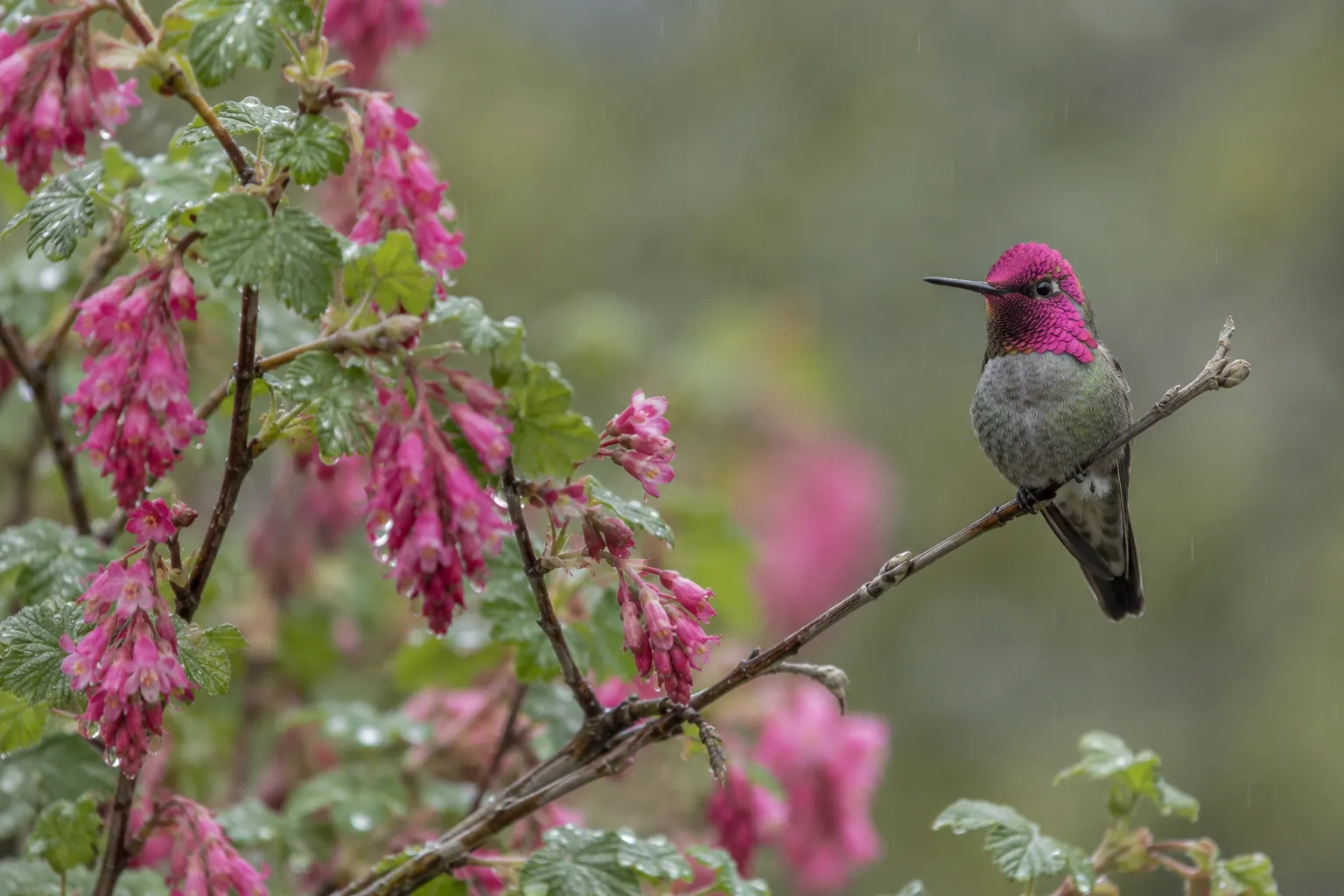
- Iridescent rose-pink crown and throat. The Cornell Lab notes the gorget extends over the head, making it more like a balaclava than a bib.
- In poor light the whole head can look dark or blackish, then flash hot pink when he turns.
- Green back, grayish underparts washed with green.
Female and immature
- Metallic green above, grayish below.
- Usually a small patch of reddish-pink feathers in the center of the throat.
- A small white spot behind the eye.
- Immature males are duller than adults and show a blotchy pink crown and throat rather than a full hood.
Song
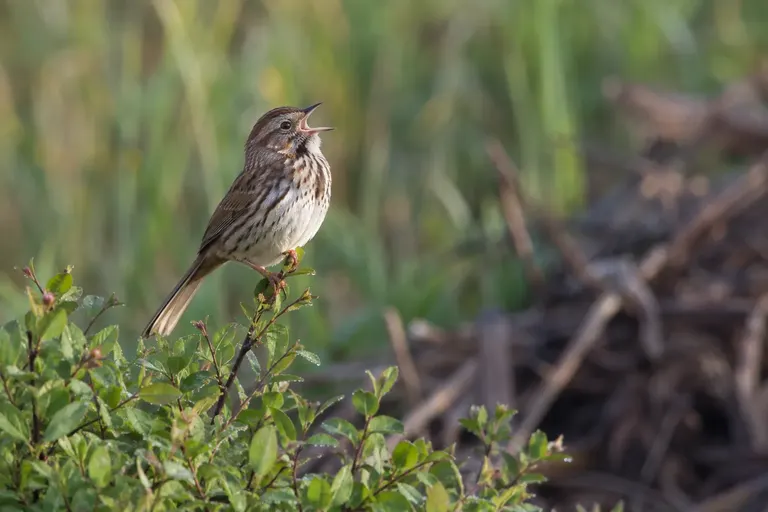
Male Anna’s sing, which is unusual among North American hummingbirds. The song is a thin, scratchy, buzzy series of notes often delivered from a high perch, even in winter. If you hear squeaky, electric-sounding phrases from the top of a shrub in January, look for a male Anna’s.
Similar species
- Costa’s Hummingbird: a desert species with a purple crown and throat whose gorget flares into long points at the sides.
- Rufous and Allen’s Hummingbirds: show orange or rufous on the sides and tail, and males have orange-red throats. Anna’s has no rufous color.
- Black-chinned Hummingbird: slimmer, with a black chin and thin purple band on males. Females are paler below than female Anna’s and lack the pink throat patch.
- Broad-tailed Hummingbird: a mountain species with a rose-red throat only, not the crown.
For practice with lookalikes, see our guide on how to identify birds.
Where Anna’s Hummingbirds live, and why they are spreading
The Cornell Lab notes Anna’s was once limited to northern Baja California and southern California. Since the 1930s its range has expanded to Vancouver, Canada, helped by backyard feeders and introduced flowering trees such as eucalyptus. Audubon notes the breeding range has expanded north and east since the 1950s, now reaching British Columbia and Arizona, and that some southwestern birds move seasonally between Arizona and California while others stay year-round.
Anna’s are common in cities and suburbs. The Cornell Lab lists chaparral, coastal scrub, oak savannah and open woodland among natural habitats, and notes the birds are notably abundant around eucalyptus. Populations grew by more than 2 percent a year between 1966 and 2019, with a global breeding population estimated at 9.6 million.
That range growth is good news for backyard feeders, but it also puts a responsibility on you: in places like Seattle, Portland and Vancouver, some Anna’s rely on feeders to get through cold snaps.
What Anna’s Hummingbirds eat
The Cornell Lab lists nectar from currant, gooseberry, manzanita and eucalyptus, and notes Anna’s also catch insects from leaves, crevices, spider webs and the air, mainly midges, whiteflies and leafhoppers. One female was documented with 32 leafhoppers in her stomach. They also take tree sap and trapped insects from sapsucker wells.
Insects are critical for raising young and for getting through winter days when few flowers bloom. A yard without pesticides, with some leaf litter and a few spider webs left alone, supports the small insects Anna’s hunt.
Hummingbird nectar for Anna’s: the recipe
The Cornell Lab and Audubon both recommend one part plain white sugar to four parts water, a quarter cup of sugar per cup of water. Stir until dissolved and let it cool before filling. Our step-by-step hummingbird nectar recipe covers batch sizes and storage.
- Cold-weather option: the Cornell Lab notes some people use about one-third cup of sugar per cup of water in cold, rainy weather, when birds need extra energy. A slightly stronger mix also freezes at a lower temperature than a weak one, though it will still freeze in a hard frost.
- Never add red dye. Audubon warns it is unnecessary and could be harmful.
- Never use honey. Audubon says it can promote dangerous fungal growth.
- Plain white table sugar only. Skip brown, raw or organic sugars and artificial sweeteners.
How often to change nectar
Audubon’s schedule: every day or every other day in hot weather, every three days in temperate weather and twice a week in cooler weather. Along the coast, where summers are mild, that often means every three days most of the year. Inland in hot summers, change it daily. Our guide on how to clean a bird feeder covers scrubbing and rinsing.
Winter feeding: keeping Anna’s going through cold snaps
This is the part of Anna’s care that matters most, and where the species differs from eastern hummingbirds.
Why winter feeders matter
The Cornell Lab says Anna’s do not migrate much, and Audubon notes they stay through winter in many areas where no other hummingbirds are present. On cold nights they enter torpor: according to the Cornell Lab, breathing and heart rate slow, and body temperature, normally around 107 degrees Fahrenheit, can fall as low as 48 degrees Fahrenheit. At dawn a bird coming out of torpor needs food quickly. A frozen feeder at first light is a real problem.
How to keep nectar from freezing
- Rotate two feeders. Keep one indoors. At dawn, swap the frozen one for the thawed one. This is the simplest method and costs nothing extra if you already own two feeders.
- Bring the feeder in at night. Take it indoors after dusk and rehang it before sunrise. Anna’s feed very early, so set an alarm if a hard freeze is forecast.
- Add gentle heat. Some people clip an outdoor-rated incandescent bulb or a purpose-made feeder heater near or under the feeder. Follow the product’s instructions and keep electrical connections dry.
- Wrap the feeder. Pipe insulation or a sock around a bottle feeder can slow freezing on marginal nights, but it will not stop a hard freeze.
- Choose a sheltered spot. Hang winter feeders under an eave, out of the wind, where you can reach them easily in bad weather.
Audubon notes drinking cold nectar does not appear to cold stun hummingbirds, so the goal is to keep it liquid, not warm.
Do not stop partway through winter
If Anna’s are using your feeder in late fall, keep it going until spring. Birds that have built their winter routine around your yard may struggle if the food disappears during a freeze. If you travel, ask a neighbor to swap feeders.
Choosing and placing a feeder for Anna’s
Based on manufacturer designs and patterns in owner feedback, the features that matter most for year-round use are:
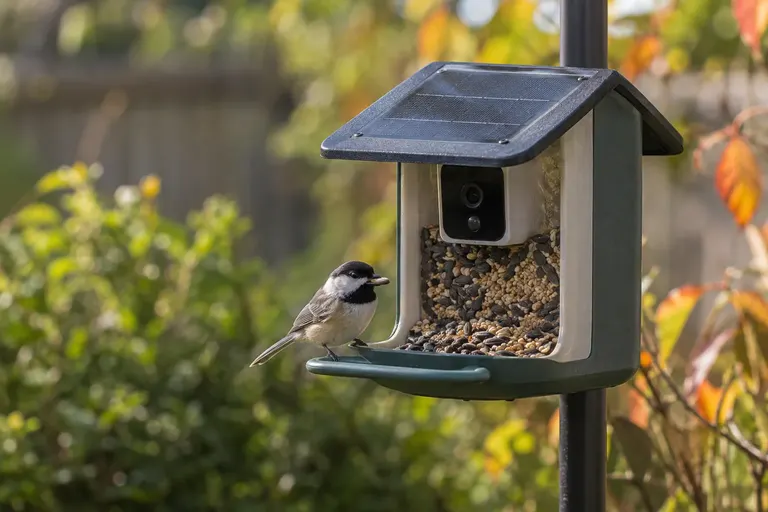
- Parts you can scrub. You will clean this feeder more than a hundred times a year.
- Small to medium capacity. An 8 to 12 oz feeder is enough for most yards. Big feeders mostly mean wasted nectar.
- Built-in or add-on ant moat. Ants are active much of the year in mild climates.
- Red color on the feeder, not in the nectar.
Placement tips:
- Partial shade. The Cornell Lab warns direct sun spoils nectar quickly.
- A nearby perch. Male Anna’s defend feeding territories from exposed twigs. Leave a small bare branch nearby.
- Multiple feeders out of sight of each other. One dominant male can guard a single feeder all winter. A second feeder around a corner lets other birds feed.
- Window safety. Put feeders either right on the glass or well back from it, and treat windows as described in how to stop birds hitting windows.
- Out of reach of cats. Hang feeders high and away from shrubs where a cat can wait.
Our roundup of hummingbird feeders that are easy to clean and do not leak compares models in more detail.
The best native plants for Anna’s Hummingbirds
The ideal Anna’s garden has something blooming in every month, especially from late fall through early spring, when other food is scarce.
| Plant | Type | Main bloom | Notes |
|---|---|---|---|
| Red-flowering currant (Ribes sanguineum) | Shrub | Late winter to spring | Pacific Northwest and northern California favorite |
| Fuchsia-flowered gooseberry (Ribes speciosum) | Shrub | Winter to spring | Southern and central California, drought tolerant |
| Manzanitas (Arctostaphylos species) | Shrub | Winter to early spring | Named by the Cornell Lab as a nectar source |
| Hummingbird sage (Salvia spathacea) | Perennial | Spring | Part shade, California native |
| Cleveland sage and other native salvias | Shrub or perennial | Spring to summer | Drought tolerant, regional species vary |
| Penstemons (red and pink species) | Perennial | Spring to summer | Choose species native to your area |
| California fuchsia (Epilobium canum) | Perennial | Late summer to fall | Fills the fall gap when little else blooms |
| Orange honeysuckle (Lonicera ciliosa) | Vine | Late spring | Pacific Northwest native vine |
Many gardeners in the Anna’s range also grow non-native winter bloomers such as grevilleas and some eucalyptus, which Anna’s use heavily. Natives are the better long-term choice because they also support the insects Anna’s feed on. Check your local native plant society or extension office for species suited to your county.
Nesting: the earliest hummingbird of the year
Anna’s are famous for nesting in winter. Audubon notes they may begin nesting in December or even earlier.
The Cornell Lab describes the nest as a small cup of plant down and spider web, sometimes with cattail, willow or thistle fluff, feathers, lichens and moss, about 1 inch tall and 1.5 inches across. It is usually on a horizontal branch of a tree or shrub 6 to 20 feet up, often near a nectar source, and commonly in oak, sycamore or eucalyptus. Building takes about a week.
| Nesting detail | Anna’s Hummingbird |
|---|---|
| Eggs | 2, white |
| Incubation | About 16 days |
| Nestling period | About 20 days |
| Broods per year | 2 to 3 |
| Who raises young | Female only |
Anna’s do not form pair bonds, according to the Cornell Lab, and only females care for the young. You can help nesting females by leaving spider webs on eaves and fences, not tidying away every bit of plant fluff, and never spraying for insects around shrubs.
Hummingbirds do not use nest boxes. If you find a nest, watch from a distance and do not touch it or the branch.
The courtship dive
The Cornell Lab describes the male’s display: he climbs as high as 130 feet into the air, then dives past the female and produces an explosive squeak with his tail feathers at the bottom. He also performs a shuttle display, swinging side to side just above her. Seeing dives in your yard in winter is a strong sign a female is nesting nearby.
How Anna’s differ from eastern hummingbirds
If you moved west from the East, or read hummingbird advice written for eastern yards, a few habits need to change.
| Question | Anna’s Hummingbird | Ruby-throated Hummingbird |
|---|---|---|
| Migration | Mostly resident, some local movement | Long-distance migrant to Mexico and Central America |
| When feeders matter most | Winter cold snaps and early spring | Spring arrival and late-summer migration |
| Nesting season | Can start in December | Late spring and summer |
| Broods per year | 2 to 3 | 1 to 2 |
| Male display dive | Up to about 130 ft | U-shaped dives from about 50 ft |
| Take feeders down in fall? | No | Only two weeks after the last bird |
The practical takeaway: an Anna’s feeder is a twelve-month commitment. Plan your cleaning routine, nectar supply and winter thawing method before you start.
Attracting Anna’s to a balcony or small patio
Anna’s are one of the most urban hummingbirds in North America, and they readily use apartment balconies in cities along the coast.
- Start with a small feeder. An 8 oz window or hanging feeder is enough. Our guide to bird feeders for balconies and small spaces covers railing and window mounts.
- Grow one winter bloomer in a pot. A container of hummingbird sage, a dwarf manzanita or a native currant gives birds a reason to stop between feeder visits.
- Pick the sheltered side. A balcony out of the prevailing winter wind keeps nectar from freezing as quickly.
- Plan for winter access. You will be swapping feeders on dark, cold mornings, so hang it where you can reach it without a ladder.
Give birds a second reason to visit by keeping a shallow dish or mister nearby; many hummingbirds bathe by flying through fine spray or rubbing against wet leaves.
A year with Anna’s Hummingbirds
| Season | What is happening | What to do |
|---|---|---|
| Late fall to winter | Males defend territories, first nests begin | Keep feeders thawed, plant winter bloomers |
| Late winter to spring | Peak nesting, courtship dives | Leave spider webs, avoid pruning shrubs with nests |
| Summer | Later broods, young birds disperse | Change nectar more often in heat |
| Early fall | Numbers at feeders can shift as birds move around | Keep feeders up, plant fall bloomers like California fuchsia |
Common mistakes with Anna’s Hummingbirds
- Taking feeders down in fall. Unlike eastern hummingbirds, most Anna’s do not leave. A feeder in December can be a lifeline.
- Letting a feeder freeze solid at dawn. Rotate feeders or bring them in on frosty nights.
- Leaving nectar too long. Even in cool weather, change it at least twice a week.
- One feeder in full sun. It spoils fast and one male will control it.
- Spraying insecticides. Anna’s need small insects year-round.
- Pruning shrubs heavily in winter and spring. You may remove an active nest; Anna’s are protected under the Migratory Bird Treaty Act.
- Expecting instant results. If no Anna’s have been using your yard, it may take time for one to find a new feeder. See why birds are not coming to a new feeder.
Sources
- Anna’s Hummingbird Life History, All About Birds, Cornell Lab of Ornithology
- Anna’s Hummingbird Identification, All About Birds, Cornell Lab of Ornithology
- Anna’s Hummingbird Overview, All About Birds, Cornell Lab of Ornithology
- Anna’s Hummingbird, Audubon Guide to North American Birds
- Hummingbird Feeding FAQs, Audubon
- Aspects Jewel Box Window Hummingbird Feeder, Birds Choice
Gear mentioned in this guide
Aspects HummZinger HighView 12 oz
A saucer feeder that separates for scrubbing, with a built-in ant moat. Saucer designs keep nectar in a shallow reservoir, which is easy to swap for a thawed spare on frosty mornings.
- Best for
- West Coast yards feeding Anna's through all four seasons.
- Skip it if
- You need a feeder that sticks to a window; a suction-cup window model suits that better.
- Capacity
- 12 oz
- Ports
- 4
- Ant moat
- Built in
Aspects Jewel Box Window Hummingbird Feeder 8 oz
A small suction-mount feeder that puts Anna's at arm's length. Feeders mounted directly on glass also reduce the risk of high-speed window strikes.
- Best for
- Apartments, balconies and anyone who wants close views from indoors.
- Skip it if
- Your windows face hot afternoon sun, which spoils nectar quickly.
- Capacity
- 8 oz
- Ports
- 3
- Size
- 8.5 x 6 x 2.2 in
Frequently asked questions
Do Anna's Hummingbirds stay all winter?
In much of their range, yes. The Cornell Lab notes Anna's Hummingbirds do not migrate much, so many yards along the Pacific Coast see them year-round. Audubon says the species stays through winter in many areas where no other hummingbirds are present. That is why keeping a feeder clean and thawed in winter matters so much for this species.
How do I keep my hummingbird feeder from freezing?
Common approaches are to bring the feeder indoors on freezing nights and rehang it at first light, rotate two feeders so a thawed one is always ready, or hang the feeder near a heat source such as an outdoor incandescent light or a purpose-made feeder heater. Audubon notes drinking cold nectar does not appear to cold stun hummingbirds.
What sugar water ratio should I use for Anna's Hummingbirds?
Use one part plain white sugar to four parts water, a quarter cup of sugar per cup of water, as the Cornell Lab and Audubon recommend. The Cornell Lab notes some people use about one-third cup per cup of water in cold, rainy weather. Never use honey, red dye or sweeteners, and change nectar at least twice a week in cool weather.
When do Anna's Hummingbirds nest?
Very early. Audubon notes Anna's Hummingbird may begin nesting in December or even earlier, which makes it one of the earliest nesting birds in North America. The Cornell Lab lists 2 white eggs per clutch, about 16 days of incubation, about 20 days in the nest, and 2 to 3 broods a year.
How do I tell an Anna's Hummingbird from other hummingbirds?
Adult males have an iridescent rose-pink crown and throat that covers the head like a hood, which the Cornell Lab compares to a balaclava. Females are green above and grayish below, usually with a small central patch of pink throat feathers. Anna's is also stockier than Rufous or Black-chinned Hummingbirds and lacks rufous color.
Where do Anna's Hummingbirds live?
Anna's live along the Pacific Coast from Baja California to British Columbia and inland in parts of the Southwest, including Arizona. The Cornell Lab notes the breeding range was once limited to northern Baja California and southern California, and has expanded dramatically since the 1930s, helped by backyard feeders and introduced flowering trees.