Cats and Birds: Keeping Your Yard Safe
Cats and birds: outdoor cats kill billions of US birds a year. What works to protect feeder birds, from indoor cats and catios to smarter feeder placement.
In this article
- Quick answer: how to protect birds from cats
- How many birds do cats actually kill?
- Why are cats so hard on birds?
- Which birds are most at risk?
- Do cats hurt birds even when they don’t catch them?
- What actually works to stop cats killing birds?
- How should I set up feeders if cats visit my yard?
- How can I keep neighborhood cats out of my yard?
- How do I protect nesting birds from cats?
- What should I do if a cat catches a bird?
- Myths vs facts about cats and birds
- Common mistakes
- Does this mean cat owners shouldn’t feed birds?
- Quick facts
- Sources
- Frequently asked questions
Cats and birds do not mix well. Free-ranging domestic cats are one of the biggest human-caused threats to birds, killing an estimated 1.3 to 4.0 billion birds a year in the contiguous US, according to a widely cited 2013 study. If you feed birds, the most effective single step is to keep cats, yours and ideally everyone’s, away from the feeding area, and the most reliable way to do that is to keep pet cats indoors or in an enclosure.
That does not mean cat owners and bird lovers are on opposite sides. Many people are both. This guide explains why cats have such an impact, what the evidence says about bells, collars and other fixes, and how to set up your yard so feeder birds are as safe as possible.
Quick answer: how to protect birds from cats
- Keep your own cat indoors, or give it outdoor time in a catio, on a harness, or in a fenced enclosure.
- Place feeders thoughtfully: high off the ground, clear of ambush cover by about 10 to 12 feet, with escape cover nearby.
- Stop ground feeding if cats visit your yard.
- Use harmless deterrents such as motion-activated sprinklers, fencing and prickly ground cover.
- Protect nest boxes with pole-mounted boxes and predator guards.
- Act fast if a cat catches a bird: call a wildlife rehabilitator even if the bird looks unhurt.
How many birds do cats actually kill?
The best-known estimate comes from a 2013 study by Scott Loss, Tom Will and Peter Marra, published in Nature Communications. By combining data from many earlier studies, they estimated that free-ranging domestic cats kill between 1.3 and 4.0 billion birds a year in the contiguous United States, along with billions of small mammals. Unowned cats, including strays and feral colonies, were responsible for most of the kill, but pet cats allowed outside contributed a substantial share.
Other countries show similar patterns:
- Canada: government-supported research has estimated cat predation in the range of 100 to 350 million birds a year.
- Australia: studies estimate feral and pet cats kill hundreds of millions of birds a year, and cats have contributed to the extinction of several native mammals.
- United Kingdom: survey work by the Mammal Society in the early 2000s estimated millions of birds brought home by pet cats in a single spring and summer, and cats catch more than they bring home.
These figures are estimates with wide ranges, and critics have questioned some assumptions. But even the low end of the US range places cats among the largest direct human-linked sources of bird mortality, alongside collisions with buildings and glass. For the wider context, see why bird populations are declining.
Why are cats so hard on birds?
Are cats a natural predator?
Not in most places. Domestic cats descend from the African wildcat and were spread worldwide by people. On many islands and continents, native birds evolved without a small, agile, ambush predator living at such high densities. The IUCN’s invasive species specialists list the domestic cat among the world’s worst invasive species, and cats have been linked to dozens of bird, mammal and reptile extinctions, especially on islands.

Why does a well-fed cat still hunt?
Hunting in cats is driven largely by instinct and triggered by movement, not only by hunger. A well-fed pet still stalks and pounces. Feeding does not switch the behavior off, although research suggests diet and play may reduce it somewhat, as explained below.
Why are cats so numerous?
Pet cats are subsidized by people with food, shelter and veterinary care, so they live at densities far higher than any wild predator of similar size. In suburban neighborhoods, the local cat population can outnumber native predators many times over, and a few cats patrolling several yards can affect local birds even if each cat catches only a few.
Which birds are most at risk?
- Ground feeders: juncos, sparrows, towhees, doves, thrushes and robins spend time on the ground or in low cover where cats hunt.
- Fledglings: young birds leaving the nest spend days on or near the ground, poor at flying. Late spring and early summer are peak risk.
- Nesting birds: open-cup nests in low shrubs and hedges are vulnerable, and incubating adults can be caught on the nest.
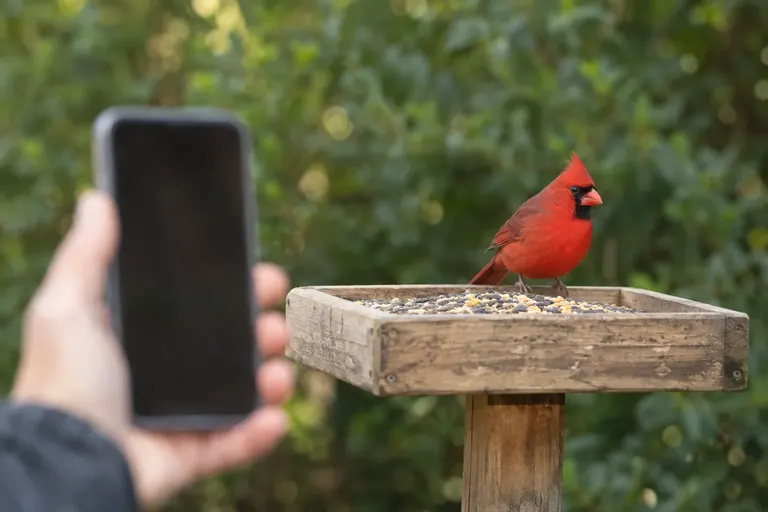
- Birds at poorly placed feeders: feeders beside dense shrubs or low to the ground give cats an easy ambush.
- Birds stunned by window strikes: a bird sitting dazed below a window is easy prey.
If you find a young bird on the ground, see found a baby bird before intervening. In most cases the best help is keeping cats and dogs away while the parents do their job.
Do cats hurt birds even when they don’t catch them?
Yes. Researchers call these “fear effects” or sublethal effects. A UK study published in 2013 found that when a model cat was placed near Blackbird nests, the parents fed their chicks less often, and nests were then more likely to be attacked by other predators, probably because the alarm calls and disturbance drew attention.
Birds that feel threatened spend more time watching and less time feeding, which matters in winter when every minute of foraging counts. A cat regularly sitting under a feeder can cut feeding visits even if it never catches anything.
Cats also carry diseases that can affect wildlife. The parasite Toxoplasma gondii, which completes its life cycle in cats, has been linked to deaths of endangered birds in Hawaii and to sea otter deaths in California.
What actually works to stop cats killing birds?
Is keeping cats indoors the best solution?
Yes. Keeping cats indoors all the time removes the problem entirely, and many veterinary organizations note that indoor cats also avoid traffic, fights, diseases and other hazards. The American Bird Conservancy’s Cats Indoors program has long promoted this approach in the US.
If your cat is used to going out, the transition takes patience:
- Add enrichment first. Window perches, cat trees, puzzle feeders and daily play sessions.
- Reduce outdoor time gradually. Start by keeping the cat in from dusk to dawn and during early morning.
- Offer safe outdoor access. A catio, a secure fenced run, or harness training.
What is a catio?
A catio is an enclosed outdoor space for cats, ranging from a window box to a full screened porch or a wire-mesh run on a patio. It gives the cat fresh air, sounds and smells without access to birds. Many owners find it the easiest compromise.
Do bells and collars work?
Somewhat. Studies of cats wearing bells found they brought home fewer birds than unbelled cats, but reductions varied and belled cats still caught many animals. Cats may learn to move without ringing the bell, and bells do nothing for fledglings that cannot fly away.
Brightly colored collar covers, which are designed to be highly visible to birds, reduced bird captures substantially in some published trials. They appear to work because birds see color very well and spot the cat earlier. They had little effect on mammal captures. Collars should always be breakaway types to avoid injuring the cat.
Do diet and play change hunting?
A UK study led by researchers at the University of Exeter, published in 2021, found two simple changes reduced the number of prey cats brought home. Cats switched to a high-meat, grain-free food brought home about a third fewer prey, and cats given 5 to 10 minutes of daily object play with a toy that mimics prey brought home about a quarter fewer. These are useful additions, but not a substitute for keeping cats in.
What about keeping cats in at certain times?
If your cat does go out, keeping it in at night and especially around dawn and dusk helps, since many birds are most active in the early morning. Keeping cats in during the main fledging season, roughly spring to midsummer in temperate regions, protects the most vulnerable birds.
How should I set up feeders if cats visit my yard?
Feeder placement makes a large difference.
How far from bushes should feeders be?
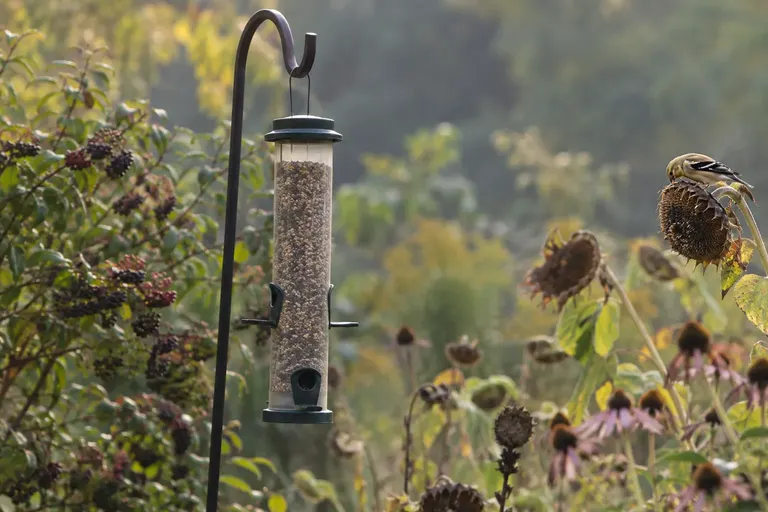
Place feeders roughly 10 to 12 feet from dense shrubs, fences, woodpiles or low walls where a cat can hide and pounce. At the same time, birds need cover within a short flight to escape hawks. The ideal spot has open ground around the feeder with shrubs or trees at a moderate distance. Our guide on where to put a bird feeder walks through the trade-offs.
How high should feeders be?
Mount feeders at least 5 feet off the ground on a smooth metal pole, with a baffle below. A baffle stops raccoons and squirrels, and a smooth pole also denies cats a climbing route. See squirrel baffles explained for sizes and placement.
Should I stop ground feeding?
If cats are around, yes. Scattered seed on the ground concentrates juncos, sparrows and doves exactly where cats hunt. If you want to feed ground birds, use a low platform in open lawn well away from cover, or accept that some birds will not visit until the cat problem is solved.
What about window feeders?
Feeders stuck directly on the glass or placed within 3 feet of a window reduce collision injuries. Make sure there is no ledge or shrub nearby that a cat could use to reach birds at the feeder.
Keep the area under feeders clean
Spilled seed attracts ground birds, and also rodents, which in turn attract cats. A tray under the feeder or a no-waste seed blend reduces the pile.
How can I keep neighborhood cats out of my yard?
You cannot control other people’s cats, but you can make your yard less attractive to them.
- Motion-activated sprinklers are one of the most effective humane deterrents. Cats dislike being sprayed and learn to avoid the area.
- Fencing. Standard fences rarely stop cats, but angled toppers or rollers along the top can prevent climbing.
- Prickly ground cover. Thorny prunings, coarse mulch, or plastic spike mats around feeders and garden beds make stalking uncomfortable.
- Remove hiding spots near feeders. Move feeders away from low shrubs, or trim lower branches so cats cannot lurk inside.
- Talk to the neighbor. A friendly conversation, especially during nesting season, often works better than anything else. Many cat owners simply do not know how many birds their cat catches.
- Check local laws. Some cities and counties have ordinances on free-roaming cats. Animal control can explain options.
Avoid anything that could harm a cat: poisons, glue traps, and unlicensed trapping are illegal in many places and can injure wildlife and pets.
What about feral cat colonies?
Managing unowned cats is a debated issue. Some groups support trap-neuter-return programs, in which cats are sterilized and returned to where they were found. Many conservation and wildlife organizations, including the American Bird Conservancy, argue that returned cats continue to kill wildlife and that colonies are often replenished by new abandoned cats. If a colony is near your yard, contact local animal services and wildlife agencies to learn the policy where you live.
How do I protect nesting birds from cats?
- Mount nest boxes on smooth metal poles with a predator guard such as a cone or stovepipe baffle, rather than on fences or trees cats can climb. See how to mount a birdhouse.
- Choose boxes without perches. Birds do not need them, and they help predators.
- Plant thorny native shrubs such as native roses, hawthorn or holly, which give nesting birds some protection.
- Keep cats in during nesting and fledging season. This is when a single cat can do the most damage.
What should I do if a cat catches a bird?
Act quickly, even if the bird appears unhurt.
- Gently contain the bird in a ventilated cardboard box lined with a soft cloth.
- Keep it dark, quiet and warm. Do not handle it more than necessary.
- Do not give food or water. Birds can aspirate liquids, and the wrong food can harm them.
- Call a licensed wildlife rehabilitator right away. Cat saliva contains bacteria that can cause fatal infection within a day or two, even from a tiny puncture. Prompt antibiotics can save the bird.
Our guide on what to do with an injured bird explains how to find a rehabilitator and what to expect.
Myths vs facts about cats and birds
| Myth | Fact |
|---|---|
| Well-fed cats don’t hunt. | Hunting is driven by instinct; well-fed cats still hunt. |
| Cats only catch old or sick birds. | Cats take healthy adults, nestlings and fledglings. |
| A bell solves the problem. | Bells reduce captures somewhat but do not protect fledglings or nests. |
| Birds that escape a cat are fine. | Small punctures can cause fatal infections without treatment. |
| Cats are a natural part of the ecosystem. | Domestic cats are introduced predators in most places they live. |
Common mistakes
- Putting feeders right beside dense shrubs, which gives cats an ambush point.
- Scattering seed on the ground when cats are known to visit.
- Letting a cat out at dawn in spring and early summer, the riskiest time for fledglings.
- Mounting nest boxes on fence posts that cats can walk along.
- Releasing a cat-caught bird without treatment because it seems fine.
- Assuming the problem is only feral cats. Pet cats that go outside account for a meaningful share of bird deaths.
Does this mean cat owners shouldn’t feed birds?
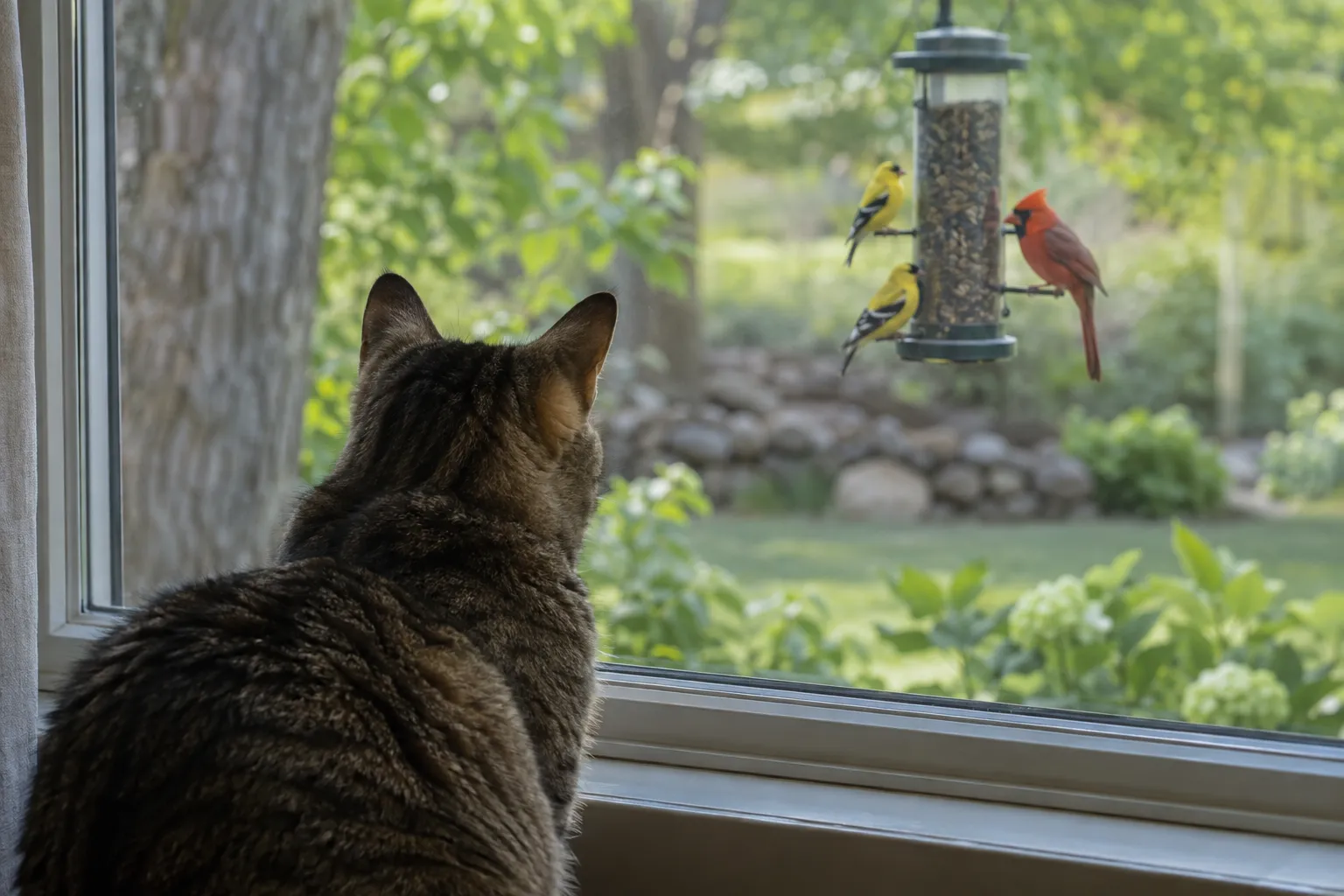
No. Many cat owners feed birds responsibly. The key is keeping your cat indoors or contained, and placing feeders where visiting cats have little chance. An indoor cat watching a busy feeder from a windowsill is a common and harmless sight, and it can be good enrichment for the cat. If you share a yard with outdoor cats you cannot control, focus on feeder height, placement and deterrents, and consider pausing ground feeding.
Hawks at the feeder are a separate issue with a different answer. Native hawks are wild predators protected by law, and we explain how to reduce their impact in how to stop hawks hunting at your feeder.
Quick facts
- US estimate: 1.3 to 4.0 billion birds killed a year by free-ranging cats.
- Unowned cats cause most of the deaths, but outdoor pets add a substantial share.
- Fledglings and ground feeders are at greatest risk.
- Bells and bright collar covers help but do not match indoor housing.
- Meat-rich diets and daily play reduced prey brought home in a UK study.
- Birds caught by cats need a rehabilitator quickly, even if they look fine.
- Motion-activated sprinklers are a humane and effective deterrent.
Sources
- Loss, S. R., Will, T. and Marra, P. P. (2013). The impact of free-ranging domestic cats on wildlife of the United States. Nature Communications
- American Bird Conservancy: Cats Indoors
- Cecchetti, M. et al. (2021). Provision of high meat content food and object play reduce predation of wild animals by domestic cats. Current Biology
Frequently asked questions
How many birds do cats kill each year?
A widely cited 2013 study in Nature Communications estimated that free-ranging domestic cats kill between 1.3 and 4.0 billion birds a year in the contiguous United States, with most of those deaths caused by unowned cats. Studies in Canada, Australia and Europe also estimate losses in the tens or hundreds of millions of birds a year. Exact numbers are uncertain, but cats rank among the largest direct human-linked causes of bird deaths.
Do bells on cat collars stop them catching birds?
Bells help somewhat. Several studies found belled cats brought home fewer birds than unbelled cats, though they still caught many. Brightly colored collar covers, which birds can see well, reduced bird captures more in some studies. Neither option protects fledglings on the ground or nests, and neither works as well as keeping the cat indoors or in an enclosure.
Should I take a bird to a vet if a cat caught it but it looks fine?
Yes, contact a licensed wildlife rehabilitator right away. Cat saliva carries bacteria, including Pasteurella, that can cause fatal infections in birds from even tiny punctures. Birds caught by cats often need antibiotics quickly to survive. Place the bird in a ventilated box in a dark, quiet, warm spot and do not give food or water while you arrange help.
How far should a bird feeder be from bushes if there are cats around?
A common recommendation is to place feeders about 10 to 12 feet from dense shrubs, fences or woodpiles where a cat could hide and pounce, while keeping some cover within a short flight for escape from hawks. Feeders should also be well off the ground. If cats are a regular problem, avoid ground feeding and low platform feeders entirely.
Is it legal to trap or deter a neighbor's cat?
Laws vary widely by state, county and city. Harmless deterrents such as motion-activated sprinklers, fencing and prickly ground cover are generally legal. Trapping, relocating or harming a cat can be illegal or regulated, and some areas treat pet cats as property. Talk with the neighbor first, and check with local animal control before doing anything more than deterring the cat.