Best Robin Nest Box: Open-Fronted Picks and Where to Hang
A robin nest box must be open-fronted and hidden low in ivy or a climber. Our top pick is the Schwegler 2H woodcrete box, plus height, timing and cleaning.
If you buy through links on this page we may earn a commission, at no cost to you. It never decides what we recommend. How we earn
In this article
- Quick picks
- How we chose
- What kind of nest box does a robin use?
- Schwegler 2H Open-Fronted Nest Box: best robin nest box overall
- Gardman Robin Nest Box (A04380): best budget wooden robin box
- CJ Wildlife Birch Log Open Front Nest Box: best natural-looking robin box
- WILDLIFE FRIEND Robin Half-Cave Nest Box: best roomy wooden robin box
- JCs Wildlife All Poly Lumber Robin Roost: best for American robins (US readers)
- Comparison table
- Where should you put a robin nest box?
- How high should a robin nest box be?
- Which way should a robin nest box face?
- When should you put up a robin nest box?
- How big should the front of a robin nest box be?
- Which other birds use an open-fronted nest box?
- Why is a robin ignoring my nest box?
- How do you clean a robin nest box, and when?
- Building or buying a robin bird house for American robins
- Common mistakes with robin nest boxes
- Sources
- Frequently asked questions
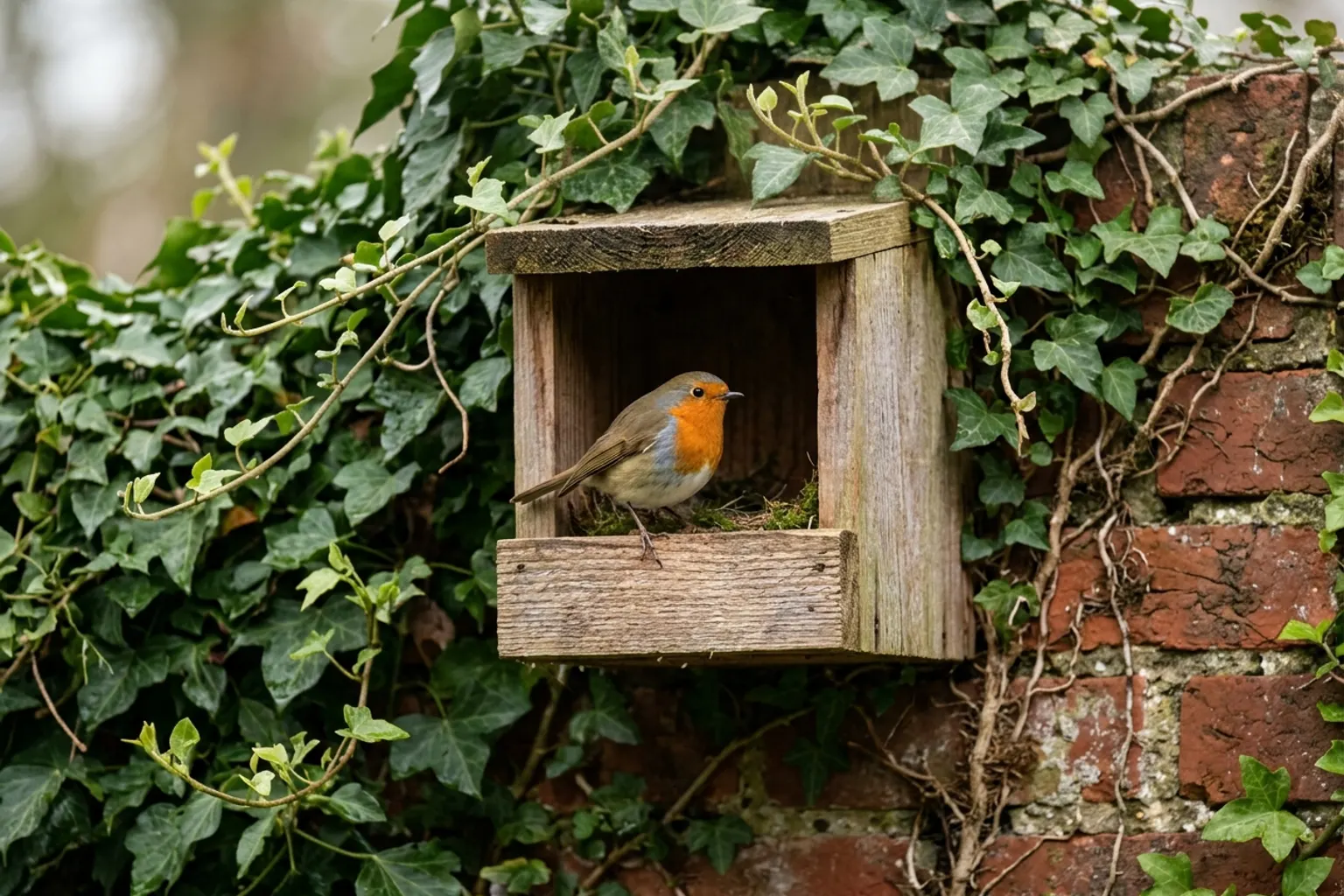
The best robin nest box is an open-fronted box, not one with a round hole, hidden low down in ivy, a climber or a thick hedge. Our top pick for UK and Irish gardens is the Schwegler 2H, a woodcrete open-front box that the RSPB shop says lasts at least 20 to 25 years.
Quick picks
- Best overall: Schwegler 2H Open-Fronted Nest Box. Woodcrete, removable front, galvanised hanger.
- Best budget wooden box: Gardman Robin Nest Box (A04380). FSC timber, slide-out floor.
- Best natural look: CJ Wildlife Birch Log Open Front Nest Box. Carved from one birch log.
- Best roomy wooden box: WILDLIFE FRIEND Robin Half-Cave Nest Box. Untreated pine with a metal roof.
- Best for American robins (US): JCs Wildlife All Poly Lumber Robin Roost. An open nesting shelf, not a box.
Schwegler 2H Open-Fronted Nest Box
A woodcrete half-open box with a side-facing opening, a removable front panel and a galvanised hanger, made for robins, wrens, spotted flycatchers and redstarts.
- Best for
- Walls and sheds with climbers, where you want a box that lasts decades.
- Skip it if
- You want to fix a box to a thin fence panel that may not take 2.5 kg.
- Material
- Woodcrete (wood-concrete)
- Size
- 150 x 200 x 200 mm (5.9 x 7.9 x 7.9 in)
- Inside diameter
- 120 mm (4.7 in)
- Weight
- 2.5 kg (5.5 lb)
Gardman Robin Nest Box (A04380)
A simple open-fronted box in FSC-certified timber with a slide-out floor for cleaning, built to BTO nest box standards according to the retailer listing.
- Best for
- A first robin box on a fence or shed wall inside a climber.
- Skip it if
- You want a box that will still be sound in ten years without upkeep.
- Material
- FSC-certified timber
- Size
- 24 x 13.5 x 24 cm (9.4 x 5.3 x 9.4 in)
- Front
- Open front
- Cleaning
- Removable slide-out floor
CJ Wildlife Birch Log Open Front Nest Box
An open-fronted box carved from a single FSC birch log, with a roof that shelters the nest from above and a shape that blends into a hedge or tree trunk.
- Best for
- Hedges, trunks and wild corners where a plain box would stand out.
- Skip it if
- You need exact dimensions or a cleaning door; each log is slightly different.
- Material
- FSC 100% birch log
- Size
- 256 x 156 x 223 mm (10.1 x 6.1 x 8.8 in), varies per log
- Weight
- About 1.6 kg (3.6 lb)
- Front
- Half open
WILDLIFE FRIEND Robin Half-Cave Nest Box with Metal Roof
A solid untreated pine box for robins and other half-cave nesters, with a metal roof to shed rain and rough-sawn wood that breathes.
- Best for
- Gardens with black redstarts or wagtails as well as robins.
- Skip it if
- You want a box made to UK BTO patterns with a set front height.
- Material
- Untreated pine, metal roof
- Size
- 17 x 22.5 x 24.5 cm (6.7 x 8.9 x 9.6 in)
- Front
- Half-cave (open front)
- Species listed
- Robins, redstarts, black redstarts, wagtails
JCs Wildlife Modern Style All Poly Lumber Robin Roost
A US-made open nesting shelf in recycled poly lumber for American robins, phoebes, doves and swallows, with pre-drilled holes and screws included.
- Best for
- North American gardens where robins already nest on ledges, eaves or light fittings.
- Skip it if
- You live in the UK or Ireland; a European robin needs a closed-in, open-fronted box, not a shelf.
- Material
- Recycled poly lumber
- Size
- 24.1 x 20.3 x 23.5 cm (9.5 W x 8 D x 9.25 H in)
- Mounting
- Pre-drilled holes, screws included
- Made in
- USA (Southern Indiana)
How we chose
We have not tested these boxes ourselves. This guide is research-based. We compared maker and retailer specifications for material, front design, size, mounting and cleaning access against nest box guidance from the RSPB and the BTO, and against Cornell Lab NestWatch for the American robin shelf. We checked each model is listed on Amazon in the right market. Amazon ratings and reviews played no part in the ranking. We weighted what decides whether robins nest: the right open front, a dry material and a fixing that lets you hide the box.
What kind of nest box does a robin use?
Answer: A robin uses an open-fronted nest box. The RSPB says robins don’t take to standard boxes with a round entrance hole and prefer a box whose front is cut open. The BTO plan for a robin box uses a front panel 100 mm (about 4 in) high, which it calls the medium height that works best for robins, with the top of the front left open.
That open front copies a robin’s natural nest site. The BTO Gardenwatch robin guide describes natural nests in enclosed spaces on or near the ground, among tree roots, under logs or in thick, tangled vegetation, so well hidden that many garden owners never know one is there.
The old kettle and flower pot tradition
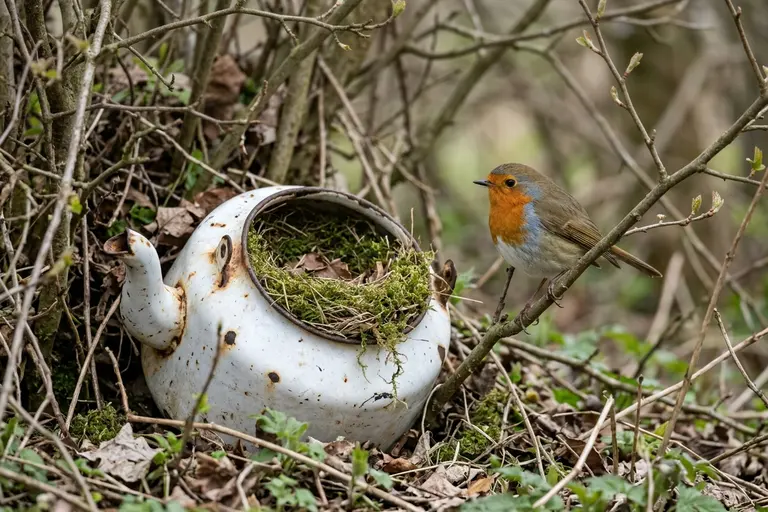
Robins are famous for odd nest sites. The RSPB lists plant pots, car bonnets and even a plane engine, and the BTO mentions flower pots in sheds, post boxes and old boots. The old garden habit of tucking a kettle or a flower pot on its side into a hedge works on the same idea as an open-fronted box: a dry, half-closed cup with a view out, hidden in cover.
Schwegler 2H Open-Fronted Nest Box: best robin nest box overall
What it is: A half-open box made from Schwegler woodcrete, a mix of wood and concrete. Wildcare and NHBS list it at 150 x 200 x 200 mm (5.9 x 7.9 x 7.9 in), with an inside diameter of 120 mm (4.7 in) and a weight of 2.5 kg (5.5 lb). A galvanised hanger and aluminium nail are included.
Why it stands out: Woodcrete doesn’t rot. The RSPB shop says the material is 75% wood, insulates and breathes, and that the box lasts at least 20 to 25 years. The opening sits at 90 degrees to the wall, and the front lifts off for cleaning. Listed users are robins, black redstarts, spotted flycatchers, pied wagtails and wrens.
Good to know: Plan for the weight: 2.5 kg needs a solid wall, shed or post. NHBS warns against hanging it on a conspicuous tree or bush, because small predators can enter the open front, so hide it in ivy or honeysuckle.
Key specs: Woodcrete, 150 x 200 x 200 mm, 120 mm inside, 2.5 kg, hanger and nail included.
- Best for: Gardens with a wall or shed covered in climbers.
- Skip it if: Your only spot is a thin fence or an open branch.
See available listings on Amazon
Gardman Robin Nest Box (A04380): best budget wooden robin box
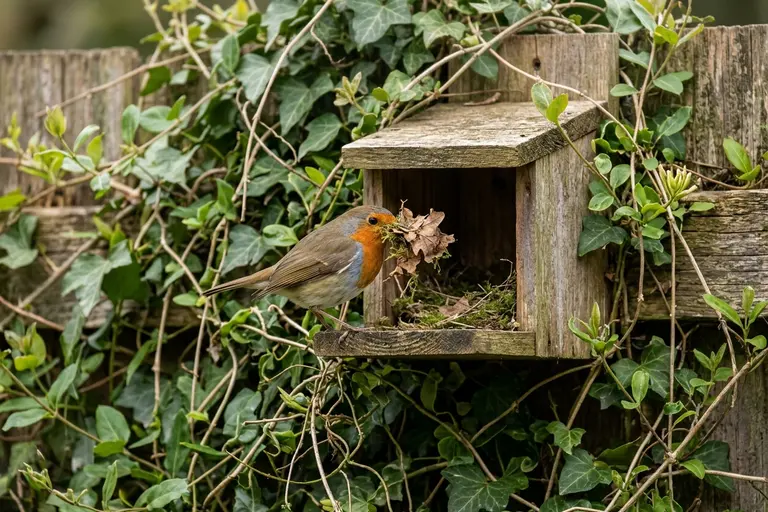
What it is: A plain open-fronted box in FSC-certified timber. The retailer listing gives 24 x 13.5 x 24 cm (9.4 x 5.3 x 9.4 in) and says it is built to BTO nest box standards.
Why it stands out: It is simple and has a slide-out floor, which makes the autumn clean-out quick.
Good to know: The listing says to fix it at least 3 metres (about 10 ft) up, high on a wall, away from cats and squirrels. That is higher than the BTO’s note that robins usually nest below 2 metres; we explain the trade-off below.
Key specs: FSC timber, 24 x 13.5 x 24 cm, open front, slide-out floor.
- Best for: A first robin box on a shed or fence covered in a climber.
- Skip it if: You want a box that lasts a decade without upkeep.
See available listings on Amazon
CJ Wildlife Birch Log Open Front Nest Box: best natural-looking robin box
What it is: An open-fronted box carved from a single FSC birch log. CJ Wildlife sells its open birch box as the Stockholm Open Birch Nest Box and lists it at about 256 x 156 x 223 mm (10.1 x 6.1 x 8.8 in) and 1.6 kg (3.6 lb), noting that every log varies.
Why it stands out: A log box disappears into a hedge or against a trunk far better than a planed box. The roof shelters the nest while the half-open front gives a clear way in. CJ Wildlife lists robin, song thrush and wren as users.
Good to know: Each log is slightly different, and there is no cleaning door listed. Check the roof each autumn.
Key specs: FSC birch log, about 256 x 156 x 223 mm, about 1.6 kg, half-open front.
- Best for: Wildlife gardens, hedges and the base of trees.
- Skip it if: You need a hinged lid or removable floor for cleaning.
See available listings on Amazon
WILDLIFE FRIEND Robin Half-Cave Nest Box: best roomy wooden robin box
What it is: A half-cave box (the German term for an open-fronted box) in untreated pine with a metal roof. The listing gives 17 x 22.5 x 24.5 cm (6.7 x 8.9 x 9.6 in).
Why it stands out: The metal roof sheds rain over the top joint, which is where wooden boxes tend to fail first. The listing describes rough, breathable wood and a life of up to 10 years, and names robins, redstarts, black redstarts and wagtails as target species.
Good to know: The listing gives no front height or fixings, so bring your own galvanised screws.
Key specs: Untreated pine, metal roof, 17 x 22.5 x 24.5 cm, half-cave front.
- Best for: Gardens with wagtails or black redstarts as well as robins.
- Skip it if: You want a box made to the BTO’s 100 mm front pattern.
See available listings on Amazon
JCs Wildlife All Poly Lumber Robin Roost: best for American robins (US readers)
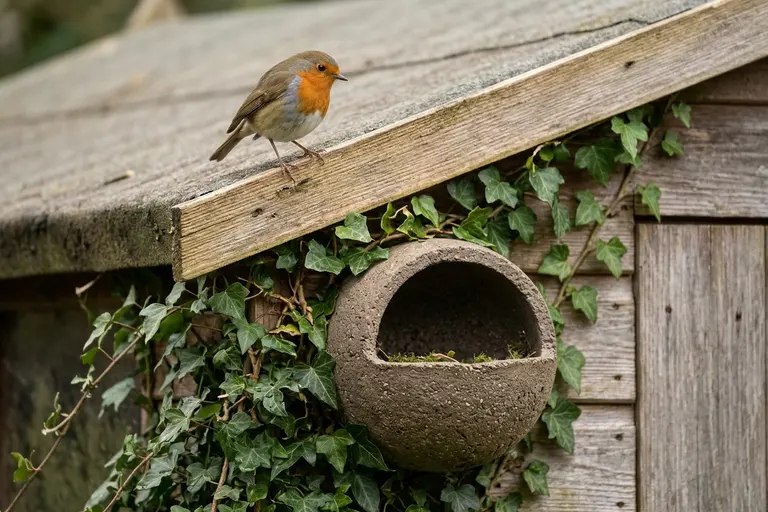
What it is: An open nesting shelf, not a box, made in Southern Indiana from recycled poly lumber. JCs Wildlife lists it at 24.1 x 20.3 x 23.5 cm (9.5 in wide, 8 in deep, 9.25 in high), with pre-drilled holes and screws included.
Why it stands out: American robins nest on ledges, not in cavities, and a roofed shelf with open sides gives them a dry ledge under cover. JCs Wildlife says the poly lumber won’t crack, split or fade in normal weather, and lists robins, doves, phoebes and swallows as users.
Good to know: The thing to plan is the site: NestWatch recommends a sheltered spot under eaves or over a light fixture.
Key specs: Recycled poly lumber, 24.1 x 20.3 x 23.5 cm, screws included, made in the USA.
- Best for: US gardens where robins already nest on ledges or light fixtures.
- Skip it if: You are in the UK or Ireland. It is the wrong design for a European robin.
See available listings on Amazon
Comparison table
| Box | Material | Size | Front | Cleaning | Market |
|---|---|---|---|---|---|
| Schwegler 2H | Woodcrete | 150 x 200 x 200 mm | Open, side-facing | Removable front | UK |
| Gardman A04380 | FSC timber | 24 x 13.5 x 24 cm | Open front | Slide-out floor | UK |
| CJ Wildlife Birch Log Open | FSC birch log | About 256 x 156 x 223 mm | Half open | Not specified | UK |
| WILDLIFE FRIEND Half-Cave | Pine, metal roof | 17 x 22.5 x 24.5 cm | Half-cave | Not specified | UK |
| JCs Wildlife Robin Roost | Recycled poly lumber | 24.1 x 20.3 x 23.5 cm | Open shelf | Open design | US |
Where should you put a robin nest box?
Answer: Put it in thick cover, such as ivy on a wall or fence, honeysuckle, a climbing rose or a dense hedge. The BTO says the box should sit within the cover of a climber or overhanging vegetation, and its Gardenwatch guide says open boxes are most likely to be used when sheltered, copying a hidden natural site.
Robins choose concealment over height. An open box on a bare post is easy for cats and squirrels to reach, and Schwegler warns that small predators can get into an unprotected open front.
| Do | Don’t |
|---|---|
| Tuck it into ivy or a climber on a wall or fence | Hang it in the open on a bare post or trunk |
| Face it roughly north to east | Fix it on a south-facing wall that heats up |
| Tilt the front slightly forward so rain runs off | Angle it back so rain pools inside |
| Fix it firmly with galvanised or stainless fixings | Let it swing from a branch |
| Keep it away from feeders and busy paths | Put it next to a bird table |
If cats roam your garden, our guide to cats and birds covers ways to make nest areas safer. For fixings, see how to mount a birdhouse.
How high should a robin nest box be?
Answer: Keep it low and hidden. The BTO says robins typically nest quite low, usually less than 2 metres (about 6.5 ft) off the ground, but can nest much higher; its robin box plan puts it as below 6 to 7 feet. Dense cover around the box matters more than the exact height.
Sources differ here. The Gardman listing suggests at least 3 metres (about 10 ft) to keep cats and squirrels out of reach, and the RSPB shop’s general advice for all nest boxes is roughly 3 to 5 metres. Our reading:
- Thick cover low down, such as a mature ivy wall or thorny hedge: a box at 1 to 2 metres (3 to 6.5 ft) matches where robins nest naturally.
- Cats about and thin cover: go higher on a wall inside a climber, where a cat can’t reach or sit beside the box.
Which way should a robin nest box face?
Answer: Face it roughly north-east, sheltered from the prevailing wind and rain. The BTO says to avoid obvious sun traps such as south-facing walls, and the RSPB shop says directions between north and east are best, with the front tilted slightly down to keep rain out.
An open front lets in more weather than a holed box. If your best ivy faces another way, use the cover anyway and let the leaves shade the front.
When should you put up a robin nest box?
Answer: Put it up in autumn or winter, well before nesting starts. The RSPB says autumn is a great time and that early boxes can be used for winter roosting. BTO BirdFacts records an average first robin clutch around 18 April, with laying as early as 19 March, so have the box up by February.
Our guide on when to put up birdhouses covers other species.
A robin’s nesting year, month by month
| Month | What robins do | What you do |
|---|---|---|
| September to January | Boxes may be used for winter roosting | Clean old boxes (1 Sept to 31 Jan); put up new ones |
| February | Birds start looking at nest sites | Last good month to fix a new box |
| March to April | Nest building; first clutches from mid March, average 18 April | Keep away from the box |
| April to July | Second, sometimes third broods | Watch from a distance only |
| July to August | Adults moult and go quiet | Leave the box alone |
The BTO lists a usual clutch of 4 to 5 eggs, incubation of about 14 to 16 days by the female and fledging after about 12.5 to 16 days. Robins typically raise 2 broods a season and exceptionally 3.
How big should the front of a robin nest box be?
Answer: The BTO’s robin box plan uses a front panel 100 mm (about 4 in) high, which it says works best for robins, with timber at least 15 mm (0.6 in) thick. BBC Wildlife’s nest box guide gives the same 100 mm for robins and pied wagtails, 60 mm (2.4 in) for spotted flycatchers and 140 mm (5.5 in) for wrens.
A lower front makes an open, airy box for flycatchers; a taller one makes a darker box for wrens. The 100 mm middle size lets a sitting robin see out while the nest cup stays hidden. Our guide on how to build a birdhouse covers tools. For holed boxes, see birdhouse hole sizes by species.
Which other birds use an open-fronted nest box?
Answer: BBC Wildlife lists robin, pied wagtail, spotted flycatcher and wren as users of open-fronted boxes, each suited to a different front height. Schwegler names black redstarts too, and CJ Wildlife lists blackbirds, song thrushes and wagtails for its larger open boxes.
A tall front suits wrens; our wren house guide covers wren boxes. In most gardens a robin is still the likeliest tenant.
Why is a robin ignoring my nest box?
Answer: The usual reasons are too little cover, too much disturbance or the wrong spot. The BTO says robins are wary and avoid nest sites they think are being watched, and its Gardenwatch guide says open boxes are most likely to be used when sheltered.
- Not enough cover. Move it into ivy or a thick climber.
- Too much traffic. A box by the back door or a bird table rarely gets used.
- Wrong direction. A box facing wind, rain or full sun gets too wet or too hot.
- Hung too late. By April many pairs are already laying.
- A nest you haven’t seen. Robins are secretive. In the BTO’s Gardenwatch survey, nesting was recorded in only 29% of gardens, and many nests are never found.
- Too many boxes. The RSPB notes male robins defend their patch fiercely, so one robin box per garden is usually enough.
Be patient. The BTO notes that boxes are often reused in later years, so an empty box may be taken next spring. See also birds not using a birdhouse.
How do you clean a robin nest box, and when?
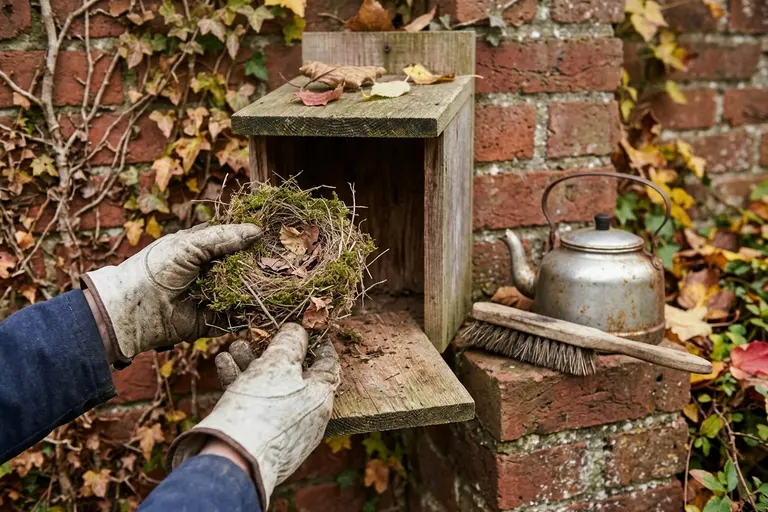
Answer: Clean it once a year, between 1 September and 31 January, as the BTO advises, after the birds have finished. Check it is empty first, since robins sometimes nest late. The RSPB notes that unhatched eggs can only legally be removed from September to January in England and Wales, and from August to January in Scotland.
- Lift off the front or slide out the floor and remove the old nest.
- Wear gloves and a dust mask.
- Rinse with boiling water. BBC Wildlife advises this rather than insecticides or flea powders.
- Let it dry fully before refitting.
Any unhatched eggs you remove must be destroyed, not kept. Our guide on when and how to clean out a birdhouse has more detail.
Building or buying a robin bird house for American robins
Answer: American robins do not nest inside boxes, so the right robin bird house in the US is an open nesting shelf. The Canadian Wildlife Federation says American robins won’t nest in boxes but will use shelves under eaves or on trees, and Cornell Lab NestWatch recommends mounting a shelf 5 to 25 feet (1.5 to 7.6 m) up.
The American robin is a different species from the European robin and nests very differently. Cornell’s All About Birds says the female builds a cup of dead grass and twigs on horizontal branches, often in the lower half of a tree, reinforces it with mud and lines it with fine grass. The nest is 6 to 8 in (15 to 20 cm) across. Robins also nest in gutters, eaves and on light fixtures.
NestWatch’s siting rules for a robin shelf:
- Height: 5 to 25 feet (1.5 to 7.6 m), on a building or post.
- Facing: any direction.
- Best site: sheltered, under the eaves or soffits, or over a light fixture.
- Spacing: about 65 feet (20 m) between shelves.
- Aftercare: remove the nest after the young fledge.
For DIY builders, the Canadian Wildlife Federation suggests untreated softwood about 2 cm (3/4 in) thick and a spot 4 or 5 m (13 to 16 ft) from a doorway. NestWatch’s full plan is a free download, so we have not repeated its measurements. Read more on how to attract American robins.
Common mistakes with robin nest boxes
- Buying a holed box. Robins need an open front; small round holes are for tits and sparrows.
- Hanging it in the open. An exposed open box is easy for cats and squirrels to reach.
- Facing it south. The BTO warns against sun traps.
- Putting it up in April. Aim for autumn or winter.
- Fixing it next to a feeder. Feed robins elsewhere; our robin feeder guide covers what to put out.
- Cleaning it in spring. Clean between 1 September and 31 January only.
Sources
- RSPB: Robin
- RSPB shop: When should you put up a nest box? And our top nest box tips
- BTO: Robin nest box plan (PDF)
- BTO: Nest boxes, your essential guide (PDF)
- BTO BirdFacts: Robin
- BTO: Gardenwatch robin guide (PDF)
- BBC Wildlife (Discover Wildlife): Garden bird nestbox guide
- Cornell Lab NestWatch: American Robin nest structure
- Canadian Wildlife Federation: Nesting shelf for American robins
- Cornell Lab, All About Birds: American Robin life history


Frequently asked questions
What kind of nest box does a robin use?
A robin uses an open-fronted nest box, not a box with a small round hole. The RSPB says robins prefer an open front nest box, where the front panel is cut low instead of drilled. The BTO plan uses a front panel 100 mm (about 4 in) high, which it says works best for robins. Hide the box low down in a climber or hedge.
How high should a robin nest box be?
Low and hidden. The BTO says robins typically nest quite low, usually less than 2 metres (about 6.5 ft) off the ground, though they can nest much higher. Some makers, including Gardman, suggest at least 3 metres to keep cats away. Cover matters more than height, so put it where ivy or a dense climber screens it.
When should I put up a robin nest box?
Put it up in autumn or winter. The RSPB says autumn is a great time, and early boxes can also be used for winter roosting. The BTO records the average first robin clutch around 18 April, but laying has started as early as 19 March, so a box hung by February gives birds time to find it.
Which way should a robin nest box face?
Face it roughly north-east, out of the prevailing wind, rain and strong sun. The BTO says to avoid sun traps such as south-facing walls, and the RSPB says directions between north and east are best. Tilt the front slightly forward so rain runs off, and let ivy or another climber shade the opening.
When can I clean out a robin nest box?
Clean it between 1 September and 31 January, as the BTO advises, once the box is no longer in use. The RSPB notes that unhatched eggs can only legally be removed from September to January in England and Wales, and from August to January in Scotland, and they must then be destroyed. Wear gloves and use boiling water, not insecticide.