Birds Not Using Your Bird Bath? 10 Reasons and Fixes
Birds not using your bird bath? It is usually too deep, slippery, badly placed or dirty. 10 reasons birds stay away and the simple fix for each one.
In this article
- Why are birds not using my bird bath?
- 1. Is the water too deep?
- 2. Are the sides too steep or the surface too slippery?
- 3. Can cats or other predators hide near the bath?
- 4. Is the bath in the wrong place?
- 5. Is the water dirty, green or smelly?
- 6. Does the bath dry out or run empty?
- 7. Is the water still and hard to notice?
- 8. Is the bath new, or has it just been moved?
- 9. Is there other water nearby?
- 10. Are bigger birds taking over?
- Why have birds stopped using a bird bath they used before?
- Can a bird bath make birds sick?
- Do birds use bird baths in winter?
- How do you make a bird bath more attractive to birds?
- Sources
- Frequently asked questions
Birds usually ignore a bird bath for one of a few fixable reasons: the water is too deep, the sides are steep or slippery, cats can hide close by, or the water is dirty, warm or gone by midday. Make it shallow (about 2.5 cm at the edge), rough underfoot, clean and always full, place it in the open with cover nearby, then give birds time.
A bird bath is a small thing, but to a bird it is a risky one. Bathing birds get wet, distracted and slow to take off, so they only use water that feels safe and easy. This guide walks through the ten most common reasons a bath sits empty, how to check each one in your own garden, and what to change. The advice comes from Cornell Lab of Ornithology, Audubon, the RSPB, NABU, the LPO and Vogelbescherming Nederland.
Why are birds not using my bird bath?
Most of the time, the bath fails one of four tests birds care about: depth, footing, safety and reliability. Looks and price don’t matter to them. A plant saucer on the ground that gets those four right will be busier than an expensive glazed bowl that gets them wrong.
Use this quick checklist before you change anything:
| Check | What birds want | Quick test |
|---|---|---|
| Depth | About 2.5 cm at the edge, no more than 5 cm in the middle | Dip a finger at the rim: water should reach the first knuckle at most |
| Slope | Very gentle, like a puddle | A small bird should be able to walk in from the rim |
| Footing | Rough base or stones | Run a wet finger across the bottom: if it slides, birds slip too |
| Cover | Shrubs a short flight away, open ground right around the bath | Could a cat hide within a jump of the rim? |
| Water | Fresh every day or two, never dry | Is it green, smelly, warm or empty by afternoon? |
| Stability | No wobble | Press one side of the rim: it should not rock |
| Time | Days to weeks for a new bath | Has it been out long enough for birds to learn it is there? |
The depth figures come from Cornell Lab, which recommends no more than 2.5 cm at the edges sloping to a maximum of 5 cm in the middle. Audubon gives a similar range of about 2.5 to 3.8 cm of water. If your bath passes every line in the table and is still quiet, the answer is usually time, season or competition from other water nearby.
1. Is the water too deep?
Deep water is the number one reason small birds skip a bath. Songbirds wade into water; they don’t swim, and they avoid anything where they can’t see or feel the bottom.
Cornell Lab advises about 2.5 cm of water at the edge and no more than 5 cm in the middle. Vogelbescherming Nederland, the Dutch bird protection society, gives the same 5 cm limit for the centre and says birds prefer a shape like a rain puddle. The RSPB’s own bath design allows up to about 10 cm at the deepest point, but only with very shallow sloping sides, so most of the surface is still ankle-deep for a sparrow. NABU, Germany’s nature conservation union, notes that a bath with depths between 2.5 and 10 cm gives different species somewhere suitable to bathe.
Fix: If your bowl is deep, you don’t need a new one. Add flat stones, clean gravel or a large slate to build a shallow shelf at one side, or simply fill it less. A bath that is shallow at one edge and a little deeper in the middle suits small and large birds at once.
2. Are the sides too steep or the surface too slippery?
Birds walk into water gradually. A bowl with steep sides forces them to drop straight into deep water, and a glossy surface gives wet feet nothing to grip.
Cornell Lab recommends a gentle slope so birds can wade in, and warns that glazed concrete baths may be slippery. NABU says the edge should be shallow so birds can approach the water and the bottom should be rough so they get a grip. Glass, glazed ceramic and smooth plastic are the usual culprits. Our guide to bird bath materials explains which surfaces stay grippy and which turn slick with algae.
Fix:
- Add stones. Audubon suggests a few large pebbles or a flat stone so birds can judge the depth. Cornell Lab says stones or branches let birds drink without getting wet.
- Lay down grit. A thin layer of clean gravel on the bottom of a slippery bowl works well.
- Add a ramp. The LPO, France’s bird protection league, recommends a rough board or half-submerged mesh as a sloping ramp, so insects and small birds that fall in can climb out.
3. Can cats or other predators hide near the bath?
If birds can’t see danger coming, they won’t risk getting wet. A bath tucked into a flower bed or right beside a hedge looks natural, but it gives a cat the perfect ambush spot.
The RSPB advises keeping a bath away from long grass and low bushes where a cat could hide and pounce. NABU points out that bathing birds are distracted and can become prey for cats creeping up on them. Vogelbescherming Nederland adds that wet birds are especially vulnerable because they can’t take off quickly. The LPO recommends a clear, open spot and warns against placing water right next to a bush, a low wall or a side branch.
Fix: Move the bath into the open, with clear ground all around it, but keep shrubs or a small tree a short flight away so birds have an escape route. If cats are common in your area, a raised bath on a pedestal or stand is safer than one on the ground. For more ways to reduce the risk, see our guide to cats and birds.
4. Is the bath in the wrong place?
Even a perfect bath fails in a spot birds don’t visit. Birds find water by passing it, so a bath in a bare corner far from any trees or feeders may simply go unnoticed.
Cornell Lab suggests leaving open ground between the bath and the nearest thick shrubbery, and putting the bath in shade during hot months, with trees nearby where birds can preen. Audubon suggests a spot you can watch from a window, with evergreens or other shrubs nearby. NABU recommends a place with a good view of the surroundings.
Other placement problems to rule out:
- Directly under a feeder or a busy perch. Seed husks and droppings foul the water, and birds avoid dirty water.
- In full sun all day in summer. The water warms up, evaporates fast and grows algae.
- Close to a big window. Birds that flush from the bath can fly into the glass.
- Next to a noisy path, door or play area. Constant disturbance keeps shy birds away.
Fix: Put the bath where birds already spend time, a short flight from shrubs or trees, in partial shade, and within sight of the house. Our full guide to where to put a bird bath has a step-by-step checklist.
5. Is the water dirty, green or smelly?
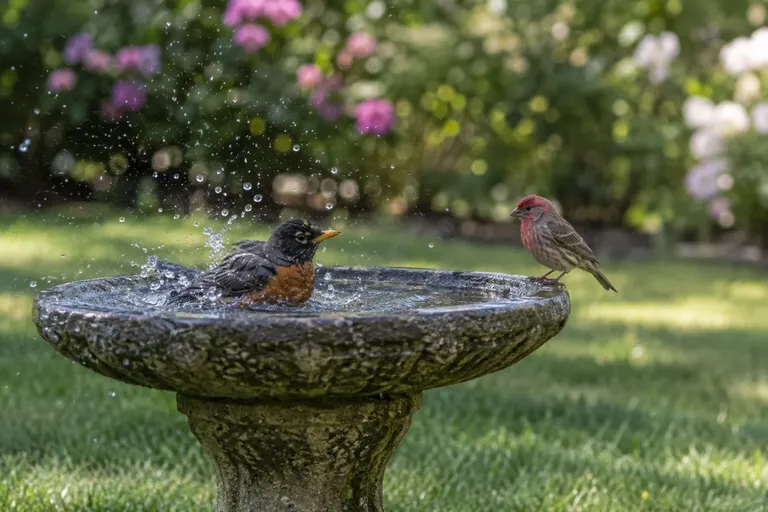
Birds are wary of water that looks or smells off, and dirty water is a disease risk. Green water, slime, floating droppings and a sour smell are all signs the bath needs attention.
The RSPB advises refilling bird baths with fresh tap water daily and giving them a thorough clean and disinfection once a week. Cornell Lab says to change the water every day or two. NABU says that, above all in hot weather, the water must be changed daily and the bath cleaned, and that a brush and boiling water are enough; one trick is to use two dishes in turn and let each dry in the sun for 24 hours. The LPO also asks for water renewed every day.
Fix: Tip the water out, scrub the bowl with a stiff brush, rinse and refill. Do this every day or two and give it a deeper clean every week. If you use a disinfectant, rinse thoroughly before refilling. Never add anything to the water itself: the LPO lists alcohol, salt, oil and antifreeze as things that must never go in. Our guide on how to clean a bird bath covers the full routine.
6. Does the bath dry out or run empty?
A bath that is full in the morning and dry by afternoon teaches birds not to bother. Birds return to water they can rely on, and they drop places that let them down.
Shallow baths are the right shape for birds, but they lose water fast in sun and wind, and splashing starlings or pigeons can empty one in minutes.
Fix:
- Top up the bath every morning, and again in the afternoon on hot or windy days.
- Choose a wider dish rather than a deeper one. The RSPB suggests making a bath as wide as possible, ideally more than 30 cm across, so it holds more water at the same depth.
- Move it into partial shade so it evaporates more slowly.
7. Is the water still and hard to notice?
Birds notice moving water far more easily than a still dish. The sound and sparkle of drips catches their attention from a distance.
Cornell Lab suggests adding a dripper or sprayer, or making one from an old bucket or container with a tiny hole in the bottom hung above the bath. Movement also helps keep the water fresher between changes.
Fix: Hang a leaky bucket or a drip bottle above the bath, add a small solar fountain, or use a circulating pump. Our roundup of solar bird bath fountains compares options that need no cable. Keep any fountain gentle; a strong jet can scare small birds and empty a shallow dish.
8. Is the bath new, or has it just been moved?
Birds are creatures of habit. A new bath, or an old one in a new place, can take time to be discovered and trusted, even when everything about it is right.
There is no fixed timetable. Some gardens see visitors within days, others wait weeks. The bath is more likely to be found quickly if it sits near places birds already use, such as feeders, hedges and trees.
Fix: Be patient, and don’t keep moving it. Keep it clean and full every single day so the birds that do find it come back. Place it within sight of your feeders, but not underneath them. A few days of dripping water often speeds things up.
9. Is there other water nearby?
If birds have easier water elsewhere, they may not need your bath. Ponds, streams, gutters, puddles after rain and even a neighbour’s bath all compete with yours.
This is why a bath can be busy in a dry spell and quiet in a wet week. In cool, rainy weather, puddles and wet leaves give birds plenty to drink. Vogelbescherming Nederland notes that water is especially welcome during hot, dry days, when natural sources dry up.
Fix: Nothing is wrong with your bath. Keep it going, because birds learn which sources stay reliable when the puddles vanish. A bath that offers fresh water through a dry summer week or a winter freeze will earn regular visitors.
10. Are bigger birds taking over?
Starlings, pigeons, jackdaws and other large birds can dominate a bath, splash most of the water out and leave it dirty. Smaller birds then wait their turn or go elsewhere.
Fix:
- Offer a second, smaller dish in a different spot, or a hanging bath that suits small, agile birds better than heavy ones.
- Keep part of the bath very shallow with stones, so small birds have a corner of their own.
- Clean and refill more often after a crowd has used it.
If the problem is at your feeders too, our guide to starlings and grackles covers ways to give smaller birds a better chance.
Why have birds stopped using a bird bath they used before?
If birds used your bath and then stopped, something has changed. Work through these in order:
| What changed | Likely cause | What to do |
|---|---|---|
| Water looks green or cloudy | Algae, droppings or old water | Empty, scrub and refill; change every day or two |
| A cat has been seen nearby | Predator pressure | Move the bath into the open or raise it |
| The weather turned wet | Puddles everywhere | Keep it clean and full; birds will return |
| You moved the bath | New, untested spot | Give it time, or move it back |
| You added a new bowl or coating | Slippery or unfamiliar surface | Add stones or gravel |
| Leaves and plants have grown up around it | Cats can hide there | Trim back the cover around the bath |
| Birds look fluffed up or sick | Disease at the bath | Empty it and stop feeding, see below |
| It is midwinter | Ice, or a frozen bath | Offer fresh water daily, see the winter section |
Seasons matter too. In late summer many birds moult and stay hidden, and in autumn flocks move around the landscape, so the mix of visitors changes. A quiet spell is normal. A bath that stays clean and reliable through these changes is the one birds come back to.
Can a bird bath make birds sick?
Yes, if it isn’t kept clean. Birds crowd together at water, and some diseases spread easily where birds share food and drinking water.
The RSPB says trichomonosis spreads quickly when sick birds pass it to others at shared food and water. If you see birds with signs of disease, the RSPB advises stopping feeding for at least three weeks and emptying any bird baths, and starting again only when you no longer see sick birds. It also says that if you can’t keep up with cleaning, it is better to leave the bath dry. NABU warns that dangerous pathogens can multiply quickly in small water points.
So if birds have stopped using your bath and you have seen sick birds nearby, empty and disinfect it, rinse it well and leave it dry for a while. Clean water is not a luxury; it is the reason the bath helps birds at all.
Do birds use bird baths in winter?
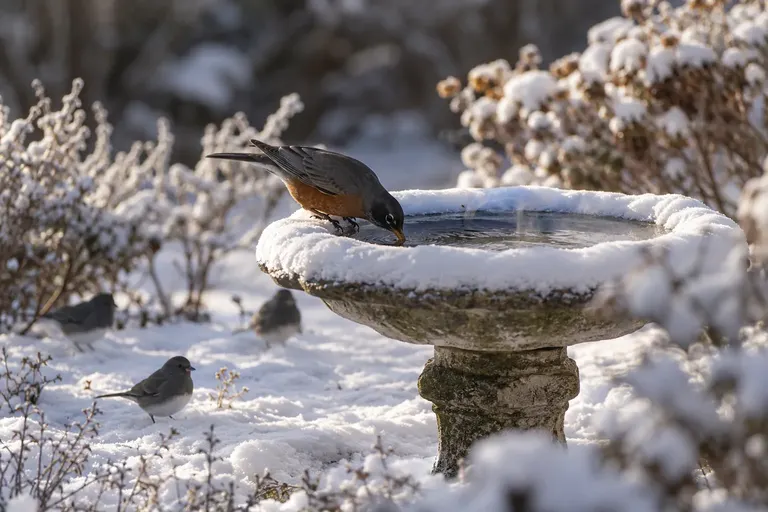
Yes. Birds need water all year, and Cornell Lab notes that birds use baths in every season. In winter a bath can be one of the few open water sources in a frozen garden.
Cornell Lab says keeping a bath ice-free is not critical, because birds can use snow and icicles, but open water still helps. The simplest approach it suggests is a plastic bowl set out at the same time each day and brought in when ice forms. Heated baths and heaters should be thermostatically controlled and plugged into a ground-fault protected outlet. Never add antifreeze or glycerin, and the LPO adds no salt or oil either.
If your bath freezes solid, birds will stop coming, which is a reason to fix it rather than a sign they don’t want water. See our guides to keeping a bird bath ice-free and the best heated bird baths.
How do you make a bird bath more attractive to birds?
Make it shallow, grippy, safe, clean, reliable and a little lively. In short:
- Keep the water shallow: about 2.5 cm at the edge, no more than 5 cm in the middle.
- Add stones or gravel so birds can grip and judge the depth.
- Put it in the open with shrubs or trees a short flight away and no hiding place for cats right beside it.
- Give it some shade in summer.
- Change the water every day or two and scrub it weekly.
- Never let it run dry, and keep it open in winter if you can.
- Add a drip or gentle fountain to catch birds’ attention.
- Leave it in one place and give birds time.
Water also brings in birds that never visit feeders. Cornell Lab notes that bird baths can attract species that don’t eat seed. If you are still choosing a bath, our guide to the best bird baths compares pedestal, ground, hanging and heated types, and our explainer on how birds drink water shows why a shallow edge matters so much.
Sources
- Cornell Lab of Ornithology, All About Birds: Attract birds with birdbaths
- National Audubon Society: How to make a birdbath
- RSPB: Make the perfect bird bath
- RSPB: Keep your garden birds healthy
- NABU Münster: Tiertränken im Sommer (press release, 2023)
- LPO: Je récupère l’eau et dispose des points d’eau pour la faune
- Vogelbescherming Nederland: Geef vogels extra water tijdens warme dagen

Frequently asked questions
Why won't birds use my bird bath?
The most common reasons are water that is too deep, steep or slippery sides, a spot where cats can hide close by, and water that is dirty, warm or missing for part of the day. Cornell Lab recommends about 2.5 cm of water at the edge and no more than 5 cm in the middle, a gentle slope and open ground around the bath. Fix those first, then give birds time to find it.
How long does it take birds to find a new bird bath?
There is no fixed timetable. Some gardens see visitors within days, others wait several weeks, especially in cool, wet weather when puddles are everywhere. Keep the bath shallow, clean and topped up every day so it is reliable, add a few stones, and put it where birds already feed or perch. Dripping or moving water is one of the quickest ways to get a new bath noticed.
Do birds prefer a bird bath on the ground or on a pedestal?
Many birds look for water at ground level, which is where Cornell Lab says they usually find it, and thrushes, Blackbirds, robins and doves happily use ground water. The catch is cats. If cats roam your garden, a raised bath in an open spot is safer, and Vogelbescherming Nederland advises a raised position so cats can't easily reach the water.
Does a bird bath need stones in it?
Stones help a lot. Audubon suggests a few large pebbles or a flat stone so birds can judge how deep the water is, and Cornell Lab says stones or branches let birds drink without getting wet. The LPO in France adds that half-submerged stones and a rough ramp let insects and small birds climb out if they fall in. They also give grip on a glazed or plastic base.
Should I stop using my bird bath if birds look sick?
Yes. The RSPB advises emptying bird baths and stopping feeding for at least three weeks if you see birds with signs of disease, because trichomonosis and other infections spread where birds share food and water. Clean and disinfect the bath, rinse it well and leave it dry. Start again only once you no longer see sick birds, and then refresh the water daily.