Bluebird House: 6 Best Nest Boxes That Meet NABS Standards
The best bluebird house has a 1.5 inch hole, vents, drainage, a side door and no perch. Compare 6 NABS-style boxes, from slot to Peterson and Gilbertson.
If you buy through links on this page we may earn a commission, at no cost to you. It never decides what we recommend. How we earn
In this article
- Quick picks
- How we chose
- What makes a bluebird house meet NABS standards?
- JCs Wildlife Ultimate Eastern and Western Bluebird House: best overall
- Coveside Classic Eastern Bluebird House with Large Roof: best wooden box
- Coveside Sparrow-Resistant Eastern Bluebird House: best slot box for sparrow areas
- DutchCrafters Pole Mount Gilbertson Bluebird House: best Gilbertson style
- Stovall 3H Wood Peterson Bluebird House: best Peterson style
- Kettle Moraine Cedar Super Eastern Bluebird House: best with a viewing window
- Bluebird houses compared
- Which bluebird house size do I need?
- Should I choose a slot box, Gilbertson or standard box? (sparrow decision table)
- Where should you put a bluebird house?
- How do you keep a bluebird house clean?
- How much does a good bluebird house cost?
- Which birds use a bluebird house?
- Buyer’s checklist for a bluebird house
- What are the alternatives to a store-bought bluebird house?
- Sources
- Frequently asked questions
A good bluebird house is a plain, ventilated box with a 1.5-inch (38 mm) round hole or a matching oval or slot, no perch, a door that opens, and a smooth pole with a baffle beneath it. On paper, the JCs Wildlife Ultimate Bluebird House is the most complete pick, and the Coveside Sparrow-Resistant box is the one to buy where House Sparrows are common.
The North American Bluebird Society (NABS) and trail monitors have refined these boxes over decades, and most decorative “bluebird houses” miss at least one key point. The six picks below follow those standards, and the sizing chart and sparrow decision table further down help you choose.
Quick picks
- Best overall: JCs Wildlife Ultimate Eastern and Western Bluebird House. Recycled poly lumber, entrance guard, separate viewing and cleaning doors.
- Best wooden box: Coveside Classic Eastern Bluebird House with Large Roof. 3/4-inch pine, vents, drainage and an entrance block.
- Best slot box for sparrow areas: Coveside Sparrow-Resistant Eastern Bluebird House. Shallow cavity and a horizontal slot.
- Best Gilbertson style: DutchCrafters Pole Mount Gilbertson Bluebird House. PVC body that slides onto a conduit pole.
- Best Peterson style: Stovall 3H Wood Peterson Bluebird House. Tall cedar box with an oval hole.
- Best with a viewing window: Kettle Moraine Cedar Super Eastern Bluebird House. Hinged side door and a sliding window.
JCs Wildlife Ultimate Eastern and Western Bluebird House
A recycled poly lumber box with a built-in entrance guard, separate viewing and cleaning doors, and a stainless mesh nest riser.
- Best for
- Bluebird landlords who want a box that will not rot, crack or need repainting.
- Skip it if
- You want the lightest box to carry along a trail, or you prefer natural wood.
- Entrance hole
- 1.5 in (38 mm)
- Size
- 9.5 in W x 12 in H x 8 in D
- Material
- Recycled poly lumber, stainless hardware
Coveside Classic Eastern Bluebird House with Large Roof
A US-made 3/4-inch pine box with a deep roof overhang, vent slots, floor drainage, an entrance block and a lift-up side panel.
- Best for
- People who want a classic wooden bluebird box with every functional feature.
- Skip it if
- You want a box you never need to inspect for weathering.
- Entrance hole
- 1.5 in (38 mm)
- Size
- 9.25 in L x 9 in W x 12.5 in H
- Wall thickness
- 0.75 in pine
Coveside Sparrow-Resistant Eastern Bluebird House
A shallow slot-entrance box with an adjustable depth block, built around research showing House Sparrows prefer deeper cavities.
- Best for
- Suburban yards, farms and edges of town where House Sparrows claim standard boxes.
- Skip it if
- You have no sparrow problem, where a standard round-hole box is simpler.
- Entrance
- Slot, 4 in x 1.25 in
- Size
- About 8.5 in L x 5.75 in W x 10 in H
- Wall thickness
- 0.75 in pine
DutchCrafters Pole Mount Gilbertson Bluebird House
The trail-proven Gilbertson design: a round PVC body under a poly roof that slides straight onto a 1/2-inch electrical conduit pole.
- Best for
- Anyone setting up several boxes or a small bluebird trail on a budget of time and effort.
- Skip it if
- You want a wooden box or a traditional look.
- Entrance hole
- 1.5 in (38 mm)
- Body diameter
- 4.25 in
- Weight
- 2 lb
Stovall 3H Wood Peterson Bluebird House
A tall cedar Peterson box with an oval entrance, a sloped front and a front panel that pulls down for nest checks.
- Best for
- Bluebirders who like the Peterson design and want a larger roof and deeper shade over the hole.
- Skip it if
- You want a compact box or a round 1.5-inch hole.
- Entrance
- Oval
- Size
- 6.25 in D x 11.5 in W x 19.25 in H
- Material
- Cedar
Kettle Moraine Cedar Super Eastern Bluebird House with Side Opening Viewing Window
A cedar box with a 1.5-inch hole, a copper portal around the entrance, and a hinged side door with a sliding viewing window.
- Best for
- Families who want to peek at eggs and nestlings without the nest being exposed to open air.
- Skip it if
- You never plan to monitor the nest, since the window adds cost you will not use.
- Entrance hole
- 1.5 in (38 mm)
- Material
- Cedar
- Entrance guard
- Copper portal
How we chose
We have not put up or monitored these boxes ourselves. This is a research-led guide. We compared each product against nest box guidance from NABS, Sialis.org and Cornell Lab’s NestWatch, using manufacturer and retailer pages for entrance size and shape, material, ventilation, drainage, cleaning access, predator features and mounting. We also looked for patterns in verified owner feedback, such as sticking doors, warping or sparrow takeovers. We excluded any box with a perch, a starling-sized hole or no way to open it, and left out any spec we could not confirm.
What makes a bluebird house meet NABS standards?
A NABS-style bluebird box copies a safe woodpecker cavity: a correctly sized entrance, a floor roughly 4 to 5.5 inches (10 to 14 cm) square, the hole several inches above the floor, and features that keep nestlings dry, cool and out of reach.
The core checklist that bluebird groups share looks like this:
- Entrance: 1.5-inch (38 mm) round for Eastern and Western Bluebirds, 1 9/16 inches (40 mm) for Mountain Bluebirds. A vertical oval about 1 3/8 inches wide or a horizontal slot about 1 1/8 to 1 3/16 inches high also works.
- Depth: Enough space between the hole and the nest that a cat or raccoon paw struggles to reach the eggs. Many standard boxes place the hole around 6 inches (15 cm) above the floor.
- No perch: Bluebirds do not need one. Perches help House Sparrows and predators.
- Ventilation and drainage: Gaps or slots under the roof and holes or cut corners in the floor.
- Access: A side or front panel that opens, so you can monitor weekly and remove old nests.
- Materials: Untreated wood about 3/4 inch (19 mm) thick, or thick, light-colored poly lumber or PVC. Nothing painted or stained inside.
- Roof: An overhang in front to shade the hole and keep rain out.
Each pick below meets these points on paper. For hole sizes for other species, see our birdhouse hole size chart.
JCs Wildlife Ultimate Eastern and Western Bluebird House: best overall
What it is: A bluebird box made of high-density recycled poly lumber with stainless steel hardware, handcrafted in the USA, with separate doors for viewing and cleaning and a stainless steel mesh nest riser.
Who it suits: People who want a box that lasts for years and never needs repainting.
Key specs: JCs lists a 1.5-inch entrance for Eastern and Western Bluebirds, with a 1 9/16-inch version for Mountain Bluebirds. The house measures 9.5 inches wide, 12 inches high and 8 inches deep. The maker says the poly lumber will not crack, split, warp or fade.
Strengths: The built-in entrance guard lengthens the tunnel into the box, which makes it harder for a raccoon or cat to reach the nest. The mesh riser lifts the nest off the floor, which the maker says improves airflow and helps it stay dry after rain.
Drawbacks: Poly lumber is heavier than pine, and each extra door is one more latch to close after a check.
Skip it if: You want a traditional wooden box or plan to carry many boxes along a long trail.
Coveside Classic Eastern Bluebird House with Large Roof: best wooden box
What it is: A traditional pine bluebird box made in the USA by Coveside Conservation Products, with a deep roof overhang and a wooden block around the entrance.
Who it suits: Anyone who wants a wooden box built to the standards trail monitors use.
Key specs: Coveside lists a 1.5-inch entrance, 3/4-inch pine and outside dimensions of 9.25 by 9 by 12.5 inches. Vent slots sit under the roof, corner gaps drain the floor, one side panel lifts for nest checks, and a small ladder inside the front helps nestlings climb out.
Strengths: Three-quarter-inch wood insulates against heat and cold. The entrance block adds depth to the hole, and the large roof shades the front.
Drawbacks: Pine weathers. Expect to check hinges, latches and the roof each winter and to replace the box eventually.
Skip it if: You want a box that needs no care for a decade.
Coveside Sparrow-Resistant Eastern Bluebird House: best slot box for sparrow areas
What it is: A compact pine box with a horizontal slot entrance and a removable block that makes the cavity shallower.
Who it suits: Yards near barns, houses, towns or busy feeders, where non-native House Sparrows claim standard boxes.
Key specs: The slot is 4 inches long and 1.25 inches high. The box is about 8.5 by 5.75 by 10 inches in 3/4-inch pine, the front pulls up for checks, and a 1.5-inch-thick block reduces depth. Coveside says the design draws on University of Kentucky research on sparrow and bluebird preferences.
Strengths: It targets the biggest threat to bluebird boxes in many areas. House Sparrows are known to destroy eggs and kill bluebird nestlings and adults in boxes, and monitors report they are less drawn to shallow cavities.
Drawbacks: It is sparrow-resistant, not sparrow-proof. A shallow nest also sits closer to the entrance, so a baffled pole matters even more.
Skip it if: You live in open country with few sparrows.
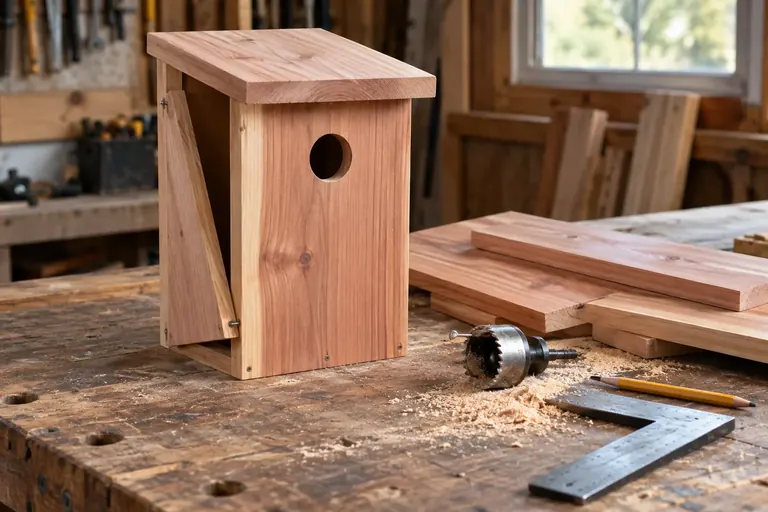
DutchCrafters Pole Mount Gilbertson Bluebird House: best Gilbertson style
What it is: A Gilbertson-style box, the design Minnesota bluebirder Steve Gilbertson developed from PVC pipe, here with a poly roof and a round PVC body made by Amish craftsmen in Indiana.
Who it suits: Anyone putting up several boxes, since it mounts in minutes on 1/2-inch electrical conduit.
Key specs: The listing gives a 1.5-inch entrance, a body 4.25 inches in diameter, an overall size of 7 by 8 3/8 by 9 inches, and a weight of 2 lb. The body comes off the roof for monitoring and cleaning.
Strengths: Trail monitors report House Sparrows use Gilbertson boxes less than standard wooden ones. Smooth conduit is hard to climb, and a baffle slips on easily.
Drawbacks: The round floor is small, so large broods are crowded. PVC does not breathe like wood, so this design relies on its vents and light color.
Skip it if: You want a wooden box, or you plan to mount it on a fence post.
Stovall 3H Wood Peterson Bluebird House: best Peterson style
What it is: A Peterson-style cedar box, named for Minnesota bluebirder Dick Peterson, with a tall sloped front, a small triangular floor and an oval entrance.
Who it suits: Bluebirders who want the trail-favorite Peterson design with its deep roof overhang.
Key specs: Stovall and its retailers list dimensions of 6.25 by 11.5 by 19.25 inches, cedar construction, an oval entrance and a front that pulls down for observing the nest.
Strengths: The long roof shades the entrance and sheds rain. An oval hole is one of the three entrance shapes bluebird groups accept.
Drawbacks: It is tall and heavier than a standard box, so mount it on a sturdy pole. Retailers state the oval’s size differently, so measure the hole on arrival and confirm it is no wider than about 1 3/8 inches if starlings live nearby.
Skip it if: You want a compact box or you prefer a round hole.
Kettle Moraine Cedar Super Eastern Bluebird House: best with a viewing window
What it is: A cedar bluebird box with a 1.5-inch hole ringed by a copper portal, and a hinged side door with a window that slides out.
Who it suits: Families and new monitors who want quick, sheltered nest checks.
Key specs: Retailers list cedar construction, a 1.5-inch entrance, a copper entrance portal, vents under the roofline and drainage holes in the floor. The seller describes it as approved by the North American Bluebird Society.
Strengths: The copper portal stops squirrels and woodpeckers enlarging the hole for starlings. The window allows quick egg counts.
Drawbacks: The window adds cost and one more part to keep clean.
Skip it if: You will not monitor the nest.
Bluebird houses compared
| Bluebird house | Entrance | Material | Opens from | Sparrow resistance | Best mounting |
|---|---|---|---|---|---|
| JCs Wildlife Ultimate | 1.5 in round | Recycled poly lumber | Two side doors | Standard | Pole with baffle |
| Coveside Classic | 1.5 in round | 3/4 in pine | Side panel | Standard | Pole with baffle |
| Coveside Sparrow-Resistant | 4 x 1.25 in slot | 3/4 in pine | Front panel | Higher (shallow slot box) | Pole with baffle |
| DutchCrafters Gilbertson | 1.5 in round | PVC body, poly roof | Body slides off | Higher (per trail reports) | 1/2 in conduit with baffle |
| Stovall 3H Peterson | Oval | Cedar | Front panel | Standard | Sturdy pole with baffle |
| Kettle Moraine Super | 1.5 in round, copper portal | Cedar | Side door with window | Standard | Pole with baffle |
Which bluebird house size do I need?
Match the entrance to the bluebird species in your area, then choose a style. Eastern and Western Bluebirds use the 1.5-inch hole; Mountain Bluebirds need 1 9/16 inches. Here is our sizing chart for the three common bluebird box styles:
| Style | Entrance | Typical floor | Hole above floor | Strength | Trade-off |
|---|---|---|---|---|---|
| Standard (NABS type) | 1.5 in (38 mm) round | About 4 x 4 to 5.5 x 5.5 in | About 6 in (15 cm) | Widely accepted, easy to build and clean | Sparrows readily use it |
| Slot box | Slot about 1 1/8 to 1 3/16 in high | Varies, often shallow | Often less than 6 in | Less attractive to sparrows | Shallower nest, needs a baffle |
| Peterson | Oval about 1 3/8 in wide | Small, sloped | Deep | Big roof, good shade | Tall, heavier to mount |
| Gilbertson | 1.5 in round | About 4.25 in round | About 4.5 in | Fast conduit mount, less sparrow use | Smaller floor, PVC |
In the West, see our guide to attracting Western Bluebirds. Mountain Bluebirds need the slightly larger hole, so check the variant before ordering.
Should I choose a slot box, Gilbertson or standard box? (sparrow decision table)
Choose based on how many House Sparrows live within sight of the box. Where sparrows are rare, any standard box works. Where they are common, start with a slot or Gilbertson design and monitor closely.
| Your situation | Sparrow pressure | Best style | Extra steps |
|---|---|---|---|
| Open pasture, far from buildings | Low | Standard or Peterson | Weekly checks |
| Rural yard near a barn or livestock | High | Slot or Gilbertson | Remove sparrow nests promptly |
| Suburban lawn, neighbors feed millet | High | Slot box | Stop feeding millet and cracked corn nearby |
| Park or golf course edge | Medium | Standard or Gilbertson | Pair boxes for Tree Swallows |
| Small town lot beside houses | Very high | Slot box, or wait | Consider habitat elsewhere |
House Sparrows are not native and are not protected under the Migratory Bird Treaty Act, so removing their nests is legal. Bluebird groups are blunt: if you will not control sparrows at a box, do not put it up. Some monitors also hang fishing-line “sparrow spookers” above the box after the first bluebird egg appears.
Where should you put a bluebird house?
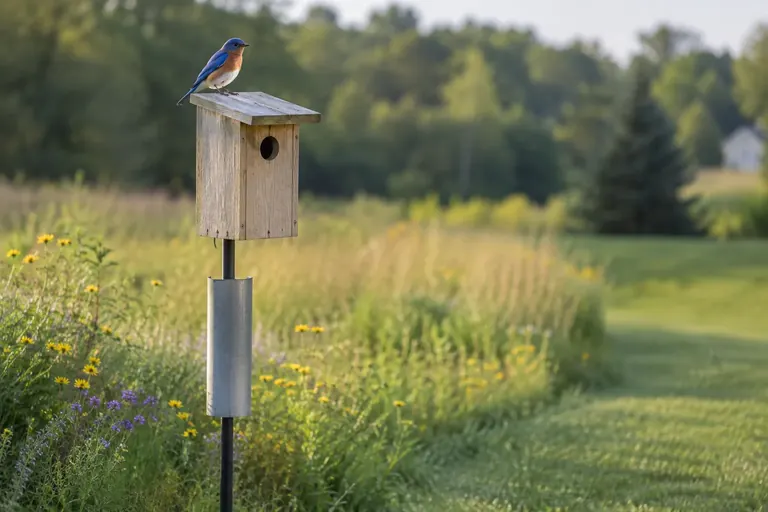
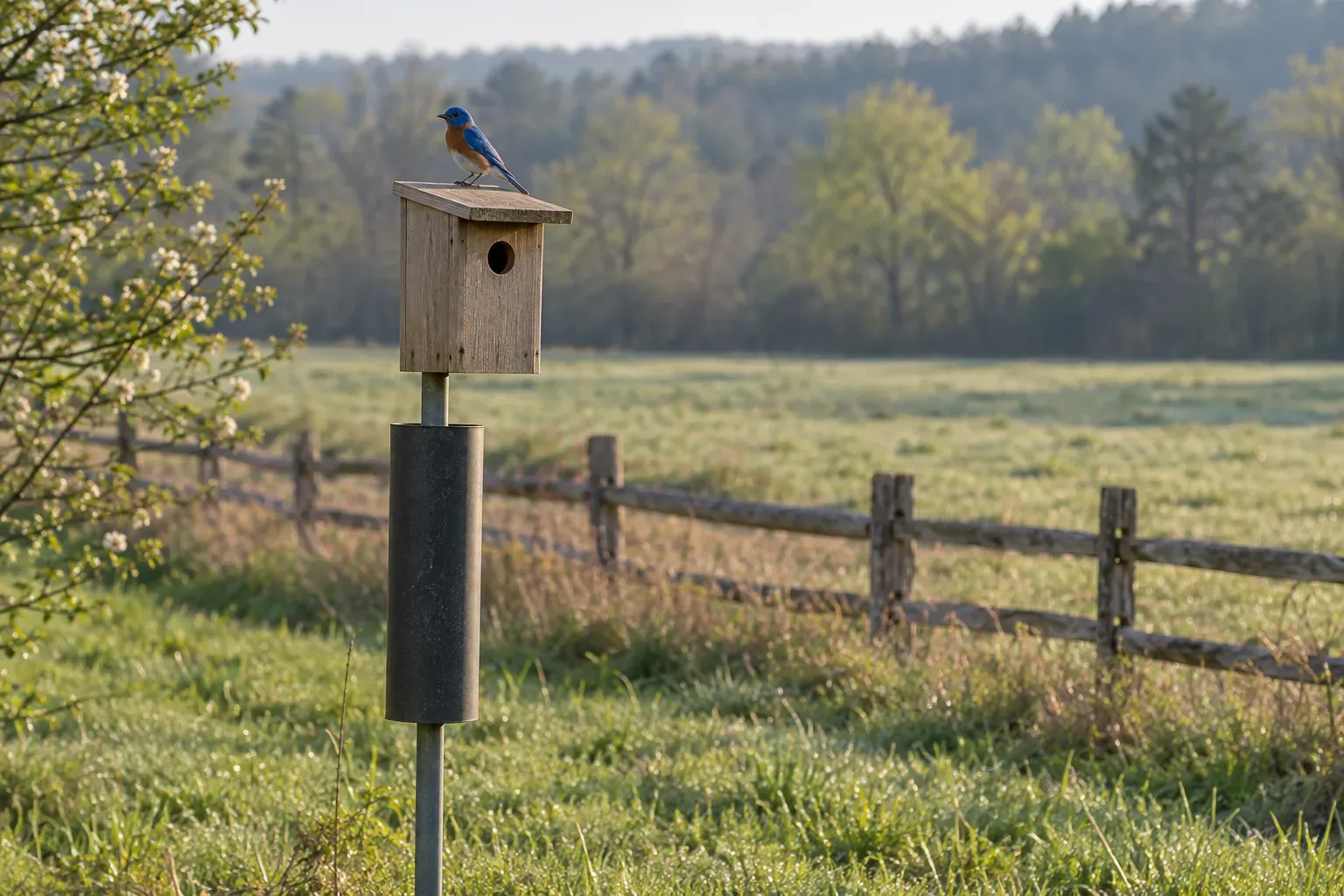
Put it in open, short grass with scattered trees, fences or wires nearby for hunting perches, on a smooth pole about 5 feet high, and well away from buildings and busy feeders. Bluebirds hunt insects on the ground, so open ground matters more than any box feature.
- Pick open habitat. Lawns, pastures, orchards and golf course edges, not dense woods.
- Keep distance from buildings. House Sparrows cluster around houses and barns.
- Space boxes out. NABS suggests about 100 yards (90 m) between Eastern Bluebird boxes. Many monitors pair two boxes 5 to 15 feet apart, so Tree Swallows take one and tend to tolerate bluebirds in the other.
- Face it sensibly. Away from prevailing winds and harsh afternoon sun. Our bluebird house mounting guide covers poles, conduit and hardware.
- Add a guard. A stovepipe baffle below the box stops snakes and raccoons. A wire mesh Noel guard over the hole blocks paws.
- Time it right. Put boxes up in late winter, before pairs start scouting. See when to put up birdhouses.
For the full species picture, including plants and food, see our Eastern Bluebird guide.
How do you keep a bluebird house clean?
Check the box about once a week in nesting season, remove each old nest after the young fledge, and do a full clean-out at season’s end. Clean boxes carry fewer parasites and are ready for the next brood.
- Monitor weekly. Open the door, look quickly and close it. Cornell Lab lists an Eastern Bluebird nestling period of roughly 17 to 21 days.
- Stop opening near fledging. NABS and trail monitors advise against opening the box once nestlings are about 12 to 13 days old, because it can cause them to leave too early.
- Clean between broods. Remove the old nest with gloves after fledging. Bluebirds often raise two broods a year and sometimes three in warm areas.
- Watch for blowflies. Larvae in the nest material feed on nestlings. A clean box and a mesh nest riser help.
Step-by-step methods are in when and how to clean out a birdhouse.
How much does a good bluebird house cost?
A good bluebird house usually costs less than a decorative one, but budget about as much again for a pole and baffle. Spend on durable material, vents, drainage and easy access, then a smooth pole and predator guard. Skip paint, porches, perches and carving. A plain box on a baffled pole beats an ornamental house on a fence post for nest success.
Which birds use a bluebird house?
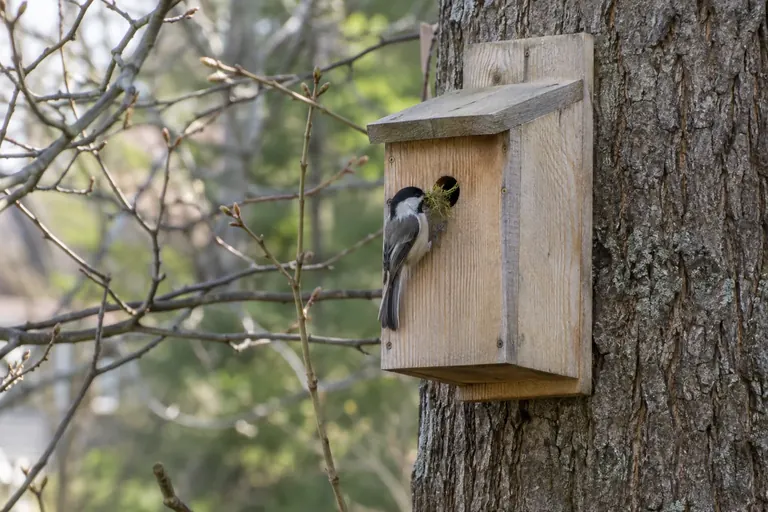
Eastern, Western and Mountain Bluebirds are the target, but Tree Swallows, Violet-green Swallows, chickadees, Tufted Titmice, House Wrens and House Sparrows will also use a 1.5-inch box. European Starlings cannot fit through a correct 1.5-inch hole.
Native species are protected by law, so leave their active nests alone. Tree Swallows are the most common alternative tenants, which is why pairing boxes works. House Wrens sometimes damage other birds’ eggs, so keep bluebird boxes away from shrubby edges.
Buyer’s checklist for a bluebird house
Use this checklist on any listing. A strong box ticks all ten.
- Entrance is 1.5 in round (1 9/16 in for Mountain Bluebirds), a Peterson oval or a correctly sized slot.
- No perch.
- Walls about 3/4 in thick, or thick, light-colored poly or PVC.
- Vents under the roof.
- Drainage in the floor.
- A panel or body that opens for monitoring.
- Unpainted, untreated interior.
- Rough or grooved inside front so fledglings can climb.
- Roof overhangs the front.
- Designed to mount on a pole with a baffle.
What are the alternatives to a store-bought bluebird house?
The two main alternatives are building your own box from NABS plans and improving habitat so bluebirds find food and perches.
- Build one. NABS and Sialis.org publish free plans for standard, Peterson, Gilbertson and slot boxes.
- Improve food supply. Bluebirds eat insects most of the year and fruit in winter. Native berry shrubs help, and offering dried mealworms for bluebirds in a small dish can draw them in during cold snaps.
- Consider other species. If your yard is shaded, a box for chickadees or wrens may suit it better. Our best birdhouses roundup covers those.
Sources
- North American Bluebird Society
- Sialis.org: The story of the Gilbertson nestbox
- NestWatch, Cornell Lab of Ornithology: All About Birdhouses
- All About Birds: Eastern Bluebird Life History
- US Fish and Wildlife Service: Migratory Bird Treaty Act of 1918
- JCs Wildlife: Ultimate Bluebird House product page
- Coveside Conservation Products: Sparrow-Resistant Eastern Bluebird House
Frequently asked questions
What size hole does a bluebird house need?
Eastern Bluebirds need a 1.5-inch (38 mm) round hole. Western Bluebirds use the same size, and Mountain Bluebirds need 1 9/16 inches (40 mm). Oval Peterson-style holes and horizontal slots about 1 1/8 to 1 3/16 inches high also work. Holes larger than about 1 9/16 inches let European Starlings in, so buy a box made for bluebirds, not a general birdhouse.
How high should a bluebird house be mounted?
Mount the box so the entrance sits about 5 feet (1.5 m) above the ground on a smooth metal pole with a predator baffle below it. At that height you can check the nest easily, bluebirds accept it readily and a baffle has room to work. Fence posts and trees are easier but let snakes, cats and raccoons climb straight to the box.
Which direction should a bluebird house face?
Research on bluebird nest boxes has not found one direction that bluebirds strongly prefer. In practice, facing the hole away from prevailing wind and strong afternoon sun helps, which often means east or toward a tree or fence line in much of North America. Facing open field is also common. Height, habitat and predator protection matter much more than compass direction.
Should you clean out a bluebird house?
Yes. Remove the old nest soon after the young fledge, because bluebirds often raise a second or third brood and a fresh box reduces blowfly larvae and mites. Scrape out debris and let it dry. Never remove an active nest of a native bird, since it is protected by the Migratory Bird Treaty Act. Nests of non-native House Sparrows are not protected.
Why is no bird using my bluebird house?
The usual causes are habitat, timing and competition. Bluebirds want open, short grass with scattered perches, not shade. Boxes put up after nesting starts may sit empty until next season. House Sparrows near buildings and feeders can claim or guard a box. Check for a perch, a wrong hole size or a box on a tree trunk, then try moving it into open ground.