How to Attract American Robins to Your Yard
How to attract American Robins: they rarely eat seed, so offer an open lawn, fruiting native shrubs, water, mealworms and a covered nest shelf instead.
In this article
- American Robin at a glance
- How to identify an American Robin
- What do American Robins eat?
- What are the best feeders for robins?
- Water: the most reliable robin magnet
- Plants and habitat that attract robins
- Nest shelves: how to help robins nest
- Seasonal calendar: robins through the year
- Common problems with robins
- Common mistakes when trying to attract robins
- Sources
- Frequently asked questions
If you are wondering how to attract American Robins, stop thinking about seed feeders and start thinking about lawn, fruit and water. Robins eat earthworms, insects and berries, with fruit making up roughly 60 percent of their annual diet according to Audubon, so a yard with a patch of short pesticide-free grass, fruiting native shrubs, a clean birdbath and a covered nest shelf will draw them more reliably than any seed mix. Mealworms and soft fruit on a low tray help when natural food runs short.
Robins are one of the easiest backyard birds to host, because they already like the same open, lightly treed spaces that most suburban yards offer. The work is mostly about removing the things that push them away (chemical lawn treatments, bare yards, dry summers) and adding the few things they cannot find elsewhere.
American Robin at a glance
| Trait | Details |
|---|---|
| Size | 7.9 to 11 in long, 2.7 to 3.0 oz, wingspan 12.2 to 15.8 in (largest North American thrush) |
| Range | Nearly all of North America, from Alaska and Canada to Mexico |
| Season | Year-round across much of the US; northern birds move south in winter |
| Diet | Earthworms, insects, snails, and fruit such as dogwood, sumac, juniper, hawthorn and chokecherry |
| Feeder type | Low platform or tray with mealworms and fruit; they do not eat much seed |
| Nesting | Open mud-reinforced cup in trees, shrubs or on ledges; uses nest shelves, not enclosed boxes |
| Eggs | 3 to 5 unmarked sky-blue or blue-green eggs, 1 to 3 broods a year |
| Conservation | Low concern; about 370 million birds (Partners in Flight estimate) |
How to identify an American Robin
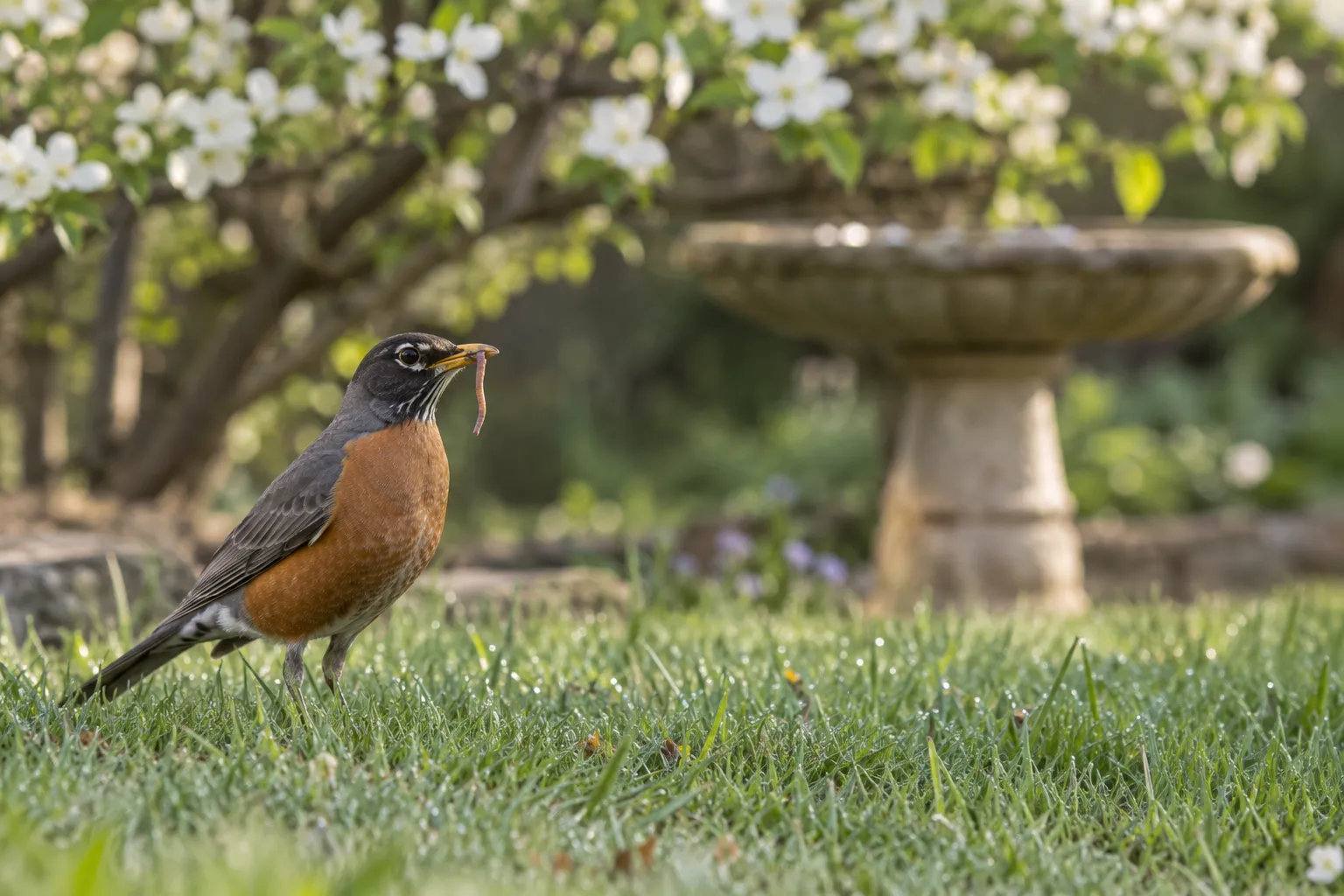
Robins are large, round-bodied thrushes with long legs and a fairly long tail. They often stand very upright with the bill tilted up, then run a few steps across a lawn, stop abruptly and stare at the ground before stabbing at a worm. When they land they tend to flick the tail downward several times.
Male, female and juvenile
- Adult male: dark gray to nearly black head, broken white ring around the eye, yellow bill, white throat with black streaks, and a warm brick-orange breast. The back is gray-brown.
- Adult female: similar pattern but paler overall. The head contrasts less with the gray back, and the belly and throat show more white. Side by side with a male the difference is easy; alone, a female can be hard to sex.
- Juvenile: fledglings in summer have a heavily spotted breast and pale spots on the back, a reminder that robins are thrushes, related to bluebirds and wood-thrushes.
In flight, look for a white patch on the lower belly and under the tail. Western birds tend to be paler than eastern birds, and robins in Atlantic Canada are richer in color with a blackish upper back.
Similar species
- Varied Thrush: a Pacific Northwest and western forest bird with an orange eyebrow, orange wing bars and a dark band across the orange breast. Robins have no breast band.
- Eastern and Spotted Towhees: smaller, with a black hood, rufous sides and a clean white belly. Towhees scratch in leaf litter under shrubs rather than running across open lawns.
- Eastern Bluebird: shares the orange breast, but is much smaller (a robin is almost half again as big) and blue above. If you want both, our guide to attracting Eastern Bluebirds covers the overlap.
Robin song and calls
The male’s song is a series of clear, lilting whistles often described as “cheerily, cheer up, cheer up.” Robins are among the first birds singing before dawn in spring. Alarm calls include a sharp “peek” and a rapid “tut tut tut.” A sound identification app such as Merlin can help confirm what you hear.
What do American Robins eat?
Robins eat two main kinds of food: invertebrates and fruit. In spring and summer they take large numbers of earthworms plus beetle grubs, caterpillars, other insects and some snails. In fall and winter they shift heavily to fruit. Audubon notes that fruit makes up roughly 60 percent of their annual diet, and the Cornell Lab lists chokecherries, hawthorn, dogwood, sumac and juniper berries among their foods.
The Cornell Lab also points out a daily pattern: robins tend to eat more earthworms in the morning and more fruit later in the day. That is worth knowing if you are wondering why the lawn is busy at breakfast and the berry bush is busy in the afternoon.
What to feed robins at a feeder
Because robins are not seed eaters, the classic tube or hopper feeder does little for them. These foods work better:
- Mealworms. Live mealworms are the strongest draw, especially in spring. Dried mealworms soaked in warm water for a few minutes are easier to store and still widely taken. See our roundup of the best dried mealworms for what to look for in a bag.
- Soft fruit. Chopped apples, blueberries, chopped grapes and raisins soaked in water. Fruit is most useful in late winter and very early spring, when berry crops are depleted and the ground may still be frozen.
- Suet crumbles or soft suet dough. Some robins take small pieces offered on a tray, particularly in cold snaps. Robins cannot cling to a vertical suet cage the way woodpeckers can, so crumble it onto a flat surface.
- Hulled sunflower chips. Occasionally eaten in hard weather. Treat this as a bonus, not a strategy.
What not to feed robins
Avoid bread, which fills birds up without much nutrition, and anything salted, seasoned or moldy. Our guide to what not to feed birds covers the full list. Skip whole grapes for very small birds, but for robins chopped grapes are fine. Do not put out large amounts of fruit that will sit and ferment.
What are the best feeders for robins?
The right feeder for a robin is simply a flat, open surface close to the ground or at waist height:
- A low platform or tray feeder. Robins like to stand on a broad surface and see around them. A tray with drainage holes keeps mealworms and fruit from sitting in water. Our list of platform and tray feeders compares designs with screened bottoms and roofs.
- A shallow dish on a deck rail. A ceramic or metal dish with a few sides works well for mealworms, as long as it is easy to clean.
- A dish mounted on a pole with a baffle. Mealworms on an unprotected tray are popular with squirrels, starlings and grackles too. A pole with a baffle stops the mammals; starlings are harder. If they become a problem, offer smaller portions at times when robins are active.
Place the tray where the robin can see open ground around it but has trees or shrubs within a short flight for cover. Clean it often: fruit and mealworms spoil faster than seed.
Water: the most reliable robin magnet
If you add only one thing for robins, add water. Robins drink often and bathe enthusiastically, and a clean birdbath is often busier with robins than with any other species. This matters most in hot, dry summers, when worms retreat deeper into the soil and fresh water is hard to find, and in winter, when natural water freezes.
Birdbath tips for robins
- Depth: a gentle slope from a shallow edge to no more than about 2 inches deep in the center. Robins wade in rather than splash from above.
- Surface: a rough or textured basin so birds do not slip.
- Height: ground-level and pedestal baths both work. Robins are comfortable on the ground, but a pedestal bath gives them a better view of approaching cats.
- Cleaning: scrub and refill every few days in warm weather to limit algae and mosquito larvae.
- Winter: a heated birdbath or bath heater keeps water open. Wintering robin flocks will come to open water even when they ignore every feeder in the yard.
A dripper or small bubbler adds movement and sound, which catches the attention of passing birds.
Plants and habitat that attract robins
The single best long-term investment for robins is a yard that grows their food. That means two things: a patch of healthy, chemical-free lawn or soft ground where they can hunt worms, and trees and shrubs that hold fruit into fall and winter.
Keep some open lawn, and skip the pesticides
Robins hunt by sight on short grass and bare soil. You do not need a huge lawn; a modest open patch near trees is enough. What matters more is what is in the soil. The Cornell Lab notes that lawn foraging makes robins vulnerable to pesticide poisoning, and lawn insecticides also reduce the earthworms and grubs they eat. Robins in a yard that is not sprayed have more to eat and less to fear.
A freshly watered or recently mowed lawn brings worms closer to the surface. Many robin watchers notice birds arriving right after the sprinkler shuts off.
Native fruiting plants by region
Choose shrubs and trees that are native to your region, and try to mix species so fruit ripens at different times. A few reliable options:
| Region | Good native choices for robins |
|---|---|
| Northeast and Midwest | Serviceberry, flowering or gray dogwood, winterberry holly, chokecherry, eastern red cedar, staghorn sumac, hawthorn |
| Southeast | Flowering dogwood, American holly, yaupon holly, southern wax myrtle, eastern red cedar, American beautyberry |
| Great Plains and Mountain West | Chokecherry, Rocky Mountain juniper, serviceberry, hawthorn, skunkbush sumac |
| Pacific Coast | Toyon, Pacific madrone, blue elderberry, native serviceberry, western juniper in drier zones |
Serviceberry fruits early in summer, dogwood in late summer and fall, and hollies, junipers and sumacs often hold fruit into late winter. That spread is what keeps robins around through the seasons.
Avoid invasive berry plants
Robins eat the fruit of invasive shrubs such as bush honeysuckle and buckthorn, and help spread them. The Cornell Lab even notes robins that gorge exclusively on honeysuckle berries can become intoxicated. Replacing invasives with native fruiting shrubs gives robins better food and protects local habitat.
Mud for nest building
Robins reinforce their nests with mud. In a dry spring, a small muddy patch at the edge of a garden bed or under a dripping hose gives nesting females the material they need. It sounds minor, but in drought years it can decide where a pair builds.
For more ideas on layering trees, shrubs and open ground, see our guide to backyard birding and habitat.
Nest shelves: how to help robins nest
Robins will not use a standard birdhouse with an entrance hole. They build open cups, usually on one or more horizontal branches hidden in dense leaves in the lower half of a tree, and also on gutters, eaves, light fixtures and ledges. You can offer the same thing with a nesting shelf.
How to set up a robin nest shelf
- Choose the right design. A flat platform slightly larger than a robin nest (the nest itself is about 6 to 8 inches across) with a roof and at least one open side. Cornell’s NestWatch program publishes a free plan.
- Mount it under cover. Under a porch eave, on the side of a shed or garage, or on a tree trunk under overhanging branches. The roof protects the nest from rain and some predators.
- Put it up early. The Cornell Lab advises installing nest structures before the breeding season. In most of the US that means late winter.
- Mount it high enough. Audubon notes robin nests are typically 5 to 25 feet off the ground. A shelf at 6 feet or higher is a reasonable starting point.
- Leave it alone. Once a female is building, avoid the area as much as possible.
Robin nesting facts
| Stage | Details (Cornell Lab) |
|---|---|
| Builder | Female, working from the inside out with grass and twigs, reinforced with mud |
| Clutch | 3 to 5 eggs |
| Eggs | Sky blue or blue-green, unmarked |
| Incubation | 12 to 14 days |
| Nestling period | About 13 days |
| Broods per year | 1 to 3 |
Only about 40 percent of robin nests succeed, and predators, weather and disturbance account for many failures. That is one reason a covered shelf in a sheltered spot is helpful.
Fledglings on the ground
Young robins often leave the nest before they can fly well and spend a few days hopping on the ground while parents feed them. This is normal. If you find one, keep pets away and watch from a distance before intervening. Our guide on what to do if you find a baby bird explains when help is actually needed.
Seasonal calendar: robins through the year
| Season | What robins are doing | What to offer |
|---|---|---|
| Late winter (Feb to Mar) | Flocks feeding on leftover berries; males start singing | Soft fruit, soaked raisins, mealworms, open water |
| Spring (Mar to May) | Pairing, territory fights, first nests | Mealworms, nest shelves, mud patch, unsprayed lawn |
| Summer (Jun to Aug) | Second and third broods, spotted juveniles | Water in dry spells, fruiting shrubs, lawn |
| Fall (Sep to Nov) | Flocks form, diet shifts to fruit, some migrate | Fruiting natives, water |
| Winter (Dec to Jan) | Many stay, roosting in trees and roaming for berries | Heated birdbath, fruit on a tray |
Timing shifts by latitude. In the Deep South and along the Pacific Coast, winter robin flocks can be large; in the northern Plains, most robins leave.
Do robins really disappear in winter?
A robin on the lawn is widely seen as the first sign of spring, but many robins never left. The Cornell Lab notes that many American Robins spend the whole winter in their breeding range. They stop hunting worms, roost in trees and travel in flocks to fruiting trees, so they are simply less visible. Winter robin roosts can be huge; the Cornell Lab reports some hold a quarter of a million birds.
For how cold weather changes what backyard birds need, see our guide to winter bird feeding.
Common problems with robins
A robin attacking your window or car mirror
In spring, a territorial robin may fight its own reflection in a window or side mirror for days. It is defending territory, not trying to get in. Cover the outside of the glass with screens, external film, tape or string patterns, or netting to break up the reflection. The same fixes reduce window collisions year-round; our guide to stopping birds hitting windows explains which methods work best.
Robins eating your berries
Robins love cultivated blueberries, cherries and strawberries as much as wild fruit. Bird netting over a few prized plants, installed properly so birds cannot get tangled, is the most reliable fix. Planting extra native fruiting shrubs elsewhere in the yard also spreads the pressure.
Nests in awkward places
Robins sometimes build on a porch light, a door ledge or a grill. Once eggs are laid the nest is protected under the Migratory Bird Treaty Act, so wait until the young have fledged, then remove it. To discourage a repeat, block the ledge before the next season and offer a nest shelf nearby.
Starlings and grackles taking mealworms
Mealworms on an open tray attract starlings and grackles, which can clear a dish in minutes. Offer small portions at times robins are active, or switch to fruit, which starlings eat less eagerly than insects.
Cats and hawks
Robins spend much of their time on open ground, which makes them vulnerable to outdoor cats. Keeping cats indoors is the most effective way to protect ground-feeding birds. Placing trays and baths within a short flight of shrubs gives robins a quick escape route.
Common mistakes when trying to attract robins
- Putting out only seed. Robins rarely eat it. Offer mealworms, fruit and water.
- Treating the lawn with insecticides. It reduces worms and grubs and can poison robins.
- Offering an enclosed birdhouse. Robins need an open shelf.
- Leaving fruit out too long. Fermented or moldy fruit is worse than none.
- Letting the birdbath go dry or dirty. Water is the strongest year-round draw; neglecting it undoes most of the benefit.
- Planting only ornamental non-fruiting shrubs. Choose natives that hold berries.
Sources
Frequently asked questions
Do American Robins eat bird seed?
Very rarely. Robins eat earthworms, insects, snails and fruit, and the Cornell Lab lists their diet as invertebrates plus berries such as dogwood, sumac, juniper, hawthorn and chokecherry. A few may pick at hulled sunflower chips or suet crumbs, but seed feeders alone will not attract them. Offer mealworms, fruit, water and open lawn instead.
Where do robins go in the winter?
Many do not go far. The Cornell Lab notes that many American Robins spend the whole winter in their breeding range. They simply become less visible because they stop hunting worms on lawns and instead roost in trees and travel in flocks to find berries. Northern populations move south, and winter numbers shift yearly with fruit supplies.
Will robins use a birdhouse?
Not an enclosed box with a small hole. Robins build open cup nests and will use a nesting shelf: a flat platform with a roof and one or more open sides, mounted under an eave, on a shed or on a tree trunk. Put it up before the breeding season begins in early spring.
What fruit can I put out for robins?
Robins take soft fruit readily, especially in late winter when berry crops run low. Chopped apples, blueberries, raisins soaked in water, and chopped grapes offered on a platform feeder or low tray are common choices. Put out only what disappears in a day, and remove fermenting or moldy fruit so it does not spoil.
Why does a robin keep attacking my window?
In spring a territorial robin sees its reflection as a rival and fights it, sometimes for days or weeks. It is not trying to get inside. Break up the reflection from the outside with screens, external film, tape or string patterns, or netting, and the behavior usually stops once the reflection is gone or the nesting season ends.
How many times a year do robins nest?
The Cornell Lab lists 1 to 3 broods per season, and an American Robin can produce three successful broods in one year. Each clutch holds 3 to 5 sky-blue eggs, incubated for 12 to 14 days, and the young leave the nest about two weeks after hatching. Only about 40 percent of nests produce young.