Best Bird Feeders for Balconies and Small Spaces
The best bird feeder for a balcony is small, mess-free and easy to mount. Research-based picks for windows, railings and patios, plus how to avoid a mess.
If you buy through links on this page we may earn a commission, at no cost to you. It never decides what we recommend. How we earn
In this article
- Quick picks
- How we chose
- What to look for in a balcony bird feeder
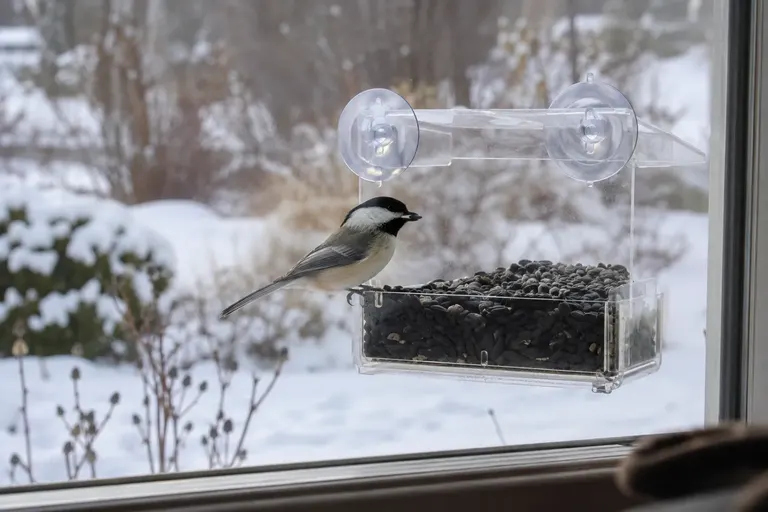
- Nature Anywhere Birds-I-View Window Feeder: best overall for balconies
- Brome Squirrel Buster Mini: best small tube feeder
- Kettle Moraine Recycled Mini Moraine Hopper: best compact hopper
- Droll Yankees X-1 Seed Saver: best tray for mixed visitors
- Woodlink Slot and Pin Deck Clamp: best railing mount
- Birdbuddy Pro Solar: best smart feeder for small spaces
- Balcony feeder comparison
- How to set up a bird feeder on a balcony
- Window, hanging or railing feeder: which is best for a balcony?
- How do you keep squirrels off a balcony feeder?
- What can you plant on a balcony for birds?
- Which birds visit balcony feeders?
- Should you add water to a balcony?
- Common balcony feeding mistakes
- Sources
- Frequently asked questions
The best bird feeder for a balcony is small, easy to mount without tools, and filled with seed that leaves no shells behind. Based on specs and owner feedback, the Nature Anywhere Birds-I-View window feeder is the most practical start because it uses no railing or floor space. If you would rather hang something, the Brome Squirrel Buster Mini, which holds 1 lb of seed, is the best compact tube for most balconies.
Small spaces change the rules. Mess lands on your floor or a neighbor’s, pigeons are more likely than cardinals, and mounting options are limited by what a lease allows. The picks below are chosen for those constraints.
Quick picks
- Best overall for balconies: Nature Anywhere Birds-I-View Window Feeder.
- Best small tube feeder: Brome Squirrel Buster Mini.
- Best compact hopper: Kettle Moraine Recycled Mini Moraine Hopper.
- Best tray for mixed visitors: Droll Yankees X-1 Seed Saver.
- Best railing mount: Woodlink Slot and Pin Deck Clamp.
- Best smart feeder for small spaces: Birdbuddy Pro Solar.
Nature Anywhere Birds-I-View Window Feeder
Takes no floor or railing space, sits right on the glass for close views, and has a sliding tray that lifts out for refilling.
- Best for
- Balconies with a sliding door or window you can reach from outside.
- Skip it if
- Your glass is tinted, textured or out of reach for cleaning.
- Size
- 10 x 4.3 x 10 in
- Material
- 4 mm polycarbonate
- Mounting
- Four suction cups
Brome Squirrel Buster Mini
A compact weight-activated tube that closes when squirrels climb on, sized for a short railing hook.
- Best for
- Balconies where squirrels climb up from trees or neighboring units.
- Skip it if
- You want to attract cardinals or other large birds.
- Capacity
- 1 lb of seed
- Ports
- 4
- Squirrel guard
- Weight-activated shroud
Kettle Moraine Recycled Mini Moraine Hopper
A small recycled-plastic hopper designed for no-mess blends, with a perforated floor and a hinged roof.
- Best for
- Railing or wall hooks where you want a sturdy, weatherproof feeder.
- Skip it if
- You want to see seed levels at a glance from indoors.
- Size
- 10 x 6.5 x 7.5 in
- Capacity
- About 3.5 cups
- Material
- Recycled plastic, stainless screws
Droll Yankees X-1 Seed Saver Domed Feeder
A clear hanging tray under a 10-inch adjustable dome that keeps rain off and lets you shut out pigeons.
- Best for
- Offering hulled seed, mealworms or fruit in a small space.
- Skip it if
- Wind on your balcony is strong, since light trays swing.
- Capacity
- 1 lb
- Dome
- 10 in, adjustable
Woodlink Slot and Pin Deck Clamp
A clamp that grips a horizontal or vertical deck rail so you can add a feeder arm without drilling.
- Best for
- Renters who cannot screw hardware into railings or walls.
- Skip it if
- Your railing is glass panels or very thick masonry.
- Styles
- Single or double, horizontal or vertical rail
- Size
- 3 x 6 x 1.75 in (horizontal)
Birdbuddy Pro Solar
A compact camera feeder with an optional wall mount, so you can see and identify visitors on a phone even when the balcony is out of view.
- Best for
- Tech-friendly birders with a balcony they cannot see from their desk or couch.
- Skip it if
- You want a simple feeder with no app or battery.
- Size
- 9 x 6.3 x 6.89 in
- Capacity
- 3.8 cups
- Camera
- 2K video, 5 MP photos
How we chose
We have not tested these feeders on a balcony ourselves. This list is research-based. We compared manufacturer specifications for size, capacity, materials and mounting, checked each product is currently listed by its maker or a major retailer, and left out any number we could not confirm.
We scored feeders on what matters in small spaces: footprint, how they mount without drilling, how much mess they tend to make, how easy they are to clean in a sink, and how well they resist pigeons and squirrels. We also looked for repeated patterns in verified owner feedback, such as suction cups letting go or trays swinging in wind. Bird behavior and window-safety guidance come from Cornell Lab of Ornithology.
What to look for in a balcony bird feeder
Small footprint and capacity
A small feeder is a feature on a balcony. It empties faster, so seed stays fresh, and it spills less. Around 1 lb or a few cups of seed is plenty for most balconies.
Mounting that fits your space
Your options are glass (suction cups), railings (clamps or hooks), walls (brackets, if allowed), and ceilings or overhangs (hooks). Renters should favor suction cups and clamps, which leave no holes.
Mess control
Seed husks and kicked-out filler are the main cause of complaints from neighbors and building managers. Feeders with catch trays, and food with no shells, solve most of it.
Easy cleaning
Balcony feeders are often cleaned in a kitchen sink, so smaller feeders that come apart without tools are easier to keep up with. Our guide on how to clean bird feeders explains how often.
Nature Anywhere Birds-I-View Window Feeder: best overall for balconies
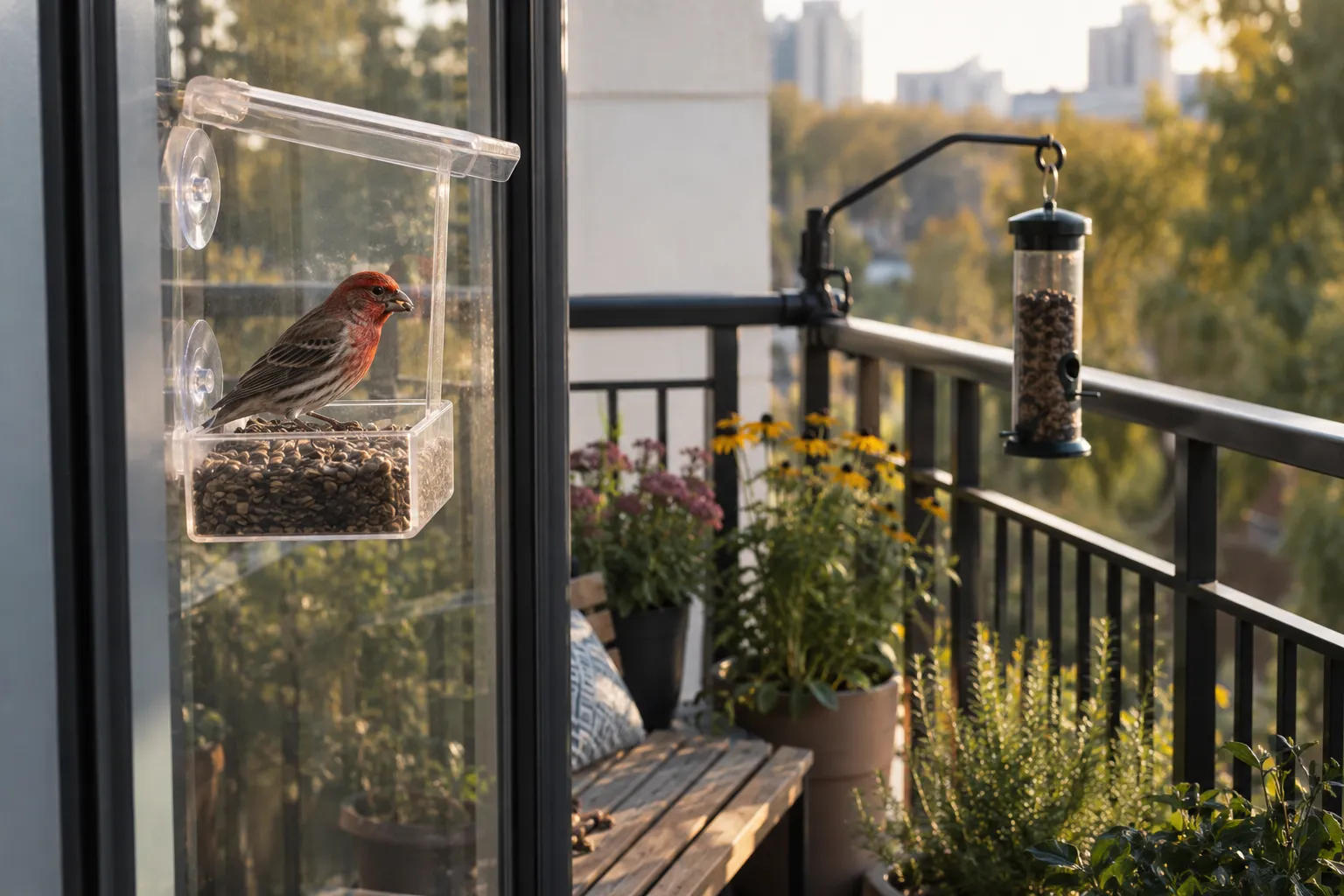
What it is: A clear polycarbonate window feeder that sticks to glass with four suction cups. The seed tray slides out, so you can refill it without removing the feeder.
Who it suits: Anyone with a balcony door or window they can reach from outside. It uses no floor or railing space.
Key specs: 10 x 4.3 x 10 inches, made from 4 mm polycarbonate, with four suction cups and a sliding tray. Nature Anywhere does not publish a seed capacity.
Strengths: It puts birds a few inches from the glass, which is the best view you can get in a small space. Cornell Lab notes that past distance rules for feeders near windows are no longer thought to be valid, and it recommends making windows bird-friendly instead. A feeder on the glass itself removes the risk of birds flying into that pane at speed. The sliding tray makes refilling quick.
Drawbacks: Suction cups need clean, smooth glass. Owners commonly report they can loosen in very hot or very cold weather until reseated. Husks can gather on the sill below, so hulled seed is the better fill.
Skip it if: Your glass is textured or coated, or you cannot safely reach it from outside.
Brome Squirrel Buster Mini: best small tube feeder
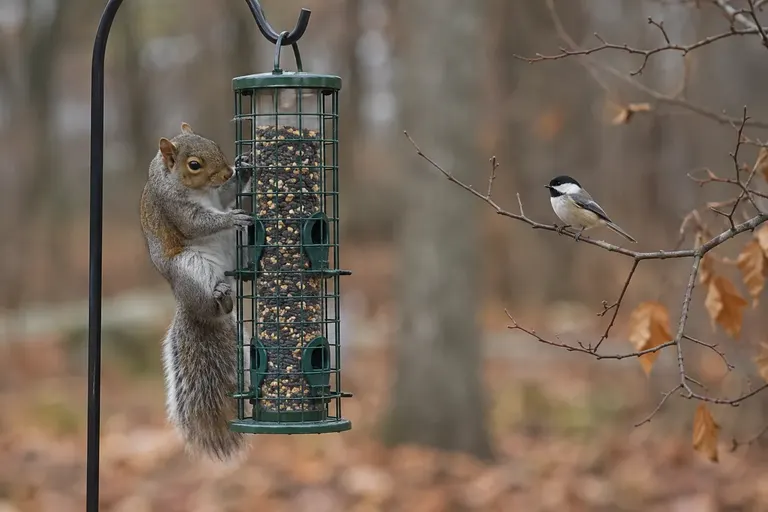
What it is: A small version of Brome’s weight-activated tube. When a squirrel climbs on, its weight pulls a shroud down over the ports.
Who it suits: Balconies that squirrels reach from nearby trees, fire escapes or neighboring units.
Key specs: Holds 1 lb of seed, four ports for perching and clinging birds, chew-resistant, UV-resistant materials and Brome’s Lifetime Care program. Unlike the larger Squirrel Buster Plus, the Mini’s weight setting is not adjustable.
Strengths: One pound is the right amount for a balcony, and a tube keeps seed dry. Short perches suit chickadees, titmice and finches while being awkward for pigeons.
Drawbacks: Large birds like cardinals and jays are not well served. Because the weight trigger is fixed, you cannot fine-tune it. Tubes with sunflower in the shell still drop husks.
Skip it if: Your main target is cardinals, or you want to see birds from a low chair; a tube hangs at eye level or above.
Kettle Moraine Recycled Mini Moraine Hopper: best compact hopper
What it is: A small two-sided hopper made of lumber from recycled milk jugs, with polycarbonate windows, a hinged roof and a perforated floor.
Who it suits: People who want a solid, low-maintenance feeder to hang from a railing arm or a wall hook.
Key specs: 10 inches wide, 6.5 inches deep and 7.5 inches tall (13.5 inches with its stainless steel hanging cable). Holds about 3.5 cups. Kettle Moraine says it is designed for no-mess blends and carries a lifetime guarantee.
Strengths: Recycled plastic will not rot or warp, which matters for a feeder that lives outdoors year-round. The perforated floor drains rain. Its two feeding sides let a couple of birds eat at once in a small footprint.
Drawbacks: It is heavier than a plastic tube. The hanging cable adds 6 inches of height, so check your overhead clearance. Seed levels are harder to judge from a distance than with a clear tube.
Skip it if: You want a feeder you can see refill needs from across a room.
Droll Yankees X-1 Seed Saver: best tray for mixed visitors
What it is: A clear polycarbonate tray under a 10-inch dome that slides up and down a brass rod.
Who it suits: Anyone who wants to offer more than seed, such as mealworms, fruit or suet pieces, in a small space.
Key specs: Holds 1 lb, 10-inch dome, about 11 x 10 x 10 inches overall, UV-stabilized polycarbonate and a brass rod. It hangs or pole-mounts with an adapter, and the tray unscrews for cleaning.
Strengths: Lowering the dome keeps pigeons out, which is one of the biggest balcony complaints. The dome also shelters the food from rain. The tray catches most dropped seed rather than letting it fall to the floor below.
Drawbacks: Lightweight trays can swing in strong wind, which is common on higher floors. Getting the dome height right takes some trial and error.
Skip it if: Your balcony is very exposed to wind.
Woodlink Slot and Pin Deck Clamp: best railing mount
What it is: A metal clamp that grips a deck or balcony rail and accepts Woodlink’s Slot and Pin hangers, such as a 20-inch angle hanger or a 16-inch shepherd hook.
Who it suits: Renters and condo owners who cannot drill into railings or walls.
Key specs: Woodlink makes single and double versions for horizontal rails (about 3 x 6 x 1.75 inches) and for vertical rails (about 5 x 4.5 x 1.75 inches).
Strengths: A clamp holds a feeder away from the railing, which helps keep seed off the railing and off the floor directly below. Choosing the rail orientation that matches yours matters, and Woodlink offers both.
Drawbacks: A clamp is only as strong as the railing and how tightly it is set. It does not suit glass-panel railings or wide masonry walls. It also gives squirrels an easy route if they already use your railing.
Skip it if: Your railing is glass or stone, or squirrels run along it.
Birdbuddy Pro Solar: best smart feeder for small spaces
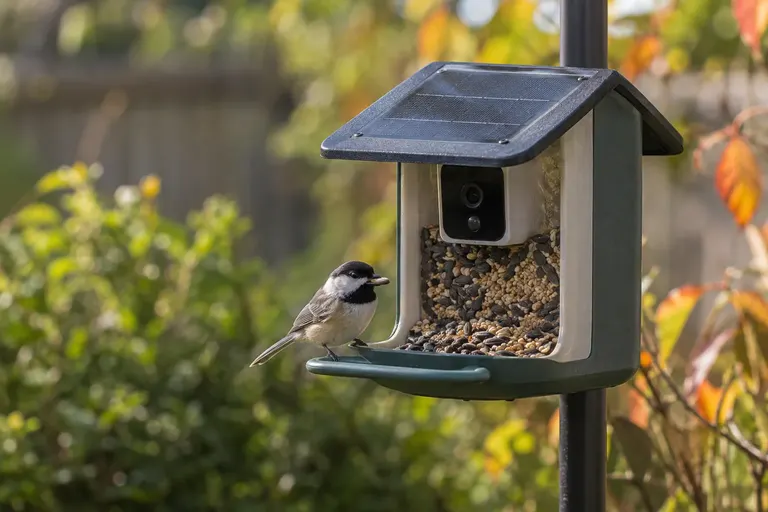
What it is: A compact camera feeder with a solar roof, a 2K camera and AI species recognition in its app. Birdbuddy sells a separate wall mount.
Who it suits: People who want to see which birds visit when they are not looking at the balcony, or who share sightings with family.
Key specs: Birdbuddy lists the feeder at 9 x 6.3 x 6.89 inches with a 3.8-cup capacity. The camera shoots 2K video and 5 MP photos with a 122-degree field of view, and the unit is rated IP67. It uses 2.4 GHz Wi-Fi.
Strengths: It is small enough for a railing or wall. Solar charging suits a sunny balcony. The free plan includes photo and sound identification, and Premium plans add features like 2K video viewing. Our smart feeder worth-it guide covers the trade-offs.
Drawbacks: It needs Wi-Fi at the balcony and a shaded spot can reduce solar charging. It costs far more than a plain feeder. The seed tray is open, so shells will fall.
Skip it if: You want a feeder with no app, battery or Wi-Fi to manage. See our best bird feeder cameras for more options.
Balcony feeder comparison
| Feeder | Mount | Capacity | Pigeon resistance | Mess level |
|---|---|---|---|---|
| Nature Anywhere Birds-I-View | Window suction cups | Not listed | Medium | Low with hulled seed |
| Brome Squirrel Buster Mini | Hanging | 1 lb | High | Medium |
| Kettle Moraine Mini Moraine | Hanging | About 3.5 cups | Medium | Low with no-mess blend |
| Droll Yankees X-1 | Hanging or pole | 1 lb | High with dome lowered | Low |
| Woodlink Deck Clamp | Railing | Not applicable | Depends on feeder | Depends on feeder |
| Birdbuddy Pro Solar | Hanging or wall mount | 3.8 cups | Low | Medium |
How to set up a bird feeder on a balcony
- Check the rules. Read your lease or HOA covenants. Some limit where feeders can go or what they can hold.
- Pick the spot. Choose a place near plants if you have them and away from where neighbors sit below. Corners out of strong wind work best.
- Mount without damage. Use suction cups on glass or clamps on railings.
- Choose clean food. Hulled sunflower or a no-mess blend. See our no-mess bird seed picks.
- Add a catch tray. A saucer or tray under a hanging feeder catches the few bits that drop.
- Add water. A shallow dish, cleaned every few days, often draws as many birds as seed.
- Be patient. Birds may take a few weeks to find a new balcony feeder. Our guide on why birds are not coming to your feeder has fixes.
Window, hanging or railing feeder: which is best for a balcony?
Each mounting style solves a different small-space problem.
Window feeders are best when floor and railing space are tight, or when you mostly watch from indoors. They give the closest views and keep seed away from the edge of the balcony. The trade-off is that you must reach the outside of the glass to refill and clean.
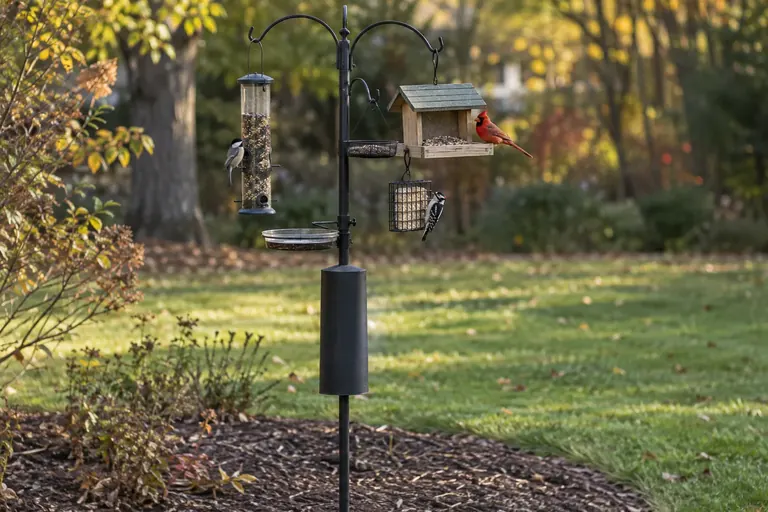
Hanging feeders on a ceiling hook or bracket are best when you have an overhang. They keep food off the floor and away from climbing squirrels if the hook is well away from walls and railings. They can swing in wind, and they need clearance above your head.
Railing-mounted feeders on a clamp and arm are best when you have no overhang and no reachable window. Keep the arm pointing inward so spills land on your side. They are the easiest for squirrels to reach if squirrels already travel along your railing.
If you have room for two, a window feeder plus a small nectar feeder in summer covers the widest range of birds with the least mess.
How do you keep squirrels off a balcony feeder?
Squirrels reach balconies from trees, drainpipes, fire escapes and neighboring railings. On a balcony there is rarely space to put a feeder out of jumping range, so the feeder itself has to do the work.
- Use a weight-activated feeder like the Squirrel Buster Mini, which closes its ports under a squirrel’s weight.
- Hang, do not clamp, where squirrels run along the rail, and keep the feeder away from walls.
- Add a small dome above a hanging feeder to stop squirrels climbing down the hanger.
- Offer foods squirrels like less, such as safflower, though some squirrels learn to eat it.
Our guide on keeping squirrels off bird feeders covers more tactics.
What can you plant on a balcony for birds?
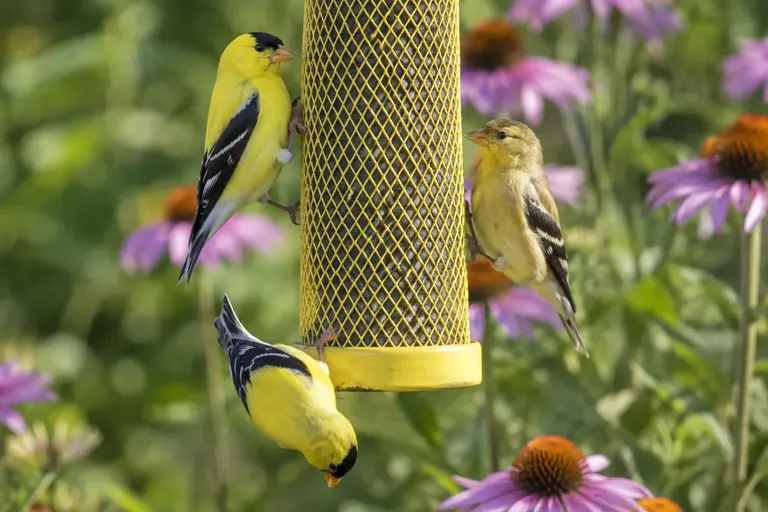
Plants turn a bare balcony into habitat and give birds a reason to linger. Containers of native flowering plants provide nectar, seeds and insects. Coneflowers and other seed-producing perennials can feed finches in late summer and fall if you leave the seed heads standing. Tubular red and orange flowers, such as native salvias and bee balm, draw hummingbirds. A small shrub or climbing vine in a large pot adds perching cover. Check with a local native plant society or extension office for species suited to your region and sun exposure.
Which birds visit balcony feeders?
It depends on your region and how much green space is nearby. Small, adaptable birds find balconies first. In many US cities that means House Finches, House Sparrows, chickadees, titmice, and in season, hummingbirds. Mourning Doves may come to trays. Balconies near parks or tree-lined streets get more variety.
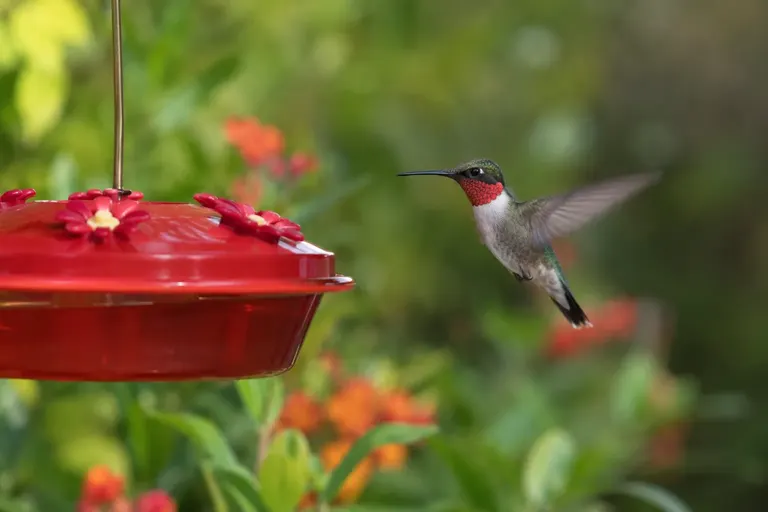
A small nectar feeder is often the best balcony feeder of all in spring and summer, since hummingbirds readily visit containers and hanging baskets. See our hummingbird feeder picks for easy-clean designs.
Should you add water to a balcony?
Yes, if you can keep it clean. Birds need water for drinking and bathing all year, and in built-up areas it can be scarcer than food. A shallow dish works: aim for water no deeper than about an inch or two at the edges, with a rough surface or a flat stone so birds can stand. Place it where you can see it from indoors and where splashes will not drip onto the unit below.
Change the water every day or two in warm weather, and scrub the dish at least weekly to prevent algae and mosquito larvae. In freezing climates, bring it in at night or use a small heated dish made for birds, following the maker’s outdoor-electrical guidance. On a windy balcony, a heavier ceramic or stone dish is less likely to tip than a plastic one.
Common balcony feeding mistakes
- Filling with cheap mixed seed. Birds kick out filler, which lands on your floor or the balcony below.
- Hanging the feeder over the edge. Anything dropped falls onto neighbors. Keep feeders over your own balcony.
- Feeding pigeons by accident. Seed on the floor or an open tray will draw pigeons fast.
- Using a big feeder. Large feeders hold seed long enough to spoil and attract rodents.
- Skipping cleaning. Small, busy feeders get dirty quickly. Clean at least every couple of weeks, more in wet weather.
- Ignoring window safety. Add markers to large balcony doors. Our guide to stopping birds hitting windows explains which work.
Sources
- Why Birds Hit Windows, All About Birds (Cornell Lab of Ornithology)
- How to Choose the Right Kind of Bird Feeder, All About Birds
- Birds-I-View Window Bird Feeder, Nature Anywhere
- Squirrel Buster Mini, Brome Bird Care
- Recycled Mini Moraine Hopper Feeder, Kettle Moraine Woodworking
- Slot and Pin Products, Woodlink
- Birdbuddy Pro Solar, Birdbuddy
Frequently asked questions
Can you put a bird feeder on an apartment balcony?
Usually yes, but check your lease or HOA rules first. Many buildings allow feeders but ban anything that drops seed onto balconies below or attracts pigeons and rodents. Choose a small feeder, use hulled seed or a no-mess blend, and add a tray to catch spills. Keeping the area clean is the best way to avoid complaints.
Will birds come to a high-floor balcony?
They can, although visits tend to be fewer as you go higher and farther from trees. Nearby street trees, parks and green roofs all help. House finches, chickadees, sparrows and hummingbirds are common balcony visitors in many US cities. Adding potted native plants and a shallow water dish can make a high balcony more attractive.
What is the least messy bird seed for a balcony?
Hulled sunflower hearts and no-mess blends with no shells or fillers are the least messy. Because there are no husks, very little drops to the floor. They cost more per pound than seed in the shell, but most of it is eaten. Avoid cheap mixes with millet and milo, which birds kick out and which can sprout in planters.
How do I keep pigeons off my balcony bird feeder?
Avoid open trays and seed on the floor, which pigeons love. Use a tube feeder with short perches, a window feeder with a narrow tray, or a domed feeder with the dome lowered so large birds cannot fit. Sweep up spills daily and never scatter seed. If pigeons persist, pause feeding for a week or two so they move on.
Are window feeders bad for birds?
No. Cornell Lab of Ornithology says window feeders offer close views and advises that if feeders are near windows, you should make the windows themselves bird-friendly rather than worry about exact distances. A feeder right on the glass means birds cannot fly into it at speed. Adding window markers elsewhere on the same glass further reduces collisions.