Best Finch Feeders for Nyjer Seed
The best finch feeder for most yards is a nyjer mesh feeder like the More Birds 13 Inch Finch Screen: room for many goldfinches, easy to fill. 6 picks compared.
If you buy through links on this page we may earn a commission, at no cost to you. It never decides what we recommend. How we earn
In this article
- Quick picks
- How we chose
- More Birds 13 Inch Finch Screen: best overall
- Droll Yankees Ring Pull Tube Finch Feeder: easiest to clean
- More Birds Topsy Tails Tube Finch Feeder: best for mixed finches
- Perky-Pet Upside Down Thistle Feeder: best for goldfinches only
- Brome Squirrel Buster Finch (Nyjer): best squirrel-proof
- Perky-Pet Classic Flexport Finch Feeder: best budget
- Finch feeder comparison table
- Mesh or tube: which finch feeder is better?
- How big should a finch feeder be?
- What else can you put in a finch feeder?
- Which birds eat nyjer seed?
- How to keep nyjer seed fresh
- Where to hang a finch feeder
- Why clean finch feeders often?
- Common mistakes with finch feeders
- The bottom line
- Sources
- Frequently asked questions
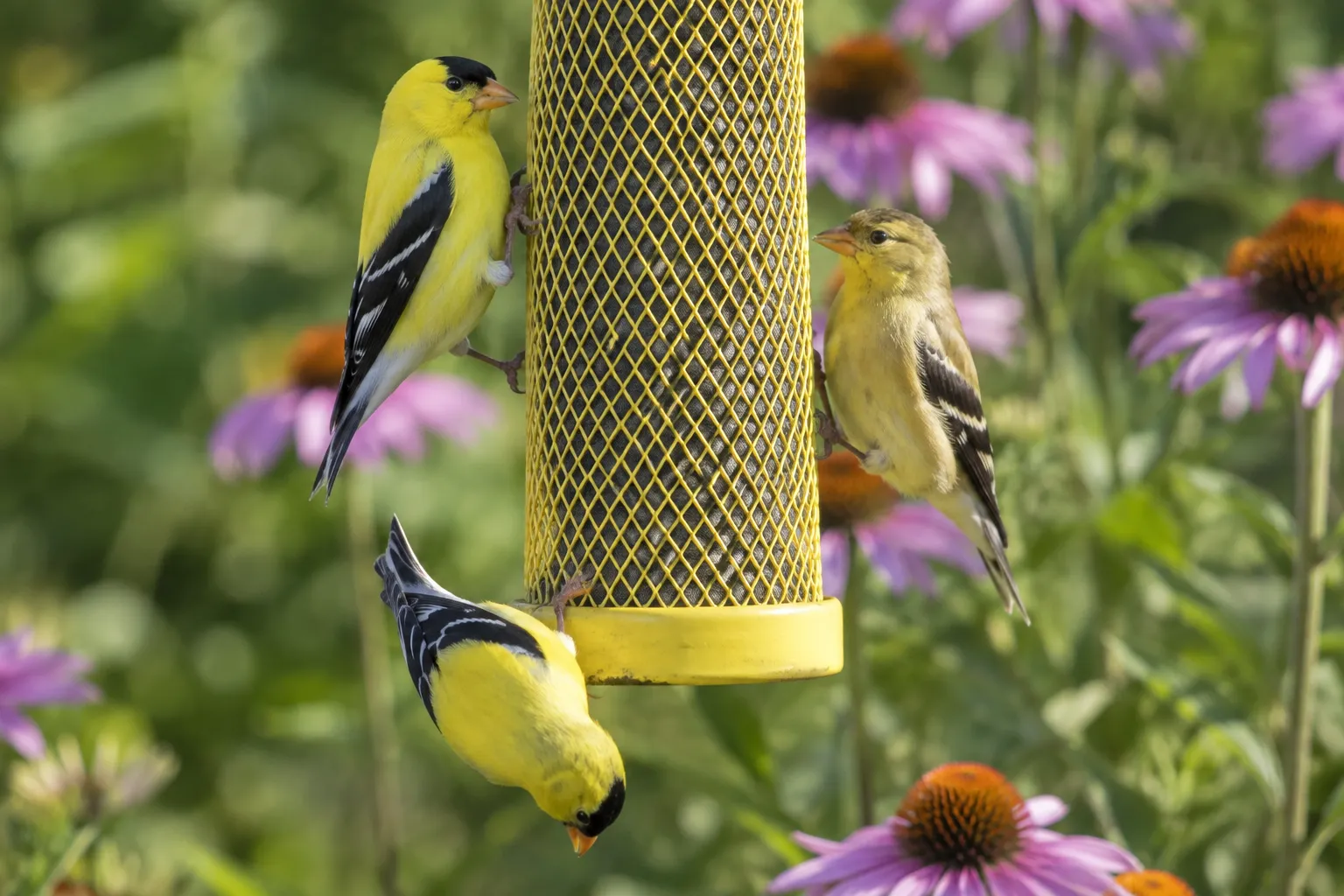
The best finch feeder for most yards is a mesh nyjer feeder, and the More Birds 13 Inch Finch Screen is our pick. Goldfinches can cling anywhere on the mesh, several birds can feed at once, and it holds 1.6 lb of seed. If you want a port-style tube that is quick to clean, the Droll Yankees Ring Pull Tube Finch Feeder comes apart in seconds. If House Finches are crowding out goldfinches, an upside-down feeder like the Perky-Pet Upside Down Thistle Feeder changes who gets to eat.
Nyjer is expensive and small birds are picky about freshness, so the right feeder is one that wastes little seed and keeps it dry.
Quick picks
- Best overall: More Birds 13 Inch Finch Screen. Cling-anywhere mesh, 1.6 lb.
- Easiest to clean tube: Droll Yankees Ring Pull Tube Finch Feeder. Tool-free takedown.
- Best for mixed finches: More Birds Topsy Tails. Ports above and below each perch.
- Best for goldfinches only: Perky-Pet Upside Down Thistle Feeder. Perches above the ports.
- Best squirrel-proof: Brome Squirrel Buster Finch (Nyjer). Weight-activated shroud, 2.4 lb.
- Best budget: Perky-Pet Classic Flexport Finch Feeder. Inexpensive, 1.5 lb.
More Birds 13 Inch Finch Screen Bird Feeder
A steel mesh tube that lets finches cling anywhere, plus perches and a tray, holding 1.6 lb of nyjer.
- Best for
- Goldfinches, siskins and redpolls, which love to cling.
- Skip it if
- Your feeder is exposed to frequent rain, which clumps seed in mesh.
- Capacity
- 1.6 lb nyjer
- Size
- 13.5 x 6 x 6 in
- Material
- Steel mesh, powder-coated
Droll Yankees Ring Pull Tube Finch Feeder
A classic polycarbonate tube with small nyjer ports that comes apart in seconds when you pull a ring, no tools needed.
- Best for
- People who clean feeders often and want it to take minutes.
- Skip it if
- You need it right away; stock at the maker has been intermittent.
- Capacity
- 1 lb
- Size
- 16 x 5 x 2.6 in
- Material
- UV-stabilized polycarbonate, zinc-plated metal
More Birds Topsy Tails Tube Finch Feeder
Seed ports sit above and below each perch, so goldfinches can feed upside down and other finches upright.
- Best for
- Yards that want goldfinches and House Finches alike.
- Skip it if
- You want to discourage House Finches.
- Capacity
- 1.5 lb
- Size
- 18.75 x 5.5 x 5.5 in
- Material
- Steel, PVC, aluminum
Perky-Pet Upside Down Thistle Feeder
Perches sit above the ports, so only birds that feed upside down, mainly goldfinches, can eat comfortably.
- Best for
- Yards where House Finches crowd out goldfinches.
- Skip it if
- You enjoy House Finches or siskins at the feeder.
- Capacity
- 2 lb
- Ports
- 6
- Height
- 19.25 in
Brome Squirrel Buster Finch (Nyjer)
A weight-activated shroud closes the ports on squirrels, and a vented seed tube helps nyjer stay dry.
- Best for
- Yards where squirrels chew through plastic finch tubes.
- Skip it if
- You want a small, inexpensive feeder to try nyjer.
- Capacity
- 2.4 lb
- Ports
- 8
- Warranty
- Brome Lifetime Care
Perky-Pet Classic Flexport Finch Feeder
An inexpensive 1.5 lb tube with six flexible ports and perches for upright or upside-down feeding.
- Best for
- Testing whether finches will come before spending more.
- Skip it if
- You want a feeder that fully comes apart; the base does not remove.
- Capacity
- 1.5 lb
- Ports
- 6
- Height
- 15 in
How we chose
We have not hung these feeders in our own yard yet, so this guide is research-based. We compared manufacturer specifications for capacity, port count, size and materials. We read maker cleaning instructions to see which feeders truly come apart. We looked for patterns in verified owner feedback on clumping, clogged ports, squirrel damage and durability. And we used the Cornell Lab of Ornithology and Project FeederWatch for guidance on finch behavior, nyjer seed and disease prevention.
Every pick is designed for nyjer’s tiny seed size. General-purpose tube feeders with large ports were excluded, since nyjer pours right out of them.
More Birds 13 Inch Finch Screen: best overall
A steel mesh cylinder with a powder-coated top and base and a small built-in tray. Goldfinches cling to the screen and pick seed through the openings, and the maker notes they can also use the perches or the tray, even upside down.
Who it suits: Yards that mainly host American Goldfinches, plus Pine Siskins and, in the North, Common Redpolls in winter.
Key specs: 1.6 lb nyjer capacity, 13.5 by 6 by 6 inches, steel mesh with yellow powder coating, model 38115. The maker also lists sunflower chips and finch blends as suitable.
Strengths:
- The whole surface is a feeding area, so many birds can eat at once.
- Steel mesh resists squirrel chewing better than plastic.
- Clear cleaning guidance from the maker: weekly, with a 15-minute soak in 9 parts water to 1 part bleach.
Drawbacks: Mesh lets rain in, and wet nyjer clumps and molds. The maker warns against the dishwasher. The yellow finish can chip over time.
Skip it if: Your feeder hangs in the open in a rainy climate. Use a covered tube instead, or add a weather dome.
Droll Yankees Ring Pull Tube Finch Feeder: easiest to clean
Droll Yankees made tube feeders famous, and the Ring Pull design fixes their old weakness: cleaning. Pull the ring at the top, and the ports and base drop away from the tube. No tools, no stuck screws.
Who it suits: Anyone who knows they will only clean a feeder that is quick to take apart.
Key specs: 1 lb capacity, 16 by 5 by 2.6 inches, UV-stabilized polycarbonate tube with heavy-duty zinc-plated metal parts. It can hang from its stainless steel wire or mount on a pole through the threaded base.
Strengths:
- The fastest disassembly in this group.
- Small nyjer ports limit spills and waste.
- Metal parts resist chewing at the ports and base.
Drawbacks: The maker says it is not for the dishwasher. The tube itself is plastic, so a determined squirrel can still damage it. The feeder has been listed as out of stock on the maker’s site at times, so check availability.
Skip it if: Squirrels already raid your feeders and you cannot baffle the pole.
More Birds Topsy Tails Tube Finch Feeder: best for mixed finches
Topsy Tails puts a seed port above and below each perch. American Goldfinches, which happily feed upside down, use the lower ports. House Finches and Purple Finches, which prefer to feed upright, use the upper ones.
Who it suits: Yards that want every finch species welcome, including House Finches.
Key specs: 1.5 lb capacity, 18.75 by 5.5 by 5.5 inches, steel, PVC and aluminum with a yellow powder-coated finish, model 38169. A built-in seed baffle stops seed from sitting below the lowest ports.
Strengths:
- Two feeding positions at every perch double the usable ports.
- The internal baffle reduces stale seed trapped at the bottom.
- The bottom cap slides up the hanging wire to open the feeder for filling and cleaning.
Drawbacks: With perches for upright feeding, House Finches can dominate. Owners sometimes report ports clogging after rain, which is common to all nyjer tubes.
Skip it if: Your goal is to give goldfinches priority over House Finches.
Perky-Pet Upside Down Thistle Feeder: best for goldfinches only
This feeder flips the usual layout. Each of the six perches sits above its port, so a bird has to hang upside down to eat. American Goldfinches do this naturally. House Finches generally do not, so they tend to move on.
Who it suits: Yards where House Finches crowd the feeder and goldfinches cannot get a turn.
Key specs: 2 lb capacity, 6 ports, 19.25 inches tall, model 399-6. The cap slides up the hanging bail for refilling.
Strengths:
- Selects for goldfinches without any mechanical parts.
- Large 2 lb capacity means fewer refills.
- A clear tube shows the seed level.
Drawbacks: Perky-Pet has listed it as out of stock at times, so you may need to look at other retailers. Owners commonly report that some House Finches eventually learn to hang upside down, so the effect can fade. Perky-Pet cautions that careless disassembly can shorten its life.
Skip it if: You enjoy watching House Finches, Pine Siskins and goldfinches together.
Brome Squirrel Buster Finch (Nyjer): best squirrel-proof
Squirrels rarely target nyjer itself, but owners commonly report them chewing plastic finch tubes and ports anyway. The Squirrel Buster Finch, which Brome lists as the Squirrel Buster Nyjer, uses the same weight-activated shroud as the rest of the Squirrel Buster line: when a squirrel climbs on, the shroud drops and covers the ports.
Who it suits: Yards with persistent squirrels and plenty of finches.
Key specs: 2.4 lb capacity, 8 nyjer ports, perches plus a wire shroud for clinging birds, UV-resistant and chew-proof parts. Brome’s Seed Tube Ventilation is designed to let humid, hot air escape so seed stays fresher. It comes apart by hand for cleaning, is covered by Lifetime Care, and Brome says to use only nyjer in it.
Strengths:
- Chew-proof design protects your investment.
- Ventilated tube targets nyjer’s biggest enemy, humidity.
- Perches and clinging surface serve both feeding styles.
Drawbacks: It is tall and far more expensive than any other pick. It still needs open space so squirrels cannot reach the ports from a branch.
Skip it if: Squirrels ignore your finch feeder already, which is common.
Perky-Pet Classic Flexport Finch Feeder: best budget
A basic plastic tube with six Flexport feeding stations, which are flexible rubber ports sized for nyjer, and dual T-shaped perches that allow upright and upside-down feeding.
Who it suits: Anyone trying nyjer for the first time, or adding a second feeder to spread birds out.
Key specs: 1.5 lb capacity, 6 ports, 15 inches tall, model 481F.
Strengths:
- Low cost.
- Six ports and two perch styles serve both goldfinches and House Finches.
- Light and easy to hang almost anywhere.
Drawbacks: The base does not come off, so you must scrub the inside with a bottle brush. Perky-Pet notes that Flexport replacement parts are not sold; its one-year policy replaces the whole feeder instead.
Skip it if: Easy cleaning is your priority.
Finch feeder comparison table
| Feeder | Style | Capacity | Ports | Height (in) | Comes apart | Squirrel resistant |
|---|---|---|---|---|---|---|
| More Birds 13 in Finch Screen | Mesh | 1.6 lb | Mesh surface | 13.5 | Top opens | Steel resists chewing |
| Droll Yankees Ring Pull | Tube | 1 lb | Nyjer ports | 16 | Yes, tool-free | No |
| More Birds Topsy Tails | Tube | 1.5 lb | Above and below perches | 18.75 | Bottom cap removes | No |
| Perky-Pet Upside Down | Tube | 2 lb | 6 | 19.25 | Partly | No |
| Brome Squirrel Buster Finch | Tube | 2.4 lb | 8 | Tallest in group | Yes, tool-free | Yes |
| Perky-Pet Flexport 481F | Tube | 1.5 lb | 6 | 15 | No | No |
Mesh or tube: which finch feeder is better?
Both work, and many birders hang one of each.
Mesh feeders suit the way goldfinches naturally feed. Cornell Lab describes American Goldfinches as acrobatic foragers that balance on seedheads to pluck seeds. On mesh they can cling at any angle, and more birds fit at once. The downside is weather: rain soaks through the mesh, and wet nyjer clumps quickly.
Tube feeders with nyjer ports keep seed drier and control waste, because birds can only take seed from a few small openings. They also let you choose who feeds, through perch placement. The downside is that ports clog when seed gets damp, and fewer birds can eat at once.
A simple rule: in dry climates or under a roof overhang, choose mesh. In wet, exposed spots, choose a tube, or add a weather dome over a mesh feeder.
How big should a finch feeder be?
Match capacity to how fast your birds eat, not to how rarely you want to refill. Nyjer that sits for weeks, especially in humid weather, goes stale or clumps, and finches start ignoring it.
- 1 lb or less: Right for a first finch feeder, a small yard, or summer, when goldfinches also feed on wild seedheads.
- 1.5 to 2 lb: A good middle ground for yards with a steady group of goldfinches.
- 2 lb and up: Worth it in winter, or during irruption years when Pine Siskins or redpolls arrive in flocks.
If you already own a large feeder, fill it only partway until you know how quickly the seed disappears.
What else can you put in a finch feeder?
Nyjer is the classic finch food, but it is not the only one.
- Sunflower chips (hulled sunflower): Goldfinches and House Finches eat them eagerly, and there are no shells to clean up. They need a feeder with larger mesh or ports than pure nyjer.
- Finch blends: Usually nyjer mixed with fine sunflower chips. Check that your feeder’s ports or mesh are rated for blends; the More Birds screen and Topsy Tails list them as suitable.
- Black oil sunflower seed: American Goldfinches readily eat it from a standard tube feeder, which is a cheaper way to feed them if nyjer is going to waste.
Cornell Lab notes that American Goldfinches favor nyjer and sunflower seeds at feeders, so offering both in separate feeders is a sensible way to see which your birds prefer.
Why did the goldfinches disappear?
Many people see goldfinch numbers drop at times during the year. Wild food is one reason: when native plants in the aster family go to seed, goldfinches spend more time feeding in the field and less at feeders. Males also look very different in winter, when they trade bright yellow for a duller olive-brown, so some people assume they have left when they are still visiting. Stale seed is the other common cause, which is why freshness matters so much.
Which birds eat nyjer seed?
- American Goldfinch: The main nyjer customer across most of the US and southern Canada.
- Lesser Goldfinch: The West and Southwest’s small goldfinch, a regular at nyjer feeders.
- Pine Siskin: Streaky and irregular. Some winters they arrive in large numbers, other years almost none.
- House Finch and Purple Finch: Both eat nyjer, though they often prefer sunflower.
- Common Redpoll: A northern winter visitor in some years.
Cornell Lab notes that American Goldfinches nest later than most songbirds, waiting until mid-summer when thistles and other plants go to seed. That is one reason goldfinch activity at feeders can shift through the season.
How to keep nyjer seed fresh
Nyjer is small, oily and pricey, and birds are quick to reject it when it goes off. Project FeederWatch notes that nyjer is imported and heat-treated before import, and recommends buying it fresh.
- Buy smaller bags you will use in a few weeks.
- Store it sealed in a cool, dry place, not a hot garage. Our guide on how to store bird seed covers containers.
- Fill feeders partway when finch numbers are low, so seed turns over faster.
- Empty and dry the feeder after rain if seed has clumped. Do not just top it off.
- Shake the feeder occasionally to check that seed flows to the lowest ports.
If you want a broader mix for more species, see our guide to the best bird seed to attract the most species.
Where to hang a finch feeder
Goldfinches like open, weedy, sunny places, but they also want cover nearby. Hang your finch feeder:
- Within a short flight of shrubs or small trees, so birds can retreat.
- At eye level or a bit higher, where you can reach it to clean.
- Away from your main sunflower feeder, if larger birds crowd it.
- Under an eave or with a weather dome in wet climates.
Our guide on where to put a bird feeder covers height, cover and window safety in more depth.
Why clean finch feeders often?
Finches crowd together at feeders, and that makes them vulnerable to disease. Project FeederWatch explains that House Finch eye disease, caused by a strain of the bacterium Mycoplasma gallisepticum, has also been confirmed in American Goldfinches, Purple Finches, Evening Grosbeaks and Pine Grosbeaks. Infected birds show red, swollen or crusty eyes.
FeederWatch recommends cleaning with a 10 percent bleach solution, 1 part bleach to 9 parts water, letting feeders dry fully, raking up old seed and droppings below, and spacing feeders apart. If you see sick birds, take feeders down for a while and clean them thoroughly. Our guides on sick birds at the feeder and how to clean a bird feeder walk through the steps.
Common mistakes with finch feeders
- Putting nyjer in a standard seed feeder. It pours out of large ports.
- Filling a big feeder for a few birds. Seed goes stale before it is eaten.
- Topping off wet seed. Clumped nyjer at the bottom rots and blocks ports.
- Giving up after a week. Goldfinches can take several weeks to find a new feeder, especially in spring and summer when natural seed is plentiful.
- Skipping cleaning. Crowded finches spread disease quickly.
The bottom line
For most yards, the More Birds 13 Inch Finch Screen gives goldfinches the most room for the money. Choose the Droll Yankees Ring Pull if easy cleaning comes first, the Perky-Pet Upside Down if House Finches dominate, and the Brome Squirrel Buster Finch if squirrels chew everything. For our broader recommendations, see the best bird feeders for your backyard.
Sources
- Cornell Lab of Ornithology, All About Birds: American Goldfinch Life History
- Project FeederWatch: Feeding Birds
- Project FeederWatch: House Finch Eye Disease
- Perky-Pet: More Birds 13 Inch Finch Screen Feeder
- Perky-Pet: Droll Yankees Ring Pull Tube Finch Feeder
- Brome: Squirrel Buster Finch product support
Frequently asked questions
Is nyjer the same as thistle seed?
No. Nyjer, sometimes sold as thistle, comes from Guizotia abyssinica, an African and Asian plant that is not related to the thistles in North American fields. It is imported and, according to Project FeederWatch, heat-treated before import so it will not sprout. The thistle name stuck because finches eat both.
Why won't finches eat my nyjer seed?
The most common reasons are stale or wet seed. Nyjer is oily, and seed that has dried out, clumped or molded is often ignored. Buy smaller bags, store them sealed in a cool place, and empty any feeder where seed has clumped after rain. A new feeder can also take a few weeks to be found.
Do goldfinches prefer mesh or tube feeders?
Goldfinches readily use both. Mesh feeders let them cling anywhere, which suits their acrobatic feeding style and allows more birds at once. Tube feeders with small ports keep seed drier and waste less. In a wet climate a covered port tube is often the better choice. Many birders hang one of each.
Can I put nyjer in a regular bird feeder?
Usually not. Nyjer is tiny and pours straight out of the larger ports on standard sunflower tube feeders. Use a finch feeder with small nyjer ports or fine mesh. Some sunflower-chip and finch-mix feeders handle both, but check that the port or mesh size is specified for nyjer.
How often should I clean a finch feeder?
Project FeederWatch suggests cleaning seed feeders every week or two, and more often in wet weather or when many birds visit. Finches can spread House Finch eye disease, so scrub the feeder, soak it in 1 part bleach to 9 parts water, rinse and let it dry fully before refilling.