Best Bird Feeder for Cardinals: 6 Research-Based Picks
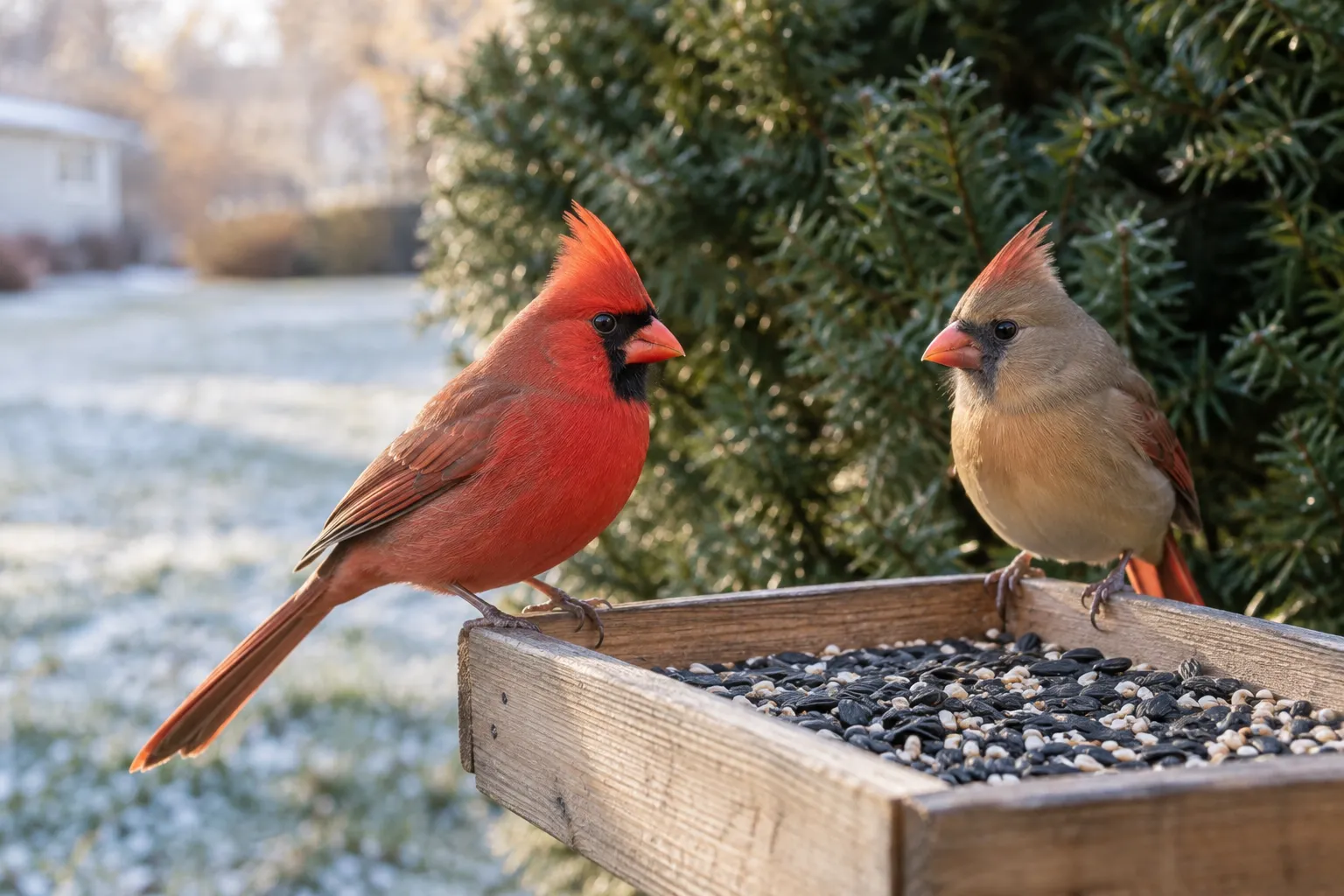
The best bird feeder for cardinals gives them a wide, steady place to stand. Our research picks hoppers, platforms and trays that suit this heavy seed-eater.
If you buy through links on this page we may earn a commission, at no cost to you. It never decides what we recommend. How we earn
In this article
- Quick picks
- How we chose
- What makes a feeder good for cardinals?
- Woodlink Absolute II Squirrel-Resistant Feeder: best overall
- Brome Squirrel Buster Plus: best squirrel-proof tube
- Woodlink Going Green Platform Feeder: best platform feeder
- Woodlink Audubon 3-in-1 Platform Feeder: best ground and low feeder
- Droll Yankees X-1 Seed Saver: best for keeping big birds off
- Nature Anywhere Birds-I-View Window Feeder: best window feeder
- Cardinal feeder comparison table
- Where should you put a cardinal feeder?
- What should you put in a cardinal feeder?
- Hopper vs platform vs tube: which is best for cardinals?
- When do cardinals come to feeders?
- Common mistakes when feeding cardinals
- How do you keep squirrels and bully birds off a cardinal feeder?
- Sources
- Frequently asked questions
The best bird feeder for cardinals is one that lets a heavy, short-legged bird stand flat and face its food; Northern Cardinals weigh roughly 1.5 to 1.7 ounces, according to All About Birds. On paper, the Woodlink Absolute II hopper is the best all-round choice because it pairs long counterweighted perches with real squirrel resistance. If you just want cardinals to show up, start with a simple platform tray filled with black oil sunflower or safflower, placed near thick shrubs.
Most “cardinal feeder” problems come down to perch design, feeder height and cover, not brand names. This guide covers all three and six feeders that suit how cardinals feed.
Quick picks
- Best overall: Woodlink Absolute II Squirrel-Resistant Feeder. A 12 lb steel hopper with adjustable weight-sensitive perches.
- Best squirrel-proof tube: Brome Squirrel Buster Plus. The Cardinal Ring perch makes a tube feeder cardinal-friendly.
- Best platform feeder: Woodlink Going Green Platform Feeder. A wide, low-maintenance recycled-plastic tray.
- Best ground and low feeder: Woodlink Audubon 3-in-1 Platform Feeder. A cedar screen tray that hangs, posts or sits on the ground.
- Best for keeping big birds off: Droll Yankees X-1 Seed Saver. An adjustable dome that filters out larger birds.
- Best window feeder: Nature Anywhere Birds-I-View. A roomy tray that fits a cardinal on your glass.
Woodlink Absolute II Squirrel-Resistant Feeder
A big steel hopper with long counterweighted perches that cardinals can stand on comfortably, and a weight setting that shuts out squirrels.
- Best for
- Yards with squirrels and a steady cardinal population.
- Skip it if
- You want a light feeder you can hang from a thin branch.
- Capacity
- 12 lb of seed
- Size
- About 9.9 x 13.5 x 11.3 in
- Perches
- Counterweighted, 3 weight settings
Brome Squirrel Buster Plus
The only tube feeder here built with cardinals in mind, thanks to a round perch ring that gives them room to face the port.
- Best for
- People who want one feeder that serves cardinals, chickadees and finches.
- Skip it if
- Starlings and grackles are your main problem, because the shroud does not stop them.
- Capacity
- 5.1 lb of seed
- Height
- 28 in including hanger
- Ports
- 6, with Cardinal Ring perch
Woodlink Going Green Platform Feeder
An open recycled-plastic tray that matches how cardinals like to feed: wide, flat and easy to see around.
- Best for
- Anyone trying to attract a first cardinal.
- Skip it if
- Squirrels roam freely in your yard and you have no baffle.
- Size
- 12.75 x 12.75 x 2.5 in
- Material
- Recycled plastic
Woodlink Audubon 3-in-1 Platform Feeder
A cedar screen-bottom tray that can hang, sit on a post or rest on the ground, which suits cardinals' habit of feeding low.
- Best for
- Yards with thick shrubs where cardinals already forage near the ground.
- Skip it if
- Rabbits, raccoons or rats already visit your yard at night.
- Size
- 13 x 13 x 2.5 in
- Capacity
- 3 lb
- Mounting
- Hang, post or ground
Droll Yankees X-1 Seed Saver Domed Feeder
A clear tray under an adjustable 10-inch dome, so you can lower the roof until grackles and pigeons stop fitting.
- Best for
- Yards where grackles, jays or pigeons clear out open trays.
- Skip it if
- You want a feeder that holds several days of seed.
- Capacity
- 1 lb
- Dome
- 10 in, height adjustable
- Material
- UV-stabilized polycarbonate, brass rod
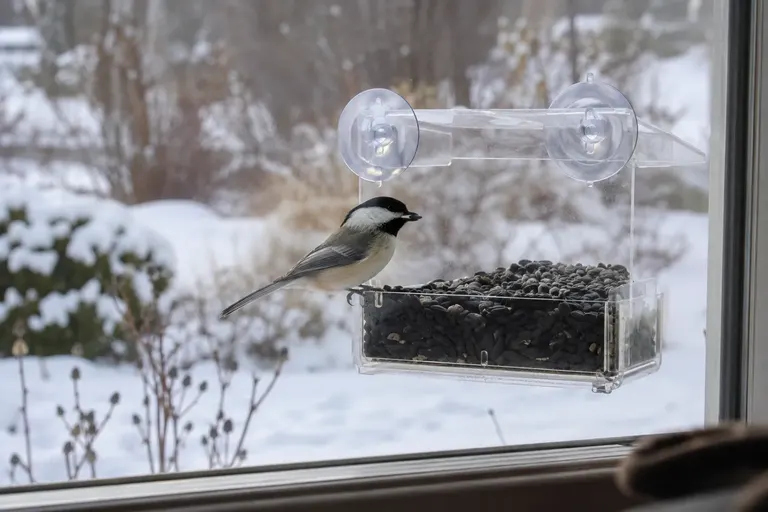
Nature Anywhere Birds-I-View Window Feeder
A suction-cup window feeder with a deep sliding tray, big enough for a cardinal to land and eat within arm's length of your glass.
- Best for
- Close views from a kitchen or living room window.
- Skip it if
- Your windows are hard to reach from outside for cleaning.
- Size
- 10 x 4.3 x 10 in
- Material
- 4 mm polycarbonate
- Mounting
- Four suction cups
How we chose
We have not physically tested these feeders. This list is research-led. We started with what cardinals need, using Cornell Lab of Ornithology’s All About Birds species account and Project FeederWatch’s feeder and food guidance. Then we compared feeders on the features that matter for this species: perch or ledge width, open landing space, capacity, drainage, ease of cleaning and squirrel resistance.
We checked each product against the manufacturer’s page or a major retailer listing to confirm it is sold and to verify specs. Where no number was published, we left it out. We also looked for consistent patterns in verified owner feedback on lids, perches and durability. No brand paid for placement.
What makes a feeder good for cardinals?
Northern Cardinals measure about 8.3 to 9.1 inches long and weigh roughly 1.5 to 1.7 ounces, according to All About Birds. That is noticeably bigger than a chickadee or goldfinch. They also have short legs and a thick seed-cracking bill, and they like to sit still and face their food while they crack each seed.
That body shape explains the four features to look for:
- A wide, flat place to stand. A tray edge, a long hopper ledge or a ring perch. Short peg perches on tube feeders force cardinals to twist sideways, and many will not bother.
- Room to turn around. Cardinals are wary and like to look up between bites. Open trays and wide hoppers let them do that.
- Stability. A feeder that swings hard in the wind or tilts under weight makes cardinals nervous. Pole-mounted or well-anchored feeders tend to keep them calmer.
- Drainage. Any open tray needs a mesh or perforated floor. FeederWatch specifically recommends plenty of drainage holes on platform feeders so seed does not sit in water.
Do cardinals use tube feeders?
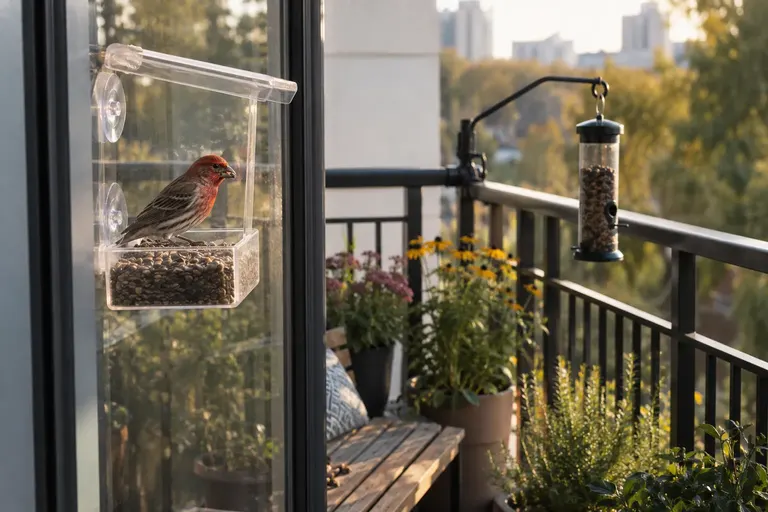
Sometimes, but not reliably. FeederWatch notes that tube feeders with short perches tend to exclude larger birds. Cardinals can perch on a standard tube, but they usually have to eat from an awkward angle. The exception is a tube with a wraparound ring perch, such as the Brome Squirrel Buster Plus, which gives them a platform to stand on.
Woodlink Absolute II Squirrel-Resistant Feeder: best overall
What it is: A large powder-coated steel hopper with a clear seed window, a locking lid and two long counterbalanced perch bars on either side. When something heavy lands, a spring mechanism drops a shield over the seed opening.
Who it suits: Anyone with squirrels, and anyone who wants to fill a feeder once and leave it for several days. The 12 lb capacity is large by backyard standards.
Key specs: Holds 12 lb of seed (sunflower, safflower, peanut halves or mixed seed). Tractor Supply lists the dimensions as roughly 9.9 in wide, 13.5 in tall and 11.3 in deep. The perches adjust to three positions, labeled for light, medium and heavy birds. It can hang from its steel rod or mount on a pole, and some retail bundles include a sectional pole.
Strengths: The perch bars run the full width of each side, which gives a cardinal a long, level bar to stand on while it faces the seed. The weight settings let you keep cardinals feeding while closing the ports on squirrels and, on the lighter settings, on some larger birds like grackles. Steel construction resists chewing. Owners commonly report that the feeder holds up for years outdoors.
Drawbacks: It is heavy when full, so it needs a sturdy hook or pole. Owners often mention that the counterweight needs fine-tuning, because the heavy setting can let a small squirrel through and the light setting can close on a pair of cardinals feeding together. The large capacity also means seed sits longer, so it matters to fill it partway in wet weather.
Skip it if: You need to hang it from a thin tree branch or a light shepherd’s hook, or you prefer a feeder you can wash in a sink.
Brome Squirrel Buster Plus: best squirrel-proof tube
What it is: A 28-inch weight-activated tube feeder. When a squirrel’s weight pulls on the outer shroud, it slides down and covers all six feeding ports. The “Cardinal Ring” is a circular perch around the lower ports.
Who it suits: People who want one feeder to serve cardinals and small birds together, in a yard with squirrels.
Key specs: Holds 5.1 lb of seed, six feeding ports, a spring mechanism that lets you adjust how much weight the shroud supports, and a ventilated seed tube. Brome says the whole feeder comes apart without tools for cleaning, and it is covered by the company’s Lifetime Care program.
Strengths: The ring is what makes this feeder work for cardinals. It gives them a curved platform to stand on, so they can face the port instead of hanging sideways. The shroud mechanism has a strong reputation among owners for stopping gray squirrels. Tool-free disassembly makes a thorough cleaning much easier than on most tubes.
Drawbacks: Brome itself states the feeder does not deter grackles, starlings, chipmunks, raccoons or bears. Cardinals also share the ring with every other bird, so on busy mornings they may wait their turn. Ports are sized for sunflower-type seed, so it is not a nyjer feeder.
Skip it if: Grackles or starlings are your main nuisance, or you want a feeder cardinals will use in groups.
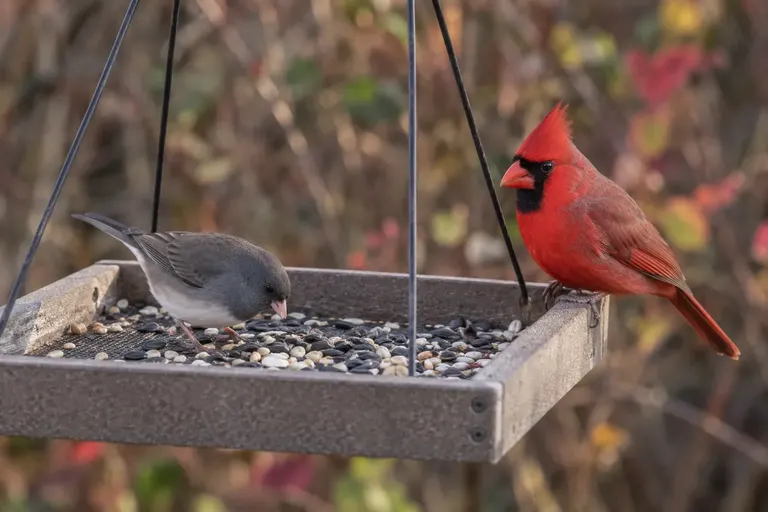
Woodlink Going Green Platform Feeder: best platform feeder
What it is: An open square tray made from recycled plastic, sized for hanging or mounting.
Who it suits: Beginners and anyone trying to attract cardinals for the first time. A flat tray is the most natural-looking surface for a bird that usually forages on the ground.
Key specs: Woodlink lists it at 12.75 x 12.75 x 2.5 in and 2.5 lb. The Going Green line is made from recycled plastic.
Strengths: Cardinals can land, turn and look around, which makes them comfortable. Recycled plastic does not rot like thin softwood and can be scrubbed hard.
Drawbacks: Open trays attract everything, including doves, jays, grackles and squirrels. Seed is exposed to rain and snow, so it needs frequent emptying and cleaning. All About Birds recommends washing platform feeders with a dilute bleach solution every couple of weeks.
Skip it if: Squirrels can reach it and you do not plan to add a baffle, or you cannot check it every day or two in wet weather.
Woodlink Audubon 3-in-1 Platform Feeder: best ground and low feeder
What it is: A kiln-dried cedar tray with a screen bottom, designed to hang, mount on a post or sit on the ground with its legs.
Who it suits: Yards where cardinals already forage under shrubs. All About Birds describes cardinals hopping through low branches and foraging on or near the ground, so a low tray meets them where they already are.
Key specs: 13 x 13 x 2.5 in, 3 lb capacity, cedar frame with screen floor, three mounting options (model NAPLAT2).
Strengths: The screen floor drains quickly and lets seed dry out after rain. Being able to start on the ground and move the tray up later is useful: many feeders find that cardinals discover a low tray first, then keep using it after it is raised.
Drawbacks: Ground feeding brings ground problems. A tray at ground level is open to rabbits, raccoons, rats and neighborhood cats. Cedar weathers and needs more care than plastic.
Skip it if: You already see rodents or outdoor cats in your yard at night or at dawn.
Droll Yankees X-1 Seed Saver: best for keeping big birds off
What it is: A round clear polycarbonate tray under a 10-inch dome. The dome slides up or down the brass hanging rod to change how much space there is above the tray.
Who it suits: People whose open trays get emptied by grackles, starlings, pigeons or jays.
Key specs: Holds 1 lb of seed, fruit, suet or mealworms. Overall size about 11 x 10 x 10 in. UV-stabilized polycarbonate that resists yellowing, and the tray unscrews for cleaning. It can hang or mount on a pole with an adapter.
Strengths: The adjustable dome is a simple way to tune which birds can fit. Lowered part of the way, cardinals can still hop in while bulkier birds find it awkward. The dome also keeps rain and snow off the seed. Clear plastic gives a good view from indoors.
Drawbacks: One pound is not much, so it may need daily filling in busy seasons. Set the dome too low and cardinals, which have a tall crest and like headroom, may avoid it. Finding the right height takes some trial and error.
Skip it if: You want a feeder you only fill once or twice a week.
Nature Anywhere Birds-I-View Window Feeder: best window feeder
What it is: A clear polycarbonate box that attaches to glass with four suction cups, with a sliding seed tray that lifts out for refilling.
Who it suits: Anyone who wants to watch cardinals closely from indoors, including people who cannot easily walk out to a yard feeder.
Key specs: 10 x 4.3 x 10 in, made from 4 mm polycarbonate, four suction cups, sliding removable tray.
Strengths: The tray is deep enough for a cardinal to stand in, unlike many slim window feeders. Cornell Lab notes that window feeders give close views, and it now advises that if you have feeders near windows, you should make the windows bird-friendly rather than worry about exact distances. A feeder right on the glass means birds cannot build up speed before they reach the window.
Drawbacks: Suction cups need clean glass and can let go in extreme cold or heat. Cardinals are wary and may take longer to use a window feeder than a yard tray. Seed husks will collect on your sill.
Skip it if: You cannot reach the outside of the window to clean it, or the window faces a busy walkway.
Cardinal feeder comparison table
| Feeder | Type | Capacity | Squirrel resistance | Best feature for cardinals |
|---|---|---|---|---|
| Woodlink Absolute II | Hopper | 12 lb | High (weight-activated) | Long, level perch bars |
| Brome Squirrel Buster Plus | Tube | 5.1 lb | High (weight-activated) | Cardinal Ring perch |
| Woodlink Going Green Platform | Tray | Not listed | None without a baffle | Wide open landing area |
| Woodlink Audubon 3-in-1 | Tray, ground or hanging | 3 lb | None without a baffle | Can sit low like natural foraging |
| Droll Yankees X-1 Seed Saver | Domed tray | 1 lb | Low | Adjustable dome blocks big birds |
| Nature Anywhere Birds-I-View | Window | Not listed | Depends on window height | Deep tray, close views |
Where should you put a cardinal feeder?
Placement matters as much as the feeder. Cardinals live in dense shrubby places such as forest edges, hedgerows, thickets and backyards, according to All About Birds. They nest in shrubs or small trees 1 to 15 feet off the ground. A feeder in the middle of an open lawn asks a wary bird to cross open ground to reach it.
Follow these steps:
- Put the feeder near cover. About 10 to 15 feet from a dense shrub, hedge or small evergreen is a good target. That is close enough for a quick escape, but not so close that a cat can hide right next to it.
- Keep it low to medium height. Four to five feet works well for trays and hoppers. Ground trays suit yards without predators.
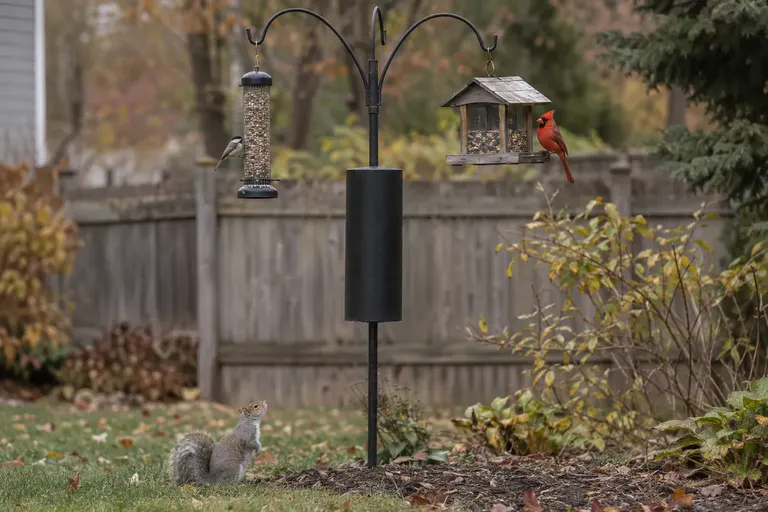
- Leave a gap from jump points. If squirrels are around, keep pole-mounted feeders well away from fences, roofs and branches. Our guide to where to put a bird feeder covers distances in detail.
- Add a baffle on poles. A cone or cylinder baffle under the feeder stops climbers. See our picks for bird feeder poles and baffles.
- Make nearby windows bird-safe. Use window markers or screens on glass near feeders. Our guide to stopping birds hitting windows explains what works.
What should you put in a cardinal feeder?
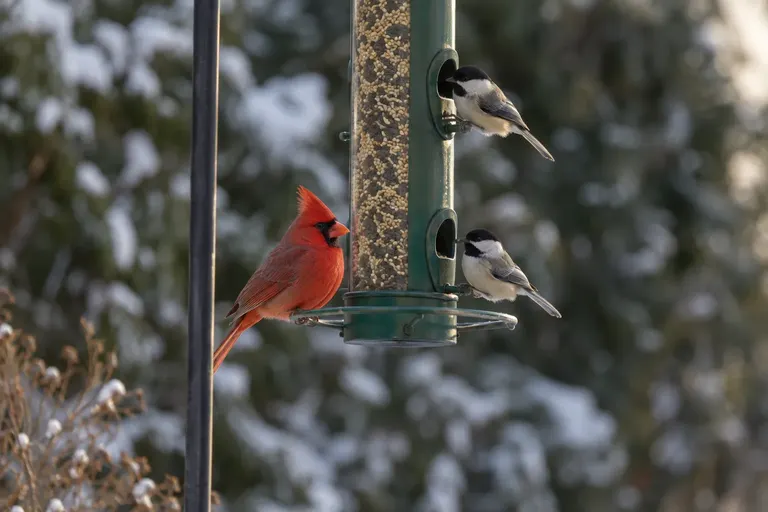
Cardinals eat mostly seeds and fruit, plus insects such as beetles, crickets, katydids and moths, especially when feeding young. At feeders, two foods stand out:
- Black oil sunflower. Project FeederWatch calls it the preferred food of a wide variety of feeder birds, including cardinals. It is thin-shelled and high in fat. Read more in our guide to black oil sunflower seed.
- Safflower. FeederWatch notes it attracts cardinals and other big-billed birds, though most birds prefer sunflower. Many feeders use safflower because squirrels, grackles and starlings tend to eat less of it. Our safflower seed guide covers the trade-offs.
Other options include hulled sunflower (less mess), peanut pieces and fruit such as chopped apple on a tray. Avoid bargain mixes heavy in milo and other fillers, which FeederWatch notes many birds leave behind. For product picks, see our list of the best bird seed for cardinals.
Hopper vs platform vs tube: which is best for cardinals?
Platform or tray feeders are the most cardinal-friendly style, because they mimic ground foraging. They also attract the widest range of birds, which is a strength and a weakness. They need the most cleaning.
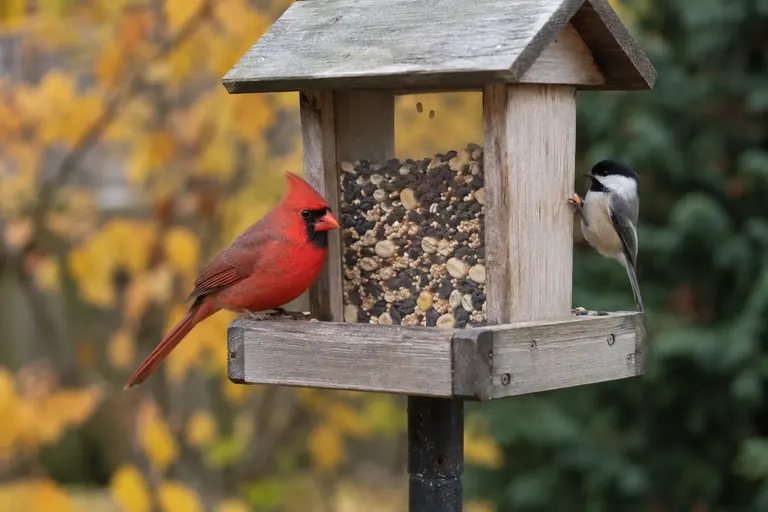
Hopper feeders are the best compromise. They keep seed drier under a roof, hold several days of food and, in weight-activated versions like the Absolute II, block squirrels. Choose one with a long ledge or perch bar, not tiny pegs.
Tube feeders are the least natural fit. Choose one only with a ring perch or tray attachment. If you can have two feeders, pair a tube for small birds with a tray for cardinals.
When do cardinals come to feeders?
Cardinals do not migrate. They stay on their territories year-round across the East, Midwest and South, and All About Birds notes they have expanded their range northward alongside suburban development. That makes them one of the few bright birds you can feed through the whole winter.
Feeder watchers often notice cardinals early and late in the day, in low light. Winter is usually the busiest season, when natural food is scarce. In spring and summer, pairs are nesting and visit less predictably, though they often bring fledglings along.
Common mistakes when feeding cardinals
- Using only a tube feeder with short perches. Cardinals may visit, but far less often.
- Placing the feeder in open lawn. No cover means a nervous bird that feeds briefly or not at all.
- Letting trays go moldy. Wet seed in an undrained tray spoils fast. Choose mesh floors and clean regularly. Our feeder cleaning guide has a simple routine.
- Buying cheap filler mixes. Milo and cracked grain attract house sparrows and blackbirds more than cardinals.
- Setting weight-activated perches too light. Two cardinals on the same side can trigger a shield set for small birds. Test the setting after installing.
- Giving up too soon. A new feeder can take days or a few weeks to be found. Scattering a little seed on the ground under the feeder can speed things up.
How do you keep squirrels and bully birds off a cardinal feeder?
Squirrels love the same sunflower seed cardinals do. Weight-activated feeders such as the Absolute II and Squirrel Buster Plus close when something heavy lands. A baffle on a pole placed away from jump points protects an open tray; our guide to keeping squirrels off bird feeders covers setups that work. Safflower is less popular with many squirrels, though some learn to eat it. For grackles and starlings, lower the dome on a domed feeder or switch to safflower.
Sources
- Northern Cardinal Life History, All About Birds (Cornell Lab of Ornithology)
- Northern Cardinal Identification, All About Birds
- Feeder Types, Project FeederWatch
- Food Types, Project FeederWatch
- How to Choose the Right Kind of Bird Feeder, All About Birds
- Squirrel Buster Plus, Brome Bird Care
- Droll Yankees X-1 Seed Saver, Perky-Pet
- Going Green Platform Feeder, Woodlink
Frequently asked questions
What type of feeder do cardinals prefer?
Cardinals prefer feeders that give them a wide, stable place to stand: platform trays, hopper feeders with long ledges, and ground trays. They are heavy-bodied birds that feed facing their food and do not cling well, so tube feeders with short perches often go unused by them. A tray about four to five feet off the ground near dense cover is the most reliable starting point.
What is the best food for cardinals?
Black oil sunflower seed and safflower are the two best choices. Cornell Lab's Project FeederWatch lists sunflower as the favorite food of many feeder birds, including cardinals, and notes that safflower attracts cardinals and other big-billed birds. Safflower has the added benefit that many squirrels, grackles and starlings eat less of it than sunflower.
Where should I place a cardinal feeder?
Place it within about 10 to 15 feet of dense shrubs, hedges or small evergreens, where cardinals can retreat quickly. Cardinals forage on or near the ground and nest in thick shrubs 1 to 15 feet high, so they are most comfortable when cover is close. Keep the feeder far enough from branches, fences and roofs that squirrels cannot jump onto it.
Why are cardinals not coming to my feeder?
The most common reasons are the wrong feeder style, no nearby cover, and poor food. A narrow tube with small perches, a feeder in an open lawn, or a cheap mix full of milo will all discourage cardinals. Switch to a tray or hopper, move it closer to shrubs, and offer sunflower or safflower. New feeders can take days to weeks to be found.
Do cardinals stay at feeders all winter?
Yes. Northern Cardinals do not migrate and hold territories year-round across the East, Midwest and South, and Cornell Lab notes their range has expanded northward alongside suburban development. Winter is often the busiest season at feeders because natural food is scarce. Keeping sunflower or safflower available through cold snaps, with dense cover nearby, gives you the best chance of regular visits.