How to Attract Northern Cardinals: Seed, Cover and Water
How to attract northern cardinals: offer sunflower or safflower on a sturdy platform or hopper, keep dense shrubs close, add water, and plant native berries.
In this article
- Northern Cardinal at a glance
- How to identify a Northern Cardinal
- Where do Northern Cardinals live?
- What do Northern Cardinals eat?
- What kind of feeder attracts cardinals?
- How long does it take to attract cardinals?
- Where to put a feeder for cardinals
- Water for cardinals
- Plants and habitat that attract cardinals
- Do cardinals use nest boxes?
- Why aren’t cardinals coming to my feeder?
- Cardinal behavior worth watching
- Seasonal calendar: cardinals through the year
- Common problems and fixes
- Common mistakes when trying to attract cardinals
- Sources
- Frequently asked questions
Here is how to attract Northern Cardinals: offer black oil sunflower or safflower seed on a sturdy platform or hopper feeder, place it within a short flight of dense shrubs, where they nest 1 to 15 feet up, and provide fresh water. Cardinals are year-round residents across most of their range, so a well-set-up yard can host them in every season.
Add native berry-producing shrubs and thick cover for nesting, and you give them a reason to stay rather than just visit.
Northern Cardinal at a glance
| Feature | Details |
|---|---|
| Size | 8.3 to 9.1 in long; 1.5 to 1.7 oz; wingspan 9.8 to 12.2 in (Cornell Lab) |
| Range | Eastern and central US, southeastern Canada, the desert Southwest, and south into Mexico |
| Season | Year-round resident; does not migrate |
| Diet | Mostly seeds and fruit, plus insects; nestlings fed mainly insects |
| Best feeder foods | Black oil sunflower, safflower, sunflower hearts |
| Best feeders | Platform, hopper with ledge, tube with tray |
| Nesting | Open cup in dense shrubs or small trees, about 1 to 15 ft up |
| Nest boxes | Not used |
| Conservation | Low concern; population increasing |
How to identify a Northern Cardinal
The Northern Cardinal is a medium songbird, slightly smaller than an American Robin, with a tall crest and a short, very thick bill built for cracking seeds. The Cornell Lab notes they often sit hunched over with the tail pointed straight down.
Male
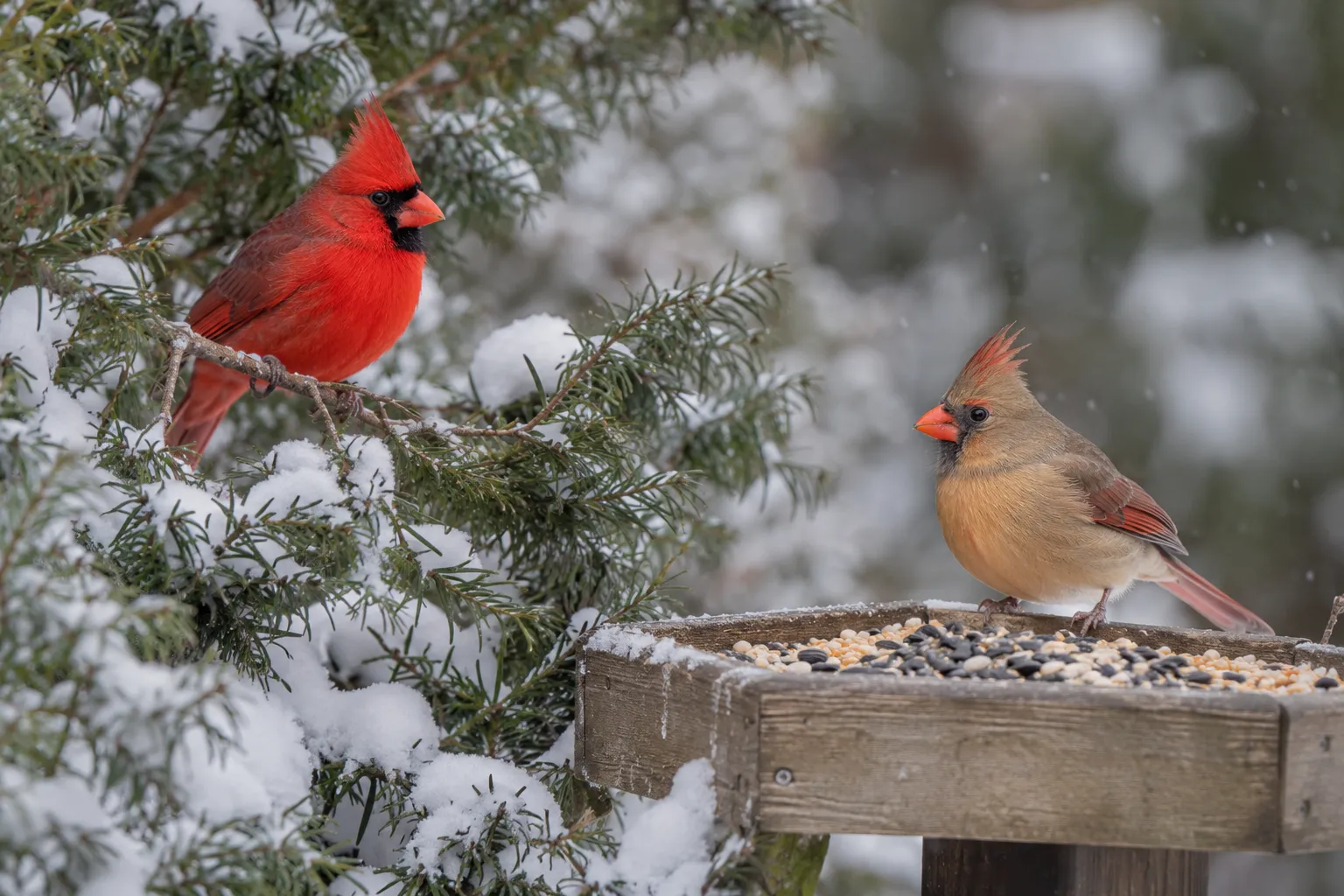
Males are brilliant red all over, with a black mask around a reddish bill. They keep this color year-round, which is why they stand out so vividly against snow.
Female
Females are pale brown overall with warm reddish tinges on the wings, tail and crest, and the same black mask around a red-orange bill. Many people mistake them for a different species at first.
Juvenile
Young cardinals look like females but have a grayish-black bill instead of a red-orange one. In summer you may see a brown, dark-billed cardinal following an adult and begging with fluttering wings.
Song
Both sexes sing. The song is a loud series of clear whistles, often written as “cheer, cheer, cheer” or “birdie, birdie, birdie.” The Cornell Lab notes that females often sing while sitting on the nest, and pairs sometimes sing together. The common call is a sharp, metallic “chip.” The free Merlin app from the Cornell Lab can help you confirm songs you hear.
Similar species
- Pyrrhuloxia: A close relative of the desert Southwest. Grayer overall, with red on the face, crest and chest, and a stubby yellowish bill.
- Summer Tanager: Males are all red but have no crest and a paler, longer bill.
- Scarlet Tanager: Males are red with black wings and tail, and no crest.
- Female cardinal vs. other brown birds: The crest and heavy orange bill separate her from sparrows and female finches.
Where do Northern Cardinals live?
Cardinals live across the eastern and central United States, southeastern Canada, parts of the desert Southwest, and south through Mexico. Audubon describes a long northward range expansion over the past century, and the Cornell Lab links that spread to the growth of towns and suburbs.
They prefer edges and thickets rather than deep forest. The Cornell Lab lists forest edges, overgrown fields, hedgerows, backyards, marshy thickets, mesquite, regrowing forest and ornamental landscaping. In practical terms, a yard with feeders, shrubs and a few trees is close to ideal cardinal habitat.
What do Northern Cardinals eat?
In the wild, cardinals eat mostly seeds and fruit, plus insects. The Cornell Lab lists dogwood, wild grape, buckwheat, grasses, sedges, mulberry, hackberry, blackberry, sumac and corn among their plant foods. Insects include beetles, crickets, katydids, leafhoppers, cicadas, caterpillars, spiders and more. Nestlings are fed mostly insects.
The male’s red plumage comes from carotenoid pigments in the food it eats, which is one reason a diet of varied seeds, fruit and insects matters.
Best foods for cardinals at feeders
| Food | How much cardinals like it | Notes |
|---|---|---|
| Black oil sunflower | Very high | The Cornell Lab names sunflower as their feeder favorite |
| Safflower | High | A cardinal favorite that many squirrels and blackbirds avoid |
| Sunflower hearts or chips | High | No shells to crack, no mess under the feeder |
| Striped sunflower | Moderate | Thicker shell; cardinals can crack it |
| Cracked corn | Moderate | Offer small amounts on platforms; keep dry |
| Peanut pieces | Moderate | Unsalted only |
| Fruit and berries | Occasional | Especially in winter |
| Nyjer, millet-heavy mixes | Low | Better for finches and sparrows |
Start with black oil sunflower. It draws cardinals along with most other feeder birds. Our guide to black oil sunflower seed explains why.
Switch to or add safflower if squirrels, grackles or starlings are a problem. The Cornell Lab describes safflower as a favorite among cardinals. Project FeederWatch cautions that most birds still prefer sunflower, so switch gradually. See our guide to safflower seed and our roundup of the best bird seed for cardinals.
Keep it plain. Avoid salted, flavored or coated seeds and nuts.
What kind of feeder attracts cardinals?
Cardinals are fairly large, stocky birds that feed facing forward. They prefer a stable, flat place to stand.
Platform and tray feeders
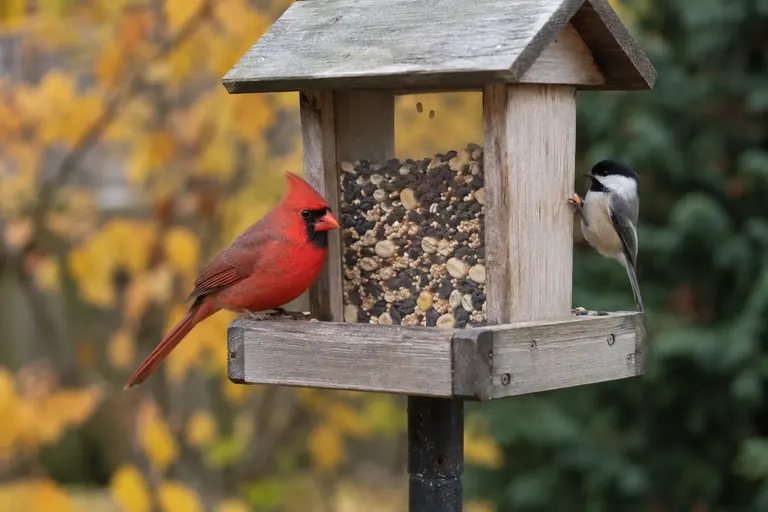
A platform feeder is the most cardinal-friendly option. It gives them room to land, turn and crack seeds. Choose one with a mesh or drainage bottom so seed stays dry, and clean it often.
Hopper feeders
Hopper feeders with a wide ledge on each side work well and protect seed from rain. Some weight-activated squirrel-resistant hoppers have perches or ledges suited to cardinals.
Tube feeders with trays or ring perches
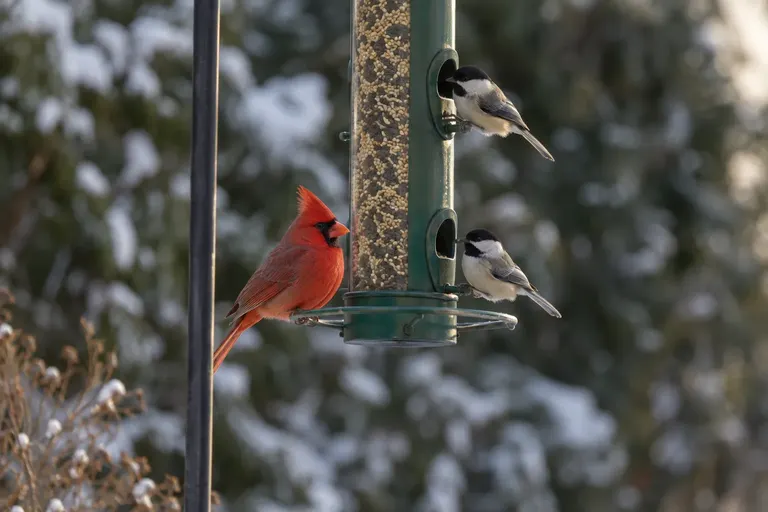
Standard tube feeders with short perches are awkward for cardinals. Adding a tray under the tube, or choosing a tube with a ring perch, makes it much more usable.
Ground feeding
Cardinals forage on the ground naturally, hopping through leaf litter. They will clean up seed under feeders. A low tray a foot or so off the ground, near cover, suits them well.
Our roundup of the best feeders to attract cardinals compares specific models.
How long does it take to attract cardinals?
There is no fixed timeline. In a neighborhood where cardinals are already common, a sunflower feeder near shrubs may get a visit within days. In a new development with few shrubs, it can take much longer, because the birds need cover before they will use the yard at all.
You can speed things up in three ways: put a little seed on a low tray as well as in the feeder, so it is easy to spot; place the feeder close to existing shrubs rather than in the open; and keep it filled consistently, since birds learn which yards are reliable.
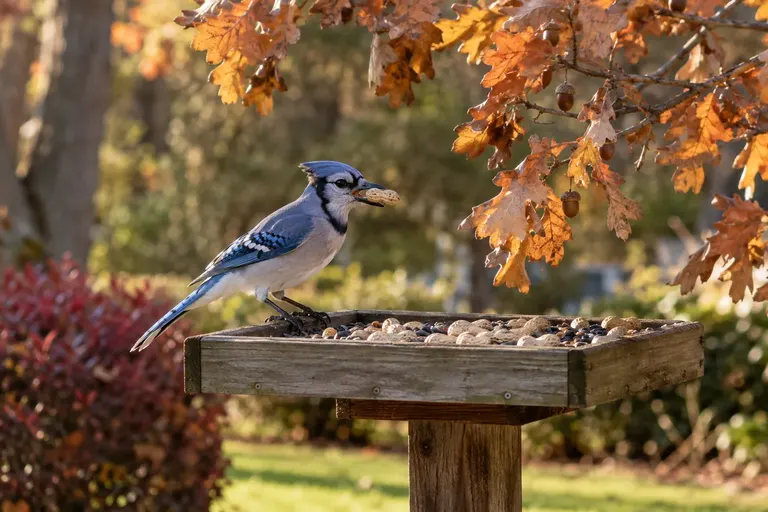
Where to put a feeder for cardinals
Cardinals are wary birds. They like to approach food from cover, pause, then fly in.
- Near dense shrubs: Place feeders within a short flight of thick shrubs, hedges or evergreens so cardinals can dash to safety. Keep the feeder far enough from dense cover that cats cannot ambush from it.
- Moderate height: Cardinals feed low. Feeders around eye level or lower, plus a low tray, suit them.
- Visible but sheltered: A spot out of strong wind, with morning sun, is ideal in winter.
- Away from reflections: Keep feeders away from large reflective windows, or treat the glass. See how to stop birds hitting windows.
Our guide on where to put a bird feeder covers distances from cover and windows in more depth.
Water for cardinals
Cardinals drink and bathe year-round. A birdbath can be as effective as a feeder at drawing them in.
- Keep it shallow: A gently sloping basin, no deeper than a couple of inches at the center, suits songbirds.
- Place it near cover: Within a short flight of shrubs, but not right next to a hiding spot for cats.
- Keep it clean: Scrub and refill every few days.
- Keep it open in winter: A heated birdbath or de-icer gives cardinals water when natural sources freeze.
Plants and habitat that attract cardinals
Feeders bring cardinals in. Shrubs and native plants make them stay and nest.
Dense cover
Cardinals rely on thickets. Hedges, shrub borders, brush piles, vine tangles and evergreens give them shelter from hawks, wind and snow. Leaving a corner of your yard a little wild helps.
Native plants by region
Choose plants native to your area. The Cornell Lab’s list of cardinal foods is a good starting point, and Audubon’s native plants database lets you search by ZIP code.
| Region | Native plants that feed or shelter cardinals |
|---|---|
| Northeast and Midwest | Gray and silky dogwood, American elderberry, serviceberry, staghorn and smooth sumac, wild grape, eastern red cedar, viburnums |
| Southeast | Flowering dogwood, American beautyberry, blackberry, hackberry, red mulberry, wax myrtle, eastern red cedar |
| Great Plains and Texas | Hackberry, fragrant sumac, rough-leaf dogwood, wild grape, native grasses for seed |
| Desert Southwest | Mesquite, desert hackberry, native grasses and shrubs in washes |
Leave seed heads standing. Native grasses, coneflowers and sunflowers left standing through fall and winter give cardinals natural seed.
Go easy on pesticides. Nestlings depend on insects. A yard with caterpillars and beetles supports more successful broods.
Do cardinals use nest boxes?
No. Cardinals build open cup nests, and they do not use enclosed birdhouses.
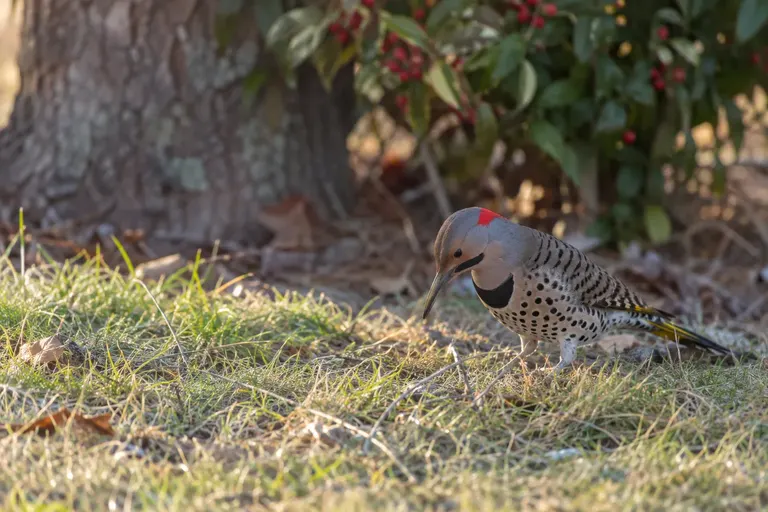
The Cornell Lab describes the nest as wedged into a fork of a shrub or sapling, 1 to 15 feet high and hidden in dense foliage. The female builds it from crushed twigs and lines it with grapevine bark, grasses and pine needles, taking 3 to 9 days.
Nesting facts
| Detail | Northern Cardinal |
|---|---|
| Clutch size | 2 to 5 eggs |
| Eggs | Grayish, buffy or greenish white, speckled gray to brown |
| Incubation | 11 to 13 days |
| Nestling period | 7 to 13 days |
| Broods per year | 1 to 2 (Cornell Lab); Audubon says 2 to 3, rarely 4 |
How to help cardinals nest
- Plant or keep dense shrubs and vine tangles.
- Avoid pruning thick shrubs in spring and early summer, when nests may be active.
- Keep cats indoors. Low nests are vulnerable.
- Leave natural nest materials: twigs, dry grasses and pine needles.
Why aren’t cardinals coming to my feeder?
If you have a feeder but no cardinals, one of these is usually the reason:
- The wrong food. Mixes heavy in millet, milo and corn attract sparrows, doves and blackbirds more than cardinals. Switch to sunflower or safflower.
- The wrong feeder. A narrow tube with short perches is hard for a cardinal to use. Add a tray or a platform.
- No cover nearby. Cardinals rarely cross wide open lawns to reach food. A feeder in the middle of the yard, far from shrubs, may be ignored.
- Bullies at the feeder. Flocks of grackles, starlings or squirrels can keep cardinals away. Safflower helps with all three.
- Timing. Cardinals often feed early and late. You may be missing them. Watch at dawn and in the last hour of daylight.
- Patience. A new feeder can take days to weeks to be discovered, and a new food can take a week or two to be accepted. Our guide to why birds are not coming to a new feeder walks through the rest.
- You are outside their range. Cardinals are scarce or absent in much of the Mountain West and Pacific Northwest. Check the range map on All About Birds.
Cardinal behavior worth watching
Once cardinals are regular visitors, their behavior is as interesting as their color.
Mate feeding. In late winter and spring, watch for a male picking up a seed, hopping to a female and passing it to her beak to beak. This courtship feeding is one of the classic signs that a pair is forming.
Crest signals. The Cornell Lab notes cardinals raise and lower their crest when agitated or at rest. A fully raised crest often goes with a sharp chip call and an alert posture.
Winter flocks. Pairs that hold territories in summer loosen up in fall and winter. The Cornell Lab describes flocks of a dozen to several dozen birds, so a winter yard can suddenly have many more cardinals than a summer one.
Short flights. Cardinals have short, rounded wings and tend to fly low and briefly from cover to cover. That is why shrubs near feeders matter so much.
Long lives for a songbird. The Cornell Lab records a wild female that lived to at least 15 years, 9 months, although most cardinals live far shorter lives.
Seasonal calendar: cardinals through the year
| Season | What cardinals are doing | What to offer |
|---|---|---|
| Winter | Flocks gather; heavy feeder use at dawn and dusk | Sunflower, safflower, water, dense cover |
| Late winter to early spring | Males start singing; pairs form and males feed females | Keep feeders full; add shrubs |
| Spring and summer | Nesting; possible multiple broods; window fighting | Insects in the yard, shallow water, dense shrubs |
| Late summer | Molt; young birds with dark bills follow adults | Continue seed, add fruit |
| Fall | Pairs loosen; flocks start to form | Native berries, seed heads, refilled feeders |
Common problems and fixes
A cardinal attacking your window or car mirror
Cardinals defend territories fiercely in spring and summer, and the Cornell Lab notes both males and females attack their reflections, sometimes for hours. It is not a sign the bird is sick. Break up the reflection on the outside of the glass with screens, window film, or closely spaced markers, and cover car mirrors with a bag when parked.
Squirrels and blackbirds taking the food
Switch to safflower, or combine a baffle with a weight-activated feeder. Our guide to bird food squirrels won’t eat covers the food side.
Cardinals visit but do not stay
Add cover. A yard with feeders but no shrubs is a stop, not a home.
Cowbirds
Brown-headed Cowbirds lay eggs in other birds’ nests, and cardinals are among their frequent hosts. There is little a homeowner can do directly, but dense, well-hidden nest sites may help.
Hawks
A cardinal flock at a feeder can draw Cooper’s and Sharp-shinned Hawks. Keep cover close to feeders so birds can escape. If a hawk starts visiting daily, taking feeders down for a week or two usually moves it on.
Common mistakes when trying to attract cardinals
- Relying only on a hanging tube feeder. Cardinals want room to stand.
- Cleaning up every shrub and tangle. Tidy yards offer little cover or nest sites.
- Letting seed go moldy on platforms. Trays collect rain. Offer small amounts and clean them often.
- Putting up a nest box for cardinals. They will not use it; plant shrubs instead.
- Stopping feeding in summer. Cardinals stay all year and bring fledglings to feeders.
- Pruning hedges in nesting season. Wait until late summer or fall.
Sources
- Cornell Lab of Ornithology, All About Birds: Northern Cardinal Overview
- Cornell Lab of Ornithology, All About Birds: Northern Cardinal Identification
- Cornell Lab of Ornithology, All About Birds: Northern Cardinal Life History
- Audubon Guide to North American Birds: Northern Cardinal
- Cornell Lab of Ornithology, All About Birds: A Quick Guide to Seed Types
- Project FeederWatch: Food Types
- Audubon: Native Plants Database
Frequently asked questions
What is the best food to attract cardinals?
Black oil sunflower seed and safflower are the two best foods. The Cornell Lab of Ornithology names sunflower as the cardinal's feeder favorite and describes safflower as a favorite too, with the bonus that many squirrels and blackbirds avoid it. Sunflower hearts, cracked corn, peanut pieces and fruit also draw cardinals, especially on a platform feeder.
What kind of feeder do cardinals like?
Cardinals prefer to feed on a stable, flat surface. Platform feeders, hopper feeders with a wide ledge, and tube feeders fitted with a tray or ring perch all work well. Short perches on narrow tube feeders suit them poorly because of their size and forward-facing posture. Many also feed on the ground below feeders.
Do cardinals use birdhouses?
No. Northern Cardinals build open cup nests in dense shrubs, vines and small trees, usually 1 to 15 feet off the ground according to the Cornell Lab. They do not use enclosed nest boxes. To give them nest sites, plant or keep thick shrubs, tangles and evergreens, and avoid heavy pruning in spring.
Do cardinals stay all winter?
Yes. Northern Cardinals are year-round residents across their range and do not migrate. In fall and winter they often gather in flocks of a dozen to several dozen birds, according to the Cornell Lab, and visit feeders heavily, especially early in the morning and late in the day.
Why does a cardinal keep attacking my window?
It is fighting its own reflection. In spring and summer, male and female cardinals defend territories and treat the reflection as a rival, sometimes for hours. The Cornell Lab lists this as common behavior. Breaking up the reflection on the outside of the glass with screens, film or closely spaced markers usually stops it.
What time of day do cardinals come to feeders?
Cardinals are often among the first birds at feeders in the morning and among the last at dusk. Many backyard watchers see the most cardinal activity around dawn and in the hour or two before dark. Keep feeders filled before evening so food is there when they arrive.