How Do Birds Stay Warm in Winter?
How do birds stay warm in winter? Fluffed feathers, daily fat, shivering muscles, cold-proof legs, shared roosts and controlled overnight cooling, explained.
In this article
- Quick answer: the main ways birds keep warm
- Why is winter so hard for small birds?
- How do feathers keep birds warm?
- How do birds make their own heat?
- Why don’t birds’ feet freeze?
- Do birds lower their body temperature at night?
- Where do birds sleep in winter to stay warm?
- Do birds huddle together for warmth?
- How do birds find enough food in winter?
- Does sunshine help birds stay warm?
- Myths vs facts about birds in winter
- What does this mean for backyard birders?
- Common mistakes when trying to help birds in winter
- Quick facts
- Sources
- Frequently asked questions
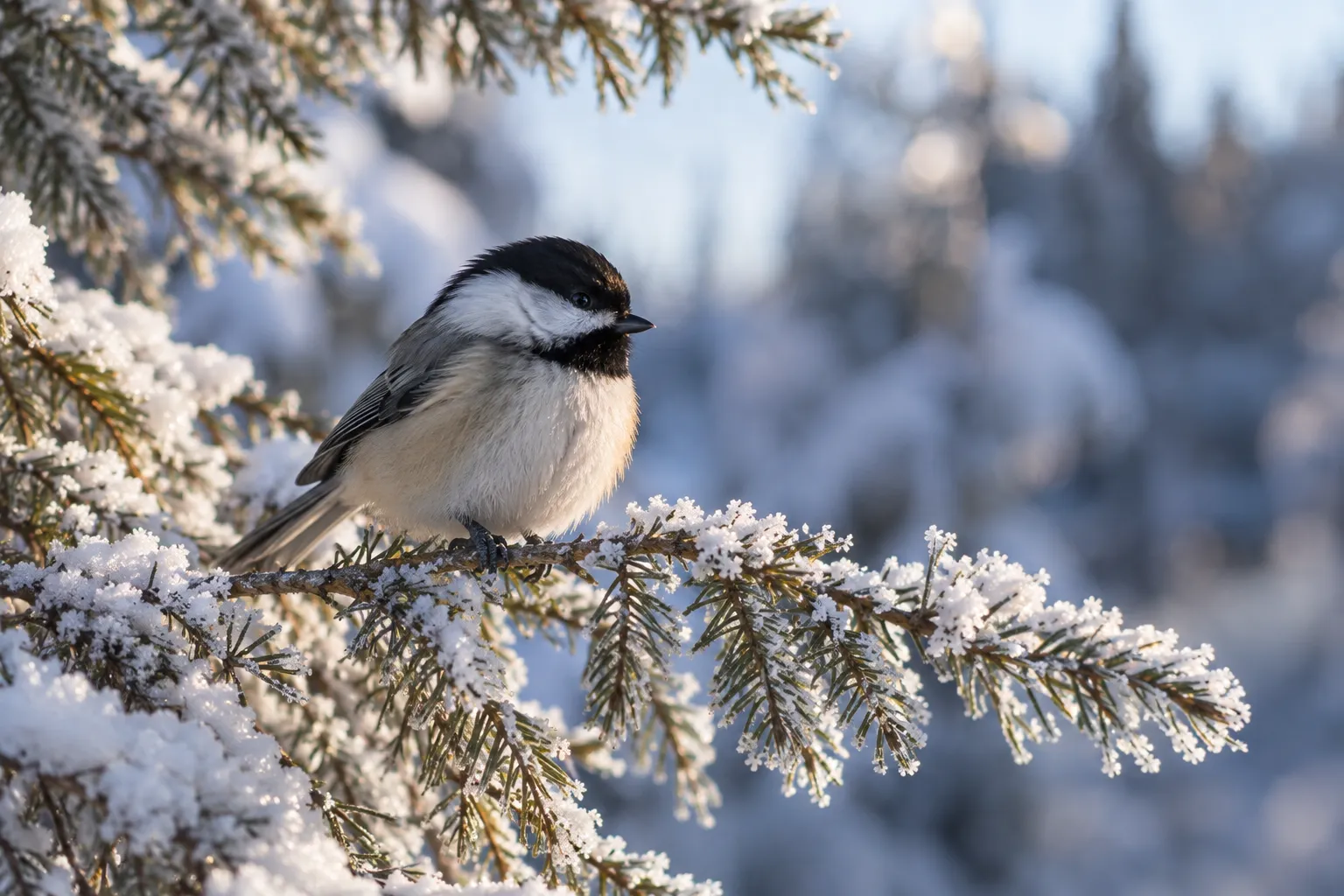
Birds stay warm in winter by combining good insulation with a fast-burning engine. Fluffed feathers trap a thick layer of still air, daily fat reserves (in chickadees, often around 10 percent of body weight by evening) fuel shivering muscles through long nights, cold-tolerant legs limit heat loss, and sheltered or shared roosts cut wind and cold. Some species go further and let their body temperature drop overnight to save energy.
That is how a chickadee weighing less than half an ounce can live through nights well below 0°F. This guide explains each strategy, shows how birds around the world use them, separates myth from science, and ends with what it all means for your yard.
Quick answer: the main ways birds keep warm
| Strategy | How it works | Classic examples |
|---|---|---|
| Insulating feathers | Fluffed contour and down feathers trap warm air next to the skin | Chickadees, goldfinches, redpolls |
| Fat reserves | Fat stored by day is burned overnight | Most small songbirds |
| Shivering | Flight muscles contract to make heat without movement | All small songbirds in cold weather |
| Heat-saving legs | Countercurrent blood flow keeps feet cool and heat in the body | Ducks, gulls, geese |
| Controlled cooling | Body temperature is lowered at night to save fuel | Chickadees, hummingbirds, nightjars |
| Sheltered roosts | Cavities, dense conifers, snow burrows | Bluebirds, grouse, ptarmigan |
| Huddling | Several birds share body heat | Long-tailed Tits, wrens, Emperor Penguins |
| Behavior | Tucking the bill, standing on one leg, basking in sun | Many species |
Why is winter so hard for small birds?
The core problem is physics. Birds are warm-blooded, and most songbirds keep a daytime body temperature around 104°F (40°C), higher than ours. The colder the air, the faster that heat leaks away, and small bodies leak heat fastest because they have a lot of surface area relative to their volume. A chickadee or a kinglet loses heat far faster, per ounce of body, than a crow or a goose.
Winter also stacks the odds in other ways. Days are short, so there are fewer hours to find food. Nights are long, so the fasting period is longer. Snow and ice can bury seeds and lock insects inside bark. A small bird in a northern winter may need to spend most of the daylight hours feeding just to break even.
The result is a daily cycle. Birds eat hard all day, build a fat reserve by late afternoon, then spend the night burning it. If the reserve runs out before dawn, the bird is in trouble. Almost every winter adaptation below is about either earning more energy or spending less of it.
How do feathers keep birds warm?
Feathers are among the best natural insulators known. A bird’s body is covered by overlapping contour feathers on the outside, with soft, fluffy down and semiplume feathers underneath. The loose, branching structure of down traps pockets of air, and still air is a poor conductor of heat. A down jacket works the same way.
What does fluffing up do?
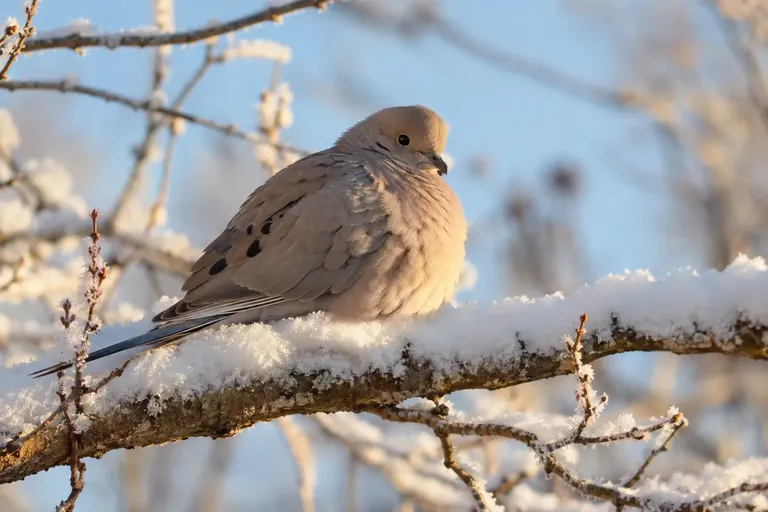
Birds can raise their feathers using tiny muscles attached to the feather follicles in the skin. When a bird fluffs up, the layer of trapped air gets thicker and the insulation improves. That is why a House Sparrow or a Northern Cardinal looks noticeably rounder on a frigid morning than it does in June. The bird has not gained weight overnight; it has simply thickened its coat. For more on this behavior and its other meanings, see our guide to why birds puff up.
Do birds grow more feathers for winter?
Many do. Most songbirds replace their feathers in a molt after the breeding season, so they enter winter with a fresh, undamaged set. Studies of several northern species have found that winter plumage can be denser or heavier than summer plumage, and American Goldfinches are often cited as an example of a bird that carries noticeably more feather insulation in winter. The exact increase varies by species and study, but the pattern is well established.
Why does feather care matter so much in cold weather?
Insulation only works if the feathers are clean and aligned. Birds spend a lot of time preening, spreading oil from the uropygial gland near the base of the tail and zipping the tiny barbs of each feather back together. A matted or oily feather lets cold in. This is why birds keep bathing in winter when they can find open water, and why a heated birdbath can be one of the busiest spots in a frozen yard. Our guide to keeping a bird bath ice-free in winter explains the safe ways to do it.
Waterbirds take this further. Ducks, loons and seabirds have extremely dense, well-oiled plumage that stays dry against the skin even while they float in icy water.
How do birds make their own heat?
Insulation slows heat loss, but it does not create heat. For that, birds rely on their metabolism, and above all on their muscles.
Do birds shiver?
Yes, and shivering is their main source of extra heat in the cold. The big flight muscles of the breast make up a large share of a songbird’s body weight. When a bird shivers, these muscles contract in opposing directions so they produce heat without flapping the wings. Birds can keep this up for many hours, which is why a small bird on a winter perch may look still but be working hard.
Unlike many mammals, most birds do not appear to rely on brown fat, a specialized tissue that mammals use to generate heat without shivering. Researchers are still investigating other ways birds might produce heat in their muscles, so it is fair to say shivering is the best-documented mechanism.
How much fat do birds store each day?
Winter songbirds build up fat during the day and burn it at night. Small species such as chickadees and titmice are often reported to gain something on the order of 10 percent of their body weight by evening, then lose most of it overnight. The exact figure varies with species, temperature and food supply, but the daily cycle of fattening and burning is one of the best-studied patterns in winter bird biology.
Carrying fat has costs, though. A heavier bird flies less nimbly and may be easier for a hawk to catch. So birds seem to balance the risk of starving overnight against the risk of being caught by day, and some studies suggest birds carry less fat when food is reliable and more when it is unpredictable.
Do birds raise their metabolism in winter?
Many resident birds in cold regions appear to adjust their bodies seasonally, increasing their capacity to produce heat as winter sets in. Researchers call this winter acclimatization. It can involve changes in muscle size and in the cell machinery that burns fuel. The details vary between species, but the overall picture is that a chickadee in January is physiologically tuned for cold in a way that the same bird in July is not.
Why don’t birds’ feet freeze?
This is one of the most common winter questions, and the answer is elegant. Bird legs are mostly bone, tendon and scaly skin, with very little muscle, so they need relatively little blood and have little tissue to damage.
More importantly, many birds have a countercurrent heat exchange system in their legs. The arteries carrying warm blood down to the feet run right alongside the veins bringing cold blood back up. Heat passes from the outgoing blood to the returning blood, so it is recycled into the body instead of being lost through the feet. In some species these vessels form a dense network near the top of the leg.
The result is that the feet run cold, sometimes close to freezing, while the body stays warm. A gull standing on ice or a duck paddling in near-freezing water loses much less heat than you would expect. Birds can also adjust blood flow to the feet, sending a little extra warm blood when needed to prevent tissue damage.
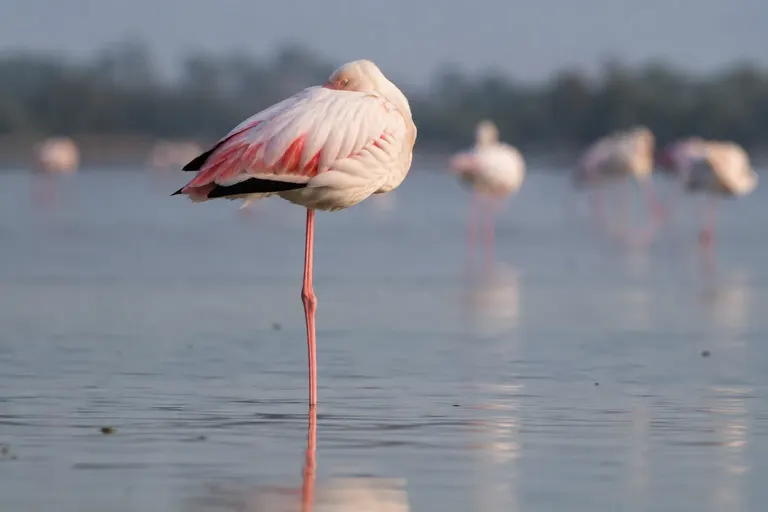
Birds reduce leg heat loss further through posture. They stand on one leg with the other tucked into the belly feathers, or crouch down so their feathers cover both feet. See do birds get frostbite for the cases where this system does fail.
Do birds lower their body temperature at night?
Yes, and this is one of the most remarkable winter strategies. Some birds allow their body temperature to fall in a controlled way overnight, which slows their metabolism and stretches their fat reserves further. Biologists call the milder version regulated or nocturnal hypothermia, and the deeper version torpor.
Chickadees and tits
Black-capped Chickadees are the classic example. Research dating back to the 1970s showed they can drop their body temperature by several degrees on cold nights, with some studies reporting falls of around 10°C (about 18°F) below their normal daytime level. Even a modest drop cuts the energy needed to stay warm, which can make the difference between surviving the night and running out of fat. Related tits in Europe and Asia, such as the Great Tit and Willow Tit, have also been studied using similar approaches.
Hummingbirds and torpor
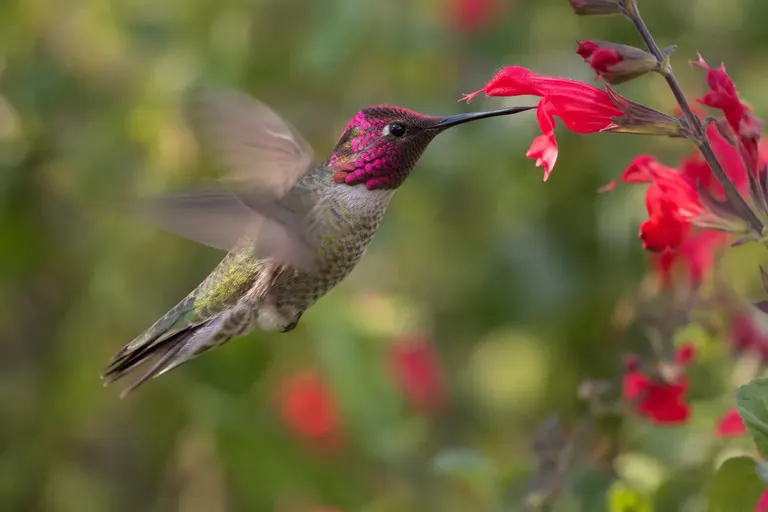
Hummingbirds take it much further. At night they can enter torpor, a deep, sleep-like state in which body temperature and heart rate plunge. A 2020 study of hummingbirds in the high Andes of Peru recorded one species, the Black Metaltail, letting its body temperature fall to about 3.3°C (around 38°F), the lowest recorded for any bird at the time. Torpor lets these tiny birds survive cold mountain nights on very little fuel. We cover this in detail in do hummingbirds sleep.
The bird that hibernates
The Common Poorwill, a nightjar of western North America, is the one bird known to enter torpor for days or even weeks at a time in winter, which is the closest any bird comes to true hibernation. Its native name among the Hopi is often translated as “the sleeping one”, a reminder that people noticed the behavior long before scientists did.
Where do birds sleep in winter to stay warm?
Choosing where to spend the night can matter as much as body chemistry. A good roost blocks wind, holds a little warmth and keeps the bird hidden from predators.
- Tree cavities and nest boxes. Woodpeckers, chickadees, titmice, nuthatches and bluebirds often roost in holes. A cavity can stay several degrees warmer than the open air and cuts wind completely.
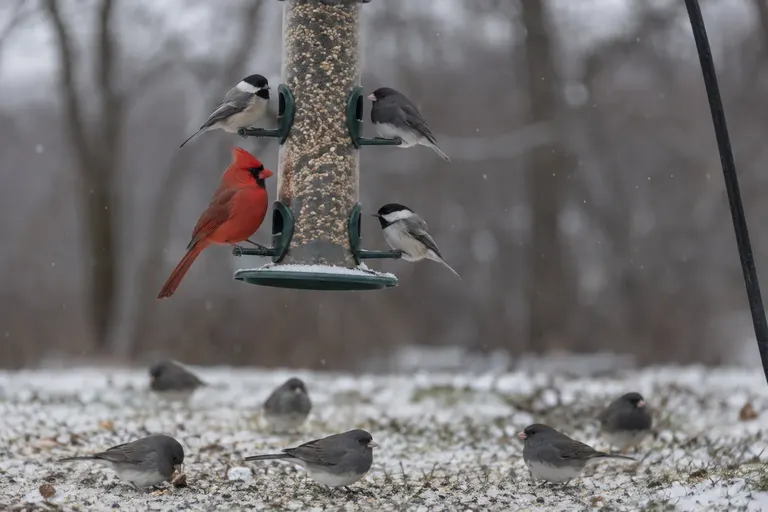
- Dense evergreens. Many birds that do not use cavities, such as cardinals, juncos and sparrows, roost deep inside spruces, pines, cedars, hollies or thick hedges.
- Snow burrows. Ruffed Grouse, ptarmigan and some other northern grouse burrow into soft snow and spend the night in a snow chamber. Snow is an excellent insulator, so the air inside stays far milder than the air outside.
- Buildings and crevices. House Sparrows, starlings and pigeons use gaps in roofs, eaves and walls.
Most birds do not sleep in nests outside the breeding season, but a good nest box can double as a winter roost.
Do birds huddle together for warmth?
Many do, and the savings can be significant because each bird loses less heat from the sides that touch its neighbors.
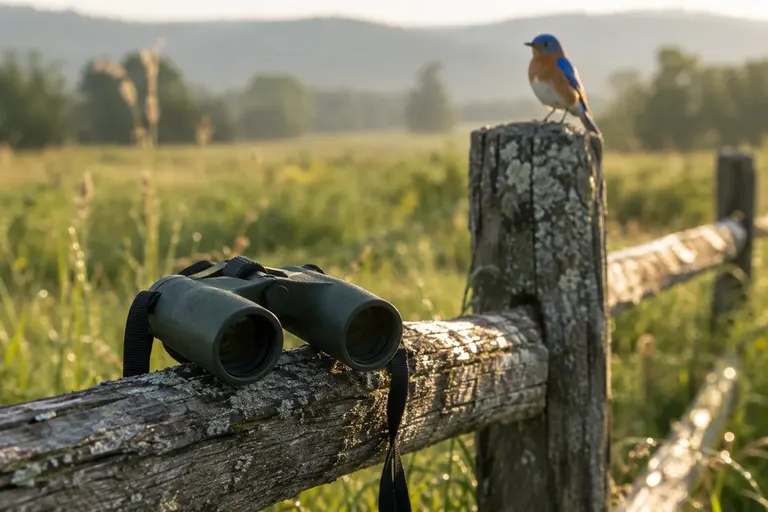
- Eastern Bluebirds sometimes pack into a single nest box on bitter nights, and observers have reported groups of a dozen or more.
- Pygmy Nuthatches in western pine forests are known for communal roosts, with reports of dozens of birds sharing a single cavity.
- Long-tailed Tits in Europe and Asia roost in tight rows along a branch, pressed side by side.
- Eurasian Wrens (the Winter Wren of the Old World) sometimes cram into nest boxes or holes in large numbers in hard winters. British records of several dozen wrens in a single box are often cited.
- Emperor Penguins are the most famous huddlers. Breeding males incubating eggs through the Antarctic winter form dense, slowly shifting huddles, taking turns on the cold outer edge.
How do birds find enough food in winter?
Staying warm depends on fuel, and winter birds have several strategies to secure it.
Food caching
Chickadees, titmice, nuthatches, jays and crows hide food in autumn and winter and retrieve it later. Chickadees can store many thousands of items in a season, tucking seeds into bark and lichen, and they remember a remarkable number of locations. Food-storing species tend to have a larger hippocampus, the part of the brain involved in spatial memory, than related birds that do not store food. Read more in why birds hoard food.
Storing food inside the body
Common and Hoary Redpolls, small finches of the far north, have an expandable pouch in the esophagus that can hold extra seeds. They can fill it before dark and digest the seeds through the night, like a bedtime snack. Crossbills and some other finches store seeds in a similar way.
Flocking
Mixed winter flocks of chickadees, titmice, nuthatches, kinglets and woodpeckers roam together. More eyes find food and spot predators, which lets each bird spend more time feeding.
Leaving
Of course, many birds solve the winter problem by migrating to places where food stays available. The strategies above belong mostly to residents and short-distance migrants that stay in cold regions.
Does sunshine help birds stay warm?
Yes. On cold, clear mornings, birds often perch in the sun with their backs to the rays and feathers slightly raised, absorbing free heat. Darker feathers and skin absorb more sunlight. The Greater Roadrunner of the American Southwest is a well-known example: on cold mornings it raises the feathers on its back to expose patches of dark skin to the sun. Our guide to why birds sunbathe covers the other reasons birds bask.
Myths vs facts about birds in winter
Myth: Birds’ feet freeze to metal perches. Birds’ feet are dry and usually cool, so they do not normally stick to metal the way a wet tongue would. There is no good evidence that metal feeders are dangerous in winter.
Myth: Fluffed-up birds are always sick. Most fluffed birds on a cold day are simply insulating themselves. A bird that stays fluffed, sluggish and approachable for long periods in mild weather, especially with crusty eyes, may be ill. See sick birds at the feeder.
Myth: If you start feeding, you must never stop. Research on wild birds suggests feeders supply only part of their diet and that birds use many food sources. Still, it helps to keep feeders filled during severe cold spells and storms if you have been feeding all winter.
Myth: Birds get cold feet the way we do. A bird’s feet may be near freezing and still work normally, because the tissues are adapted to it. What feels cold to us is not necessarily harmful to them.
What does this mean for backyard birders?
Knowing how birds stay warm points straight to the most helpful things you can do.
- Offer high-fat food late in the day. Birds are building their overnight reserve in the afternoon. Suet, black oil sunflower seed and unsalted peanuts are dense fuel. Our guide to winter bird feeding goes into detail.
- Keep water open. Clean feathers insulate better, and birds still need to drink. A birdbath heater is safer than any additive; never use antifreeze.
- Provide dense shelter. Evergreen trees and shrubs, hedges and a brush pile give birds wind-free roosts close to food.
- Leave nest boxes up. Cleaned boxes become winter roosts for cavity birds.
- Grow winter food. Berry shrubs and standing seed heads give birds natural fuel.
- Feed before storms. Birds often feed heavily before bad weather. Fill feeders ahead of a forecast cold snap.
Common mistakes when trying to help birds in winter
- Putting out bread or kitchen fat. Bread has little nutritional value, and cooking fat can smear feathers and ruin their insulation.
- Adding heat lamps or heaters to nest boxes. These can overheat birds or become fire hazards. A well-built, draft-free box is enough.
- Stuffing nest boxes with loose cotton or fibers. These can tangle feet. Birds bring their own roost material if they want it.
- Using glycerin or antifreeze in water. Both can harm birds; use a heater designed for birdbaths instead.
- Letting feeders get dirty. Crowded winter feeders can spread disease.
Quick facts
- Most songbirds keep a body temperature around 104°F (40°C).
- Small birds lose heat faster than large birds because of their high surface-to-volume ratio.
- Shivering flight muscles are the main source of extra heat.
- Countercurrent blood flow keeps bird feet cold and bodies warm.
- Chickadees can lower their body temperature several degrees on cold nights.
- A Black Metaltail hummingbird in the Andes was recorded at about 3.3°C (38°F) in torpor.
- The Common Poorwill can stay torpid for days or weeks.
- Grouse and ptarmigan sleep in snow burrows.
- Redpolls store seeds in an esophageal pouch for the night.
Sources
- Black-capped Chickadee life history, Cornell Lab of Ornithology, All About Birds
- Common Redpoll overview, Cornell Lab of Ornithology, All About Birds
- Common Poorwill overview, Cornell Lab of Ornithology, All About Birds
- Project FeederWatch, Cornell Lab and Birds Canada
- National Audubon Society
- British Trust for Ornithology
Frequently asked questions
How do small birds survive freezing nights?
Small birds survive freezing nights by fluffing their feathers into thick insulation, burning fat stored during the day, shivering to make heat, and roosting in sheltered spots such as tree cavities, nest boxes or dense evergreens. Some species, such as chickadees, also let their body temperature drop several degrees overnight, which reduces the amount of fat they burn before dawn.
Why don't birds' feet freeze in winter?
Birds' legs and feet contain little muscle and are mostly tendon, bone and scaly skin, so they need little blood. Arteries carrying warm blood to the feet run close to veins bringing cold blood back, so heat passes to the returning blood before it reaches the feet. The feet run cold, close to freezing in some species, which limits heat loss without damaging tissue.
Do birds get cold at night?
Winter nights are the hardest part of a small bird's day. It cannot feed for 14 hours or more in northern winters and must live on fat stored the previous afternoon. Birds reduce heat loss by roosting in sheltered places, fluffing up and tucking their bills into their back feathers, and some lower their body temperature in a controlled way to save energy.
Should I put out food to help birds stay warm?
Feeding is not essential for most healthy wild birds, but high-fat foods such as suet, black oil sunflower seed and unsalted peanuts can help small birds rebuild fat reserves quickly, especially before and after cold snaps and snowstorms. Open water and dense evergreen shelter near feeders are equally valuable in a frozen yard.
Do birds use nest boxes in winter?
Yes. Cavity-roosting birds such as bluebirds, chickadees, titmice, nuthatches and, in Europe, tits and wrens often shelter in nest boxes on cold nights. Several birds may pack into one box to share body heat. Leaving boxes up through winter, cleaned out after the breeding season, gives these birds extra roost sites.