Hawks at Bird Feeders: How to Stop Them, Safely and Legally
Hawks at bird feeders? The fix the Cornell Lab recommends is simple: take feeders down for one to two weeks, add dense cover nearby and never harm the hawk.
In this article
- Quick answer: what to do when a hawk hunts at your feeder
- Which hawks hunt at bird feeders?
- Why do hawks hunt at bird feeders?
- Step 1: Take your feeders down for one to two weeks
- Step 2: Give small birds dense cover to escape into
- Step 3: Rethink ground and tray feeding
- Step 4: Treat nearby windows so fleeing birds don’t crash
- Step 5: Keep the rest of the setup healthy
- What doesn’t work (and what’s illegal)
- When are hawks most likely at feeders?
- How to tell if a hawk took a bird
- Should you do anything at all?
- Common mistakes
- What to do if you find an injured hawk or songbird
- A setup that makes hawk visits less of a problem
- Sources
- Frequently asked questions
The most effective fix for hawks at bird feeders is also the simplest: take your feeders down for 1 to 2 weeks. That is the Cornell Lab of Ornithology’s recommendation. Small birds disperse, the hawk loses its easy hunting spot and moves on, and your songbirds come back when the feeders return. After that, rebuild the setup so small birds have dense cover within a short dash of the feeder.
What you should never do is harm, trap or harass the hawk. Every native hawk is federally protected, and a hawk taking a songbird is ordinary predation, not a sign that something is wrong with your yard.
Quick answer: what to do when a hawk hunts at your feeder
| Situation | What to do | Why it works |
|---|---|---|
| Hawk visited once or twice | Nothing. Enjoy the sighting | Occasional visits are normal and short-lived |
| Hawk returns daily or perches nearby | Take feeders down for 1 to 2 weeks | Birds disperse, hawk hunts elsewhere |
| Birds have nowhere to hide | Add dense shrubs or a brush pile within a short flight of feeders | Gives prey a place to escape |
| Feeders sit in open lawn | Move them closer to cover, but not inside it | Open lawn exposes birds on approach |
| Birds flee into windows when hawk strikes | Treat windows with closely spaced markers | Panicked birds hit reflective glass |
| Ground feeding draws doves and sparrows | Reduce or pause ground and tray feeding | Ground feeders are the easiest targets |
| Hawk is injured or stuck | Call a licensed wildlife rehabilitator | Handling raptors takes training and permits |
Which hawks hunt at bird feeders?
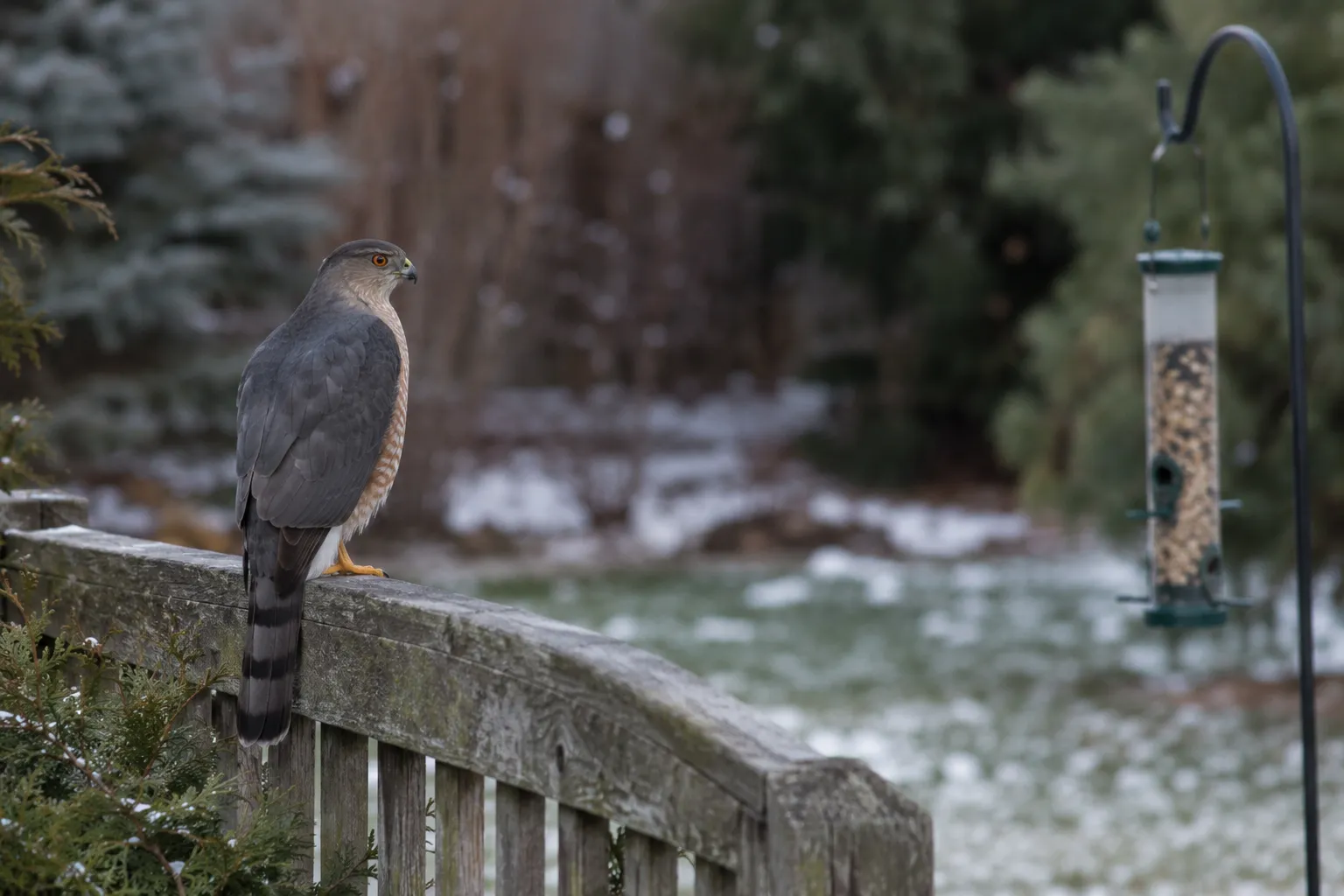
Most backyard hawk problems involve two species in the genus Accipiter: the Cooper’s Hawk and the Sharp-shinned Hawk. Both are built for chasing birds through cover. They have short, rounded wings and long tails that let them turn hard in tight spaces. The Cornell Lab describes Cooper’s Hawks as among the most skillful fliers in the bird world, tearing through cluttered tree canopies in high-speed pursuit of other birds.
Other raptors occasionally show up. Merlins, small and fast falcons, sometimes hunt around feeders in winter, especially in the northern states and in towns where they nest. Red-tailed Hawks, the big hawk you see on highway light poles, mainly hunt rodents and rarely chase songbirds at feeders, even if one perches nearby.
Cooper’s Hawk
The Cooper’s Hawk is the hawk most feeder watchers meet. It is roughly crow-sized, with females noticeably larger than males. Adults have a slate-gray back, a chest barred in rusty orange, and a long tail with a rounded tip. The Cornell Lab notes that Cooper’s Hawks in towns and suburbs often favor Rock Pigeons and Mourning Doves, which makes a yard with doves feeding on the ground a natural target. They catch prey with their feet, and in open flight they often show a distinctive flap-flap-glide rhythm.
Sharp-shinned Hawk
The Sharp-shinned Hawk is the smallest hawk in the United States and Canada, according to the Cornell Lab, with females about a third bigger than males. It targets songbirds and small mammals. Sharp-shins breed deep in forest cover, so most people see them during fall migration and in winter, when they turn up in suburbs with some tree cover and plenty of small birds.
How to tell Cooper’s from Sharp-shinned
Even experienced birders find this pair tricky, and the Cornell Lab calls it a famously difficult identification. A few clues help:
- Tail tip. Cooper’s tends to show a rounded tail tip with a broader white band. Sharp-shinned tends to look square or notched at the tip.
- Head size. Cooper’s looks larger-headed, and the head projects well ahead of the wings in flight. Sharp-shinned looks small-headed, with the head barely sticking out.
- Size. A female Sharp-shinned can overlap a male Cooper’s, so size alone is unreliable.
- Behavior. Both species ambush from cover. That habit tells you it is an accipiter, not which one.
For backyard purposes, the difference barely matters. The same fixes work for both. If you want to learn the identification anyway, our guide on how to identify birds covers the shape and behavior clues that matter most with raptors.
Why do hawks hunt at bird feeders?
Feeders concentrate small birds in one place at predictable times. For a bird-eating hawk, that is like a restaurant with a posted schedule. The Cornell Lab’s summary is blunt: hawks that feed on birds take the term bird feeder at face value.
It helps to keep this in perspective. According to the Cornell Lab’s Sharp-shinned Hawk account, research suggests feeders do not greatly increase an individual songbird’s chance of being taken by a Sharp-shinned Hawk, because the hawks get the great majority of their diet elsewhere. A hawk at your feeder is part of the local food web that your feeder has joined. It is not a crisis for the bird population.
That said, you control how easy the setup makes hunting. A feeder in open lawn with no escape cover, next to reflective windows, with doves feeding on bare ground beneath it, favors the hawk. The steps below tilt things back toward the songbirds.
Step 1: Take your feeders down for one to two weeks
This is the core fix, and it works because of how both hawks and songbirds use food.
- Remove every feeder in the yard, including tray feeders and any seed you scatter on the ground. A single feeder left up keeps birds gathering.
- Rake up spilled seed and hulls under the feeding area so ground-feeding birds do not keep visiting.
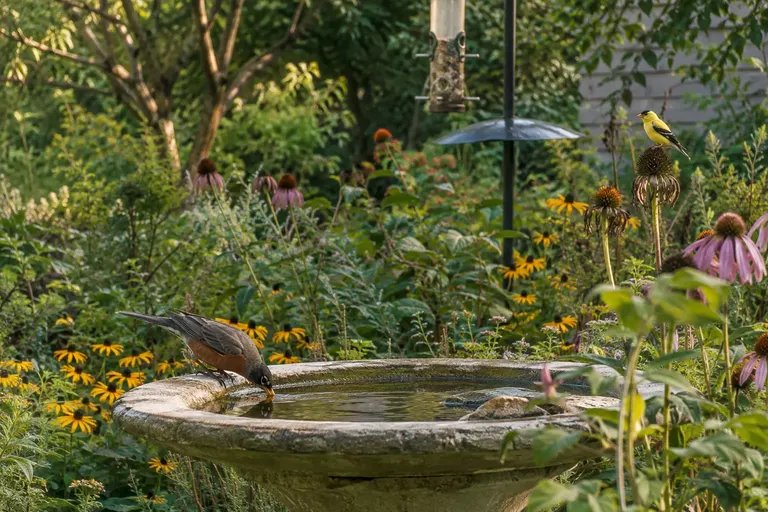
- Leave water available if you like. A bird bath does not concentrate birds the way seed does, but if the hawk is ambushing at the bath, pause that too.
- Wait one to two weeks. The Cornell Lab recommends this window. Small birds spread out to natural food sources, and the hawk shifts to other hunting areas.
- Put feeders back up, ideally in a better spot. Use the pause to move feeders nearer to cover, as described below.
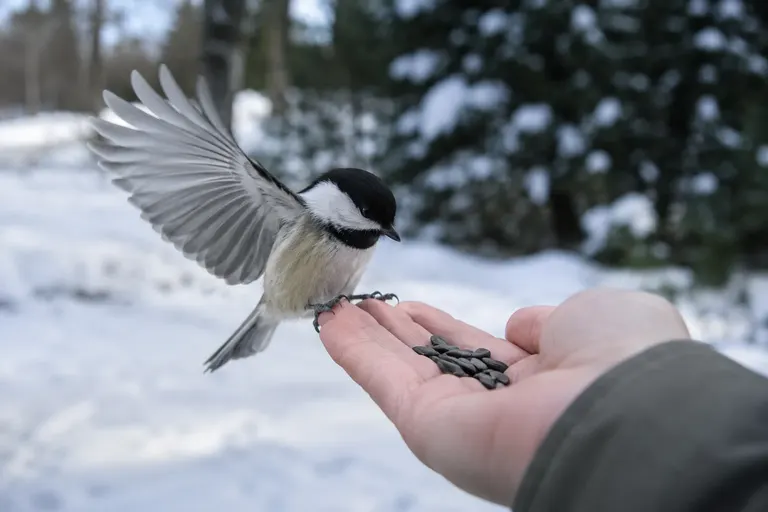
Songbirds track food supplies closely and usually find returned feeders within days. The hawk may eventually check back, especially in winter, so if repeat visits start again, repeat the pause.
Taking feeders down does not harm the birds that use them. The Cornell Lab and Project FeederWatch both note that wild birds get most of their food from natural sources, and they are used to food supplies that come and go. For more on how birds find and re-find feeders, see why birds aren’t coming to your new feeder.
Step 2: Give small birds dense cover to escape into
Songbirds survive hawk attacks by reaching thick cover fast. An accipiter can chase through branches, but dense, twiggy shrubs and evergreens slow it down and give prey a real chance.
What makes good escape cover
- Dense evergreens such as junipers, arborvitae, hollies and spruces offer year-round cover and are especially valuable in winter, when hawk visits peak.
- Thick native shrubs with twiggy branching, such as viburnums, dogwoods and native roses, provide cover plus berries or insects later.
- Brush piles made from pruned branches, stacked loosely, give sparrows, juncos and wrens a hiding place right away.
- Thorny plants add another layer of protection, since hawks avoid crashing into thorns.
How far should feeders be from cover?
Project FeederWatch suggests that about 10 feet from trees or dense shrubs is a good compromise. At that distance birds have a short escape route, while squirrels have a harder time jumping across and predators such as cats have less room to lurk right beside the feeder. Placing feeders deep inside a shrub can backfire, because it gives cats and hawks a hidden approach.
Our full guide to where to put a bird feeder covers distances, heights and cover in more detail.
Why open lawn is risky
A feeder in the middle of a lawn forces birds to cross open ground both ways. That is exactly where an accipiter strikes from a perch at the yard’s edge. Moving feeders closer to cover is often the single biggest permanent change you can make.
Step 3: Rethink ground and tray feeding
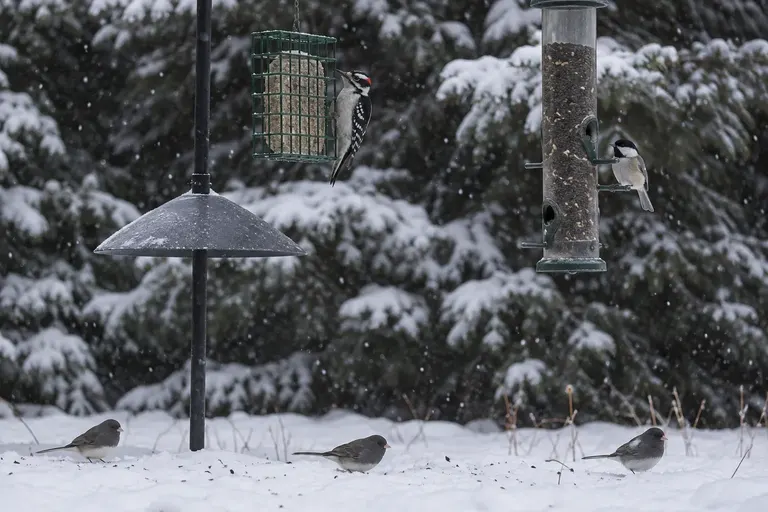
Doves, sparrows, juncos and towhees feed on the ground or on low trays. They are also the birds hawks catch most easily, because they are out in the open and slow to take off.
Options to reduce the risk:
- Pause ground scattering while a hawk is active in the neighborhood.
- Move tray feeders next to cover rather than in the open.
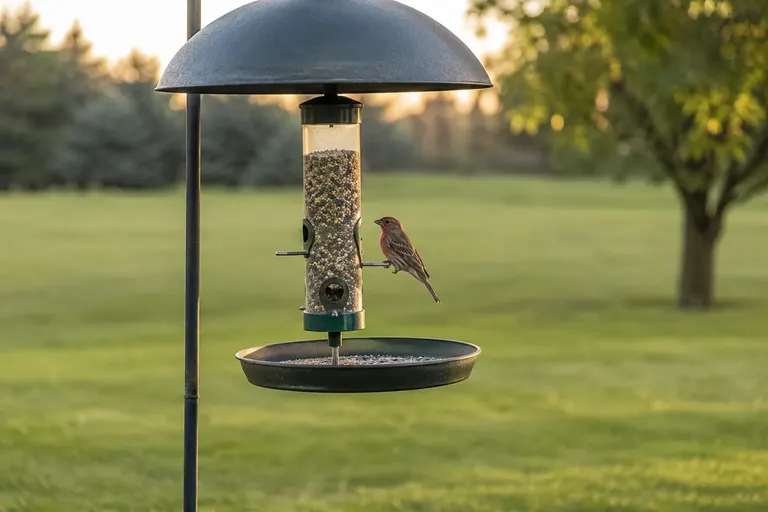
- Use a hanging tube or hopper for most of your seed, which keeps birds off open ground.
- Clean up spilled seed so birds do not linger on bare lawn under the feeder.
Mourning Doves deserve special mention. They are slow to react, feed in groups on the ground and are a favorite prey of suburban Cooper’s Hawks, according to the Cornell Lab. If doves are the birds being taken, ground feeding is the likely reason.
Step 4: Treat nearby windows so fleeing birds don’t crash
When a hawk swoops in, the whole flock bolts. Panicked birds fly toward what looks like open sky or shrubbery, and a window that reflects the yard can be exactly that. Many feeder watchers first notice a hawk because of a thump on the glass.
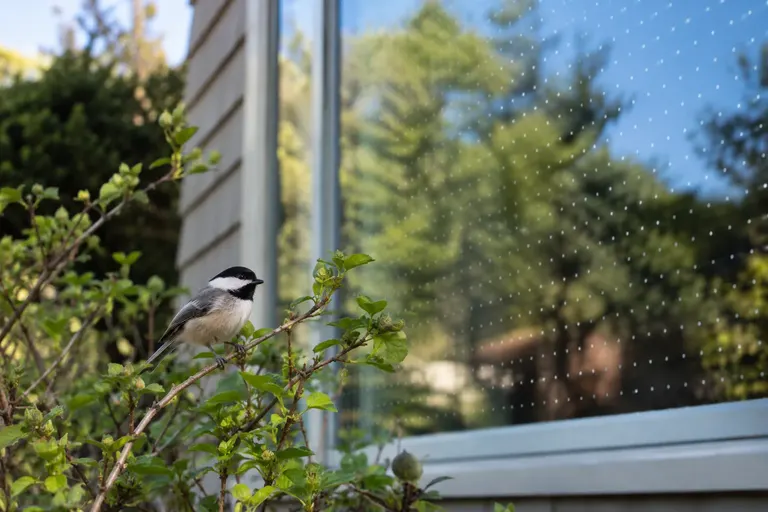
The Cornell Lab now considers the old safe-distance rules for feeder placement obsolete. The current advice is simpler: if you have windows near a feeder, make those windows bird-friendly. That means marking the outside of the glass with patterns spaced no more than 2 inches apart, installing exterior screens, or using netting. Our guide on how to stop birds hitting windows explains each option step by step.
Step 5: Keep the rest of the setup healthy
A hawk is more likely to catch weak or sick birds. That is part of its role, and it is not something to fight. But dirty feeders help spread diseases such as salmonellosis and House Finch eye disease, and sick birds are easier prey.
Use the pause while feeders are down to scrub and disinfect them. The Cornell Lab recommends a soak in a solution of no more than 1 part bleach to 9 parts water, then a thorough rinse and full drying. Our step-by-step guide to how to clean a bird feeder covers the full routine, and if you notice fluffed-up, lethargic birds, read our guide to sick birds at the feeder.
What doesn’t work (and what’s illegal)
Hawk decoys and owl statues
Plastic owls, hawk silhouettes and scarecrow-style decoys are widely sold, but there is little evidence they keep real hawks away. Birds quickly learn that a decoy never moves. Worse, a predator shape next to the feeder can make the small birds you want to see more nervous, while the hawk itself ignores it.
Shiny tape, noise and chasing
Reflective tape, wind chimes and running out to shoo the hawk may cause a short flight, but the hawk will return to a reliable food source. Constant chasing also scares off the songbirds.
Harming or trapping the hawk
All native hawks, falcons and owls are protected under the federal Migratory Bird Treaty Act, which the U.S. Fish and Wildlife Service enforces. It is illegal to kill, trap, capture or possess them without a federal permit. That includes trapping and relocating. Only licensed wildlife professionals may handle raptors, and only for specific purposes.
Putting cages around every feeder as a hawk fix
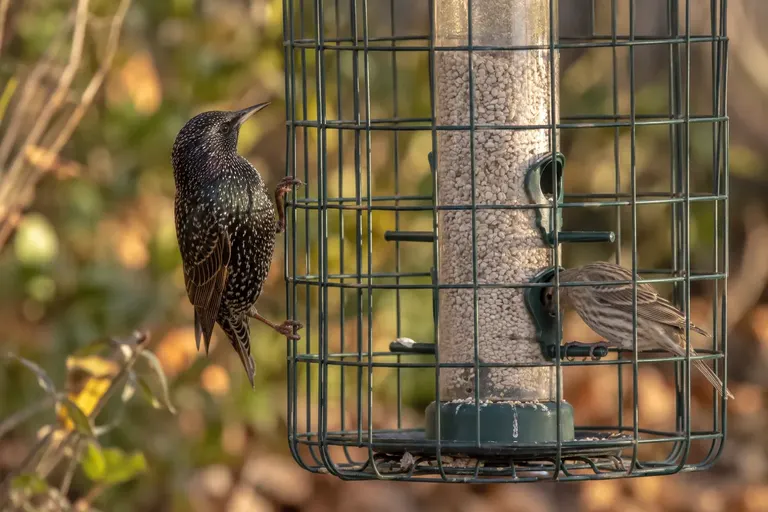
Cage-style feeders, with an outer wire mesh, keep large birds and squirrels away from the seed. They may make it harder for a hawk to grab a bird on the feeder itself, but accipiters mostly catch birds in flight or on the ground nearby. A cage alone rarely solves a hawk problem. It can help against starlings and grackles, which we cover in how to keep starlings and grackles off feeders.
When are hawks most likely at feeders?
Hawk visits are not evenly spread through the year.
| Season | What to expect |
|---|---|
| Fall (September to November) | Migrating Sharp-shinned and Cooper’s Hawks pass through; the Cornell Lab notes Sharp-shins are easiest to spot in fall migration |
| Winter (December to February) | Peak feeder visits in many areas; natural food is scarce and feeders concentrate birds |
| Spring (March to May) | Visits drop as migrants move north and resident hawks settle on territories |
| Summer (June to August) | Resident Cooper’s Hawks nesting nearby may hunt regularly to feed young |
Cooper’s Hawks now nest in many towns and suburbs, so some yards see visits all year. In those cases, permanent changes to cover and feeder placement matter more than temporary pauses.
How to tell if a hawk took a bird
Many hawk kills happen without anyone watching. Common signs:
- A circle or scatter of feathers on the lawn or under a shrub, often with no body.
- A sudden empty yard, with birds hiding silently in shrubs and not returning for many minutes.
- Alarm calls from chickadees, titmice, jays and robins, often high-pitched and thin when a hawk is overhead.
- Blue Jays or crows mobbing a perched bird at the edge of the yard.
Feathers alone don’t prove a hawk. Outdoor cats also kill large numbers of birds, and the Cornell Lab’s FAQ on cats covers that separate problem. Keeping cats indoors protects birds far more than any hawk-related change you could make.
Should you do anything at all?
This is a real choice, and both answers are reasonable.
Some people enjoy seeing a Cooper’s Hawk as much as any songbird. It is a native predator doing what it evolved to do, and a feeder that occasionally feeds a hawk is still part of a healthy ecosystem. If the hawk visits occasionally, doing nothing is fine.
Take action when:
- The hawk perches in view of the feeder daily, and the yard goes quiet for long stretches.
- You are finding feathers under the feeder repeatedly.
- Birds are hitting your windows while fleeing attacks.
In those cases, the one to two week pause plus better cover is the proportionate response.
Common mistakes
- Leaving one feeder up during the pause. Even a single feeder keeps birds gathering and the hawk hunting.
- Pausing for only a day or two. The Cornell Lab’s window is one to two weeks. A short pause rarely breaks the hawk’s habit.
- Placing feeders deep inside shrubs. That hides approaching cats and hawks. Near cover, not in it, is the goal.
- Relying on decoys. They do not move, so birds learn to ignore them.
- Ignoring the windows. A hawk attack can turn into several window strikes if glass near the feeder is untreated.
- Trying to handle an injured hawk. Raptors have sharp talons and strong feet. Call a licensed rehabilitator instead.
What to do if you find an injured hawk or songbird
If a hawk is injured, perhaps after hitting a window during a chase, do not try to pick it up. Its feet and talons can cause serious injuries. Keep pets and children away and contact a licensed wildlife rehabilitator or your state wildlife agency. The Animal Help Now website (ahnow.org) can help you find wildlife help near you.
If a songbird survives an attack but is injured, the Cornell Lab advises placing it in a lined box, keeping it dark, quiet and warm, and contacting a rehabilitator right away. Do not give food or water. Birds caught by any predator can develop infections quickly, so professional care matters even when wounds look minor.
A setup that makes hawk visits less of a problem
If you want to reduce hawk hunting permanently, aim for this layout:
- Feeders about 10 feet from dense evergreen or shrub cover, not in open lawn and not buried inside a bush.
- Most seed offered in hanging tube or hopper feeders, with limited ground scattering.
- A brush pile or thick native shrubs along at least one side of the feeding area.
- Windows near the feeders treated with closely spaced exterior markers or screens.
- Clean feeders every couple of weeks, with the ground underneath raked.
- Pets indoors, especially cats.
With that setup, a hawk may still visit, and it will sometimes succeed. But the small birds will have a fair chance, and you will see fewer repeat attacks. For a broader look at designing your yard for birds, see our guide to backyard birding.
Sources
Frequently asked questions
Why is a hawk hanging around my bird feeder?
Feeders gather small birds in one predictable place, and bird-eating hawks such as Cooper's and Sharp-shinned Hawks learn to check them. The Cornell Lab puts it plainly: these hawks take the term bird feeder at face value. The hawk is not after the seed; it is after the sparrows, finches and doves the seed attracts.
How long should I take my feeders down to get rid of a hawk?
The Cornell Lab recommends taking feeders down for a week or two. Without the concentrated food, small birds spread out across the neighborhood, and the hawk usually shifts its hunting elsewhere. When you put the feeders back up, songbirds typically return within days, often before the hawk does.
Is it legal to scare off or trap a hawk?
All native hawks are protected under the federal Migratory Bird Treaty Act, so it is illegal to kill, trap, capture or harm them without a federal permit. Gentle, nonharmful changes to your yard, such as removing feeders temporarily or adding cover, are the right tools. Contact your state wildlife agency if a hawk is injured.
Do hawk decoys or owl statues keep hawks away?
There is little evidence that plastic owls or hawk decoys deter real hawks for long. Birds quickly learn that a decoy never moves. A decoy near your feeder is more likely to make small birds nervous without affecting the hawk that is hunting them. Feeder removal and cover are more reliable.
Do bird feeders make songbirds easier prey for hawks?
Research summarized by the Cornell Lab suggests feeders do not greatly increase an individual bird's chance of being taken by a Sharp-shinned Hawk, because these hawks get most of their food away from feeders. Feeders do concentrate birds, though, so placing them near good escape cover gives prey a better chance.