Birdhouse Hole Sizes by Species: Chart in Inches and mm
Birdhouse hole sizes by species: 1-1/8 inches for chickadees and wrens, 1-1/2 for bluebirds, 2-1/2 for flickers. Full chart in inches and mm, plus tips.
In this article
- Birdhouse hole size chart: North America
- Birdhouse hole size chart: UK and Europe
- Why does hole size matter so much?
- What else decides which bird uses a box?
- How do you cut an accurate entrance hole?
- Does the shape of the entrance matter?
- How do you measure an existing birdhouse hole?
- Common mistakes
- Can one box serve several species?
- What about bats, squirrels and bees?
- Quick facts
- Sources
- Frequently asked questions
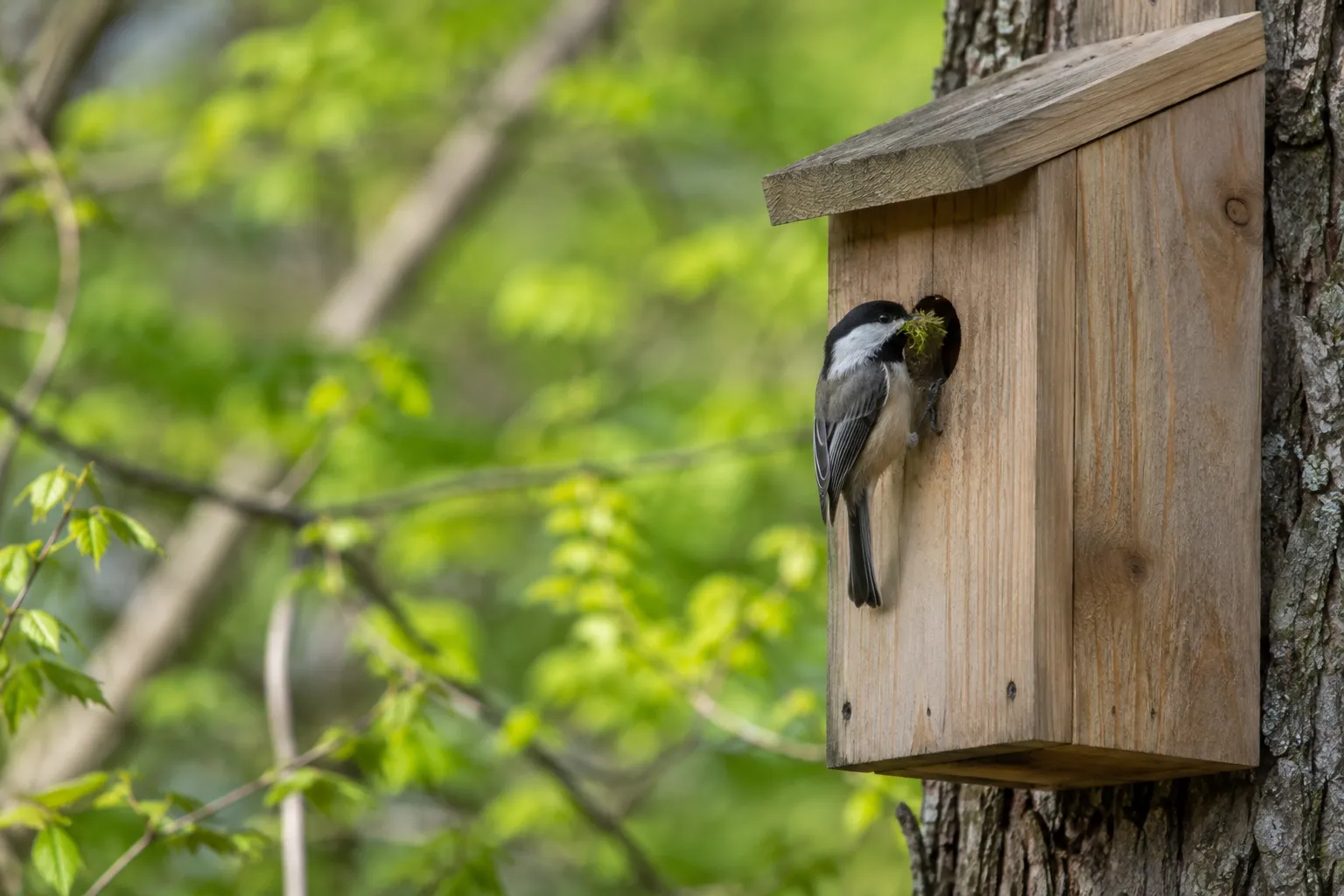
Birdhouse hole sizes by species matter more than any other measurement on a nest box, because the entrance decides which birds can get in and which are kept out. The key sizes to remember: 1-1/8 inches (29 mm) for chickadees and House Wrens, 1-1/4 inches (32 mm) for titmice, nuthatches and Downy Woodpeckers, 1-1/2 inches (38 mm) for bluebirds and Tree Swallows, and 2-1/2 inches (64 mm) for Northern Flickers. In Europe, 25 mm suits Blue Tits and 28 mm suits Great Tits.
The chart below gives the standard entrance size for common cavity nesters in North America, Europe and beyond, with metric conversions. After it, we explain why a few millimeters matter so much, how to keep out House Sparrows and starlings, and what else besides the hole decides who moves in.
Birdhouse hole size chart: North America
Sizes are round entrance diameters unless noted. Values follow widely used guidance from Cornell Lab’s NestWatch program and bluebird and cavity-nester societies. Where sources give a range, the range is shown.
| Species | Hole size (inches) | Hole size (mm) | Notes |
|---|---|---|---|
| House Wren | 1 to 1-1/8 | 25 to 29 | 1 inch excludes House Sparrows |
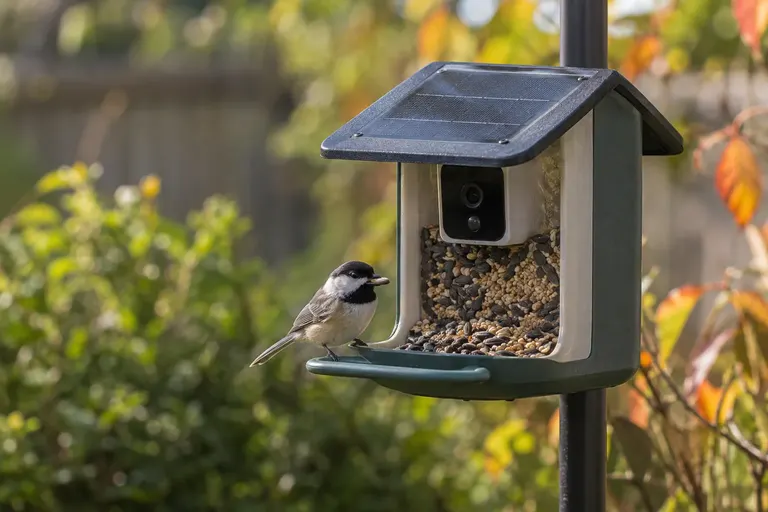
| Black-capped Chickadee | 1-1/8 | 29 | Also Carolina, Mountain and Chestnut-backed Chickadees |
| Prothonotary Warbler | 1-1/8 to 1-1/4 | 29 to 32 | Boxes over or near water in wooded swamps |
| Red-breasted Nuthatch | 1-1/8 to 1-1/4 | 29 to 32 | Conifer and mixed woods |
| Tufted Titmouse | 1-1/4 | 32 | Also Oak and Juniper Titmice |
| White-breasted Nuthatch | 1-1/4 to 1-3/8 | 32 to 35 | Mature deciduous trees nearby |
| Downy Woodpecker | 1-1/4 | 32 | Box packed with wood shavings |
| Bewick’s Wren | 1-1/4 | 32 | Western and southern US |
| Carolina Wren | 1-1/2 | 38 | Often prefers open fronts or ledges |
| Eastern Bluebird | 1-1/2 | 38 | Excludes starlings |
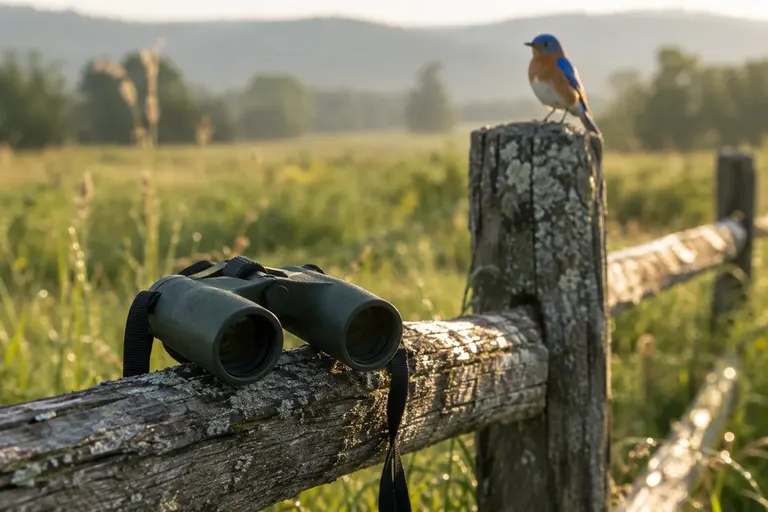
| Western Bluebird | 1-1/2 | 38 | Open woodland edges, meadows |
| Mountain Bluebird | 1-9/16 | 40 | Largest bluebird |
| Tree Swallow | 1-3/8 to 1-1/2 | 35 to 38 | Open areas, ideally near water |
| Violet-green Swallow | 1-3/8 to 1-1/2 | 35 to 38 | Western North America |
| Ash-throated Flycatcher | 1-1/2 | 38 | Arid West |
| Hairy Woodpecker | 1-1/2 to 1-5/8 | 38 to 41 | Rarely uses boxes |
| Great Crested Flycatcher | 1-3/4 | 44 | Eastern woodlands |
| Red-bellied Woodpecker | 2 | 51 | Box packed with shavings |
| Red-headed Woodpecker | 2 | 51 | Open woods, savanna |
| Purple Martin | About 1-3/4 to 2-1/4, or a crescent | 44 to 57 | Colonial housing; crescent entrances deter starlings |
| Northern Flicker | 2-1/2 | 64 | Fill box to the top with shavings |
| Eastern and Western Screech-Owl | 3 | 76 | Wood shavings in the floor |
| American Kestrel | 3 | 76 | Open country, box on a pole or building |
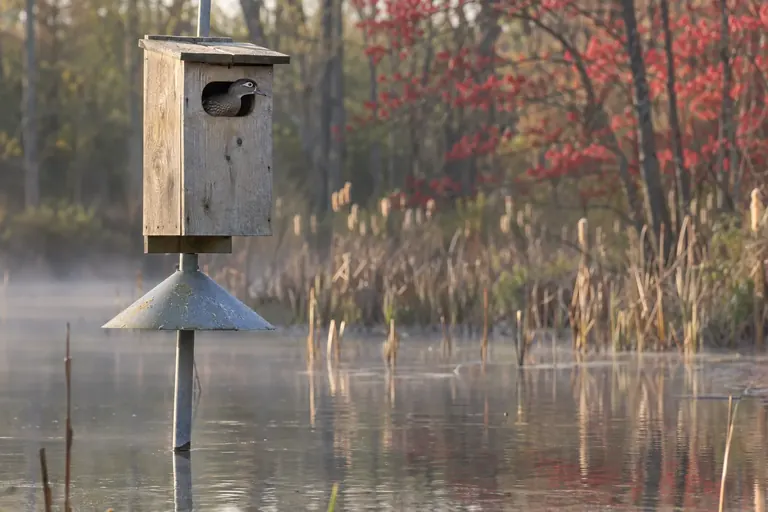
| Wood Duck | 3 x 4 oval | 76 x 102 | Near water; needs a climbing strip inside |
If you are building for a specific bird, start with its species page. We cover nest boxes in detail for the Eastern Bluebird, Black-capped Chickadee, Tufted Titmouse and House Wren.
Birdhouse hole size chart: UK and Europe
European nest-box guidance, including advice from the RSPB and BTO, is usually given in millimeters. These sizes are also a good starting point for gardens in Turkey and much of western Asia, where many of the same species breed.
| Species | Hole size (mm) | Approx. inches | Notes |
|---|---|---|---|
| Blue Tit | 25 | 1 | Also Coal Tit and Marsh Tit |
| Great Tit | 28 | 1-1/8 | Also used by Blue Tits |
| Tree Sparrow | 28 | 1-1/8 | Often nests in loose colonies |
| Pied Flycatcher | 28 | 1-1/8 | Oak woodland, western Britain and much of Europe |
| House Sparrow | 32 | 1-1/4 | Colonial; multi-chamber “terrace” boxes work well |
| Eurasian Nuthatch | 32 | 1-1/4 | Plasters mud around a larger hole to shrink it |
| Common Starling | 45 | 1-3/4 | Declining in the UK; boxes are welcome |
| Robin, Wren, Spotted Flycatcher, Pied Wagtail | Open-fronted | Open-fronted | Box with the top half of the front removed |
Notice that Blue Tits and Great Tits are separated by only 3 mm. That small gap is what lets a 25 mm box stay reserved for Blue Tits, which are smaller than Great Tits and lose contests over nest sites.
Other regions
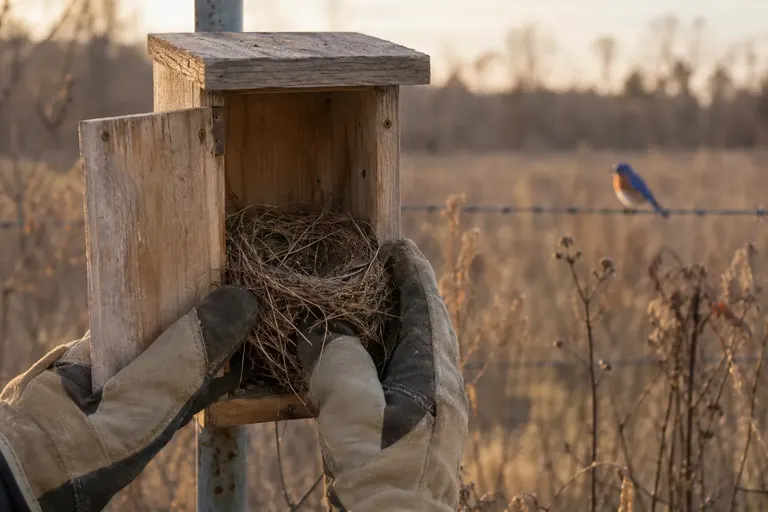
Cavity-nesting birds exist on every continent, but local nest-box standards vary and are less standardized outside North America and Europe.
- Brazil and much of South America: the Southern House Wren (a close relative of the North American House Wren) readily uses small boxes, and the Saffron Finch and some flycatchers also nest in cavities. A hole around 25 to 32 mm suits the wren; follow guidance from local bird groups for other species. The famous Rufous Hornero builds its own mud oven and does not use nest boxes.
- Turkey: Great Tits, Blue Tits, Eurasian Nuthatches, House Sparrows and Tree Sparrows are the most likely box users in gardens, so the European sizes above apply.
Why does hole size matter so much?
A nest box is a contested resource. Natural cavities, especially old woodpecker holes, are in short supply, and many species compete for them. Hole size acts as a filter.
It excludes larger competitors. A bird cannot enter a hole smaller than its body. A 1-1/8 inch hole is too tight for House Sparrows, and a 1-1/2 inch hole is too tight for European Starlings. Both are non-native in North America and aggressive nest-site competitors. They can kill adult bluebirds, swallows and wrens, destroy eggs and take over boxes.
It protects against some predators. A smaller hole keeps out larger nest predators such as crows, jays and some squirrels. It does not stop snakes, mice or small weasels, so mounting and guards still matter.
It matches what the bird looks for. Birds assess nest sites carefully. A hole that is too large may make a small bird feel exposed, while a hole too small simply cannot be used.
Which birds do sparrows and starlings affect?
| Hole size | Keeps out | Still admits |
|---|---|---|
| 1 inch (25 mm) | House Sparrows, starlings, most competitors | House Wrens, Blue Tits, Coal Tits |
| 1-1/8 inch (29 mm) | House Sparrows, starlings | Chickadees, Great Tits, House Wrens |
| 1-1/4 inch (32 mm) | Starlings | House Sparrows, titmice, nuthatches |
| 1-1/2 inch (38 mm) | Starlings | House Sparrows, bluebirds, swallows |
| 1-9/16 inch (40 mm) or larger | Nothing reliable | Starlings may get in |
The practical rule: any box with a hole of 1-1/4 inches or more is open to House Sparrows. In North America, where House Sparrows are non-native and not protected by federal law, bluebird trail managers remove sparrow nests to protect native birds. In Europe, the House Sparrow is a native and declining species, so the approach is the opposite, and boxes are put up for it.
What else decides which bird uses a box?
Hole size opens the door, but the rest of the box and its setting decide who actually moves in.
Floor size
The floor needs to fit the full clutch and growing young. Rough guide:
- About 4 x 4 inches (10 x 10 cm): chickadees, House Wrens, nuthatches, titmice, Blue and Great Tits.
- About 5 x 5 inches (13 x 13 cm): bluebirds, Tree Swallows. Many bluebird boxes use 4 x 4 or 5 x 4 floors and work well.
- About 6 x 6 to 7 x 7 inches (15 to 18 cm): larger flycatchers, Red-bellied Woodpeckers, flickers.
- About 8 x 8 inches or more (20 cm): screech-owls, kestrels.
- About 10 x 10 to 12 x 12 inches (25 to 30 cm): Wood Ducks.
Hole height above the floor
The entrance should sit well above the nest, usually 5 to 7 inches (13 to 18 cm) for small songbirds and bluebirds. A deep box keeps chicks out of reach of a cat’s paw or a raccoon’s arm reaching through the hole, and keeps them from leaving too early. Very shallow boxes are a common fault in decorative birdhouses.
Habitat and placement
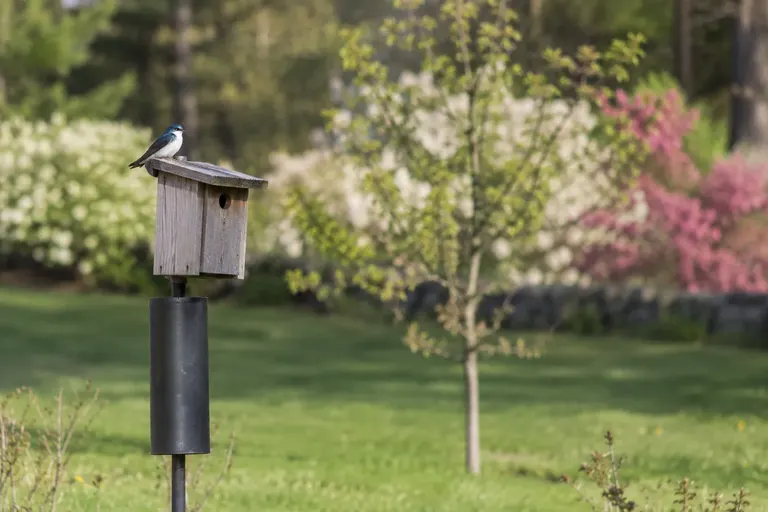
The same box attracts different birds in different places. A 1-1/2 inch box on a post in an open meadow is ideal for bluebirds and Tree Swallows. Put it at the edge of woods and you may get a titmouse, a chickadee or a Carolina Wren. Woodpeckers want boxes on or near trees. Our guides to how to mount a birdhouse and when to put up birdhouses cover this in detail.
Box interior
Woodpeckers, flickers and some owls excavate their own cavities and do not carry in nest material. Pack their boxes with wood shavings (not sawdust, which packs down and holds water) so they can “excavate” to their preferred depth. See our species guides for the Downy Woodpecker and Northern Flicker.
How do you cut an accurate entrance hole?
Getting the hole exactly right is easier than it sounds.
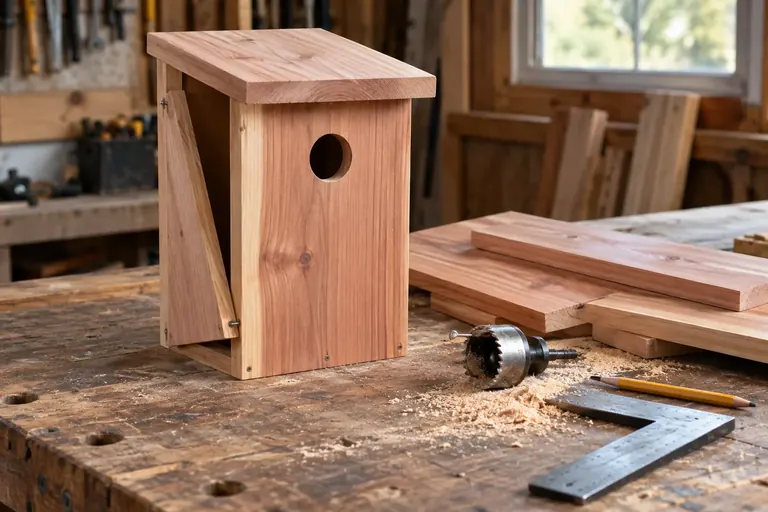
- Use a spade bit or hole saw of the exact size. Hole saws in 1-1/8, 1-1/4 and 1-1/2 inch sizes (or 25, 28 and 32 mm in Europe) are widely available.
- Drill from the outside inward with a scrap board clamped behind to prevent splintering.
- Measure after drilling. Some bits cut slightly oversize, and 1/16 of an inch can admit a sparrow. Check with calipers or a hole template.
- Smooth the edges lightly, but do not enlarge the opening.
- Rough up the inside of the front panel below the hole with shallow saw cuts or a wire brush, so fledglings can climb out.
What if a squirrel or woodpecker enlarges the hole?
Squirrels chew holes wider, and woodpeckers sometimes enlarge them. A metal or thick-wood hole guard (a plate with the correct-sized hole) screwed over the entrance restores the size and deters chewing. A thicker wooden block also makes it harder for predators to reach in, because it extends the tunnel.
Does the shape of the entrance matter?
Mostly, round holes are standard, and they are what the chart assumes. A few alternative shapes are used deliberately.
Slot entrances. Some bluebird boxes, such as the Peterson-style designs popular in the American Midwest, use an oval entrance or a horizontal slot about 1-1/8 to 1-3/8 inches high. Slots let more light in and are easy for bluebirds to use, but slot height must be exact, because a slightly taller slot may admit starlings.
Crescent entrances. Purple Martin housing often uses a half-moon entrance that is wide but low. Martins can pass through it while most starlings cannot. Martin landlords report good results, but sizing should follow guidance from the Purple Martin Conservation Association rather than guesswork.
Oval holes for ducks. Wood Ducks use a horizontal oval of about 3 by 4 inches, which lets the hen squeeze in while excluding some larger predators.
Open fronts. Robins, wrens and Spotted Flycatchers in Europe, and phoebes and American Robins in North America, prefer a ledge or a box with half the front open. These are not cavity nesters in the strict sense, so a round hole of any size will be ignored. Phoebes and robins use a simple nesting shelf under an eave.
How do you measure an existing birdhouse hole?
If you bought a box without clear specifications, check it before you hang it.
- Measure the widest point across the hole with a ruler or, better, digital calipers. Measure twice at right angles, because hand-cut holes are not always perfectly round.
- Compare with the chart. A hole that falls between two sizes will admit the larger bird. A box sold as a “wren house” with a 1-1/4 inch hole will admit House Sparrows.
- Check hole height above the floor. Measure from the inside floor to the bottom of the hole. Less than about 4 inches is too shallow for most species.
- Check the floor. A floor smaller than 4 by 4 inches is too cramped for most cavity nesters.
- Fix what you can. A hole guard can shrink an oversized hole to the right size. A shallow box is harder to fix and may be better used as garden decoration.
Common mistakes
- Buying on looks. Many decorative birdhouses have holes that are too big, floors that are too small or no ventilation. Check the measurements.
- Adding a perch. Cavity nesters do not need one, and perches help sparrows and predators.
- Guessing at hole size. A 1-1/4 inch hole meant for chickadees invites House Sparrows. Measure.
- Using the wrong hole for the habitat. A bluebird box in dense woods will probably never host a bluebird.
- Painting the inside or using treated wood. Use untreated, unpainted wood inside; if you paint the outside, choose a light color.
- Forgetting drainage, ventilation and access. Good boxes have drain holes in the floor, vent gaps near the top and a side or front that opens for cleaning. See when and how to clean out a birdhouse.
- Mounting on a fence without a guard. Cats and raccoons use fences as highways.
Can one box serve several species?
Yes, within limits. A 1-1/4 inch box in mixed woodland edge might host a chickadee one year, a titmouse the next and a nuthatch after that. A 1-1/2 inch box in open country might go to bluebirds, Tree Swallows or House Wrens. That is one reason many people put up two or three boxes of different sizes.
Placing boxes in pairs, about 15 to 25 feet (5 to 8 m) apart, is a common trick on bluebird trails. Tree Swallows defend one box, bluebirds take the other, and the two species tolerate each other at that distance. Boxes meant for the same species, by contrast, need more spacing, often 100 yards or more for bluebirds.
What about bats, squirrels and bees?
Boxes with larger holes also appeal to non-birds. Flying squirrels, deer mice and red squirrels readily move into boxes of 1-1/4 inches and up in wooded areas. Paper wasps and bees may nest inside in summer. In North America, native species found in boxes are usually best left alone. Bats need a completely different design, a narrow, open-bottomed bat house, and will not use a standard bird box.
Quick facts
- 1 inch (25 mm): House Wren, Blue Tit, Coal Tit.
- 1-1/8 inches (28 to 29 mm): chickadees, Great Tit, Tree Sparrow, Pied Flycatcher.
- 1-1/4 inches (32 mm): titmice, nuthatches, Downy Woodpecker, House Sparrow in Europe.
- 1-1/2 inches (38 mm): Eastern and Western Bluebirds, Tree Swallow, Carolina Wren.
- 1-9/16 inches (40 mm): Mountain Bluebird.
- 2-1/2 inches (64 mm): Northern Flicker.
- 3 inches (76 mm): screech-owls and American Kestrel.
- Holes of 1-1/8 inches or smaller keep out House Sparrows; holes of 1-1/2 inches or smaller keep out starlings.
- No perch, ever.
Sources
Frequently asked questions
What size hole does a bluebird house need?
Eastern and Western Bluebirds use a round hole 1-1/2 inches (38 mm) across. Mountain Bluebirds are slightly larger and are usually given 1-9/16 inches (40 mm). A 1-1/2 inch hole keeps out European Starlings but not House Sparrows, so bluebird boxes still need monitoring.
What size hole keeps out House Sparrows?
A round hole of 1-1/8 inches (about 29 mm) or smaller keeps out House Sparrows while still admitting chickadees, House Wrens and most small tits. Any hole of 1-1/4 inches or more will admit sparrows, so boxes for bluebirds, swallows and titmice need other management.
What size hole is best for a wren house?
House Wrens use holes from 1 to 1-1/8 inches (25 to 29 mm). The smaller 1-inch size excludes House Sparrows and most other competitors. Carolina Wrens are larger and prefer about 1-1/2 inches, and they often choose open-fronted boxes or sheltered ledges instead.
What size hole do blue tits and great tits need?
In the UK and Europe, a 25 mm hole suits Blue, Coal and Marsh Tits and excludes larger birds. Great Tits need 28 mm, the same size used by Tree Sparrows and Pied Flycatchers. House Sparrows and Eurasian Nuthatches use 32 mm, and Common Starlings need about 45 mm.
Does the hole size alone decide which bird moves in?
No. Hole size sets the largest bird that can enter, but habitat, box height, floor size and hole height above the floor all affect which species chooses a box. A 1-1/2 inch box in open lawn attracts bluebirds or Tree Swallows, while the same box in woodland may attract a titmouse or a flying squirrel.
Should a birdhouse have a perch below the hole?
No. Cavity-nesting songbirds do not need a perch to enter, and a perch helps House Sparrows, starlings and predators such as jays reach the nest. A slightly roughened face or shallow grooves inside the front help fledglings climb out.