Birds Not Using Your Birdhouse? 10 Reasons and Fixes
Birds not using your birdhouse? The usual causes are the wrong hole size, a bad spot, a perch, heat or predators. Here are 10 reasons and how to fix each one.
In this article
- Quick checklist: why is my birdhouse empty?
- 1. Is the entrance hole the right size?
- 2. Is the box in the right habitat?
- 3. Which way is the box facing?
- 4. Is it mounted at the right height, firmly?
- 5. Does the birdhouse have a perch?
- 6. Can predators reach the box?
- 7. Are other birds taking it over?
- 8. Is the box too hot, damp or poorly built?
- 9. Did the box go up too late?
- 10. Are your boxes too close together?
- How long should you wait before moving a birdhouse?
- Can an empty box still be doing its job?
- Sources
- Frequently asked questions
Birds usually skip a birdhouse for one of a few fixable reasons: the entrance hole is the wrong size for the birds near you, the box sits in the wrong habitat or faces hot sun or driving rain, it has a perch or is easy for predators to reach, or it went up too late. Most empty boxes get used once these are corrected.
Sometimes nothing is wrong at all. The BTO explains that occupancy also depends on how many pairs live nearby, how many natural cavities are available and where territory boundaries fall. This guide walks through the 10 most common reasons a birdhouse stays empty and what to do about each one, in roughly the order you should check them.
Quick checklist: why is my birdhouse empty?
Work through this table first. The top rows are the most common causes.
| Reason | What to check | Fix |
|---|---|---|
| Wrong hole size | Does the hole match a species that lives near you? | Use the right hole for your target bird or add a hole reducer |
| Wrong habitat | Is the box in the kind of place that bird nests? | Move it to matching habitat |
| Bad orientation | Does the hole face wind, rain or afternoon sun? | Turn it away from the weather and hot sun |
| Wrong height or mount | Is it too low, swinging or on a fence post? | Fix it firmly at the right height, ideally on a baffled pole |
| A perch | Is there a peg under the hole? | Remove it |
| Predators | Can cats, raccoons, squirrels or snakes reach it? | Add a baffle, move it away from branches and fences |
| Competition | Are House Sparrows, wrens or starlings nearby? | Change hole size or location |
| Too hot or wet | No vent or drainage holes, dark paint, thin walls? | Choose a well-built box in plain wood |
| Too late | Did it go up in late spring? | Leave it up and wait for next season |
| Too close together | Several boxes of one type crowded in one spot? | Space them out |
1. Is the entrance hole the right size?
The hole size decides which birds can get in, so it’s the first thing to check. A hole that is too big lets in larger, more aggressive competitors, and one that is too small keeps out the bird you want.
NestWatch notes that a hole smaller than 1 9/16 inches keeps European Starlings out, and smaller holes again exclude House Sparrows. Match the hole to a species that actually lives in your area. Our birdhouse hole size chart by species lists the exact diameters, and the chickadee house guide covers one of the most common small-hole birds.
2. Is the box in the right habitat?
Birds nest where they find food and cover, not wherever a box happens to be. A bluebird house in a shady wooded corner or a chickadee box in an open lawn will often stay empty.
NestWatch’s placement guide shows how specific species are. Eastern Bluebirds want open, grassy ground with scattered perches, and Black-capped Chickadees prefer a spot that gets roughly 40 to 60 percent sunlight. NestWatch also advises keeping boxes away from areas where pesticides and herbicides are used. In Germany, NABU makes the same point from the other side: you can only really expect a box to be occupied if the garden is fairly natural and offers enough food. Native shrubs, seed heads and leaf litter help more than a second box.
3. Which way is the box facing?
A box that faces into driving rain, strong wind or hot afternoon sun is a poor home, and birds seem to know it. Turn the hole away from the prevailing wind and the hottest sun.
The BTO suggests facing boxes between north and east in Britain, unless trees or buildings provide shade. NABU advises against facing the weather side (usually west in Central Europe) and against very sunny south-facing walls. NestWatch adds that holes should face away from the prevailing wind. In hot climates, shade from afternoon sun matters even more than compass direction.
4. Is it mounted at the right height, firmly?
Height depends on the species, and a box that swings or wobbles is less attractive and less safe. Mount it firmly so it can’t sway in the wind.
NestWatch lists Eastern Bluebird boxes at 3 to 6 feet and Purple Martin housing at 10 to 15 feet, while kestrels nest much higher. For general songbird boxes in European gardens, NABU recommends about 2 to 3 metres. Tilt the box slightly forward, never back, so rain runs off the roof and away from the hole. Our guide to mounting a birdhouse on a pole, tree or wall shows each method.
5. Does the birdhouse have a perch?
If there’s a peg under the hole, take it off. Cavity nesters don’t need it, and NestWatch says perches only help predators and competing birds reach in or harass the nest. A perch also gives House Sparrows a handy spot to guard a box they want to take over.
6. Can predators reach the box?
Birds avoid sites that feel exposed, and a box that’s been raided before may be abandoned. Cats, raccoons, squirrels and snakes are the usual culprits in North America.
NestWatch recommends mounting boxes on a metal pole rather than a fence post or tree, because a pole can carry a predator guard. A stovepipe baffle about 8 inches wide and 24 to 36 inches long stops most climbers. Keep the box away from branches, fences and roofs that animals can jump from. Its troubleshooting guide also suggests mounting boxes high enough to keep cats out of reach. For more on cats, see how to keep cats away from birds in your yard.
7. Are other birds taking it over?
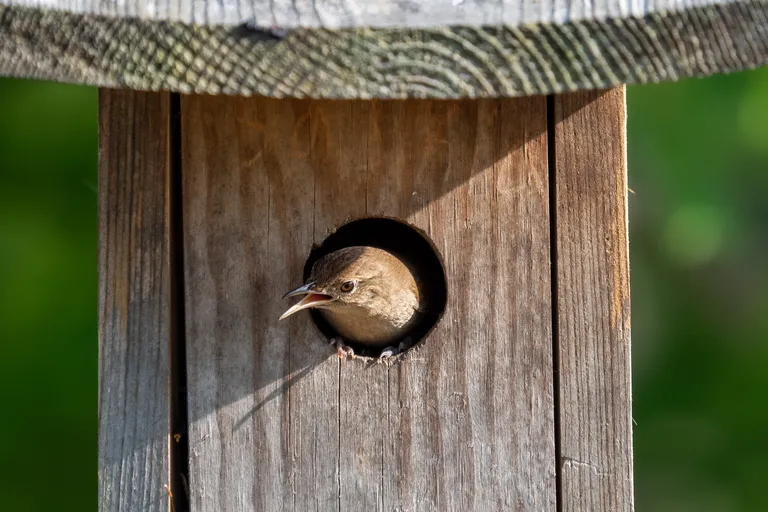
Sometimes the box is used, just not by the bird you hoped for, or a competitor keeps your target species away. House Sparrows, European Starlings and House Wrens are the main rivals in North America.
NestWatch’s troubleshooting guide links destroyed eggs and nests to House Sparrows and House Wrens, and suggests moving boxes away from places where sparrows are dense and away from prime House Wren habitat such as brushy edges. A correctly sized hole helps too. If you keep finding sparrow nests, a sparrow-resistant design from our best birdhouses list may be worth the switch.
8. Is the box too hot, damp or poorly built?
A cheap decorative box can look fine but be too hot, wet or small inside. Birds tend to pass these by, and those that do nest may lose their brood.
NestWatch’s model birdhouse uses untreated, unpainted wood (cedar, pine or cypress) at least 3/4 inch thick, at least four drainage holes in the floor and ventilation holes near the top of the side walls. The roof overhangs the front by 2 to 4 inches to keep rain out of the hole, and the inside below the hole is rough so fledglings can climb out. NABU sets similar minimums for European boxes: a floor of at least 12 by 12 centimetres, walls about 1.8 centimetres thick and the bottom of the hole at least 17 centimetres above the floor to keep predators from reaching the nest. Avoid dark paint, metal roofs and any treatment inside the box.
9. Did the box go up too late?
Many birds pick nest sites weeks before they lay eggs, so a box put up in May may be ignored until next year. Timing matters more than most people think.
NestWatch advises having boxes up by February in southern regions and by mid to late March in the north. NABU recommends autumn, so birds can use the box to roost over winter, and the BTO notes that boxes are used as winter roosts too. Even so, late nesters and second broods keep looking into early summer. See when to put up birdhouses for timing by region.
10. Are your boxes too close together?
Most songbirds defend a territory, so a cluster of identical boxes often means only one gets used. Spread them out.
NestWatch’s spacing table runs from about 30 feet between boxes for Carolina Chickadees to more than 1,000 feet for White-breasted Nuthatches. NABU suggests at least 10 metres between boxes for the same species and 3 metres for different species, with exceptions for colonial nesters such as sparrows, starlings and swallows. NestWatch also describes setting boxes up in pairs 15 to 25 feet apart in some situations.
How long should you wait before moving a birdhouse?
Give a new, well-placed box at least one full nesting season, and ideally two, before you move it. If it’s still empty after that, change one thing at a time: location first, then hole size or orientation.
Always make changes outside the nesting season. A box that’s in use must be left alone, and in many countries active nests are protected by law. In England and Wales, for example, old nests and unhatched eggs may only be removed between 1 September and 31 January. Our guide to cleaning out a birdhouse covers the right timing.
Can an empty box still be doing its job?
Yes. A box with no nest in spring may still be used as a winter roost, and the BTO notes that birds shelter in boxes on cold nights through autumn and winter. Look for droppings or a few feathers when you clean it. If a box has been checked and improved and still sits empty, the simplest explanation is often that local birds already have enough natural cavities. That’s not a failure, and the box will be ready when a pair needs it.
Sources

Frequently asked questions
How long does it take for birds to find a new birdhouse?
It varies a lot. Some boxes are claimed within days of going up, while others sit empty for a full season or longer. NestWatch notes that it can simply take time for birds to discover a new box. Putting it up in autumn or by late winter gives local birds the longest possible window to find and inspect it before nesting starts.
Should a birdhouse have a perch?
No. Cavity-nesting birds cling to the entrance hole without trouble, so a perch adds nothing for them. NestWatch advises against perches because they give predators and competing species such as House Sparrows a convenient place to stand while they reach in or harass the nest. If your box has a perch, you can usually saw or pull it off.
Do birds use birdhouses in winter?
Many do, but for sleeping rather than nesting. The BTO points out that birds use nest boxes as a sheltered place to roost on cold nights in autumn and winter. A box you leave up after cleaning it in early autumn can help small birds through the winter and is already familiar to them when the nesting season begins.
Should I move a birdhouse that nobody uses?
If a box has stayed empty through two full nesting seasons, moving it is usually the best fix. Pick a spot that matches the habitat of the species you want, face it away from the prevailing wind and hot afternoon sun, and mount it on a pole with a baffle. Move it outside the nesting season so you never disturb an active nest.
What color should a birdhouse be?
Plain, untreated wood is the safest choice. NestWatch recommends unpainted cedar, pine or cypress, and NABU advises against chemicals and insect sprays in nest boxes. If you want to protect the outside, choose a light, muted color, because dark paint absorbs heat and can make the box dangerously warm for eggs and chicks. Never paint or treat the inside.