How to Attract Eastern Bluebirds: Nest Boxes and Food
How to attract Eastern Bluebirds: mount a correctly sized nest box with a predator guard facing open lawn, offer mealworms, and plant native berry shrubs.
If you buy through links on this page we may earn a commission, at no cost to you. It never decides what we recommend. How we earn
In this article
- Eastern Bluebird at a glance
- How to identify an Eastern Bluebird
- What Eastern Bluebirds eat
- The Eastern Bluebird nest box: exact specifications
- Dealing with House Sparrows and other competitors
- Monitoring your bluebird box
- Native plants for Eastern Bluebirds
- Water and winter care
- How long does it take bluebirds to find a new nest box?
- Should you clean out a bluebird box in fall?
- Watching bluebirds without disturbing them
- A year of Eastern Bluebirds
- Common mistakes when attracting Eastern Bluebirds
- Sources
- Gear mentioned in this guide
- Frequently asked questions
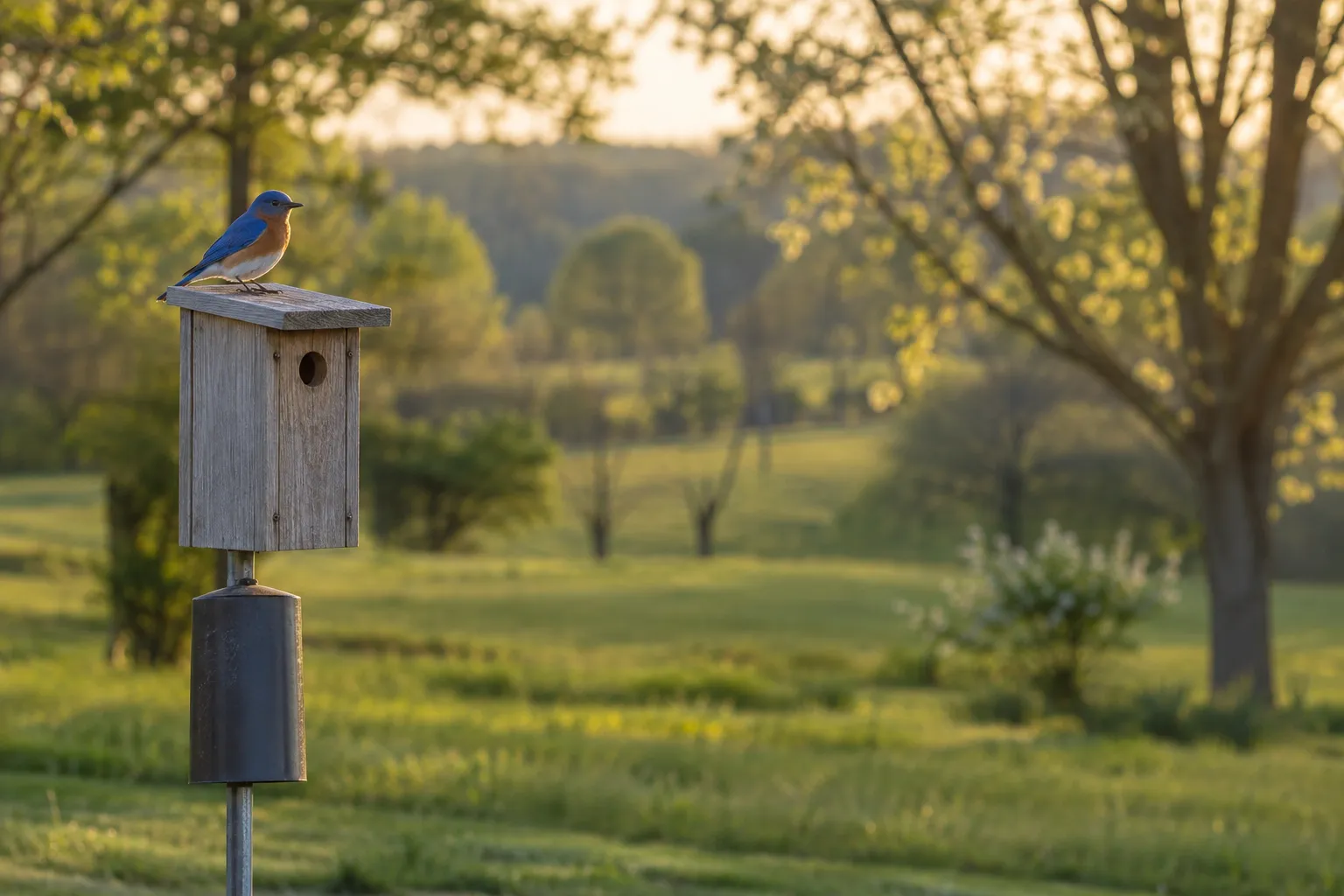
If you want to know how to attract Eastern Bluebirds, start with a well-built nest box with a 1.5 inch entrance hole, mounted on a metal pole with a predator guard and facing open, short grass. Add mealworms, native berry-producing shrubs and water, and keep House Sparrows out of the box. Bluebirds rarely eat seed, so a yard full of seed feeders alone will not draw them.
Eastern Bluebird at a glance
| Trait | Details |
|---|---|
| Size | 6.3 to 8.3 in long, wingspan 9.8 to 12.6 in, 1.0 to 1.1 oz (about two-thirds the size of an American Robin) |
| Range | Eastern North America east of the Rockies, south through Mexico to Nicaragua |
| Season | Year-round in much of the range, northern birds move south in winter |
| Diet | Ground insects in spring and summer, berries and fruit in fall and winter |
| Feeder food | Mealworms (live or dried), occasionally suet and fruit |
| Feeder type | Open tray or enclosed bluebird feeder with 1.5 in holes |
| Nesting | Cavity nester, readily uses nest boxes, 2 to 7 pale blue eggs, 1 to 3 broods |
| Habitat | Open ground with short grass and scattered trees or perches |
How to identify an Eastern Bluebird
The Cornell Lab describes a small thrush with a rounded head, plump body, short straight bill and alert posture, often perched upright on wires, posts and low branches while scanning the ground.
Adult male
- Vivid, deep blue above
- Rusty or brick-red throat and breast, with the color wrapping up onto the sides of the neck
- White belly
Female
- Grayish above with bluish wings and tail
- Subdued orange-brown breast
- White belly and a pale eye ring
Juvenile
- Spotted back and chest
- Varying amounts of blue in the wings and tail
- Easy to mistake for a different species if you do not see the blue flash in flight
Similar species
- Western Bluebird: males have a blue throat and rust on the upper back. The two species barely overlap in range.
- Mountain Bluebird: males are sky blue all over, with no orange. Mainly a western bird.
- Indigo Bunting: males are entirely blue with a thick, conical seed-eater’s bill and no orange breast.
What Eastern Bluebirds eat
According to the Cornell Lab, the core of the diet is ground insects: caterpillars, beetles, crickets, grasshoppers and spiders. Bluebirds hunt by perching and then fluttering down to grab prey, and the Lab notes they can spot an insect from 60 feet or more away. That is why open, short grass matters: they need to see the ground.
In fall and winter the diet shifts to fruit. The Cornell Lab lists mistletoe, sumac, blueberries, black cherry, tupelo, currants, wild holly, dogwood, hackberry, honeysuckle, bay, pokeweed and juniper berries.
Mealworms: the most reliable feeder food
Project FeederWatch says mealworms are one of the only foods that reliably attract bluebirds. Guidance from the North American Bluebird Society (NABS) is worth following closely:
- Live mealworms for nestlings. NABS says only live mealworms should be used as food for nestlings, and never freeze-dried.
- Limit the amount. NABS suggests offering mealworms once or twice a day. About a hundred worms a day, half in the morning and half in the afternoon, should be adequate for a pair feeding a box of nestlings.
- Watch the calcium. Mealworms are low in calcium. NABS recommends using them as a supplement only and dusting them with calcium carbonate or calcium citrate powder, or ground sterilized eggshell.
- Dried worms outside nesting season. Dried mealworms are handy for winter and for training birds to find a feeder. Soaking them briefly in warm water can make them more appealing.
Our roundup of the best dried mealworms for bluebirds and wrens compares products and calcium-boosted alternatives.
How to train bluebirds to a mealworm feeder
- Start with a shallow open dish near a spot where bluebirds already perch.
- Whistle or tap the dish each time you fill it, at the same times each day. Many birds learn the routine.
- Once they visit reliably, move the dish in small steps toward where you want it.
- If starlings, mockingbirds or jays steal the worms, switch to an enclosed bluebird feeder. NABS notes that a 1 1/4 or 1 3/8 inch hole at each end of a hopper-style mealworm feeder effectively excludes larger birds.
Other foods
In very cold weather, bluebirds sometimes take suet, suet dough, chopped fruit and hulled sunflower chips. These are extras, not the main draw.
The Eastern Bluebird nest box: exact specifications
Nest boxes are the heart of bluebird attraction. The Cornell Lab credits bluebird trails and starling-resistant nest boxes, put up since the 1960s and 1970s, with helping the species recover. Populations increased from 1966 to 2019, with an estimated global breeding population of 23 million.
Box dimensions (NABS recommendations)
| Feature | Recommendation |
|---|---|
| Entrance hole | 1.5 in round, or 1 3/8 x 2 1/4 in vertical oval, or 1 1/8 in horizontal slot |
| Floor | 4 x 4 in up to 5.5 x 5.5 in |
| Hole to floor | About 4.5 to 6 in |
| Ventilation | Several 3/8 in holes on each side near the top |
| Drainage | 1/4 to 1/2 in holes in the floor |
| Wood | Untreated solid wood 3/4 to 1 in thick, or exterior-grade plywood |
| Perch | None. NABS says perches should never be used on bluebird boxes |
| Color | Unpainted, or light earth tones or white |
| Access | Side or front opening panel for monitoring and cleaning |
The Cornell Lab notes studies show Eastern Bluebirds may prefer snug boxes (4 inches square rather than 6) with somewhat larger entrances. NABS publishes free plans for several proven designs, including its standard Eastern/Western box and the Gilbertson and Peterson boxes.
Where to mount the box
- Open habitat. Short grass, lawn, pasture, golf course edges, parks, with scattered trees or fence lines for perches. Avoid dense woods and brushy tangles, which favor House Wrens.
- Height. NABS recommends at least 5 feet above the ground. NestWatch lists 4 to 6 feet.
- Direction. NABS suggests facing the entrance east or south and away from prevailing winds. NestWatch recommends facing it toward open habitat.
- Spacing. NestWatch suggests about 300 feet between bluebird boxes.
- Tree Swallow pairing. Where Tree Swallows are common, NestWatch suggests pairing boxes about 15 to 20 feet apart, with pairs about 300 feet from each other. Swallows take one box and often keep other swallows away, leaving the second for bluebirds.
- Away from House Sparrow hotspots. Barns, stables, farmyards and busy seed feeders attract sparrows.
Predator guards: not optional
The Cornell Lab advises attaching a guard to keep predators from raiding eggs and young. Snakes, raccoons, cats and squirrels all raid boxes on wooden posts and fences.
- Mount the box on a smooth metal pole. NABS mentions 1/2 to 3/4 inch electrical metal conduit.
- Add a stovepipe baffle or cone baffle below the box. NABS publishes a free stovepipe baffle plan.
- Consider a wire or wood block guard around the entrance to stop raccoons and cats reaching in.
- Never mount boxes on fence posts or trees where predators have an easy climb.
Our guide to squirrel baffles explains baffle sizes that also apply to nest box poles.
Dealing with House Sparrows and other competitors
House Sparrows are non-native and one of the biggest threats to nesting bluebirds; they destroy eggs and kill nestlings and adults. NABS describes a House Sparrow nest as a tall, sloppy pile of coarse grasses, often with seed heads, feathers, paper, cloth or plastic. A bluebird nest, by contrast, is a neat cup of fine grasses or pine needles.
Practical steps:
- Monitor weekly so you spot a sparrow nest early.
- Remove House Sparrow nesting material as soon as you see it. House Sparrows and European Starlings are not protected under the Migratory Bird Treaty Act. Native birds are, and NABS stresses it is illegal to remove an active nest of any native cavity-nesting bird.
- Place boxes away from buildings and seed feeders that sparrows use.
- Try the second-hole trick. NestWatch suggests that if House Sparrows are a problem, drilling a second identical entrance hole beside the first may help bluebirds defend the box.
- Stop offering cheap mixed seed with millet and cracked corn, which sparrows love.
Tree Swallows, chickadees, titmice and House Wrens may also take bluebird boxes. These are native birds and must be left alone. Adding more boxes is the fix.
Monitoring your bluebird box
NABS recommends checking active boxes at least once a week. Its guidance:
- Record the date and the number of eggs or young each visit.
- Monitor only in calm, mild, dry weather so eggs and chicks do not chill.
- After about day 12 to 13 after hatching, view only from a distance. Opening the box later can make chicks leave early.
- After a nesting ends, remove the old nest. NABS notes this may encourage the pair to renest in the same box.
Knock gently before opening so an adult can leave. NestWatch, a Cornell Lab citizen-science program, lets you log your box checks and contributes to research.
Nesting timeline
| Nesting detail | Eastern Bluebird |
|---|---|
| Nest | Loose cup of grasses and pine needles, lined with fine grass, built by the female |
| Eggs | 2 to 7, pale blue or rarely white |
| Incubation | 11 to 19 days |
| Nestling period | 17 to 21 days |
| Broods per year | 1 to 3 |
The Cornell Lab notes males show off nest sites by carrying material and flapping at the entrance, but only females build and incubate. Early-season young leave their parents in summer, while young from late broods often overwinter with the parents.
Native plants for Eastern Bluebirds
Berry-producing plants carry bluebirds through fall and winter. Choose natives suited to your area:
| Plant | Fruit season | Notes |
|---|---|---|
| Flowering dogwood (Cornus florida) | Fall | Classic bluebird fruit in the East |
| Gray and silky dogwoods | Late summer to fall | Shrubby, good for hedgerows |
| American holly and winterberry (Ilex) | Fall into winter | Female plants need a male nearby |
| Eastern redcedar (Juniperus virginiana) | Fall to winter | Berry-like cones and winter shelter |
| Sumacs (smooth, staghorn) | Fall through winter | Fruit persists into late winter |
| Hackberry (Celtis occidentalis) | Fall to winter | Durable tree with small fruits |
| Black cherry and serviceberry | Summer | Also feed many other birds |
| Highbush and lowbush blueberry | Summer | Also for you |
Keep an area of short grass for foraging. Long, unmowed meadow looks natural but makes ground insects harder for bluebirds to spot. A mix of short lawn and taller native plantings nearby works well. Avoid broad insecticide use, which removes the insects bluebirds feed nestlings.
Water and winter care
- Water all year. A shallow bird bath 1 to 2 inches deep draws bluebirds, especially in winter when water is scarce. A heated bath helps in freezing climates. See winter bird feeding for cold-weather tips.
- Leave boxes up in winter. Bluebirds may roost together inside boxes on cold nights. Some people plug the ventilation holes in winter and reopen them in spring.
- Winter fruit and mealworms. A cold snap after snow covers berries is when a mealworm feeder helps most.
How long does it take bluebirds to find a new nest box?
It varies. In good habitat with bluebirds already nearby, a box put up in late winter can be checked out within days and occupied the same spring. In yards on the edge of suitable habitat, it may take a season or more. A few factors speed things up:
- Timing. Mount boxes before breeding season, as the Cornell Lab advises. In the South that means by late winter; farther north, by early spring. Pairs scout sites early, and a box put up in midsummer may still be used for a second or third brood.
- Visibility. A box on a pole in the open, near a wire, fence or low branch where bluebirds perch, gets noticed.
- More than one box. Two boxes paired for Tree Swallows, or two boxes a few hundred feet apart on a larger property, raise the odds.
- Local population. If you have never seen a bluebird within a mile, check eBird for nearby records before investing in a trail. Our guide on how to use eBird shows how to search sightings near you.
If a season passes with only House Sparrows or no interest, move the box. Often a shift of a hundred feet toward more open ground makes the difference.
Should you clean out a bluebird box in fall?
Yes. NABS advises removing old nests after each nesting ends, and a fall cleanout clears parasites, droppings and any failed eggs. Wear gloves, scrape the box clean, check for damage, and tighten the hinges and mounting hardware. Many monitors leave the box up over winter for roosting and give it a second check in late winter before the first pairs arrive.
Watching bluebirds without disturbing them
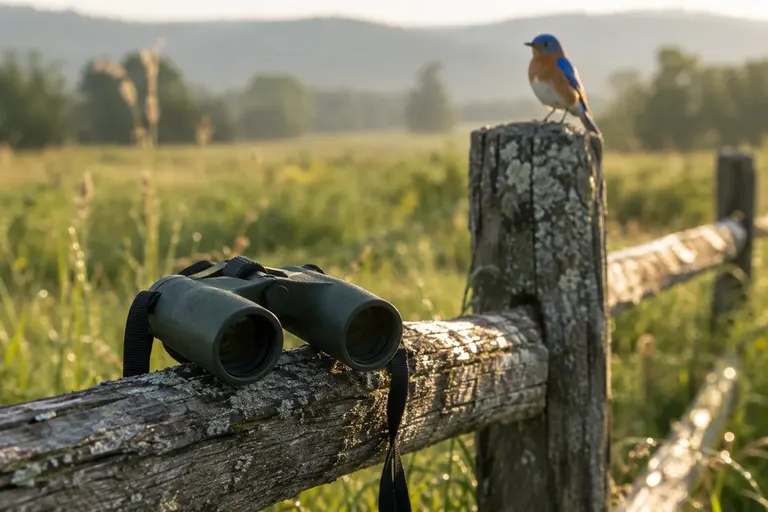
Bluebirds hunt from perches near their box, so a window with a view of the box and a pair of binoculars gives great looks without walking up to it. Keep your distance during the last week before fledging, when chicks can be startled into leaving early. Our guide to binoculars for watching birds from your window covers models suited to close range and indoor viewing.
A year of Eastern Bluebirds
| Season | What is happening | What to do |
|---|---|---|
| Late winter | Pairs scout nest sites | Clean and mount boxes before breeding season, add guards |
| Spring | First nests and eggs | Monitor weekly, remove House Sparrow nests |
| Summer | Second and sometimes third broods | Remove old nests after fledging, offer live mealworms |
| Fall | Flocks form, fruit becomes key | Let berries ripen, keep water available |
| Winter | Small flocks, communal roosting | Leave boxes up, offer mealworms and heated water |
Common mistakes when attracting Eastern Bluebirds
- Adding a perch to the box. It helps House Sparrows, not bluebirds.
- Mounting on a wooden fence post or tree. Easy access for snakes, raccoons and cats.
- Using a hole larger than 1 9/16 inches. Starlings can get in.
- Placing the box in the woods. Bluebirds want open ground.
- Never checking the box. Sparrow takeovers and predator damage go unnoticed.
- Feeding unlimited dried mealworms at nesting time. Use live worms for nestlings, in limited amounts, with calcium.
- Putting the box right beside a busy seed feeder. It draws sparrows and predators. For feeder placement basics, see where to put a bird feeder.
Nestling bluebirds that end up on the ground are usually close to fledging. Our guide on what to do if you find a baby bird explains when to leave it alone.
Sources
- Eastern Bluebird Life History, All About Birds, Cornell Lab of Ornithology
- Eastern Bluebird Identification, All About Birds, Cornell Lab of Ornithology
- Nestbox Recommendations fact sheet, North American Bluebird Society
- Mealworms fact sheet, North American Bluebird Society
- Monitoring Bluebird Nest Boxes fact sheet, North American Bluebird Society
- Eastern Bluebird nest box guidance, NestWatch
- Feeding Birds, Project FeederWatch
- Bluebird Feeder in Taupe and Blue Recycled Plastic, Birds Choice
Gear mentioned in this guide
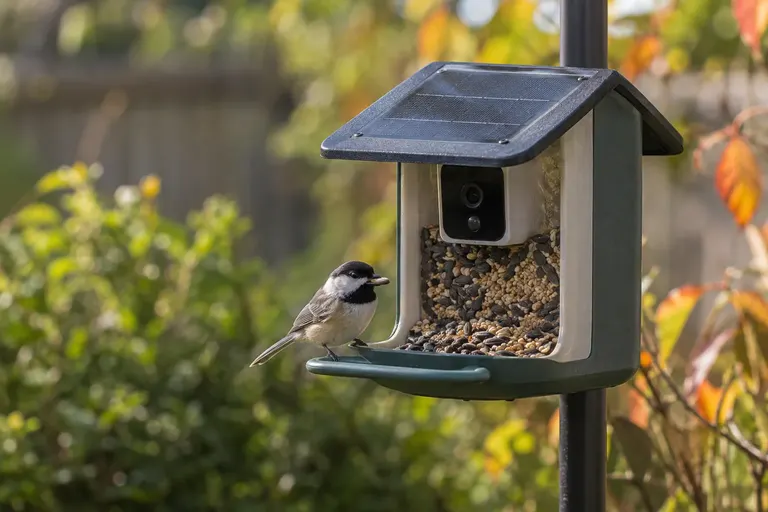
Birds Choice Recycled Bluebird Feeder
An enclosed feeder with 1.5 in entry holes and clear sides, designed so bluebirds go inside for mealworms while many larger birds are kept out.
- Best for
- Yards where starlings, grackles or jays take mealworms from open dishes.
- Skip it if
- Your bluebirds have never used an open dish yet; start with an open tray, then switch once they are regulars.
- Entry holes
- 1.5 in
- Size
- 13.5 x 10.25 x 8 in
- Weight
- 5.25 lb
- Material
- Recycled poly lumber
Kaytee Mealworms
Widely sold dried mealworms in several bag sizes, useful for teaching bluebirds where the feeder is before you move to live worms at nesting time.
- Best for
- Winter and early spring feeding, and for getting bluebirds used to a feeder.
- Skip it if
- You are feeding parents with nestlings; NABS advises live mealworms only for nestlings.
- Sizes
- 3.5 oz, 7 oz, 17.6 oz
- Processing
- Oven dried
Frequently asked questions
What is the best way to attract Eastern Bluebirds?
Put up a nest box made for bluebirds, with a 1.5 inch round entrance, mounted on a metal pole with a predator guard, facing open lawn or pasture with scattered trees and perches. Add mealworms, native berry shrubs and a bird bath. The Cornell Lab notes bluebirds rarely visit seed feeders, so nest boxes and mealworms are the main tools.
What size hole does an Eastern Bluebird house need?
The North American Bluebird Society recommends a 1.5 inch round hole for Eastern Bluebirds, or a 1 3/8 by 2 1/4 inch vertical oval, or a 1 1/8 inch horizontal slot. A 1 9/16 inch hole is acceptable for all three bluebird species. Larger holes admit European Starlings, which take over bluebird boxes.
Where should I put a bluebird house?
Mount it at least 5 feet high on a smooth metal pole with a predator guard, in an open area with short grass and scattered trees or perches. NABS suggests facing the entrance east or south and away from prevailing winds. Avoid dense woods, which favor wrens, and spots near barns or feeders busy with House Sparrows.
What do Eastern Bluebirds eat?
Mostly insects caught on the ground, such as caterpillars, beetles, crickets and grasshoppers, plus spiders. In fall and winter they switch heavily to fruit, including dogwood, sumac, holly, hackberry, juniper and mistletoe berries. At feeders, mealworms are the most reliable draw. Suet and chopped fruit are occasionally taken in cold weather.
Do Eastern Bluebirds stay in winter?
Many do across the southern and central parts of the range, and some even in the north, especially where fruit is plentiful. They often travel in small flocks in winter and may roost together in nest boxes on cold nights. Keeping boxes up, offering mealworms and heated water helps wintering birds.
How many times a year do Eastern Bluebirds nest?
The Cornell Lab lists 1 to 3 broods a year, with 2 to 7 pale blue or rarely white eggs, 11 to 19 days of incubation and 17 to 21 days in the nest. NABS advises removing the old nest after young fledge, since that can encourage the pair to renest in the same box.