Bird Roosting Box: How to Give Birds a Warm Winter Night
A bird roosting box gives small birds a sheltered spot to sleep on cold nights. How it differs from a nest box, which birds use it, and where to put one.
In this article
- What is a roosting box?
- Roosting box vs nest box: what is the difference?
- Do birds really use roosting boxes?
- Which birds use roosting boxes?
- How much does a roost help a small bird?
- What makes a good roosting box?
- Can you turn a nest box into a winter roost?
- Where should you put a roosting box?
- When should you put up a roosting box?
- Should you put bedding or nesting material in a roost box?
- Do roosting pockets and wicker pouches work?
- Are roosting boxes safe for bluebirds?
- How do you keep predators away from a roosting box?
- How do you clean a roosting box, and when?
- What about birds that don’t use boxes?
- Common mistakes with roosting boxes
- Sources
- Frequently asked questions
A bird roosting box is a wooden box where small birds sleep on cold winter nights. It has the entrance near the bottom, few vents and several perches inside, so body heat stays in and a group can huddle together. Put it up in autumn, sheltered from the wind, facing the winter sun.
Most of what gets written about birdhouses is about spring: hole sizes, nesting dates and fledglings. But a good box works all year. On long winter nights a sparrow-sized bird can lose a large share of its energy reserves just staying warm, and a dry cavity out of the wind makes that easier. This guide explains what a roosting box is, how it differs from a nest box, which birds use one, and how to set one up or convert a box you already have. It draws on Cornell Lab of Ornithology, NestWatch, the British Trust for Ornithology (BTO), the National Wildlife Federation and the French bird charity LPO.
What is a roosting box?
A roosting box is a winter shelter, not a nursery. Birds use it only to sleep in, mostly from late autumn to early spring, and they leave it at dawn.
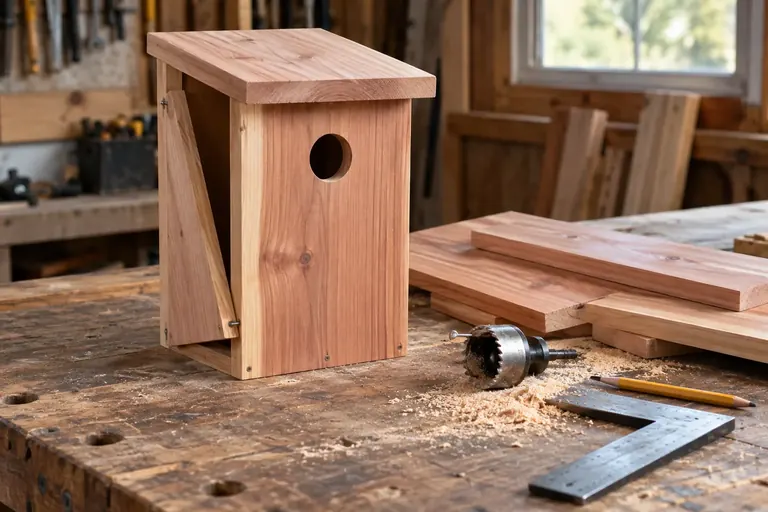
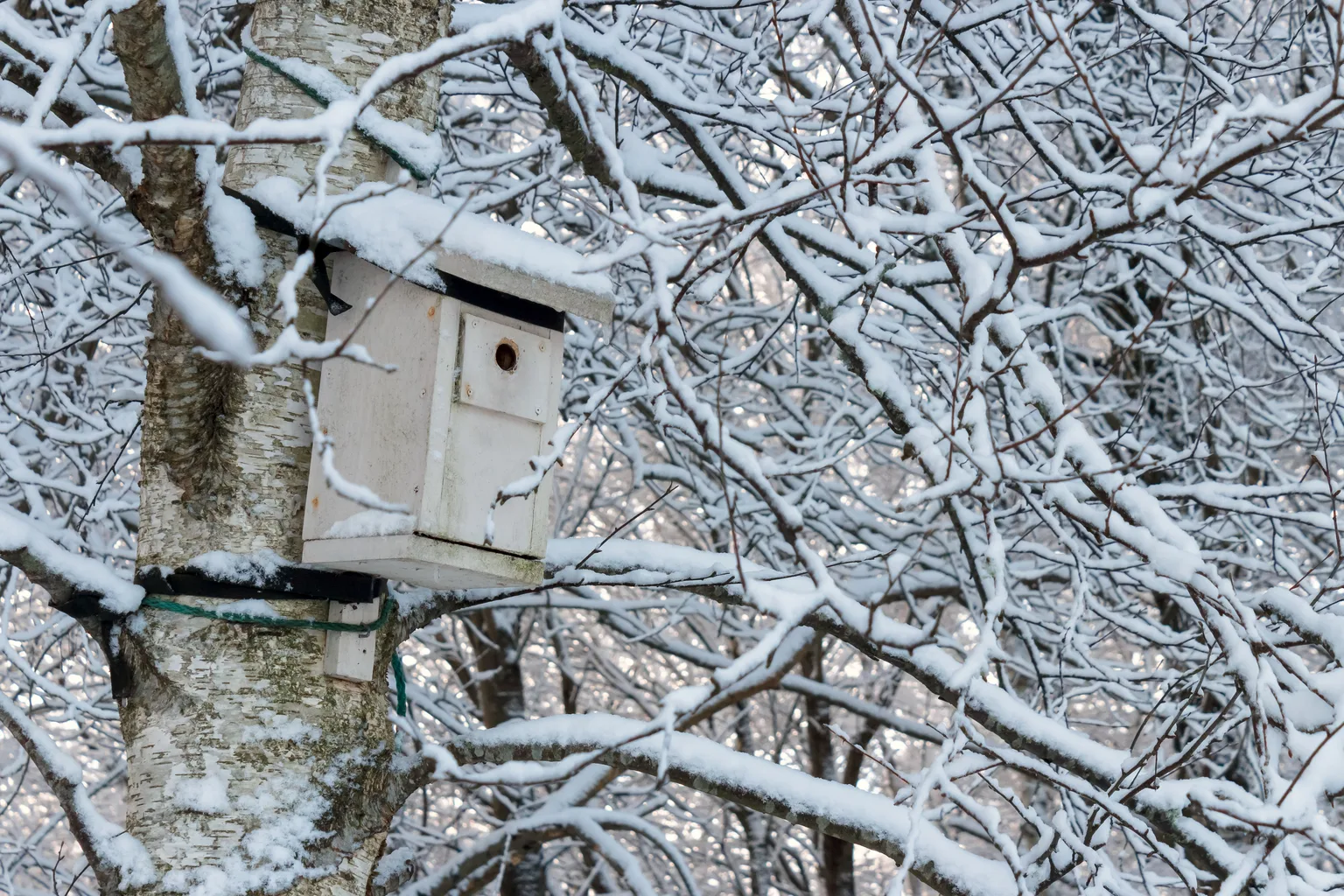
Cornell Lab describes roost boxes as boxes designed to stop the birds’ body heat from escaping. The main design changes compared with a nest box are simple: the entrance sits low on the front panel, there are fewer ventilation holes, and the inside has several small perches at different heights. Some designs also roughen the inside walls so woodpeckers can cling to them. A hinged top makes cleaning easy.
The idea copies what birds already do in the wild. Many small birds that nest in tree holes also sleep in tree holes, woodpecker cavities, wall crevices and dense ivy in winter. A roosting box simply adds one more safe, dry hole to your garden at the time of year when natural cavities are taken or wet.
Roosting box vs nest box: what is the difference?
The difference is where the heat goes. A nest box is built to stay cool and dry when it holds a nest of growing chicks in spring and summer, while a roosting box is built to hold warm air on a winter night.
| Feature | Nest box (spring) | Roosting box (winter) |
|---|---|---|
| Main job | Raising one family | Sleeping on cold nights |
| Entrance position | High on the front panel | Near the bottom of the front panel |
| Ventilation | Gaps or holes near the top | Few or none, to keep warm air in |
| Inside | Empty floor for the nest | Several staggered perches or dowels |
| Birds per box | Usually one pair and its brood | One to a dozen or more |
| Nesting material | Birds bring their own | None needed |
| Typical season | Late winter to summer | Late autumn to early spring |
The reason for the low entrance is that warm air rises. In a nest box the hole is high, so the warmest air at the top simply leaks out of it. In a roosting box the hole is low and the birds sit on perches above it, inside a pocket of warmer air.
Do birds really use roosting boxes?
Yes, and the best evidence comes from ordinary garden nest boxes. The BTO ran a Roosting Survey with its Garden BirdWatch volunteers, who checked boxes and other cavities at dusk and dawn in winter.
The results show how common winter roosting is:
| Species | Share of nest boxes used for roosting | Average birds per nest box | Average birds per other cavity |
|---|---|---|---|
| Blue Tit | Recorded by more than half of observers | 1.5 | 2.3 |
| Great Tit | Just over 1 in 8 boxes | Not given | Not given |
| Wren | Just over 1 in 8 boxes | 10.4 | 17.4 |
| House Sparrow | Less often | 3.5 | 6.1 |
Source: BTO Garden BirdWatch Roosting Survey, direct observations.
Two patterns stand out. Blue Tits usually roost alone, and the BTO notes they will chase other birds away when good roosting sites are scarce. Wrens do the opposite and pack in together. The BTO reports that the record for Wrens roosting in a single nest box is 63 birds. In the survey, other cavities such as gaps in walls and roofs held even bigger groups than nest boxes, possibly because they pick up heat from the house.
Nuthatches, Starlings and Tree Sparrows also turned up roosting in boxes, though less often. In North America, Cornell Lab lists bluebirds, chickadees, titmice, nuthatches and small woodpeckers as the birds most likely to use a roost box, plus flickers and screech-owls where the entrance is big enough.
So a roosting box is not a guaranteed sleeping place every night. It is one option among many. But it is an option birds clearly take.
Which birds use roosting boxes?
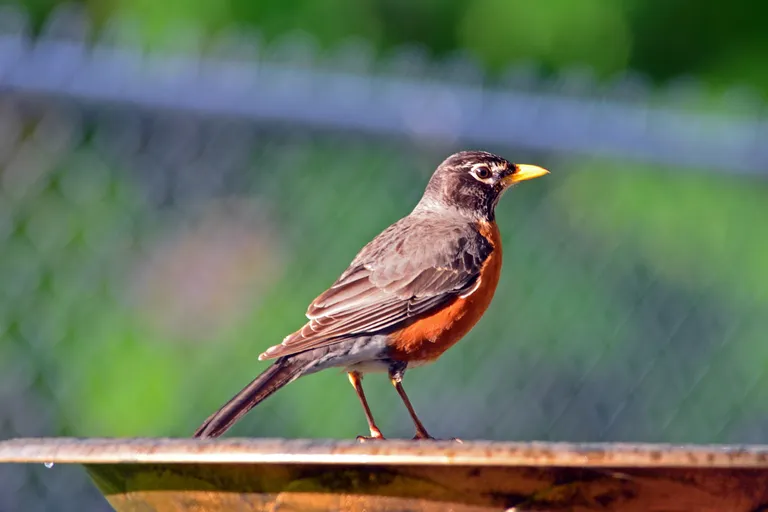
Cavity nesters use them. If a species nests in a hole or a box in spring, there’s a good chance it will sleep in one in winter. Birds that build open cup nests, such as robins in North America or Blackbirds in Europe, roost in dense shrubs and evergreens instead.
The most likely users by region:
- North America: Black-capped and Carolina Chickadees, Tufted Titmouse, White-breasted and Red-breasted Nuthatches, Eastern and Western Bluebirds, Downy Woodpecker, Carolina Wren and, in larger boxes, Eastern Screech-Owl.
- Britain and Europe: Blue Tit, Great Tit, Coal Tit, Wren, Nuthatch, House Sparrow, Tree Sparrow and Treecreeper.
If you already see chickadees, tits or wrens at your feeders, you have the right birds for a roosting box. Our chickadee house guide and wren house guide cover the spring side of the same species.
How much does a roost help a small bird?
A sheltered roost cuts heat loss, and heat loss is the biggest cost of a winter night for a small bird. Tiny birds have a lot of body surface for their weight, so they cool fast.
Birds have several ways to cope. They fluff their feathers, tuck in their bills and feet, shiver to make heat, and some let their body temperature drop at night. Researchers at Lund University in Sweden, who studied Blue Tits and Great Tits sleeping in nest boxes in winter, cite earlier work estimating that this night-time drop in body temperature may save at least 10 to 30 percent of a bird’s energy. Their daytime body temperature sits around 41 to 43 °C (about 106 to 109 °F), so even a few degrees down is a real saving.
A box adds to those savings in three ways:
- Out of the wind. Wind strips warm air from feathers. A closed box takes wind chill out of the night.
- Dry. Wet feathers lose their insulation. A box keeps rain, sleet and snow off.
- Shared warmth. Where birds huddle, like Wrens, each bird loses less heat to the air around it.
There’s a cost too. The same Lund study found that young tits sleeping in boxes reacted to the scent of a predator by keeping their body temperature higher, which uses more energy. A roost only helps if birds feel safe in it, which is why placement and predator guards matter as much as the box itself. You can read more about the whole toolkit in how birds stay warm in winter.
What makes a good roosting box?
A good roosting box is solid, tight and simple. Look for these features when you buy one, or build them in if you make your own:
- Low entrance. The hole sits in the lower third of the front panel.
- Right hole size. Cornell Lab gives about 2 inches (5 cm) for most small birds, about 1 1/2 inches (3.8 cm) to keep out starlings, and about 3 inches (7.6 cm) for flickers and screech-owls. A hole of 1 1/2 inches suits chickadees, titmice, nuthatches and wrens and keeps European Starlings out.
- Perches inside. Several short wooden dowels, staggered at different heights, so birds don’t sit on top of each other. Woodpeckers prefer rough inside walls they can cling to, so some boxes have scored wood or a strip of hardware cloth on the inner walls.
- Few vents. A roost box needs some air but far less than a nest box. Small vents can be plugged in the coldest months.
- Thick, plain wood. Untreated wood at least 1.5 cm (about 5/8 inch) thick holds a steadier temperature than thin panels or metal. Avoid dark paint that overheats in sun and avoid any wood preservative on the inside.
- Easy access. A hinged top or side panel lets you clean it once a year.
- No outside perch. A perch under the hole helps predators and sparrows more than the birds you want.
Roosting boxes are usually taller than nest boxes to fit several perches and a pocket of warm air above them. Research on the best roost box design is limited, as the National Wildlife Federation points out, so don’t worry about exact dimensions. The low hole, the perches and a tight build matter most.
Can you turn a nest box into a winter roost?
Yes, and it’s the easiest way to start. Cornell Lab and NestWatch both suggest winterizing the nest boxes you already have rather than buying new ones.
Here’s how:
- Clean it first. Take out the old nest, scald the inside with boiling water, let it dry and fix any loose panels. Our guide to cleaning out a birdhouse covers timing and the law in more detail.
- Flip the front panel. If the front comes off, turn it upside down so the hole ends up near the bottom. Many simple boxes allow this.
- Add perches. Fix two or three twigs or thin dowels across the inside, at different heights, above the hole.
- Plug most vents. Fill ventilation gaps and drainage holes with foam weatherstripping, rags or hay, or cover them from the outside with tape. NestWatch notes the goal is to keep the wind out.
- Don’t seal it completely. The National Wildlife Federation notes that birds tend to check a box before going in and avoid one that is completely dark.
- Reverse it in late winter. Take the plugs out and turn the front back before birds start nesting, so the box ventilates properly for chicks.
Foam weatherstripping is the tidiest option because it fills gaps well and pulls out easily in spring.
Where should you put a roosting box?
Put it high, sheltered from the wind, facing the winter sun, and out of reach of predators.
- Shelter. Cornell Lab recommends a spot out of prevailing winds. Next to a hedge, a wall or a group of evergreens works well.
- Sun. South-facing boxes get the most warmth from the winter sun, according to Cornell Lab. NestWatch suggests a spot with long afternoon sun, so the box holds its warmth into the evening. In Europe, the LPO recommends an east to south-east facing entrance and a spot that is neither in full sun nor full shade all day, which avoids overheating if the box stays up into spring.
- Height. Higher is usually better for roosting. The National Wildlife Federation reports anecdotal evidence that birds prefer roosts mounted about 10 feet (3 m) or higher in winter, possibly because they feel safer up high. A telescoping pole makes that easier to reach for cleaning.
- Mounting. A metal pole with a baffle is safest, since cats, raccoons, weasels and rats can all climb trees and wooden posts. See how to mount a birdhouse on a pole, tree or wall and our guide to poles and baffles.
- Distance from feeders. Keep the box a little way from busy feeders, so the comings and goings at dusk don’t draw attention to it.
When should you put up a roosting box?
Put it up in autumn, by October or November. That gives birds time to find it before the coldest nights arrive.
Birds check out possible shelters as the days shorten, and an established box is more likely to be used than one that appears in a cold snap. There’s a bonus too: Dutch and French guidance both point out that boxes put up in autumn give birds time to get used to them, which makes a spring nest in the same spot more likely. Our guide to when to put up birdhouses covers the spring timing.
If you’re converting a nest box, wait until the breeding season is clearly over and the box is empty. In Europe, the LPO suggests cleaning nest boxes in September or October. In the UK, unhatched eggs may only be removed from September to January under the Wildlife and Countryside Act 1981, and must be destroyed, not kept.
Should you put bedding or nesting material in a roost box?
No. Leave the box clean and empty, apart from the perches.
Birds don’t carry nest material into a winter roost, and Dutch guidance from Vroege Vogels notes that you don’t need to add any. Loose straw, cotton or pet fur can get damp, harbor mites and fleas, and take up the space birds need to huddle. Some fibers, like cotton wool or dryer lint, can also tangle around feet. A dry box holds warmth well on its own.
Do roosting pockets and wicker pouches work?
Sometimes, but less often than boxes. The small woven pouches sold as winter roosting pockets are mostly a Wren thing.
In the BTO Roosting Survey, observers watched about 60 roosting pouches, and roughly three in four went unused. Wrens made up about 20 percent of pouch records and were the only species using them widely. When Wrens did use them, they averaged about seven birds per pouch.
So pouches are cheap and harmless, and worth trying low in a dense hedge or under a porch roof if you have Wrens. But a proper wooden box with a low entrance gives more birds a better chance.
Are roosting boxes safe for bluebirds?
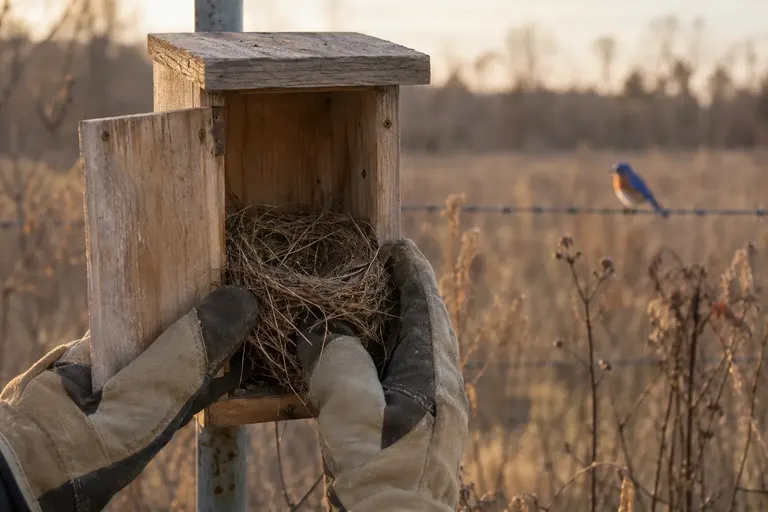
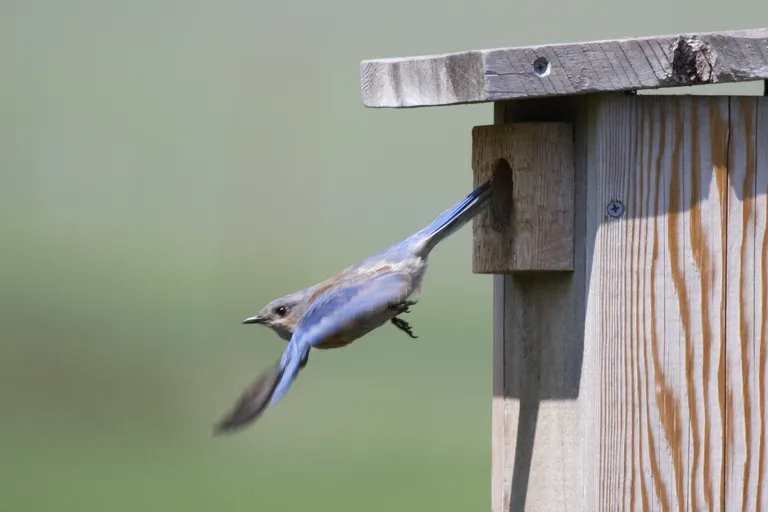
Use care with bluebirds. The National Wildlife Federation notes that some bluebird groups don’t recommend ready-made roost boxes for them, because bluebirds sleep in a heap on the floor rather than on perches. A low entrance can then let in drafts and lets a predator reach straight into the pile of birds.
A gentler option is to leave your usual bluebird box up over winter, cleaned and with its vents plugged as NestWatch suggests for any nest box, and keep the entrance where it is. Our bluebird house guide covers the box designs that work for them in spring.
How do you keep predators away from a roosting box?
Make the box hard to reach and hard to reach into. A roost full of sleeping birds is an easy meal if a predator can get to it.
- Mount it on a smooth metal pole with a baffle below the box, as both Cornell Lab and NestWatch recommend.
- Don’t add an outside perch under the hole.
- Use a thick front panel or a hole guard, so a raccoon or cat can’t reach far inside.
- Keep it away from fences, roofs and branches a cat or squirrel could jump from.
- Don’t open the box at night or poke a camera in while birds are roosting. If you have a nest box camera, winter is a good time to switch it on, and the BTO actively asks camera owners to report what they see.
How do you clean a roosting box, and when?
Clean it once a year, after winter and before nesting starts, if it will stay up as a nest box. Or clean it in autumn before winter use, if it served as a nest box over summer.
A roost box collects droppings, feathers and the odd parasite over winter. Take out any debris, scald the inside with boiling water and let it dry fully in the sun. Wildlife groups advise against insecticides and flea powders, which aren’t needed. The LPO recommends doing nest box cleaning in September or October, when there is less risk of disturbing bats, dormice or wasps that may have moved in. Wear gloves and wash your hands afterward.
What about birds that don’t use boxes?
Most garden birds never use a box at all. Open-cup nesters, finches, doves and thrushes sleep in dense cover instead, so give them that too.
- Evergreens. NestWatch suggests keeping evergreen trees and shrubs, which birds that don’t use cavities rely on, often huddling together on severe nights.
- Your old Christmas tree. NestWatch also suggests standing an old Christmas tree outside after the holidays, as a temporary shelter until the needles drop.
- Brush piles and ivy. A loose pile of branches or a wall of ivy gives wrens, sparrows and juncos instant cover. Here’s how to build a brush pile.
- Food and water. Shelter only works if birds can refuel. A steady winter feeding routine and open water do as much for survival as a warm roost.
Common mistakes with roosting boxes
These are the errors that leave a roost box empty or make it risky:
- Putting it up in January. Birds settle on roost sites as nights get colder. Autumn is better.
- Leaving it fully vented. A nest box with open vents and a high hole is a drafty bedroom. Plug the vents and use a low hole.
- Sealing it completely. A pitch-black box gets avoided. Leave a little light and air.
- Filling it with bedding. Empty and dry beats stuffed and damp.
- Facing it into the wind. Check where your cold winds come from, often north or west, and turn the hole away.
- Mounting it on a wooden fence post with no baffle. Cats and rats climb wood easily.
- Forgetting to reverse it in spring. A roost-converted nest box needs its vents and normal front back before nesting, or chicks can overheat.
- Expecting instant results. Many boxes go unused for a season. Leave it up, and it may be found the following winter or used as a nest box in spring.
If you want a box that does both jobs, our roundup of the best birdhouses and the birdhouse hole sizes by species chart help you pick one, and a convertible design lets you switch it between nest and roost each season.
Sources
- Attract Birds With Roost Boxes, Cornell Lab of Ornithology (All About Birds)
- Nestkasten nu ophangen, Vroege Vogels (BNNVARA)
- Winter-Proofing Your Birdhouse, NestWatch (Cornell Lab)
- Winter roosts for birds, National Wildlife Federation
- Roosting Survey results: direct observations, British Trust for Ornithology
- Age-dependent effects of predation risk on night-time hypothermia in two wintering passerine species, Andreasson, Nord and Nilsson, Oecologia (2019)

Frequently asked questions
What is the difference between a roosting box and a birdhouse?
A birdhouse is built for raising young in spring, so it has a hole near the top and plenty of ventilation. A roosting box is built for sleeping in winter. Cornell Lab describes it as having the entrance near the bottom so warm air stays inside, fewer ventilation holes, and several staggered perches so a group of birds can sit together.
Do birds actually use roosting boxes?
Yes, though not every box gets used. In the BTO Roosting Survey, Blue Tits were recorded roosting in nest boxes by more than half of observers, and Wrens and Great Tits each used just over one in eight boxes. Wrens roosted in groups averaging about ten birds per box, and the British record is 63 Wrens in a single box.
Can I use a normal nest box as a roosting box?
Often, yes. Cornell Lab and NestWatch both suggest cleaning the box, then turning the front panel upside down if it is removable so the hole sits near the bottom, adding a few twigs as perches and plugging some vents with foam weatherstripping or rags. Undo the changes in late winter before birds start nesting.
Should I put straw or bedding in a roosting box?
No. Birds roosting in winter don't bring nest material, and Dutch guidance from Vroege Vogels notes that you don't need to add any. Loose bedding can get damp, hold parasites and fill the space where birds huddle. A clean, dry box with perches and a few plugged vents is warmer than a box stuffed with material.
Which way should a roosting box face?
Face it away from the prevailing wind and toward the winter sun. Cornell Lab notes that south-facing boxes get the most warmth from the winter sun, and NestWatch suggests a spot with long afternoon sun so the box stays warm into the evening. In Europe, the LPO recommends an east to south-east facing hole and a spot that is not in full sun all day.