Hanging Bird Bath: Depth, Safe Spots and Easy Care
A hanging bird bath works best shallow, level and out of cats' reach: under 5 cm deep, a rough base, near cover. Where to hang it, balcony tips and cleaning.
In this article
- Quick answer: what makes a good hanging bird bath?
- How deep should a hanging bird bath be?
- Which birds use hanging bird baths?
- Where should you hang a bird bath?
- How do you hang a bird bath so it stays level?
- Glass, metal or ceramic: which material is best?
- Can you use a hanging bird bath on a balcony?
- How do you keep a hanging bird bath clean?
- What should you do with a hanging bird bath in winter?
- How do you get birds to use a new hanging bath?
- Common mistakes with hanging bird baths
- Sources
- Frequently asked questions
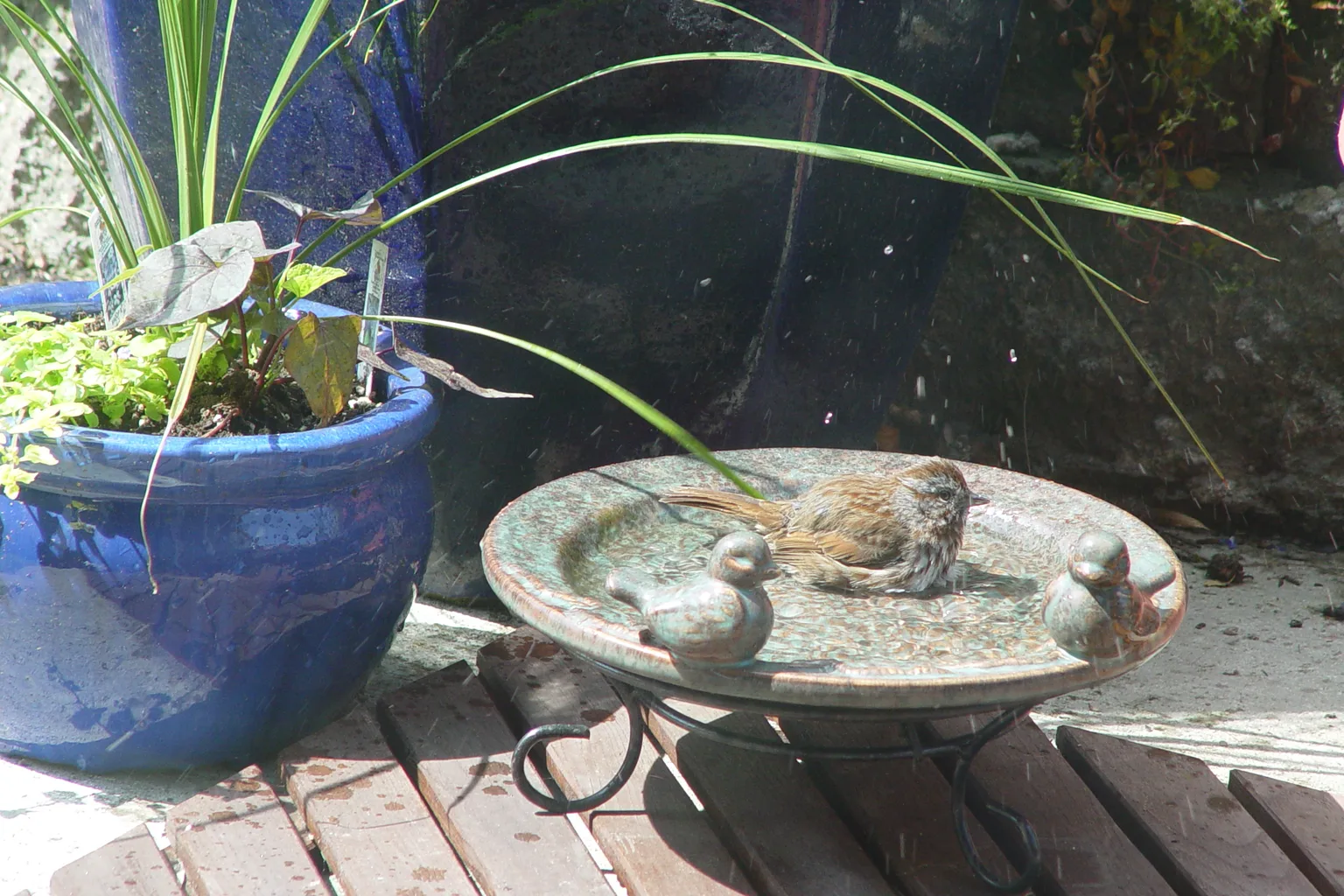
A hanging bird bath works when it copies a safe puddle in the air: shallow water (no more than about 5 cm in the middle), a rough, non-slip base, a level bowl that barely swings, and a spot high enough to keep cats away with cover a short flight off. Get those four things right and small garden birds will drink and bathe in it all year.
Hanging baths suit small gardens, patios and balconies where a pedestal bath will not fit. They also lift water out of reach of most cats, which is why NABU recommends a bird bath at least 1.5 m off the ground. But a hanging bowl has its own problems: many are too deep, some are slippery glass, and a bowl on a single hook can swing and spill. This guide covers how to choose, hang and look after one.
Quick answer: what makes a good hanging bird bath?
| Feature | What to look for | Why it matters |
|---|---|---|
| Depth | Under 2.5 cm at the edge, about 5 cm in the middle | Songbirds wade, they don’t swim |
| Width | As wide as fits, ideally 30 cm or more | Room to bathe, and the water lasts longer |
| Base | Textured, or add flat stones | Wet feet slip on smooth glass and glaze |
| Edge | Gently sloping, with a rim birds can grip | Birds test the water from the edge first |
| Hanger | Three chains or a rigid bracket | Keeps the bowl level and steady |
| Material | Frost-tolerant metal, resin or thick glass | Thin ceramic and concrete can crack in frost |
| Cleaning | Lifts off the hook easily | You’ll clean it more often |
The RSPB’s own design advice for a garden bird bath is a maximum depth of about 10 cm, very shallow sloping sides and a width of more than 30 cm. For a hanging bowl, which is usually smaller, the shallower Cornell Lab figures are the safer target.
How deep should a hanging bird bath be?
About 2.5 cm at the edges and no more than about 5 cm in the deepest part. Cornell Lab’s All About Birds gives exactly those numbers, and Vogelbescherming Nederland says the center of a bird bath should be no deeper than 5 cm because birds avoid deep water. The LPO, the French bird protection league, notes that 3 to 4 cm is enough for small species, while larger birds need up to 9 cm.
Most hanging baths are bought for small birds, so aim for the shallow end. If your bowl is deeper:
- Add flat stones to one side so there is a shallow shelf to stand on.
- Lay clean gravel across the bottom to raise the floor and add grip.
- Fill it only partway. A half-full deep bowl still works if the edge slopes gently.
A stone or short stick that breaks the surface also lets birds drink without getting wet, which Cornell Lab suggests for any bath.
Which birds use hanging bird baths?
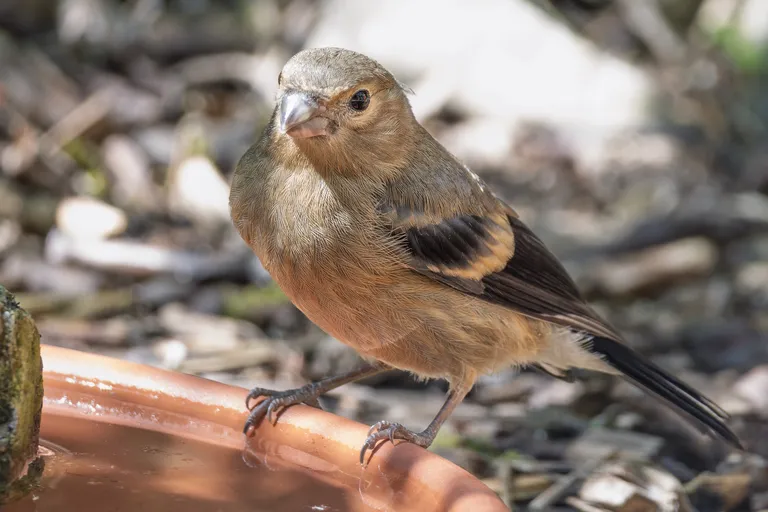
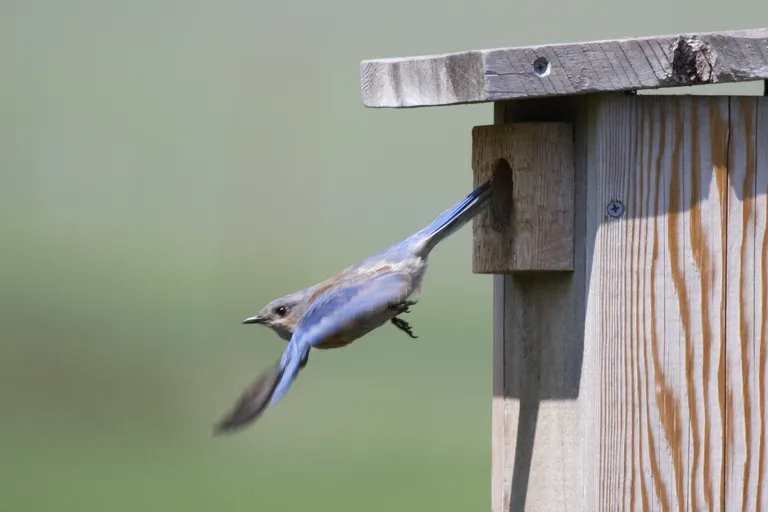
Birds that already feed off the ground and land easily on small, moving perches use them most. In Europe that means Blue Tits, Great Tits, Coal Tits, Goldfinches, Greenfinches, House Sparrows and Chaffinches. In North America chickadees, titmice, House Finches, goldfinches, sparrows and warblers are the usual visitors.
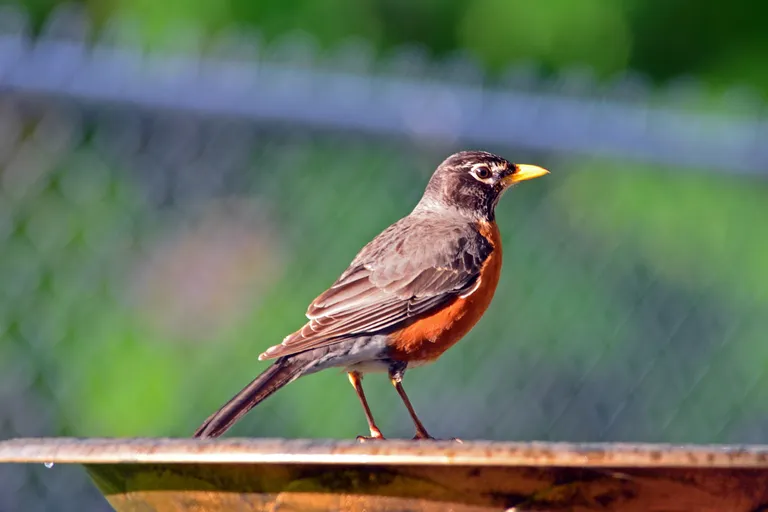
Birds that drink at puddles and stream edges, such as thrushes, Blackbirds, American Robins and doves, often prefer a bath on or near the ground. If you have the space, a low bath plus a hanging one covers both groups.
Where should you hang a bird bath?
In partial shade, out of cats’ reach, with cover a short flight away but not right underneath. These are the same rules as for any bath, adjusted for height.
- Height. NABU recommends at least 1.5 m above the ground to keep birds safe from cats. Hang it where a cat cannot jump from a fence, roof or wall onto the bowl.
- Cover. Vogelbescherming Nederland advises placing water near a shrub or small tree so birds can escape danger, because wet birds cannot fly off quickly. The RSPB adds that you should avoid long grass or low bushes right next to the bath, where a cat could hide.
- Shade. Partial shade keeps water cooler in summer and slows algae. In winter, a sunnier, sheltered spot thaws sooner.
- Away from feeders. Keep the bath a few meters from seed feeders so hulls and droppings don’t land in the water.
- Away from mid-range windows. Hang it very close to glass (under about 1 m) or well away from it. Birds flushed from mid-range can hit the window at full speed.
- Not directly under a busy branch. Birds perched overhead foul the water.
For a full checklist on placement, including sun and distances, see where to put a bird bath, and for cat-proofing ideas, cats and birds.
How do you hang a bird bath so it stays level?
Use three chains or a rigid bracket, and a hook strong enough for the full weight. Water is heavy: every liter weighs about 1 kg, so a wide bowl holding 2 to 3 liters plus a metal or glass dish can easily reach 4 to 5 kg, and more when a crowd of starlings or a pigeon lands on the rim.
- Three-point chains keep the bowl level far better than a single loop. Adjust each chain until the water line sits evenly around the rim.
- Rigid brackets that screw into a post, wall or railing barely move at all, which shy birds prefer.
- Shorter is steadier. A long chain turns the bowl into a pendulum in the wind.
- Check the hook. Use a screw-in hook or bracket rated well above the loaded weight, and check branches for rot.
- Make it easy to unhook. If you need a ladder to reach it, you will clean it less often.
A bowl that tilts spills water and leaves one side dry and the other too deep, so check the level after every refill for the first week.

Glass, metal or ceramic: which material is best?
Each material works if the base gives grip and it survives your winter.
| Material | Pros | Watch out for |
|---|---|---|
| Glass | Attractive, easy to wipe clean | Slippery unless textured; add stones |
| Metal (steel, copper finish) | Light, frost-tolerant | Heats up in full sun; check the coating |
| Resin or plastic | Light, cheap, frost-tolerant | Can fade or crack in strong UV over years |
| Ceramic or terracotta | Natural look, good grip if unglazed | Can crack when water freezes in it |
| Concrete | Heavy and stable | Too heavy for most hooks; can crack in frost |
Cornell Lab warns that glazed surfaces can be slippery and that concrete can crack below freezing. For a deeper comparison of bath materials in general, see our guide to the best bird baths, which also covers a hanging option alongside pedestal, deck and ground baths.
Can you use a hanging bird bath on a balcony?
Yes, and it is one of the easiest ways to offer water in a flat. Vogelbescherming Nederland suggests a hanging water bowl as an option for both the garden and the balcony.
- Pick the quietest corner, away from the door and seating.
- Use a ceiling hook or railing bracket that cannot tip over the edge.
- Add potted shrubs or climbers as a landing and preening spot.
- Keep it away from glass doors, or mark the glass.
- Think about the neighbors. Hang it where splashes, droppings and cleaning water won’t drip onto the balcony below.
- Check building rules if you rent, since some forbid fixings in railings or ceilings.
Balcony bowls are small and warm up fast, so they need fresh water more often than a garden bath.
How do you keep a hanging bird bath clean?
Change the water daily and scrub the bowl weekly. The RSPB advises refilling with fresh water every day and disinfecting the bath thoroughly once a week, and Cornell Lab says to change the water every day or two. NABU recommends fresh water daily and scalding the bath with hot water to kill germs. The LPO suggests at least once a day in high summer and three times a week in winter.
Hygiene matters because shared water spreads disease. The RSPB describes trichomonosis as a highly contagious infection that spreads where sick and healthy birds share food and water. If you see sick or dead birds, the RSPB and NABU both advise stopping feeding and emptying baths for a while, so they can’t become a point of infection. Our guide to sick birds at the feeder lists the signs.
Fresh water also beats mosquitoes. Cornell Lab notes that mosquitoes lay eggs in birdbaths, and frequent water changes stop the larvae from emerging. Vogelbescherming suggests rinsing the bowl through with a garden hose. For a step-by-step routine, see how to clean a bird bath.
What should you do with a hanging bird bath in winter?
Keep it if you can manage the water, but never add anything to stop it freezing. Cornell Lab warns that antifreeze is poisonous to all animals, including birds, and that glycerin can mat feathers and lead to hypothermia. The LPO adds that salt, alcohol and oil don’t belong in bird water either.
Safer options:
- Refill with lukewarm water in the morning, as the LPO suggests, and empty the bowl before a hard frost to stop it cracking.
- Move it to the sunniest, most sheltered spot you have.
- Bring fragile ceramic or glass bowls indoors during long freezes.
- Use a heated bath instead if you want water all winter. Cornell Lab recommends plugging any heater into a ground-fault protected outlet.
In very hard frost the LPO advises preventing birds from bathing, since wet feathers lose insulation. See keeping a bird bath ice-free in winter and our heated bird bath guide for options.
How do you get birds to use a new hanging bath?
Birds can take days or weeks to find new water, especially in wet weather. To speed it up:
- Hang it within sight of your feeders (but not under them).
- Add movement. Cornell Lab notes that dripping water attracts birds; a bucket with a tiny hole hung above the bath works, or a small solar fountain in a wide bowl.
- Keep it shallow and full. A bowl that dries out by noon teaches birds not to come back.
- Stop the swing. Shorten the chains or switch to a bracket if the bowl moves in the breeze.
Common mistakes with hanging bird baths
- Too deep. A 10 cm bowl filled to the brim is a hazard for small birds.
- Slippery base. Smooth glass with nothing to grip.
- A single hook and a long chain. The bowl tilts and swings.
- Hanging it in a dense hedge. It looks natural, but it gives cats and sparrowhawks cover.
- Directly under a feeder. Seed and droppings foul the water within hours.
- Hard to reach. If it needs a ladder, it won’t get daily water.
- Leaving it full in a hard frost. Ice can crack ceramic, glass and concrete.
Sources

Frequently asked questions
How deep should a hanging bird bath be?
Shallow. Cornell Lab advises edges no deeper than 1 inch (2.5 cm), sloping to about 2 inches (5 cm) in the middle, and Vogelbescherming Nederland also says the center should be no deeper than 5 cm. Many hanging bowls are deeper than that, so add a few flat stones or a layer of clean gravel until small birds can stand with dry backs.
Where is the best place to hang a bird bath?
Hang it from a sturdy branch, bracket or pergola beam in partial shade, with a shrub or tree a short flight away and no dense cover right underneath where a cat could wait. Keep it a few meters from feeders so seed and droppings stay out, and either very close to a window or well away from it to cut collision risk.
Do birds actually use hanging bird baths?
Yes, mainly small, agile birds such as tits, chickadees, finches, sparrows and warblers, which already feed off the ground. Ground-loving birds such as thrushes and doves often prefer a low bath. A hanging bath gets used most when it hangs level, barely swings, is shallow with a rough base and has fresh water every day or two.
Can I put a hanging bird bath on a balcony?
Yes. Vogelbescherming Nederland suggests a hanging water bowl for the garden or the balcony. Use a strong ceiling hook or railing bracket, keep the bowl away from glass doors, place potted plants nearby as a landing spot and check that splashes and cleaning water cannot drip onto neighbors below.
How often should I clean a hanging bird bath?
Change the water daily if you can and scrub the bowl at least once a week. The RSPB advises fresh water every day and a thorough weekly clean, and Cornell Lab says every day or two. Small hanging bowls foul and warm up fast. If you cannot keep up, the RSPB says it is better to leave the bath dry.