How to Build a Birdhouse From One 1x6 Board (Cut List)
How to build a birdhouse from one 1x6 board: cut list in inches and cm, hole sizes by species, vents, drainage, a hinged side for cleaning and safe mounting.
If you buy through links on this page we may earn a commission, at no cost to you. It never decides what we recommend. How we earn
In this article
- What do you need to build a birdhouse?
- What is the cut list for a one-board birdhouse?
- How do you build a birdhouse step by step?
- Which hole size should you drill, and for which birds?
- Why shouldn’t a birdhouse have a perch?
- Should you paint or stain a birdhouse?
- How do you keep a birdhouse clean?
- Where should you put a birdhouse?
- How much does it cost to build a birdhouse?
- Pre-install checklist: will birds use your box?
- What are the alternatives to building a birdhouse?
- Common mistakes when building a birdhouse
- Sources
- Gear mentioned in this guide
- Frequently asked questions
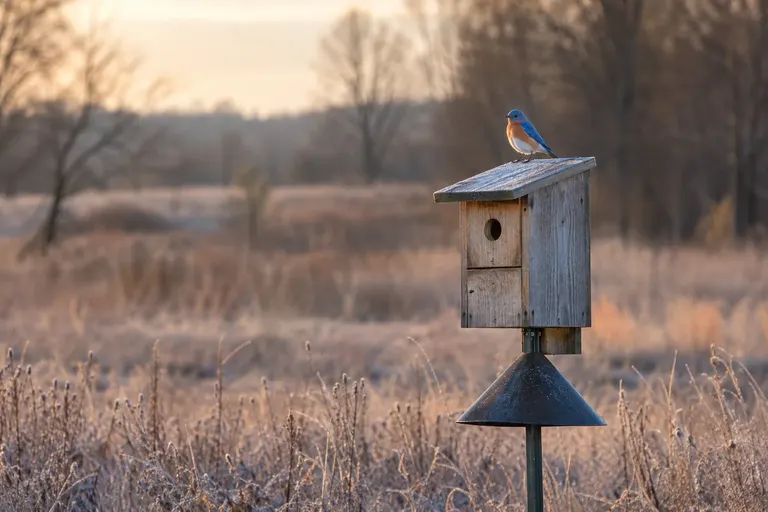
To build a birdhouse that birds will actually use, cut six pieces from one 1x6 board of untreated cedar or pine, drill an entrance hole sized for your target species, add vents and drainage, make one side swing open for cleaning, and skip the perch. Mount it on a baffled pole about 5 feet (1.5 m) up.
Below are the exact cut list, tools, step-by-step assembly, how to adapt the design for different birds, and the mistakes that cost the most nests. The plan follows the features recommended by Cornell Lab’s NestWatch program and bluebird societies: thick untreated wood, a recessed floor, ventilation, a roof overhang and easy access for monitoring.
What do you need to build a birdhouse?
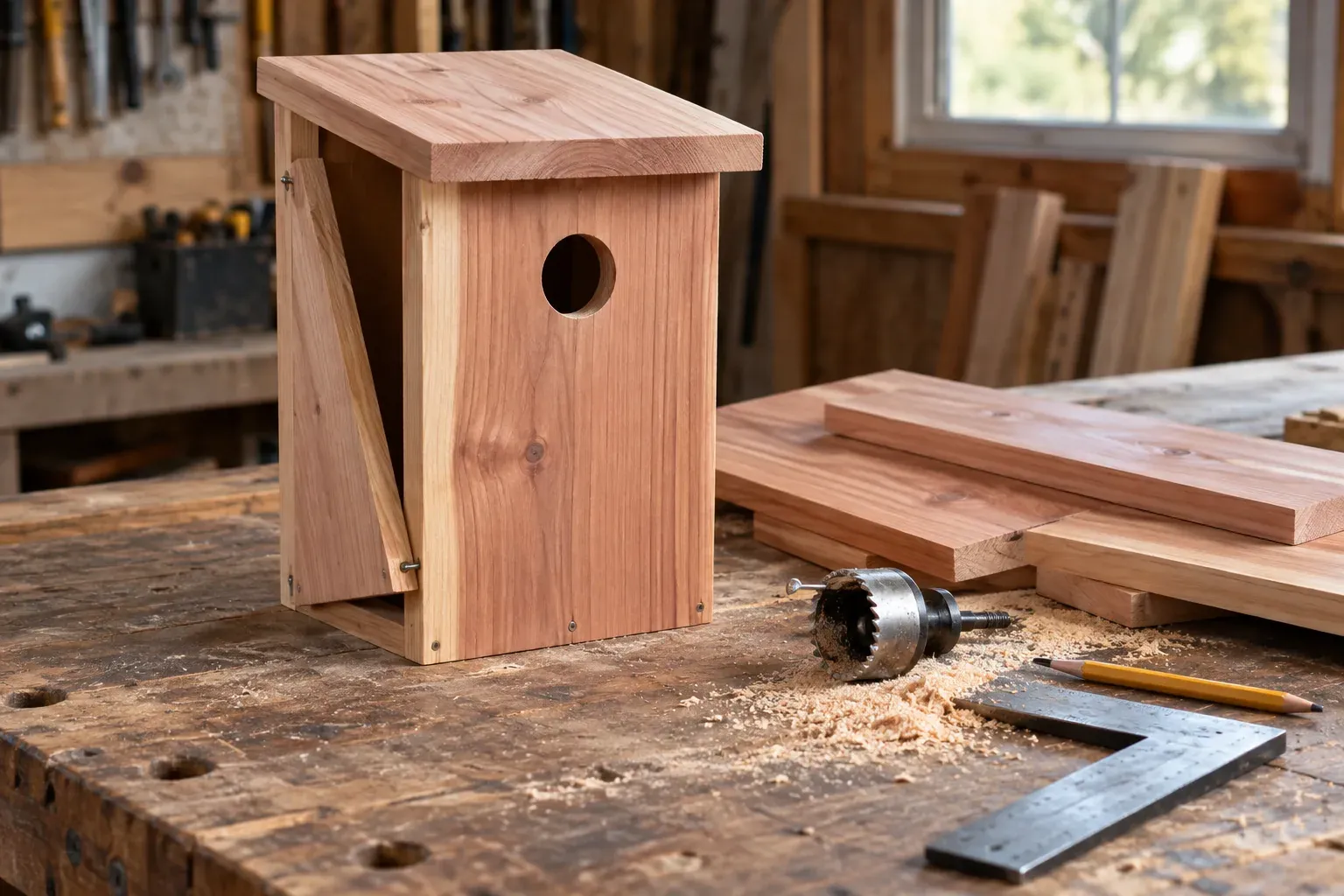
You need one 1x6 board at least 5 feet long, about 20 exterior screws or galvanized nails, two pivot nails, a saw, a drill and a hole saw or spade bit that matches your entrance size. Nothing else is required.
A “1x6” is a nominal lumber size. The actual board is 3/4 inch thick and 5-1/2 inches wide (19 x 140 mm). That thickness insulates eggs and chicks far better than the thin plywood on many decorative houses.
Materials
- One 1x6 board, 5 or 6 feet long. Untreated cedar is ideal. Cypress and redwood also last. Untreated pine is fine but will need replacing sooner.
- Screws or nails. 1-5/8 inch (40 mm) exterior deck screws or galvanized ring-shank nails. Screws hold better as wood swells and shrinks.
- Two 6d galvanized nails for the pivot of the hinged side.
- One screw or a bent nail to lock the side closed.
Tools
| Tool | What it does in this build | Must have? |
|---|---|---|
| Handsaw, circular saw or miter saw | Crosscuts and the angled roof cut | Yes |
| Drill and driver | Pilot holes, screws, vent and drain holes | Yes |
| Hole saw or spade bit in your entrance size | Cuts the entrance cleanly | Yes |
| Tape measure, pencil and carpenter’s square | Accurate, square cuts | Yes |
| 1/4 inch drill bit | Drainage and ventilation holes | Yes |
| Clamps | Hold pieces while fastening | Helpful |
| Rasp or sandpaper | Smooths the hole edge and cut ends | Helpful |
| Utility knife or saw | Scores grooves inside the front | Helpful |
A single matching hole saw is enough for one species. For several, a general-purpose set helps. The Milwaukee 49-22-4185 Hole Dozer 28-Piece Hole Saw Kit includes 22 saws from 3/4 to 4-3/4 inches, which covers 1-1/8, 1-1/4, 1-1/2 and 3 inch entrances, among others. Check price on Amazon
What is the cut list for a one-board birdhouse?
Six pieces come out of about 55 inches (140 cm) of 1x6, so a 5-foot board works and a 6-foot board leaves spare wood for a mistake. The finished box has an inside floor of 4 x 5-1/2 inches and an entrance about 6 inches above the floor.
| Piece | Qty | Length (in) | Length (cm) | Width | Notes |
|---|---|---|---|---|---|
| Back | 1 | 14 | 35.6 | Full 5-1/2 in (14 cm) | Extends below the box for mounting |
| Front | 1 | 9 | 22.9 | Full 5-1/2 in (14 cm) | Entrance hole goes here |
| Sides (cut from one blank) | 2 | 19-1/4 blank | 48.9 blank | Full 5-1/2 in (14 cm) | One diagonal cut makes two sides, each 10 in (25.4 cm) at the back and 9 in (22.9 cm) at the front |
| Roof | 1 | 8 | 20.3 | Full 5-1/2 in (14 cm) | Overhangs the front by about 1-3/4 in |
| Floor | 1 | 4 | 10.2 | Full 5-1/2 in (14 cm) | Corners clipped for drainage |
Total length before saw kerfs is 54-1/4 inches (about 138 cm). Every piece uses the full width of the board, so you never have to rip a board lengthwise.
Why these dimensions?
- Floor of 4 x 5-1/2 inches (10 x 14 cm): close to the 4 x 4 to 5 x 5 inch floors recommended for bluebirds, and workable for Tree Swallows, chickadees, titmice and wrens. A much bigger floor means more nesting material and a more crowded box for predators to reach.
- Entrance about 6 inches (15 cm) above the floor: deep enough that a cat or raccoon paw has a harder time reaching the nest cup.
- Roof sloping toward the front: rain runs off over the entrance instead of pooling against the back.
- Back longer than the box: gives you a flange to screw to a pole bracket, post or wall without driving screws through the nest chamber.
How do you build a birdhouse step by step?
Cut all six pieces, drill the holes while the pieces are flat, then assemble around the back board.
- Mark and cut the back, front, roof and floor. Use a square on every cut.
- Cut the side blank, then split it on a diagonal. On the 19-1/4 inch blank, mark 10 inches from the left end along the top edge and 9-1/4 inches from the left end along the bottom edge. Join the marks and cut. Each side ends up about 10 inches tall at the back and about 9 inches at the front, with the saw kerf taking up the difference.
- Shorten one side by 1/4 inch at the top. This will be the hinged door. The gap at the top gives it room to swing without binding on the roof, and doubles as a ventilation slot.
- Drill the entrance hole in the front. Center it side to side, with its center 7 inches up from the bottom edge. Clamp the board to scrap wood so the hole saw does not tear out the back face. Sand the edge smooth.
- Rough up the inside of the front. Cut three or four shallow horizontal saw kerfs, or score grooves with a knife, from the floor line up to just below the hole. Chicks climb these to reach the entrance when they fledge.
- Clip the floor corners. Cut about 3/8 inch (1 cm) off each corner, and drill two or three 1/4 inch holes through the middle. Water that blows in drains out instead of soaking the nest.
- Drill vent holes. Two 1/4 to 5/8 inch holes high on the fixed side, just under the roof line, let hot air escape on summer afternoons.
- Attach the fixed side to the back. Lay the back flat. Screw the fixed side onto it along its back edge, with the tops matching, so the back projects about 3 inches below the side and about 1 inch above it.
- Fit the floor. Set it between the sides, recessed about 1/4 inch up from their bottom edges. The recess keeps the floor’s end grain out of standing water. Screw it through the fixed side and the back.
- Attach the front. Screw it to the front edge of the fixed side and to the floor. Its top sits slightly below the roof line, which leaves a second small air gap.
- Hang the hinged side. Hold it in place, then drive one pivot nail through the front and one through the back into the side, both about 1 inch below the top. The side should swing out at the bottom. Drive a screw or bent nail near the bottom through the front to lock it closed.
- Attach the roof. Butt it against the back, overhanging the front, and screw it into the back and the fixed side only. Never fasten the roof to the hinged side, or it will not open.
Check that the door swings freely and latches firmly before you mount it.
Which hole size should you drill, and for which birds?
Drill the smallest hole your target bird can use. For most North American backyard boxes that means 1-1/8 inches (29 mm) for chickadees, 1-1/4 inches (32 mm) for titmice and nuthatches, or 1-1/2 inches (38 mm) for bluebirds and Tree Swallows.
One box design works for several species if you change the hole and the mounting. Our birdhouse hole size chart by species covers more than 20 North American and European birds.
Adapt-this-box decision table
| Target bird | Hole size | Hole center above floor | Mounting height | Change to this design |
|---|---|---|---|---|
| House Wren | 1 to 1-1/8 in (25 to 29 mm) | About 4 to 6 in | 5 to 10 ft | None; can hang from a branch |
| Black-capped or Carolina Chickadee | 1-1/8 in (29 mm) | About 6 in | 5 to 15 ft | Add 1 in of wood shavings to the floor |
| Tufted Titmouse | 1-1/4 in (32 mm) | About 6 in | 5 to 15 ft | Mount near woods or mature trees |
| White-breasted Nuthatch | 1-1/4 to 1-3/8 in (32 to 35 mm) | About 6 in | 5 to 20 ft | Tree mount near mature deciduous trees |
| Eastern or Western Bluebird | 1-1/2 in (38 mm) | About 6 in | About 5 ft | Baffled pole in open grass |
| Tree Swallow | 1-3/8 to 1-1/2 in (35 to 38 mm) | About 6 in | About 5 ft | Open area, ideally near water |
| Blue Tit (Europe) | 25 mm (1 in) | 12.5 cm (5 in) or more | 2 to 4 m | Face between north and east in the UK |
| Great Tit or House Sparrow (Europe) | 28 or 32 mm | 12.5 cm (5 in) or more | 2 to 4 m | Sparrows like boxes under eaves |
House Wrens fill nearby boxes with sticks, so keep wren boxes away from bluebird boxes. In North America, a 1-1/2 inch hole also admits House Sparrows, which are non-native and kill bluebirds and swallows at the nest. If sparrows are common where you live, see the monitoring advice in our Eastern Bluebird guide before you put up a bluebird-sized box. Species pages such as the House Wren cover habitat in more detail.
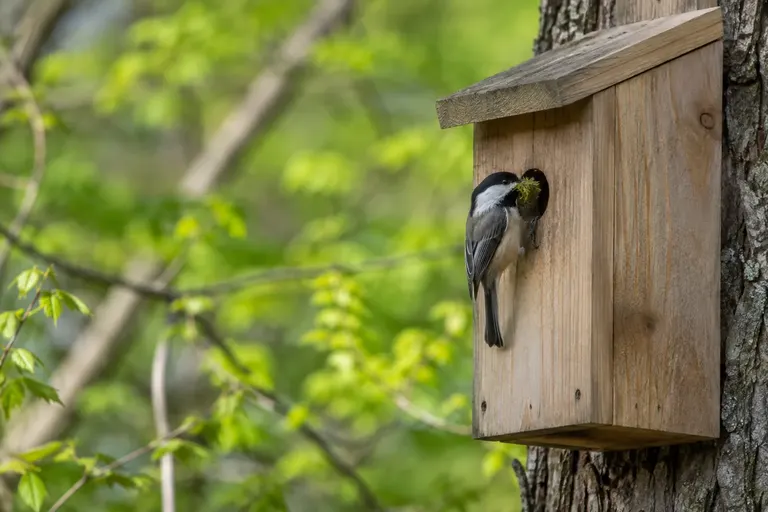
For chickadees in particular, the box is only part of it. Our guide to chickadee houses covers placement and the details these small, choosy birds respond to.
Why shouldn’t a birdhouse have a perch?
Native cavity nesters do not need a perch, and a perch helps the birds and predators you want to keep out. Bluebirds, chickadees, wrens and swallows grip the edge of the hole or fly straight in.
A perch gives House Sparrows and starlings a place to sit while they harass the owners, and gives a raccoon or cat something to brace against while reaching in. NestWatch advises against perches on nest boxes for this reason.
Should you paint or stain a birdhouse?
Leave it bare. Untreated cedar weathers to a silver gray and lasts for years without any finish, and bare wood is what the birds are adapted to.
If you do want to finish the outside, follow three rules:
- Outside only. Never paint, stain or seal the inside, the entrance hole or the inside of the door. Fumes and smooth surfaces are both problems for nestlings.
- Light colors. Tan, gray or muted green. Dark colors absorb sun and can push the inside of a box to dangerous temperatures.
- Water-based, and early. Use a water-based exterior paint or stain and let it cure for several weeks before birds arrive.
Never use pressure-treated lumber or wood preservatives. Older treated wood contained arsenic compounds, and modern treatments are still not recommended for nest boxes by NestWatch or bluebird societies.
How do you keep a birdhouse clean?
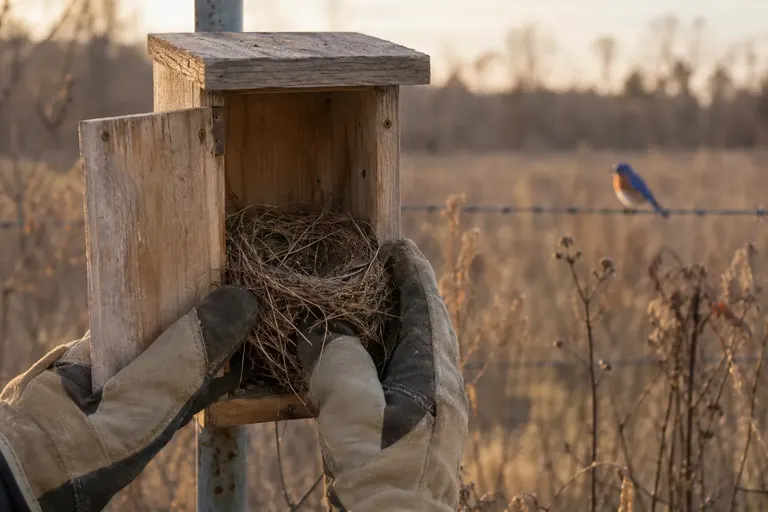
Swing the hinged side open, lift out the old nest after the young fledge, and scrape the box clean. That is the reason this design has a pivoting side instead of a fixed box with a small hole.
Clean after each nesting attempt and again in late fall or winter. Old nests can hold mites, blowfly larvae and mold. Our guide to when and how to clean out a birdhouse covers timing, the legal side of touching nests and what to do if you find eggs or wasps.
The side door also makes brief weekly monitoring checks easy, which tell you when to clean and when to leave the box alone.
Where should you put a birdhouse?
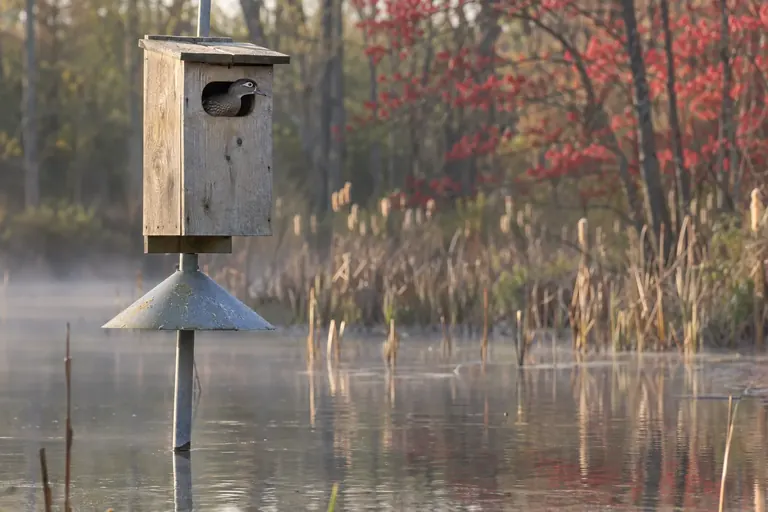
Put it on a smooth metal pole with a predator baffle, about 5 feet (1.5 m) up for bluebirds and swallows, facing away from prevailing wind and hot afternoon sun. Keep it away from feeders and away from fences, branches and roofs that predators use as bridges.
The 3 inch flange at the bottom of the back makes mounting simple. You can screw it to a pole bracket, a 4x4 post (with a baffle) or a wall. Drive two screws through the flange below the box, then open the door and add one more from inside through the back near the top. Our step-by-step guide to mounting a birdhouse on a pole, tree or wall covers baffle sizes, heights for each species and the exact hardware.
Finish and hang a new box before birds start prospecting in late winter. See when to put up birdhouses for dates by region.
How much does it cost to build a birdhouse?
Building one costs little: one board, a handful of exterior screws and two nails. The main expense is the entrance tool if you do not already own one, and that can be reused for every box you make.
Cedar costs more than pine per board, but it usually lasts several times longer outdoors, so it tends to be the better value over the life of the box. Vents, drainage, grooves and a pivoting door cost nothing but a few minutes.
Pre-install checklist: will birds use your box?
Run this checklist before you mount the box. Each point matches a common reason nest boxes sit empty or fail.
| Check | Pass if… |
|---|---|
| Wood | Untreated, at least 3/4 in (19 mm) thick |
| Entrance | Measured size for one target species, edges smooth |
| Perch | None |
| Inside front | Rough, with grooves below the hole |
| Ventilation | Gaps or holes near the top on at least one side |
| Drainage | Floor corners clipped and recessed about 1/4 in |
| Roof | Overhangs the front by at least 1-1/2 in |
| Access | Side or front opens fully and locks shut |
| Finish | Bare inside; outside bare or light and water-based |
| Mount | Firm, baffled, clear of branches and fences |
What are the alternatives to building a birdhouse?
If you do not have tools, or you would rather spend the time watching birds, you have two good options: a pre-cut kit or a ready-built box made to the same standards.
A pre-cut kit
The Songbird Essentials BlueBird House Kit is a set of pre-cut cedar pieces made in the company’s Missouri workshop. The finished box measures 12 inches high, 4.25 inches wide and 6.5 inches deep, and the maker lists only a hammer, a Phillips screwdriver, a pencil and a ruler as the tools needed. The company describes the entrance and cavity as sized for bluebirds and the box as opening for clean-out. It suits families and first-time builders. Skip it if you want a wren or chickadee box, because the hole is too large for those species. Check price on Amazon
A ready-built box
If you would rather buy, our roundup of the best birdhouses covers cedar, recycled plastic and woodcrete boxes that meet the same features: thick walls, the right hole, ventilation, drainage and a door that opens. Avoid decorative houses with thin walls, perches, painted interiors or no way to open them.
Common mistakes when building a birdhouse
Most failed boxes share the same handful of errors.
- Guessing the hole size. An extra 1/8 inch (3 mm) can let in House Sparrows or starlings. Use a measured saw or bit, not a spade bit that “looks about right.”
- Using treated lumber or thin plywood. Chemicals and poor insulation both harm nestlings.
- Adding a perch. It helps predators and competitors, not the birds you want.
- Sealing the box. No vents and no drain holes turn a box into an oven in summer and a puddle in spring storms.
- Skipping the grooves inside. Smooth walls make it harder for chicks to climb out when they fledge.
- Mounting on a fence or tree without protection. Cats, raccoons and snakes use fences and trunks as highways.
- Putting up too many boxes too close together. Territorial birds like bluebirds rarely nest within about 100 yards (90 m) of each other, although Tree Swallows will nest closer.
Sources
- NestWatch, Cornell Lab of Ornithology: All About Birdhouses
- NestWatch, Cornell Lab of Ornithology: Features of a Good Birdhouse
- North American Bluebird Society
- Sialis.org: bluebird and nest box resources
- Songbird Essentials: BlueBird House Kit product page
- Milwaukee Tool: 49-22-4185 Hole Dozer General Purpose Hole Saw Kit
Gear mentioned in this guide
Milwaukee 49-22-4185 Hole Dozer 28-Piece Hole Saw Kit
A general-purpose bi-metal kit that covers every common songbird entrance size in one case, from wren to screech-owl.
- Best for
- Builders who plan boxes for several species, or who also do general home repairs.
- Skip it if
- You only ever need one hole size; a single matching saw or Forstner bit is cheaper and lighter.
- Saws included
- 22 bi-metal hole saws, 3/4 in to 4-3/4 in
- Nest box sizes covered
- 1-1/8, 1-1/4, 1-3/8, 1-1/2, 1-3/4, 2 and 3 in
- Arbors
- 3 arbors with pilot bits, plus 3 spare pilot bits
Songbird Essentials BlueBird House Kit
A pre-cut cedar bluebird box made in Missouri, sized for bluebirds and designed to open for clean-out, that goes together with basic hand tools.
- Best for
- Families, first-time builders and anyone without a saw who still wants to assemble their own box.
- Skip it if
- You want a box for wrens, chickadees or titmice; the entrance is sized for bluebirds.
- Material
- Cedar, pre-cut
- Size
- 12 in H x 4.25 in W x 6.5 in D
- Tools needed
- Hammer, Phillips screwdriver, pencil, ruler
Frequently asked questions
What is the best wood for building a birdhouse?
Untreated cedar is the most common choice because it resists rot and insects without chemicals. Cypress and redwood also last well. Untreated pine works and is easy to find, but it wears out faster outdoors. Use boards at least 3/4 inch thick for insulation, and avoid pressure-treated lumber, particleboard and wood with strong stains or preservatives.
Should a birdhouse have a perch?
No. Native cavity nesters such as bluebirds, chickadees, wrens and swallows do not need one, since they cling to the entrance or fly straight in. A perch mainly helps House Sparrows, starlings and predators that reach inside or harass the nest. If you buy a box with a perch, you can usually cut or pull it off.
What size hole should a birdhouse have?
It depends on the species. Common sizes are 1 to 1-1/8 inches (25 to 29 mm) for House Wrens, 1-1/8 inches (29 mm) for chickadees, 1-1/4 inches (32 mm) for titmice and nuthatches, and 1-1/2 inches (38 mm) for Eastern and Western Bluebirds. Measure carefully, because an extra 1/8 inch can let in larger competitors.
Should I paint the inside of a birdhouse?
No. Leave the inside and the entrance hole bare wood. Paint and stain can give off fumes and make surfaces too smooth for nestlings to climb. If you want to protect the outside, use a light-colored, water-based exterior paint or stain, and let it cure fully before the season. Dark colors can overheat a box in sun.
How long does it take to build a birdhouse?
With the boards cut, assembly takes about an hour. Marking and cutting the pieces, drilling the entrance and vents and fitting the hinged side usually add another hour or two for a first-time builder. Plan on an afternoon, and build before late winter so the box is up before birds start choosing nest sites.