How to Attract Western Bluebirds: Nest Boxes and Food
How to attract Western Bluebirds: mount a guarded nest box with a 1.5 to 1 9/16 in hole near open ground, offer mealworms and plant native berry shrubs.
If you buy through links on this page we may earn a commission, at no cost to you. It never decides what we recommend. How we earn
In this article
- Western Bluebird at a glance
- How to identify a Western Bluebird
- Where Western Bluebirds live, and whether your yard fits
- Why dead trees matter so much
- What Western Bluebirds eat
- The Western Bluebird nest box: specifications
- Nesting: what to expect
- Native plants for Western Bluebirds
- Water and winter care
- How long does it take Western Bluebirds to find a nest box?
- Attracting Western Bluebirds to a suburban yard
- Should you clean out a bluebird box in fall?
- A year of Western Bluebirds
- Common mistakes when attracting Western Bluebirds
- Sources
- Gear mentioned in this guide
- Frequently asked questions
Here is how to attract Western Bluebirds: put up a bluebird nest box with a 1.5 to 1 9/16 inch entrance on a guarded pole near open ground and scattered trees, then add mealworms, water and native berry shrubs such as elderberry and toyon. Like all bluebirds they rarely eat seed, and they depend on cavities they cannot dig themselves, so boxes and dead trees matter more than feeders.
Western Bluebird at a glance
| Trait | Details |
|---|---|
| Size | 6.3 to 7.5 in long, wingspan 11.4 to 13.4 in, 0.8 to 1.1 oz |
| Range | Western North America from the Pacific Coast into the interior West and Southwest, south into Mexico |
| Season | Resident in many lowland areas, mountain birds move downslope or south in winter |
| Diet | Ground insects in summer, berries and mistletoe in winter |
| Feeder food | Mealworms, occasionally suet and fruit |
| Feeder type | Open dish or enclosed bluebird feeder |
| Nesting | Tree cavities and nest boxes, 2 to 8 pale blue eggs, 1 to 3 broods |
| Habitat | Open woodland, forest edges, oak savannah, farmland, backyards and burns |
How to identify a Western Bluebird
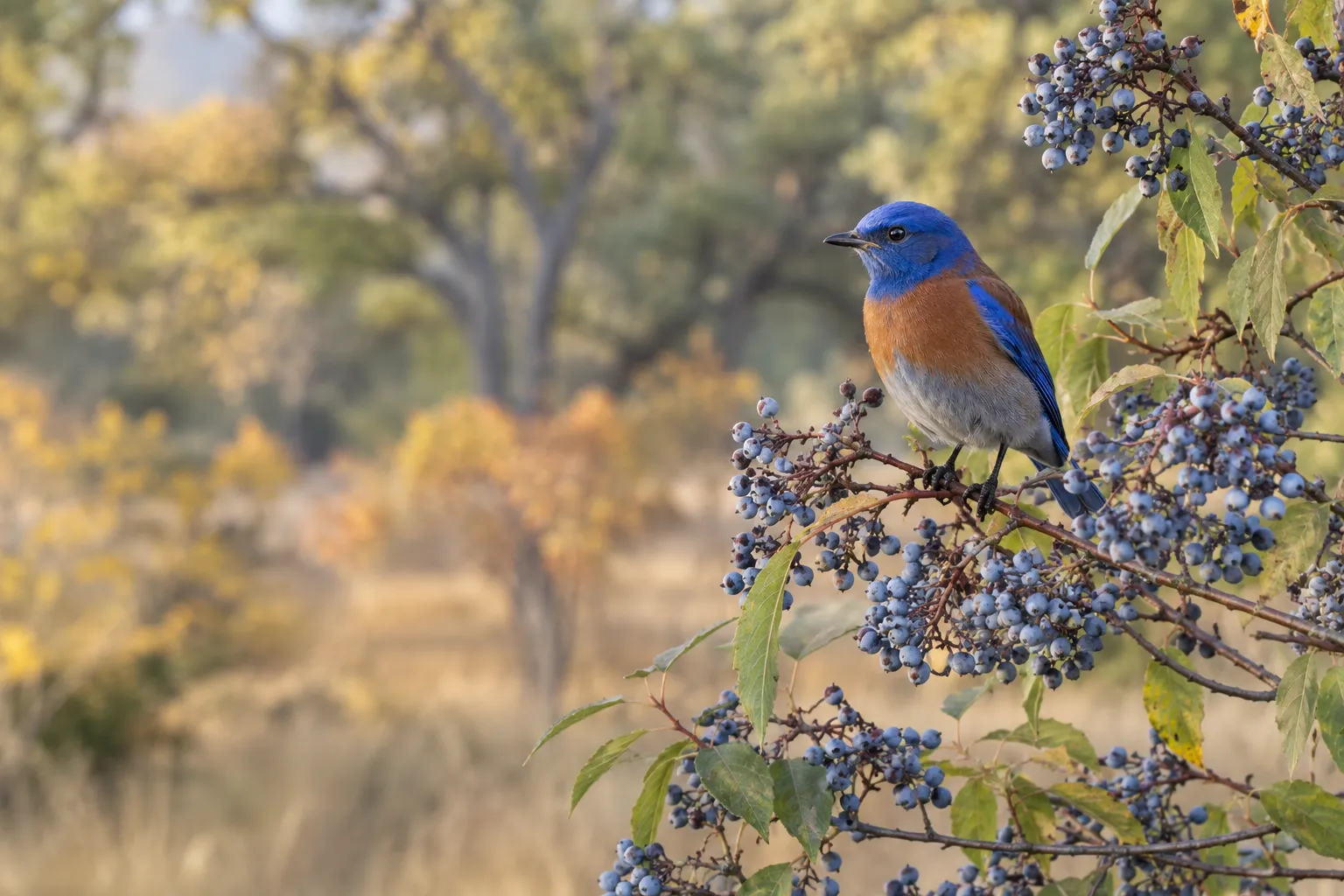
The Cornell Lab describes the Western Bluebird as larger than a sparrow and smaller than an American Robin. Like other bluebirds, it perches upright on low branches, fences and wires, then drops to the ground for prey.
Adult male
- Shiny blue head, throat, wings and tail
- Rust-orange that extends from a vest on the breast onto the upper back
- The blue throat is the key mark
Female
- Gray-buff overall with a pale orange wash on the breast
- Blue tints on the wings and tail
- Gray-buff throat
Juvenile
- Like the female, but with spotting on the back and streaking on the breast
- Blue in the wings and tail helps separate young bluebirds from other spotted juveniles
Western vs. Eastern vs. Mountain Bluebird
| Feature (males) | Western Bluebird | Eastern Bluebird | Mountain Bluebird |
|---|---|---|---|
| Throat | Blue | Orange-red | Sky blue |
| Breast | Rust-orange | Rusty orange-red | Pale blue |
| Upper back | Often rust-orange patch | Solid blue | Solid sky blue |
| Typical range | Pacific states, interior West, Southwest | East of the Rockies | Interior West, Great Basin, Rockies |
Other lookalikes include the Lazuli Bunting (small, with a conical bill and white wing bars) and scrub-jays (much larger, with long tails). For more on sorting similar birds, see our guide on how to identify birds.
Where Western Bluebirds live, and whether your yard fits
The Cornell Lab lists open woodland, both coniferous and deciduous, as the core habitat, especially ponderosa pine, pinyon-juniper, mixed conifer and aspen stands, plus backyards, burned areas and farmland from sea level far up into the mountains. In California and Oregon, oak woodland and savannah are classic habitat.
Your yard is a good candidate if it has:
- Open ground with short or sparse grass where insects are visible
- Scattered trees, fences or wires for perches
- Oak woodland, pine forest, orchards, vineyards, parks or golf courses nearby
- Dead trees or old woodpecker holes in the area
Dense suburbs with few trees and small lawns are less promising, though Western Bluebirds do nest in larger suburban yards and parks where boxes are provided.
Why dead trees matter so much
Western Bluebirds are secondary cavity nesters. The Cornell Lab notes they rely on woodpeckers to create nest sites, which makes dead trees a valuable commodity. They also nest readily in burned forests, where fire-killed trees provide both cavities and open ground.
If you have a standing dead tree or a large dead limb that is safe to keep, leaving it is one of the best things you can do for bluebirds, woodpeckers and many other cavity nesters. Where snags have been lost, nest boxes fill the gap.
What Western Bluebirds eat
Summer: insects
The Cornell Lab lists a summer diet dominated by ground-dwelling insects: grasshoppers, caterpillars, beetles, ants, wasps and pillbugs. Birds scan the ground from a perch and then drop abruptly to seize prey. The Lab notes a Western Bluebird weighs about an ounce and needs only about 15 to 23 calories a day, but it must find that food steadily.
Winter: berries and mistletoe
In winter the diet switches to fruit. The Cornell Lab lists elderberry, grapes, mistletoe, raspberries and blackberries, serviceberry, sumac, chokecherries, juniper and poison oak. Outside the breeding season, Western Bluebirds form flocks of up to about 100 birds that roam in search of fruit. Mistletoe in oaks and junipers is a particularly important winter food in many areas, so do not assume every clump of mistletoe needs removing.
Mealworms at feeders
The Cornell Lab notes Western Bluebirds readily visit feeders stocked with mealworms. Follow the North American Bluebird Society (NABS) guidance:
- Live mealworms for nestlings, never freeze-dried.
- Offer limited amounts once or twice a day. NABS suggests about a hundred worms a day, split between morning and afternoon, for a pair with a box of nestlings.
- Add calcium. Mealworms are low in calcium. NABS recommends dusting with calcium carbonate or calcium citrate, or using ground sterilized eggshell.
- Use an enclosed feeder if bigger birds steal worms. NABS notes a 1 1/4 or 1 3/8 inch hole at each end of a hopper-style feeder effectively excludes larger birds.
Our roundup of the best dried mealworms for bluebirds and wrens compares products and calcium-rich alternatives.
The Western Bluebird nest box: specifications
Box dimensions
| Feature | NestWatch (Western Bluebird) | NABS (Western and Mountain Bluebirds) |
|---|---|---|
| Entrance | 1.5 in round | 1 9/16 in round, or 1 3/16 in slot |
| Floor | 5.5 x 5.5 in | 4 x 4 in up to 5.5 x 5.5 in |
| Inside depth | 9 in | Hole to floor about 4.5 to 6 in |
| Mounting height | 4 to 6 ft | At least 5 ft |
| Facing | East into an open area | East or south, away from prevailing winds |
| Spacing | About 215 ft between boxes | Not specified in the fact sheet |
Other NABS recommendations apply to all bluebird boxes:
- No perch on the front. NABS says perches should never be used on bluebird boxes.
- Ventilation near the top and drainage holes in the floor.
- Untreated wood 3/4 to 1 inch thick, or exterior-grade plywood.
- Light colors or natural wood if painted at all.
- An opening side or front so you can monitor and clean it.
NestWatch adds that some midday shade is desirable, and if the box will be in full sun it should face south. In hot inland valleys, placing boxes where they get afternoon shade can help keep nestlings from overheating.
Mounting and predator guards
The Cornell Lab advises attaching a guard to keep predators from raiding eggs and young. NestWatch lists either a live tree or a pole as an attachment option, but a smooth metal pole with a baffle is far easier to protect from snakes, raccoons, cats and squirrels than a tree trunk.
- Use smooth metal pipe or conduit. NABS mentions 1/2 to 3/4 inch electrical metal conduit.
- Add a stovepipe or cone baffle under the box.
- Consider an entrance hole guard against reaching raccoons and cats.
- Keep the box away from overhanging branches predators could drop from.
Our guide to squirrel baffles covers baffle sizing that also applies to nest box poles.
Competitors: House Sparrows, starlings and swallows
- European Starlings cannot fit through a correctly sized entrance, which is the main reason not to go above 1 9/16 inches.
- House Sparrows can fit and are a serious threat. They are non-native and not protected under the Migratory Bird Treaty Act, so removing their nesting material is legal. NestWatch suggests that drilling a second identical entrance hole beside the first may help bluebirds defend a box against sparrows.
- Tree Swallows, Violet-green Swallows, chickadees, titmice and wrens are native, protected birds. Leave their nests alone and add more boxes instead.
Nesting: what to expect
According to the Cornell Lab, the female builds the nest from grasses, straw, pine needles, moss, other plant fibers and fur.
| Nesting detail | Western Bluebird |
|---|---|
| Eggs | 2 to 8, pale blue and unmarked |
| Incubation | 12 to 17 days |
| Nestling period | 18 to 25 days |
| Broods per year | 1 to 3 |
Western Bluebird family life is more complicated than it looks. The Cornell Lab notes helpers, often adult males, sometimes assist a pair with feeding young, and some helpers are birds whose own nesting attempt failed. The Lab also reports that up to 45 percent of nests contain at least one young bird not fathered by the resident male. Males can be fiercely territorial: rival males may grab each other’s legs, tumble to the ground and pin an opponent.
Monitoring the box
NABS recommends checking active boxes at least once a week, only in calm, mild, dry weather, and recording the number of eggs or young each time. Stop opening the box after about day 12 to 13 after hatching and watch from a distance, or chicks may leave early. NestWatch advises cleaning out old nests as soon as a brood fledges so the box can be used for another attempt. NABS reminds monitors that it is illegal to remove an active nest of any native cavity-nesting bird.
Native plants for Western Bluebirds
Choose fruiting plants native to your region. Several appear on the Cornell Lab’s list of winter foods.
| Plant | Region | Fruit season |
|---|---|---|
| Blue elderberry (Sambucus cerulea, also listed as S. nigra ssp. caerulea) | Much of the West | Summer to fall |
| Toyon (Heteromeles arbutifolia) | California | Winter |
| Serviceberry (Amelanchier species) | Much of the West | Summer |
| Chokecherry (Prunus virginiana) | Interior West, mountains | Late summer |
| Junipers (Juniperus species) | Interior West, Southwest | Fall to winter |
| Native sumacs (skunkbush and others) | Interior West, Southwest | Fall to winter |
| Native grapes (Vitis californica and others) | California, Southwest | Late summer to fall |
| Coffeeberry (Frangula californica) | California, Oregon | Late summer to fall |
Keep some ground short or sparse so insects are visible, avoid broad insecticide use, and leave oaks with mistletoe where it is not harming a valued tree. Your local native plant society or extension office can confirm species for your county.
Water and winter care
- Provide water all year. A shallow bath 1 to 2 inches deep draws bluebirds, and a heated bath helps in freezing mountain and interior areas. See winter bird feeding for more.
- Leave boxes up in winter. Bluebirds may use them for shelter on cold nights.
- Offer mealworms in cold snaps. When snow or ice covers fruit, a mealworm feeder can make a real difference.
How long does it take Western Bluebirds to find a nest box?
In good habitat with bluebirds already around, a box put up in late winter may be inspected within days and used that spring. On the edge of suitable habitat, it can take a season or two. Ways to improve the odds:
- Mount early. The Cornell Lab advises installing boxes before breeding season. Pairs start prospecting in late winter, earlier at low elevations than in the mountains.
- Make it visible. Put the box in the open, near a fence, wire or low branch where bluebirds already perch.
- Put up more than one. On larger properties, two or more boxes spaced a couple of hundred feet apart give birds a choice and leave room for swallows.
- Check local records first. If you have never seen a Western Bluebird nearby, look at eBird sightings before building a trail. Our guide on how to use eBird explains how.
If a full season passes with no interest, or only House Sparrows, move the box toward more open ground and away from buildings.
Attracting Western Bluebirds to a suburban yard
Western Bluebirds nest in larger suburban lots, parks, school grounds and golf courses across much of the West. In a typical yard:
- Find the most open spot. A back corner facing a field, park or open space is better than a narrow side yard.
- Use a pole, not the house. A guarded pole in the open keeps predators off and keeps the birds away from busy doors.
- Keep a patch of lawn or sparse ground short. Bluebirds hunt insects they can see.
- Skip the seed mix near the box. Seed feeders draw House Sparrows, which compete for boxes.
- Plant one or two fruiting natives. An elderberry or toyon on the edge of the yard gives winter flocks a reason to stop.
Should you clean out a bluebird box in fall?
Yes. Remove the old nest after each brood, as NestWatch and NABS advise, and give the box a thorough cleanout in fall. Wear gloves, scrape out old material, check hinges and screws, and replace any cracked panels. Leave the box up over winter for roosting, and check it again in late winter before pairs start prospecting.
A year of Western Bluebirds
| Season | What is happening | What to do |
|---|---|---|
| Late winter | Pairs look for nest sites | Clean and mount boxes before breeding season, add guards |
| Spring | Nest building and first clutches | Monitor weekly, remove House Sparrow nests |
| Summer | Second and third broods, helpers at some nests | Clean out old nests after fledging, offer live mealworms |
| Fall | Families join into flocks | Let berries ripen, keep water out |
| Winter | Flocks of up to about 100 roam for fruit | Offer mealworms and heated water, protect mistletoe and berry shrubs |
Common mistakes when attracting Western Bluebirds
- Oversized entrance holes. Anything above 1 9/16 inches admits starlings.
- Perches on the box. They help House Sparrows.
- Boxes on fence posts or trees with no guard. Easy access for predators.
- Boxes in full afternoon sun in hot valleys. Nestlings can overheat.
- Cutting down every snag and clearing mistletoe. You remove nest sites and winter food.
- Unlimited dried mealworms at nesting time. Use live worms for nestlings, in limited amounts, with added calcium.
- Never checking the box. Sparrow takeovers and predation go unnoticed. For general feeder placement, see where to put a bird feeder.
Sources
- Western Bluebird Identification, All About Birds, Cornell Lab of Ornithology
- Western Bluebird Overview, All About Birds, Cornell Lab of Ornithology
- Western Bluebird nest box guidance, NestWatch
- Nestbox Recommendations fact sheet, North American Bluebird Society
- Mealworms fact sheet, North American Bluebird Society
- Monitoring Bluebird Nest Boxes fact sheet, North American Bluebird Society
- Grubblies, Grubbly Farms
Gear mentioned in this guide
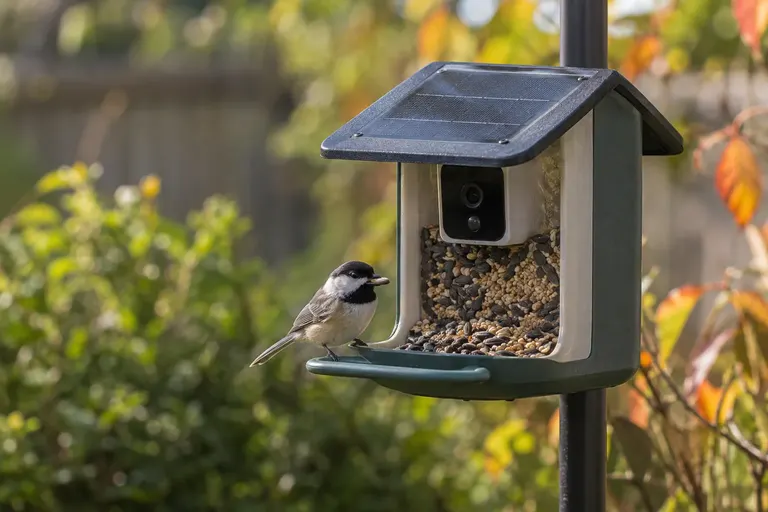
Birds Choice Recycled Bluebird Feeder
An enclosed feeder with 1.5 in entry holes and clear sides, built so bluebirds go inside for mealworms while many larger birds, including scrub-jays and starlings, are kept out.
- Best for
- Yards where jays, starlings or mockingbirds take mealworms from open dishes.
- Skip it if
- Your bluebirds have not found mealworms yet; start with an open dish and switch once they are regular visitors.
- Entry holes
- 1.5 in
- Size
- 13.5 x 10.25 x 8 in
- Weight
- 5.25 lb
Grubbly Farms Grubblies
Dried black soldier fly larvae with a guaranteed calcium content, a useful alternative to low-calcium dried mealworms outside the nestling period.
- Best for
- Winter and early spring feeding in yards with regular bluebird visits.
- Skip it if
- You are feeding parents with nestlings; NABS advises live mealworms only for nestlings.
- Calcium (guaranteed)
- 1.0% min to 1.5% max
- Sizes
- 1 lb to 20 lb
Frequently asked questions
What is the best way to attract Western Bluebirds?
Put up a bluebird nest box with a 1.5 to 1 9/16 inch entrance, mounted 4 to 6 feet high with a predator guard, facing open ground with scattered trees. Add mealworms, a bird bath and native fruiting shrubs such as elderberry, toyon and serviceberry. Keeping dead trees standing also helps, since the species depends on old woodpecker holes.
What size hole does a Western Bluebird house need?
NestWatch lists a 1.5 inch entrance for Western Bluebirds. The North American Bluebird Society recommends a 1 9/16 inch round opening or a 1 3/16 inch slot for Western and Mountain Bluebirds, and says 1 9/16 inch works for all three bluebird species. Holes larger than that let in European Starlings.
What do Western Bluebirds eat in winter?
The Cornell Lab says the winter diet switches to berries, including elderberry, grapes, mistletoe, raspberries, blackberries, serviceberry, sumac, chokecherry, juniper and poison oak, supplemented with insects. Winter flocks move to where fruit is plentiful. At feeders, mealworms are the most reliable draw, and a heated bird bath helps in freezing weather.
How do I tell a Western Bluebird from an Eastern or Mountain Bluebird?
Male Western Bluebirds have a blue throat and rust-orange that extends from the breast onto the upper back. Male Eastern Bluebirds have an orange throat and a solid blue back. Male Mountain Bluebirds are sky blue all over with no orange. Females are subtler, so check range and throat color first.
Where do Western Bluebirds live?
They live in open woodland and edges across western North America, from sea level far up into the mountains, including the Pacific states, the Southwest and parts of the interior West, south into Mexico. The Cornell Lab lists ponderosa pine, pinyon-juniper, mixed conifer and aspen woods, plus backyards, burned areas and farmland.
Do Western Bluebirds use nest boxes?
Yes. The Cornell Lab notes females readily accept nest boxes and build nests of grasses, straw, pine needles, moss, plant fibers and fur. Clutches are 2 to 8 pale blue eggs, incubation lasts 12 to 17 days and young stay in the nest 18 to 25 days, with 1 to 3 broods a year.